
So, what is scaling a business, really? It's simple: you make your revenue grow much faster than your costs. You handle a massive flood of new customers without needing a massive flood of new expenses.
The result? Your profitability explodes. It's the secret sauce that turns your scrappy startup into an industry giant.
The Real Difference Between Scaling and Growing
Let's get this straight: growing and scaling are not the same thing. I see founders mix these up constantly, and the difference is critical. Get it wrong, and you'll burn yourself out chasing revenue that never actually becomes profit.
Think of it this way. Growing a business is like being a baker who wants to sell more cakes. To sell more, you have to buy more flour, more sugar, and hire more bakers. Your revenue goes up, but your costs go up right with it. You work harder and make more, but your effort is directly tied to your reward. It’s a one-for-one deal.
Scaling, however, is like you invented a cake recipe that magically duplicates itself. You bake one cake, and it can suddenly serve 100 people with no extra ingredients or effort from you. Your revenue skyrockets, but your costs barely move. That’s the entire game—decoupling your revenue from your resources.
Scaling vs Growing a Business at a Glance
To make this dead simple, here’s a table breaking down the difference between scaling your business and just growing it.
| Aspect | Growing | Scaling |
|---|---|---|
| Resources | You add resources (people, money, equipment) directly in line with revenue. To make more, you spend more. | You add revenue without a big jump in resources. Your systems and processes handle the extra load. |
| Revenue Model | Revenue increases at a similar rate as your costs. Profit margins stay about the same. | Revenue increases exponentially while costs only creep up. Profit margins expand like crazy. |
| Strategy Focus | Focused on getting the next customer and filling that order, usually through manual work. "More in, more out." | Focused on building repeatable systems, automation, and infrastructure that can handle more volume without breaking. |
This shows you it's not just about numbers; it's your entire approach to building your company.
Your goal isn't just to get bigger; it's to get better and more efficient as you expand. Growth adds, but scaling multiplies.
This change in mindset is everything. When you focus on growth, you ask, "How do I get the next customer?" But when you focus on scaling, you ask, "How do I build a system that gets the next 1,000 customers?"
This requires a completely different way of thinking and a solid framework for making decisions that puts long-term efficiency over short-term wins. Getting this right is your first, most vital step toward building something that lasts.
A Brutally Honest Checklist to See if You Are Ready to Scale
Jumping into scaling before you're ready is like trying to build a skyscraper on a foundation of sand. It might look impressive for a second, but it will come crashing down.
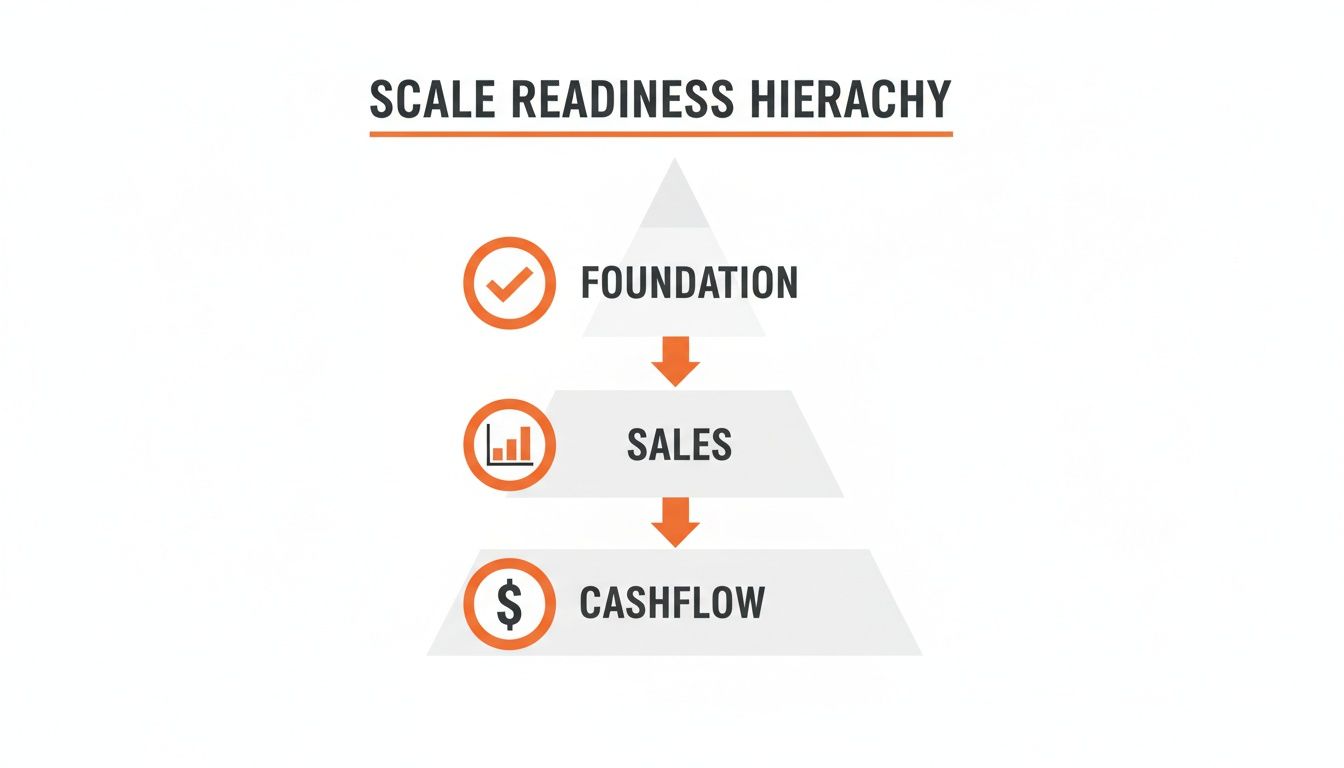
So, before you slam your foot on the gas, let's have a brutally honest chat about your business's foundation. Are you actually ready?
This isn't about gut feelings or how many likes your last post got. This is about knowing your numbers, cold. Think of this checklist as a stress test for your business, so you can scale with confidence, not just blind hope.
This decision tree nails the choice you face: do you just add more people and money to grow, or do you build smart systems to scale?

The big takeaway here is that scaling isn't about throwing more resources at a problem. It’s a conscious shift toward creating a system where your revenue grows way faster than your costs.
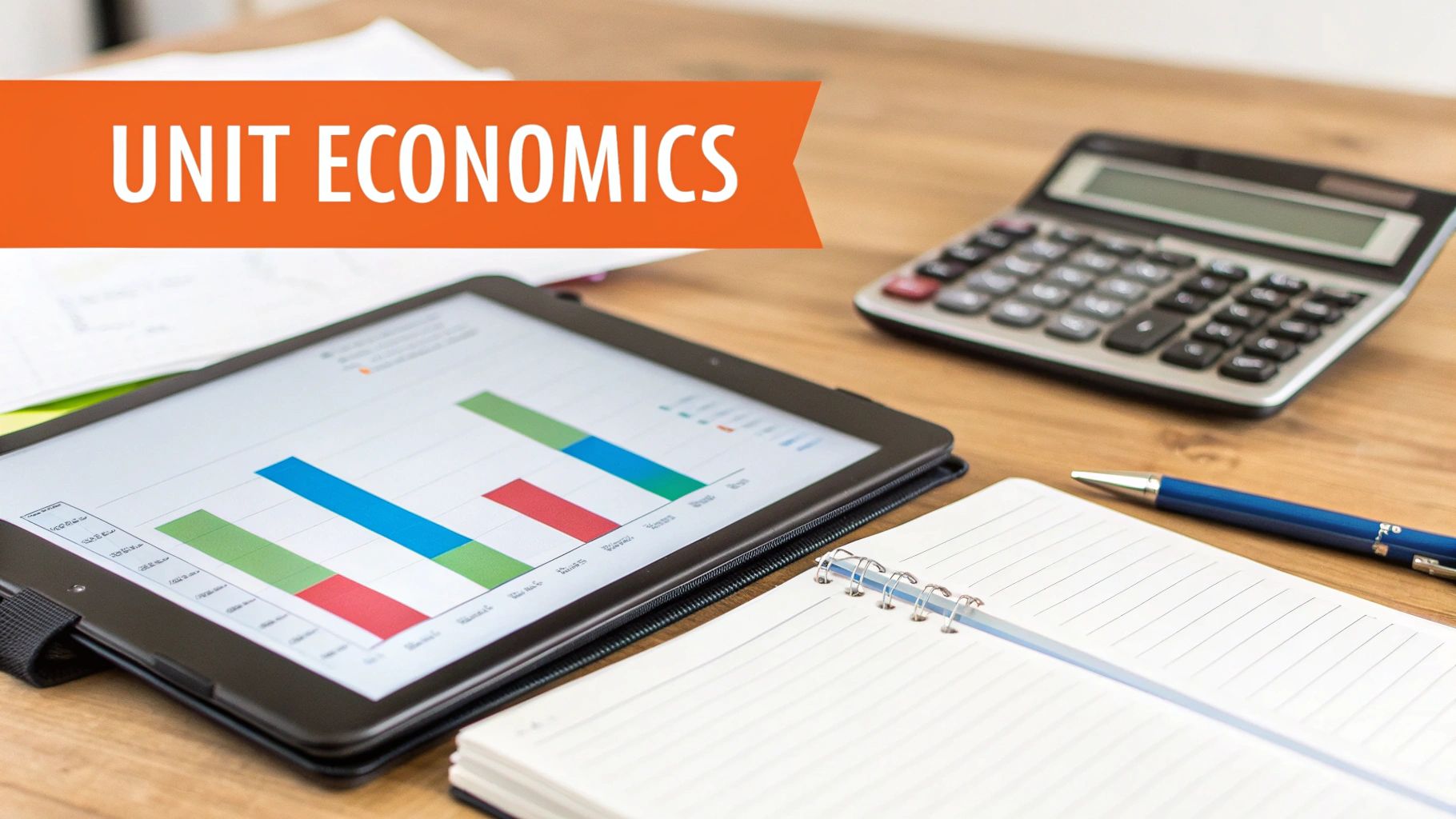
Know Your Unit Economics Cold
First, you have to master unit economics. This is the DNA of your business model. It answers one simple question: do you make a profit on every single thing you sell?
If you sell a physical product, you take the revenue from one item and subtract all the direct costs to make and sell it—materials, shipping, transaction fees, everything. For a software subscription, it's the monthly fee minus the cost of serving that one user.
If you don't know this number, you're flying blind.
Is Your LTV/CAC Ratio Healthy?
Next up are two acronyms you need to love: LTV and CAC. They sound complex, but the idea is simple.
- Customer Acquisition Cost (CAC): How much do you spend, on average, to get one new customer? If you spend $1,000 on ads and get 10 new customers, your CAC is $100. Simple.
- Lifetime Value (LTV): This is the total profit you expect to make from an average customer over the entire time they do business with you.
Here's the deal: your LTV needs to be much, much higher than your CAC. A healthy ratio is at least 3:1. That means for every dollar you spend to get a customer, you make at least three dollars back in profit.
If your ratio is 1:1, you're just buying customers at cost. Trying to scale that model is a guaranteed way to burn through cash with nothing to show for it.
What Is Your Gross Margin Telling You?
Your gross margin is the oxygen for your business. It's the percentage of revenue you have left after subtracting the cost of goods sold (COGS).
A high gross margin gives you the cash to pour back into marketing, hiring, and R&D—all the things you need to fuel your scaling engine.
A weak gross margin is like trying to run a marathon while breathing through a straw. You can only go so far before you run out of air. Improving it is non-negotiable before you try to scale.
And don't think scaling is just for tech startups. The truth is, many businesses that scale successfully are mature small or medium-sized companies. Data shows that firms of any size can scale, with around 60% holding onto their new size over time. Even more impressive, 26%-35% manage to scale up again, proving they’ve truly figured out how to operate more efficiently.
Getting these numbers right is your first step. It shows you what levers you can pull and proves you're building on solid ground. It's a critical part of learning how to set business goals that are both ambitious and achievable.
Alright, let's get into the nitty-gritty. Knowing you're ready to scale is one thing; actually pulling it off is a whole different beast. Scaling isn't one giant project. Think of it as a series of smart, connected upgrades you make across every part of your business.
Let's walk through the playbook for turning your scrappy operation into a well-oiled machine, piece by piece.

This image nails it. You’re not just piling on more blocks. You’re building a stronger, more efficient structure that can handle more weight and reach new heights.
Fortify Your Product and Sales Systems
Your product is your foundation. If every sale requires a ton of custom, one-off work, you're dead in the water. You can't scale that. Your goal is to "productize" what you do—turn it into a repeatable solution that a thousand customers can buy just as easily as one.
I always think of it like a restaurant. A chef making a unique, custom meal for every diner can only serve a handful of people a night. But a chef who perfects a signature dish and creates a solid process to nail it every time? That chef can serve hundreds.
Your job is to build a system that sells, not just a product.
- Standardize Your Offering: Package your services or products into clear, simple tiers. This makes it easier for people to buy and makes your sales process more predictable.
- Create a Repeatable Sales Process: Write down every single step, from how you find a lead to how you close the deal. This document becomes the training manual for your new hires, keeping everything consistent as you bring on more people.
Streamline Your Operations with Automation
Operations are the gears that keep your machine running. As you get bigger, all those manual tasks you used to do yourself become bottlenecks that grind everything to a halt. The fix? Automate or outsource anything that isn't your absolute core strength.
Let's be real—you didn't start a business to spend half your day wrestling with invoices or doing mind-numbing data entry. Automation frees you from that low-value work so you can focus on the big-picture stuff that actually moves your business forward.
Automation isn't about replacing people; it's about empowering them. You're giving your team—and yourself—the leverage to achieve more without just working more hours.
An easy place to start is customer service. Using simple tools to auto-reply to common questions can save hundreds of hours, freeing up your team to handle only the most complex, high-touch issues.
Build Your Team for the Future
This is a huge mental shift. When you're scaling, you have to stop hiring for the problems you have today. You need to start hiring for the challenges you’ll face six to twelve months from now.
Instead of hiring someone to put out today's fire, you're hiring someone who can build the fire department. Look for people who've already been through the stage of growth you're about to hit. They should be excited by building systems, not just checking off tasks.
The right people won't just do the work; they'll constantly look for ways to improve the process. They are force multipliers for your entire business. These are a few of the small business growth strategies that truly make the biggest difference.
Leverage Technology That Grows with You
Your tech stack can either be your launchpad or your anchor. Going with cheap, limited tools might feel like a win now, but it will cost you dearly when it's time to scale and everything breaks.
Invest in platforms that can grow with you. This is especially true for your core systems—think CRM, accounting software, and project management tools.
The Software-as-a-Service (SaaS) industry is a masterclass in this. The global SaaS market is expected to hit $408.21 billion in 2025, and it’s a perfect model for scaling. Companies can start on a small plan and just upgrade as they grow. This is why nearly half of companies with over $5 billion in revenue are scaling AI across their operations—scalable tech is what fuels big-time growth. You can dive deeper into these SaaS trends at Zylo.
Develop Scalable Marketing Channels
Finally, your marketing can't just be a series of one-off tactics or rely on your personal hustle. You have to build acquisition channels that are repeatable, predictable, and don't require you to be "on" 24/7.
For example, creating amazing content that ranks on search engines is a scalable strategy. You do the work once, and that article or video can bring you new customers for years. Contrast that with attending a networking event, which only generates leads from that single night.
Here are a few channels built for scaling:
- Content Marketing & SEO: Writing valuable articles, guides, or shooting videos that pull in your ideal customer through search.
- Paid Advertising: Using platforms like Google Ads or social media ads where you have proven numbers. If you know that every dollar you put in spits out two, you can scale that predictably.
- Referral Programs: Building a system that actually encourages your happy customers to tell their friends about you.
Building these channels takes time, but they create a reliable engine for new customers that doesn't depend on your daily grind. And that, right there, is what scaling is all about—moving from manual effort to automated, systematic growth.
How to Use Data as Your Scaling Engine
Your gut instinct got you this far, but it won’t get you to the next level. If you're trying to figure out what scaling a business really means, the answer is almost always hiding in your data. It's the only way to make smart, repeatable decisions without just throwing stuff at the wall and hoping it sticks.
Think of your data as the dashboard of a race car. You wouldn't try to win a race by "feeling" how fast you're going or guessing how much fuel is left, would you? Of course not. You rely on precise instruments to tell you when to push the engine, when to pit, and when to hold back. That’s what data does for your business.
Your goal isn't to track every single number under the sun. That's a classic rookie mistake that leads to drowning in information. Instead, you need to find the few key metrics that act as your compass, guiding every big move you make.
Turning Customer Feedback into a Better Product
One of the most valuable—and often ignored—data sources you have is what your customers are telling you directly. Are you really listening? Scaling isn't just about selling more of what you already have; it's about constantly refining your product based on what people actually want and need.
You need a system to collect, organize, and act on this feedback. Don't just let it rot in your inbox or DMs.
- Surveys: Keep them short and sweet. Send them after a purchase or interaction to get a quick pulse on satisfaction.
- Reviews: Pay close attention to your product reviews. Look for recurring themes, both good and bad. Those patterns are gold.
- Direct Conversations: Seriously, just make time to talk to your customers. A single 15-minute phone call can reveal more than a thousand rows on a spreadsheet.
When you see a pattern—a feature request that keeps popping up or a complaint that multiple people mention—that's not noise. That's your product roadmap, handed to you on a silver platter.
Using Marketing Analytics to Double Down
Marketing without data is like throwing darts in a dark room. You might hit the board eventually, but it’s pure, dumb luck. When you're trying to scale, you can't afford to waste a single dollar on channels that don’t work.
Dive into your analytics and find your winners. Where are your most profitable customers coming from? Is it that blog post you wrote six months ago? Your paid ads on Instagram? Your email list?
Once you identify a channel that delivers a strong return, your job is simple: double down. Pour more resources—time, money, attention—into what's already proven to work. This turns your marketing from a guessing game into a predictable, scalable revenue machine.
Eliminating Bottlenecks with Operational Data
As you grow, your internal processes will start to creak. The way you did things with 10 customers will fall apart with 1,000. Operational data helps you spot these weak points before they snap.
Keep an eye on things like:
- Order Fulfillment Time: How long does it take to get a product out the door? Is that number creeping up?
- Customer Support Tickets: Are response times getting slower? Is one particular issue clogging up the queue?
- Team Capacity: Is one person or department consistently overloaded? Burnout is a silent killer of scale.
Using data is like giving your business a regular health check-up. It reveals the hidden problems so you can fix them before they become emergencies. This is how you build a resilient company that doesn't just grow, but gets stronger with scale.
Getting good at this isn't just a nice-to-have; it's a massive competitive advantage. Organizations that get a handle on big data analytics see an average 8% revenue boost and a 10% cost reduction. In a world where 97.2% of companies are investing in Big Data and AI, being data-informed is the price of admission. You can discover more insights about big data's impact on businesses and learn how to navigate the challenges of collecting quality data.
The Common Pitfalls That Wreck Scaling Attempts
I’ve seen it happen more times than I can count. You have a great product, solid numbers, and a clear path forward. You hit the gas to scale, and within a year, everything has imploded. Scaling a business is like walking through a minefield, and the traps are surprisingly predictable.
Learning what they are ahead of time is like getting a map of the danger zones. Let me walk you through the most common killers so you can sidestep the mistakes that have sunk countless promising companies.

This image says it all. You have to be intentional and watch your step. The path is there, but so are the hazards.
The Siren Song of Premature Scaling
This is, without a doubt, the number one reason startups die. You get a little traction, a bit of buzz, and suddenly you feel this immense pressure to go big or go home. You start pouring money into marketing you can't measure and hiring people you don't need yet.
It’s like trying to build the second floor of a house when the foundation is still wet cement. You’re building on instability, and it’s destined to crumble. Before you even think about scaling, you must have a proven, repeatable system for acquiring happy, profitable customers. Anything less is just gambling.
Hiring Too Fast or Hiring the Wrong People
When demand spikes, the panic sets in. Your immediate reaction is to just throw bodies at the problem. "We need more salespeople! More support reps! More engineers!" This reactive hiring is a massive trap.
Hiring too quickly almost always leads to hiring the wrong people. You lower your standards just to fill a seat, and a bad hire is incredibly costly—not just in salary, but in lost momentum and team morale. A single C-player can drain the energy of five A-players.
A small team of the right people will always outperform a large team of the wrong people. Don't hire to solve today's capacity problem; hire to build tomorrow's capabilities.
Your hiring process needs to be just as scalable as your sales or operations. It should be a deliberate, thoughtful system designed to find people who fit your future, not just patch a leak in the present.
Losing Touch with Your Customers
Here’s a painful truth: the very things that made you successful early on are the first things to break when you scale. As the founder, you used to talk to every customer. You knew their names, their problems, their feedback.
But as you grow, layers of management and process wedge themselves between you and the people who actually pay your bills. You start looking at dashboards instead of talking to humans. The moment you lose that direct connection, you start making assumptions. And in business, assumptions are expensive.
You have to intentionally build systems to keep that feedback loop wide open.
- Schedule regular customer calls. Put them on your calendar like any other critical meeting.
- Read every single support ticket. Or at least a daily digest. This is the raw, unfiltered voice of your customer.
- Empower your team to be customer advocates. Make it everyone's job to bring customer insights back into the business.
Losing this connection is how you get blindsided by a competitor who is still hungry and still listening.
Letting Your Company Culture Evaporate
In the early days, your culture is just… you. It’s the way you and your first few hires work together, the values you live by, and the shared mission that gets you through the tough times. It happens naturally.
But culture by osmosis doesn't work past about 15 people. When you’re hiring rapidly, new people bring their old habits and assumptions. If you haven’t explicitly defined what your culture is, it will get diluted into a generic, uninspired mess.
Your culture is your company’s immune system. A strong one repels people who aren't a good fit and attracts those who will thrive. But you have to be its fiercest protector. Write down your values. Talk about them constantly. Hire, fire, and promote based on them. Because once a great culture is gone, it's almost impossible to get back.
Don't Try to Scale Your Business Alone
The founder's journey can be brutally lonely. As the pressure to scale builds, you start to feel like every fire—from a broken process to a key person quitting—is your problem and yours alone. It’s a heavy weight, and it's tempting to think you have to carry it all by yourself.
You don't.
This is where finding a community of peers becomes your single greatest advantage. I’m not talking about those transactional networking events where everyone is just pushing business cards and trying to sell you something. I mean finding a real, vetted group of people who are on the exact same rollercoaster you are.
Finding Your Real-Life Support System
Imagine having a safe place where you can ask the questions you’re afraid to ask anywhere else. A room where you can share your screw-ups and get brutally honest feedback from people who get it because they’re living it, too.
That’s the magic of a true peer group. It’s not about fake positivity for LinkedIn; it’s about real relationships built on trust and shared struggle. You're surrounded by founders who know the anxiety of making payroll, the 2 AM cold sweats, and that constant feeling that you're just making it all up as you go.
The biggest breakthroughs I've ever had didn't come from a stuffy boardroom. They happened over a beer with another founder who just said, "Oh yeah, I hit that wall last year. Here’s how I got through it."
This is how you move from theory to action. You stop guessing and start using proven tactics from people who are just a few steps ahead of you. It’s the ultimate shortcut, helping you sidestep expensive mistakes and dramatically speed up your learning.
The Power of Shared War Stories
Scaling a business is really just solving one problem after another. Having a trusted circle gives you a ton of different perspectives to tackle whatever comes your way.
- Honest Feedback: You hear what’s actually working and what isn’t, cutting through all the public-facing success porn.
- Practical Help: You might get a direct introduction to a game-changing supplier or learn about a software tool that saves you ten hours a week.
- Staying Sane: Most importantly, you realize you're not the only one. That connection keeps you grounded and motivated when things get rough.
Here in Chicago, we value kindness and hard work. A community like Chicago Brandstarters is built on those principles—it’s a place for givers who want to help each other win. Building in isolation is a recipe for burnout. Building with a community is how you create something that actually lasts.
Your Top Scaling Questions, Answered
Let's dig into the questions I hear all the time from founders who are just starting to wrap their heads around what it really means to scale. No fluff, just straight answers to help you move forward.
How Long Does It Take to Scale a Business?
Honestly, there's no magic number. Scaling isn't a race with a finish line; it’s a constant process of making your systems stronger. For some lucky founders who hit product-market fit early and have a solid model from day one, you might see rapid scaling in 1-2 years. But for most of us, it’s a slower, steadier climb over 3-5 years or even longer.
Your timeline depends completely on your readiness. Rushing it before your unit economics are rock-solid is just asking for trouble. Get the foundation right first, and speed will come naturally.
Can Any Business Be Scaled?
Theoretically? Maybe. In reality? No. A business that runs entirely on one person's unique, one-of-a-kind skill—think of a world-famous artist painting custom portraits—is almost impossible to scale. True scaling is all about having a product or service that you can standardize and build a system around.
If your business is built on tasks that can be documented, automated, or taught to someone else, you've got the raw ingredients. The whole game is about shifting from you doing the work to a system doing the work.
What Is the First Thing I Should Focus on When Scaling?
Your numbers. Period. Before you spend a single dollar on a new marketing campaign or hire another person, you need to know your key metrics inside and out. Specifically, get a death grip on your LTV to CAC ratio and your gross margin.
These numbers are your business's ultimate truth-tellers. They’ll tell you if pouring more money in the top will spit out profits, or if you're just building a bigger bonfire to burn your cash.
Scaling magnifies whatever you already have. If you have a profitable, efficient system, you'll get more of that. If you have a leaky, unprofitable model, you'll just leak cash faster.
How Will AI Affect Scaling and Hiring?
AI is becoming a massive advantage for scaling smart, especially for automating the grind in marketing, customer service, and data analysis. We're seeing a huge jump in its use, with 40% of service firms now on board.
What's interesting is that it's not the job-killer many people feared. It's changing the game, not ending it. While about 12% of service firms hired fewer people because of AI, a similar number actually hired more people who had AI skills. The big picture is that companies are choosing to retrain their current teams to work with AI, not just replace them. It's becoming a tool for efficiency, not a pure job eliminator.
If you’re a founder in Chicago building a brand and you're tired of going it alone, Chicago Brandstarters is for you. We are a free, vetted community of kind, hard-working builders who share real war stories and support—no transactional networking, just genuine connection. Join our community and build with people who get it.