
Look, nobody enjoys getting that gut-wrenching, angry email from a customer. It’s a punch to the gut. When you’re a founder, that stuff feels incredibly personal, like a direct attack on you and your baby.
I’ve been there. My first reaction was always to get defensive, to rattle off all the reasons why they were wrong and I was right. But let me tell you, that approach is a dead end.
The Mindset Shift For Handling Tough Customers
The single biggest change I ever made was realizing that most unhappy customers aren't actually attacking me. They're just frustrated. They're upset because what they got didn't line up with what they expected.
Their anger isn't a personal vendetta; it's a signal. A loud, flashing one.
Think of it this way: customer anger is the check-engine light for your business. You don't get mad at the light, right? You pop the hood to figure out what's actually broken. Is it a shipping screw-up? A confusing product description on your site? A bug in your software? The emotional outburst is just the symptom, not the disease.
Once you train yourself to see past the heat of the moment, you can start diagnosing the real problem. This isn’t just about putting out fires. It's about collecting priceless data that will make your entire business stronger.
The goal is not to prove you're right. The goal is to make the customer feel heard and understood, which is the only way you can guide the conversation toward a solution.
This shift in perspective is more critical now than ever. Let's be honest, people are getting more tense. Over the last decade, things have really escalated. Back in 2015, about 35% of customers admitted to raising their voice during a service issue. By 2023, that number jumped to 43%.
And with 63% of customers feeling genuine anger when they feel wronged, your ability to stay cool and objective is your biggest superpower. You can learn more about these customer service trends and see how they’re changing the game.
So, what does this look like day-to-day?
- Separate the Person from the Problem: Drill this into your head: their anger is aimed at a situation, not at you personally.
- Embrace the Data: Every single complaint is a goldmine of information about a friction point in your customer's journey.
- Focus on the Fix, Not the Fight: Your energy is finite. Spend it on finding a resolution, not on winning an argument.
Adopting this viewpoint changes everything. It turns a draining, soul-crushing experience into a productive one. Instead of losing a customer for good, you get a rare chance to show them what your brand truly stands for—and maybe even build some unexpected loyalty along the way.
Your De-Escalation Playbook for Heated Moments
When a customer is upset, your first move determines everything. It’s so easy to get that knot in your stomach and just react, but trust me, having a clear plan is always better. My playbook for these tough moments starts with one simple, non-negotiable rule: listen first, act second.
Think of yourself as a firefighter arriving at a blaze. You don't just start spraying water everywhere, right? You have to assess the situation, find the source of the heat, and then apply a targeted solution. Rushing in with solutions before you truly get what’s going on is like aiming the hose at the smoke instead of the fire.
This is where active listening becomes your most powerful tool. And I don’t just mean staying quiet while they talk; it’s about making them feel genuinely heard.
The Power of the Empathy Opener
The first words out of your mouth (or in your email) can immediately lower the temperature. I call this the 'empathy opener.' It’s a simple, non-robotic phrase that acknowledges their emotional state without you having to admit fault right away.
Here are a few you can use in a pinch:
- "I can absolutely understand why you're feeling frustrated about this."
- "That sounds like a really difficult situation, and I'm sorry you're dealing with it."
- "Thank you for bringing this to my attention. It’s clear this has been a major headache for you."
Notice you aren't saying, "You're right, we messed up." You're validating their feeling, not necessarily their version of the facts. This small step is huge. It shifts the dynamic from a confrontation (you vs. them) to a collaboration (you and them vs. the problem).
When a customer feels understood, their defensiveness drops. Only then can you start guiding the conversation toward a productive resolution. This is the core of effective de-escalation.
You have the power to guide a customer's mindset during a tough interaction, shifting them from pure frustration to seeing you as a helpful partner.
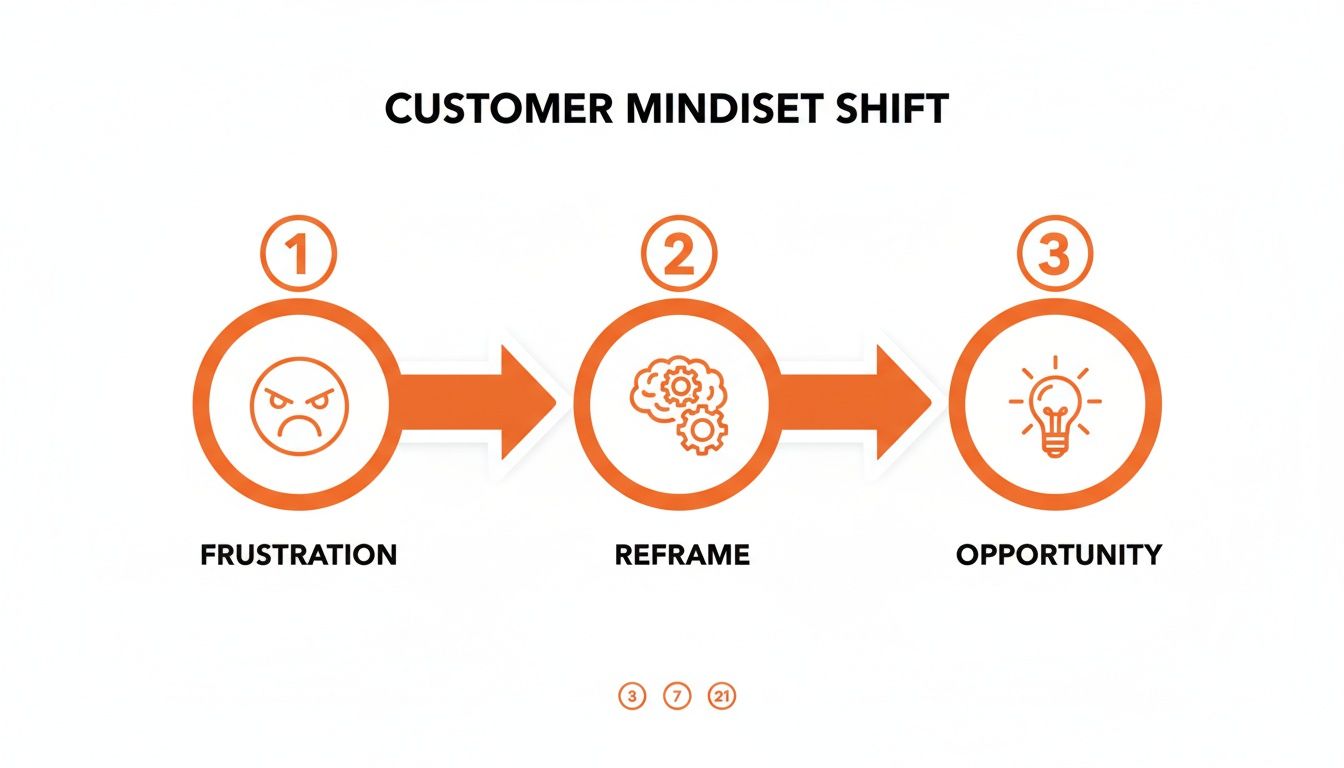
The key takeaway here is that you can reframe the entire interaction from a moment of pure frustration into an opportunity to show your brand's commitment. It’s a chance to turn a bad experience into a memorable, positive one.
From Listening to Problem-Solving
Once you’ve validated their feelings, it’s time to pivot to finding a solution. This transition is crucial—you need to take control of the conversation calmly and clearly.
Your next move is to summarize their complaint back to them. I use this all the time. It shows you were actually paying attention and makes sure you're both on the same page before taking another step.
For example:
"Okay, just to make sure I've got this right, the package arrived three days late, and when you opened it, the item was the wrong color. Is that correct?"
This simple confirmation does two things. First, it gives them a chance to correct any misunderstandings. Second, it proves you're taking them seriously, which builds the trust you absolutely need to solve the problem. Only after you get their "yes, that's right" should you start exploring next steps. This keeps you from solving the wrong problem and keeps the interaction moving forward.
Scripts And Templates That Sound Human
Knowing how to de-escalate is half the battle. Knowing the exact words to use is the other.
Forget the robotic, corporate-speak that makes customers feel like they're talking to a wall. I'm going to give you the same plug-and-play phrases I've personally used to turn tense situations around.
This isn't about becoming a script-reading robot, though. Think of these phrases like a musician learning scales. You practice them so that when it’s time to improvise, the right notes just flow.

A Human-Centered Email Template
Here’s a simple, effective structure you can adapt for almost any email response. I've found it follows a clear psychological path that works: acknowledge, align, then act.
- The Sincere Opener (Acknowledge): First, you have to validate their frustration. Don't fake it. "I'm so sorry to hear about the issue with your order. I can definitely see how frustrating that would be."
- The Quick Summary (Align): Next, briefly restate their problem to show you're on the same page. "Just to confirm I understand correctly, the package arrived damaged, and you're unable to use the product. Is that right?"
- The Action Step (Act): Now, tell them exactly what you’re going to do. Be clear and direct. "I've already processed a replacement for you, which will ship out today. You'll get a new tracking number shortly."
- The Simple Close: End on a human, helpful note. No corporate jargon. "Thanks for your patience as we get this sorted out for you."
This structure works because it puts their experience first. You’re not just solving a problem; you’re showing you actually care about their frustration.
Phrases For Specific Scenarios
Let's be real, you don't have time to workshop the perfect response when an angry email lands in your inbox. Having a few key phrases ready to go can make all the difference.
Here are some of my go-to lines for common headaches:
- For a Shipping Delay: "I know how disappointing it is when a delivery doesn't arrive as expected. I've looked into this, and here's the latest update from the carrier…"
- For a Product Defect: "That's definitely not the quality we aim for, and I'm really sorry about that. Could you please send a quick photo so I can get this fixed for you right away?"
- For Stating a Policy Firmly but Kindly: "I understand where you're coming from. While our policy doesn't allow for refunds on used items, here is what I can do for you as a gesture of goodwill…"
Using the right words is critical because the stakes are incredibly high. The threshold for a customer leaving is shockingly low. One study found that after just a single poor experience, 32% of customers will abandon a brand they previously loved.
That number skyrockets after a second bad interaction. A staggering 86% of customers are willing to walk away for good. Your words are your best defense against that churn. You can dig into more of these customer retention statistics to get the full picture.
These scripts aren't magic wands, but they are a solid foundation. They give you a calm, structured response when your own stress levels are through the roof, ensuring you sound helpful and human every single time.
Setting Boundaries And When To Say Goodbye
As a founder, your gut tells you to do anything to make a customer happy. But you can’t build a lasting business by bending until you break. The real key to sustainability is setting clear, fair boundaries that protect your sanity, your team, and your bottom line.
Think of your company policies—especially for returns and refunds—as guardrails. They're not there to be mean; they keep everything on a safe, predictable path when things get shaky. Without them, every difficult situation becomes a new fire you have to put out based on emotion, and that's a one-way ticket to burnout.
Your Policies Are Your Best Friend
A good, solid policy isn't about being rigid. It's about being consistent and fair to everyone, including yourself. When you're in the trenches with a frustrated customer, the last thing you want is to make a decision on the fly. You need a reliable framework to fall back on.
Make sure your policies are:
- Easy to find: Don't hide your return policy in your site's footer. Make it obvious. Put it where people can see it before they even think about buying.
- Written in plain English: Ditch the legal jargon. A customer should be able to read your policy and understand exactly what's up.
- Fair but firm: Be generous where it makes sense, but clearly define your limits. A 30-day return window for unused products is a pretty standard, solid starting point.
This kind of proactive communication cuts down on tons of confusion and headaches later. It also gives you a calm, objective document to point to when a customer's request is just not something you can do. Getting these decisions straight from the get-go is critical. If you need help building this muscle, check out our framework for making decisions.
Knowing When to Fire a Customer
Look, sometimes no amount of de-escalation or policy-quoting is going to fix the situation. There are customers who will drain every ounce of energy from your team, cost you more in time than their business is worth, and just generally make everyone miserable. Learning to spot these situations and act on them is a survival skill.
And it’s not always the loudest ones. In fact, a whopping 56% of consumers who have a bad experience never even complain—they just ghost you. While that silent churn hurts, it's the overtly abusive or endlessly demanding customer that requires a firm, final response. You can find more data like this in these customer service statistics.
It is 100% okay to say goodbye to a customer who is abusive, makes completely unreasonable demands, or repeatedly ignores your policies. Your mental health and your team's well-being are worth more than any single sale. Period.
So how do you pull the plug professionally? When a customer has truly crossed the line, you don't need a dramatic breakup. A simple, direct script is all you need to end the relationship cleanly.
Here’s a template you can adapt:
"Hi [Customer Name],
We've done our best to find a solution that works for you, but it seems we aren't able to meet your expectations. At this point, it's clear our company isn't the right fit.
We are issuing a final refund and will be closing your account. We wish you the best in finding a company that's a better match for your needs."
This response is final, professional, and keeps emotion out of it. It closes the loop and lets you and your team get back to focusing your energy on the fantastic customers you can help.
Protecting Your Most Important Asset: Your Team
You can't pour from an empty cup. It’s an old saying, but it's the absolute truth when you and your team are on the front lines, dealing with tough customers day in and day out.
If you're a solo founder, you’re the one taking every single emotional punch. And if you have a team, their well-being is squarely on your shoulders.
Every tense interaction chips away at your collective energy. Think of it like an emotional battery draining a little with every angry email or frustrated phone call. You wouldn't let your phone hit 0% and still expect it to perform, so why would you do that to yourself or your people?

Let's be clear: this isn't some fluffy, feel-good topic. This is about building a brand that's resilient enough to handle any storm that comes its way. A burned-out, exhausted team simply can't deliver the kind of thoughtful, high-quality service needed to turn a bad situation around. In fact, research shows that 74% of agents feel more empowered to handle stress when they have the right tools and support.
Building Resilience and a Safety Net
First things first: you have to build a culture where it's not just okay, but actively encouraged, for your team to admit they're struggling. You need a system where someone can raise their hand and say, "I need to tap out on this one," without an ounce of judgment. This is your psychological safety net.
Your team's mental health isn't a secondary priority; it is the engine of your customer experience. When they feel supported, they can support your customers. When they feel drained, that negativity inevitably leaks into every interaction.
After a particularly draining call or a nasty email chain, you need a cooldown ritual. This doesn't need to be fancy. It can be as simple as stepping away from the desk for five minutes, grabbing a coffee, or just chatting about something totally unrelated with a colleague. That small act creates a buffer, stopping the stress from one bad interaction from bleeding into the next.
For solo founders, this is even more critical. You don't have a coworker in the next room to vent to. This is where peer support becomes a lifeline. Finding a trusted circle of other founders is a complete game-changer. You might find real value in exploring options like mastermind groups for entrepreneurs to build that essential network. It's lonely out there otherwise.
Celebrate the Wins and Debrief the Losses
It's so easy to get bogged down in what went wrong. Don't fall into that trap. You have to celebrate the "saves"—those moments when a team member masterfully turns a furious customer into a fan. These wins are proof that your approach is working and are a massive morale booster.
Here's a simple way to structure this:
- The Post-Mortem Debrief: For the really tough cases that didn't go well, hold a blameless debrief. The goal isn't to point fingers. It's to ask, "What can we learn from this? What could we try differently next time?"
- The "Save of the Week": Make a point to highlight a great customer interaction in your team meetings or Slack channel. Share the story, shout out the person who handled it, and celebrate them. This reinforces the right behaviors and reminds everyone that their hard work really does pay off.
By learning from the losses and celebrating the wins, you create a balanced, supportive environment. This proactive approach isn't just about being nice—it's the ultimate strategy for consistently and successfully navigating the challenges of difficult customers.
Answering Your Toughest Customer Questions
Alright, let's get into the weeds. I want to tackle some of those sticky situations that pop up and make you feel totally stuck as a founder. When you’re not sure what the right move is, this is your playbook for making the tough calls.
What If a Customer Is Publicly Trashing My Brand?
First thing: take a deep breath. Your gut reaction might be to delete the comment or fire back with a defensive reply. Don't do either. I promise you, you cannot win a public argument.
Instead, post a single, calm, professional response. Your only goal is to acknowledge them and pull the conversation into a private channel, fast.
"We're so sorry to hear about your experience and want to make this right. Please DM us your order number so we can investigate this for you immediately."
This simple script does two things. It shows everyone else watching that you're on top of it, and it moves the messy back-and-forth out of the public square. Once you're in the DMs, you can actually solve the problem.
How Do I Handle a Customer Who Is Clearly Wrong but Won't Back Down?
Ah, the classic founder headache. We've all been there. The secret is to validate their feeling, not their version of the facts. You don't have to agree that your product spontaneously combusted, but you can absolutely agree that being frustrated is a valid feeling.
Try using phrases that separate their emotion from the objective reality:
- "I can definitely understand why that would be so frustrating."
- "It sounds like this has been a really difficult experience for you."
Once they feel heard, you can gently pivot back to your policy or the facts. "While our policy doesn't cover this specific issue, here is what I can do for you…"
Often, a small, unexpected gesture of goodwill—like a discount on a future order—is all it takes. You're not trying to win the argument; you're just trying to make them feel heard and move on.
Is It Okay to Just Issue a Refund to Make Someone Go Away?
Yes. But you have to be smart about it.
Your time and mental energy are your most valuable resources. If a customer is hammering your inbox over a $20 refund and it’s going to cost you an hour and a spike in your blood pressure, it's just not a battle worth fighting. Cut your losses and move on.
Think of the "goodwill refund" as a tool for efficiency, not a knee-jerk reaction to every complaint. The key is to track these. If you notice the same person is constantly finding "issues" to get free stuff, that's when you draw the line and stand firm.
How Can I Set Up Good Policies From Day One?
Keep it simple. Keep it clear. Keep it fair. A policy filled with legalese is just a recipe for confusion and angry emails.
Start with the basics. A 30-day return window for unused products is a solid, standard starting point. Be crystal clear about who pays for return shipping (usually the customer, unless you made a mistake). For refunds, give a clear timeline, like, "Refunds will be processed within 5-7 business days of receiving your return."
Building a solid sales process from the start is one of the smartest things a new brand can do. You can learn more by checking out our guide on the B2B sales process to get started.
The most important thing? Be consistent. A clear policy that you apply fairly to everyone is your absolute best defense against unreasonable demands.
At Chicago Brandstarters, we know that building a brand is full of these tough moments. Our community is a place where kind, hardworking founders share real stories and get practical advice so you never have to feel stuck or alone. Apply to join our free community and start building with us.