
An e-commerce growth strategy isn't some fancy MBA buzzword; it's your repeatable engine for finding and keeping customers. Forget chasing fleeting trends. I'm talking about building a solid, predictable machine that fuels your brand's expansion, turning complete strangers into your biggest fans.
What Is An E-commerce Growth Strategy
Let's be real for a second. Building an e-commerce brand can feel like you're just shouting into a void. You poured your heart into a great product, but growth feels random, unpredictable, and sometimes, downright impossible.
What if you had a recipe instead of just guessing?
Think of your growth strategy like my recipe for your favorite deep-dish pizza. You need the right ingredients (acquisition channels), precise measurements (your key metrics), and clear, repeatable steps (a solid framework). Without a recipe, you’re just throwing dough and cheese in the oven and hoping for the best. With one, you create something amazing, every single time. My goal here is to help you shift from just 'selling stuff' to building a strategic growth machine that works for you, even while you sleep.
This isn't about finding a single "growth hack" that'll fizzle out in a week. It’s about building a durable foundation—understanding exactly who you're selling to, where to find them, and how to create an experience that makes them want to come back again and again.
The Opportunity Is Massive
The scale of e-commerce is just staggering. Global sales are on track to hit $6.88 trillion by 2026, with the US market alone blowing past $1.17 trillion. For founders like us, that’s a monumental opportunity.
And a huge piece of that pie is mobile. In the US, mobile commerce is projected to jump from $491 billion in 2023 to $745 billion in 2026. This isn’t just a trend; it's how people shop now. Over 3 billion people are expected to be shopping online every year by 2026. Shopify has some great data on these global e-commerce trends if you want to dive deeper.
More customers is great news, but it also means way more competition. That’s why a deliberate growth strategy is so critical. It’s your game plan to cut through all that noise and claim your piece of this ever-expanding market.
A great strategy isn't about doing everything. It's about doing the right things, in the right order, for the right customers. It’s the difference between being busy and being productive.
Why You Need a Plan Now
Without a strategy, you’re just throwing spaghetti at the wall. You might burn through your marketing budget on Facebook ads that don't convert or spend countless hours on TikTok with nothing to show for it. A clear strategy gives you focus and direction.
Here’s what a solid plan actually does for you:
- Make Smarter Decisions: You'll know which marketing channels to pour money into and which ones to ignore completely.
- Allocate Resources Wisely: Your limited time and money will go toward activities with the highest chance of paying off.
- Measure What Matters: You can track your progress against clear goals and know exactly when to pivot if something isn't working.
If you're just starting out, having a plan from day one is everything. For those first crucial steps, check out our guide on how to start an e-commerce business.
The AARRM Framework For Sustainable Growth
Forget the dense theories from a business textbook. When you’re in the trenches building a brand, you need a framework that’s simple, powerful, and actually works. I’ve found the most useful one by far is AARRM, which stands for Acquisition, Activation, Retention, Referral, and Monetization.
To make it stick, I like to use an analogy that feels very Chicago: throwing a killer dinner party.
Think of your brand as a party you're hosting. The AARRM framework is your game plan for making sure everyone has an incredible time. I break the whole customer experience down into five distinct, manageable stages, each with its own job to do. This keeps you from just lighting money on fire with ads and hoping for the best. Instead, you're building a thoughtful journey from the first invite to the final thank you.
Breaking Down The AARRM Stages
Let’s walk through each piece of the puzzle. This isn’t a one-way street where people just fall out the bottom. It’s a loop where each stage can feed the others, creating a growth engine that runs itself.
Acquisition (Sending the Invites): This is how you get people to your front door. How do they even hear about your party? Are you posting on social media, sending out emails, or running ads? In e-commerce, this is all about channels like SEO, paid ads, content marketing, or social media. Your only goal here is to get the right people to your website.
Activation (The Welcome Drink): The moment a guest walks in, you hit them with a fantastic drink and a perfect appetizer. It's their first "aha!" moment—they instantly know they’re in the right place and this party is going to be good. For your store, Activation is that first meaningful thing a new visitor does. Maybe it’s signing up for your newsletter to get 10% off, creating an account, or watching a product demo. They’ve taken a small step that proves they're genuinely interested.
Retention (The Great Food & Conversation): This is the main event. The food is incredible, the music is on point, and the conversation is flowing. Your guests are having such a good time they don't want to leave. For your brand, Retention is about creating an experience that keeps customers coming back again and again. Are your shipping updates clear? Is your product quality top-notch? Do you send thoughtful follow-up emails? One study I saw found that bumping up customer retention by just 5% can boost profits by 25% to 95%. This is where you build a real brand. If you want to go deeper, check out these customer retention tactics.
Referral (Telling Their Friends): The party was so epic that the next day, your guests are texting their friends, "You have to come to the next one!" This is word-of-mouth, the most powerful marketing you've got. In e-commerce, this means you create referral programs, push for reviews, and encourage user-generated content. You’re turning your happiest customers into your best sales team.
Monetization (Catering Their Event): A guest was so blown away they ask you to cater their next big event. They're no longer just a guest; they're a high-value client. Monetization is where you measure the revenue from each customer—the first purchase, repeat buys, and any upgrades or subscriptions. It’s the ultimate report card for the value you're creating.
This visual helps me show how all these pieces—the ingredients, the steps, and the measurements—fit together to build your growth strategy.
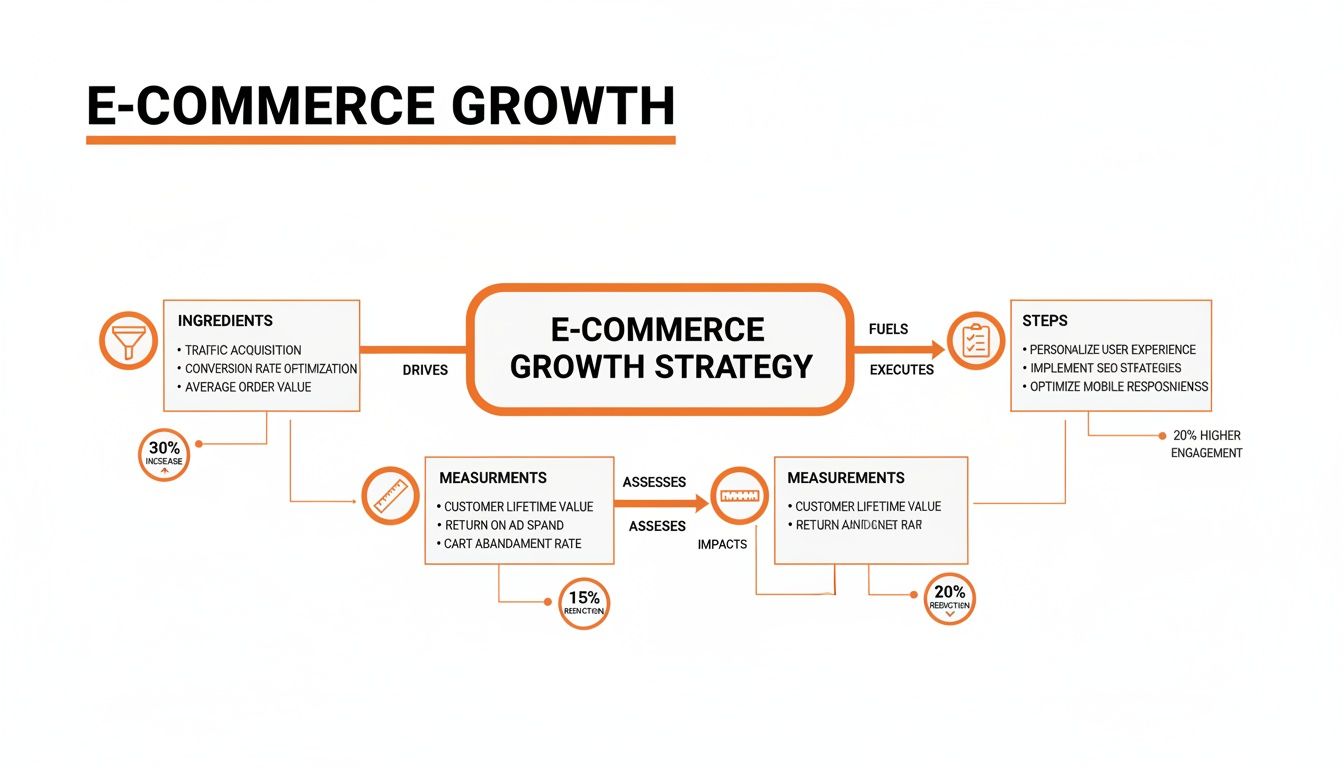
This map drives home the point that a solid strategy isn't about just one thing. It's about combining the right ingredients (like your funnel), following clear steps, and constantly measuring your results so you can get better.
Think of the AARRM framework as a diagnostic tool. If your sales are down, you don't just have a "sales problem." You can use it to find the leak. Is your Acquisition weak? Is your Activation experience confusing? Are you failing to Retain customers?
This framework gives you a clear language and a structured way to think about growth. Instead of feeling swamped by a hundred different marketing ideas, you can ask a simple question: "Which stage of the AARRM funnel is this activity supposed to improve?" It brings focus to your efforts, which is everything when you're just starting out.
Finding Your First 100 True Fans

Before you even think about scaling to seven figures, you need a rock-solid foundation. Seriously, forget about throwing money at expensive ads and casting a wide net for a minute. Your first real mission is to find your first 100 true fans.
These are the people who won’t just buy from you once. They'll become your earliest evangelists, your ride-or-dies who tell all their friends about you.
This isn’t about just getting numbers on a spreadsheet; it’s about surgical precision. You're looking for the right people, not just any people. Think of it like a treasure hunt. You wouldn't just start digging holes all over the place, right? You need a map that points to where the treasure is buried. For us founders, that map is your Ideal Customer Profile (ICP).
Building Your Ideal Customer Profile
An ICP is so much more than basic demographics like age and zip code. It gets into the psychology of your perfect customer. It’s about truly understanding their worldview, their struggles, and what really makes them tick. Get this right, and you'll create messaging and products that feel like they were made just for them.
To really nail your ICP, you have to dig deeper and answer some real questions:
- Beliefs & Values: What do they fundamentally believe about the world? What causes do they get fired up about?
- Pains & Problems: What’s the one problem keeping them up at night that your product can actually solve? What are they genuinely frustrated with?
- Watering Holes: Where do they actually hang out online? Are they buried in specific subreddits, active in niche Facebook groups, or following certain creators on Instagram?
- Language: How do they talk? What specific words and phrases do they use to describe their problems and what they want? Speaking their language builds trust instantly.
Your Ideal Customer Profile isn't just some fluffy marketing exercise. It’s the compass for your entire business. It dictates your product roadmap, your brand voice, and, most importantly, where you spend your time and money.
Once you have a crystal-clear picture of this person, everything else gets a whole lot easier. Instead of trying to be everywhere at once, you can pour all your energy into the one or two channels where your future fans actually live.
Go Deep, Not Wide
This is the exact spot where I see so many founders trip up. They get a burst of excitement and try to launch on TikTok, Instagram, Pinterest, and run Google Ads all at the same time. It’s a classic recipe for burnout and blowing through your cash.
Your first e-commerce growth strategy needs to be about depth, not breadth. Pick one channel and completely own it.
I worked with a founder here in Chicago who was selling beautiful, high-end, sustainable home goods. She burned through $5,000 on Facebook ads and got almost nothing back. It was painful to watch. She was targeting broad interests like "eco-friendly" and "home decor," which was like trying to find a needle in a continent-sized haystack.
We went back to the drawing board on her ICP. We figured out her true fan wasn't just casually into green products. They were deeply invested in the "buy it for life" philosophy—artisans and craftspeople who valued quality above all else. And where did these folks hang out? Not scrolling through Facebook. They were in a niche online forum dedicated to durable goods and craftsmanship.
She pulled the plug on all her ads and spent a month just being a real, helpful member of that forum. She answered questions, shared her own expertise, and only brought up her products when it felt natural. It cost her zero dollars, just her time. That effort landed her the first 50 customers who became the bedrock of her brand. That’s the power of focus.
This approach is about building real relationships, not just chasing clicks. You're not just another brand yelling into the void; you're becoming a member of their community. This is how you find your first 100 true fans and build a business that can actually last.
Your 90-Day Growth Experiment Playbook

A strategy is just a dream without action. This is where we get our hands dirty and turn your brilliant ideas into cold, hard data. You’re about to become a scientist in your own business lab, running small experiments to see what truly moves the needle.
Think of this playbook as a series of short, focused sprints. You’re not committing to a massive, year-long plan that’s doomed to fail. Instead, you're making small, calculated bets, learning quickly, and doubling down on what works. This approach builds a habit of continuous improvement right into the DNA of your brand.
We'll structure this into three distinct 30-day sprints. Each month has a clear focus, helping you avoid the chaos of trying to do everything at once.
Month 1: The Activation And Discovery Sprint
Your first 30 days are all about your core promise. Before you pour money into ads, you need to be absolutely sure your product delivers that "aha!" moment. This sprint is dedicated to testing your value proposition and nailing the initial customer experience.
Your main goal is to answer one question: "Do people who try my product actually get it and see its value?" You're not chasing huge sales numbers yet. You're hunting for proof that you’ve built something people genuinely want.
Here are some experiments you can run:
- The Landing Page A/B Test: Create two versions of your main landing page. One might highlight "Free Shipping," while the other emphasizes "Handcrafted Quality." Drive a small amount of traffic to both and see which headline converts better.
- The Welcome Email Sequence: Test two different welcome emails for new subscribers. Does an email with your founder story build more trust, or does a straight-up 15% off coupon drive more first-time purchases?
- The Product Page Video Test: Add a short, simple video to one of your key product pages showing the item in use. Track the conversion rate of that page against a similar product page without a video.
This first month is your foundation. You’re making sure the first impression is perfect before you invite the whole world to your party.
Month 2: The Acquisition Channel Sprint
With some confidence in your core experience, month two is about finding out where your customers are hiding. This is your acquisition channel testing phase. The key here is to run small, budget-controlled tests across a few different channels to see what sticks.
You're not trying to master Facebook Ads, SEO, and TikTok all in one month. You're just trying to find a signal. Think of it like fishing. You’re casting a few lines in different parts of the lake to see where the fish are biting before you set up camp.
Your goal isn't to be everywhere. It’s to find the one or two channels that deliver the best customers for the lowest cost, and then go all-in on those.
For example, you could allocate a small budget to test these channels:
- Instagram Influencer Outreach: Identify five micro-influencers whose audience perfectly matches your ICP. Offer them a free product in exchange for a story or post and track the traffic and sales from their unique discount code.
- Google Ads for High-Intent Keywords: Run a small campaign targeting very specific keywords like "buy handmade leather journal Chicago." This targets people who are already looking to buy, giving you a quick read on conversion potential.
- Niche Community Engagement: Spend time in that subreddit or Facebook group you identified earlier. Actively participate, offer value, and see if you can generate your first few sales organically.
Track everything. At the end of the month, you should have a clear winner or two—the channels that gave you the most bang for your buck.
Month 3: The Retention And Optimization Sprint
You’ve activated new users and acquired some customers. Now what? Month three is all about keeping them. Acquiring a new customer can cost five times more than retaining an existing one, so this sprint is where you start building a truly profitable business.
The focus here is on improving the post-purchase experience and encouraging that crucial second sale. You'll run experiments designed to increase customer lifetime value (LTV).
Here’s a sample plan:
- Test a Post-Purchase Email Flow: Send a follow-up email a week after delivery asking for a review. A few weeks later, send another with a special "thank you" discount on their next order.
- Experiment with a Simple Loyalty Program: Offer points for every dollar spent that can be redeemed for future discounts. See if this encourages faster repeat purchases compared to customers not in the program.
- Optimize Your Packaging: Try including a handwritten thank-you note in 50% of your orders and see if those customers leave more positive reviews or have a higher repeat purchase rate.
To help you visualize this, here’s a sample table outlining what a 90-day sprint could look like in practice.
90-Day Growth Sprint Example
| Sprint (30 Days) | Primary Focus | Example Experiment | Key Metric To Track |
|---|---|---|---|
| Days 1-30 | Activation | A/B test a welcome email series (founder story vs. 15% off coupon) | First-time purchase conversion rate |
| Days 31-60 | Acquisition | Run micro-influencer outreach on Instagram vs. a targeted Google Ad campaign | Cost Per Acquisition (CPA) |
| Days 61-90 | Retention | Implement a post-purchase email flow to encourage a second purchase | Repeat purchase rate |
This 90-day cycle of testing, learning, and optimizing is the engine of any successful e-commerce growth strategy. It turns guessing into knowing. Rinse and repeat.
Unlocking Growth With B2B Partnerships
While everyone else is locked in a brutal street fight over the same B2C customers, there’s a massive, often-ignored opportunity waiting for you. I'm talking about Business-to-Business (B2B) partnerships—a powerful way to add a stable, predictable revenue stream to your e-commerce growth strategy.
Think of it like opening a second front in your growth battle. It's a front your competitors are probably overlooking entirely.
This isn't about hiring a slick sales team in suits. For a small brand like yours, B2B could be as simple as striking a wholesale deal with a local boutique, setting up a corporate gifting program for tech companies, or supplying your products to other businesses that serve your ideal customer.
Why B2B Is Your Untapped Goldmine
You might think B2B is a totally different universe, but it’s more accessible than ever. The B2B e-commerce market is set to explode to an incredible $36 trillion by 2026. That’s a massive pond to fish in. And since 2020, I've seen over 90% of B2B firms shift to virtual sales, making it way easier for small, nimble brands like yours to get in the game. You can check out more stats on this from CraftBerry.co.
The real magic of B2B is diversification. When a B2C channel like Facebook Ads gets too expensive or an algorithm changes overnight, your B2B revenue acts as a reliable anchor, protecting you from those wild market swings.
B2B partnerships transform your business from a one-to-one seller into a one-to-many distributor. Instead of finding one customer at a time, you find one partner who brings you hundreds of customers at once.
Finding Your First Partner Without a Sales Team
So, where do you start? Forget cold calling. Your first B2B partner is likely already in your orbit.
Think about your Ideal Customer Profile. Where do they work? What services do they use? Who already has their trust? The answer to these questions is your treasure map.
Here’s a simple, actionable path to find them:
- Map Complementary Businesses: If you sell high-end coffee beans, who else serves a customer that appreciates quality? Think co-working spaces, boutique hotels, or even high-end real estate agencies that give client gifts.
- Start with a Warm Introduction: Lean on your existing network. A simple post on LinkedIn saying, "I'm looking to connect with office managers at Chicago tech companies for a new corporate coffee program," can work wonders.
- Create an Irresistible "Pilot" Offer: Don’t lead with a complicated wholesale contract. Instead, offer a small, low-risk pilot program. For example, "Let me supply your office with free coffee for one week. If your team loves it, we can discuss a simple monthly subscription."
A Chicago-based founder I know sells artisanal snack boxes. She landed her first major deal by noticing a new co-working space opening in her neighborhood. She just walked in, introduced herself, and offered to stock their kitchen with free snacks for their grand opening.
The members loved the products, and the co-working space signed a year-long contract. That one relationship created a stable new revenue stream and gave her incredible brand credibility. Finding the right business partners is a critical skill, and we've put together a guide on how to find business partners that can help you get started.
What To Do When Your Growth Stalls
It happens to all of us. Eventually. The exhilarating rocket launch of early growth starts to sputter. Your sales chart, which used to be a beautiful upward climb, goes flat. That initial buzz is replaced by a quiet, gnawing frustration. You've hit the plateau.
This is the part of the startup journey nobody likes to talk about, but it's probably the most critical. This is the moment that tests your grit and forces you to think like a real strategist. Hitting a wall isn’t a sign you’ve failed; it’s a mandatory rite of passage for every founder.
My first gut reaction is usually panic. You might be tempted to just throw a bunch of money at new ads or make some drastic, hasty change to your product. Stop. The real work begins with a calm, brutally honest diagnosis. You have to figure out where the engine is smoking before you can even think about fixing it.
Diagnosing The Real Problem
When growth slams to a halt, the root cause almost always falls into one of three buckets. Think of your business as a car that’s suddenly stopped running. Are you out of gas? Is the engine busted? Or are you just lost on the wrong road? You’ve got to pop the hood before you call for a tow.
Here's how I break it down for a gut check:
- Is It The Product? Have you started getting more returns lately? Seeing more negative reviews pop up? Have your repeat purchase rates dipped? Sometimes a subtle drop in quality or a shift in what your customers actually need can slam the brakes on growth. You have to be mercilessly honest with yourself here.
- Is It The Channel? Did the cost of your go-to marketing channel—say, Instagram ads—suddenly go through the roof? Did a sneaky algorithm change completely tank your organic reach? A channel that was a goldmine yesterday can be totally tapped out today.
- Is It The Message? Are your ads getting ignored all of a sudden? Has the conversion rate on your key landing page taken a nosedive? Your messaging might have just gone stale, or a new competitor is out there telling a much better story than you are.
A growth plateau isn’t a dead end. It’s a fork in the road. It forces you to re-examine every assumption you’ve made and get way smarter about your e-commerce growth strategy. This is where you level up from just a founder into a resilient operator.
The Power Of A Trusted Peer Group
After you’ve stared at your spreadsheets until your eyes glaze over, the most powerful next step often isn't found in more data. It’s in a conversation. As founders, it’s so easy to feel like we’re stuck on an island, fighting these battles completely alone. But I promise you, the solution to your plateau is probably sitting in the head of another founder who smashed through the exact same wall six months ago.
This is why having a trusted peer group isn't a "nice-to-have." It's a non-negotiable part of your survival toolkit. I’m not talking about those awful, transactional networking events where everyone is just trying to sell you something. I mean a small, private circle of fellow operators you can be 100% vulnerable with—people who just get it.
In our Chicago Brandstarters group, I’ve watched this play out time and time again. A founder will show up to one of our dinners feeling completely stuck, convinced their problem is unique. Then someone else at the table will pipe up, "Oh yeah, that happened to me last year. Here’s exactly what I did." That one simple conversation can save you months of painful, expensive trial and error.
This is how you build real resilience. You realize you’re not the first person to face this, and you definitely won’t be the last. Finding your people is how you find your way through the fog.
Your Top E-commerce Growth Questions, Answered
You’ve got questions, I’ve got answers. No fluff. Here are the most common things I hear from founders trying to nail down their growth strategy. My goal here is to get you unstuck and moving forward.
How Much Should I Spend On Marketing?
This is the classic "how long is a piece of string?" question. The textbook answer you'll hear is to set aside 10-20% of your projected revenue for marketing. It's a decent benchmark if you need one.
But here’s a better way I think about it. Forget a big, scary, fixed budget. Instead, give yourself a small "testing budget" for each channel you want to try in your 90-day sprints. Your goal isn't to hit a spending number; it's to find a channel where you can get customers without losing your shirt.
Once you find that magic combination, then you can pour more fuel on the fire.
Which Marketing Channel Is The Best?
I'll be blunt: there is no "best" channel. There’s only the best channel for your customers. This is exactly why doing the hard work on your Ideal Customer Profile is non-negotiable. Your ICP is the map that tells you where to find your people.
Don't chase whatever platform is trending on Twitter this week. Go where your ideal customers are already hanging out, having conversations, and looking for solutions. Be a part of their community, not just another advertiser shouting at them.
If you’re selling high-end kitchenware, your people are probably geeking out on Pinterest or a niche foodie blog. Selling streetwear? You'd be crazy not to be on TikTok and Instagram. Your ICP dictates the channel strategy, never the other way around.
How Long Does It Take To See Growth?
Growth is never a straight line up and to the right. It’s messy. Patience is your single biggest competitive advantage, especially when you feel like nothing is working.
You might get a quick win from an influencer post that goes viral, but real, sustainable growth takes time to build. It’s more like planting a tree than flipping a light switch.
If you stick to the 90-day experiment playbook, you should start seeing a clear signal—which channels have potential and which are duds—within the first three to six months. But getting to that point where the growth engine feels like it's running on its own? I find that often takes 12-18 months of consistent, focused effort.
Should I Focus On Acquisition Or Retention?
When you're just starting out, you don't have a choice. It's acquisition all the way. You have no one to retain! Your only job is to find those first 100 people who truly love what you've built and will actually pay for it.
But the second you have a handful of customers, you need to become obsessed with retention. Why? The data is brutal: getting a new customer is five times more expensive than keeping an existing one.
A business you build on one-time buyers is a leaky bucket. You’ll burn all your cash and energy just trying to keep it full. The brands that last are built on the backs of repeat customers who feel like they're part of something special.
If you're a founder in Chicago tired of figuring this all out alone, Chicago Brandstarters is your community. We’re a group of kind, bold builders sharing real stories and tactics to help each other win. Learn more and see if you’re a fit at https://www.chicagobrandstarters.com.