Tag: ecommerce marketing

  • Your Authentic Ecommerce Growth Strategy Playbook

    Your Authentic Ecommerce Growth Strategy Playbook

    Forget everything you've read about growth hacking. I think an ecommerce growth strategy isn't about shiny objects or chasing trends. It's about building a durable, repeatable system that brings you customers you can actually keep, profitably.

    You need a real plan—one that mixes a deep understanding of your market, smart choices about your time and money, and creating an experience people talk about.

    Let's Get Real About What Growth Actually Means

    I want to be straight with you. Building an ecommerce brand is a grind. It's not the get-rich-quick reel you see on social media. I’ve been in the trenches for years, and I’m here to give you the kind of advice I wish I had before making a ton of expensive mistakes.

    So, let's ditch the generic fluff. We're going to build a real, durable ecommerce growth strategy together, step by step.

    A smiling man writing in a notebook at a desk with a laptop and a 'DURABLE GROWTH' sign.

    This playbook is my complete A-to-Z system for founders like you. Before we get into the weeds, let’s zoom out. Think of this as our blueprint.

    The Core Pillars of Your Ecommerce Growth Strategy

    This table breaks down the essential parts of a solid growth strategy. It gives you a quick-glance framework before we dive deep into each one.

    Pillar What It Means For You Key Metric to Watch
    Market & Competitive Diagnosis Knowing who you're selling to, what they really want, and who you're up against. This is your foundation. Customer Lifetime Value (LTV)
    Channel & Funnel Strategy Deciding where to find your customers (e.g., social, search, email) and mapping their journey from stranger to loyal fan. Customer Acquisition Cost (CAC)
    Acquisition & Retention Tactics The specific plays you'll run to get new customers and, more importantly, get them to come back again and again. Repeat Purchase Rate
    Growth Experiments & Sprints A system for constantly testing new ideas in a structured way, so you learn fast and double down on what works. Conversion Rate (by experiment)
    Metrics & Analytics Knowing which numbers actually matter and how to track them without getting lost in a sea of data. Profit Margin
    Operations & Scaling Playbooks Building the systems (think customer service, fulfillment) that let you grow without everything breaking. Order Fulfillment Time

    Each pillar builds on the last. If you get them right, you'll have a business that not only grows, but lasts.

    Stop Chasing Vanity Metrics

    Too many founders I meet get fixated on the wrong things—follower counts, website traffic, you name it. Those numbers feel good, but they don't pay your bills. A real growth strategy is like building a house with a solid foundation, not just a flashy facade.

    It’s about sustainable, profitable growth that doesn't burn you or your bank account out.

    We’re going to focus on what actually moves the needle:

    • Finding Your Unique Place: Discovering what makes you different in a sea of competitors.
    • Choosing the Right Channels: Picking one or two marketing channels and absolutely dominating them, instead of spreading yourself thin.
    • Building a Lasting Connection: Creating a customer experience so good that it breeds loyalty and word-of-mouth.

    Think of me as your guide who's already walked through the minefield. I want to help you build a plan that feels authentic to your brand, one that respects your budget and your sanity.

    Your Slice of a Trillion-Dollar Pie

    The opportunity in front of you is staggering. Global retail ecommerce sales will likely hit $6.42 trillion, climbing to nearly $7.89 trillion by 2028. This isn't just hype—ecommerce now makes up 20.5% of all retail sales worldwide.

    Your slice of that pie is waiting. You don’t need to be Amazon to claim it.

    You can read more about these ecommerce trends and what they mean for you. I designed this playbook to give you an edge. We’ll build a strategy that’s less about chasing every shiny object and more about doing a few things exceptionally well.

    Ready to build something that lasts? Let's get started.

    Find Your Unfair Advantage in a Crowded Market

    Before you think about spending a single dollar on ads, we need to do something most founders skip. We need to figure out exactly where you stand. This isn't about expensive software; it's about being scrappy and observant.

    Your entire growth strategy hinges on this: finding your unfair advantage. Think of it like a coffee shop. If every shop on the block sells lattes, your advantage might be that you're the only one who knows every customer's dog by name. It’s a small thing that makes a huge difference.

    A person writes on a paper with a pen, surrounded by colorful sticky notes, with 'UNFAIR ADVANTAGE' banner.

    Uncover What Your Competitors Are Really Doing

    Your rivals are leaving clues everywhere. Your job is to become a detective. Forget their homepage—that’s the polished storefront. I want you to peek into their back alley.

    I want you to go deep on 2-3 direct competitors. Don't just browse their site. You need to actually become their customer.

    • Buy Their Product: Go through the entire checkout. Is it smooth or clunky? How long does shipping actually take?
    • Observe the Unboxing: When the package arrives, what’s it like? A cheap poly mailer or a thoughtful, branded experience? A handwritten note? A special offer?
    • Sign Up for Their Emails: What happens next? Do they welcome you and share their story, or just slam you with discounts? Track the frequency and type of emails they send for at least two weeks.

    This hands-on research gives you a real feel for their customer experience. You see the gaps, the places where they drop the ball and where you can shine.

    Build Your Competitive Matrix

    Okay, let's get organized. This isn't some complex spreadsheet. It’s a simple tool to give you a bird's-eye view of the battlefield. I suggest you create a basic table and map out what you've learned.

    Feature/Tactic Competitor A Competitor B Your Brand (The Opportunity)
    Brand Voice Corporate & formal Humorous & trendy Authentic & helpful
    Shipping Speed 5-7 days 3-5 days Can I offer 2-day shipping?
    Unboxing Feel Basic poly mailer Branded box, no insert Custom tissue, handwritten note
    Post-Purchase Email Immediate discount offer Generic "thanks for ordering" Founder story + care instructions
    Social Media Focus Polished Instagram feed Relentless TikTok ads Behind-the-scenes community on IG Stories

    You'll start to see patterns almost immediately. Maybe everyone competes on price, but no one offers amazing, personal customer service. That’s your opening. Perhaps their products are great, but their post-purchase experience is nonexistent. That's your chance to build serious loyalty.

    Your goal isn't to copy your competitors. It's to understand the standard they've set for customers, and then find an authentic way for you to be ten times better in one or two specific areas.

    Find Your Unique Angle

    Your unfair advantage rarely comes from having a "better" product, especially at first. It comes from a place your competitors can't easily copy. It's something woven into your brand's fabric.

    So, what's your story?

    • The Origin Story: Did you start your company to solve a personal problem? I know a skincare founder who had severe eczema. Her entire brand story is built around her genuine quest for a solution. It resonates because it’s real.
    • The Underserved Niche: Are you serving a customer ignored by the big players? Think of brands making apparel for petite-plus women or left-handed golfers. They thrive by being the go-to experts for a specific group.
    • The Superior Experience: Maybe your advantage is pure kindness. In a world of chatbots, being a real human who cares about customer success is a powerful differentiator. This is a core value for me and my team at Chicago Brandstarters.

    This diagnostic work is the bedrock of your growth strategy. By knowing where the gaps are, you can position your brand to fill them. You stop competing on their terms and start playing a game you're built to win. This clarity will guide every decision you make from here.

    Choose Acquisition Channels That Actually Work

    Feeling swamped by all the marketing options out there? I see it all the time. You hear about TikTok, SEO, Google Ads, email… the list is endless. The trap is trying to do a little bit of everything, which spreads you too thin and gets you nowhere.

    Let's fix that right now.

    A smart growth strategy isn’t about being everywhere. It’s about being in the right places, with intense focus. I'm going to walk you through how to pick one or two channels that are a perfect match for your brand, your customers, and your bank account.

    Your Channels Are Not Created Equal

    Think of acquisition channels like fishing. You could throw a giant net in the water and hope for the best (that's like running broad Facebook ads). Or, you could use a specific lure in a quiet part of the lake where you know your target fish hang out (that's creating niche content that ranks on Google).

    One isn't better, but one is definitely better for you right now. Trying to stretch a tiny budget across five channels is like trying to fill five buckets with a dripping faucet. You just end up with five slightly damp buckets instead of one full one.

    I use a simple framework to help founders decide where to put their energy. It boils down to three questions:

    • Where does my audience already spend time? If you sell high-end kitchen gadgets, your people are probably searching Google and saving ideas on Pinterest. They're likely not scrolling through teenage dance videos on TikTok. You must go where they are.
    • What's the cost to play? Google Ads can get expensive, fast. On the flip side, building an organic SEO presence costs you more time than money upfront.
    • Can this channel actually scale with me? Selling at local craft fairs is fantastic for your first 50 sales. But you can't build a million-dollar business that way. You need a channel that can grow as you do.

    The Mobile and Social Commerce Game-Changer

    Right now, two of the most powerful forces in ecommerce are happening in your customers' hands. The shift to mobile and social commerce isn't a passing trend; it's a fundamental change in how people discover and buy things.

    Mobile and social commerce are exploding. Mobile now drives 59% of all online retail sales, and social commerce has ballooned into a $1.17 trillion annual market. Here in the US, mobile sales shot past $564 billion, closing in on desktop. Billions of people are turning "I love that" moments on their Instagram feed into purchases without ever leaving the app.

    This isn't just data; it's your roadmap. For a new brand, a focused strategy on platforms like Instagram Shops or TikTok can deliver huge returns. You're meeting people exactly where they are, in a mindset of discovery and entertainment.

    This is your unfair advantage against big, slow brands. While they're stuck in meetings debating a Q4 campaign, you can launch a TikTok video, see what connects with people, and validate a new product idea by the end of the day.

    Building Your First Simple Funnel

    The word "funnel" sounds way more complicated than it is. It's just the path a stranger takes to become your customer. For your very first channel, let's keep it dead simple.

    I’ll use Instagram as an example for a founder selling handmade leather goods.

    • Top of Funnel (Awareness): You create beautiful, short videos showing your crafting process. You aren't hard-selling; you're telling a story and showcasing your skill. You use relevant hashtags like #handmadeleather to get discovered.
    • Middle of Funnel (Consideration): People who engage with your videos start seeing more of your content. Here, you talk about the quality of your materials, share photos from happy customers, and answer common questions. This is where you build trust.
    • Bottom of Funnel (Conversion): You direct people from your posts and bio to your Instagram Shop, where they can browse and buy right inside the app. Make it frictionless. Your call to action is clear: "Tap the link in my bio to shop the collection."

    That’s it. That’s your whole funnel. No complex email sequences or expensive retargeting ads… yet. The goal is for you to master this simple flow on one platform first.

    For another perspective, you can check out my guide on other foundational ecommerce growth strategies to see how channel selection fits into the bigger picture.

    By picking one channel and building a simple, repeatable funnel, you create a machine for getting customers. Once that machine is humming along, then you can think about adding a second channel. Focus is your superpower.

    Turn One-Time Buyers Into Raving Fans

    Look, getting a new customer is brutally expensive. Keeping one is how you actually build a profitable business. While everyone else burns cash on ads to fill a leaky bucket, you're going to plug the holes. This is where a real, human connection becomes your secret weapon.

    Think of that first purchase not as the finish line, but as the start of a relationship. Your job now is to turn that transaction into genuine trust. When you get this right, you don't just get repeat buyers—you create a small army of advocates who will do your marketing for you.

    Craft an Unforgettable Post-Purchase Experience

    The moment a customer clicks "buy" is when the real magic should start. Most brands just send a boring, automated receipt. What a massive missed opportunity. You have their complete attention, so use it to make them feel amazing about their decision.

    A killer post-purchase email sequence is your first move. This isn't about ramming another sale down their throat. It's about building excitement and validating their choice.

    • Email 1 (Right away): The "You're In!" Email. This has to be more than a simple order confirmation. Welcome them to the family. Maybe you share a quick, unpolished video from you, the founder, just genuinely thanking them for their support.
    • Email 2 (When it ships): The "It's On The Way!" Email. Don't just dump a tracking number on them. Give them a reason to be pumped. You could include a "What to do first when it arrives" tip or a link to a handy care guide.
    • Email 3 (A few days after delivery): The "How's It Going?" Email. This is a simple, human check-in. You ask for their thoughts and open the door for a real conversation. This isn't about scraping for a review; it's about showing you actually care.

    This simple sequence transforms a cold transaction into a warm, personal interaction. You’re setting the stage for a long-term friendship.

    I remember ordering a custom leather wallet once. Two days after it arrived, the founder emailed me personally—not a bot—just to ask how the leather was breaking in. I’ve bought three more wallets from him since and have told at least a dozen friends. That one email probably took him 60 seconds.

    The Power of Small, Unexpected Gestures

    In a world of automated everything, a small human touch stands out like a bonfire. You don't need a huge budget to make a massive impact. It’s these small gestures that people can't stop talking about.

    Think about the unboxing experience. I once helped a client who sold premium dog treats. We started including a simple, handwritten thank you note in every order, addressed to the dog by name. Customers went wild, plastering Instagram with photos of their pups next to the notes.

    This doesn't have to be complicated or expensive for you:

    • A Handwritten Note: It takes you ten seconds but shows a level of care that feels a mile deep.
    • A Surprise Freebie: Toss in a small sample of a different product. It's a super low-cost way to introduce them to more of your catalog.
    • Decent Packaging: Use custom tissue paper or a branded sticker. Make opening the package feel like unwrapping a gift, not just tearing open a box.

    These details show you see your customers as people, not just order numbers. This is how you create loyalty that no discount code could ever buy.

    Turn Feedback Into Your Greatest Asset

    Finally, you need to actively listen. Your customers are handing you a goldmine of information on how to improve. The key is making them feel heard.

    When a customer leaves a review—good or bad—you should respond personally. If they had a problem, don't just fix it; make it right. If they have a great idea for a new product, thank them and keep them in the loop if you decide to make it. You can learn more about building this kind of community by diving into these proven customer retention tactics.

    This creates a powerful feedback loop. You’re not just improving your products; you’re co-creating them with your community. They become invested in your success because they feel like part of the story. That’s how you turn one-time buyers into lifelong fans who stick with you.

    Build an Operations Playbook for Smart Scaling

    Success in ecommerce feels amazing right up until it feels like you’re juggling chainsaws. One minute you're celebrating 10 orders a day; the next, a surprise shout-out sends 100 orders your way, and your whole system catches fire.

    This is where your growth strategy has to evolve. It's no longer just about getting customers—it's about keeping up with them.

    Growth without a plan is just chaos. You need a playbook. I'm talking about a set of simple, repeatable systems that can handle more volume without you losing your mind. This isn't about fancy software or a huge team right away. It's about building an operational engine as strong as your marketing one.

    From Manual Mayhem to Automated Flow

    In the very beginning, you do everything yourself. You print the labels, pack the boxes, answer every email. That's how it should be. But you can't scale that way.

    The first step in building a real playbook is for you to find and automate the most repetitive, soul-crushing tasks on your plate.

    Your time is your most valuable asset. Period. If you're spending three hours a day copying and pasting shipping info, that’s three hours you’re not spending on growing the business. We need to buy that time back.

    You can start by looking at these areas:

    • Order Management: Find a platform that pulls orders from all your channels into one clean dashboard. No more toggling between five different tabs.
    • Shipping Labels: Put label printing on autopilot. You can set up rules that automatically pick the cheapest carrier based on package weight and destination.
    • Customer Service: Create a bank of saved replies for the 80% of questions you get every day (you know the one: "Where is my order?"). This frees you up to personally handle the tricky issues that really matter.

    Automating these small things doesn't make your business impersonal. It does the opposite. It frees you up to be more personal where it counts. This is a critical part of what business scaling really means.

    When to Hire Your First Helper

    The idea of hiring your first employee is terrifying. I get it. It feels like a massive leap.

    But the real question isn't if you can afford it. It's if you can afford not to. If you’re constantly buried in tasks that someone else could easily do for $20 an hour, you're putting a hard cap on your company's growth.

    You don't need a full-time operations manager right away. Your first hire should be a part-time helper, maybe 10-15 hours a week, focused on one thing: fulfillment. Find someone reliable and detail-oriented to simply pick, pack, and ship your orders.

    This single hire is a force multiplier. It gets you out of the weeds and back to focusing on high-level strategy—the stuff that only you, the founder, can do.

    The moment you hand off the packing tape gun is the moment you go from being a worker in your business to being the owner of it. It’s a profound mental shift.

    Tapping Into the Trillion-Dollar B2B Opportunity

    Once you start streamlining your direct-to-consumer operations, a massive, overlooked growth channel opens up: B2B ecommerce. This isn’t about cold-calling giant corporations. It's about selling your products in bulk to other small businesses, like boutique shops.

    This market is gigantic. Global B2B ecommerce is on track to hit $36 trillion, growing at a staggering 14.5% CAGR and dwarfing B2C growth. With over 90% of B2B companies now using virtual sales models, you can strike wholesale deals digitally without ever setting foot in a trade show.

    You don't need a huge investment to test the B2B waters. You can start small by:

    • Creating a simple, password-protected wholesale page on your existing website.
    • Listing your products on a B2B marketplace like Faire to get in front of active retail buyers.
    • Offering a small "bulk discount" right on your site (e.g., "Buy 10, Get 20% Off") just to see if there's any interest.

    This all feeds back into creating an amazing customer journey, turning a first-time buyer into a true advocate for your brand.

    A customer retention journey infographic showing three stages: Purchase, Experience, and Advocate with timelines.

    This path from a simple purchase to active advocacy is where your operational excellence really shines. A smooth, hassle-free experience is what turns a one-time buyer into a repeat customer who tells their friends. Building a solid operational playbook ensures you can deliver that great experience every time, even as you grow.

    Your Toughest Ecommerce Growth Questions, Answered

    Let's get into some of the real-world, keep-you-up-at-night questions I hear from founders all the time. My goal here is to give you clear, no-fluff answers pulled from years in the trenches—not from some dusty textbook.

    I want to hit the tough stuff, the questions that don't have a simple answer but are make-or-break for your ecommerce growth strategy.

    How Do I Budget for Growth with No Money?

    This is the big one, isn't it? The classic catch-22. You know you need to spend money to make money, but what happens when the tank is empty? Good news: you have more firepower than you think.

    In the early days, your most valuable currency isn't cash; it’s your time.

    You should stop thinking, "I need $5,000 for ads," and start thinking, "I have 15 hours a week to pour into marketing." This simple mental shift changes everything. It forces you to get creative and pick channels that reward hustle over dollars.

    Here’s where you should funnel that time-based budget:

    • Content & SEO: Writing genuinely helpful blog posts or creating simple, practical videos costs you nothing but time. A single great piece of content can be a gift that keeps on giving, bringing you customers for years.
    • Organic Social: Building a real, engaged community on a platform like Instagram or TikTok is pure sweat equity. It’s about you showing up consistently and having actual conversations with people, one comment at a time.
    • PR & Outreach: Forget fancy agencies. You should spend your hours building real relationships with micro-influencers or bloggers in your niche. One authentic product feature from a trusted voice can blow a month's worth of paid ads out of the water.

    Think of it like building a fire. You don’t just toss a giant log on and hope for the best. You start with small kindling (your time and effort), nurture a small flame, and only then do you start adding bigger pieces of wood (your ad spend) once it's burning bright.

    Should I Focus on One Hero Product or Expand My Catalog?

    I see founders tear themselves apart over this. One camp preaches going an inch wide and a mile deep, becoming known for one single thing. The other camp argues for diversification to give customers more choice.

    The real answer? You do both, but it’s all about the timing.

    You absolutely must start with a hero product. This is your champion, your flagship, the one thing you're going to become famous for. Every ounce of your marketing energy, storytelling, and ad spend needs to point directly at this product. Why? Because focus creates clarity. It's infinitely easier for you to market one incredible solution than a dozen pretty-good ones.

    Once you’ve nailed it—once sales are consistent and the glowing reviews are rolling in for that hero product—then you earn the right to expand. And your first new products shouldn't be random shots in the dark. They should be logical additions that your happy, existing customers are already asking you for.

    It's like a band's first album. They don't drop a sprawling 30-song triple album out of nowhere. They release a tight, 10-song record with one or two absolute bangers. Once they have a dedicated fanbase, then they can start experimenting.

    What Metrics Actually Matter in the Beginning?

    It is dangerously easy for you to drown in a sea of data. You've got Google Analytics, your Shopify dashboard, your email platform… all of them screaming numbers at you.

    Here's my advice: ignore 95% of them.

    In the very early stages, only three numbers truly matter. This is your "canary in the coal mine" dashboard.

    1. Conversion Rate: Of all the people who land on your site, what percentage actually buys something? This is the ultimate gut check. It tells you if your core offer, your message, and your website experience are working. A low conversion rate is a red flag pointing to a problem with your pricing, your copy, or your checkout flow.

    2. Average Order Value (AOV): On average, how much does a customer spend in a single transaction? You should constantly be thinking about how to nudge this number up. Smart bundles, a simple post-purchase upsell, or a free shipping threshold can work wonders.

    3. Customer Feedback: Okay, this isn't a hard metric, but it's the most important signal you have. What are real customers actually saying in their emails, DMs, and reviews? This qualitative data is gold—it gives you the "why" behind all the other numbers.

    Don't even think about metrics like Customer Lifetime Value (LTV) or Customer Acquisition Cost (CAC) until you have at least a few hundred orders. First, you just need to prove the basic engine works. If you focus on these three, they'll guide you toward building a solid foundation for a killer ecommerce growth strategy.


    I know how lonely and challenging building a brand can be, especially when you're just starting out. At Chicago Brandstarters, we've created a free, private community for founders just like you. It's a place to share real stories, get honest feedback, and connect with kind, hardworking people who are on the same journey. If you value real connection over transactional networking, I'd love for you to join us. Learn more about our community and apply to join.

  • A Founder’s E-commerce Growth Strategy Playbook

    A Founder’s E-commerce Growth Strategy Playbook

    An e-commerce growth strategy isn't some fancy MBA buzzword; it's your repeatable engine for finding and keeping customers. Forget chasing fleeting trends. I'm talking about building a solid, predictable machine that fuels your brand's expansion, turning complete strangers into your biggest fans.

    What Is An E-commerce Growth Strategy

    Let's be real for a second. Building an e-commerce brand can feel like you're just shouting into a void. You poured your heart into a great product, but growth feels random, unpredictable, and sometimes, downright impossible.

    What if you had a recipe instead of just guessing?

    Think of your growth strategy like my recipe for your favorite deep-dish pizza. You need the right ingredients (acquisition channels), precise measurements (your key metrics), and clear, repeatable steps (a solid framework). Without a recipe, you’re just throwing dough and cheese in the oven and hoping for the best. With one, you create something amazing, every single time. My goal here is to help you shift from just 'selling stuff' to building a strategic growth machine that works for you, even while you sleep.

    This isn't about finding a single "growth hack" that'll fizzle out in a week. It’s about building a durable foundation—understanding exactly who you're selling to, where to find them, and how to create an experience that makes them want to come back again and again.

    The Opportunity Is Massive

    The scale of e-commerce is just staggering. Global sales are on track to hit $6.88 trillion by 2026, with the US market alone blowing past $1.17 trillion. For founders like us, that’s a monumental opportunity.

    And a huge piece of that pie is mobile. In the US, mobile commerce is projected to jump from $491 billion in 2023 to $745 billion in 2026. This isn’t just a trend; it's how people shop now. Over 3 billion people are expected to be shopping online every year by 2026. Shopify has some great data on these global e-commerce trends if you want to dive deeper.

    More customers is great news, but it also means way more competition. That’s why a deliberate growth strategy is so critical. It’s your game plan to cut through all that noise and claim your piece of this ever-expanding market.

    A great strategy isn't about doing everything. It's about doing the right things, in the right order, for the right customers. It’s the difference between being busy and being productive.

    Why You Need a Plan Now

    Without a strategy, you’re just throwing spaghetti at the wall. You might burn through your marketing budget on Facebook ads that don't convert or spend countless hours on TikTok with nothing to show for it. A clear strategy gives you focus and direction.

    Here’s what a solid plan actually does for you:

    • Make Smarter Decisions: You'll know which marketing channels to pour money into and which ones to ignore completely.
    • Allocate Resources Wisely: Your limited time and money will go toward activities with the highest chance of paying off.
    • Measure What Matters: You can track your progress against clear goals and know exactly when to pivot if something isn't working.

    If you're just starting out, having a plan from day one is everything. For those first crucial steps, check out our guide on how to start an e-commerce business.

    The AARRM Framework For Sustainable Growth

    Forget the dense theories from a business textbook. When you’re in the trenches building a brand, you need a framework that’s simple, powerful, and actually works. I’ve found the most useful one by far is AARRM, which stands for Acquisition, Activation, Retention, Referral, and Monetization.

    To make it stick, I like to use an analogy that feels very Chicago: throwing a killer dinner party.

    Think of your brand as a party you're hosting. The AARRM framework is your game plan for making sure everyone has an incredible time. I break the whole customer experience down into five distinct, manageable stages, each with its own job to do. This keeps you from just lighting money on fire with ads and hoping for the best. Instead, you're building a thoughtful journey from the first invite to the final thank you.

    Breaking Down The AARRM Stages

    Let’s walk through each piece of the puzzle. This isn’t a one-way street where people just fall out the bottom. It’s a loop where each stage can feed the others, creating a growth engine that runs itself.

    • Acquisition (Sending the Invites): This is how you get people to your front door. How do they even hear about your party? Are you posting on social media, sending out emails, or running ads? In e-commerce, this is all about channels like SEO, paid ads, content marketing, or social media. Your only goal here is to get the right people to your website.

    • Activation (The Welcome Drink): The moment a guest walks in, you hit them with a fantastic drink and a perfect appetizer. It's their first "aha!" moment—they instantly know they’re in the right place and this party is going to be good. For your store, Activation is that first meaningful thing a new visitor does. Maybe it’s signing up for your newsletter to get 10% off, creating an account, or watching a product demo. They’ve taken a small step that proves they're genuinely interested.

    • Retention (The Great Food & Conversation): This is the main event. The food is incredible, the music is on point, and the conversation is flowing. Your guests are having such a good time they don't want to leave. For your brand, Retention is about creating an experience that keeps customers coming back again and again. Are your shipping updates clear? Is your product quality top-notch? Do you send thoughtful follow-up emails? One study I saw found that bumping up customer retention by just 5% can boost profits by 25% to 95%. This is where you build a real brand. If you want to go deeper, check out these customer retention tactics.

    • Referral (Telling Their Friends): The party was so epic that the next day, your guests are texting their friends, "You have to come to the next one!" This is word-of-mouth, the most powerful marketing you've got. In e-commerce, this means you create referral programs, push for reviews, and encourage user-generated content. You’re turning your happiest customers into your best sales team.

    • Monetization (Catering Their Event): A guest was so blown away they ask you to cater their next big event. They're no longer just a guest; they're a high-value client. Monetization is where you measure the revenue from each customer—the first purchase, repeat buys, and any upgrades or subscriptions. It’s the ultimate report card for the value you're creating.

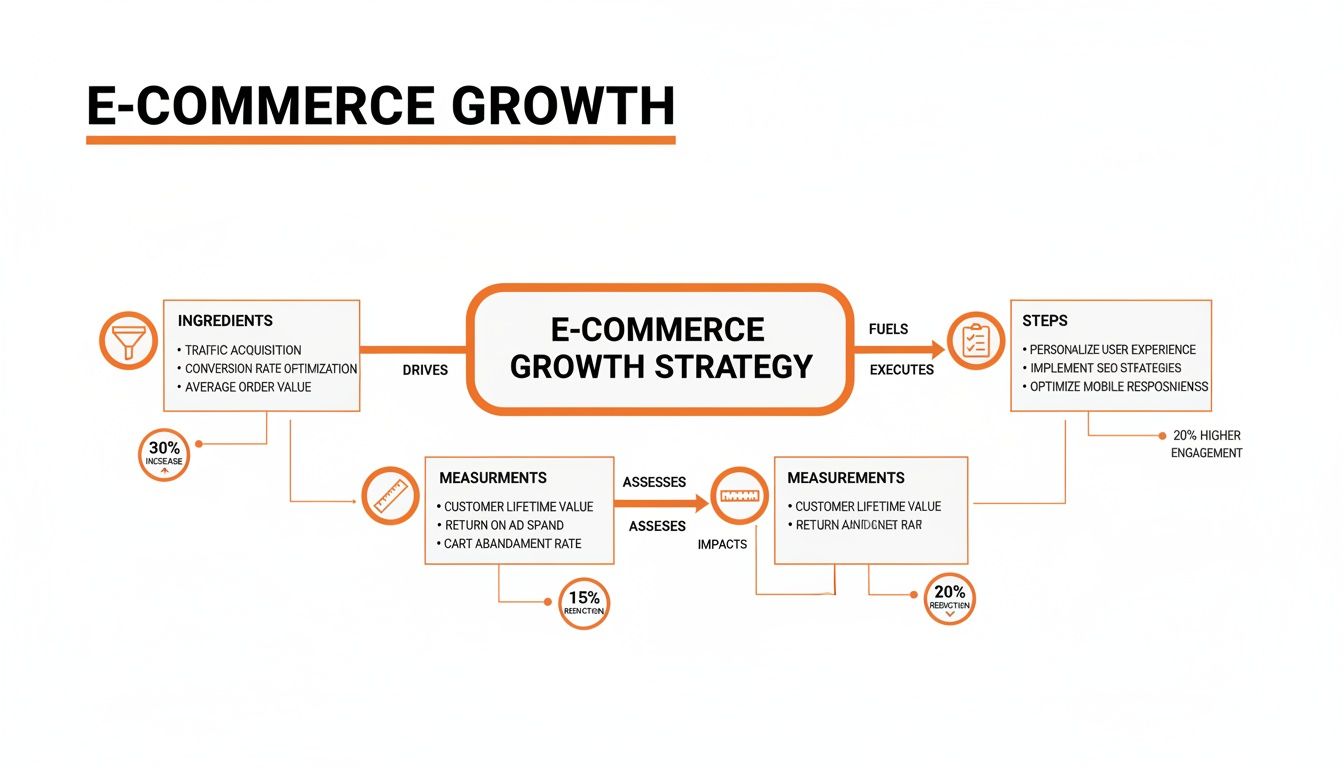
    This visual helps me show how all these pieces—the ingredients, the steps, and the measurements—fit together to build your growth strategy.

    A detailed diagram outlining an e-commerce growth strategy with ingredients, steps, and measurements.

    This map drives home the point that a solid strategy isn't about just one thing. It's about combining the right ingredients (like your funnel), following clear steps, and constantly measuring your results so you can get better.

    Think of the AARRM framework as a diagnostic tool. If your sales are down, you don't just have a "sales problem." You can use it to find the leak. Is your Acquisition weak? Is your Activation experience confusing? Are you failing to Retain customers?

    This framework gives you a clear language and a structured way to think about growth. Instead of feeling swamped by a hundred different marketing ideas, you can ask a simple question: "Which stage of the AARRM funnel is this activity supposed to improve?" It brings focus to your efforts, which is everything when you're just starting out.

    Finding Your First 100 True Fans

    A man writing notes next to a laptop at an outdoor cafe with a text overlay: "100 TRUE FANS."

    Before you even think about scaling to seven figures, you need a rock-solid foundation. Seriously, forget about throwing money at expensive ads and casting a wide net for a minute. Your first real mission is to find your first 100 true fans.

    These are the people who won’t just buy from you once. They'll become your earliest evangelists, your ride-or-dies who tell all their friends about you.

    This isn’t about just getting numbers on a spreadsheet; it’s about surgical precision. You're looking for the right people, not just any people. Think of it like a treasure hunt. You wouldn't just start digging holes all over the place, right? You need a map that points to where the treasure is buried. For us founders, that map is your Ideal Customer Profile (ICP).

    Building Your Ideal Customer Profile

    An ICP is so much more than basic demographics like age and zip code. It gets into the psychology of your perfect customer. It’s about truly understanding their worldview, their struggles, and what really makes them tick. Get this right, and you'll create messaging and products that feel like they were made just for them.

    To really nail your ICP, you have to dig deeper and answer some real questions:

    • Beliefs & Values: What do they fundamentally believe about the world? What causes do they get fired up about?
    • Pains & Problems: What’s the one problem keeping them up at night that your product can actually solve? What are they genuinely frustrated with?
    • Watering Holes: Where do they actually hang out online? Are they buried in specific subreddits, active in niche Facebook groups, or following certain creators on Instagram?
    • Language: How do they talk? What specific words and phrases do they use to describe their problems and what they want? Speaking their language builds trust instantly.

    Your Ideal Customer Profile isn't just some fluffy marketing exercise. It’s the compass for your entire business. It dictates your product roadmap, your brand voice, and, most importantly, where you spend your time and money.

    Once you have a crystal-clear picture of this person, everything else gets a whole lot easier. Instead of trying to be everywhere at once, you can pour all your energy into the one or two channels where your future fans actually live.

    Go Deep, Not Wide

    This is the exact spot where I see so many founders trip up. They get a burst of excitement and try to launch on TikTok, Instagram, Pinterest, and run Google Ads all at the same time. It’s a classic recipe for burnout and blowing through your cash.

    Your first e-commerce growth strategy needs to be about depth, not breadth. Pick one channel and completely own it.

    I worked with a founder here in Chicago who was selling beautiful, high-end, sustainable home goods. She burned through $5,000 on Facebook ads and got almost nothing back. It was painful to watch. She was targeting broad interests like "eco-friendly" and "home decor," which was like trying to find a needle in a continent-sized haystack.

    We went back to the drawing board on her ICP. We figured out her true fan wasn't just casually into green products. They were deeply invested in the "buy it for life" philosophy—artisans and craftspeople who valued quality above all else. And where did these folks hang out? Not scrolling through Facebook. They were in a niche online forum dedicated to durable goods and craftsmanship.

    She pulled the plug on all her ads and spent a month just being a real, helpful member of that forum. She answered questions, shared her own expertise, and only brought up her products when it felt natural. It cost her zero dollars, just her time. That effort landed her the first 50 customers who became the bedrock of her brand. That’s the power of focus.

    This approach is about building real relationships, not just chasing clicks. You're not just another brand yelling into the void; you're becoming a member of their community. This is how you find your first 100 true fans and build a business that can actually last.

    Your 90-Day Growth Experiment Playbook

    A desk with a 90-Day Playbook banner, an open calendar notebook, colorful sticky notes, and other notebooks.

    A strategy is just a dream without action. This is where we get our hands dirty and turn your brilliant ideas into cold, hard data. You’re about to become a scientist in your own business lab, running small experiments to see what truly moves the needle.

    Think of this playbook as a series of short, focused sprints. You’re not committing to a massive, year-long plan that’s doomed to fail. Instead, you're making small, calculated bets, learning quickly, and doubling down on what works. This approach builds a habit of continuous improvement right into the DNA of your brand.

    We'll structure this into three distinct 30-day sprints. Each month has a clear focus, helping you avoid the chaos of trying to do everything at once.

    Month 1: The Activation And Discovery Sprint

    Your first 30 days are all about your core promise. Before you pour money into ads, you need to be absolutely sure your product delivers that "aha!" moment. This sprint is dedicated to testing your value proposition and nailing the initial customer experience.

    Your main goal is to answer one question: "Do people who try my product actually get it and see its value?" You're not chasing huge sales numbers yet. You're hunting for proof that you’ve built something people genuinely want.

    Here are some experiments you can run:

    • The Landing Page A/B Test: Create two versions of your main landing page. One might highlight "Free Shipping," while the other emphasizes "Handcrafted Quality." Drive a small amount of traffic to both and see which headline converts better.
    • The Welcome Email Sequence: Test two different welcome emails for new subscribers. Does an email with your founder story build more trust, or does a straight-up 15% off coupon drive more first-time purchases?
    • The Product Page Video Test: Add a short, simple video to one of your key product pages showing the item in use. Track the conversion rate of that page against a similar product page without a video.

    This first month is your foundation. You’re making sure the first impression is perfect before you invite the whole world to your party.

    Month 2: The Acquisition Channel Sprint

    With some confidence in your core experience, month two is about finding out where your customers are hiding. This is your acquisition channel testing phase. The key here is to run small, budget-controlled tests across a few different channels to see what sticks.

    You're not trying to master Facebook Ads, SEO, and TikTok all in one month. You're just trying to find a signal. Think of it like fishing. You’re casting a few lines in different parts of the lake to see where the fish are biting before you set up camp.

    Your goal isn't to be everywhere. It’s to find the one or two channels that deliver the best customers for the lowest cost, and then go all-in on those.

    For example, you could allocate a small budget to test these channels:

    1. Instagram Influencer Outreach: Identify five micro-influencers whose audience perfectly matches your ICP. Offer them a free product in exchange for a story or post and track the traffic and sales from their unique discount code.
    2. Google Ads for High-Intent Keywords: Run a small campaign targeting very specific keywords like "buy handmade leather journal Chicago." This targets people who are already looking to buy, giving you a quick read on conversion potential.
    3. Niche Community Engagement: Spend time in that subreddit or Facebook group you identified earlier. Actively participate, offer value, and see if you can generate your first few sales organically.

    Track everything. At the end of the month, you should have a clear winner or two—the channels that gave you the most bang for your buck.

    Month 3: The Retention And Optimization Sprint

    You’ve activated new users and acquired some customers. Now what? Month three is all about keeping them. Acquiring a new customer can cost five times more than retaining an existing one, so this sprint is where you start building a truly profitable business.

    The focus here is on improving the post-purchase experience and encouraging that crucial second sale. You'll run experiments designed to increase customer lifetime value (LTV).

    Here’s a sample plan:

    • Test a Post-Purchase Email Flow: Send a follow-up email a week after delivery asking for a review. A few weeks later, send another with a special "thank you" discount on their next order.
    • Experiment with a Simple Loyalty Program: Offer points for every dollar spent that can be redeemed for future discounts. See if this encourages faster repeat purchases compared to customers not in the program.
    • Optimize Your Packaging: Try including a handwritten thank-you note in 50% of your orders and see if those customers leave more positive reviews or have a higher repeat purchase rate.

    To help you visualize this, here’s a sample table outlining what a 90-day sprint could look like in practice.

    90-Day Growth Sprint Example

    Sprint (30 Days) Primary Focus Example Experiment Key Metric To Track
    Days 1-30 Activation A/B test a welcome email series (founder story vs. 15% off coupon) First-time purchase conversion rate
    Days 31-60 Acquisition Run micro-influencer outreach on Instagram vs. a targeted Google Ad campaign Cost Per Acquisition (CPA)
    Days 61-90 Retention Implement a post-purchase email flow to encourage a second purchase Repeat purchase rate

    This 90-day cycle of testing, learning, and optimizing is the engine of any successful e-commerce growth strategy. It turns guessing into knowing. Rinse and repeat.

    Unlocking Growth With B2B Partnerships

    While everyone else is locked in a brutal street fight over the same B2C customers, there’s a massive, often-ignored opportunity waiting for you. I'm talking about Business-to-Business (B2B) partnerships—a powerful way to add a stable, predictable revenue stream to your e-commerce growth strategy.

    Think of it like opening a second front in your growth battle. It's a front your competitors are probably overlooking entirely.

    This isn't about hiring a slick sales team in suits. For a small brand like yours, B2B could be as simple as striking a wholesale deal with a local boutique, setting up a corporate gifting program for tech companies, or supplying your products to other businesses that serve your ideal customer.

    Why B2B Is Your Untapped Goldmine

    You might think B2B is a totally different universe, but it’s more accessible than ever. The B2B e-commerce market is set to explode to an incredible $36 trillion by 2026. That’s a massive pond to fish in. And since 2020, I've seen over 90% of B2B firms shift to virtual sales, making it way easier for small, nimble brands like yours to get in the game. You can check out more stats on this from CraftBerry.co.

    The real magic of B2B is diversification. When a B2C channel like Facebook Ads gets too expensive or an algorithm changes overnight, your B2B revenue acts as a reliable anchor, protecting you from those wild market swings.

    B2B partnerships transform your business from a one-to-one seller into a one-to-many distributor. Instead of finding one customer at a time, you find one partner who brings you hundreds of customers at once.

    Finding Your First Partner Without a Sales Team

    So, where do you start? Forget cold calling. Your first B2B partner is likely already in your orbit.

    Think about your Ideal Customer Profile. Where do they work? What services do they use? Who already has their trust? The answer to these questions is your treasure map.

    Here’s a simple, actionable path to find them:

    1. Map Complementary Businesses: If you sell high-end coffee beans, who else serves a customer that appreciates quality? Think co-working spaces, boutique hotels, or even high-end real estate agencies that give client gifts.
    2. Start with a Warm Introduction: Lean on your existing network. A simple post on LinkedIn saying, "I'm looking to connect with office managers at Chicago tech companies for a new corporate coffee program," can work wonders.
    3. Create an Irresistible "Pilot" Offer: Don’t lead with a complicated wholesale contract. Instead, offer a small, low-risk pilot program. For example, "Let me supply your office with free coffee for one week. If your team loves it, we can discuss a simple monthly subscription."

    A Chicago-based founder I know sells artisanal snack boxes. She landed her first major deal by noticing a new co-working space opening in her neighborhood. She just walked in, introduced herself, and offered to stock their kitchen with free snacks for their grand opening.

    The members loved the products, and the co-working space signed a year-long contract. That one relationship created a stable new revenue stream and gave her incredible brand credibility. Finding the right business partners is a critical skill, and we've put together a guide on how to find business partners that can help you get started.

    What To Do When Your Growth Stalls

    It happens to all of us. Eventually. The exhilarating rocket launch of early growth starts to sputter. Your sales chart, which used to be a beautiful upward climb, goes flat. That initial buzz is replaced by a quiet, gnawing frustration. You've hit the plateau.

    This is the part of the startup journey nobody likes to talk about, but it's probably the most critical. This is the moment that tests your grit and forces you to think like a real strategist. Hitting a wall isn’t a sign you’ve failed; it’s a mandatory rite of passage for every founder.

    My first gut reaction is usually panic. You might be tempted to just throw a bunch of money at new ads or make some drastic, hasty change to your product. Stop. The real work begins with a calm, brutally honest diagnosis. You have to figure out where the engine is smoking before you can even think about fixing it.

    Diagnosing The Real Problem

    When growth slams to a halt, the root cause almost always falls into one of three buckets. Think of your business as a car that’s suddenly stopped running. Are you out of gas? Is the engine busted? Or are you just lost on the wrong road? You’ve got to pop the hood before you call for a tow.

    Here's how I break it down for a gut check:

    • Is It The Product? Have you started getting more returns lately? Seeing more negative reviews pop up? Have your repeat purchase rates dipped? Sometimes a subtle drop in quality or a shift in what your customers actually need can slam the brakes on growth. You have to be mercilessly honest with yourself here.
    • Is It The Channel? Did the cost of your go-to marketing channel—say, Instagram ads—suddenly go through the roof? Did a sneaky algorithm change completely tank your organic reach? A channel that was a goldmine yesterday can be totally tapped out today.
    • Is It The Message? Are your ads getting ignored all of a sudden? Has the conversion rate on your key landing page taken a nosedive? Your messaging might have just gone stale, or a new competitor is out there telling a much better story than you are.

    A growth plateau isn’t a dead end. It’s a fork in the road. It forces you to re-examine every assumption you’ve made and get way smarter about your e-commerce growth strategy. This is where you level up from just a founder into a resilient operator.

    The Power Of A Trusted Peer Group

    After you’ve stared at your spreadsheets until your eyes glaze over, the most powerful next step often isn't found in more data. It’s in a conversation. As founders, it’s so easy to feel like we’re stuck on an island, fighting these battles completely alone. But I promise you, the solution to your plateau is probably sitting in the head of another founder who smashed through the exact same wall six months ago.

    This is why having a trusted peer group isn't a "nice-to-have." It's a non-negotiable part of your survival toolkit. I’m not talking about those awful, transactional networking events where everyone is just trying to sell you something. I mean a small, private circle of fellow operators you can be 100% vulnerable with—people who just get it.

    In our Chicago Brandstarters group, I’ve watched this play out time and time again. A founder will show up to one of our dinners feeling completely stuck, convinced their problem is unique. Then someone else at the table will pipe up, "Oh yeah, that happened to me last year. Here’s exactly what I did." That one simple conversation can save you months of painful, expensive trial and error.

    This is how you build real resilience. You realize you’re not the first person to face this, and you definitely won’t be the last. Finding your people is how you find your way through the fog.

    Your Top E-commerce Growth Questions, Answered

    You’ve got questions, I’ve got answers. No fluff. Here are the most common things I hear from founders trying to nail down their growth strategy. My goal here is to get you unstuck and moving forward.

    How Much Should I Spend On Marketing?

    This is the classic "how long is a piece of string?" question. The textbook answer you'll hear is to set aside 10-20% of your projected revenue for marketing. It's a decent benchmark if you need one.

    But here’s a better way I think about it. Forget a big, scary, fixed budget. Instead, give yourself a small "testing budget" for each channel you want to try in your 90-day sprints. Your goal isn't to hit a spending number; it's to find a channel where you can get customers without losing your shirt.

    Once you find that magic combination, then you can pour more fuel on the fire.

    Which Marketing Channel Is The Best?

    I'll be blunt: there is no "best" channel. There’s only the best channel for your customers. This is exactly why doing the hard work on your Ideal Customer Profile is non-negotiable. Your ICP is the map that tells you where to find your people.

    Don't chase whatever platform is trending on Twitter this week. Go where your ideal customers are already hanging out, having conversations, and looking for solutions. Be a part of their community, not just another advertiser shouting at them.

    If you’re selling high-end kitchenware, your people are probably geeking out on Pinterest or a niche foodie blog. Selling streetwear? You'd be crazy not to be on TikTok and Instagram. Your ICP dictates the channel strategy, never the other way around.

    How Long Does It Take To See Growth?

    Growth is never a straight line up and to the right. It’s messy. Patience is your single biggest competitive advantage, especially when you feel like nothing is working.

    You might get a quick win from an influencer post that goes viral, but real, sustainable growth takes time to build. It’s more like planting a tree than flipping a light switch.

    If you stick to the 90-day experiment playbook, you should start seeing a clear signal—which channels have potential and which are duds—within the first three to six months. But getting to that point where the growth engine feels like it's running on its own? I find that often takes 12-18 months of consistent, focused effort.

    Should I Focus On Acquisition Or Retention?

    When you're just starting out, you don't have a choice. It's acquisition all the way. You have no one to retain! Your only job is to find those first 100 people who truly love what you've built and will actually pay for it.

    But the second you have a handful of customers, you need to become obsessed with retention. Why? The data is brutal: getting a new customer is five times more expensive than keeping an existing one.

    A business you build on one-time buyers is a leaky bucket. You’ll burn all your cash and energy just trying to keep it full. The brands that last are built on the backs of repeat customers who feel like they're part of something special.


    If you're a founder in Chicago tired of figuring this all out alone, Chicago Brandstarters is your community. We’re a group of kind, bold builders sharing real stories and tactics to help each other win. Learn more and see if you’re a fit at https://www.chicagobrandstarters.com.