Tag: founder guide

  • A Practical Roadmap for Business to Turn Your Idea Into Revenue

    A Practical Roadmap for Business to Turn Your Idea Into Revenue

    Got that brilliant idea keeping you up at night? I know the feeling. That’s the spark. But a spark is fleeting. A roadmap for business is what you need to turn that spark into a sustainable fire, guiding your idea from a thought into actual revenue.

    Why Your Great Idea Needs a Real Business Roadmap

    You have an amazing idea. I don't doubt that for a second. But an idea without a clear path forward is just a dream waiting to get lost in the day-to-day chaos.

    Let me be clear: a roadmap for business isn't some rigid, fifty-page corporate document you write once and forget. It’s your personal guide from ‘what if’ to ‘what is.’

    Think of it like planning a cross-country road trip. You wouldn’t just get in the car and start driving west, hoping you end up in California. You'd pick your destination, identify major cities to stop in, and maybe book a few hotels. Your business roadmap does the exact same thing for your entrepreneurial journey.

    Man thoughtfully examining a wall filled with notes and an inspiring 'MAP YOUR IDEA' sign.

    From Sticky Notes to Strategic Action

    My first roadmap was just a collection of sticky notes on my bedroom wall.

    That simple act forced me to get honest with myself about my priorities. It turned my abstract dreams into concrete, actionable steps I could take the next day. This isn't about predicting the future with a crystal ball. It’s about you making intentional choices today that build the future you actually want.

    This clarity is your superpower as a founder. It helps you confidently say 'no' to the shiny objects and distractions that constantly pull for your attention. Instead, you can say 'yes' to the opportunities that truly move your business forward.

    A roadmap doesn't just tell you what to do; it reminds you what not to do. It’s your strategic filter for every decision, ensuring you stay focused on the destination.

    Building Your Foundation First

    Imagine trying to build a skyscraper. You wouldn't just show up with a truck full of bricks and start stacking them, would you? Of course not. You'd start with a blueprint—a plan that outlines the foundation, the structure, and every critical system.

    Your business deserves that same thoughtful planning.

    Your roadmap is that foundational blueprint. It provides the structure you need to support your growth and helps you avoid critical mistakes that can derail an otherwise brilliant idea. Without it, you're just building on shaky ground.

    Defining Your Destination and Ideal Customer

    Before you draw a map, you have to know precisely where you’re going. This isn't just some fluffy goal; it's your 'North Star'—your core mission. What change are you trying to create in the world, and why should anyone care?

    Think of your mission as the destination you’d plug into your GPS before a long trip. Without it, you're just driving aimlessly. This mission statement becomes your gut check for every single decision, helping you navigate the endless choices you'll face. It’s what keeps you grounded when things inevitably get tough.

    From Vague Ideas to a Real Person

    But a mission is meaningless without people to champion it. This is where your roadmap for business gets personal. You need to get laser-focused on your ideal customer. I don’t mean a vague demographic like ‘millennial women.’ That’s like trying to find a friend in a crowded stadium by shouting their first name. It's useless.

    You need to know them intimately.

    • Who are they, really? Go beyond age and gender. What do they do for work? What are their passions and frustrations?
    • Where do they hang out? Are they scrolling Instagram, networking on LinkedIn, or lurking in specific Reddit communities? What podcasts do they listen to?
    • What do they actually value? What beliefs drive their buying decisions? Do they prioritize sustainability, convenience, or status?

    Suddenly, 'millennial women' becomes: 'Jessica, a 32-year-old creative professional in Austin who values sustainable products and follows local artists on Instagram.' Now you have a real person to talk to.

    When you know exactly who you're building for, every decision becomes simpler—from product features to marketing copy. It’s the difference between shouting into a void and having an intimate conversation with a friend.

    Why This Focus Is Your Superpower

    When you’re starting out, you absolutely cannot afford to be everything to everyone. Trying to do so dilutes your message and burns through your limited resources. Pinpointing your 'Jessica' is your most powerful asset.

    This intense focus ensures you're building something a specific group of people will absolutely love, rather than something a lot of people will just kind of like. That’s how you build a real brand.

    This deep customer understanding is the first critical stop on your business roadmap. If you need help refining this crucial step, you might be interested in our guide on how to properly validate your business idea. It's the foundation upon which you'll build every other milestone.

    Alright, you've got your grand vision and you know exactly who you're building this thing for. Now for the hard part: how do you actually get from here to there without crashing?

    The secret is to stop thinking about it as one giant, terrifying leap. A real-deal roadmap for business breaks the journey down into smaller, manageable legs. It’s a series of intentional, sequential steps.

    Think of it like building a house. You don't just start nailing boards together. You have to pour the foundation, then frame the walls, and only then do you get to the roof. Your business grows the exact same way, in phases.

    Phase 1: The Hustle (Months 0-12)

    Your first year is all about one thing: validation. I call this the Hustle Phase. Your goal isn't to build a perfect, polished machine. It’s to prove your core assumptions are right and, most importantly, get that first dollar in the door.

    It’s messy. It’s hands-on. And it’s absolutely critical.

    During this phase, your key milestones should be laser-focused on learning:

    • Get a Minimum Viable Product (MVP) out the door. It doesn't have to be pretty, but it must be real enough for your ideal customer to use.
    • Find your first 10 true fans—these are the people who genuinely get what you're doing and are willing to pay for it.
    • Have brutally honest, unfiltered conversations with potential customers. You need to understand their real-world pain points, not what you think they are.

    This initial timeline visualization shows how your mission and ideal customer become the guiding stars for your growth strategy.
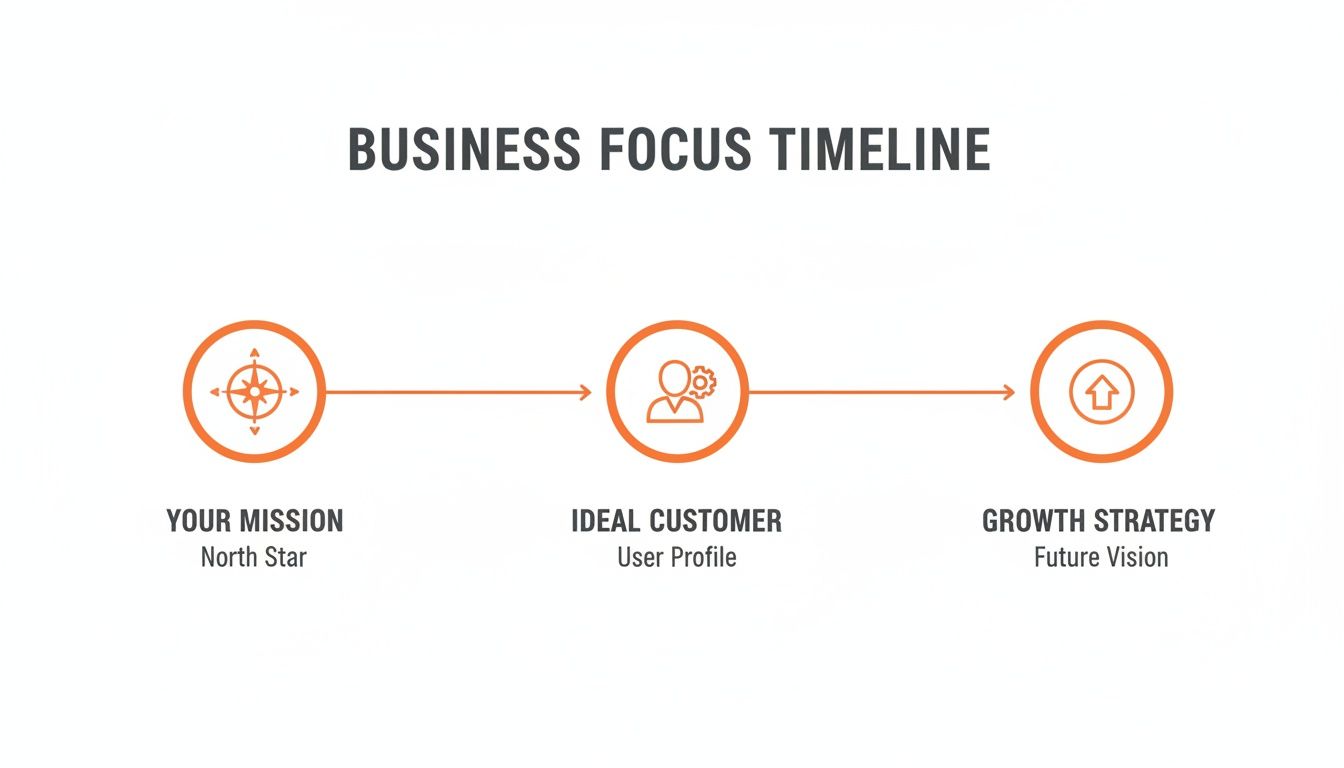
    A business focus timeline graphic with three stages: Your Mission, Ideal Customer, and Growth Strategy.

    These aren't just one-and-done tasks. You'll come back to these foundational pillars again and again as you grow.

    Phase 2: The Foundation (Months 12-24)

    Once you've proven that people want what you're selling, year two is about building systems that can run without you. Welcome to the Foundation Phase. You’re graduating from scrappy tactics to sustainable processes.

    The goal here is to create an engine that doesn't require you to manually crank it every single day. This is less about frantic discovery and more about deliberate, solid construction.

    Maybe this means you dial in your marketing funnel, streamline how you deliver your product, or make that crucial first hire to finally get some tasks off your plate. If you want to dig deeper into this stage, our startup business plan template is a great place to start.

    Phase 3: The Scale (Months 24-36)

    By year three, you should have a solid foundation and a predictable way to make money. Now, it's time to pour fuel on the fire. This is the Scale Phase.

    This is where you start looking at those big growth opportunities that were just distractions before. You're no longer in survival mode; you're actively hunting for ways to multiply your impact and revenue.

    This could mean exploring new customer segments, launching a complementary product, or even expanding into different cities or countries.

    This phased approach turns a massive, intimidating goal into a series of achievable checkpoints. You build momentum and confidence with every milestone you hit, making the journey feel possible.

    This table gives you a high-level look at what to focus on during each phase of your business journey, from that first spark of an idea to really scaling up.

    Your 36-Month Roadmap At A Glance

    Timeframe Primary Focus Key Milestones Example
    0-12 Months Validation & Learning Launch MVP, secure first 10 paying customers, achieve initial product-market fit.
    12-24 Months Systemization & Repeatability Document core processes, hire first key employee, reach consistent monthly revenue.
    24-36+ Months Strategic Growth & Expansion Explore new markets, develop a second product line, build out a leadership team.

    Having a structured roadmap makes a massive difference. Think about it: organizations that use them achieve a 73% faster time-to-insight, turning ideas into actionable strategies way quicker than competitors who just wing it. It's about moving smarter, not just harder.

    Choosing The Metrics That Actually Matter

    It’s way too easy to get hooked on vanity metrics. Seeing your social media likes shoot up or website traffic spike feels incredible, but those numbers don't pay the bills. Your roadmap needs to be anchored in metrics that signal real financial health, not just popularity.

    Think of yourself as the pilot of a small plane. The altitude meter is cool to look at, but the fuel gauge is what tells you if you're actually going to make it to your destination. You need to be obsessed with your "fuel gauge" metrics.

    Identifying Your Core KPIs

    The whole game is about picking a handful of Key Performance Indicators (KPIs) that you live and breathe. These are different for every business, but they always, always tie directly to revenue and sustainable growth. Trying to track twenty different numbers is a recipe for confusion.

    • For an e-commerce brand, you're probably looking at Customer Acquisition Cost (CAC) and Customer Lifetime Value (CLV). Bottom line: are you paying more to get a customer than they'll ever spend with you? If so, you've got a leaky bucket.
    • For a software startup, your lifeblood is likely Monthly Recurring Revenue (MRR) and churn rate. How much predictable cash are you bringing in, and how fast are your customers leaving?
    • For a service business, it could be your profit margin per project and your client retention rate. Are your jobs actually profitable, and do clients stick around for more?

    These aren't just numbers on a spreadsheet; they are the vital signs of your business. They tell you what's working, what's broken, and where to point your limited energy.

    You're not trying to become a data scientist overnight. Your goal is to be an informed founder who makes decisions based on reality, not just wishful thinking.

    From Theory to a Simple Dashboard

    Once you’ve locked in your 2-3 core metrics, track them like a hawk. You don't need some fancy, expensive software for this. A simple spreadsheet is all you need to get going.

    Set up a basic dashboard and commit to logging these numbers every single week. This weekly ritual forces you to confront the truth. It makes it impossible to ignore the red flags. From there, you can set realistic targets for these KPIs right inside your roadmap, giving you clear benchmarks to shoot for.

    I've seen it happen time and again. A kind-hearted 9-5er in Chicago dreams of building a side-hustle empire. They turn that dream into a real plan by anchoring their roadmap with clear KPIs. When they review their progress, they're able to make 28% tactic pivots to stay on track. These simple visual tools help you sequence big moves—like a product launch in Q1 or landing two key partnerships by year-end—and can boost team performance by as much as 35%. You can learn more about mastering this kind of strategic planning to ensure your business actually succeeds.

    Choosing the right metrics is what turns your roadmap from a wish list into a practical, no-BS guide. It keeps you focused on what really matters: building a healthy, profitable business that lasts.

    You've got a million ideas swirling around and a to-do list that looks like a novel. So, what do you actually do next? This is the moment most founders freeze up, paralyzed by choice. You end up doing a lot of stuff, but making very little real progress.

    The problem is usually emotional guesswork. We chase the shiny new idea or the task that feels exciting, not the one that will actually push the business forward. To build a roadmap that works, you need a system to cut through the noise.

    Introducing the RICE Framework

    Let me introduce you to a simple but incredibly powerful framework for this exact problem. It's called the RICE model, and it's a way for you to score your ideas objectively, forcing you to think critically instead of just reacting.

    It stands for:

    • Reach: How many people will this actually touch in a given timeframe?
    • Impact: How much will this move the needle on your main goal (like revenue or sign-ups)?
    • Confidence: How sure are you about your estimates? Be honest with yourself here. A wild guess gets a low score.
    • Effort: How much time and how many resources will this really take from you or your team?

    This isn't about getting lost in math. It's about creating a quick, logical filter. You give each factor a score, run a simple calculation (Reach x Impact x Confidence / Effort), and the ideas with the highest scores bubble up to the top. It pulls your ego and emotions right out of the decision.

    RICE in the Real World

    Let's make this tangible. Imagine you're an e-commerce founder trying to figure out your next quarter's focus. You've got three big ideas on the table:

    1. Launch a Company Blog: This is a ton of work, but it could have a huge long-term reach.
    2. Run Targeted Social Media Ads: Much less effort to get started, with a measurable but maybe smaller reach.
    3. Build a New Product Feature: High impact for your current customers, but it won't reach any new people.

    When you score each of these using RICE, the right choice often becomes surprisingly clear. You might realize that while that new feature sounds sexy, the targeted ads offer a much better return on your effort right now.

    A prioritization framework like RICE doesn’t just tell you what to do. It gives you permission to ignore everything else. That's how you build real momentum instead of just staying busy.

    Think about it: a solo e-commerce founder in the Midwest, feeling crushed by the big-city hustle, finds out that building Strategic Business Roadmaps takes moderate effort but delivers massive organizational alignment. We know that getting executive input can lead to 30% better investment prioritization.

    Unlike those rigid, soul-crushing Gantt charts, these high-level maps are about your vision, not micromanaging every single task. That’s perfect for you in the early stages. For more on this, you can discover more insights about project roadmaps and how they drive success. This is how you stop spinning your wheels and start building a business that actually gets somewhere.

    Finding Your Community So You Don't Build Alone

    Let’s be honest: building a business is an incredibly lonely journey. You're constantly wrestling with problems you’ve never seen before, and it’s so easy to trick yourself into thinking everyone else has it figured out.

    I can promise you, they don’t.

    The single greatest accelerator I’ve ever found as a founder is a trusted circle of peers who just get it. This isn’t about superficial networking events. It's about genuine connection with people who are right there in the trenches with you.

    Smiling colleagues chat over coffee at a white table in a bright, orange-walled office.

    Why Peer Feedback Is Your Secret Weapon

    Your roadmap is a living document, not some sacred text you carve in stone. Getting feedback from people who are a few steps ahead or right alongside you is like having a world-class advisory board on speed dial. They’ll spot the potholes in your plan that you’re too close to see.

    This is exactly why I started a group called Chicago Brandstarters. We wanted an intentional space where you can share war stories over dinner, admit you're stuck, and get brutally honest advice from people who have been there.

    This kind of environment is where your roadmap gets pressure-tested against reality. For a deeper dive, check out our thoughts on why mastermind groups for entrepreneurs are so powerful for actually moving the needle. It's all about turning theory into tangible results.

    The Power of Shared Experience

    You’re going to hit walls. You’ll have moments of crippling self-doubt. In those moments, knowing you’re not the only one fighting this battle makes all the difference.

    Your goal isn’t to find people who will tell you what you want to hear. Your goal is to find people who care enough to tell you what you need to hear, even when it’s tough.

    A strong peer community offers more than just tactical advice. It provides you with:

    • Accountability: They’ll call you out when you’re not hitting the milestones on your own roadmap.
    • Perspective: They’ll remind you that the crisis you’re facing today is just a temporary roadblock, not a dead end.
    • Motivation: Their wins will inspire you, and their struggles will normalize your own.

    Whether it's our community or another one, find your people. Your journey will be faster, less stressful, and far more rewarding because you didn't try to do it all alone.

    Alright, let's clear up a few questions that always pop up when I talk to founders about their roadmap. Getting these sorted out is the last step before you can really dive in and start mapping your own journey.

    How Often Should I Update My Business Roadmap?

    Look, your roadmap isn't some sacred text you carve into stone. It’s a living, breathing guide.

    I tell most founders to sit down with it once a quarter. That’s the sweet spot—long enough for you to see real progress, but short enough for you to pivot if the market throws you a curveball.

    But if you're in the super early days, like pre-product or still chasing that first dollar, you need to check in more often. Monthly is probably best. Things move at lightning speed when you're just getting off the ground, and your map needs to keep up.

    Think of your roadmap as a GPS, not a paper map. It’s built to recalculate when you hit a roadblock. It's not there to make you drive off a cliff just because the original plan said to go straight.

    What's the Difference Between a Business Plan and a Roadmap?

    This one’s easy. Imagine you’re building a house.

    The business plan is the massive, formal architectural blueprint. It’s what you show the bank to get your loan. It’s dense, packed with financial projections, market analysis, and all the stuff that proves you’ve done your homework. It’s mostly static.

    Your business roadmap? That's the high-level construction schedule you tape to the wall for your crew. It’s visual. It shows what’s happening and when—foundation in Q1, framing in Q2, plumbing in Q3. It's an internal tool for you, focused purely on action and built for flexibility.

    Can I Create a Roadmap If I Only Have an Idea?

    Yes! In fact, that's the absolute best time to start. Don't overthink it. Your first roadmap will be beautifully simple, and that’s a good thing.

    Your "0-3 Months" milestone might just be:

    • Talk to 20 people who might be customers.
    • Throw up a simple landing page to see if anyone signs up.

    That's it. This simple act takes your dream out of your head and gives it the first, most important thing it needs: an actionable step forward.


    Building a roadmap alone is tough. At Chicago Brandstarters, you'll find a community of kind, hard-working founders in the trenches with you, ready to pressure-test your plan and cheer you on. Join our free community and start building with support.

  • A Founder’s Framework for Making Decisions That Drive Growth

    A Founder’s Framework for Making Decisions That Drive Growth

    A framework for making decisions is just a simple, repeatable process that guides your choices. It's how you move beyond just a gut feeling.

    Think of it like a recipe. You wouldn't toss expensive ingredients in a bowl and hope for a Michelin-star dish. You'd follow proven steps for a great result, every time. A framework does the same for your business strategy, building it on clarity, not chance.

    Why Your Gut Feeling Isn't Enough

    A productive workspace with a laptop, notebooks, and an alarm clock on a desk overlooking a stormy ocean, with text 'BEYOND GUT FEELING'.

    As a founder, I get hit with a firehose of decisions every day. It’s so easy to just go with your intuition. I mean, your gut got you this far, right?

    The problem is, building a business on gut feelings is like sailing through a hurricane without a compass. It feels decisive in the moment, but it's a fast track to getting lost. The hidden costs of bad calls go beyond money—they burn your time, energy, and momentum. Those are your most precious resources.

    This isn't just a startup problem. One study found that huge Fortune 500 companies lose an incredible $250 million in wages every year from broken decision-making. As a startup, you don't have that cash to burn. You need a better way.

    The Power of a Repeatable Process

    I once worked with a founder about to give up. Her main product line was bombing, and her gut screamed at her to shut it all down.

    Instead of panicking, she took a breath. She used a simple decision-making framework to look at customer feedback, market trends, and production costs.

    This structured approach uncovered something totally unexpected. Her customers were obsessed with one tiny feature of her failing product. So, she didn't quit. She pivoted her entire company around that one feature.

    The result? A 300% jump in pre-orders. That simple process didn't just save her business—it showed her a path to massive growth her intuition completely missed.

    This is exactly why having a repeatable process isn't some "nice-to-have" corporate thing. It's the most powerful tool in your arsenal for building a resilient brand. It gives you the clarity to make big, bold moves with real confidence, turning uncertainty into your biggest advantage.

    Start With a Classic: The SWOT Analysis

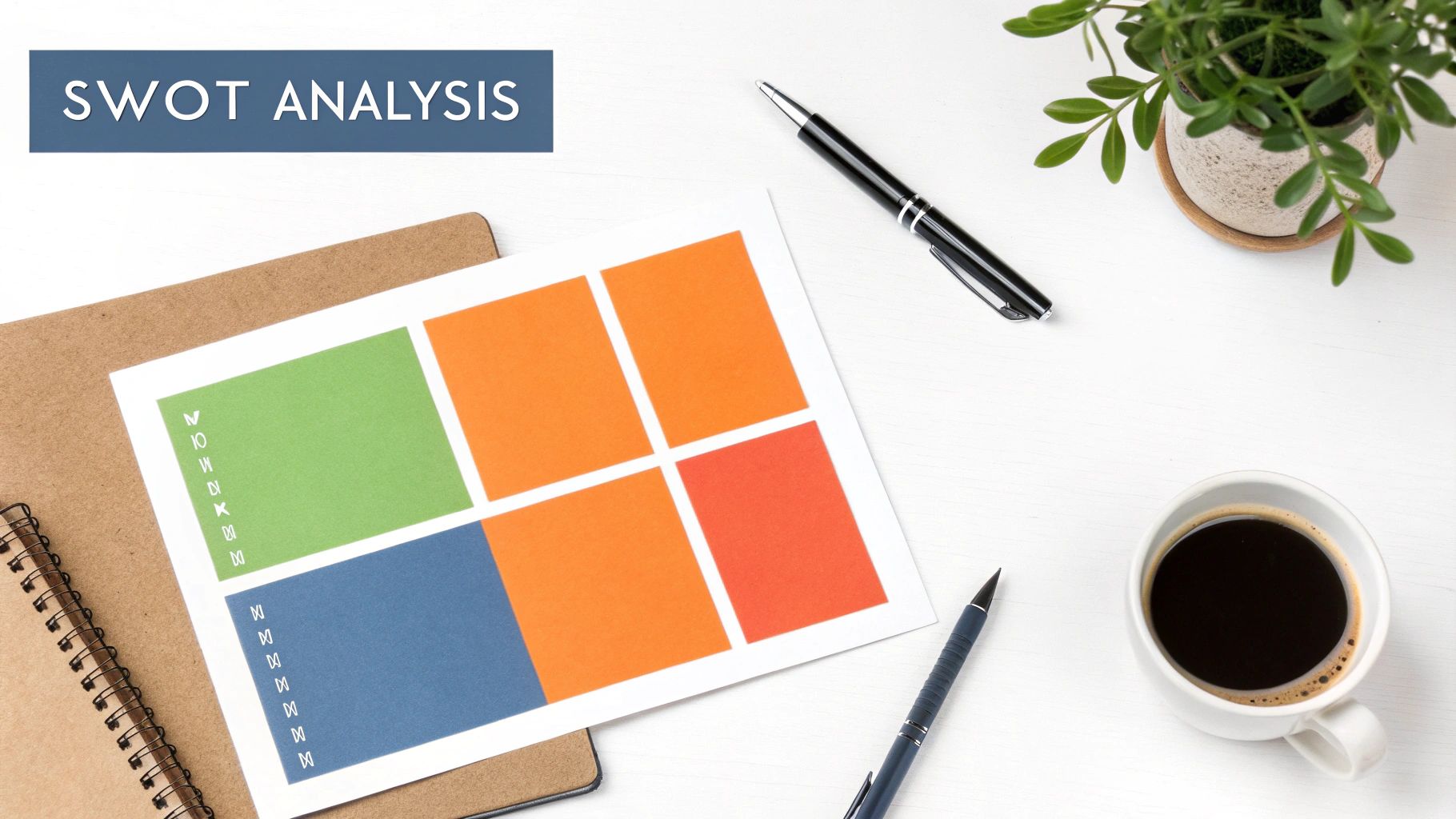
    A top-down view of a SWOT analysis template, pens, coffee, and a plant on a white desk.

    If you're just getting your feet wet with decision-making frameworks, let's start with a classic. The SWOT analysis is still around for a reason: it’s simple, and it works. I use it to map my Strengths, Weaknesses, Opportunities, and Threats.

    Think of it like getting ready for a Chicago winter. Your strengths are your insulated coat and snow tires—internal advantages you already have. Your weaknesses are that drafty old window you keep forgetting to seal; internal things holding you back.

    Opportunities are those rare, sunny winter days perfect for getting things done. Threats are the surprise blizzards that can shut everything down. These last two are external forces—you can prepare for them, but you can’t control them.

    Breaking Down the Four Boxes

    The real magic of a SWOT analysis is how it forces you to separate your thinking into two buckets: internal factors (Strengths and Weaknesses) and external factors (Opportunities and Threats). This gives you a brutally honest snapshot of where you actually stand.

    • Strengths: What do you do better than anyone else? This could be a killer product feature, a deep network in your neighborhood, or a unique skill your team has.
    • Weaknesses: Where are you falling short? Maybe it's a tiny marketing budget, a shaky supply chain, or no brand recognition. Don't be gentle here.
    • Opportunities: What's happening out there that you can jump on? Think new tech, changing customer habits, or a competitor dropping the ball.
    • Threats: What could seriously hurt your business? This is where you list new competitors, rising costs, or a potential economic downturn.

    This simple act of sorting stops you from confusing what you can control with what you can only react to. It’s the first step to building a real strategy instead of just putting out fires.

    By forcing you to look at your venture from these four distinct angles, the SWOT analysis turns a messy cloud of ideas and fears into an organized map. You can’t chart a course until you know your starting point.

    A good SWOT analysis provides clarity. Let’s make this concrete with an example for a local startup here in Chicago. The table below shows how a new apparel brand might fill this out.

    SWOT Analysis Template for a Chicago Startup

    Category Guiding Question Example (For a Local Apparel Brand)
    Strengths What internal advantages do we have over others? Our designs are created by a well-known local artist, giving us an authentic Chicago connection.
    Weaknesses What internal factors are holding us back? We have limited production capacity and rely on a single local manufacturer.
    Opportunities What external trends or events can we exploit? There's a growing "shop local" movement and several upcoming neighborhood festivals.
    Threats What external factors could jeopardize our business? Fast-fashion giants can produce similar styles for a fraction of the cost.

    See how that works? The framework instantly reveals a path. The brand's strength (local artist) directly taps into an opportunity (the "shop local" movement). It also highlights a critical threat (fast fashion) that their weakness (limited production) makes them vulnerable to. Right away, you can see they need to double down on their local story and perhaps find a backup manufacturer. That's a strategy.

    Upgrade Your Decisions with Data

    A laptop on a wooden desk displays various colorful business performance charts and graphs.

    Alright, you've mapped your landscape with a SWOT analysis. Now it's time to add a critical layer to your framework for making decisions: data.

    This isn't about becoming a spreadsheet guru. It's about listening to the story your customers and the market are telling you through numbers.

    So many founders I know have access to powerful tools like Google Analytics or Shopify reports but get overwhelmed. The sheer volume of numbers feels like staring into a blizzard. But here’s the secret: you don’t need to track everything.

    You just need to identify the three to five Key Performance Indicators (KPIs) that truly matter for your business right now. Think of yourself as a ship captain again. Data is your weather forecast, sea charts, and crew reports all in one. It doesn’t replace your judgment, but it gives you the clarity to make confident moves.

    Identifying Your North Star Metrics

    Your KPIs are your business's vital signs. They tell you if you're healthy, growing, or heading for trouble.

    For an early-stage founder, these metrics often revolve around validating your idea and finding your first customers. You can learn more about how to validate a business idea, which is a critical first step.

    Here are a few examples of KPIs that might matter to you:

    • Customer Acquisition Cost (CAC): How much does it cost you in marketing and sales to get one new customer?
    • Customer Lifetime Value (LTV): How much total revenue can you expect from a single customer?
    • Conversion Rate: What percentage of website or store visitors actually make a purchase?
    • Monthly Recurring Revenue (MRR): If you're a subscription business, this is your lifeblood.

    Choosing the right KPIs is about focus. Picking too many is like trying to listen to five radio stations at once—you just get noise. Start by asking, "What are the one or two numbers that, if they moved, would fundamentally change my business?"

    Don't Just Collect Data; Use It

    It's shocking how many companies collect data they never use. One global survey revealed a staggering gap: while 79% of organizations have defined KPIs, only 36% actually use them consistently to drive decisions.

    The study also found that highly data-driven companies are three times more likely to report significant improvements in their decision-making. That's a powerful insight. It means your advantage isn't just in gathering numbers, but in building the habit of acting on them.

    The goal isn’t to drown in data. It’s to find the essential signals that tell you whether you’re on the right track or need to change course.

    I suggest you set up a simple dashboard—it can even be a basic spreadsheet. Review your key metrics weekly. This consistent rhythm turns abstract numbers into a clear, actionable story about your business, empowering every choice you make.

    Making Tough Calls When the Future is a Total Blur

    So far, we’ve looked at frameworks that help you make sense of what you already know. But what about when the data is murky and the future feels like a shot in the dark? This is the exact moment I see most founders freeze up.

    You don't have to get stuck. When you’re staring into the fog of uncertainty, the goal isn't to magically predict the one "right" future. Your smartest move is to have a framework that gets you ready for multiple futures.

    Think of it like building a choose-your-own-adventure story for your company. You map out a few ways things could go, decide what you’d do in each chapter, and then figure out the signs that tell you which story you’re actually in. This turns gut-wrenching anxiety into focused action.

    A Four-Step Playbook for Navigating the Unknown

    This approach is about building strategic flexibility. Instead of betting the farm on a single outcome, you build a main plan with a few backup plans in your back pocket.

    Here's a simple, four-step process you can use for your next big, uncertain decision:

    1. Diagnose Your Uncertainty: First, get painfully honest about what you don't know. Is it a simple unknown with limited outcomes, or true ambiguity where you can't even list all the possibilities? Big difference.
    2. Brainstorm Scenarios: Based on that uncertainty, dream up two or three believable future scenarios. For example, a best-case (hockey-stick growth), a worst-case (the market tanks), and a weird-case (a surprise competitor pops up).
    3. Develop Your Plans: Now, build your primary plan for the most likely scenario. Then, create smaller "pivot" plans for the others. What moves would you make if the worst-case happens?
    4. Set Your Tripwires: This is the most important step. A tripwire is a specific, measurable event that screams, "It's time to switch plans!" It’s a trigger you decide on before things get chaotic, so you pull emotion out of the equation. For example: "If our customer acquisition cost jumps by 50% for two straight months, we immediately activate Plan B."

    This process gives you a clear playbook, no matter how the story unfolds. You’ve already done the hard thinking when you were calm and rational.

    By preparing for multiple outcomes, you're no longer a victim of the future—you're an active player, ready to adapt. Your decision stops being "what do I do?" and becomes "which pre-built plan do I execute now?"

    Experts have pointed out that leaders often get uncertainty wrong. They look for data that confirms what they believe instead of exploring other possibilities. A classic case study looked at three hospital ICUs with the same average infection rate. But when they dug in, the distribution of those infections was wildly different, revealing huge risks the average number hid. If you want to go deeper, you can explore more about how leaders can better handle uncertainty with a structured approach.

    Using this four-step framework helps you sidestep the trap of just going with your gut or relying on simple averages. You end up building a more resilient business—one that can thrive not just in spite of uncertainty, but because of it.

    Putting Your Framework into Practice

    All this theory is great, but let's get our hands dirty. A framework for making decisions is worthless if you don't use it. I'm going to walk you through how to apply these models to three real-world scenarios you will absolutely face as a founder.

    We'll kick things off with a product decision, then tackle hiring, and finally size up a potential partnership. This is where we make abstract concepts immediately useful for your business.

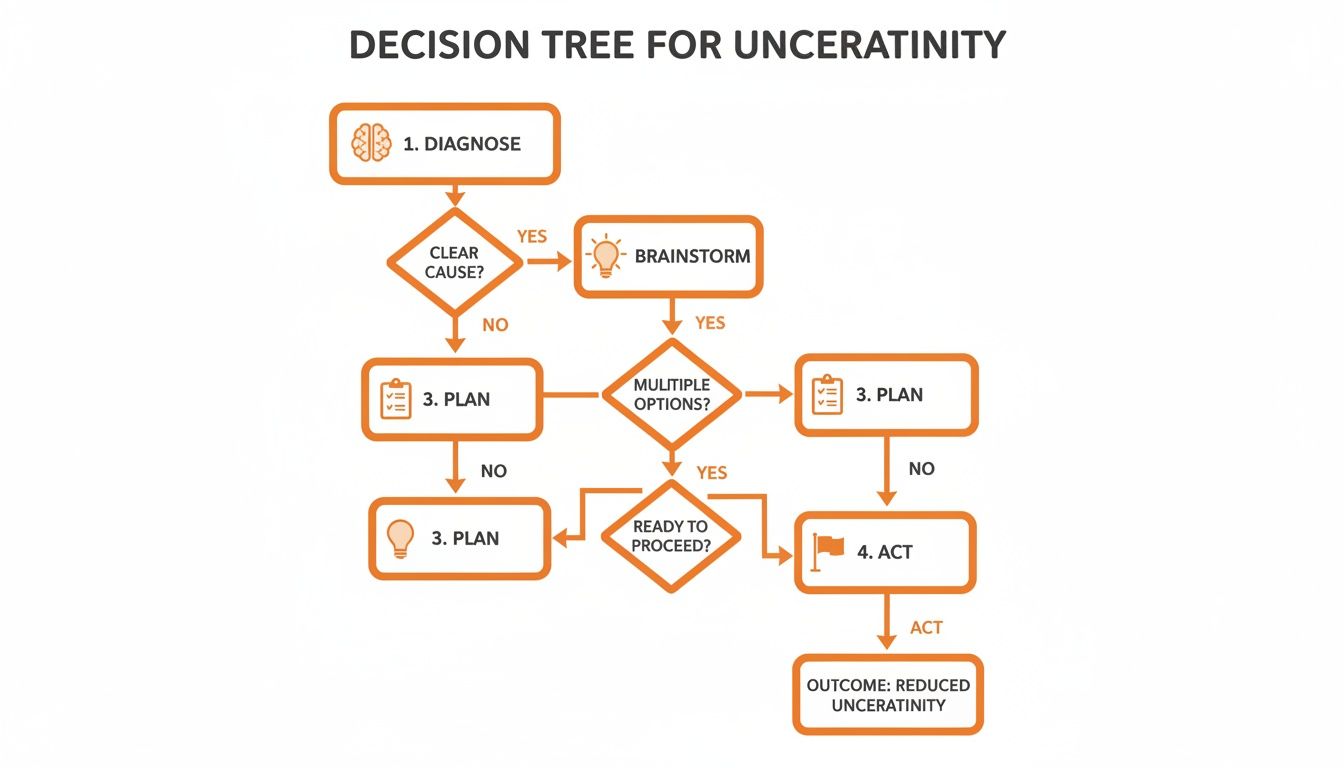
    When you're staring down uncertainty, this simple decision tree can guide your thinking. It breaks the process down into four clear steps: Diagnose, Brainstorm, Plan, and Act.

    Flowchart outlining a decision-making process for uncertainty, including diagnose, brainstorm, plan, and act.

    This visual is a crucial reminder: you can't just jump straight to a solution. You have to move deliberately from understanding the problem to taking action.

    Scenario 1: The Product Feature Debate

    Imagine you run a small e-commerce brand that sells custom notebooks. You have two potential features to build next: an online monogramming tool or a subscription box. Your resources are tight, so you can only pick one.

    In a spot like this, a decision matrix is your best friend. It’s a simple grid that helps you score your options against what actually matters to your business.

    Decision Matrix Example: New Product Feature

    Criteria (Scored 1-5) Monogram Tool Subscription Box
    Customer Demand 4 3
    Revenue Potential 2 5
    Technical Difficulty (Low=5) 5 2
    Brand Alignment 4 4
    Total Score 15 14

    Looking at the scores, the monogram tool squeaks out a win. Sure, its direct revenue potential might be lower, but it’s a heck of a lot easier to build and it’s something customers are already asking for. It’s the lower-risk, faster path to adding real value.

    Scenario 2: The First Hire Dilemma

    Your business is growing, and you’ve accepted you can’t do it all yourself anymore. You need help, but what kind of help? Do you hire a full-time employee or bring on a contractor?

    This decision has massive ripple effects on your cash flow, culture, and legal paperwork. Hiring your first employee is a huge step, especially when you're starting out. It's a common hurdle; I know many founders wonder how to get their business off the ground, which is why we put together a guide on how to start a business with no money.

    Let’s use a simple pros-and-cons list to get some clarity.

    • Full-Time Employee:
      • Pros: Deeper commitment and integration into your company culture. They can take on more tasks as needs pop up.
      • Cons: Way more expensive (salary, benefits, taxes), adds management overhead, and it's much harder to undo if it's a bad fit.
    • Contractor:
      • Pros: Lower financial commitment upfront. You get specialized skills for a specific project, and it’s a more flexible arrangement.
      • Cons: They're less integrated, might be juggling other clients, and their knowledge walks out the door when the contract ends.

    The right choice here depends entirely on your most painful need. If you need a specific skill for a short-term project (like a website redesign), a contractor is perfect. If you need someone to grow with the company and wear multiple hats, an employee is the better long-term investment.

    Scenario 3: The Partnership Opportunity

    A popular local coffee shop approaches you about a collaboration. They want to sell your notebooks in their stores and co-host a community event. It sounds exciting, but is it the right move?

    Before you jump in, dust off your SWOT analysis skills. Let's look at this purely through the lens of Opportunities and Threats.

    1. Opportunity: Does this partnership give you access to a new audience you couldn't reach on your own? Does their brand reputation elevate yours?
    2. Threat: Is there a risk of brand misalignment? What if the partnership flops—could it damage your reputation? What are the real resource costs (your time, your money) to make this happen?

    By walking through these questions, you move from an emotional "yes!" to a strategic one. You can see the real benefits clearly while also creating a plan to handle the downsides.

    Your Go-To Decision Making Checklist

    Okay, you’ve seen the theory. Now it’s time to build the habit. A killer decision-making framework is useless if you don't use it until it's second nature.

    Think of this checklist like a pilot's pre-flight routine. You run through it every time, especially when the pressure is on. It’s a simple, repeatable process that stops you from skipping a crucial step when you’re moving fast.

    The Founder's Go-To Checklist

    1. Define the Real Problem: What question are you actually trying to answer? Get specific. Write it down in one clean sentence.

    2. Gather the Right Intel: Take inventory. What data do you have versus what data do you need? Pinpoint your key metrics and call out any huge knowledge gaps.

    3. Evaluate Your Options: You need at least three viable paths. Don't forget, doing nothing is always an option. Score each one against your core business values.

    4. Pressure-Test Your Choice: Time to play devil’s advocate. What are the biggest risks with your top choice? Seriously, what's the most likely way this could blow up in your face?

    The point isn't to get rid of all risk—that's impossible. It's about making sure you're taking the right risks. A simple process like this turns your blind spots into calculated bets on your company's future.

    1. Commit and Communicate: Make the call. Then, make sure every single person on your team understands the "why" behind it. Getting your team on board is everything.

    2. Review and Learn: Put a date on the calendar to circle back and review the outcome. Did it work? What did you learn? This last step turns one good decision into a compounding advantage over time.

    This checklist is meant to be a living tool. If you're looking to get deeper into structuring your overall strategy, our guide on building a startup business plan template is a great resource for formalizing your long-term goals.

    Common Questions and Sticking Points

    Founders I work with often run into the same questions when they start using a more structured way to make decisions. Here are some of the most common ones, with my straight-up advice.

    What If My Data Is Conflicting?

    This happens all the time. Your customer surveys say people want Feature A, but your analytics show they only use Feature B. It can feel like you're getting pulled in different directions.

    Don't let it paralyze you. Conflicting data isn't a stop sign; it's a signal to dig deeper. Is the survey data from your ideal customers, while your sales data is a mix of everyone?

    This is where your gut as a founder comes back in. A framework for making decisions isn't supposed to spit out the answer for you. It's about giving your intuition better, cleaner information to work with. Pick the data source that points most directly at your strategic goals, make the call, and accept it as a calculated risk.

    How Do I Get My Team on Board?

    You can design the most brilliant decision-making process, but it's useless if your team isn't bought in. Dropping a new spreadsheet on them and expecting cheers won't happen.

    You get them on board by bringing them in from the beginning. It's been shown over and over that when you involve your team, you don't just get better ideas—you build a team that actually cares. People always support what they help create.

    Walk them through the framework on a small, low-stakes decision first. Show them how it leads to a clearer outcome. When they see it works and feel their input is valued, they'll become champions for the process, not roadblocks.

    At the end of the day, your team needs to see that this new way of doing things makes their jobs easier and the company stronger. A shared sense of purpose is a powerful thing.

    What If I Make the Wrong Decision?

    Let’s get one thing straight: you will. It’s not a question of if, but when. The best founders I know don’t make fewer mistakes; they just get incredibly good at catching and correcting them fast.

    A bad decision is only a true failure if you learn nothing from it. When you've used a framework, you have a paper trail—a clear record of your assumptions, the data you looked at, and the logic you followed. This makes it so much easier to go back, see exactly where you zigged when you should have zagged, and fix your approach for next time. This is how you turn a mistake into one of your most valuable business assets.


    At Chicago Brandstarters, we believe that building a great company starts with making great decisions, together. If you're a kind, hard-working founder in Chicago looking for a community that shares honest war stories and real support, not just transactional networking, let’s connect. Learn more about joining our free community at https://www.chicagobrandstarters.com.

  • A Startup Business Plan Template for Founders Who Get Things Done

    A Startup Business Plan Template for Founders Who Get Things Done

    I've seen countless startup business plan templates. They're all useless without one thing: the right mindset. Most founders treat a business plan like homework—a boring document to please investors.

    That's a huge mistake.

    Why Your Business Plan Is More Than Just a Document

    Think of your business plan as your startup's operating system. It’s the blueprint that turns an idea into a real company. This planning process is your first competitive advantage.

    A man outlines a strategic blueprint on a whiteboard in an office with a laptop and notepad.

    Imagine you're building a custom race car. You wouldn't just start welding pieces together, would you? Of course not. You’d start with a schematic—a blueprint showing how every part works together to hit top speed.

    Your startup business plan is that schematic. It’s where you engineer success before you write a line of code or place your first order.

    A Framework for Clarity and Confidence

    Writing a business plan forces you to confront the tough questions. It’s an exercise in structured thinking that brings incredible clarity. Vague ideas become concrete strategies.

    This blueprint helps you:

    • Uncover Blind Spots: Spot weaknesses in your model or cash flow problems before they become expensive disasters.
    • Align Your Team: Ensure everyone—from your co-founder to your first hire—is rowing in the same direction.
    • Make Confident Decisions: A clear plan simplifies daily choices. You can weigh opportunities against your core goals and stay focused.

    A business plan is your business's story—where it is, where it’s going, and how you'll get there. It’s less about predicting the future and more about creating it on purpose.

    Turning Hope into a Tangible Game Plan

    Hope is not a strategy. A great idea is a starting point, but the path from idea to impact is paved with deliberate planning. The data is clear.

    Entrepreneurs who write a formal business plan are 152% more likely to launch their companies. Better yet, businesses with plans grow 30% faster than their competition. This isn't just theory. Nearly 7 out of 10 VCs won't invest in a startup without a plan. Those that have one secure 133% more investment capital. You can explore more business plan statistics and see for yourself.

    At the end of the day, this document is for you. It’s your guide, your reality check, and your roadmap for building something that lasts. It turns your vision into an actionable game plan.

    Crafting Your One-Page Executive Summary

    Before anyone reads your full business plan, they read this. The executive summary is your startup's first handshake. Think of it as your movie trailer. Get it right, and doors open. Get it wrong, and the conversation is over.

    Overhead shot of a wooden desk with a notebook, pen, coffee, plant, and 'Executive Summary' banner.

    Picture this: an investor gets dozens of pitches a week. They don't have time to wade through a 30-page document. Your summary is their filter. In just a few hundred words, you must convince them your idea is worth their most valuable asset—their attention.

    This single page is a test. It proves you can distill complexity into a clear, compelling story. It shows you know what matters. Pro tip: write it last, after you’ve wrestled with every other section.

    The Anatomy of a Winning Summary

    Your goal isn't just to list facts. It's to tell a story that makes your startup feel inevitable. A great one-pager from your startup business plan template must hit four key points with absolute conviction.

    Here’s the breakdown:

    • The Problem: Paint a vivid picture of a real, painful problem. Who is struggling? Why do current options fall short? Make the reader feel the urgency.
    • Your Solution: Introduce your company as the hero. How do you uniquely solve this problem? Ditch the jargon and focus on the "magic" of what you do.
    • The Market Opportunity: Zoom out. Show them how big this problem really is. Prove there's a significant market ready for what you've built.
    • The Vision and Ask: End with a glimpse of the future. Touch on your business model, traction, team, and what you need to hit the next milestone. State your "ask" with confidence.

    Your one-page summary is the heart of your plan. It’s not about cramming in every detail; it’s about connecting the most important dots into a picture of inevitable success.

    Putting It Into Practice: A SaaS Example

    Let's make this real. Imagine a Chicago SaaS startup called "ConnectLocal" that helps small retail shops compete with e-commerce giants. Their plan is solid, but it all hinges on this summary.

    Here’s how they could lay it out:

    ConnectLocal Executive Summary

    Section Content Snippet
    The Problem Main Street retailers lose $200 billion annually to e-commerce. They lack the tools to offer the personalized, on-demand service modern customers expect, leaving them unable to compete.
    Our Solution ConnectLocal is a simple mobile platform giving independent shops big-box power. Our app lets them manage inventory, offer same-day local delivery, and run text campaigns—all from one dashboard.
    Market Opportunity The target market includes over 300,000 independent retailers in the Midwest, a $1.2 billion addressable market for our software. We're initially focused on the 15,000 shops in the Chicago metro area.
    Traction & Team We have 50 shops on our waitlist and a successful pilot with 5 boutiques, driving a 15% average sales increase. Our team is led by a former Shopify product manager and a logistics expert.
    Financials & Ask We project $1M in annual recurring revenue within 24 months. We are raising a $500,000 pre-seed round to expand our sales team and onboard our first 500 customers.

    This example works. It's specific, data-packed, and tells a complete story. It flows from a massive problem to a clear solution, a defined market, and a tangible ask. This is the kind of summary that gets you a meeting.

    Defining the Problem You Uniquely Solve

    Every great startup begins with a painful problem, not a cool product. Get this right, and your business plan falls into place. Your goal is to define the problem with such clarity that anyone who reads it instantly gets it.

    Think of yourself as a doctor. Your patient doesn’t care about your fancy medical device; they just want a diagnosis. They need to feel you understand their pain completely before they trust your cure. Your plan must diagnose a market pain point with that same precision.

    You want the reader nodding, thinking, "Yep, I know exactly what that feels like."

    Stop Building Solutions in a Vacuum

    The biggest mistake founders make is falling in love with their solution before confirming anyone has the problem. You might build the world’s most elegant key, but if it doesn't fit a single lock, it’s worthless.

    This is where you shift from assuming to gathering evidence. Get out of your head and talk to real people. This process, customer discovery, is non-negotiable. It’s the difference between building something people will pay for and building a hobby.

    Your mission is to validate that the problem is real, urgent, and widespread enough to build a business around. Before you sketch your product, you need answers:

    • Who is your customer? Get specific. "Small businesses" isn't an answer. "Independent coffee shop owners in Chicago struggling with unpredictable foot traffic" is.
    • What are they trying to do? What outcome are they trying to reach?
    • How do they solve this now? Map their current workarounds. Clunky spreadsheets? Duct-taped tools? This is your real competition.
    • What does this problem cost them? Put a number on the pain. Wasted time? Lost revenue? A problem that costs someone $10,000 a year is one they'll gladly pay to solve.

    Your solution doesn't have to be perfect on day one, but your understanding of the problem absolutely does. The deeper you dig here, the more you de-risk your entire venture.

    This initial research is everything. For practical advice, see our guide on how to validate a business idea before you commit serious time and money.

    Frame Your Solution as the Perfect Key

    Once you've defined the problem with clarity, introduce your solution. This isn't about listing features. It's about showing how your solution makes your customer's life better.

    Your solution should be the perfect key for the specific lock you just described. It’s not a Swiss Army knife; it's a specialized tool that does one thing incredibly well. This focused story is your value proposition.

    Let’s use a Chicago example.

    The Problem: Local breweries in neighborhoods like Logan Square waste hours manually tracking keg inventory in messy spreadsheets. This leads to lost kegs (costing over $100 each) and missed sales when they can't restock fast enough.

    The Solution: We're building "KegFlow," a simple QR-code app that lets brewers track every keg. With a quick scan, they know where their assets are, get alerts for returns, and can forecast demand. This saves them an average of 10 hours a week and cuts keg loss by 90%.

    See the difference? The solution isn't just "an inventory app." It's the direct, powerful answer to the painful problem you just laid out. This problem-solution fit is the foundation of a compelling startup business plan template.

    Mapping Your Market and Proving Traction

    A brilliant solution is useless without a hungry market. Too many founders build something incredible, only to realize nobody was waiting to buy it. This section proves your idea isn't just clever, but necessary.

    Think of yourself as a chef. You can craft the most exquisite dish, but if you open your restaurant in a town where everyone is allergic to your main ingredient, you're going out of business. This section is you confirming that the town is starving for what you're cooking.

    First, map out the size of your opportunity. Show investors you're not just chasing a niche hobby but a massive market.

    Demystifying Your Market Size

    You’ll hear investors use acronyms like TAM, SAM, and SOM. It sounds like jargon, but it's just a simple way to zoom in on your real customer base.

    Let’s use an analogy. Imagine you're launching a new cold brew in Chicago:

    • Total Addressable Market (TAM): This is the biggest pie. It's the entire global coffee market. It’s a huge number, but you're not going to capture all of it.
    • Serviceable Available Market (SAM): Now we're zooming in. This is the slice of the market you could realistically serve—perhaps all coffee drinkers in the Chicago metro area.
    • Serviceable Obtainable Market (SOM): This is your real-world target for the next few years. It’s the piece of the Chicago market you can realistically win with your current team and resources. This is the number that truly matters.

    Your goal isn't to present the biggest number, but the most believable one. A well-researched SOM shows you’re a realist with a concrete plan, not just a dreamer.

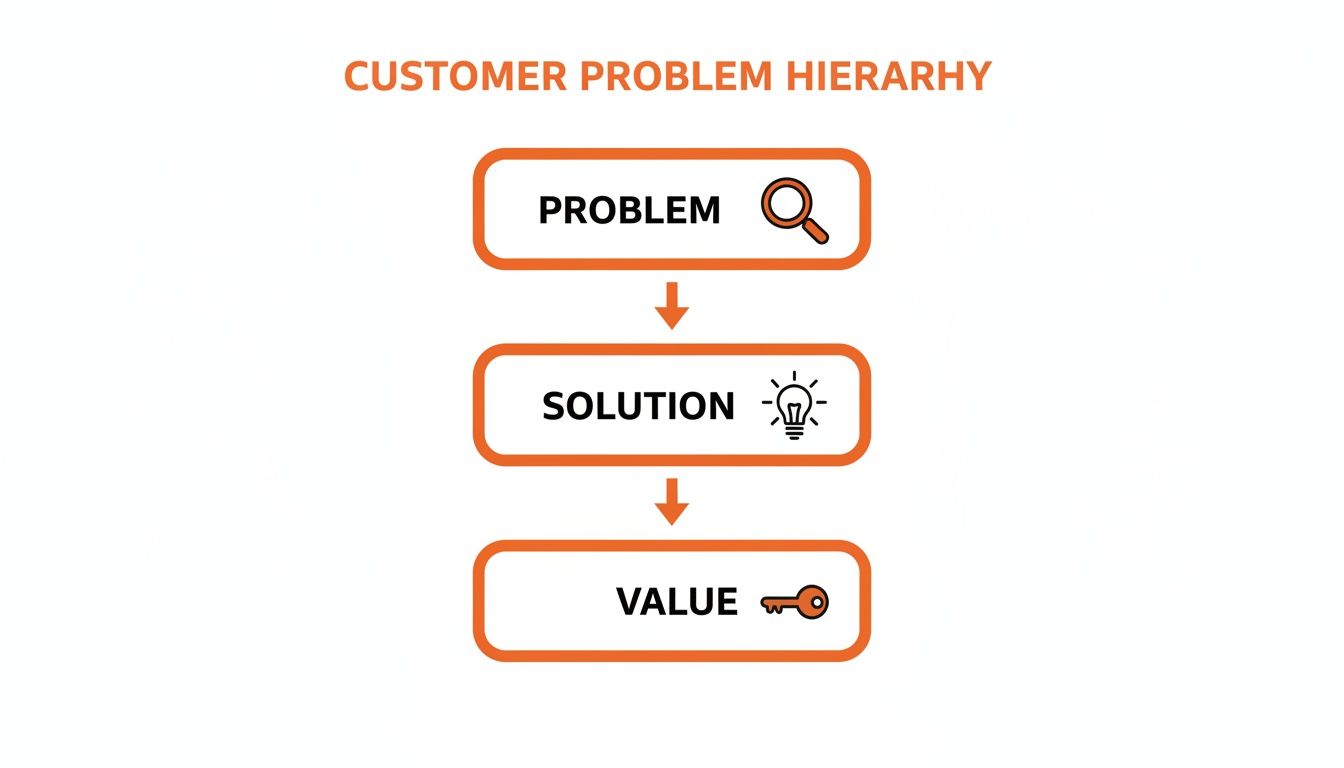
    This diagram shows how a deep understanding of the customer problem is the real starting point.

    A diagram illustrating the Customer Problem Hierarchy, showing the flow from Problem to Solution to Value.

    It all flows from the problem. Nail that, and you can create a solution that delivers real value.

    Proving You Have Traction

    Market size is theory. Traction is proof. It's the most powerful thing you can have in your business plan because it turns your story from "this could work" to "this is working."

    Traction is early evidence that people want what you’re building.

    For early startups, traction isn't always revenue. Investors look for signals of momentum—proof you're making real progress. If you need help getting those first sales, our guide on how to start a product business is a great place to start.

    Traction is the story of your progress told through data. It's tangible evidence that you're building something with momentum in the real world.

    So what counts as traction? Here are powerful examples:

    • A Growing Waitlist: Showing that 500 people have signed up to be notified when you launch is huge. It demonstrates real demand.
    • Successful Pilot Programs: Ran a test with a small group? Share the results. "Our 10 pilot users reported a 40% reduction in time spent on weekly inventory." Numbers talk.
    • Letters of Intent (LOIs): Have potential customers signed non-binding agreements saying they intend to purchase your product? An LOI from a known company is gold.
    • Key Strategic Partnerships: Landing a partnership with an established player in your industry is a massive validator.
    • Positive User Feedback: Glowing quotes from your first users provide social proof. They tell a human story that makes the opportunity feel real.

    Your job is to connect the dots. Start with the big-picture market, then bring it down to earth with tangible signs of progress that prove you're the right team to win.

    7. Showcasing Your Team and Financials

    Investors bet on people, not just ideas. I’ve seen brilliant concepts fail under a weak team and scrappy founders pivot a mediocre idea into a massive success. This section is where you prove you have the right crew to win.

    Think of your team as seasoned sailors and your idea as the ship. Investors know that even the best ship will sink in a storm without a capable crew. They're looking for proof that your team has the skills, grit, and insight to handle whatever comes.

    This is your chance to go beyond resumes.

    More Than Just Resumes

    Forget just listing job titles. Tell the story of why this specific group is uniquely qualified to solve this problem. What’s your origin story? What led you to this mission?

    A great team section connects the dots, showing a clear line between each founder's background and the company's future success.

    • Highlight Complementary Skills: Show how your team covers the critical bases. Maybe one founder is a product genius, while the other is a marketing pro. That's the balance investors love.
    • Demonstrate Industry Experience: Have you lived the problem you're solving? If you’re building a tool for restaurant owners and a co-founder managed a busy Chicago restaurant for a decade, that’s a massive advantage. Mention it.
    • Showcase Grit: Early-stage startups are a grind. Share a brief story of how your team overcame a tough obstacle. This proves your resilience.

    For solo founders, this section is just as crucial. Highlight your advisory board, mentors, or early hires who fill your knowledge gaps. If you're still looking, our guide on how to find a co-founder has practical steps for finding the right partner.

    Your team slide isn't just about who you are. It’s about why you—and only you—are the team that will make this venture succeed. It’s a statement of capability and shared purpose.

    Your Financial Sketch Not a Full-Blown Audit

    Let's talk financials. Many founders get spooked here, picturing complex spreadsheets. Relax. At this early stage, nobody expects a perfect five-year forecast.

    The real goal is to provide a clear, honest financial sketch.

    Think of it this way: you're not creating detailed architectural plans for a skyscraper. You're making a simple floor plan that shows the basic layout and how the rooms connect. It proves you've thought through how your business will make and spend money.

    Your financial sketch in the startup business plan template should clearly outline three core things.

    1. Your Business Model: In one sentence, how will you make money? A monthly subscription (SaaS)? A one-time product sale (e-commerce)? Be direct.
    2. Key Revenue Streams and Major Costs: What are your top 1-3 ways to generate income? On the flip side, what are your 3-5 biggest expenses? Usually, this includes salaries, marketing, and software.
    3. Your Use of Funds: If you're raising money, be explicit about how you'll use it. Break down your ask (e.g., "$500k") into key buckets like "40% for two engineers, 30% for marketing, and 30% for inventory."

    This simple sketch gives investors confidence. It shows you understand the economic engine of your business and that you'll be a responsible steward of their capital. It's about demonstrating thoughtfulness, not predicting the future perfectly.

    Pitching Your Plan and Building Momentum

    Think of your business plan as a living document, not a final exam. It's a conversation starter—a key you’ve forged to open important doors. Once you’ve nailed it down, the real work begins: turning that plan into powerful conversations.

    This is especially true in the Midwest. Investors in hubs like Chicago value a practical, grounded mindset. They want a real story backed by a sustainable business model. Your plan isn't a script; it's the foundation for a genuine dialogue.

    The startup journey is tough. More than two-thirds of new companies fail within 10 years, and 21.5% don't make it past their first year.

    But here’s the flip side: businesses with detailed plans grow 30% faster. That’s a critical edge, especially when 82% of business failures come from cash flow issues—a problem a good plan tackles head-on. A solid startup business plan template is your lifeline. You can read more about these entrepreneurship statistics and how to beat them.

    Adapting Your Story for the Room

    Your pitch is never one-size-fits-all. A formal VC meeting is different from a casual coffee with an advisor. Learn to read the room and adapt your narrative while staying true to your core mission.

    For a VC, you might lead with traction and market size. When talking to a mentor, you might focus more on the problem and your team.

    Your business plan gives you the core components of your story. Your job is to be the storyteller, reassembling those components to connect with whoever is across the table.

    Getting Connected in the Midwest

    Building a company is a community sport. You need to get out there and connect with people who can help. Here in Chicago and across the Midwest, the ecosystem is incredibly supportive, but you have to show up.

    Here are a few places to start:

    • Incubators and Accelerators: Programs like 1871, mHUB, and MATTER in Chicago offer incredible mentorship and resources.
    • Local Events: Keep an eye on Built In Chicago and local tech meetups for pitch nights, founder panels, and networking.
    • Peer Groups: Joining a community of fellow founders, like Chicago Brandstarters, provides a confidential space to get honest feedback on your plan.

    A Few Common Questions About Startup Business Plans

    When you’re facing your first business plan, a few questions always pop up. Let's get them out of the way. Don’t be afraid to ask the tough questions—that’s how you get to the good stuff.

    How Long Should This Thing Be?

    Clarity beats length. Every time.

    There’s no magic number, but a sharp 15-page plan destroys a rambling 50-page one. For most early-stage startups, 15-25 pages is the sweet spot.

    Your one-page summary gets your foot in the door. After that, make every page count.

    Think of it like a great presentation. It needs to be long enough to tell a compelling story but short enough that no one's eyes glaze over.

    Should I Write It Myself or Hire Someone?

    You need to hold the pen. Writing the plan isn't just about putting words on paper; it's the process of wrestling with every detail of your business. It forces you to think strategically. You can't outsource that.

    Sure, bring in a pro to help with financial modeling or deep market research. That’s smart. But the core vision, strategy, and story? That has to come from you. Investors bet on your brain, not a consultant's.

    How Often Should I Update My Business Plan?

    Your startup business plan template isn't a historical document you frame on the wall. Treat it like a living guide for your business. It's your map, not a museum piece.

    Give it a refresh:

    • Quarterly: Check your progress against your goals and tweak what isn't working.
    • Before a new funding round: Show off your latest traction and lay out what you need next.
    • After a major pivot: If you're changing direction, your plan needs to change with you.

    Keeping it current transforms the plan from a simple document into your most valuable strategic weapon.


    Ready to build your brand alongside founders who actually value kindness and hard work? Join Chicago Brandstarters, a free, vetted community for Chicago and Midwest founders. We skip the transactional networking and focus on real support. Learn more and apply at https://www.chicagobrandstarters.com.