
Tag: founder tips

  • Cash Flow Management Small Business: Master Strategies for Lasting Growth

    Cash Flow Management Small Business: Master Strategies for Lasting Growth

    Let’s talk about managing your cash flow. It's just keeping a close watch on the money coming in and going out of your business. It's the simple (but critical) practice that ensures you have enough cash in the bank to pay your bills, jump on growth opportunities, and handle any surprises life hurls your way.

    Here’s the hard truth: Profit on paper doesn't pay your bills; cash in the bank does.

    Why Cash Flow Is Your Business's Lifeblood

    As a founder, I know you're building something amazing, but the financial side can feel like a sudden storm. I’ve been there. I remember the near-misses with payroll and the surprise inventory bills that made my stomach drop.

    Those moments teach you a vital lesson. Cash flow isn't just accounting jargon—it’s the oxygen your business needs to survive.

    Think of your cash flow like the water level in a reservoir.

    • Inflows: The streams and rivers filling it up. This is your money from customer payments and sales.
    • Outflows: The water being used by the town. Think payroll, rent, inventory costs, and your marketing spend.
    • Reserves: The water left in the reservoir. This is your cash balance, your buffer against a drought.

    If your outflows keep outpacing your inflows, that reservoir will dry up. It doesn't matter how much rain you're forecasting for next season. This is the critical difference between being profitable and being cash-healthy.

    The Profit vs. Cash Reality Check

    I once worked with a founder whose e-commerce store was absolutely crushing it. His profit and loss (P&L) statement showed incredible growth, and he felt on top of the world. But just a few months later, he was scrambling, close to shutting down.

    What happened? He landed a huge sale to a big retailer. He recorded that sale on the books, making the business look wildly profitable. The problem? The retailer had 90-day payment terms.

    In the meantime, my friend had to pay his supplier upfront for the next production run. The profit was just a number on a spreadsheet; the cash wasn't in the bank.

    This happens more than you'd think. You can be profitable on paper yet fail because you run out of cash to pay immediate bills. Mastering cash flow means you're not just looking at the scoreboard; you're managing the fuel in your tank.

    To make this crystal clear, let's break down the key differences.

    Profit vs Cash Flow at a Glance

    Concept What It Means for You A Real-World Ecommerce Example
    Profit The money your business makes after you subtract all expenses from revenue. It's an accounting measure of success over a period (like a quarter or year). You sell $50,000 worth of products in a month. Your product costs, shipping, and marketing add up to $30,000. Your profit for that month is $20,000.
    Cash Flow The actual cash moving in and out of your bank account. It’s the immediate, real-time pulse of your company's financial health. You made that $50,000 sale, but your client has 60-day terms. In the meantime, you had to pay your supplier $15,000 upfront. Your cash flow for that period is negative $15,000, even though you're "profitable."

    Simply put, profit is a long-term indicator. Cash flow is what keeps you in business day-to-day. You can't pay your employees with profit—you need actual cash.

    You're Not Alone in This Struggle

    If you're a founder pouring your heart into a new brand, you get it. You're busy building real connections through communities like Chicago Brandstarters, and then cash flow hits you like a Midwest winter storm.

    It's a universal founder problem. Recent data shows a staggering 51% of small businesses grapple with uneven cash flows. It's their third biggest financial challenge.

    It’s a stark reality check, especially when you see that more businesses are reporting revenue decreases than increases for the first time since 2021. It's tough out there, and managing your cash is the single best defense you have.

    Building Your First Cash Flow Forecast (Without the Headache)

    Forecasting. The word alone sounds intimidating, right? When I first started, it made me think of complex software and accounting degrees I definitely didn't have.

    But I promise you, it’s not that bad. You can build a simple but incredibly powerful 13-week rolling cash flow forecast using just a spreadsheet. This is the exact method I used to get a real grip on my finances and start scaling. Let's walk through it together.

    The Foundation: Your Inflows and Outflows

    Think of your forecast as a simple map for your money over the next three months. It has only two parts: cash coming in (inflows) and cash going out (outflows).

    Your goal isn't to perfectly predict the future. It’s to get clarity and create an early-warning system. This simple tool will help you spot potential cash shortages weeks ahead of time, letting you act thoughtfully instead of reacting in a panic.

    This is the basic flow of how money moves through your business—from sales into your bank account, and then back out to cover all your expenses.
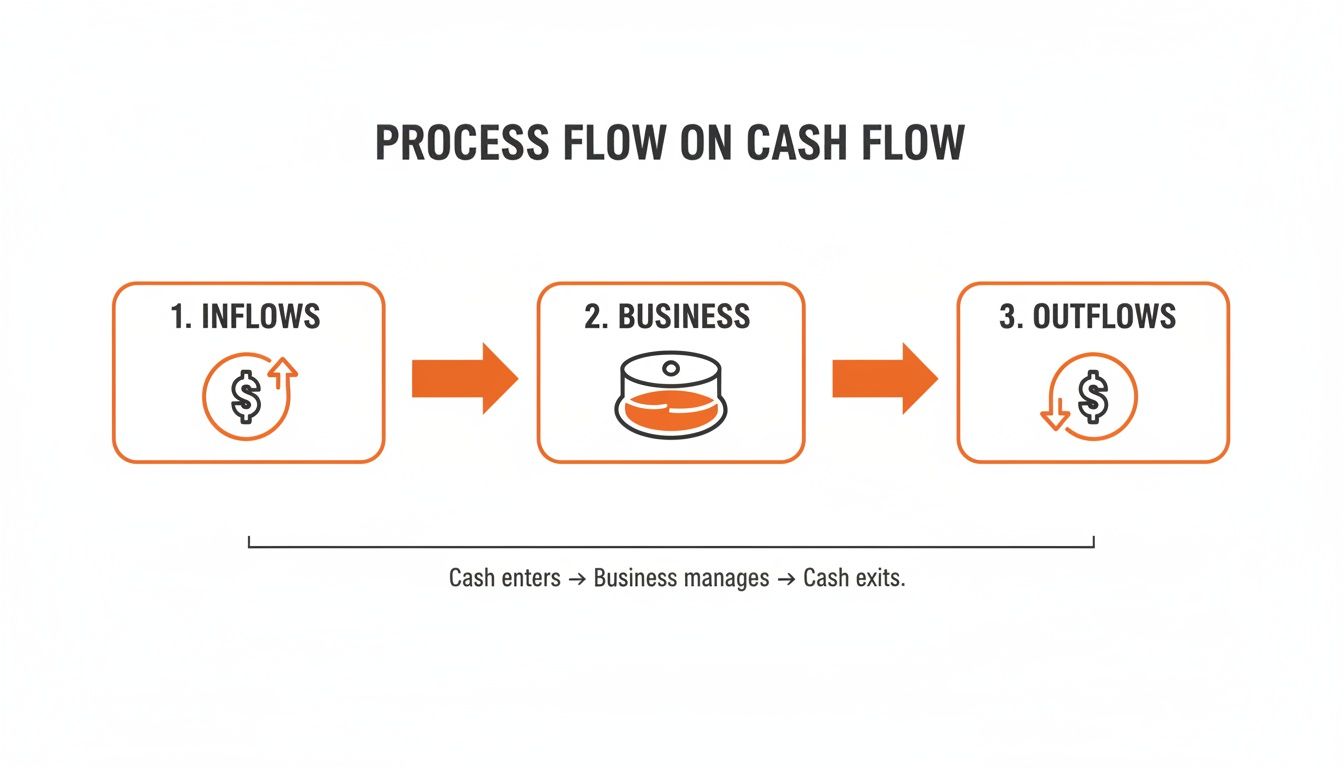
    A simple diagram illustrating the process flow of cash through inflows, business management, and outflows.

    This process is why the timing of your inflows and outflows is so critical. Get it wrong, and you can be "profitable" on paper but have no cash in the bank.

    Mapping Your Cash Inflows

    First, let's map out all the cash you realistically expect to receive each week for the next 13 weeks. Be conservative. It's way better to be pleasantly surprised by more cash than dangerously optimistic about money that never arrives.

    Here’s what you should plug into your spreadsheet:

    • Product Sales: Dig into your historical data. What do you typically bring in each week? Factor in any upcoming promotions or seasonal lulls.
    • Paid Invoices: List every single outstanding invoice and plug it into the week you genuinely expect the check to clear.
    • Other Income: Are you getting a loan disbursement, a tax refund, or any other one-off cash infusions? Get them on the map.

    This isn't just about guessing. Look at your past sales data from your payment processor or pull your bank statements. What did you make this time last year? What has the trend been for the last three months? Ground your estimates in reality.

    Projecting Your Cash Outflows

    Next, you’ll do the same thing for all the cash heading out the door. Honestly, this part is usually easier because so many of your costs are fixed or recurring. Just be brutally honest with yourself and don't leave anything out.

    Your outflows will likely include things like:

    • Payroll & Contractor Payments: The big one. A non-negotiable expense.
    • Rent or Mortgage: Your fixed occupancy costs.
    • Inventory & Supplies: When are your supplier bills actually due?
    • Marketing & Advertising: Your weekly or monthly ad spend commitment.
    • Software Subscriptions: All those little SaaS tools add up faster than you think.
    • Loan & Credit Card Payments: Mark down the exact due dates and amounts.

    It's a common founder war story: your brand is finally hitting its first revenue goals and you feel profitable, but cash is perpetually tight. You're not alone. Recent survey data shows that 31% of small businesses have only one to two months of cash reserves. Many successful brands operate on these razor-thin edges, completely vulnerable to just one late payment. Knowing your outflows is what saves you. You can learn more from the full report on Caflou.com.

    My Personal Tip: Go through your business bank and credit card statements for the last three months. Categorize every single expense. I guarantee you'll find "cash leaks"—subscriptions you forgot about or expenses that aren't providing any real value—that you can cut immediately.

    Once you have your inflows and outflows listed week by week, the magic happens. You just calculate your Net Cash Flow for each week (Inflows – Outflows) and your Ending Cash Balance. Suddenly, you have a clear line of sight into your financial future, one week at a time.

    The Only Cash Flow Metrics You Actually Need to Track

    A tablet displays cash flow metrics like runway, burn rate, and DSO on a wooden desk.

    Alright, you’ve built your first cash flow forecast. Staring at that spreadsheet can feel both empowering and overwhelming. Let’s cut through the noise. I want to show you the handful of numbers that actually matter.

    Think of it like driving a car. You don't need to be a mechanic, but you absolutely have to know how to read the fuel gauge and check your speed. These metrics are your dashboard.

    I’ve seen too many founders get obsessed with vanity metrics that look good but don't mean a thing for the health of the business. Forget all that. We’re going to focus on three numbers that will give you a brutally honest reality check on your cash situation.

    Your Cash Runway and Burn Rate

    This is the big one. Your Cash Runway is your most critical survival metric. It answers a simple, often terrifying question: "If my revenue dropped to zero tomorrow, how many months could this business survive?"

    It's your financial fuel gauge. Plain and simple.

    To figure it out, you first need your Burn Rate—the total cash your business torches every single month.

    Let’s run a quick example. Say you have $50,000 in the bank. After looking at your forecast, you know your total monthly expenses (payroll, rent, software, the works) are a steady $10,000.

    • Your Cash Balance: $50,000
    • Your Monthly Burn Rate: $10,000
    • Your Cash Runway: $50,000 / $10,000 = 5 months

    Boom. You have five months of runway. Knowing this number changes everything. It tells you when to cut costs, hammer down on sales, or start looking for funding—long before you’re in a panic. It gives you the space to be strategic, not desperate.

    For an early-stage business, a healthy cash runway is typically three to six months of operating expenses. That buffer gives you the freedom to ride out a slow quarter or jump on a big opportunity without betting the farm.

    Days Sales Outstanding (DSO)

    While runway tells you how long your cash will last, Days Sales Outstanding (DSO) tells you how fast you’re getting paid. It’s the average number of days it takes you to collect cash after you've made a sale.

    For anyone selling physical products, a high DSO is a silent killer.

    Imagine you run an online apparel brand. You have to pay your manufacturer today for a huge order of t-shirts. But you sold that inventory to a retail partner on "Net 60" terms, meaning they won't pay you for two months. You’ve just created a massive cash gap. Your money is stuck in accounts receivable, completely useless to you.

    Here’s a simplified way you can calculate it:

    1. Take your Total Accounts Receivable for a period (e.g., $30,000).
    2. Find your Total Credit Sales for the same period (e.g., $90,000).
    3. Divide Accounts Receivable by Total Credit Sales ($30,000 / $90,000 = 0.33).
    4. Multiply that by the number of days in the period (e.g., 0.33 x 90 days = 30 days).

    Your DSO is 30 days. You want this number as low as humanly possible. A high DSO is a flashing red light that your cash is getting trapped somewhere between a sale and your bank account. Tracking this metric forces you to get serious about invoicing and collections, which directly pumps cash back into your business.

    Getting Smart About Your Cash In and Cash Out

    Knowing your numbers is one thing. Actually improving them? That’s where you win. Now we get into the real playbook—the moves you can make this week to get more cash in the door faster and be smarter about the cash going out.

    These aren't complicated theories. They are practical adjustments to how you operate your business day-to-day. Think of it like tuning an engine. Small tweaks to your invoicing, supplier relationships, and spending habits can dramatically boost your financial horsepower.

    A desk with a calculator, pen, stacked coins, and a document titled 'Cash Preservation Checklist' for boosting cash flow.

    Speeding Up Your Cash Inflows

    The goal here is simple: shrink the time between when you do the work and when the money hits your bank. Every day you wait for a payment is a day that cash isn't working for you.

    Here are a few tactics I've seen deliver results almost immediately:

    • Offer a Small Discount for Paying Early: Try offering a 2% discount if a client pays an invoice within 10 days instead of the usual 30. That small hit to your margin is often worth getting the cash three weeks sooner.
    • Require Deposits for Large Projects: For any big order or custom project, get at least 30-50% upfront. This is non-negotiable. It covers your initial costs, confirms the customer is serious, and immediately improves your cash position.
    • Invoice Immediately and Follow Up Systematically: Don't wait until the end of the month. Send the invoice the moment the product ships or the service is delivered. Set up automated reminders for overdue payments—a polite but persistent follow-up system works wonders.

    These small shifts in your process can dramatically cut down your Days Sales Outstanding (DSO) and inject vital liquidity back into your operations. It’s all about creating a system where getting paid quickly is the default, not the exception.

    Getting Smarter About Your Cash Outflows

    Controlling your outflows isn't about being cheap; it's about being intentional. Every dollar you spend should have a clear purpose. This is where you plug the hidden leaks in your financial bucket.

    The reality for many founders is that costs are creeping up. A recent study found 86% of small businesses saw their expenses climb by about 11% on average, with surprise hits from labor, rent, and insurance. This squeeze makes smart outflow management a non-negotiable part of your survival strategy. You can dig into the full Relay report here to see the trends.

    Your first move should be a ruthless audit of every recurring subscription. Seriously. Go through your bank statements line by line. I guarantee you’ll find at least one or two software tools you’re paying for but no longer use. Cut them immediately.

    Beyond that, here are a few bigger levers you can pull:

    • Negotiate Better Terms with Suppliers: Don't just accept the payment terms you're given. If you have a solid payment history, ask your key suppliers to extend your terms from Net 30 to Net 45 or even Net 60. This simple ask can create a crucial buffer for your own cash flow. I have some great tips on how to negotiate with suppliers effectively that can help you get started.
    • Manage Inventory Like a Hawk: For product businesses, excess inventory is literally cash sitting on a shelf, collecting dust. Use your sales data to identify slow-moving products and run a promotion to liquidate them. Reinvest that cash into your bestsellers.

    Your Cash Preservation Checklist

    To put this all into action, I want you to build a simple checklist. This isn't a one-time task; it's a monthly or quarterly discipline. It keeps cash flow management for your small business top of mind.

    Grab a piece of paper or open a new note and answer these questions honestly:

    1. Invoices: Did I send every single invoice out the same day work was completed?
    2. Receivables: Have I followed up on all invoices that are past due by more than 3 days?
    3. Deposits: Did I secure an upfront deposit for any new large orders this month?
    4. Subscriptions: Have I reviewed my software subscriptions and cancelled anything I don’t use?
    5. Supplier Terms: Have I tried to negotiate better payment terms with my top three suppliers?
    6. Inventory: Do I know which products are my slowest sellers and have a plan to move them?
    7. Discretionary Spending: Did I review all non-essential spending (like travel or marketing experiments) and confirm its ROI?

    This simple audit forces you to confront the reality of where your money is going and where it's getting stuck. These are the tactical moves that separate the brands that make it from those that just look good on paper. They ensure your business has the cash it needs to not just survive, but to seize opportunities.

    How to Handle Cash Gaps with Smart Financing

    Look, even with a flawless forecast, cash gaps happen. It's a rite of passage for every growing business. The goal isn't to avoid them entirely—that's impossible. The key is having a smart, calm plan ready for when they show up.

    This isn’t about hitting the panic button. It’s about being prepared. Let's talk about short-term financing without the confusing jargon so you know your options long before you ever need them.

    Financing isn’t a sign you’re failing; it’s a tool. Think of it like a bridge you build over a temporary dip in the road. You don’t live on the bridge, but you’re damn glad it’s there when you need to get to the other side.

    Understanding Your Short-Term Financing Toolkit

    When cash gets tight, you have a few solid moves to bridge the gap. Each one works a bit differently, and the right choice depends completely on your specific headache.

    Let's break down the main players.

    A Business Line of Credit is my personal favorite for most small businesses. It’s like a credit card for your business bank account, but with much better rates. You get approved for a set amount—say, $25,000—but you only pay interest on what you actually draw.

    It's the ultimate safety net. You can tap into it to cover an unexpected payroll shortfall or a big inventory buy, then pay it back as your customers pay you. The beauty is its flexibility; it's there when you need it and costs nothing when you don't.

    Another powerful tool is Invoice Financing (also called factoring). This is a lifesaver if your biggest problem is waiting on big clients to pay. Instead of tapping your foot for 60 or 90 days, a financing company advances you up to 85% of the invoice amount right away.

    They take a small cut, and you get the rest when your client finally pays them. It directly solves the "profitable on paper but broke in reality" problem. You’re basically selling your invoices to get your money faster.

    The Strategic Role of Business Credit Cards

    Then there’s the humble Business Credit Card. Don't sleep on this. When you use it strategically, it's a fantastic short-term cash flow tool.

    I’m not talking about racking up long-term debt to cover losses. I’m talking about putting a large inventory purchase on a card with a 0% introductory APR. This can buy you several months to sell that inventory and generate cash to pay off the balance before a single cent of interest hits. It's a form of free, short-term financing if you’re disciplined. You can learn more about how this impacts your financial health by reading up on the essentials of building business credit.

    The golden rule of financing is simple: Apply before you are desperate. Lenders want to lend to healthy businesses, not ones hanging on by a thread. The best time to secure a line of credit is when business is good and you don't actually need the cash.

    Build Relationships Before You Need Them

    This brings me to my most important piece of advice. Sometime this month, walk into your local community bank or credit union and open an account. Get to know the branch manager by name.

    Big national banks often make decisions with algorithms. Local bankers build relationships. They get the local economy and are often way more willing to work with small businesses they know and trust.

    When you eventually need that line of credit, you won’t just be a faceless application. You’ll be a local founder they’ve spoken to, someone they’re rooting for. That personal connection can make all the difference.

    Here's a quick cheat sheet for your main options:

    Financing Option Best For… Key Consideration
    Business Line of Credit Ongoing, flexible access to cash for unexpected gaps and opportunities. Build the relationship and get approved before you need the funds.
    Invoice Financing Businesses with long payment terms (Net 30/60/90) and reliable, large clients. The fees can eat into your profit margins, so you have to do the math on the true cost.
    Business Credit Card Strategic, short-term purchases, especially when you can leverage a 0% APR offer. Requires extreme discipline to pay off the balance before interest kicks in.

    At the end of the day, smart financing is a core part of effective cash flow management for a small business. It’s not about taking on bad debt. It's about having a plan, the right tools in your toolkit, and the relationships in place to navigate the inevitable ups and downs of building something great.

    Bringing It All Together

    You've made it this far, which tells me you're not just playing around. You're serious about building a business that lasts. The road from a passionate founder with a great idea to a financially savvy CEO is where you build real, sustainable companies. It's tough, but it's worth it.

    Let's tie all these financial tactics back to why you started in the first place. Managing your cash flow isn't just about staring at spreadsheets; it’s about protecting your vision.

    This is the hard, unglamorous work that gives you the freedom to make bold moves, take care of your team, and serve your customers without that constant, nagging financial stress in the back of your mind.

    Your Quick-Start Action Plan

    Look, mastering cash flow is a skill you build over time. It’s a discipline, not a one-and-done task. Every small step you take makes your business that much stronger.

    Here are three things you can do right now to get started:

    • Map Out Your Next 13 Weeks: Don't put this off. Seriously, open a spreadsheet this week and map out your best guess for cash coming in and cash going out for the next three months. Clarity is your most powerful weapon.
    • Pick One "Get Paid Faster" Tactic: Just one. Will you offer a 2% discount for early payment? Or maybe start requiring deposits on all new projects? Pick one and implement it.
    • Find One Thing to Cut: Go through your bank statements tonight. I guarantee you'll find at least one subscription or recurring expense you don't truly need. Cancel it. That small win builds momentum.

    This whole journey is about progress, not perfection. Your first forecast will be messy. Your first attempt at negotiating with a supplier might feel awkward. That's okay. The simple act of doing it is what really counts.

    You aren't alone in this. Every founder struggles with getting their finances in order, including figuring out things like how to pay yourself from your business. By focusing on these fundamentals, you’re not just managing money—you're building a business that can endure.

    Your Top Cash Flow Questions, Answered

    I get it. After you’ve mapped everything out, a few big questions usually pop up. Here are the direct answers to some of the most common ones I hear from founders wrestling with cash flow management for their small business.

    How Often Should I Update My Cash Flow Forecast?

    For any business just starting out, I’ll tell you straight: update it weekly. It might sound like a lot, but once you have your template, it’s a quick 15-minute check-in that can save you from a world of hurt.

    Think of it like checking the weather before a big camping trip. That weekly glance prevents you from walking into a surprise thunderstorm without a raincoat. As you grow and your cash flow becomes more predictable, you can shift to bi-weekly. But never, ever go longer than a month.

    What's the Biggest Cash Flow Mistake New Entrepreneurs Make?

    The most dangerous mistake I see is confusing profit with cash. So many founders celebrate a "profitable" month on their income statement while their bank account is silently draining away.

    They book a huge sale, but the actual cash won’t land for 60 days. In the meantime, payroll and inventory bills are due now. This disconnect between paper profit and actual cash in the bank is a classic startup killer. You have to always focus on your cash balance first.

    Your P&L statement tells you if you won the game last quarter. Your cash flow statement tells you if you have enough players to even get on the field tomorrow.

    What Is a Good Cash Reserve to Aim For?

    A fantastic starting goal is to have three to six months of your essential operating expenses saved in cash. This is your business’s emergency fund. It’s your financial shock absorber.

    This stash covers the non-negotiables—rent, payroll, key software—if your revenue suddenly took a nosedive. To figure out your target, you calculate your average monthly "burn rate" (your total expenses) and multiply it by at least three.

    That number is your goal. Hitting it gives you an incredible peace of mind and, more importantly, the freedom to make strategic decisions instead of reactive, panicked ones.


    At Chicago Brandstarters, we know the founder's journey is full of questions like these. We're a free, vetted community where you can share the real war stories and get honest answers from fellow Chicagoans building their brands right alongside you. Learn more and see if our community is the right fit for you at the Chicago Brandstarters website.


  • 10 Customer Retention Tactics That Actually Work for Founders in 2026

    10 Customer Retention Tactics That Actually Work for Founders in 2026

    Let's get real. You pour your soul into getting customers. So why does it feel like you're constantly refilling a leaky bucket? It’s because we obsess over acquisition but forget the real secret to growth: keeping the amazing people who already believe in us. The churn is exhausting. It drains your revenue and your morale. You start wondering if you're building something that truly matters.

    That leaky bucket isn’t a sign you've failed; it’s a sign you’re missing the right tools. Pouring more water in won’t fix the holes. You need to patch them. This is where I've seen effective customer retention tactics become your most powerful asset for building a resilient, profitable business. They transform your one-time buyers into loyal advocates who feel seen, valued, and connected to your mission.

    Forget the generic advice. I'm going to walk you through 10 battle-tested customer retention tactics that aren't just theory. They're what I've seen work firsthand for scrappy, ambitious founders just like you, especially for those of us building with integrity and kindness. Think of this less as a list and more as your playbook for building a fortress around the customers you already have.

    I’ve broken each tactic down into simple, actionable steps you can start using today. I'll give you the implementation plan, key metrics to track, and even some quick wins for when you're short on time. No fluff, just a clear roadmap to stop the leaks and start building a community that lasts. Let’s dive in.

    1. Community-Based Peer Support Networks

    Instead of one-off networking events, I want you to build an intimate, exclusive community where your best customers can gather for genuine peer learning. This customer retention tactic isn’t about what you can sell them; it’s about what they can learn from each other. Imagine it like a high-stakes study group, not a sales pitch. You facilitate a safe space where members share vulnerabilities, challenges, and real lessons without judgment. This creates a powerful sense of belonging that a simple transaction can never match.

    Four diverse young adults laughing, sharing documents, and eating at a table with 'Peer Support' overlay.

    This model, which I've seen in groups like Chicago Brandstarters with their bi-weekly dinner format or Reforge’s cohort-based learning, transforms customers into a tribe. The value they get from the community becomes inseparable from your brand, making it incredibly difficult for them to leave.

    How I'd Implement It

    • Vet Every Member: You need to implement a strict identity check. I'd look at their LinkedIn profile to keep out self-promoters and ensure a safe, high-quality room.
    • Establish Ground Rules: Set clear confidentiality and "no-pitch" rules from day one. This builds the trust you need for authentic sharing.
    • Keep It Small: I’d intentionally limit group size to 8-12 members. This maintains intimacy and ensures everyone gets to contribute.
    • Create Rituals: Balance a structured agenda with time for organic conversation. Create rituals, like a "wins and challenges" check-in, that your members look forward to.
    • Distribute Leadership: Rotate who facilitates. This gives members a sense of shared ownership and prevents you from burning out.

    Why This Works for Me

    This strategy taps into our fundamental human need for connection. By creating a high-value, exclusive community, you're offering something competitors can't easily replicate: a trusted inner circle. The relationships they form become a powerful moat around your business, making your product indispensable.

    2. Values-Aligned Member Curation

    Instead of chasing customers based on their spending power, I want you to curate a community of people who share your core values. This customer retention tactic means you intentionally select members who align with principles like kindness, hard work, and generosity. This approach creates a self-reinforcing culture. Members feel a deep sense of belonging and are motivated to protect the community’s integrity, which cuts down on churn from poor cultural fits.

    Notebook and pen on a table in a meeting room, with blurred people in the background.

    Think of it like casting a play. You don't just pick the most famous actors; you pick the ones who fit the roles and work well together. Organizations like Chicago Brandstarters, which prioritizes kindness, and YPO (Young Presidents' Organization), which uses character-based vetting, live this philosophy. You move from "who can you be" to "who are you." The result is a cohesive group where trust is the default, making your brand incredibly sticky.

    How I'd Implement It

    • Define Your Values: Create a clear values statement that every potential member must agree with before applying. This is your first filter.
    • Vet for Culture First: Train your team to assess cultural fit as rigorously as they evaluate capability. I'd ask behavioral questions that reveal character.
    • Empower Member Referrals: Your best members know who will fit in. Create a simple system for them to refer trusted people who already share your ethos.
    • Involve Members in Vetting: Let your existing members interview or meet candidates. This ensures a mutual fit and gives them ownership over the culture.
    • Be Willing to Say No: You must be prepared to reject highly accomplished candidates if they don't align with your values. Protecting the culture is priority one.

    Why This Works for Me

    This strategy prioritizes cultural cohesion over superficial metrics. When people feel they are among "their people," they're more engaged, supportive, and loyal. You build a brand that stands for something more than a product; you create a movement.

    3. Structured Progression Pathways

    One of the biggest risks you face is when your customers succeed. They grow beyond your initial offering and churn, not because they're unhappy, but because they’ve outgrown you. Instead of losing them, you can build structured pathways that guide them to their next stage. This customer retention tactic transforms your service from a single stop into a critical junction on their journey.

    A desk calendar with '1' circled, a coffee cup, and a plant on a table in a living room.

    Think of your service like a school system. You don't want them to stay in kindergarten forever. You want to graduate them to first grade, then second, and so on. Y Combinator's extensive alumni network and Techstars' funnel of programs do this well. By creating a clear path, like referring graduates to advanced programs like Goldman Sachs 10KSB, you maintain the relationship. Their success becomes your success story.

    How I'd Implement It

    • Map Out the Journey: Define clear milestones—based on revenue, team size, or complexity—that signal when a customer is ready for the next level.
    • Build an Alumni Network: Create an exclusive community for your graduates. This maintains their connection to your brand and lets them network with advanced peers.
    • Celebrate Graduations: Make a big deal out of progression. Publicly celebrating these "graduations" honors the successful member and motivates current ones.
    • Create Advisory Roles: Invite your most successful alumni back as mentors. This provides immense value to your current customers and keeps your graduates engaged.
    • Forge Strategic Partnerships: Identify and build relationships with next-stage programs. Make the handoff seamless for your graduating members.

    Why This Works for Me

    This strategy redefines the customer lifecycle from a finite line into a continuous loop. Instead of treating churn as a failure, you reframe it as a successful graduation. By facilitating their next steps, you build immense goodwill. You're not just a service provider; you become a foundational part of their long-term success.

    4. Peer-to-Peer Mentorship and Reciprocal Teaching

    Move beyond just top-down expert advice. I want you to foster a community where members actively teach and mentor each other. This reciprocal model creates mutual obligation and deepens relationships, ensuring every member has value to contribute. It’s a powerful customer retention tactic because it builds psychological investment in the group's collective success.

    Three people, two men and one woman, discuss machinery in a bright factory building with a sign.

    It’s like a potluck dinner. Everyone brings a dish to share. The meal is richer and more varied than if one person tried to cook everything. When members share their "honest war stories," as I've seen in groups like Chicago Brandstarters, they build trust that a one-way webinar never could. The value shifts from a single expert to the shared wisdom of the group.

    How I'd Implement It

    • Structure the Sharing: Create formats like a "Problem of the Week" or "Hot Seat" session where one member presents a challenge for group brainstorming.
    • Model Vulnerability: Ask your experienced members to share their failures and hard-learned lessons first. This sets the tone and makes it safe for others.
    • Provide Feedback Tools: Offer simple templates for giving effective, constructive feedback. This prevents vague advice and encourages actionable insights.
    • Document and Archive: Capture key insights and create an internal knowledge base. This turns peer advice into a lasting asset for everyone.
    • Recognize Contributors: Publicly acknowledge members who consistently provide high-quality mentorship. This reinforces the culture of giving.

    Why This Works for Me

    This strategy taps into our desire for both contribution and learning. By giving your customers a platform to share their own expertise, you empower them. The relationships built through mutual mentorship are significantly stronger. The community becomes an indispensable advisory board, making your brand the central hub for their growth.

    5. Exclusive Access to Resources and Opportunities

    Beyond emotional connection, you can lock in loyalty by offering tangible economic value that customers can't get elsewhere. This customer retention tactic transforms your service into a strategic asset. Think of it as giving them a key to a secret VIP lounge. By providing exclusive access to investor intros, factory tours, or pre-negotiated vendor discounts, you create a powerful incentive to stay.

    This strategy moves your offering from a "nice-to-have" to a "must-have" part of your customer's growth engine. It's about building an ecosystem where the value they receive multiplies far beyond your core product. The opportunities you facilitate become a critical part of their success, linking their growth to their relationship with you.

    Models like YPO master this by leveraging their networks to create unmatched opportunities. I've seen Chicago Brandstarters do this by providing direct access to factory tours, helping founders navigate complex supply chains. This hands-on support is far more valuable than any standard perk.

    How I'd Implement It

    • Build Strategic Partnerships: Actively negotiate with suppliers and software companies to secure exclusive discounts for your customers.
    • Create an 'Opportunity Board': Set up a private channel or document where members can post needs and others can share opportunities.
    • Match Opportunities to Needs: Don't just blast out generic offers. Take the time to understand your customers' specific needs and connect them with relevant resources.
    • Document and Share Wins: When a customer benefits from an introduction, create a short case study. This social proof shows the real-world value of sticking with you.
    • Incentivize Contribution: Offer bonuses or recognition to customers who bring valuable opportunities into the ecosystem for others to share.

    Why This Works for Me

    This tactic gives a compelling, economic answer to the "what's in it for me?" question. It creates a powerful moat around your business with unique, high-value benefits. As your customers succeed using the resources you provide, their loyalty deepens. You're no longer just a vendor; you're an indispensable partner.

    6. Confidentiality and Trust-Based Privacy

    True connection only happens in an environment of absolute psychological safety. You can build that with ironclad confidentiality agreements and clear enforcement. This is one of the most powerful, yet overlooked, customer retention tactics. It turns your service into a sanctuary. It’s like a doctor’s office—what’s said in the room, stays in the room. When your customers know their challenges are protected, they engage more deeply.

    This model is the bedrock of highly effective groups, from the anonymity of 12-step programs to the strict privacy agreements in executive coaching circles. The value of the shared insights is directly proportional to the trust within the group. By making confidentiality non-negotiable, you create a uniquely valuable space that public forums can never replicate.

    How I'd Implement It

    • Onboard with a Privacy-First Mindset: Make your confidentiality policy the first thing new customers sign. Embed it directly into your onboarding.
    • Establish Clear Consequences: Don't be vague. Clearly state the consequences for a breach of trust, like immediate removal.
    • Create a Reporting Protocol: Set up a simple, confidential process for members to report potential breaches. This shows you take privacy seriously.
    • Anonymize Shared Data: When sharing case studies, always anonymize the data to protect individuals and companies.
    • Lead by Example: Regularly remind members of the confidentiality commitment. Show them it's a core value, not just a rule.

    Why This Works for Me

    This strategy directly addresses our primary barrier to authentic sharing: fear. By removing the fear of judgment or exposure, you unlock a higher level of engagement. This deep trust becomes a core feature of your offering, creating an incredibly strong bond that makes customers feel understood and protected.

    7. Regular High-Touch Engagement and Rituals

    Instead of sporadic check-ins, you should establish predictable, high-value touchpoints that become part of your customers' routines. This customer retention tactic makes your brand a fixture in their lives. It's like their favorite weekly TV show—they anticipate it and build their schedule around it. When your engagement becomes a valued ritual, leaving feels less like canceling a subscription and more like sacrificing a meaningful part of their week.

    This model is powerful because it builds community through consistency. Think of the bi-weekly dinner format from Chicago Brandstarters or the cohort meetings at Reforge. These groups know that frequency and predictability are what transform individual interactions into a powerful community fabric. The regularity itself becomes a key part of the value.

    How I'd Implement It

    • Create a Master Calendar: Make a shared, visible calendar of all events. This builds anticipation and helps members plan.
    • Establish a Consistent Cadence: Choose a rhythm—weekly, bi-weekly, monthly—and stick to it. Consistency is the foundation of any ritual.
    • Use a Flexible Agenda: Start each meeting with a consistent structure, like a "wins and challenges" check-in, but leave room for organic conversation.
    • Engage Between Events: Use a group chat to maintain momentum between your scheduled gatherings. This keeps the connection alive.
    • Document and Share Insights: After each event, share key takeaways with the group. This reinforces the value delivered and includes those who couldn't attend.

    Why This Works for Me

    This strategy leverages the "mere-exposure effect"—we develop a preference for things simply because they are familiar. By creating regular, positive interactions, you build deep-seated loyalty. Your brand becomes synonymous with the community you've built. This foundation is crucial when you're dealing with difficult customers and need to draw on a reservoir of goodwill.

    8. Transparent Leadership and Founder Vulnerability

    Instead of projecting an image of untouchable success, you can build unbreakable loyalty by modeling vulnerability. This customer retention tactic means you openly share your own business challenges and mistakes. It’s like being a hiking guide who admits they’ve gotten lost on this trail before, but now they know the way. When you, as a founder, drop the polished facade, it gives your customers permission to do the same. This creates a culture of psychological safety where authentic connection can flourish.

    This approach is powerfully demonstrated by leaders like Brené Brown and Kevin Tao at Chicago Brandstarters, who prioritizes it over performative positivity. By sharing your journey, wins and losses alike, you transform your role from a distant authority into a relatable guide. Your customers stick around not just for your product, but for the genuine relationship and trust you've built with them.

    How I'd Implement It

    • Share a Lesson: Start each meeting by sharing one personal business struggle and what you learned from it.
    • Admit What You Don't Know: When faced with a tough question, don't fake it. Saying, "I don't have the answer right now, but I'll find out," builds far more trust than bluffing.
    • Ask for Their Help: Involve your customers in the journey by asking for their advice on new features. This fosters a sense of co-ownership.
    • Be Transparent in Decisions: Briefly explain the "why" behind key business decisions. This shows you respect your customers.
    • Create Accessible "Office Hours": Set aside dedicated, informal time for customers to connect with you directly without a formal agenda.

    Why This Works for Me

    This strategy demolishes the impersonal barrier between a business and its customers. It taps into our desire for authenticity. When you are vulnerable, you signal that your business is led by real people, not a faceless corporation. This deep sense of trust is a powerful advantage. You can learn more about how I put this into practice by exploring vulnerability in leadership.

    9. Impact and Legacy-Focused Mission

    Shift your company's purpose beyond just profit. When you anchor your brand to a mission focused on impact, you attract and retain customers who share your values. This customer retention tactic connects people to a purpose larger than themselves. Think of it as inviting people to help build a cathedral, not just lay bricks. Your customers don't just buy from you; they join a movement, making them far less likely to leave.

    This philosophy is powerfully demonstrated by brands like TOMS Shoes and Patagonia. Chicago Brandstarters echoes this by focusing on helping "kind people" build impactful businesses. When your "why" aligns with your customers' core beliefs, their loyalty becomes deeply ingrained. They become advocates because your success feels like their success.

    How I'd Implement It

    • Articulate Your "Why": Clearly define your mission beyond making money. What problem are you solving for society? Make this visible everywhere.
    • Share Impact Stories: Regularly showcase how your community is making a positive impact. Feature these stories in newsletters and on your website.
    • Create Service Initiatives: Organize optional community initiatives that allow members to contribute directly to your shared cause, like volunteer days.
    • Vet for Values: During onboarding, ask potential customers about their own impact goals to ensure alignment from the start.
    • Publish an Impact Report: Create an annual report that celebrates the collective contributions of your community, reinforcing the value of their participation.

    Why This Works for Me

    This strategy leverages our powerful desire for purpose. By building your brand around a clear, authentic mission, you offer something far more valuable than a product: a chance to be part of something bigger. This values-based connection creates an emotional bond that competitors can't easily break. As Simon Sinek says, people don't buy what you do; they buy why you do it.

    10. Accountability Systems and Progress Tracking

    Go beyond simple check-ins. I want you to create structured accountability systems that leverage peer pressure for good. This tactic involves having your customers commit to specific goals and report their progress to a group. It’s like having a workout buddy for your business—you’re more likely to show up if you know someone is waiting for you. This shared journey creates deep bonds and keeps members engaged, giving them a powerful reason to stick around.

    This model is a core component of high-impact mastermind circles and communities like Indie Hackers. By facilitating a framework where members hold each other to a higher standard, you transform your service from a simple tool into an essential support system. The value shifts from your product to the collective progress it enables.

    How I'd Implement It

    • Use a Clear Framework: Guide members to set SMART (Specific, Measurable, Achievable, Relevant, Time-bound) goals. A shared "Goal Board" or Slack channel can make these commitments visible.
    • Schedule Regular Check-ins: Host dedicated monthly or bi-weekly calls focused solely on progress updates. This creates a predictable rhythm.
    • Celebrate the Process: Recognize effort and learning from setbacks, not just the final wins. This fosters a psychologically safe environment.
    • Match Accountability Partners: If your group is large, pair up members with complementary goals. These micro-connections can significantly boost commitment.
    • Track Collective Impact: Share aggregate stats, like "Our community collectively launched 15 new features this quarter," to demonstrate the power of the group.

    Why This Works for Me

    This strategy taps into powerful psychological drivers like commitment and social proof. When your customers state their goals publicly, they are far more likely to follow through. The support and gentle pressure from peers create a positive feedback loop that drives action. It makes your brand the catalyst for their growth, creating a level of loyalty a competitor's discount can't touch.

    Customer Retention: 10-Tactic Comparison

    Approach 🔄 Implementation complexity 💡 Resource requirements ⭐ Expected effectiveness 📊 Expected outcomes Ideal use cases & ⚡ Key advantages
    Community-Based Peer Support Networks High — intensive curation, logistics, moderation Medium–High — facilitators, venues, vetting time ⭐⭐⭐⭐ Deep engagement, high LTV, strong referrals Early-stage founders seeking deep connection; ⚡High stickiness and member advocacy
    Values-Aligned Member Curation Medium–High — multi-step vetting and cultural assessment Medium — vetting team, referral processes ⭐⭐⭐⭐ Lower churn, easier moderation, stronger cultural fit Communities prioritizing culture; ⚡Sustained cohesion and reduced conflict
    Structured Progression Pathways Medium — tier design and partner coordination Medium — partnerships, program managers ⭐⭐⭐ Retention of scaling members, new revenue tiers Members expected to outgrow initial stage; ⚡Keeps alumni engaged and monetizable
    Peer-to-Peer Mentorship & Reciprocal Teaching Medium — rotation, matching, quality control Low–Medium — facilitation templates, matching tools ⭐⭐⭐⭐ Increased participation, peer knowledge transfer Diverse-experience cohorts; ⚡Scalable value via mutual teaching
    Exclusive Access to Resources & Opportunities High — partner relationships and deal sourcing High — partner management, deal curation ⭐⭐⭐⭐ Quick wins, measurable ROI, improved acquisition Growth-stage founders needing tactical advantage; ⚡Immediate business value and recruitment appeal
    Confidentiality & Trust-Based Privacy Medium — legal agreements and enforcement protocols Medium — legal, verification, monitoring systems ⭐⭐⭐⭐ Deeper, more candid conversations; higher trust scores Sensitive or proprietary businesses; ⚡Psychological safety and differentiated value
    Regular High-Touch Engagement & Rituals High — event ops, consistent facilitation High — event staff, venues, comms systems ⭐⭐⭐⭐ Habit formation, predictable attendance, sustained engagement Communities that rely on routine touchpoints; ⚡Creates strong behavioral retention
    Transparent Leadership & Founder Vulnerability Low–Medium — consistent leader modeling and communication Low — leader time, structured communication channels ⭐⭐⭐ Greater member openness and perceived authenticity New or culture-setting communities; ⚡Models vulnerability to normalize sharing
    Impact & Legacy-Focused Mission Medium — define mission and align activities Medium — storytelling, initiatives, partnerships ⭐⭐⭐ Strong emotional commitment, mission-aligned recruitment Purpose-driven founders and nonprofits; ⚡Deep emotional loyalty and identity
    Accountability Systems & Progress Tracking Medium — frameworks, check-ins, facilitation Low–Medium — tracking tools, facilitators ⭐⭐⭐⭐ Higher goal completion, regular touchpoints, measurable wins Action-oriented members and cohorts; ⚡Drives follow-through and visible ROI

    Your Next Move: From Reading to Doing

    You've just navigated a deep dive into ten powerful customer retention tactics. We've moved beyond generic advice and into the foundational strategies that build fiercely loyal communities. From creating structured progression pathways to fostering trust through your own vulnerability, these aren't just one-off tricks. They are the core components of a business built on genuine relationships.

    Think of it like building a house. Customer acquisition is your foundation, absolutely essential. But retention? That's the framing, the roof, the insulation. It's what makes the structure a warm, safe place to be, protecting you from market storms and new competitors. Without it, you’re just left with a concrete slab, exposed and vulnerable. The tactics we've covered are the tools you use to build that protective, inviting structure.

    From Blueprint to Building

    The biggest mistake you can make right now is to feel overwhelmed and do nothing. I see this all the time. Founders read a dozen articles, get hyped up, and then paralysis sets in. Don't let that be you. The goal isn't to implement all ten of these customer retention tactics by next Tuesday.

    The goal is to pick one.

    Which single idea sparked the most energy for you? Was it creating exclusive access to resources? Or did the idea of establishing regular, high-touch rituals resonate with how you want to connect with your audience? Maybe the most pressing need is an accountability system to ensure your customers are actually getting results.

    "A single, well-executed strategy is infinitely more powerful than ten brilliant ideas sitting on a whiteboard. Action is the great separator."

    Your job is to translate that spark into focused action. Don't just think about it. Schedule 30 minutes on your calendar right now to map out the first, tiny step. Who do you need to talk to? What simple tool could you use? What is the minimum viable version of this tactic you can launch in the next two weeks?

    Your 90-Day Retention Sprint

    I challenge you to commit to your chosen tactic for the next 90 days. Treat it like a focused experiment. Here's a simple framework to get you started:

    1. Define Your "One Thing": Write down which tactic you're implementing. For example: "I will launch a bi-weekly 'Wins & Challenges' virtual meetup to increase high-touch engagement."
    2. Set a Metric: How will you measure success? It could be reducing churn by 5% or a leading indicator like "increase community engagement by 20%."
    3. Execute and Iterate: Run the play. Pay close attention to feedback. Don't be afraid to tweak your approach based on what your customers tell you. The first version is never the final version.

    Mastering these customer retention tactics is how you stop playing the exhausting game of refilling a leaky bucket. You start building an ecosystem where your best customers stay, contribute, and become your most passionate advocates. This is the path to sustainable, resilient, and deeply rewarding growth. You've got the knowledge. Now, go make it happen.


    If you're a founder in the Midwest who believes in growing through community and kindness, these aren't just abstract tactics for me. This playbook is the foundation of Chicago Brandstarters. I connect kind, hardworking entrepreneurs through a curated, supportive peer network so you never have to build alone. Learn more and see if our community is the right fit for your journey at Chicago Brandstarters.

  • How to Get Startup Ideas That Actually Work

    How to Get Startup Ideas That Actually Work

    Forget those forced brainstorming sessions with a wall of sticky notes and lukewarm coffee. Let me tell you a secret: finding a great startup idea isn't about some flash of creative genius. It's much simpler.

    The best business concepts I've seen come from paying attention to the friction in your own life.

    Stop Brainstorming and Start Observing

    Man at desk with laptop, notebook, coffee, and 'OBSERVE PROBLEMS' sign, surrounded by crumpled papers.

    Let's kill a myth right now: you don't need to be a visionary to find a winning idea. You just need to become a professional problem-spotter. I've found that the best ideas aren't dreamed up; they're discovered hiding in plain sight in your daily routines, your job, and your hobbies.

    Think of yourself as a detective. Your mission is to spot the clumsy workarounds, the annoying processes, and those moments that make you mutter, "There has to be a better way."

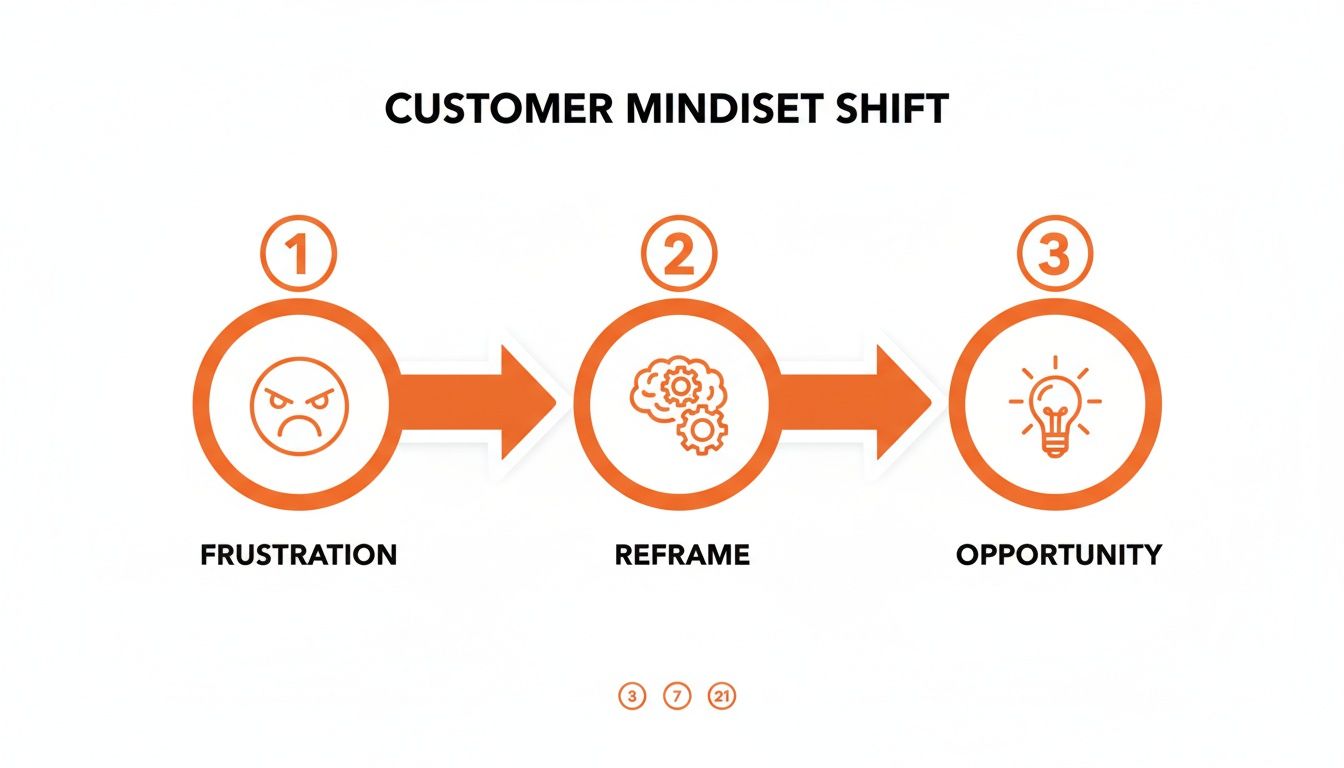
    That feeling? That's your signal. That's the starting point for a business that solves a real problem for people just like you.

    The Power of the Frustration Audit

    I call this process the 'Frustration Audit.' It’s a simple but incredibly powerful way you can turn everyday annoyances into solid business concepts. Instead of hunting for a solution, you actively hunt for the problem first. This flips the whole creative process on its head.

    Your real expertise isn't in some abstract market you've never touched. It's in the things you already know inside and out.

    • At Your Job: What software do you absolutely dread using? Is there a manual task that eats up two hours of your week, every single week? Where does communication always seem to break down?
    • In Your Hobbies: Is there a tool for your favorite activity that’s poorly designed or way overpriced? Is there a community that's underserved or badly organized? What key information is scattered all over the place and a pain to find?
    • In Your Daily Life: What recurring chore is a constant headache? What service do you wish existed just to make your errands easier?

    These aren't just complaints. This is raw, unfiltered market research pointing you directly toward unmet needs.

    Key Takeaway: Stop trying to invent the next big thing from nothing. Instead, I want you to meticulously document the small, recurring frustrations you and the people around you face. The most valuable problems are often the ones you're so used to, you've stopped even noticing them.

    From Personal Pet Peeve to Viable Business

    So many successful founders didn't start with some grand vision. They just started by scratching their own itch. Think about Drew Houston, the founder of Dropbox. He was just tired of forgetting his USB drive. He didn’t set out to reinvent cloud storage; he just wanted to fix his own annoying problem. You'll see this common thread again and again.

    This approach gives you a massive hidden advantage. When you solve a problem you personally have, you become your own first customer. You have an immediate, gut-level understanding of the user's pain points, which gives you a huge head start in building something people actually want. You can't fake that kind of authenticity.

    This is especially true when you're just getting started. A whopping 78% of startups are self-funded, meaning founders like you often use their own savings to get off the ground. This stat, highlighted in Embroker's 2025 report, shows that the best ideas—especially here in Chicago and the Midwest—often come from your own life and expertise. You don't need a fancy VC pitch.

    Capturing Your Fleeting Insights

    Your brain will throw brilliant observations at you at the worst times—in the shower, on your commute, or right as you're falling asleep. The trick is having a dead-simple system to grab them before they disappear.

    Don't overcomplicate it. A dedicated notebook or a simple app like Apple Notes or Google Keep is all you need. Your goal is to create a 'frustration log.' Whenever you hit a snag or feel that moment of annoyance, jot it down.

    Don't judge the idea. Just capture the raw feeling and the context. Your log might look something like this: "Spent 45 minutes trying to reconcile receipts for my expense report again. The software is clunky, and I have to manually enter everything. What a total waste of time."

    That one sentence is worth more than a hundred ideas from a brainstorming session because it's real, specific, and rooted in genuine pain. Over time, this log will become your personal goldmine of startup ideas.

    Four Lenses for Finding Your Next Big Idea

    Once you start really looking at the world like a founder, you'll see problems absolutely everywhere. And that's a good thing. But a long list of things that annoy you isn't a business plan. You need a filter—a way to separate the minor headaches from the major opportunities.

    This is where I turn to what I call the "four lenses." Think of them as different pairs of glasses. Each one is built to bring a specific kind of business idea into sharp focus. These aren't just some textbook theories; they're my go-to, battle-tested ways of spotting gaps in the market that you are uniquely ready to fill.

    The Unsexy Problem Lens

    Let's be real: some industries are just boring. Logistics, construction, commercial cleaning… you get the idea. Most founders are too busy chasing the next shiny thing to even notice them, which is exactly why I see these sectors as goldmines.

    The "Unsexy Problem" lens is all about you finding industries that are massive and essential, but painfully stuck in the past. You're hunting for sectors where people are still leaning on clunky spreadsheets, endless phone calls, and maybe even fax machines to get important stuff done.

    Your goal here isn't to invent something from another planet. It's about bringing a simple, modern, easy-to-use solution to an industry that time forgot.

    Example: A buddy of mine here in Chicago saw that local plumbing companies were managing their crews with this chaotic mix of whiteboards and a storm of text messages. He built a dead-simple mobile app just for scheduling and dispatching. It wasn't glamorous, but it solved a real, expensive problem for a bunch of people completely ignored by big tech.

    The New Technology, Old Industry Lens

    This one is all about you playing matchmaker. You take a powerful new technology—like AI, computer vision, or automation—and plug it into a traditional, non-tech industry. It’s like dropping a brand-new Tesla engine into a classic, reliable pickup truck.

    The industry is already there. You don't have to create a new market from scratch. Your job is just to figure out how to use the new tech to make an existing process 10x faster, cheaper, or better.

    This approach is unbelievably powerful right now. A total game-changer: AI now dominates venture deals, snatching 56% of total VC value in Q1 2025. That's a huge leap from just 20% right after ChatGPT came out. This isn't just hype; it’s a giant neon sign pointing to where the smart money is going. Hot sectors like healthcare (which grabbed 16.5% of global VC in Q1 2025) and climate tech are practically begging for this kind of shake-up. You can dig into the data in WIPO's Global Innovation Index 2025 report.

    The Fragmented Market Lens

    Put this lens on, and you'll start seeing industries that look like a shattered mirror. They're packed with hundreds, maybe thousands, of small, local players, but not a single company has any real market share. Think local breweries, independent dog walkers, or all those neighborhood nail salons.

    That fragmentation is your opening.

    When there's no clear leader, there's often no standard for quality, pricing, or your customer experience. You can come in and win by building a trusted brand, creating a better operational playbook, or making a platform that rolls up all these small businesses to offer a consistent, high-quality service.

    • Ask Yourself: Is there a local service you use where the experience is a total crapshoot every single time?
    • Look For: Industries with super low brand loyalty and really high customer frustration.

    This is your chance to bring some order to the chaos and become the name everyone trusts in a space that desperately needs one.

    The Personal Passion Lens

    This last lens is different. It’s not about you spotting some inefficiency from 30,000 feet. It’s about you building something for a community you genuinely love and are a part of. Are you obsessed with competitive board games? Urban gardening? Do you spend your weekends restoring vintage motorcycles?

    That deep, authentic passion is your unfair advantage.

    You just get the culture, the language, and the unmet needs of your fellow enthusiasts in a way an outsider never could. You're not doing "customer research"; you're just chatting with your friends.

    Building for a community you love also gives you the fuel to push through the tough times, and trust me, there will be tough times. When your motivation is shot, your connection to the mission and the people you're serving will drag you across the finish line. A business built on your passion feels less like work and more like a calling.


    I’ve found that almost every great startup idea fits into one of these four categories. To make it easier for you to see which one resonates, I've broken them down into a simple table.

    Four Lenses of Idea Generation

    Lens Core Concept Key Question to Ask Yourself
    The Unsexy Problem Solve a boring, overlooked problem in a legacy industry with a simple, modern solution. Where are people still using spreadsheets and phone calls for critical work?
    New Tech, Old Industry Apply a powerful new technology (like AI) to make a traditional industry 10x better. How could AI or automation completely change the way my local [industry] works?
    The Fragmented Market Unify a market full of small, inconsistent players under one trusted brand or platform. What service do I use where the quality is a total gamble every single time?
    The Personal Passion Build a product for a niche community or hobby that you're already deeply a part of. What problem does my own community complain about that nobody has solved yet?

    Use these questions as a starting point. Let your curiosity run wild and see what you discover. The best ideas are often hiding in plain sight, just waiting for someone like you with the right pair of glasses to spot them.

    Validate Your Idea Without Wasting Time or Money

    Having an idea feels great. But that feeling is cheap, and it can be dangerously misleading. Knowing if your idea is actually good is the only thing that matters, and it’s a whole lot harder to figure out.

    I’m going to give you my simple, low-cost playbook to get a clear signal from the market before you waste a year of your life and thousands of dollars building something nobody wants. This process is your defense against the number one startup killer: making something nobody asked for.

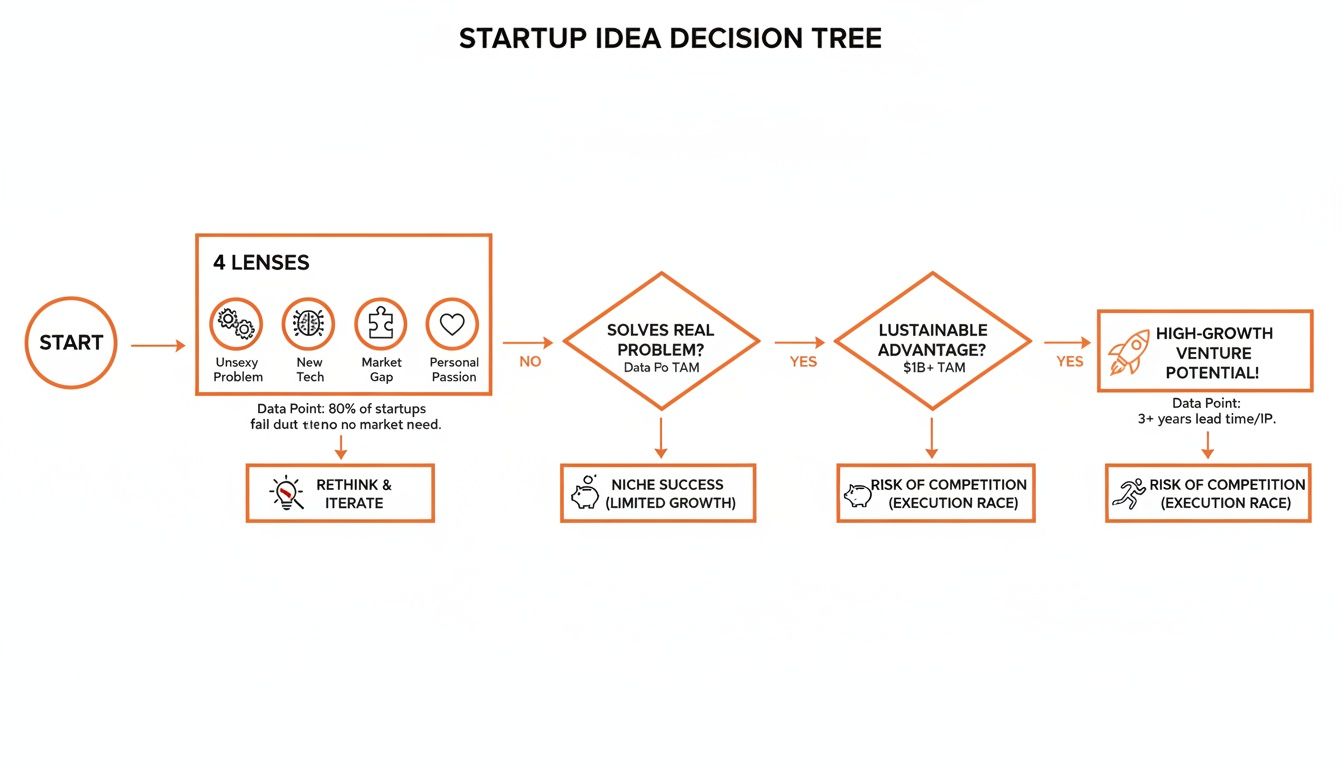
    This decision tree gives you a visual for how to filter your observations through the four lenses we talked about, helping you see where your best ideas might be hiding.

    A startup idea decision tree flow chart for evaluating venture potential.

    Notice how every single path starts with observation. You have to spot a real-world problem first, then you can apply a strategic filter to it.

    The Five Conversations Method

    Your first instinct might be to build a survey or ask your friends, "Would you use this?" Stop right there. That's the worst thing you can do. People are polite. They will lie to you to avoid hurting your feelings.

    You need to become a detective, not a salesperson. I use a method I call the 'Five Conversations.' Your goal isn't to pitch your idea; it's to learn about your potential customer's life and problems. You talk to five people who you think are your target audience and follow a specific script designed to get the unfiltered truth.

    You don't even mention your solution. You only ask about their past behavior.

    • "Tell me about the last time you dealt with [the problem your idea solves]."
    • "What was the hardest part of that?"
    • "What have you tried to do to solve this?"
    • "If you had a magic wand, what would the perfect solution look like?"

    Listen more than you talk. You’re listening for emotion—frustration, anger, desperation. If they aren’t already trying to solve this problem, even with a clunky spreadsheet or a mix of different tools, it’s probably not a painful enough problem to build a business around.

    Create a Smoke Test

    After you've had those five conversations and you're hearing consistent pain points, it's time for the next step. A 'smoke test' is like sending a flare up into the sky to see who looks up. It's a simple, one-page website that clearly describes the value proposition of your idea.

    This isn't about tricking people. It’s a powerful tool I use to measure genuine intent.

    Your landing page needs just three things:

    1. A Killer Headline: Clearly state the problem you solve and for whom. Example: "The Easiest Way for Chicago Food Truck Owners to Manage Inventory."
    2. Three Bullet Points: Briefly explain the core benefits of your proposed solution.
    3. An Email Capture Form: A simple box that says, "Enter your email to get early access and a 50% discount at launch."

    Then, you spend a tiny amount of money—maybe $50 to $100—on targeted ads aimed at your ideal customer. Or you share it in relevant online communities where those people hang out. The metric you care about is the conversion rate. If 5-10% of the people who visit your page give you their email, you're onto something. If it's less than 1%, your message isn't landing.

    Key Takeaway: Your goal with a smoke test isn't to get thousands of sign-ups. It's to prove that a real, measurable group of strangers are interested enough in your promise to give you their contact information. That's a powerful, data-driven signal.

    The hard truth is that most ideas don't survive this process. And that’s a good thing! It's far better for you to find out your idea is a dud after a week of conversations and a $100 ad spend than after a year of building and a drained bank account.

    This validation phase is your ultimate filter. It protects you from your own biases and forces you to confront market reality. Buckle up: 90% of startups fail, with 29% from running out of cash and 19% from getting crushed by competition. Yet, you're not alone: a staggering 5.5 million new businesses were launched in the U.S. in 2023.

    Being bold enough to test your assumptions early is what separates successful founders from the ones who burn out. This process gives you the data you need to confidently pivot, refine, or even kill a bad idea. For an even deeper dive, you might be interested in our guide on how to validate a business idea before you launch. It's the kindest thing you can do for your future self.

    Find Your People to Refine Your Idea

    Trying to build a startup all by yourself is a trap. The silence gets crushing, fast. And honestly, your own echo chamber is the single most dangerous place for a new idea. It's a classic mistake I see founders make all the time—they clutch their brilliant concept so tightly that they suffocate it before it ever gets a chance to breathe.

    Let me be real with you: your idea, as it exists right now, is probably wrong.

    That might sound harsh, but it’s the truth. Your initial concept is just a starting point. It’s a fragile little hypothesis that needs to get roughed up by reality. A great idea almost never survives its first contact with the real world, and a trusted group of peers is your secret weapon for getting through that process.

    This isn’t about you going to another stale networking event to collect a pocketful of business cards. I'm talking about finding your real, honest-to-god support system.

    The Power of a Founder Community

    Picture this: you’ve got a half-baked idea for a new e-commerce brand, but you’re totally stuck on a manufacturing problem. Instead of burning weeks googling into the void, you bring it to a small, confidential group of 6-8 other hardworking founders.

    Instead of getting polite nods, you get real advice. One person just went through the same sourcing nightmare and connects you with their agent. Another points out a fatal flaw in your unit economics that you completely missed. That one conversation just saved you six months of painful, expensive mistakes.

    Your goal isn't to find people who will tell you your idea is brilliant. Your goal is to find people who care enough to tell you why it might fail—and then help you fix it.

    This is exactly what I believe an operator-led community is all about. It’s an environment built on trust, where you can share your war stories—the wins, the losses, and the embarrassing screw-ups—without any judgment. That kind of raw, unfiltered feedback will accelerate your idea faster than anything else.

    How to Find Your Inner Circle

    So, where are these people? You have to be intentional about finding them.

    • Look for Curation: The best groups are vetted. I've found they filter for people who are actually in the trenches building something, not just selling services or promoting themselves. This makes sure everyone in the room is an operator facing similar struggles.
    • Prioritize Confidentiality: You need a safe space to be brutally honest about your numbers, your fears, and your biggest challenges. Look for groups that have explicit confidentiality rules or a strong culture of trust.
    • Focus on Giving, Not Taking: The magic really happens when you show up to contribute. When you look for chances to help others, you’ll find that support comes back to you tenfold. Be the person you’d want to have in your corner.

    Building these relationships takes time, but it's the most valuable thing you can do in the early days. A single conversation with the right person can change the entire path of your business.

    If you're looking for this kind of support, you can learn more about how we structure mastermind groups for entrepreneurs right here in Chicago. The right community will sharpen your thinking faster than any book or online course ever could.

    Your Next Steps from Idea to Action

    A flat lay of a desk with a notebook, pen, smartphone, and an orange card stating 'NEXT STEPS' and 'MVP STEPS'.

    Alright, you've done the real work. You've stopped just "brainstorming" and started observing, you’ve put your raw ideas through the four lenses, and you’ve had those first awkward-but-essential conversations to make sure you’re chasing a real problem.

    So, now what?

    This is where the rubber meets the road. Your momentum is everything. An idea, no matter how clever, is just a thought rattling around in your head. To give it a real shot, you have to take the next tangible step. Your goal isn’t to launch a flawless, massive company overnight. It’s much simpler: turn your validated concept into a real, live project.

    Going from a solid idea to your first dollar in revenue feels like a chasm. It’s not. It’s just a series of small, concrete steps. Let’s walk through them.

    Nail Down Your Minimum Viable Product

    First things first: you need to define your Minimum Viable Product (MVP). Your MVP is the most stripped-down, bare-bones version of your product that still actually solves the core problem for a customer. It's not your grand vision with all the bells and whistles. It’s the core solution, and nothing more.

    Think of it this way. Your dream might be a self-driving electric car. But your MVP isn't a clunky version of that car. It's a skateboard. Both get you from point A to B, but you can build the skateboard and get it into someone's hands this week.

    Your MVP should make you a little uncomfortable. If you're not slightly embarrassed by your first version, you've probably launched too late. The point is to learn, not to be perfect.

    I’ve seen way too many founders burn a year and a mountain of cash building the “perfect” product, only to discover their main assumption was totally wrong. The MVP is your shield against this common, fatal mistake. It forces you to test your biggest assumption as fast and as cheaply as possible.

    Get Ruthless About Prioritizing Features

    The minute you start sketching out your MVP, the temptation to add "just one more little feature" is overwhelming. This is feature creep, and it’s a startup killer. You need a simple, brutal system for deciding what makes the cut.

    Here's a framework I use all the time. List out every single feature you can imagine. Then, for each one, ask yourself two simple questions:

    1. How much value does this give the user? (Scale of 1-10, how much pain does it solve?)
    2. How hard is this to actually build? (Scale of 1-10, with 1 being a breeze and 10 being a total nightmare)

    Plot these on a simple chart. The features that are high-value and low-difficulty? That’s your starting lineup. That’s your MVP. Everything else goes on the back burner. It’s not about you tossing out good ideas; it's about sequencing them smartly so you can learn the most with the least amount of work.

    Take on the First Ten Customers Challenge

    With a tight MVP defined, your next job is to get your first ten paying customers. I’m stressing the word paying. Getting people to try a free tool is one thing; getting them to pull out a credit card is the ultimate form of validation.

    Here’s the trick: you have to do it with zero marketing budget. This forces you to be scrappy and do things that don't scale.

    • Circle back to your initial conversations. Those five people you interviewed? They’re your warmest leads. Shoot them a note: "Hey, remember that problem you told me about? I built something to fix it. Would you be willing to be my very first customer?"
    • Do things by hand. Find your ideal customers on LinkedIn or hanging out in niche online communities. Send them personal, non-spammy messages.
    • Lean on your local scene. Never underestimate the power of your own city. Talk to folks in communities like Chicago Brandstarters. I've found one warm introduction is worth a thousand cold emails.

    This stage isn't about growth hacking or slick marketing funnels. It's about you building genuine relationships and getting raw, unfiltered feedback from the people actually paying for your product. Those first ten customers will teach you more than the next ten thousand ever will.

    Taking these concrete steps is part of a larger journey, and you can learn more about creating a complete roadmap for your new business to guide you.

    Got Questions? Let's Talk About Them.

    Even with a solid plan, I know getting started can feel like staring up at a mountain. A ton of "what ifs" start creeping in, and before you know it, you're stuck thinking instead of doing. My goal here is to tackle the most common questions I hear, giving you some straight talk to help you get moving.

    Let's clear the air on some of these persistent worries.

    What If Someone Steals My Startup Idea?

    This is the big one. Honestly, this fear paralyzes way too many would-be founders. Let me be blunt: your ideas are cheap. Your execution is everything.

    The real magic isn't in your initial concept; it's in your unique insight, your grit, and your relentless ability to build and adapt. Being overly secretive hurts you more than it helps. You absolutely need feedback to sharpen your idea, and you can't get that hiding in a vacuum. Your energy is far better spent trying to out-execute everyone else, not hiding in the shadows.

    Do I Need a Technical Co-Founder to Start?

    Not at all, especially right at the beginning. You live in a golden age of no-code tools. You can build a surprisingly functional prototype or MVP using platforms like Bubble, Webflow, or Adalo without writing a single line of code.

    Your first job isn’t to build flawless software. It’s to validate the problem you’re trying to solve.

    Key Takeaway: Focus on proving that people actually want what you're building. Once you have that proof—real users, maybe even a little revenue—it becomes infinitely easier for you to attract a great technical co-founder or hire the right developers.

    How Do I Know If My Idea Is Big Enough?

    Stop trying to build a "unicorn" from day one. That kind of pressure is a creativity killer. The most durable, successful companies I've seen often start by solving a small, specific problem for a very niche audience, and they do it incredibly well.

    Instead of asking, "Is this a billion-dollar idea?" I want you to ask a different question: "Can I solve a real, burning problem for 100 people who will absolutely love me for it?"

    If you can nail that, you can figure out how to find the next 1,000. So many massive businesses—from Amazon just selling books to Facebook connecting college kids—started in a tiny, focused niche. Your job is to create intense value for a small group first. The rest comes later.

    What If I Have Too Many Ideas?

    First off, this is a fantastic problem for you to have. It means you’ve successfully trained your brain to see opportunities everywhere, which is a founder's superpower. The trick is to avoid getting stuck in "analysis paralysis," where you endlessly debate the merits of each idea without ever starting one.

    Here’s your action plan:

    1. Quickly Sort Them: Run each idea through the Four Lenses framework we talked about earlier. Just a gut check is fine.
    2. Pick One: Choose the single idea you're most genuinely excited about, have a unique angle on, or that seems easiest to test quickly.
    3. Get it Out There: Immediately run a quick "smoke test" on your top choice. Get it out of your head and into the world.

    The goal is for you to move from thinking to doing. You can always circle back to your other ideas later. For now, just pick one and take that next small step.


    Finding a great startup idea is a skill, not a lightning strike. It’s about building a habit of curiosity, rigorously testing your assumptions, and finding a community to build alongside. If you're a kind, hardworking builder in Chicago who wants to find that community, we’d love to meet you.

    At Chicago Brandstarters, we connect founders in small, private groups to share real stories and solve tough problems together. Learn more about joining our free community at https://www.chicagobrandstarters.com.

  • A Founder’s Guide to Dealing With Difficult Customers

    A Founder’s Guide to Dealing With Difficult Customers

    Look, nobody enjoys getting that gut-wrenching, angry email from a customer. It’s a punch to the gut. When you’re a founder, that stuff feels incredibly personal, like a direct attack on you and your baby.

    I’ve been there. My first reaction was always to get defensive, to rattle off all the reasons why they were wrong and I was right. But let me tell you, that approach is a dead end.

    The Mindset Shift For Handling Tough Customers

    The single biggest change I ever made was realizing that most unhappy customers aren't actually attacking me. They're just frustrated. They're upset because what they got didn't line up with what they expected.

    Their anger isn't a personal vendetta; it's a signal. A loud, flashing one.

    Think of it this way: customer anger is the check-engine light for your business. You don't get mad at the light, right? You pop the hood to figure out what's actually broken. Is it a shipping screw-up? A confusing product description on your site? A bug in your software? The emotional outburst is just the symptom, not the disease.

    Once you train yourself to see past the heat of the moment, you can start diagnosing the real problem. This isn’t just about putting out fires. It's about collecting priceless data that will make your entire business stronger.

    The goal is not to prove you're right. The goal is to make the customer feel heard and understood, which is the only way you can guide the conversation toward a solution.

    This shift in perspective is more critical now than ever. Let's be honest, people are getting more tense. Over the last decade, things have really escalated. Back in 2015, about 35% of customers admitted to raising their voice during a service issue. By 2023, that number jumped to 43%.

    And with 63% of customers feeling genuine anger when they feel wronged, your ability to stay cool and objective is your biggest superpower. You can learn more about these customer service trends and see how they’re changing the game.

    So, what does this look like day-to-day?

    • Separate the Person from the Problem: Drill this into your head: their anger is aimed at a situation, not at you personally.
    • Embrace the Data: Every single complaint is a goldmine of information about a friction point in your customer's journey.
    • Focus on the Fix, Not the Fight: Your energy is finite. Spend it on finding a resolution, not on winning an argument.

    Adopting this viewpoint changes everything. It turns a draining, soul-crushing experience into a productive one. Instead of losing a customer for good, you get a rare chance to show them what your brand truly stands for—and maybe even build some unexpected loyalty along the way.

    Your De-Escalation Playbook for Heated Moments

    When a customer is upset, your first move determines everything. It’s so easy to get that knot in your stomach and just react, but trust me, having a clear plan is always better. My playbook for these tough moments starts with one simple, non-negotiable rule: listen first, act second.

    Think of yourself as a firefighter arriving at a blaze. You don't just start spraying water everywhere, right? You have to assess the situation, find the source of the heat, and then apply a targeted solution. Rushing in with solutions before you truly get what’s going on is like aiming the hose at the smoke instead of the fire.

    This is where active listening becomes your most powerful tool. And I don’t just mean staying quiet while they talk; it’s about making them feel genuinely heard.

    The Power of the Empathy Opener

    The first words out of your mouth (or in your email) can immediately lower the temperature. I call this the 'empathy opener.' It’s a simple, non-robotic phrase that acknowledges their emotional state without you having to admit fault right away.

    Here are a few you can use in a pinch:

    • "I can absolutely understand why you're feeling frustrated about this."
    • "That sounds like a really difficult situation, and I'm sorry you're dealing with it."
    • "Thank you for bringing this to my attention. It’s clear this has been a major headache for you."

    Notice you aren't saying, "You're right, we messed up." You're validating their feeling, not necessarily their version of the facts. This small step is huge. It shifts the dynamic from a confrontation (you vs. them) to a collaboration (you and them vs. the problem).

    When a customer feels understood, their defensiveness drops. Only then can you start guiding the conversation toward a productive resolution. This is the core of effective de-escalation.

    You have the power to guide a customer's mindset during a tough interaction, shifting them from pure frustration to seeing you as a helpful partner.

    Infographic illustrating a customer mindset shift from frustration to opportunity through reframing.

    The key takeaway here is that you can reframe the entire interaction from a moment of pure frustration into an opportunity to show your brand's commitment. It’s a chance to turn a bad experience into a memorable, positive one.

    From Listening to Problem-Solving

    Once you’ve validated their feelings, it’s time to pivot to finding a solution. This transition is crucial—you need to take control of the conversation calmly and clearly.

    Your next move is to summarize their complaint back to them. I use this all the time. It shows you were actually paying attention and makes sure you're both on the same page before taking another step.

    For example:
    "Okay, just to make sure I've got this right, the package arrived three days late, and when you opened it, the item was the wrong color. Is that correct?"

    This simple confirmation does two things. First, it gives them a chance to correct any misunderstandings. Second, it proves you're taking them seriously, which builds the trust you absolutely need to solve the problem. Only after you get their "yes, that's right" should you start exploring next steps. This keeps you from solving the wrong problem and keeps the interaction moving forward.

    Scripts And Templates That Sound Human

    Knowing how to de-escalate is half the battle. Knowing the exact words to use is the other.

    Forget the robotic, corporate-speak that makes customers feel like they're talking to a wall. I'm going to give you the same plug-and-play phrases I've personally used to turn tense situations around.

    This isn't about becoming a script-reading robot, though. Think of these phrases like a musician learning scales. You practice them so that when it’s time to improvise, the right notes just flow.

    Laptop on a wooden desk displaying 'Human Scripts' content, alongside a notebook and plant.

    A Human-Centered Email Template

    Here’s a simple, effective structure you can adapt for almost any email response. I've found it follows a clear psychological path that works: acknowledge, align, then act.

    • The Sincere Opener (Acknowledge): First, you have to validate their frustration. Don't fake it. "I'm so sorry to hear about the issue with your order. I can definitely see how frustrating that would be."
    • The Quick Summary (Align): Next, briefly restate their problem to show you're on the same page. "Just to confirm I understand correctly, the package arrived damaged, and you're unable to use the product. Is that right?"
    • The Action Step (Act): Now, tell them exactly what you’re going to do. Be clear and direct. "I've already processed a replacement for you, which will ship out today. You'll get a new tracking number shortly."
    • The Simple Close: End on a human, helpful note. No corporate jargon. "Thanks for your patience as we get this sorted out for you."

    This structure works because it puts their experience first. You’re not just solving a problem; you’re showing you actually care about their frustration.

    Phrases For Specific Scenarios

    Let's be real, you don't have time to workshop the perfect response when an angry email lands in your inbox. Having a few key phrases ready to go can make all the difference.

    Here are some of my go-to lines for common headaches:

    • For a Shipping Delay: "I know how disappointing it is when a delivery doesn't arrive as expected. I've looked into this, and here's the latest update from the carrier…"
    • For a Product Defect: "That's definitely not the quality we aim for, and I'm really sorry about that. Could you please send a quick photo so I can get this fixed for you right away?"
    • For Stating a Policy Firmly but Kindly: "I understand where you're coming from. While our policy doesn't allow for refunds on used items, here is what I can do for you as a gesture of goodwill…"

    Using the right words is critical because the stakes are incredibly high. The threshold for a customer leaving is shockingly low. One study found that after just a single poor experience, 32% of customers will abandon a brand they previously loved.

    That number skyrockets after a second bad interaction. A staggering 86% of customers are willing to walk away for good. Your words are your best defense against that churn. You can dig into more of these customer retention statistics to get the full picture.

    These scripts aren't magic wands, but they are a solid foundation. They give you a calm, structured response when your own stress levels are through the roof, ensuring you sound helpful and human every single time.

    Setting Boundaries And When To Say Goodbye


    As a founder, your gut tells you to do anything to make a customer happy. But you can’t build a lasting business by bending until you break. The real key to sustainability is setting clear, fair boundaries that protect your sanity, your team, and your bottom line.

    Think of your company policies—especially for returns and refunds—as guardrails. They're not there to be mean; they keep everything on a safe, predictable path when things get shaky. Without them, every difficult situation becomes a new fire you have to put out based on emotion, and that's a one-way ticket to burnout.

    Your Policies Are Your Best Friend

    A good, solid policy isn't about being rigid. It's about being consistent and fair to everyone, including yourself. When you're in the trenches with a frustrated customer, the last thing you want is to make a decision on the fly. You need a reliable framework to fall back on.

    Make sure your policies are:

    • Easy to find: Don't hide your return policy in your site's footer. Make it obvious. Put it where people can see it before they even think about buying.
    • Written in plain English: Ditch the legal jargon. A customer should be able to read your policy and understand exactly what's up.
    • Fair but firm: Be generous where it makes sense, but clearly define your limits. A 30-day return window for unused products is a pretty standard, solid starting point.

    This kind of proactive communication cuts down on tons of confusion and headaches later. It also gives you a calm, objective document to point to when a customer's request is just not something you can do. Getting these decisions straight from the get-go is critical. If you need help building this muscle, check out our framework for making decisions.

    Knowing When to Fire a Customer

    Look, sometimes no amount of de-escalation or policy-quoting is going to fix the situation. There are customers who will drain every ounce of energy from your team, cost you more in time than their business is worth, and just generally make everyone miserable. Learning to spot these situations and act on them is a survival skill.

    And it’s not always the loudest ones. In fact, a whopping 56% of consumers who have a bad experience never even complain—they just ghost you. While that silent churn hurts, it's the overtly abusive or endlessly demanding customer that requires a firm, final response. You can find more data like this in these customer service statistics.

    It is 100% okay to say goodbye to a customer who is abusive, makes completely unreasonable demands, or repeatedly ignores your policies. Your mental health and your team's well-being are worth more than any single sale. Period.

    So how do you pull the plug professionally? When a customer has truly crossed the line, you don't need a dramatic breakup. A simple, direct script is all you need to end the relationship cleanly.

    Here’s a template you can adapt:

    "Hi [Customer Name],

    We've done our best to find a solution that works for you, but it seems we aren't able to meet your expectations. At this point, it's clear our company isn't the right fit.

    We are issuing a final refund and will be closing your account. We wish you the best in finding a company that's a better match for your needs."

    This response is final, professional, and keeps emotion out of it. It closes the loop and lets you and your team get back to focusing your energy on the fantastic customers you can help.

    Protecting Your Most Important Asset: Your Team

    You can't pour from an empty cup. It’s an old saying, but it's the absolute truth when you and your team are on the front lines, dealing with tough customers day in and day out.

    If you're a solo founder, you’re the one taking every single emotional punch. And if you have a team, their well-being is squarely on your shoulders.

    Every tense interaction chips away at your collective energy. Think of it like an emotional battery draining a little with every angry email or frustrated phone call. You wouldn't let your phone hit 0% and still expect it to perform, so why would you do that to yourself or your people?

    Diverse professionals smiling and engaged in a casual team discussion in an office lounge.

    Let's be clear: this isn't some fluffy, feel-good topic. This is about building a brand that's resilient enough to handle any storm that comes its way. A burned-out, exhausted team simply can't deliver the kind of thoughtful, high-quality service needed to turn a bad situation around. In fact, research shows that 74% of agents feel more empowered to handle stress when they have the right tools and support.

    Building Resilience and a Safety Net

    First things first: you have to build a culture where it's not just okay, but actively encouraged, for your team to admit they're struggling. You need a system where someone can raise their hand and say, "I need to tap out on this one," without an ounce of judgment. This is your psychological safety net.

    Your team's mental health isn't a secondary priority; it is the engine of your customer experience. When they feel supported, they can support your customers. When they feel drained, that negativity inevitably leaks into every interaction.

    After a particularly draining call or a nasty email chain, you need a cooldown ritual. This doesn't need to be fancy. It can be as simple as stepping away from the desk for five minutes, grabbing a coffee, or just chatting about something totally unrelated with a colleague. That small act creates a buffer, stopping the stress from one bad interaction from bleeding into the next.

    For solo founders, this is even more critical. You don't have a coworker in the next room to vent to. This is where peer support becomes a lifeline. Finding a trusted circle of other founders is a complete game-changer. You might find real value in exploring options like mastermind groups for entrepreneurs to build that essential network. It's lonely out there otherwise.

    Celebrate the Wins and Debrief the Losses

    It's so easy to get bogged down in what went wrong. Don't fall into that trap. You have to celebrate the "saves"—those moments when a team member masterfully turns a furious customer into a fan. These wins are proof that your approach is working and are a massive morale booster.

    Here's a simple way to structure this:

    • The Post-Mortem Debrief: For the really tough cases that didn't go well, hold a blameless debrief. The goal isn't to point fingers. It's to ask, "What can we learn from this? What could we try differently next time?"
    • The "Save of the Week": Make a point to highlight a great customer interaction in your team meetings or Slack channel. Share the story, shout out the person who handled it, and celebrate them. This reinforces the right behaviors and reminds everyone that their hard work really does pay off.

    By learning from the losses and celebrating the wins, you create a balanced, supportive environment. This proactive approach isn't just about being nice—it's the ultimate strategy for consistently and successfully navigating the challenges of difficult customers.

    Answering Your Toughest Customer Questions

    Alright, let's get into the weeds. I want to tackle some of those sticky situations that pop up and make you feel totally stuck as a founder. When you’re not sure what the right move is, this is your playbook for making the tough calls.

    What If a Customer Is Publicly Trashing My Brand?

    First thing: take a deep breath. Your gut reaction might be to delete the comment or fire back with a defensive reply. Don't do either. I promise you, you cannot win a public argument.

    Instead, post a single, calm, professional response. Your only goal is to acknowledge them and pull the conversation into a private channel, fast.

    "We're so sorry to hear about your experience and want to make this right. Please DM us your order number so we can investigate this for you immediately."

    This simple script does two things. It shows everyone else watching that you're on top of it, and it moves the messy back-and-forth out of the public square. Once you're in the DMs, you can actually solve the problem.

    How Do I Handle a Customer Who Is Clearly Wrong but Won't Back Down?

    Ah, the classic founder headache. We've all been there. The secret is to validate their feeling, not their version of the facts. You don't have to agree that your product spontaneously combusted, but you can absolutely agree that being frustrated is a valid feeling.

    Try using phrases that separate their emotion from the objective reality:

    • "I can definitely understand why that would be so frustrating."
    • "It sounds like this has been a really difficult experience for you."

    Once they feel heard, you can gently pivot back to your policy or the facts. "While our policy doesn't cover this specific issue, here is what I can do for you…"

    Often, a small, unexpected gesture of goodwill—like a discount on a future order—is all it takes. You're not trying to win the argument; you're just trying to make them feel heard and move on.

    Is It Okay to Just Issue a Refund to Make Someone Go Away?

    Yes. But you have to be smart about it.

    Your time and mental energy are your most valuable resources. If a customer is hammering your inbox over a $20 refund and it’s going to cost you an hour and a spike in your blood pressure, it's just not a battle worth fighting. Cut your losses and move on.

    Think of the "goodwill refund" as a tool for efficiency, not a knee-jerk reaction to every complaint. The key is to track these. If you notice the same person is constantly finding "issues" to get free stuff, that's when you draw the line and stand firm.

    How Can I Set Up Good Policies From Day One?

    Keep it simple. Keep it clear. Keep it fair. A policy filled with legalese is just a recipe for confusion and angry emails.

    Start with the basics. A 30-day return window for unused products is a solid, standard starting point. Be crystal clear about who pays for return shipping (usually the customer, unless you made a mistake). For refunds, give a clear timeline, like, "Refunds will be processed within 5-7 business days of receiving your return."

    Building a solid sales process from the start is one of the smartest things a new brand can do. You can learn more by checking out our guide on the B2B sales process to get started.

    The most important thing? Be consistent. A clear policy that you apply fairly to everyone is your absolute best defense against unreasonable demands.


    At Chicago Brandstarters, we know that building a brand is full of these tough moments. Our community is a place where kind, hardworking founders share real stories and get practical advice so you never have to feel stuck or alone. Apply to join our free community and start building with us.

  • 10 Bold Small Business Growth Strategies for Founders

    10 Bold Small Business Growth Strategies for Founders

    Growing a small business can feel like trying to solve a puzzle in the dark. So many "proven" tactics, so little time. But real growth isn't about chasing every shiny object. It's about building a solid foundation.

    Think of your business like a skyscraper. To stand tall, it needs deep, strong footings. This guide is your blueprint for those footings.

    We'll cover 10 proven small business growth strategies. This isn't just a random checklist. These are interconnected pillars, designed to be clear, actionable, and authentic. You won't find vague advice here. We'll give you a simple roadmap for each one: what it is, why it works, and how to start.

    From building a trusted peer group to mastering your numbers, each section is a practical tool. We'll explore how to own a niche, build a powerful personal brand, and create smart partnerships. Let's move from frantic hustle to focused action. Let's get to work.

    1. Build a Peer Support Network

    One of the most powerful and overlooked small business growth strategies is creating a tight-knit peer group. This isn't about collecting contacts at a mixer. It’s about building a small, trusted community where you can be honest about your challenges and get real support from people who get it. It’s a space for confidential, collaborative problem-solving, not just networking.

    Why It Works

    Think of it as your personal board of directors. A good peer group gives you diverse perspectives to help you see your blind spots. Stuck on pricing? A member who just solved that problem can share their playbook. This collective brainpower helps you learn faster and avoid costly mistakes. The support from a group that understands the struggle is priceless, fighting the loneliness that often sinks founders.

    Quick Implementation Steps

    1. Start Small: Find 4-6 founders you respect. Look for different skills but shared values, like kindness and a desire to help.
    2. Set Ground Rules: From day one, establish clear rules for confidentiality. Trust is everything.
    3. Create Touchpoints: Schedule regular meetings (like monthly dinners) and a private chat for real-time help.
    4. Be Vulnerable First: As the one who starts it, be the first to share a real business struggle. This sets an authentic tone and helps others open up.

    "Your peer group is the cure for founder loneliness. It's where you can drop the 'everything is great' mask and solve real problems with people who are right there with you."

    Key Metrics to Track

    • Qualitative Feedback: Are members actively sharing wins and challenges?
    • Actionable Takeaways: How many concrete ideas from the group did you actually use this quarter?
    • Retention Rate: How many original members are still active after six months?

    Chicago-Specific Tip

    For local founders, Chicago Brandstarters is a perfect example of this model. They build small, curated dinner groups and private chats for kind, ambitious builders in the city. Joining a group like this can fast-track finding a trusted peer network.

    2. Engineer Word-of-Mouth Marketing

    One of the most cost-effective small business growth strategies is turning your customers into your best sales team. This isn't just about asking for referrals. It's about designing a system where happy customers feel excited and able to share their positive experiences. This organic growth engine is built on trust and is far more powerful than any ad.

    Why It Works

    A recommendation from a friend cuts through the noise. It comes with built-in credibility, instantly bypassing skepticism and shortening the sales process. We trust people far more than we trust brands. By focusing on creating an experience worth talking about, you build a self-powering flywheel of high-quality leads that are eager to buy.

    Quick Implementation Steps

    1. Create a "Sharable" Experience: First, your product or service must be so good that people want to talk about it. This is non-negotiable.
    2. Make It Easy: Create a simple, easy way to refer. A shareable link, a pre-written email, or a clear button in your app works great. Remove all friction.
    3. Recognize and Reward: Acknowledge every referral. While money can work, a sincere thank you, a small gift, or a public shout-out often feels more authentic and meaningful.
    4. Nurture Your Champions: Find your biggest fans and build real relationships with them. Let them know the impact of their referrals.

    "Your best marketing doesn't feel like marketing. It's a real conversation between two people, and your business happens to be the topic."

    Key Metrics to Track

    • Referral Rate: What percentage of new customers come from referrals?
    • Conversion Rate of Referred Leads: How do leads from referrals convert compared to other sources?
    • Customer Lifetime Value (CLV): Compare the CLV of referred customers to others.
    • Net Promoter Score (NPS): A simple way to measure how willing customers are to recommend you.

    Chicago-Specific Tip

    The Chicago founder community runs on trusted relationships. Groups like Chicago Brandstarters have grown almost entirely through founder-to-founder referrals. To tap into this, give immense value to a few key connectors. Their authentic endorsement in these tight-knit circles is more powerful than any ad campaign.

    3. Find Product-Market Fit Through Customer Discovery

    Before you scale, the most crucial of all small business growth strategies is achieving product-market fit. This isn't a single moment. It's a process of deeply understanding customer problems, testing solutions, and changing your approach based on real feedback. It ensures you're building something people desperately need, not just something you think is cool. Skipping this step is like building a house on sand.

    Why It Works

    Product-market fit is when customers start pulling the product out of your hands, instead of you pushing it on them. When you solve a real, painful problem, growth becomes effortless. Customers become fans, marketing feels natural, and your product roadmap writes itself based on clear user needs. This obsessive customer focus prevents you from wasting time and money on features nobody wants and tells you exactly when to step on the gas.

    Quick Implementation Steps

    1. Get Out of the Building: Before you build anything, talk to at least 20-30 potential customers. Understand their world. For more, see this guide on how to validate your business idea.
    2. Ask 'Why' Like a Child: Don't accept surface-level answers. Dig deep to uncover the real motivations and pain points behind their behavior.
    3. Test with an MVP: Create the simplest possible version of your solution to test your main idea and get feedback. It could even be a simple video, like Dropbox did.
    4. Watch, Don't Just Listen: Observe how people use your prototype. Their actions often tell you more than their words.

    "Product-market fit is when you've built something that creates so much value, the market can't ignore it. It's the only thing that matters."

    Key Metrics to Track

    • Retention Rate: Are users coming back? High retention is the best signal of product-market fit.
    • "How would you feel?" Score: Ask users, "How would you feel if you could no longer use our product?" If over 40% say "very disappointed," you're on to something.
    • Clarity Score: Can a new customer explain what you do in 30 seconds?
    • NPS (Net Promoter Score): How likely are users to recommend your product?

    Chicago-Specific Tip

    Use Chicago's diverse neighborhoods to find different customer types. Spend a weekend in Logan Square, the Loop, and Hyde Park with a prototype or survey. The feedback from these distinct communities can quickly confirm (or deny) your assumptions and speed up your path to finding a market that loves what you build.

    4. Grow Through Strategic Partnerships

    One of the smartest small business growth strategies is to leverage the audience and trust someone else has already built. Strategic partnerships let you tap into new markets by collaborating with businesses that serve the same customers but don't compete with you. This isn't about buying ads. It's about building a win-win relationship where both sides grow faster by sharing audiences and credibility.

    Why It Works

    A strategic partner is like a megaphone for your business. They’ve already done the hard work of building an audience that trusts them. By partnering with them, you get a warm introduction to potential customers who are much more likely to buy. Shopify’s app store is a great example. App developers get instant access to millions of merchants, and Shopify makes its platform more valuable. It’s a powerful, mutually beneficial growth machine.

    Quick Implementation Steps

    1. Identify Potential Partners: List 5-10 companies whose customers are your ideal customers, but who aren't direct competitors.
    2. Craft a "Win-Win" Pitch: Clearly explain what’s in it for them. This could be a share of the revenue, access to your audience, or a better offering for their customers.
    3. Start with a Pilot: Propose a small, low-risk test project to prove the idea works and build trust before going all-in.
    4. Create a Partner Toolkit: Make it incredibly easy for them to promote you. Give them marketing materials, copy, and support. For a deeper dive, learn more about how to find the right business partners on chicagobrandstarters.com.

    "Partnerships are about borrowing trust. You're using a partner's years of hard-earned credibility to fast-track your own customer relationships."

    Key Metrics to Track

    • Partner-Sourced Leads: How many new leads or customers come directly from each partner?
    • Conversion Rate: How do leads from partners convert compared to other channels?
    • Partnership ROI: Measure the revenue from a partnership against the time and resources you put in.

    Chicago-Specific Tip

    Many local B2B service firms in Chicago are looking for tech partners to improve what they offer clients. Reach out to marketing agencies or consultants at hubs like 1871 or mHUB that serve your target industry. Offering a referral fee or a joint webinar is a great way to start a valuable local partnership.

    5. Build Your Personal Brand for Visibility

    One of the most powerful small business growth strategies is to build the founder's personal brand as a trusted expert. This isn't about being a celebrity. It's about making your business synonymous with your expertise and authenticity. For service and B2B companies, trust is everything. A strong founder brand creates a competitive advantage that's hard to copy and attracts high-quality opportunities.

    A woman records a podcast at a desk with a laptop, plant, and 'FOUNDER VISIBILITY' text.

    Why It Works

    People connect with people, not logos. When a founder consistently shares valuable ideas, documents their journey, and engages with their community, they build trust at scale. This personal connection acts like a magnet, attracting clients, talent, and partners who already believe in the founder's mission. It’s marketing that doesn't feel like marketing. You're just sharing what you know, and people naturally want to work with you.

    Quick Implementation Steps

    1. Pick Your Platform: Choose one or two platforms where your ideal customers hang out (like LinkedIn or Twitter for B2B) and commit to mastering them.
    2. Share Your Story: Post consistently (2-3 times a week). Share honest lessons, industry insights, and behind-the-scenes struggles. Vulnerability builds connection.
    3. Engage Authentically: Don't just post and run. Respond to comments, ask questions, and be an active part of the conversation.
    4. Create Pillar Content: Once a month, create one big piece of content, like a blog post or podcast. Then, chop it up into smaller posts for your chosen platforms.

    "Your personal brand is the ultimate lead magnet. When people trust you, they're already sold on your business before they even see a sales page."

    Key Metrics to Track

    • Inbound Mentions: How often are you or your business mentioned organically in industry chats?
    • Profile Views & Engagement Rate: Are more people visiting your profile and interacting with your content each month?
    • Lead Source: How many new leads say they first heard about you from your personal content?

    Chicago-Specific Tip

    The spirit of Chicago Brandstarters is built on this idea: kind, ambitious builders helping each other succeed. Engage with other members by creating content together, sharing their work, and cheering them on. This creates a network effect, where the group's collective visibility lifts everyone up.

    6. Master Your Unit Economics and Retention

    One of the most vital small business growth strategies is to build your company on a profitable foundation from day one. This means obsessively tracking your unit economics, running lean, and focusing on keeping the customers you have. Instead of chasing growth at any cost, this approach ensures each customer is profitable and that you're not losing them out the back door. This is the playbook for smart, sustainable scaling.

    Tablet with bar charts, calculator, and notebook on a wooden desk, overlaid with 'UNIT ECONOMICS' banner.

    Why It Works

    Think of your business as a bucket. New customers are water you pour in, but poor retention is a hole in the bottom. This strategy is about plugging the hole (retention) and making sure every drop you add is valuable (unit economics). Profitable unit economics mean you make money on every sale. High retention creates compounding revenue from your existing customers. This creates a powerful, self-funding growth engine that doesn't need constant investment.

    Quick Implementation Steps

    1. Calculate LTV:CAC: Know your Customer Lifetime Value (LTV) and Customer Acquisition Cost (CAC). Aim for a ratio of at least 3:1. This means a customer is worth at least three times what it costs you to get them.
    2. Track Everything: Use a simple spreadsheet to monitor all expenses. Review it monthly to cut what you don't need.
    3. Obsess Over Churn: Calculate your monthly customer churn rate (the percentage of customers who leave). When a customer leaves, survey them to find out why.
    4. Automate Onboarding: Create an automated welcome series for new customers to guide them to success. This directly improves retention.

    "Growth without profitable numbers isn't growth; it's just a faster way to go out of business. The best founders know every number that drives their company."

    Key Metrics to Track

    • LTV:CAC Ratio: The core health metric of your business.
    • Monthly Churn Rate: The percentage of customers who cancel each month.
    • Net Revenue Retention (NRR): Measures revenue from existing customers, including upgrades and minus churn. Aim for over 100%.
    • Gross Margin: The percentage of revenue left after the cost of selling your product.

    Chicago-Specific Tip

    Getting your pricing right is the first step to healthy unit economics. For Chicago founders, understanding how to structure your pricing is key. Learn more about how to price a new product to build a profitable foundation from the start.

    7. Use Content Marketing to Build Trust

    Instead of chasing customers, attract them by creating genuinely helpful content. This is one of the most sustainable small business growth strategies because you're building a library of assets that solve your audience's problems. This inbound approach establishes trust, boosts your search engine visibility, and generates qualified leads for years to come. It positions you as an expert, not just a seller.

    Why It Works

    Think of your content as a magnet. Each blog post, guide, or video is a tiny salesperson working for you 24/7. It answers questions your ideal customers are already searching for online, building a relationship before they even think about buying. By giving value upfront, you create goodwill and become the go-to resource in your space. When it's time to buy, you're the natural choice.

    Quick Implementation Steps

    1. Identify Core Topics: Brainstorm 10 key problems or questions your target audience has. These are your content pillars.
    2. Create a Calendar: Plan to publish at least two pieces of long-form content (like blog posts) a month. Consistency is key.
    3. Optimize for Search: Make sure every piece targets a primary keyword. Use it in the title, headers, and body to help Google find you.
    4. Repurpose & Distribute: Turn one blog post into a short video, a few social media tips, or a podcast segment. Share it everywhere your audience is.
    5. Build Your List: In every piece of content, ask readers to subscribe to your email list. This turns casual readers into a loyal audience.

    "Great content marketing isn't about what you sell, it's about what you know. It's the art of teaching so well that people are naturally drawn to do business with you."

    Key Metrics to Track

    • Organic Website Traffic: Is traffic from search engines growing each month?
    • Keyword Rankings: Are you moving up in search results for your target keywords?
    • Email Subscribers: How many new subscribers are you getting from your content?
    • Leads Generated: How many visitors turn into leads through your content?

    Chicago-Specific Tip

    Local businesses can win by creating Chicago-focused content. A catering company could write "The Ultimate Guide to Office Lunch Catering in the Loop." A local marketing agency could publish an analysis of digital trends among River North businesses. This hyperlocal approach attracts a very relevant audience looking for local solutions.

    8. Dominate a Niche Market

    Instead of trying to be everything to everyone, one of the smartest small business growth strategies is to focus intensely on a single, underserved niche market. This means becoming the absolute best solution for a very specific group of people. This allows founders with limited resources to build deep expertise, create a powerful reputation, and often charge premium prices by solving a unique and painful problem.

    Why It Works

    Think of it as being a big fish in a small pond. In a narrow market, your marketing is super efficient because you know exactly who you're talking to and where to find them. Your product is more focused because you're solving a well-defined set of problems. This focus builds a strong defense. As the recognized expert, it becomes very hard for bigger, more general competitors to beat you.

    Quick Implementation Steps

    1. Find a Painful Niche: Look for a specific industry (like craft breweries or dental practices) with unique, unsolved problems that generic tools can't fix.
    2. Do Deep Discovery: Interview at least 20 people in your target niche. Understand their workflow, budget, and frustrations before you build anything.
    3. Immerse Yourself: Join their online groups, go to their conferences, and read their trade magazines. Speak their language to build real trust.
    4. Build Niche-Specific Solutions: Create content, features, and partnerships that only serve your target niche. Your message should be "we are built for you."

    "Going niche isn't about thinking small. It's about being laser-focused so you can win bigger. You become the only logical choice for your ideal customer."

    Key Metrics to Track

    • Market Penetration: What percentage of your target niche are you serving?
    • Customer Acquisition Cost (CAC): Is your focused marketing lowering the cost to get a new customer?
    • Customer Lifetime Value (LTV): Can you charge more and keep customers longer because of your specialized value?

    Chicago-Specific Tip

    The Midwest is full of legacy industries perfect for this strategy. Think about a niche like manufacturing logistics or agricultural tech. A great local example is Jobalign, a recruiting platform built just for hourly and manufacturing workers—a huge sector in the Chicago area. They've dominated by deeply understanding the hiring challenges of this specific group.

    9. Combine Team Building with Founder-Led Sales

    One of the most important small business growth strategies for scaling is to combine smart team building with founder-led sales. This isn't about hiring fast to delegate everything. It's about building a small, amazing team while the founder stays deeply involved in closing the first 50-100 customers. This bakes the company's DNA and customer insights into its foundation.

    Why It Works

    Think of your first hires as co-builders, not just employees. When a founder personally handles early sales, they get raw feedback that is priceless for product development. This direct knowledge ensures you're building something people actually want. At the same time, a small, elite team moves faster and feels a strong sense of ownership. This combination creates strong unit economics and a resilient, mission-driven culture.

    Quick Implementation Steps

    1. Own Early Sales: As the founder, commit to personally closing the first 50-100 customers. Don't hire a salesperson until you've created a sales process that works.
    2. Hire for Values, Train for Skills: Hire people who share your core values. A small team with misaligned values will fail. Hire slowly and carefully.
    3. Establish Clear Rhythms: Set up weekly 1-on-1 meetings with every team member. Create a transparent dashboard of key metrics that everyone can see.
    4. Delegate Decisions, Not Work: Give your team clear frameworks for making decisions. Focus on creating a sense of ownership rather than micromanaging tasks.

    "Your first ten hires will define your company's culture for the next hundred. Be the chief salesperson and the chief culture officer. Don't delegate that."

    Key Metrics to Track

    • Founder-Involved Close Rate: What percentage of deals are you closing personally?
    • New Hire Performance (90-Day): Are new team members meeting or exceeding goals in their first three months?
    • Team eNPS (Employee Net Promoter Score): How likely is your team to recommend your company as a great place to work?

    Chicago-Specific Tip

    For founders in the Midwest who want to build great teams, connecting with communities like 1871 Chicago can be a game-changer. Their mentorship programs and workshops feature experienced leaders who have mastered the art of scaling small, high-impact teams and can help you avoid common hiring mistakes.

    10. Expand Geographically with a Smart Strategy

    Once you've mastered your home market, one of the best small business growth strategies is systematic geographic expansion. Instead of chasing completely new types of customers, you replicate your proven model in a new city or region. It's like a band that sells out shows in their hometown before booking a tour. You take a successful show on the road, tweaking it for a new audience but keeping the core elements that made it a hit.

    Why It Works

    Geographic expansion is a lower-risk way to grow because you're using a playbook you've already perfected. You're not starting from scratch; you're running a known process in a new place. This lets you grow revenue and market share in a predictable way. Airbnb's city-by-city launch is a classic example. They didn't try to conquer the world at once. They dominated one market, documented what worked, and then repeated it with precision in the next city.

    Quick Implementation Steps

    1. Confirm Home Market Fit: Before you expand, make sure your home market is a well-oiled machine with loyal customers and predictable costs.
    2. Prioritize New Markets: Score potential new cities based on things like population size, competition, and local rules. Start with a city that's similar to your own.
    3. Launch a Lean Test: Use a small budget for targeted digital ads or local PR in the new market to see if there's interest before you invest heavily.
    4. Create an Expansion Playbook: Document every step of your launch process, from marketing to operations, so a new team can easily repeat it.

    "Don't try to boil the ocean. True scale comes from conquering one pond, then the next, then the next. Your expansion playbook is the map that shows you how."

    Key Metrics to Track

    • Cost Per Acquisition (CAC): How does the cost to get a customer in the new market compare to your home market?
    • Time to First 100 Customers: How quickly do you get traction? This shows if the market is receptive.
    • LTV to CAC Ratio: Aim for a 3:1 ratio within the first 6-12 months to prove the new market is viable.

    Chicago-Specific Tip

    For Chicago-based brands, the next logical step is often a nearby Midwest hub like Milwaukee, Indianapolis, or Detroit. These cities have similar cultures and media markets, which shortens the learning curve. Consider a weekend pop-up shop or a targeted partnership with a local business in one of these cities to test the waters with minimal risk.

    10-Point Small Business Growth Strategy Comparison

    Strategy Implementation Complexity (🔄) Resource Requirements (⚡) Expected Outcomes (📊⭐) Ideal Use Cases (💡) Key Advantages (⭐)
    Community-Based Peer Support Networks Medium 🔄🔄 (vetting & facilitation) Low–Medium ⚡⚡ (time, coordination) Deep trust, tactical wins; steady, relationship-driven growth 📊⭐ Early-stage founders seeking peer advice & accountability 💡 High-quality confidential support; low cost ⭐
    Strategic Referral & Word-of-Mouth Marketing Low–Medium 🔄🔄 (systematize referrals) Low ⚡ (relationship-driven) High-quality leads with low CAC; self-reinforcing growth 📊⭐ Service/community businesses with satisfied users 💡 Best lead quality; highly cost-efficient ⭐
    Product-Market Fit & Customer Discovery High 🔄🔄🔄 (rigorous testing & interviews) Medium ⚡⚡ (founder time, prototypes) Validated demand, higher retention; reduced failure risk 📊⭐ Early-stage product builders validating demand 💡 Prevents wasted builds; builds stickiness ⭐
    Strategic Partnerships & Channel Development High 🔄🔄🔄 (negotiation & management) Medium–High ⚡⚡⚡ (partnership ops, assets) Faster reach & penetration; shared costs, lower CAC 📊⭐ Products needing distribution or integrations 💡 Access to partner audiences; co-funded growth ⭐
    Personal Brand & Founder Visibility Medium 🔄🔄 (consistent content & risk) Low–Medium ⚡⚡ (time, tools) Inbound opportunities & durable trust; slow compounding 📊⭐ B2B/service founders seeking thought leadership 💡 Creates founder moat; attracts customers & talent ⭐
    Unit Economics, Lean Ops & Retention Optimization High 🔄🔄🔄 (analytics & ops discipline) Medium ⚡⚡ (data systems, CS) Sustainable, profitable growth; predictable revenue 📊⭐ Bootstrapped/SaaS businesses prioritizing profitability 💡 Maximizes margins; long-term sustainability ⭐
    Content Marketing & Thought Leadership Medium 🔄🔄 (strategy & production) Medium ⚡⚡ (writers, SEO, production) Compounding organic traffic & inbound leads over time 📊⭐ B2B SaaS, agencies, education businesses needing inbound 💡 Builds authority & long-term SEO value ⭐
    Vertical or Niche Market Domination Medium 🔄🔄 (deep specialization) Low–Medium ⚡⚡ (tailored solutions) High margins & market share in niche; limited TAM 📊⭐ Bootstrapped founders targeting specific industries 💡 Less competition; premium pricing & moat ⭐
    Team Building & Founder-Led Sales Medium–High 🔄🔄🔄 (hiring & culture) Medium ⚡⚡ (salaries, training) Faster growth with strong culture; risk of founder bottleneck 📊⭐ Founders scaling toward seven-figures, early sales-led growth 💡 Founder credibility in sales; strong internal alignment ⭐
    Geographic Expansion & Market Entry Strategy High 🔄🔄🔄 (localization & ops) High ⚡⚡⚡ (capital, hiring, marketing) Multiplied TAM & diversified revenue; higher complexity 📊⭐ Proven products ready to replicate success in new regions 💡 Scale TAM & reduce regional concentration risk ⭐

    Your Next Move: Choose One Thing and Go

    We’ve walked through ten powerful small business growth strategies. Each one is a different lever you can pull to move your business forward. It’s a lot to take in. You might feel overwhelmed, seeing a mountain of work ahead.

    Resist that feeling.

    Growth isn't about doing all ten things at once. Think of it like building a house. You don't build the walls, roof, and plumbing at the same time. You lay a solid foundation. Then you frame the walls, one section at a time. The best strategy is the one you actually commit to and do with focus.

    The Power of One Thing

    Your job now isn't to create a ten-point master plan. It’s to choose your one thing. Which of these strategies lit a fire in you? Was it the idea of owning a niche? Or building a personal brand that truly reflects who you are? The best place to start is often the strategy that feels both exciting and a little scary.

    That feeling is where opportunity and growth meet. It’s a sign that you're pushing past your comfort zone into a place where real progress happens.

    Key Takeaway: Action beats perfection. Choosing one focused strategy and doing it well will get you far better results than trying to do everything at once and succeeding at nothing.

    A Quick Recap to Guide Your Choice

    To help you decide, let's revisit the core ideas:

    • Human Connection: Finding your tribe through Peer Support Networks and using those relationships for Referral Marketing. We also saw how a Personal Brand and Founder-Led Sales make your business more authentic.
    • Customer Focus: It all begins with Product-Market Fit and truly knowing your customer. From there, you build loyalty by focusing on Retention and deliver value through Thought Leadership.
    • Strategic Levers: We looked at growth multipliers like Strategic Partnerships and the focused power of Niche Market Domination.
    • Operational Excellence: The foundation of lasting growth is knowing your Unit Economics and building a strong team.

    Making Your Move

    Which of these areas feels like the biggest need or opportunity for your business right now? Don't overthink it. Pick one. Commit to it for the next 90 days. Break it down into small, actionable steps, track your progress, and learn from what happens.

    This is what building is. It’s a cycle of focused action, learning, and trying again. You are building more than a business; you are building yourself as a founder. Be bold enough to choose. Be kind enough to yourself to learn as you go, even when you stumble. This is a marathon, and every focused step moves you forward. You have the map. Now it’s time to take the first step.


    If you’re a founder in the Midwest looking for a community that believes in kindness and collaboration, you don’t have to build alone. Chicago Brandstarters is a peer support network designed to help you use these small business growth strategies with support from others on the same journey. Learn more and find your people at Chicago Brandstarters.