Googling "how to find a co-founder" is a rite of passage for almost every entrepreneur. But this isn’t just about filling a skill gap. Finding the right partner is like adding a turbocharger to your engine. It changes everything.
Think of it less like hiring and more like a business marriage.
Your First Big Win Is the Right Partner

Before we jump into the "how" and "where," let's be clear on why this choice matters so much. Getting this right is your first real victory. It sets the tone for your entire journey.
Imagine your startup is a small boat on a vast, stormy ocean. A co-founder is the person rowing with you, sharing the night watch, and helping you read the maps when you're lost. Going it alone is possible, but you’ll move slower, and the exhaustion can be overwhelming.
The Statistical Edge of a Founding Team
The numbers don't lie. Startups with co-founders consistently outperform their solo-led peers. This isn't a fluke. It’s the power of shared burdens and complementary skills.
In fact, research shows that startups with co-founders are 3x more likely to succeed, pull in 30% more investment, and grow their customer base three times faster. Wharton School data even found that solo founders take 3.6 times longer to scale than a two-person team. You can find more startup success stats on DesignRush if you want to dig deeper.
Here’s a quick look at how the two paths compare.
Solo Founder vs Co-Founder Team at a Glance
This table breaks down the realities of building alone versus with a partner.
| Metric | Solo Founder | Co-Founder Team |
|---|---|---|
| Speed to Scale | Often 3.6x slower to move past the startup phase. | Significantly faster growth and market penetration. |
| Fundraising | Can secure 30% less investment on average. | Attracts more investor interest and larger checks. |
| Decision-Making | Fast and autonomous, but prone to blind spots. | Slower, but benefits from diverse perspectives. |
| Resilience | High risk of burnout; carries all emotional weight alone. | Shared psychological burden; built-in support system. |
| Skill Gaps | Limited by one person's expertise; must hire or outsource. | Can cover more ground with complementary skills. |
| Investor Perception | Often seen as a higher risk. | Viewed as a more stable, de-risked investment. |
While going solo offers total control, the data suggests a strong team builds a more resilient and high-growth company.
A bad co-founder is infinitely worse than no co-founder. Rushing this is a classic startup mistake. Take a few extra months to find the right person. It's a small price to avoid years of misery with the wrong one.
Beyond the Balance Sheet: The Psychological Lifeline
The benefits aren't just in funding and growth. Building a company is a heavy lift. Doing it alone makes every challenge, doubt, and failure feel ten times heavier.
A great co-founder is a lifeline. They provide:
- Shared Resilience: Someone to lean on when a launch flops or a client walks away.
- Balanced Perspective: A sounding board who challenges your ideas and saves you from your own echo chamber.
- Mutual Motivation: The person who celebrates small wins with you and reminds you why you started.
This search is about finding a foundation of shared vision and trust. You're looking for someone as obsessed with the outcome as you are—a partner in the trenches, ready to build something that matters.
Know Who You're Looking For Before You Start Looking
Before you hit a single networking event, you need a blueprint. Seriously.
Searching without a clear picture of who you need is like trying to build a product without talking to a single customer. You’ll burn time, energy, and end up with a partnership that doesn’t work.
The first move isn't outward; it's inward. Get brutally honest with yourself about what you bring to the table and, more importantly, what you don’t.
The Self-Assessment Mirror
Time for some real talk. This isn't a wish list for a superhero co-founder. It's about drawing a realistic map of your skills, blind spots, and non-negotiable values.
Open a doc and draw two columns: Strengths and Weaknesses.
- Under Strengths, list what you're genuinely great at. Are you a product visionary? A natural salesperson? A wizard with a financial model?
- Under Weaknesses, be just as honest. What do you dread doing? What skills do you lack? Maybe you hate fundraising, get lost in technical details, or think marketing is dark magic.
This isn't an exercise in self-criticism; it's strategy. You're looking for someone who fills your gaps, not a clone. Two brilliant product people with zero sales ability are just as doomed as two amazing salespeople who can’t build a thing.
Before you go further, make sure your core mission is solid. Our guide on how to validate a business idea can help you nail that down.
Go Beyond Skills—Look for a Personality Match
Your perfect partner is more than a LinkedIn profile. You need someone who complements you on two levels: their skills and their personality. One without the other is a ticking time bomb.
Skill complementarity is the easy part. It’s the classic hacker/hustler or visionary/operator duo. If you can build an amazing product, you need someone who can get it to paying customers. Simple.
Personality complementarity is trickier, but it’s where most co-founder relationships live or die. This is the stuff that doesn't show up on a resume:
- Risk Tolerance: Are you the type to bet the farm on a big idea, while your potential partner needs six months of cash in the bank to sleep at night?
- Work Ethic: Does "hustle" mean a focused 40-hour week to you, but a caffeine-fueled 90-hour grind to them? Neither is wrong, but a mismatch is brutal.
- Vision vs. Execution: Are you the dreamer thinking five years out, while they live and breathe this week's sprint goals? You need both, but you must be on the same page.
A clash in these core traits creates more friction than any skill gap. It’s why diverse founding teams often win. Research shows that things like age diversity can be a huge asset, and a shared passion for the mission is just as critical as raw talent.
The point isn't to find someone you always agree with. It’s to find someone you can have productive disagreements with. The right partner challenges you, stress-tests your ideas, and makes the final product better through healthy debate, not constant war.
Create Your Co-Founder Scorecard
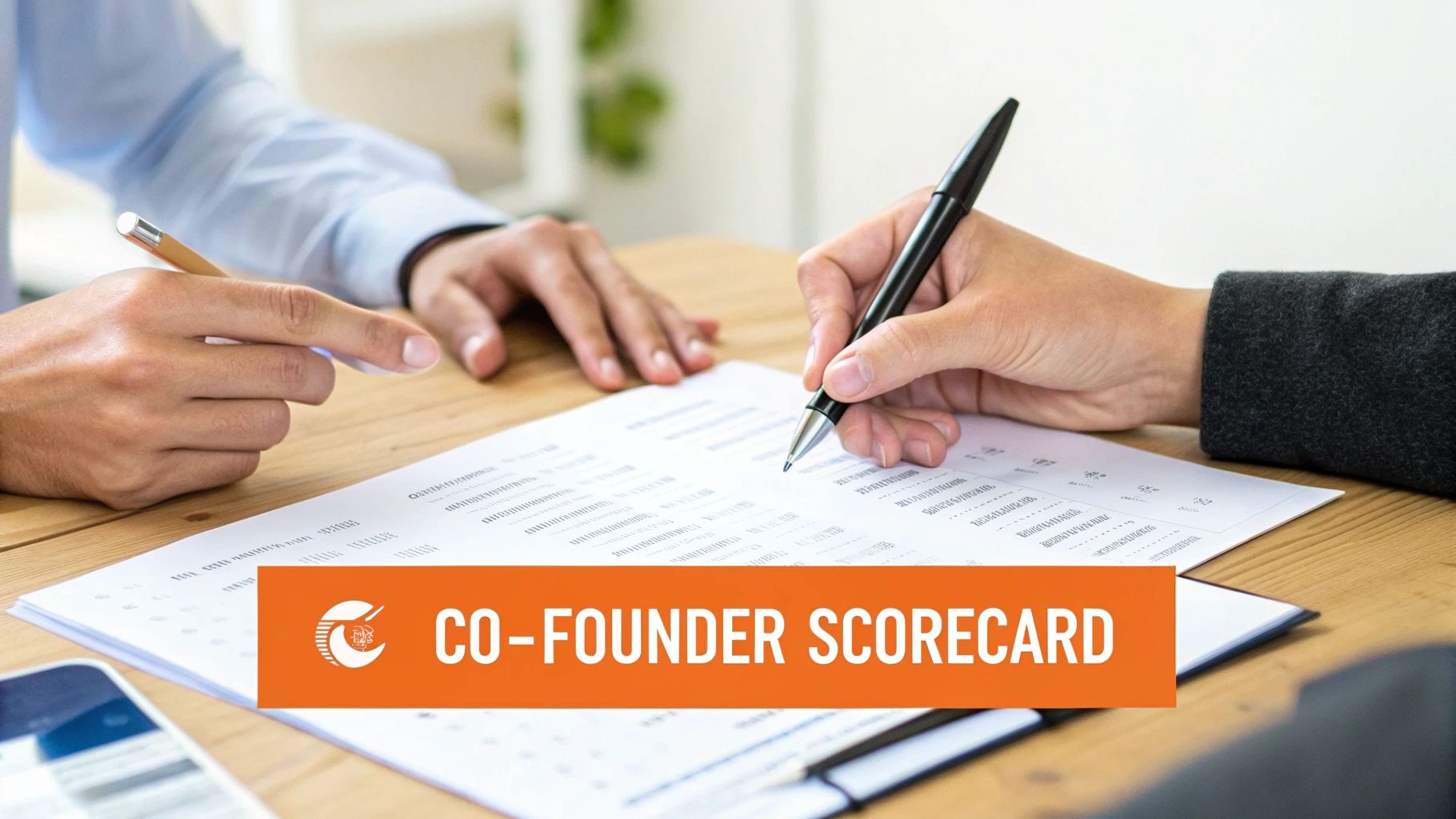
Let's turn this self-reflection into a practical tool. Build a "Co-Founder Scorecard" to objectively measure everyone you talk to. This keeps you from being distracted by a charming personality or an impressive resume that doesn't actually fit what you need.
Your scorecard should have three simple sections:
- Must-Have Skills: Based on your weaknesses, what abilities are non-negotiable? (e.g., "Proven experience scaling a B2B sales team," "Deep expertise in native iOS development.")
- Core Values: What principles are essential? (e.g., "Fanatical about customer feedback," "Unquestionable integrity," "Biased toward action over endless debate.")
- Personality Traits: What personal qualities will make for a healthy, resilient partnership? (e.g., "Stays calm under pressure," "Insatiably curious," "Communicates directly but with kindness.")
This scorecard becomes your North Star. It turns your search from a vague "I need a technical person" into a focused mission. Trust me, when you know exactly who you're looking for, finding them gets a lot easier.
Where to Hunt for Your Future Co-Founder
Let's be real: your perfect co-founder won't just appear at your door. Finding them takes deliberate, obsessive effort. Stop thinking of this as casual networking and start treating it like a high-stakes marketing campaign. You're the product, and you're searching for your single most important hire.
The secret is to go where the builders hang out. Immerse yourself in environments where people are doing, not just talking. This means looking past the usual professional networks and digging into the niche communities where the real work gets done.
The Best Digital Hunting Grounds
The internet makes finding talent easier, but it's also noisy. Generic platforms are often a waste of time. You need to focus on specialized communities built for founders and makers.
These platforms are like magnets for ambitious, proactive people.
- Y Combinator's Co-Founder Matching: This is a free, high-quality platform open to anyone—not just YC alumni. Think of it as a curated database of aspiring founders who are actively looking for a partner. The profiles are detailed, letting you filter by skills, industry, and location. It's a gold mine.
- Indie Hackers: This community is for bootstrappers and solo entrepreneurs building profitable online businesses. It’s a fantastic place to find scrappy, product-obsessed people who know how to ship. Don't just lurk—get active, share your progress, and you'll attract like-minded builders.
- Specialized Slack & Discord Groups: Almost every niche has a dedicated community server these days. Whether it's a group for AI developers, DTC brand owners, or FinTech nerds, joining these conversations puts you directly in touch with experts. Contribute value, answer questions, and make a name for yourself.
When you create profiles on these sites, be specific. Don't just say you're "looking for a technical co-founder." Instead, lay out the problem you're solving, any traction you have, and the exact skills and personality traits you need. Use that scorecard you made. Clarity is a powerful filter.
Offline Is Where Real Connections Are Forged
Online platforms are great for sourcing leads, but nothing beats face-to-face interaction for building real rapport. Meeting someone in person lets you gauge their energy, communication style, and passion in a way a Zoom call never can. You get a feel for the actual person, not just their digital resume.
The goal is to find events that attract doers, not just talkers.
Your best bet is to show up where people are solving problems under pressure. That's where you'll see someone's true character, work ethic, and ability to collaborate—qualities you can't screen for on a LinkedIn profile.
For those of us in the Midwest, it’s worth doubling down on local options. An in-person dynamic is hard to replicate remotely. For more ideas, check out our guide on how to find business partners in Chicago.
High-Impact Offline Venues
Prioritize events focused on building and learning, not just schmoozing. These environments let you see potential partners in their element.
Accelerator and Incubator Programs
These programs are intense experiences that attract motivated founders. Even if you don't get in, their demo days and public events are great places to meet people who have been pre-vetted for ambition and grit.
Industry Meetups and Conferences
Get specific. A generic "startup mixer" might be okay, but a conference on supply chain logistics or a meetup for SaaS marketers will be packed with people who have the deep domain expertise you might be missing. Go to learn and ask smart questions.
Hackathons and Startup Weekends
These are the ultimate trial runs. Working shoulder-to-shoulder with someone for 48 hours straight on a high-pressure project will tell you more than months of coffee chats ever could. You'll see how they handle stress, collaborate, and contribute when the clock is ticking. It's a real-world chemistry test.
The Vetting Process That Filters for True Fit
Alright, you've found a few promising candidates. Now the real work begins—separating the good from the great. The goal is to move past casual chats and into a structured process that reveals character, resilience, and compatibility.
Think of it like dating. The first few conversations are exciting, but you wouldn't get married after two dinners. You need to see how they act in different situations—when things are fun, when they’re stressful, and when you just have to do boring tasks together.
This process is your filter. It’s designed to simulate startup pressures before you sign any legal documents. It takes patience, but it’s the best way to avoid a catastrophic partnership later.
The search for a partner usually involves a mix of channels, from online platforms to offline events and accelerators. Each one brings a different type of candidate to the table.
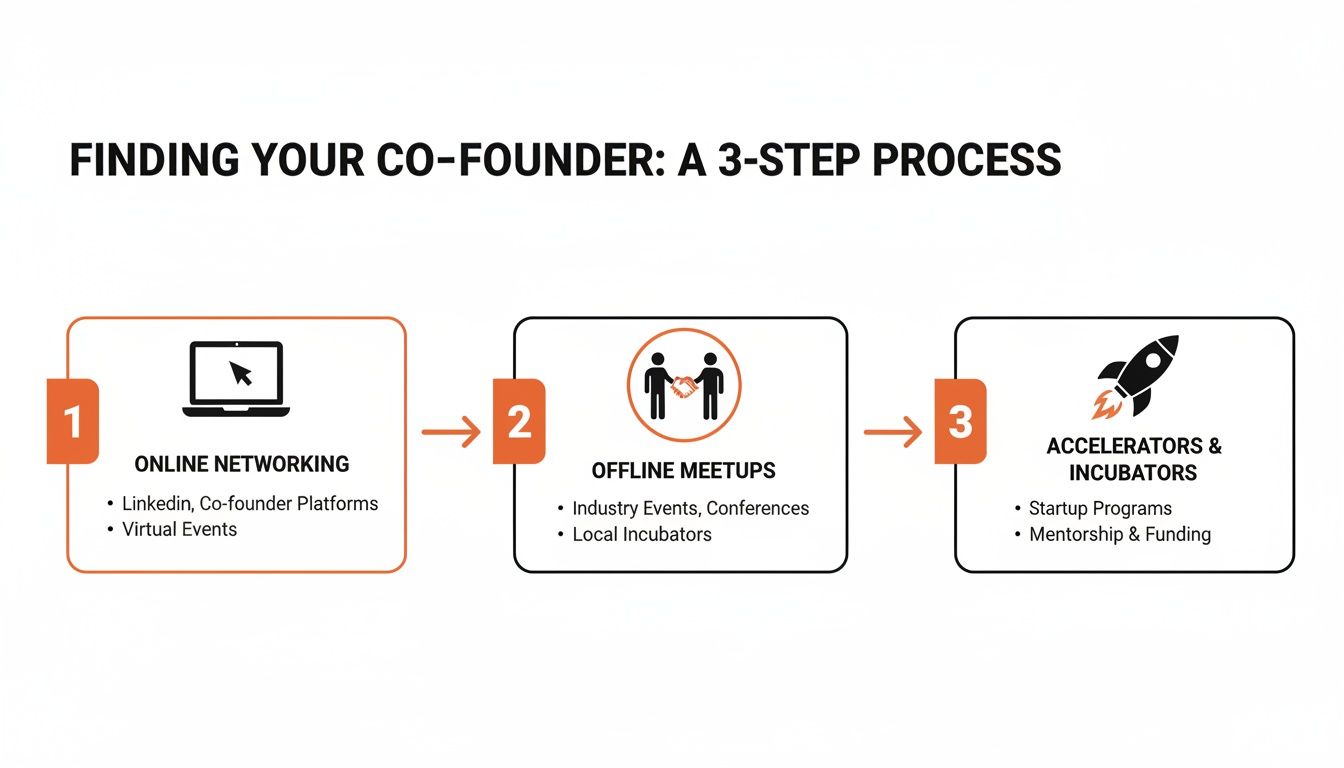
Finding potential co-founders is a multi-channel effort. Your vetting process must be robust enough to fairly evaluate people from completely different backgrounds.
Questions That Reveal Real Character
Your initial calls are for screening, not just a job interview. You need questions that peel back the layers of a rehearsed professional persona. Forget the easy questions.
Instead of asking, "Are you a hard worker?" try a question that forces a story:
-
"Tell me about a time a project you were leading went completely off the rails. What happened, and what did you do?" This reveals their problem-solving skills, accountability, and how they handle failure.
-
"Describe a professional disagreement where you were sure you were right, but you were wrong. How did you handle it?" This uncovers humility, self-awareness, and the ability to accept feedback—all non-negotiable traits.
These aren't trick questions. They are windows into how a person thinks and behaves under pressure. You’re looking for evidence of resilience, not just a perfect track record.
The most important quality to screen for is how someone handles adversity. Startups are a long series of challenges. You need a partner who gets stronger—not defensive or defeated—when things get hard.
Simulate the Real World with a Trial Project
After a few good conversations, it's time to move from talking to doing. The most effective vetting tool is the trial project. This is a small, well-defined task you work on together for a short period—maybe a weekend or a single week.
The project itself is less important than the process. It could be building a small feature, mapping a go-to-market strategy, or creating a customer survey. The key is that it forces you to collaborate under a deadline.
This trial period reveals things you can’t see in an interview:
- Communication Style: Do they go silent when they hit a roadblock or communicate proactively? How do they give and receive feedback?
- Work Ethic: When the deadline nears, do they step up or fade away? Do their actions match their words?
- Problem-Solving: How do they react to unexpected obstacles? Do they get flustered or resourceful?
Think of this as a "work sample" for your business marriage. It’s a low-stakes way to test your partnership dynamics before making a life-altering commitment. If it feels like you're dragging them across the finish line, that's a massive red flag.
A Framework for Deeper Interview Questions
As you move through the process, your questions should get more specific. Shift from general character probes to deeper assessments of skills, values, and vision.
Here’s a simple framework to guide those deeper conversations.
Co-Founder Interview Question Framework
A structured set of questions designed to assess skills, values, and vision in potential co-founders.
| Category | Sample Question | What You're Looking For |
|---|---|---|
| Resilience & Grit | "Walk me through your biggest professional failure. How did it change you?" | Accountability, self-awareness, and the ability to learn from setbacks. Avoids blaming others. |
| Values Alignment | "What's a professional decision you made that wasn't popular but was the right thing to do?" | Integrity, an ethical backbone, and a willingness to prioritize principles over easy wins. |
| Vision & Ambition | "If we succeed beyond our wildest dreams, what does that look like to you in five years?" | Alignment on the scale of ambition. Are they aiming for an acquisition, an IPO, or a lifestyle business? |
| Conflict Resolution | "Tell me about a time you had a major disagreement with a colleague. How did you resolve it?" | Communication skills, empathy, and the ability to have productive conflict without damaging the relationship. |
This structured approach ensures you aren't just swayed by charisma. It forces you to gather actual data on the traits that truly matter for a long-term partnership.
By the end of this process, you won't just think you've found the right person—you'll have evidence to back it up.
Talking Equity and Getting the Legal Stuff Right
Alright, you’ve found your person. The vibe is right, the trial project went great, and you’re ready to make it official. Now comes the first real test of your partnership: talking about equity.
This conversation feels heavy because it is heavy. It’s about money, ownership, vision, and commitment. But dodging this talk is one of the biggest mistakes you can make. Think of your company’s equity like a pie you’re baking from scratch together. How you slice it says everything about your partnership.
Why 50/50 Is a Trap
The default for many founders is to just split everything 50/50. It feels fair and it’s easy. But "equal" isn't always "fair." An even split can lead to total deadlock later and often ignores different contributions.
Picture this: one founder quits their job to go all-in. The other keeps their 9-to-5 and helps on weekends. Or what if one founder puts $50,000 of their own savings into the company? A rigid 50/50 split doesn't account for that.
A healthier way is a dynamic conversation based on what each person brings to the table. Get real about these factors:
- The Idea & IP: Who came up with the core concept? Who built the first prototype?
- Time Commitment: Who is working full-time versus part-time? Be honest about the hours.
- Cash on the Line: Is one partner putting in their own money? Capital is a tangible risk.
- Experience & Connections: Does one of you have a game-changing network or a decade of rare industry expertise?
Having this conversation openly builds trust. It proves you can navigate hard, practical stuff together. If you're wrestling with the financial side, our guide on how to start a business with no money has some solid advice.
Your New Best Friend: The Vesting Schedule
I’m serious. No matter how you split the equity, you must have a vesting schedule. This is non-negotiable. A vesting schedule is a safety net that protects the company if a co-founder leaves early.
It’s simple: equity is earned over time. The industry standard is a four-year vesting schedule with a one-year "cliff."
- Four-Year Term: A founder earns their full equity stake by staying with the company for four years.
- One-Year Cliff: This is critical. If a founder leaves before their one-year anniversary, they walk away with zero equity. The minute they cross the one-year mark, 25% of their shares "vest" instantly. The rest is earned monthly over the next three years.
A vesting schedule with a cliff is the single best tool for ensuring commitment. It protects the company and the founders who stick around from someone leaving after six months but still owning a huge chunk of the business.
Put It In Writing: The Legal Docs You Can't Skip
A handshake agreement is worthless in business. You need legally binding documents. This isn’t about mistrust; it’s about professional clarity. Getting this right now prevents catastrophic fights later.
You’ll need two key documents at a minimum:
- Founders' Agreement: This is the constitution for your partnership. It spells out roles, responsibilities, the equity split, the vesting schedule, and how major decisions get made. It should also cover what happens if a founder wants to leave, becomes disabled, or passes away.
- Intellectual Property (IP) Assignment: This agreement makes it clear that all work—the code, designs, brand name—is owned by the company, not the individuals who created it. This is critical for fundraising and protecting your assets.
Don't use a template you found online. Spend the money and hire a lawyer who specializes in startups. It will be one of the best investments you ever make.
Burning Questions on the Co-Founder Search
The hunt for a co-founder is a strange journey full of tough calls. Getting clear on the big questions is your best defense against making a huge mistake. Here's my straight-up advice on the most common dilemmas.
How Long Does This Actually Take?
Look, there’s no magic number. Prepare for a marathon, not a sprint. This process can take a few months or even more than a year.
Giving yourself that runway is critical. Rushing this decision is one of the most damaging mistakes you can make.
Think about it: you wouldn't scramble to code your entire product in a weekend just to launch something. You'd take the time to build it right. Finding your partner deserves that same patience. It's a direct investment in your company's foundation. A few extra months of searching is nothing compared to years of misery with the wrong person.
What Are the Biggest Red Flags to Watch Out For?
Every situation is unique, but some red flags are universal. These are neon signs pointing to deep issues that will poison a partnership.
Keep a sharp eye out for these warning signs:
- A Lack of Real Commitment: This is the big one. If you’re all-in and they're treating this like a side project, that imbalance will eventually sink you. You need someone who matches your fire.
- Awful Communication Habits: Do they go dark for days? Do they dodge tough conversations? If they can’t handle a little stress during a trial project, imagine what happens when real pressure is on.
- Obsessing Over Title and Equity: Be wary of anyone more hung up on their title or the equity split from day one, before any value has been created. A real partner is obsessed with building the business.
- Zero Curiosity or Coachability: The best partners are sponges for knowledge. If a candidate isn’t asking questions about your industry, your customers, or your point of view—or gets defensive with constructive feedback—that's a huge problem.
A bad co-founder is infinitely worse than no co-founder. Trust your gut. If something feels off during the vetting process, don't ignore it. It’s always better to walk away from a "pretty good" fit to keep searching for a truly great one.
Is It Better to Partner With a Friend or a Stranger?
This is the classic dilemma, and both paths have landmines. There’s no single right answer, just what’s right for you.
Bringing on a friend means you start with built-in trust and rapport. The downside? The intense pressure of a startup can strain—or destroy—a great friendship if you’re not careful. It can also be harder to have the brutally honest conversations your business needs.
Partnering with a stranger lets you build a purely professional relationship. This can make things like equity splits and role definitions more straightforward. The trade-off is that it takes a lot longer to build the deep trust you'll need to survive the storms.
The only solution? Put every candidate—friend or stranger—through the exact same rigorous vetting process. A strong friendship is an asset, but it is never a substitute for proven professional compatibility and a rock-solid legal agreement.
How Do I Break Up With a Potential Co-Founder After a Trial?
This is a tough conversation you have to learn how to have. The key is to be direct, respectful, and kind. You've both sunk time into this, and handling it with class protects your reputation.
First, schedule a specific call or meeting. Never do it over text or email.
Start by genuinely thanking them for their time and effort. Then, just get to it. Calmly and clearly state that you've decided the fit isn't right for a long-term partnership.
It’s better to frame this around compatibility—"I think we have different working styles that would create friction down the road"—than to make it a personal attack. Wish them the best. By handling the "breakup" with grace, you close the door on the partnership but keep the door open on your professional network.
Finding the right people to build with is everything. At Chicago Brandstarters, we connect kind, bold, and hardworking founders in the Midwest through a vetted community built on real support, not just transactional networking. If you’re tired of going it alone, join us to share war stories, solve tough problems, and build lasting friendships that will move your business forward. Learn more about our free community.