
Let's be honest. The thought of raising your prices can tie your stomach in knots. It feels like you might betray the very people who believed in you from day one. I've been there.
But you have to stop thinking of a price increase as greed. It's a vital sign. Think of it like this: your business is a growing plant. A price increase is like moving it to a bigger pot with better soil. It means your business is healthy, growing, and ready to deliver even more value—which is exactly what your best customers want.
For too long, you’ve probably whispered your prices, afraid to ask for what you're really worth. I want you to speak up. This isn't about shouting from the rooftops; it's about clearly and confidently explaining the value you bring. You're not just covering your costs; you're investing back into the product and service your customers rely on.
Core Principles for a Successful Price Increase
Here's a quick summary of the essential strategies you should keep in mind before you raise your prices. Think of this as your foundational checklist.
| Principle | Why It Matters | Your First Action Step |
|---|---|---|
| Value Justification | Your customers need a reason. If the value isn't clear, the price feels arbitrary. | List 3 new features or improvements you've added in the last year. |
| Customer Segmentation | Not all your customers are the same. You need to treat your loyal fans differently. | Identify your top 10% of customers by lifetime value or usage. |
| Transparent Communication | Surprises create mistrust. Your honesty builds loyalty, even with bad news. | Draft a simple, direct email explaining the "why" behind the change. |
| Strategic Timing | A price hike during a slow season or after a major success can soften the blow. | Look at your business calendar. When is your next big product win? |
Following these principles turns a potentially negative event into a positive statement about your brand's growth and your commitment to quality.
From Fear to a Framework
The biggest hurdle you face is mental. You need to shift your thinking from cost to investment. When someone buys from you, they are investing in a solution to their problem. Your price has to reflect the return they get on that investment.
Are you saving them hours of work? Making them more money? Getting rid of a massive headache? Your price tag should mirror that impact.
So many of us get paralyzed here because we're terrified of a mass exodus. But that fear is usually based on gut feelings, not actual data. I want you to move away from emotional reactions and toward a strategic approach. You'll make much better choices when you have a framework for making decisions.
A price increase is a filter. It helps you weed out the customers who only care about the cheapest deal and attract those who genuinely value your work. This is how you build a sustainable business with a base of true fans.
Finding Your True Fans
Not all of your customers are created equal. Some are your biggest cheerleaders, and others might have one foot out the door already. The trick is to figure out who's who before you announce anything.
Start by digging into your customer data. Who has been with you the longest? Who uses your product the most? Who has sent you referrals? These are your true fans. They're your most valuable asset.
This is so important because keeping customers is a huge profit driver for you. Seriously, a small 5% boost in your customer retention can launch your profits up by 25% to 95%. These loyal buyers also spend 31% more over their lifetime and are way more likely to buy from you again than a new customer.
Knowing these numbers should give you the confidence to focus on protecting these high-value relationships while you adjust your pricing for everyone else. This initial analysis is the foundation for a price change you can feel good about.
Segmenting Customers for a Smarter Price Rollout
Applying a single, blanket price hike to everyone is one of the most common mistakes I see founders make. It's like using a sledgehammer when you need a surgical scalpel. This approach treats your most loyal fan, who's been with you for years, exactly the same as some random person who signed up last week. You'll make your best people feel completely unappreciated.
You need to get smarter about your rollout. Think of your customer base not as one giant blob, but as distinct neighborhoods, each with its own character and needs. Your job is to understand these neighborhoods before you decide how to approach them.
Identify Your Customer Groups
First things first, divide your customers into a few simple groups. You don't need a complex data science model for this; just look at their behavior. I usually see three main segments emerge:
- Your Champions: These are your die-hard fans. They’ve been with you for ages, use your product all the time, and have probably even referred new business your way. They're the least price-sensitive because they're deeply invested in the value you provide.
- Your Potentials: This group sees the value but might not be fully bought-in yet. They use your service but maybe not to its full extent. They see the promise but you could lose them to a competitor if a price jump feels unjustified.
- The At-Risk Group: These are your low-engagement users. They might be on a legacy plan, barely log in, or only use one minor feature. They are highly price-sensitive and the most likely to churn at the first sign of a price increase.
This simple exercise instantly clarifies who you need to protect and where your real opportunity is. It transforms your strategy from a risky gamble into a calculated move. For a deeper look, you can explore some advanced customer retention tactics that build on this foundation.
The Power of Grandfathering
Once you've sorted your customers, you can use one of the safest and most effective strategies for raising prices without losing them: grandfathering.
This just means you lock in your existing, loyal customers (your Champions and maybe even some Potentials) at their current price. You can do this permanently or for a set period, like a year. The new, higher price only applies to new customers signing up from a specific date forward.
Grandfathering does more than just reward your loyalty; it acts as a powerful quality filter. It weeds out the low-commitment "tire-kickers" and attracts a higher caliber of customer who is serious about your solution from day one.
This approach takes a ton of risk out of the whole process. Your existing revenue base is protected, your best customers feel valued, and you get to test your new price point on an audience that has no prior bias.
This is your path to pricing with confidence. You reframe your thinking, analyze your actual customers, and then act with a clear strategy like grandfathering.
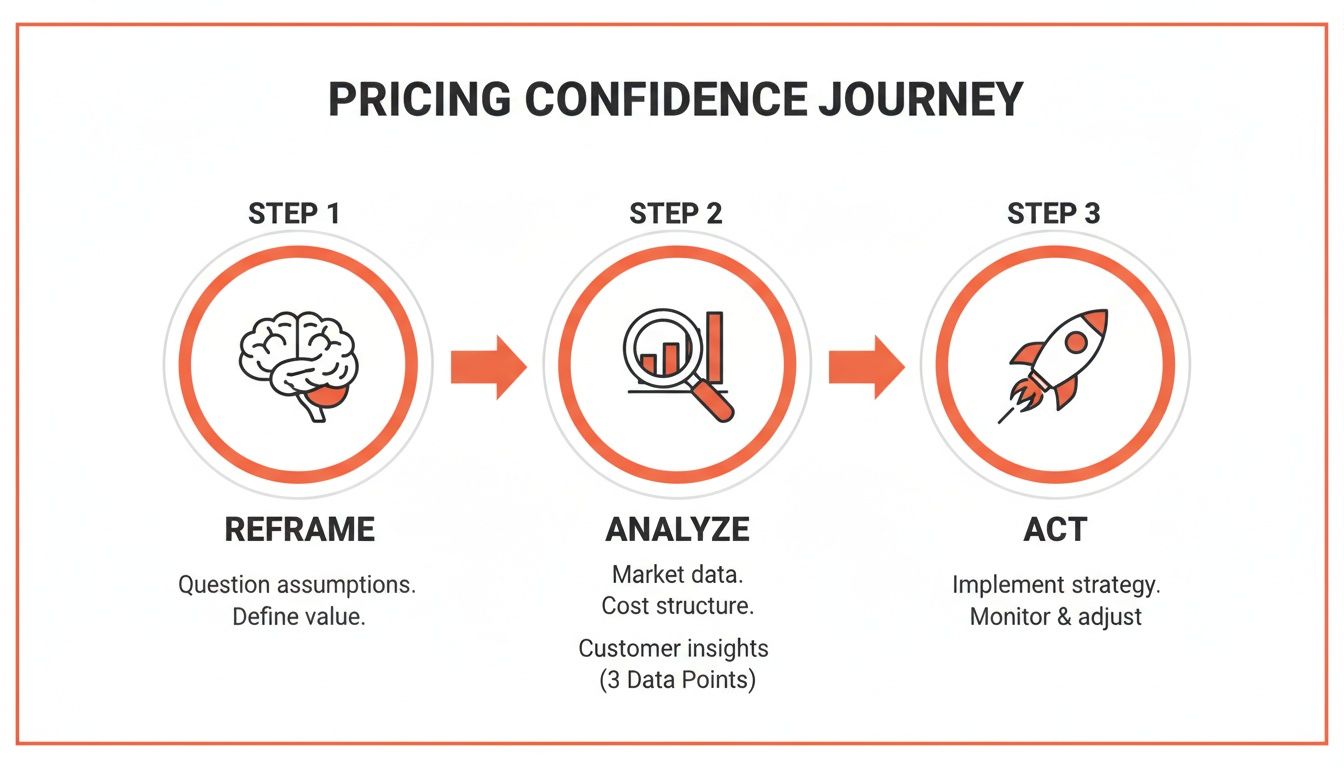
The key takeaway for you is that confidence comes from a process, not just a feeling. When you follow these steps, you replace fear with a plan backed by your own data.
In fact, one proven method you can use is to roll out a 25-35% price increase just for new signups while keeping all existing customers on their old plan. In one real-world case I saw, conversions for new customers held steady after the change. But the real win for them? Retention metrics for the new, higher-paying group saw a significant boost over a 90-day period. Sometimes, a higher price signals higher value and attracts a better, more committed customer for you.
Crafting Your Price Increase Announcement
This is the part that trips us all up. You’ve done all the strategic work behind the scenes—the math, the customer segmentation, the value analysis. But if you fumble the announcement, all that effort goes down the drain.
How you tell people about the change is just as important as the change itself. A bad email from you can destroy years of trust in minutes. Think of this less as a corporate memo and more as a direct, honest conversation with the people who believed in you from the start.
The Anatomy of an Authentic Announcement
I’ve seen so many founders hide behind awful corporate jargon like “adjusting for market conditions” or “to better serve you.” It’s a total cop-out. These phrases are empty and just create distance. Your customers are smart; they deserve the real story from you.
A great announcement is direct, confident, and empathetic. You're not apologizing. You're explaining.
Here’s what I’ve found works every time for me:
- A No-Nonsense Subject Line: Don't get cute. Something straightforward like "An Update on Our Pricing" or "Changes to Your [Product Name] Plan" is perfect.
- Start with Gratitude: Seriously. Thank them for being a customer. Acknowledge their support. It shows you see them as partners, not just numbers on a spreadsheet.
- The "What" and "When": Be painfully clear. State that prices are changing and give the exact date. Ambiguity is your worst enemy and will only lead to angry support tickets.
- The "Why" (Your Value Story): This is where you connect the dots. "This increase allows us to invest in X, Y, and Z, which will help you achieve [specific customer goal] faster." Make it tangible.
- Spell Out "What's in It for Me?": Frame the new investment in terms of direct benefits. Will the new features save them 10 hours a month? Will the server upgrade make your app 50% faster? Be specific.
Your goal isn't to make customers happy about paying more. It's to get them to read your email, nod, and think, "Okay, that's fair." That's what transparency does. It builds the kind of trust that makes a customer stick with you, even when the price goes up.
Choosing Your Channel and Timing
Email is your best bet, hands down. It’s direct, you can personalize it, and it gives everyone a written record to refer back to. You can support it with a heads-up in your app or a banner on your site, but the email is non-negotiable.
Timing is everything. You absolutely have to give people a good amount of notice. I recommend at least 30 days. For anyone on an annual plan, I’d push that to 60-90 days, especially if their renewal is just around the corner.
And whatever you do, don't send it on a Friday afternoon or right before a holiday. You’re just asking for it to get missed or ignored. Mid-week, mid-morning is usually the sweet spot for me.
Price Increase Email Template Breakdown
To make this super practical for you, I've put together a table comparing a weak, generic email to a strong one that builds trust. It’s a side-by-side look at what to avoid and what to lean into.
| Email Section | Weak Example (What You Should Avoid) | Strong Example (What You Should Use) |
|---|---|---|
| Subject Line | Important Update | A Look Ahead at Our Pricing |
| Opening | Due to market dynamics, we are adjusting our prices. | Thank you for being a core part of my journey. As I grow, I'm investing in key areas to improve your experience. |
| The "Why" | To better serve you, our prices will increase. | To fund a faster server network and launch the new analytics dashboard you've asked for, I'm updating my pricing. |
| The Action | Effective October 1, the new price will be $49/month. | On October 1, the price of your plan will change to $49/month. This helps me deliver more value, like [Feature 1] and [Feature 2]. |
| Closing | We appreciate your business. | I am committed to your success and excited about what's next. If you have any questions, just reply to this email. |
See the difference? The weak example is all corporate fluff. The strong one is specific, connects the price to real value, and sounds like a human wrote it.
This is how you do it. You treat your customers with respect, you tell them the truth, and you remind them why they chose you in the first place.
Using New Tiers and Bundles to Add Value
A price increase doesn’t have to be a blunt, take-it-or-leave-it ultimatum. Instead of just slapping a new price on your old offer, you can completely re-architect it. This is a game-changer. It turns what could be a negative experience into a moment where your customers feel like they’re getting an upgrade.
Think of it this way: a straight price hike is like telling diners the steak is now more expensive. End of story. Re-packaging is like rolling out a brand new, way more impressive "Steak Frites" platter that now includes killer fries and a house-made sauce.
Sure, the price is higher, but the value is visibly higher, too. You’re giving people a new, better choice, not just a bigger bill. This is a subtle but incredibly powerful way for you to handle a price increase without making your customers feel cornered.
Re-Architecting Your Offer With New Tiers
The goal here is to give your customers options that put them back in the driver's seat. Introducing new tiers is a classic, battle-tested way for you to do this. You're not just jacking up the price on their current plan; you're shuffling the deck and dealing them a few new, interesting cards.
Here’s how I’ve seen it work beautifully:
- Introduce a Premium Tier: This is your chance to really go for it. Bundle all your best, most powerful new features into an "Ultimate" or "Pro" plan. This new, high-priced tier acts as a price anchor, making your other plans look like a steal in comparison.
- Create a "Lite" Version: On the flip side, you can build a new, lower-priced tier with fewer features. This gives your most price-sensitive customers a place to land instead of just churning out. It’s a safety net that catches people who would have otherwise bailed.
This strategy completely reframes the internal conversation your customer is having. It changes from, "Ugh, should I pay more for the same thing?" to "Hmm, which of these new plans is the right fit for me now?" You get them suddenly thinking about value, not just cost.
The magic of new tiers is that they shift your customer's mindset from loss aversion (losing money) to one of choice and potential gain (choosing the right plan). It reframes the entire decision-making process in your favor.
The Art of the Strategic Bundle
Bundling is another killer tactic for you to add perceived value without necessarily adding a ton of cost on your end. It's all about combining existing features or services in a way that feels like a bonus to the customer.
You should start thinking about what you can bundle together to make a higher price point feel like a no-brainer. Can you toss in an exclusive e-book? A one-on-one setup call? Maybe priority support? These things often cost you very little to provide but feel incredibly valuable to the customer.
The key is packaging your offer so the new price feels like a genuine deal. If you want to dig deeper into the psychology of this, you should check out our guide on how to define premium pricing and what goes into it.
This approach is so much better than "shrinkflation"—that sneaky move where companies give you less product for the same price. Instead, you're being upfront and offering more value to justify the new cost. While some studies show customers don't always notice downsizing, being transparent builds trust. We're playing the long game here, and being straight about adding more value for a new price is always the right move for you.
By creating new tiers and smart bundles, you give your customers a sense of control. You're not forcing their hand; you're inviting them to choose a better future with your product. This is how you confidently raise your prices and keep your best customers rooting for you.
After the Announcement: How to Manage the Fallout
You’ve sent the email. The price change is out in the wild. Now what?
Your job just flipped. You’ve gone from broadcasting a message to listening for the fallout. This is where the real work begins—finding out if your product is as valuable as you think it is. You're not just kicking back and waiting for the dust to settle; you’re on high alert, gathering intel.
It’s like that moment after you’ve pushed a big new feature live. The code is deployed, but now you’re glued to the server logs, watching for errors. You can't just walk away. You have to watch the gauges.
The Key Gauges on Your Dashboard
Your gut will scream that everyone is angry, but you need real data to tell you if you're actually in trouble or just hitting some expected turbulence. Not all feedback is a fire alarm. Your mission is to sort the real signals from the predictable noise.
Here are the "instruments" I watch on my own dashboard right after a price change:
- Customer Churn Rate: This is the big one. Are more people bailing than usual? You need to look at both the number of customers leaving and, more importantly, the revenue you're losing (revenue churn). A small spike is totally normal. A huge, sustained one means you miscalculated.
- Support Ticket Volume & Sentiment: Your support team is on the front lines, taking all the heat. Don't just track how many tickets mention the price change. Read them. Are people just confused, or do they feel betrayed? That qualitative data is pure gold for you.
- Net Promoter Score (NPS): If you run NPS surveys, keep a close eye on the score after your announcement. A big dip tells you that even customers who stayed are less likely to recommend you, which will poison your growth down the line.
And please, don't look at these numbers in a vacuum. Context is everything for you. A 5% spike in churn sounds terrifying, but if your baseline was already 4%, it's a manageable bump. If your baseline was 1%, you have a problem.
Separating the Signal from the Noise
A few angry tweets or scathing emails can feel like a complete disaster. It's so easy for you to panic and start thinking you’ve blown up your entire business.
Trust me, you probably haven't. The loudest people are often a tiny minority.
The signal is a pattern. It’s when several of your best customers—the ones you’d hate to lose—all start saying the same thing. The noise is a few random, low-value users complaining about a price they were never happy with in the first place. Don't let the noise drown out the real signal for you.
This is exactly why you did that customer segmentation work earlier. If your "At-Risk" folks are leaving, well, you expected that. But if your "Champions" start heading for the exit, that’s a five-alarm fire.
How You Should Respond and Recover
How you react to the feedback is just as critical as the price change itself. This isn't the time for you to get defensive. It’s about proving you're listening and have a game plan.
Empower your support team with this simple framework:
- Listen and Empathize: Seriously, the first step is to just hear them out. Sometimes, a customer just wants to feel acknowledged. A simple, "I get it, I can see why this is frustrating" works wonders.
- Offer a Solution (When It Makes Sense): Not everyone gets a special deal. But for a valuable, long-term customer who is genuinely in a tough spot, you should have a plan ready. Maybe it's a temporary 3-month discount or an offer to switch to an annual plan to lock in their old rate for a year.
- Give Them a Downgrade Path: If they absolutely can't afford the new price, show them a clear path to a lower-cost plan (if you built one). It’s so much better to keep them in your world than to lose them completely to a competitor.
Here’s a fascinating stat: some studies show a 1% price increase can bump the probability of a customer leaving from 14% to 21%. That sounds bad. However, the same data also shows that demand almost always bounces back after the initial shock, with the negative impact on revenue fading over about 10 months.
You can dig into the economic reports yourself over at the Richmond Fed, but the takeaway for you is this: you might see a churn spike, but your loyal customers will stick around if the value is there.
By keeping a close eye on your metrics and responding with a human touch, you can get through this post-announcement chaos and prove that raising your prices was the right call.
Tough Questions I Always Get About Raising Prices
You've strategized, you've segmented your customers, and you've drafted the emails. But now the real anxieties start to creep in. I've been there, and I've walked countless founders like you through this exact moment.
After all the planning, these are the questions that keep people up at night. Let's tackle them head-on.
How Often Can I Raise Prices Without Pissing People Off?
There’s no magic formula here, but a solid rule of thumb I give is to avoid raising prices more than once every 12-18 months. Any more often and you start giving your customers "price anxiety."
They'll feel like the floor is constantly shifting under them. That kind of instability makes even happy customers peek at your competitors, just in case.
The trick is to make every price increase you make feel earned. Did you just ship a game-changing feature? Did you massively upgrade your support or service? If you can point to a huge jump in value since the last time you asked for more money, people will get it.
Here's a pro move for you if you run a subscription business: When you announce the new price, also announce you're 'locking it in' for the next 18-24 months. This completely kills price anxiety and replaces it with a feeling of stability. Your customers love that.
What If My Competitors Are Way Cheaper?
It’s a trap. Don't fall for it.
Competing on price is a race to the bottom. It's a death spiral that attracts the absolute worst customers—the ones with zero loyalty who will ditch you tomorrow for a five-cent discount.
Instead, you need to compete on value. On service. On brand. Your goal isn't to be the cheapest; it's to be the 'most reliable,' the 'best-supported,' or the 'expert's choice.' Your goal is to win the right customers, the ones who see what makes you different and are happy to pay for it.
Let your competitors fight over bargain hunters in the mud. You’re busy building something on solid ground. Your marketing needs to shout from the rooftops why you're worth more. No apologies.
Should I Test My New Prices Before Going Live?
Yes, but you have to be smart about it. The classic A/B test—where you show different prices to different visitors at the same time—is a landmine. People will find out, and when they do, they feel tricked. It's just not worth the damage to your brand's reputation.
A much cleaner, safer way for you to do this is with cohort-based testing. It's simple:
- You pick a date. Let's say May 1st.
- Starting that day, every new customer sees the new, higher price.
- You watch this "May cohort" for the next 30-90 days.
- Then, you compare their conversion rates, churn, and LTV against the "April cohort" that signed up at the old price.
This gives you clean, real-world data without making anyone feel like a lab rat. You’re testing the price in a real scenario, not some chaotic experiment.
What's The Single Biggest Mistake I Need to Avoid?
Easy. It's a toxic combination of poor communication and zero justification.
Just changing the number on your pricing page without a thoughtful, proactive heads-up is a slap in the face to your customers. It screams, "I don't value you enough to even explain this." It's arrogant.
You have to, have to, have to communicate the "why" way in advance. Frame the entire conversation around how this change allows you to build a better product and deliver more value for them.
Transparency is the currency of trust. And trust is the only thing that lets you raise your prices while keeping your best customers cheering you on.
The journey of building a brand is filled with tough moments like these. At Chicago Brandstarters, I believe you shouldn't have to face them alone. We've built a private, vetted community of kind and bold founders who share their war stories and help each other win. If you're a builder in the Midwest who values honest support over transactional networking, I'd love to have you. Learn more and apply to join our community.