Let's get straight to it. When you're just starting, rapid prototyping means building a 'good enough' version of your idea to see if anyone actually wants it—before you go broke building the real thing. It's my simple strategy of testing first, building later.
What Does Rapid Prototyping Mean in Practice?
Think of it like building a movie set. If I need a castle scene, I don't build a real medieval fortress with working plumbing. No way. I build a convincing facade—just the front wall—to see how it looks on camera and if the story even works.
That’s exactly what you do as a founder. You build the facade for your business idea. You create a simple, tangible version of your product, put it in front of real people, and get their honest feedback, fast and cheap.
It’s Not Just About 3D Printers
So many people hear "prototyping" and picture a 3D printer spitting out some plastic gadget. That's one way, sure, but the real idea is way bigger. I see it as a mindset, not a specific tool. The point isn’t to build a perfect product; it's to learn as much as possible with the least amount of work.
This approach is your best defense against the #1 startup killer: building something nobody wants. It's a hard truth. By putting a scrappy version of your vision into the hands of potential customers, you force yourself to answer the most important questions right away:
- Do people even get what my idea is?
- Does this actually solve a problem they have?
- Would they open their wallets for this?
Getting blunt answers to these questions is your superpower. It lets you change course, make things better, or even scrap a bad idea without burning through your savings or wasting months of your life.
I believe a prototype is just a question you're asking in physical form. You’re not showing off a masterpiece. You’re asking, "Hey, does this make any sense to you?" The feedback is worth a hundred times more than any business plan you could write.
Turning Thoughts into Things
So what does this look like for you? It means you stop saying, "I have an idea," and start saying, "Let me show you." You create something real enough for someone to have a genuine reaction.
This could be a napkin sketch, a clickable mockup of an app, or even a simple landing page describing a service you haven't built yet. The format doesn’t matter nearly as much as the feedback you get. It's the fastest way I know to get from a thought in your head to an idea tested in the real world.
Choosing Your Prototyping Toolkit
Alright, now that you get the "why" behind rapid prototyping, let's dive into the "how." I think of picking your method like choosing the right tool for a home project. You wouldn't use a sledgehammer to hang a picture frame, and you wouldn't use a tiny screwdriver to break down a wall.
The best approach always depends on what you're trying to build and what you need to learn. So, what does this mean when it comes to tools? It means having a versatile set of options, from dirt-cheap to digitally advanced. I'll walk you through four of my go-to techniques that I see founders use all the time.
Paper Prototypes: The Smart Napkin Sketch
This is exactly what it sounds like, but with more purpose. You grab a pen and paper—or index cards, or a whiteboard—and you sketch out the core screens or steps of your product. Seriously, that’s it.
I see it as creating a storyboard for your app or website. Each piece of paper is a different screen. When you show it to someone, you act as the "computer," swapping out pages as they "tap" on buttons. It's ridiculously simple, but it forces you to clarify your user's journey. This is your first line of defense against a confusing product flow.
3D Printing: Turning Digital into Physical
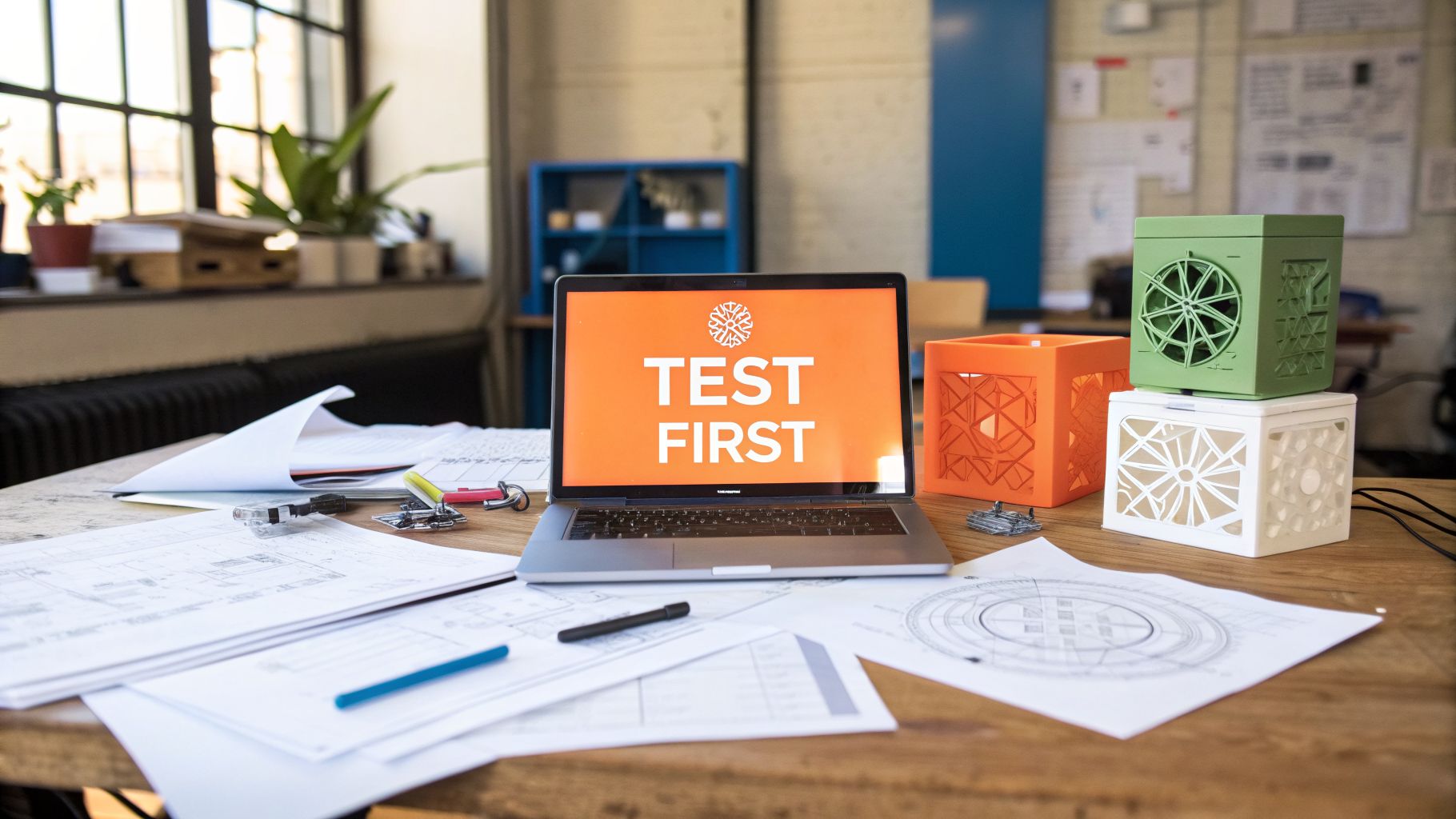
When you need to know how something feels, fits, or functions in the real world, 3D printing is your best friend. You take a digital design from your computer and turn it into a physical object you can hold in your hands within hours.
This is critical for physical products, like a new kitchen gadget from a local Chicago maker or custom packaging for a brand. I can't tell you if a grip is comfortable from a screen model. Printing a prototype answers that question immediately, saving you from a five-figure mistake on a factory order.
The core idea I want you to remember is to test an idea, validate it, and then build.

This simple flow helps you avoid common pitfalls. You have an idea, you test it, and only then do you commit serious resources to building it out.
Clickable Prototypes: The Fake App That Feels Real
Here, you use tools like Figma or Canva to create a high-fidelity mockup of your digital product. It looks and feels like a real app or website, but there's no code behind it. Users can click through screens and interact with buttons as if it were live.
This is the perfect way I know to test a user interface and get feedback on usability. You can see where people get stuck, what they find confusing, and what they love—all before you've paid a developer a single dollar.
Concierge and Landing Page Tests
This is my favorite for service-based ideas. A concierge test means you manually deliver the service you plan to automate. If you're building a meal-planning app, you'd start by being a personal meal planner for a few clients via text. It's not scalable, but you learn exactly what your customers need.
A landing page test is even simpler. You build a one-page website describing your product and include a sign-up button to gauge interest. Driving a little traffic to it (even just $50 in ads) tells you if anyone actually cares. For a deeper dive, you can learn more about prototyping for product design in our complete guide.
With a concierge or landing page test, you're not prototyping the product; you're prototyping the demand. I find it's the ultimate test of whether you've found a problem worth solving.
Which Rapid Prototyping Method Is Right for You?
Feeling a bit overwhelmed? Don't be. Choosing the right method just comes down to what you need to learn right now. Are you testing the flow, the feel, the interface, or the market?
Here's a quick cheat sheet I made to help you decide.
| Method | Best For | Cost | Speed | Best Use Case Example |
|---|---|---|---|---|
| Paper Prototype | Mapping out user flows and core concepts | Nearly free | Extremely fast | Sketching the screens for a new mobile banking app. |
| 3D Printing | Physical products for form, fit, and feel | Low to medium | Fast | Printing a new ergonomic mouse shell to test in-hand. |
| Clickable Prototype | Digital products for UI/UX and usability | Low (free tools) | Fast | Building a Figma mockup of a travel booking website. |
| Concierge/Landing Page | Validating demand for a service or product | Very low | Very fast | Creating a sign-up page for a curated newsletter. |
Remember, you aren't married to just one method. I've seen many successful founders mix and match. You might start with a paper prototype to get the flow right, then build a clickable version in Figma to refine the design, all before writing a single line of code. The key is for you to stay nimble and learn as much as you can, as fast as you can.
Why Prototyping Is Your Startup Superpower
Let's be real—building a brand from scratch is a high-stakes game. Every dollar counts. I want you to start thinking of rapid prototyping as your secret weapon, the superpower that helps you work smarter, not just harder. It's how you stack the deck in your favor.
The most immediate win? You slash your financial risk. Instead of dropping thousands of dollars to build a polished product that might bomb, you can spend a few bucks to see if the core idea even has legs.
Cut Your Financial Risk
Picture two paths. Path A is spending six months and your life savings to build a beautiful, perfect app. Path B is spending a weekend and fifty bucks on a clickable prototype to see if anyone even gets what you're trying to do.
Prototyping is always Path B. I'm all about making the smallest bet possible to get the biggest answer. This isn't about being cheap; it's about you being strategic with your cash when it's most precious.
Supercharge Your Learning Speed
Beyond just saving money, rapid prototyping is an incredible learning machine. It crushes what could be months of my internal debates and pure guesswork into a few weeks of real, hard data.
Instead of writing a 30-page business plan about what you think customers want, you put something tangible in front of them and watch what they actually do. That direct feedback is pure gold. It gives you the confidence to pivot, refine, or double down—not just hope you're right.
I think the most powerful shift happens when you go from saying, "I have an idea," to "Let me show you." Having something tangible—even just sketches on paper—makes you infinitely more credible.
This credibility is a massive advantage, whether you're talking to a potential co-founder, your first customer, or an investor. It shows you're a builder, not just a dreamer.
The numbers don't lie, either. There's a reason the global rapid prototyping market is exploding. Projections show a jump from USD 4.01 billion in 2025 to USD 24.71 billion by 2035. This boom is driven by a desperate need for speed, especially in North America, where 68% of manufacturers now use it to get products to market faster and cut waste. You can discover more insights about these prototyping market trends on Precedence Research. This isn't some niche tactic anymore; it’s becoming the standard way I see successful brands build efficiently.
Real Founder Stories from the Trenches

Theory is one thing, but seeing how real founders put these ideas to work is another story. These strategies aren't just for tech giants with massive R&D budgets. They’re for everyday entrepreneurs—people just like you, right here in the Midwest—using rapid prototyping to build their brands from scratch.
These are the war stories I love. They show you what’s possible when you test an idea before you bet the farm on it.
The Five-Figure Mistake Avoided
Let's talk about a founder I'll call 'Sarah.' She had a brilliant idea for a line of ergonomic kitchen gadgets. The old way? Lock in a design, find a factory, and drop a huge five-figure check for thousands of units. A massive gamble on one design.
Instead, Sarah went to a local makerspace and started 3D printing. For less than $100, she created a dozen different handle designs. She then took these physical prototypes to local Chicago chefs and home cooks to get their hands on them.
What she learned was a gut punch: her favorite design, the one she was sure was a winner, was actually the most uncomfortable.
By spending a tiny fraction of her budget, Sarah got immediate, real-world feedback that saved her from a warehouse full of gadgets nobody wanted. To me, this is what rapid prototyping means in practice—turning a potential catastrophe into a cheap, fast lesson.
Proving Demand with Fifty Bucks
Then you have ‘Mike,’ who wanted to build a hyper-local delivery app. He could have sunk months and a small fortune into hiring developers. But he knew the biggest risk wasn't the tech—it was whether anyone would actually use it.
So, he did something different. He built a dead-simple landing page pitching the service with a sign-up form. Then he spent $50 on social media ads targeted to his zip code.
This is a classic "concierge" test I love. The sign-ups proved people were interested before he wrote a single line of code. He then manually fulfilled the first few orders himself (running around town like a madman, I’m sure) to learn exactly what customers cared about most. You can see more on this strategy in my guide on what a real product MVP example looks like.
Both Sarah and Mike understood something crucial. I believe prototyping isn't about making something perfect. It's about you finding the absolute fastest, cheapest way to learn if your idea has a shot in the real world.
How to Start Prototyping on a Shoestring Budget

You absolutely do not need a venture capital check to bring your idea to life. I want you to see this section as your personal, actionable guide to running your first prototype on a founder's budget. It’s all about being resourceful and having the guts to just get started.
My goal is for you to finish this and feel totally ready to run your first test this week. Forget perfection. We're chasing feedback, not a finished product.
The Zero-Cost Paper Prototype
This is the fastest, cheapest way you can start. Seriously. You’re not just doodling; you’re building the bone structure of your idea to see if it even makes sense to another human.
Your First Paper Prototype Step-by-Step:
- Gather Your Tools: Grab a stack of index cards (or just regular paper), a pen, and maybe some scissors. That’s it. You have everything you need right now.
- Define the Goal: What is the one key action you want a user to take? Is it signing up? Buying a product? Focus on that single, critical path.
- Sketch Each Screen: Each index card is one screen or step. Don’t worry about your art skills. Just draw the buttons, text, and images as simple boxes.
- Test It: Grab a friend, a family member, anyone. Tell them the goal and have them “tap” the paper buttons with their finger. You act as the computer, swapping cards to show them the next screen. You’ll find confusing spots in minutes, guaranteed.
Low-Cost Digital and Physical Prototypes
Okay, so you need more realism. You can easily move into digital mockups or even physical objects without breaking the bank. I'm thrilled that affordable options for early-stage founders are everywhere now.
For instance, 3D printing is no longer some far-off, expensive dream. I see founders mocking up products in hours, not months. In fact, 68% of manufacturers use it to slash project timelines, with some seeing a massive 40% reduction with AI-optimized designs. On the digital side, tools like Figma are completely changing the game for you. This growth means you can skip the expensive guesswork. You can read the full research about the growth of rapid prototyping services at Cognitive Market Research if you want to dive deeper.
I believe prototyping on a budget isn't about cutting corners. It's about being incredibly smart with your money, making every dollar work as hard as possible to get you an answer.
Here’s how you can take advantage of these tools right now:
- For Clickable Prototypes: Use the free versions of Figma or Canva. You can build an interactive app mockup that feels real without writing a single line of code.
- For 3D Printing: You don’t need your own printer. Services like Shapeways or local makerspaces (like mHub here in Chicago) let you upload a design and get a physical part for a surprisingly low cost.
- For Landing Page Tests: Use a tool like Carrd or Mailchimp to create a simple landing page in an afternoon. This is the fastest way I've found to test if people will actually pull out their wallets for what you’re selling.
Being a resourceful founder is a mindset. If you want to learn more, check out my guide on how to start a business with no money. It’s time for you to stop waiting for permission and start building.
Answering Your Lingering Prototyping Questions
I’ve had these conversations with founders countless times. We talk through the methods, the benefits, and then, right at the end, these last few bits of doubt creep in. They’re the little uncertainties that can stop you from taking action.
So let’s tackle them head-on. My goal is to give you the clarity and confidence to go out and start testing your idea today.
How Do I Know When My Prototype Is "Good Enough" to Test?
This is the big one. But underneath, I find it’s really a question about perfectionism. The answer is much simpler than you think: your prototype is “good enough” the second it can answer your most pressing question. That’s it.
If your biggest unknown is, “Will people understand this user flow?” then a few paper sketches are good enough. If the question is, “Is this handle comfortable to hold?” then a clunky 3D print is all you need.
You are not building a final product. You are building a learning tool. The goal isn’t to impress people with a polished masterpiece; it's to get an honest, gut reaction that tells you whether you're pointed in the right direction.
But What If Someone Steals My Idea?
I get it. Your idea feels precious, like your baby. But let’s be brutally honest for a second: ideas are cheap. Execution is everything.
The risk of someone snatching your half-baked idea is microscopic compared to the massive risk of you spending a year and your life savings building something that nobody actually wants. Trust me, no one is going to drop everything they're doing to chase your napkin sketch.
Think of it this way: showing your prototype to a dozen people gives you priceless feedback that could make or break your entire business. Hiding it guarantees you learn absolutely nothing. I always choose learning over fear. Every single time.
How Can I Prototype a Service, Not a Physical Product?
This is a great question. It shows you’re thinking about what rapid prototyping truly means—it’s not just about physical objects. Prototyping a service is all about simulating the experience. You’re testing the value you promise to deliver, not the fancy tech behind it.
Here are a few ways I suggest you pull this off:
- Role-Playing: Just act out the service with a potential customer. If you’re dreaming up a new personal shopping service, literally go shopping with someone. I promise you will learn more in two hours than in two months of building an app.
- Pilot Programs: Offer the service manually to a small, hand-picked group. This is the "concierge" test we covered earlier. You do everything by hand to figure out which parts of the service are truly valuable before you even think about automating anything.
- A "Wizard of Oz" Test: Create a simple website or form that looks automated, but you're actually behind the curtain pulling all the levers. Your customers think they're dealing with software, but it's just you. This lets you test the user experience without writing a single line of code.
Each of these approaches lets you test your core promise and get real, unfiltered feedback on your service idea.
Building a brand is tough, but you don’t have to do it alone. If you're a kind, hard-working builder in the Midwest, Chicago Brandstarters is the community you've been looking for. We connect founders through small group dinners and an honest, active support network to help you grow. Learn more and join our community at Chicago Brandstarters.