
Tag: small business growth

  • 10 Customer Retention Tactics That Actually Work for Founders in 2026

    10 Customer Retention Tactics That Actually Work for Founders in 2026

    Let's get real. You pour your soul into getting customers. So why does it feel like you're constantly refilling a leaky bucket? It’s because we obsess over acquisition but forget the real secret to growth: keeping the amazing people who already believe in us. The churn is exhausting. It drains your revenue and your morale. You start wondering if you're building something that truly matters.

    That leaky bucket isn’t a sign you've failed; it’s a sign you’re missing the right tools. Pouring more water in won’t fix the holes. You need to patch them. This is where I've seen effective customer retention tactics become your most powerful asset for building a resilient, profitable business. They transform your one-time buyers into loyal advocates who feel seen, valued, and connected to your mission.

    Forget the generic advice. I'm going to walk you through 10 battle-tested customer retention tactics that aren't just theory. They're what I've seen work firsthand for scrappy, ambitious founders just like you, especially for those of us building with integrity and kindness. Think of this less as a list and more as your playbook for building a fortress around the customers you already have.

    I’ve broken each tactic down into simple, actionable steps you can start using today. I'll give you the implementation plan, key metrics to track, and even some quick wins for when you're short on time. No fluff, just a clear roadmap to stop the leaks and start building a community that lasts. Let’s dive in.

    1. Community-Based Peer Support Networks

    Instead of one-off networking events, I want you to build an intimate, exclusive community where your best customers can gather for genuine peer learning. This customer retention tactic isn’t about what you can sell them; it’s about what they can learn from each other. Imagine it like a high-stakes study group, not a sales pitch. You facilitate a safe space where members share vulnerabilities, challenges, and real lessons without judgment. This creates a powerful sense of belonging that a simple transaction can never match.

    Four diverse young adults laughing, sharing documents, and eating at a table with 'Peer Support' overlay.

    This model, which I've seen in groups like Chicago Brandstarters with their bi-weekly dinner format or Reforge’s cohort-based learning, transforms customers into a tribe. The value they get from the community becomes inseparable from your brand, making it incredibly difficult for them to leave.

    How I'd Implement It

    • Vet Every Member: You need to implement a strict identity check. I'd look at their LinkedIn profile to keep out self-promoters and ensure a safe, high-quality room.
    • Establish Ground Rules: Set clear confidentiality and "no-pitch" rules from day one. This builds the trust you need for authentic sharing.
    • Keep It Small: I’d intentionally limit group size to 8-12 members. This maintains intimacy and ensures everyone gets to contribute.
    • Create Rituals: Balance a structured agenda with time for organic conversation. Create rituals, like a "wins and challenges" check-in, that your members look forward to.
    • Distribute Leadership: Rotate who facilitates. This gives members a sense of shared ownership and prevents you from burning out.

    Why This Works for Me

    This strategy taps into our fundamental human need for connection. By creating a high-value, exclusive community, you're offering something competitors can't easily replicate: a trusted inner circle. The relationships they form become a powerful moat around your business, making your product indispensable.

    2. Values-Aligned Member Curation

    Instead of chasing customers based on their spending power, I want you to curate a community of people who share your core values. This customer retention tactic means you intentionally select members who align with principles like kindness, hard work, and generosity. This approach creates a self-reinforcing culture. Members feel a deep sense of belonging and are motivated to protect the community’s integrity, which cuts down on churn from poor cultural fits.

    Notebook and pen on a table in a meeting room, with blurred people in the background.

    Think of it like casting a play. You don't just pick the most famous actors; you pick the ones who fit the roles and work well together. Organizations like Chicago Brandstarters, which prioritizes kindness, and YPO (Young Presidents' Organization), which uses character-based vetting, live this philosophy. You move from "who can you be" to "who are you." The result is a cohesive group where trust is the default, making your brand incredibly sticky.

    How I'd Implement It

    • Define Your Values: Create a clear values statement that every potential member must agree with before applying. This is your first filter.
    • Vet for Culture First: Train your team to assess cultural fit as rigorously as they evaluate capability. I'd ask behavioral questions that reveal character.
    • Empower Member Referrals: Your best members know who will fit in. Create a simple system for them to refer trusted people who already share your ethos.
    • Involve Members in Vetting: Let your existing members interview or meet candidates. This ensures a mutual fit and gives them ownership over the culture.
    • Be Willing to Say No: You must be prepared to reject highly accomplished candidates if they don't align with your values. Protecting the culture is priority one.

    Why This Works for Me

    This strategy prioritizes cultural cohesion over superficial metrics. When people feel they are among "their people," they're more engaged, supportive, and loyal. You build a brand that stands for something more than a product; you create a movement.

    3. Structured Progression Pathways

    One of the biggest risks you face is when your customers succeed. They grow beyond your initial offering and churn, not because they're unhappy, but because they’ve outgrown you. Instead of losing them, you can build structured pathways that guide them to their next stage. This customer retention tactic transforms your service from a single stop into a critical junction on their journey.

    A desk calendar with '1' circled, a coffee cup, and a plant on a table in a living room.

    Think of your service like a school system. You don't want them to stay in kindergarten forever. You want to graduate them to first grade, then second, and so on. Y Combinator's extensive alumni network and Techstars' funnel of programs do this well. By creating a clear path, like referring graduates to advanced programs like Goldman Sachs 10KSB, you maintain the relationship. Their success becomes your success story.

    How I'd Implement It

    • Map Out the Journey: Define clear milestones—based on revenue, team size, or complexity—that signal when a customer is ready for the next level.
    • Build an Alumni Network: Create an exclusive community for your graduates. This maintains their connection to your brand and lets them network with advanced peers.
    • Celebrate Graduations: Make a big deal out of progression. Publicly celebrating these "graduations" honors the successful member and motivates current ones.
    • Create Advisory Roles: Invite your most successful alumni back as mentors. This provides immense value to your current customers and keeps your graduates engaged.
    • Forge Strategic Partnerships: Identify and build relationships with next-stage programs. Make the handoff seamless for your graduating members.

    Why This Works for Me

    This strategy redefines the customer lifecycle from a finite line into a continuous loop. Instead of treating churn as a failure, you reframe it as a successful graduation. By facilitating their next steps, you build immense goodwill. You're not just a service provider; you become a foundational part of their long-term success.

    4. Peer-to-Peer Mentorship and Reciprocal Teaching

    Move beyond just top-down expert advice. I want you to foster a community where members actively teach and mentor each other. This reciprocal model creates mutual obligation and deepens relationships, ensuring every member has value to contribute. It’s a powerful customer retention tactic because it builds psychological investment in the group's collective success.

    Three people, two men and one woman, discuss machinery in a bright factory building with a sign.

    It’s like a potluck dinner. Everyone brings a dish to share. The meal is richer and more varied than if one person tried to cook everything. When members share their "honest war stories," as I've seen in groups like Chicago Brandstarters, they build trust that a one-way webinar never could. The value shifts from a single expert to the shared wisdom of the group.

    How I'd Implement It

    • Structure the Sharing: Create formats like a "Problem of the Week" or "Hot Seat" session where one member presents a challenge for group brainstorming.
    • Model Vulnerability: Ask your experienced members to share their failures and hard-learned lessons first. This sets the tone and makes it safe for others.
    • Provide Feedback Tools: Offer simple templates for giving effective, constructive feedback. This prevents vague advice and encourages actionable insights.
    • Document and Archive: Capture key insights and create an internal knowledge base. This turns peer advice into a lasting asset for everyone.
    • Recognize Contributors: Publicly acknowledge members who consistently provide high-quality mentorship. This reinforces the culture of giving.

    Why This Works for Me

    This strategy taps into our desire for both contribution and learning. By giving your customers a platform to share their own expertise, you empower them. The relationships built through mutual mentorship are significantly stronger. The community becomes an indispensable advisory board, making your brand the central hub for their growth.

    5. Exclusive Access to Resources and Opportunities

    Beyond emotional connection, you can lock in loyalty by offering tangible economic value that customers can't get elsewhere. This customer retention tactic transforms your service into a strategic asset. Think of it as giving them a key to a secret VIP lounge. By providing exclusive access to investor intros, factory tours, or pre-negotiated vendor discounts, you create a powerful incentive to stay.

    This strategy moves your offering from a "nice-to-have" to a "must-have" part of your customer's growth engine. It's about building an ecosystem where the value they receive multiplies far beyond your core product. The opportunities you facilitate become a critical part of their success, linking their growth to their relationship with you.

    Models like YPO master this by leveraging their networks to create unmatched opportunities. I've seen Chicago Brandstarters do this by providing direct access to factory tours, helping founders navigate complex supply chains. This hands-on support is far more valuable than any standard perk.

    How I'd Implement It

    • Build Strategic Partnerships: Actively negotiate with suppliers and software companies to secure exclusive discounts for your customers.
    • Create an 'Opportunity Board': Set up a private channel or document where members can post needs and others can share opportunities.
    • Match Opportunities to Needs: Don't just blast out generic offers. Take the time to understand your customers' specific needs and connect them with relevant resources.
    • Document and Share Wins: When a customer benefits from an introduction, create a short case study. This social proof shows the real-world value of sticking with you.
    • Incentivize Contribution: Offer bonuses or recognition to customers who bring valuable opportunities into the ecosystem for others to share.

    Why This Works for Me

    This tactic gives a compelling, economic answer to the "what's in it for me?" question. It creates a powerful moat around your business with unique, high-value benefits. As your customers succeed using the resources you provide, their loyalty deepens. You're no longer just a vendor; you're an indispensable partner.

    6. Confidentiality and Trust-Based Privacy

    True connection only happens in an environment of absolute psychological safety. You can build that with ironclad confidentiality agreements and clear enforcement. This is one of the most powerful, yet overlooked, customer retention tactics. It turns your service into a sanctuary. It’s like a doctor’s office—what’s said in the room, stays in the room. When your customers know their challenges are protected, they engage more deeply.

    This model is the bedrock of highly effective groups, from the anonymity of 12-step programs to the strict privacy agreements in executive coaching circles. The value of the shared insights is directly proportional to the trust within the group. By making confidentiality non-negotiable, you create a uniquely valuable space that public forums can never replicate.

    How I'd Implement It

    • Onboard with a Privacy-First Mindset: Make your confidentiality policy the first thing new customers sign. Embed it directly into your onboarding.
    • Establish Clear Consequences: Don't be vague. Clearly state the consequences for a breach of trust, like immediate removal.
    • Create a Reporting Protocol: Set up a simple, confidential process for members to report potential breaches. This shows you take privacy seriously.
    • Anonymize Shared Data: When sharing case studies, always anonymize the data to protect individuals and companies.
    • Lead by Example: Regularly remind members of the confidentiality commitment. Show them it's a core value, not just a rule.

    Why This Works for Me

    This strategy directly addresses our primary barrier to authentic sharing: fear. By removing the fear of judgment or exposure, you unlock a higher level of engagement. This deep trust becomes a core feature of your offering, creating an incredibly strong bond that makes customers feel understood and protected.

    7. Regular High-Touch Engagement and Rituals

    Instead of sporadic check-ins, you should establish predictable, high-value touchpoints that become part of your customers' routines. This customer retention tactic makes your brand a fixture in their lives. It's like their favorite weekly TV show—they anticipate it and build their schedule around it. When your engagement becomes a valued ritual, leaving feels less like canceling a subscription and more like sacrificing a meaningful part of their week.

    This model is powerful because it builds community through consistency. Think of the bi-weekly dinner format from Chicago Brandstarters or the cohort meetings at Reforge. These groups know that frequency and predictability are what transform individual interactions into a powerful community fabric. The regularity itself becomes a key part of the value.

    How I'd Implement It

    • Create a Master Calendar: Make a shared, visible calendar of all events. This builds anticipation and helps members plan.
    • Establish a Consistent Cadence: Choose a rhythm—weekly, bi-weekly, monthly—and stick to it. Consistency is the foundation of any ritual.
    • Use a Flexible Agenda: Start each meeting with a consistent structure, like a "wins and challenges" check-in, but leave room for organic conversation.
    • Engage Between Events: Use a group chat to maintain momentum between your scheduled gatherings. This keeps the connection alive.
    • Document and Share Insights: After each event, share key takeaways with the group. This reinforces the value delivered and includes those who couldn't attend.

    Why This Works for Me

    This strategy leverages the "mere-exposure effect"—we develop a preference for things simply because they are familiar. By creating regular, positive interactions, you build deep-seated loyalty. Your brand becomes synonymous with the community you've built. This foundation is crucial when you're dealing with difficult customers and need to draw on a reservoir of goodwill.

    8. Transparent Leadership and Founder Vulnerability

    Instead of projecting an image of untouchable success, you can build unbreakable loyalty by modeling vulnerability. This customer retention tactic means you openly share your own business challenges and mistakes. It’s like being a hiking guide who admits they’ve gotten lost on this trail before, but now they know the way. When you, as a founder, drop the polished facade, it gives your customers permission to do the same. This creates a culture of psychological safety where authentic connection can flourish.

    This approach is powerfully demonstrated by leaders like Brené Brown and Kevin Tao at Chicago Brandstarters, who prioritizes it over performative positivity. By sharing your journey, wins and losses alike, you transform your role from a distant authority into a relatable guide. Your customers stick around not just for your product, but for the genuine relationship and trust you've built with them.

    How I'd Implement It

    • Share a Lesson: Start each meeting by sharing one personal business struggle and what you learned from it.
    • Admit What You Don't Know: When faced with a tough question, don't fake it. Saying, "I don't have the answer right now, but I'll find out," builds far more trust than bluffing.
    • Ask for Their Help: Involve your customers in the journey by asking for their advice on new features. This fosters a sense of co-ownership.
    • Be Transparent in Decisions: Briefly explain the "why" behind key business decisions. This shows you respect your customers.
    • Create Accessible "Office Hours": Set aside dedicated, informal time for customers to connect with you directly without a formal agenda.

    Why This Works for Me

    This strategy demolishes the impersonal barrier between a business and its customers. It taps into our desire for authenticity. When you are vulnerable, you signal that your business is led by real people, not a faceless corporation. This deep sense of trust is a powerful advantage. You can learn more about how I put this into practice by exploring vulnerability in leadership.

    9. Impact and Legacy-Focused Mission

    Shift your company's purpose beyond just profit. When you anchor your brand to a mission focused on impact, you attract and retain customers who share your values. This customer retention tactic connects people to a purpose larger than themselves. Think of it as inviting people to help build a cathedral, not just lay bricks. Your customers don't just buy from you; they join a movement, making them far less likely to leave.

    This philosophy is powerfully demonstrated by brands like TOMS Shoes and Patagonia. Chicago Brandstarters echoes this by focusing on helping "kind people" build impactful businesses. When your "why" aligns with your customers' core beliefs, their loyalty becomes deeply ingrained. They become advocates because your success feels like their success.

    How I'd Implement It

    • Articulate Your "Why": Clearly define your mission beyond making money. What problem are you solving for society? Make this visible everywhere.
    • Share Impact Stories: Regularly showcase how your community is making a positive impact. Feature these stories in newsletters and on your website.
    • Create Service Initiatives: Organize optional community initiatives that allow members to contribute directly to your shared cause, like volunteer days.
    • Vet for Values: During onboarding, ask potential customers about their own impact goals to ensure alignment from the start.
    • Publish an Impact Report: Create an annual report that celebrates the collective contributions of your community, reinforcing the value of their participation.

    Why This Works for Me

    This strategy leverages our powerful desire for purpose. By building your brand around a clear, authentic mission, you offer something far more valuable than a product: a chance to be part of something bigger. This values-based connection creates an emotional bond that competitors can't easily break. As Simon Sinek says, people don't buy what you do; they buy why you do it.

    10. Accountability Systems and Progress Tracking

    Go beyond simple check-ins. I want you to create structured accountability systems that leverage peer pressure for good. This tactic involves having your customers commit to specific goals and report their progress to a group. It’s like having a workout buddy for your business—you’re more likely to show up if you know someone is waiting for you. This shared journey creates deep bonds and keeps members engaged, giving them a powerful reason to stick around.

    This model is a core component of high-impact mastermind circles and communities like Indie Hackers. By facilitating a framework where members hold each other to a higher standard, you transform your service from a simple tool into an essential support system. The value shifts from your product to the collective progress it enables.

    How I'd Implement It

    • Use a Clear Framework: Guide members to set SMART (Specific, Measurable, Achievable, Relevant, Time-bound) goals. A shared "Goal Board" or Slack channel can make these commitments visible.
    • Schedule Regular Check-ins: Host dedicated monthly or bi-weekly calls focused solely on progress updates. This creates a predictable rhythm.
    • Celebrate the Process: Recognize effort and learning from setbacks, not just the final wins. This fosters a psychologically safe environment.
    • Match Accountability Partners: If your group is large, pair up members with complementary goals. These micro-connections can significantly boost commitment.
    • Track Collective Impact: Share aggregate stats, like "Our community collectively launched 15 new features this quarter," to demonstrate the power of the group.

    Why This Works for Me

    This strategy taps into powerful psychological drivers like commitment and social proof. When your customers state their goals publicly, they are far more likely to follow through. The support and gentle pressure from peers create a positive feedback loop that drives action. It makes your brand the catalyst for their growth, creating a level of loyalty a competitor's discount can't touch.

    Customer Retention: 10-Tactic Comparison

    Approach 🔄 Implementation complexity 💡 Resource requirements ⭐ Expected effectiveness 📊 Expected outcomes Ideal use cases & ⚡ Key advantages
    Community-Based Peer Support Networks High — intensive curation, logistics, moderation Medium–High — facilitators, venues, vetting time ⭐⭐⭐⭐ Deep engagement, high LTV, strong referrals Early-stage founders seeking deep connection; ⚡High stickiness and member advocacy
    Values-Aligned Member Curation Medium–High — multi-step vetting and cultural assessment Medium — vetting team, referral processes ⭐⭐⭐⭐ Lower churn, easier moderation, stronger cultural fit Communities prioritizing culture; ⚡Sustained cohesion and reduced conflict
    Structured Progression Pathways Medium — tier design and partner coordination Medium — partnerships, program managers ⭐⭐⭐ Retention of scaling members, new revenue tiers Members expected to outgrow initial stage; ⚡Keeps alumni engaged and monetizable
    Peer-to-Peer Mentorship & Reciprocal Teaching Medium — rotation, matching, quality control Low–Medium — facilitation templates, matching tools ⭐⭐⭐⭐ Increased participation, peer knowledge transfer Diverse-experience cohorts; ⚡Scalable value via mutual teaching
    Exclusive Access to Resources & Opportunities High — partner relationships and deal sourcing High — partner management, deal curation ⭐⭐⭐⭐ Quick wins, measurable ROI, improved acquisition Growth-stage founders needing tactical advantage; ⚡Immediate business value and recruitment appeal
    Confidentiality & Trust-Based Privacy Medium — legal agreements and enforcement protocols Medium — legal, verification, monitoring systems ⭐⭐⭐⭐ Deeper, more candid conversations; higher trust scores Sensitive or proprietary businesses; ⚡Psychological safety and differentiated value
    Regular High-Touch Engagement & Rituals High — event ops, consistent facilitation High — event staff, venues, comms systems ⭐⭐⭐⭐ Habit formation, predictable attendance, sustained engagement Communities that rely on routine touchpoints; ⚡Creates strong behavioral retention
    Transparent Leadership & Founder Vulnerability Low–Medium — consistent leader modeling and communication Low — leader time, structured communication channels ⭐⭐⭐ Greater member openness and perceived authenticity New or culture-setting communities; ⚡Models vulnerability to normalize sharing
    Impact & Legacy-Focused Mission Medium — define mission and align activities Medium — storytelling, initiatives, partnerships ⭐⭐⭐ Strong emotional commitment, mission-aligned recruitment Purpose-driven founders and nonprofits; ⚡Deep emotional loyalty and identity
    Accountability Systems & Progress Tracking Medium — frameworks, check-ins, facilitation Low–Medium — tracking tools, facilitators ⭐⭐⭐⭐ Higher goal completion, regular touchpoints, measurable wins Action-oriented members and cohorts; ⚡Drives follow-through and visible ROI

    Your Next Move: From Reading to Doing

    You've just navigated a deep dive into ten powerful customer retention tactics. We've moved beyond generic advice and into the foundational strategies that build fiercely loyal communities. From creating structured progression pathways to fostering trust through your own vulnerability, these aren't just one-off tricks. They are the core components of a business built on genuine relationships.

    Think of it like building a house. Customer acquisition is your foundation, absolutely essential. But retention? That's the framing, the roof, the insulation. It's what makes the structure a warm, safe place to be, protecting you from market storms and new competitors. Without it, you’re just left with a concrete slab, exposed and vulnerable. The tactics we've covered are the tools you use to build that protective, inviting structure.

    From Blueprint to Building

    The biggest mistake you can make right now is to feel overwhelmed and do nothing. I see this all the time. Founders read a dozen articles, get hyped up, and then paralysis sets in. Don't let that be you. The goal isn't to implement all ten of these customer retention tactics by next Tuesday.

    The goal is to pick one.

    Which single idea sparked the most energy for you? Was it creating exclusive access to resources? Or did the idea of establishing regular, high-touch rituals resonate with how you want to connect with your audience? Maybe the most pressing need is an accountability system to ensure your customers are actually getting results.

    "A single, well-executed strategy is infinitely more powerful than ten brilliant ideas sitting on a whiteboard. Action is the great separator."

    Your job is to translate that spark into focused action. Don't just think about it. Schedule 30 minutes on your calendar right now to map out the first, tiny step. Who do you need to talk to? What simple tool could you use? What is the minimum viable version of this tactic you can launch in the next two weeks?

    Your 90-Day Retention Sprint

    I challenge you to commit to your chosen tactic for the next 90 days. Treat it like a focused experiment. Here's a simple framework to get you started:

    1. Define Your "One Thing": Write down which tactic you're implementing. For example: "I will launch a bi-weekly 'Wins & Challenges' virtual meetup to increase high-touch engagement."
    2. Set a Metric: How will you measure success? It could be reducing churn by 5% or a leading indicator like "increase community engagement by 20%."
    3. Execute and Iterate: Run the play. Pay close attention to feedback. Don't be afraid to tweak your approach based on what your customers tell you. The first version is never the final version.

    Mastering these customer retention tactics is how you stop playing the exhausting game of refilling a leaky bucket. You start building an ecosystem where your best customers stay, contribute, and become your most passionate advocates. This is the path to sustainable, resilient, and deeply rewarding growth. You've got the knowledge. Now, go make it happen.


    If you're a founder in the Midwest who believes in growing through community and kindness, these aren't just abstract tactics for me. This playbook is the foundation of Chicago Brandstarters. I connect kind, hardworking entrepreneurs through a curated, supportive peer network so you never have to build alone. Learn more and see if our community is the right fit for your journey at Chicago Brandstarters.


  • How to Scale a Small Business: A Practical Growth Playbook

    How to Scale a Small Business: A Practical Growth Playbook

    So, you're thinking about scaling. It's the big dream, right? But what does that actually mean?

    Simply put, scaling is about making more money without pouring in the same amount of effort and cash. It’s about building a business that can grow without you, the founder, being the bottleneck for every single thing. The first, most crucial step isn't hiring or marketing—it's taking a hard, honest look in the mirror to see if you're even ready for the race.

    Is Your Business Truly Ready to Scale?

    A man in glasses reviews documents at a desk with a laptop, next to a 'Ready to Scale' sign.

    Before you slam the gas pedal, let’s get real for a minute. I’ve seen way too many founders dive headfirst into scaling because they felt this intense pressure to "go big or go home." That’s a recipe for disaster. Scaling at the wrong time will kill your business faster than anything else.

    Think of your business like an engine. Right now, it might be running great, getting you where you need to go. But scaling is like deciding to enter that engine in the Indy 500. If the core components aren’t absolutely solid, pushing it that hard will just make it blow up on the first lap.

    This isn’t about some generic checklist you download. It’s about a deep, brutally honest look at your operations. Are your processes repeatable, or are they held together by digital duct tape and your sheer force of will? This is your pre-flight check, and you can't skip it.

    The Real Signals of Readiness

    How do you know it's the right time? I always look for a few undeniable green lights.

    The first is consistent profitability. Are you actually making money, month after month, without wild swings? If your cash flow is a rollercoaster, adding the complexity of scaling will only make those stomach-churning dips deeper and more terrifying. You need a stable financial foundation before you can build a skyscraper on it.

    Another massive signal is overwhelming demand. Are you struggling to keep up? Are potential customers waiting in line? If you’re constantly turning business away because you just don’t have the capacity, that's the market screaming that it wants more of what you have. The demand should be pulling you forward, not you pushing a boulder uphill.

    And finally, check your customer loyalty. Do your customers keep coming back? Better yet, do they tell their friends about you without you even asking? A strong core of repeat business is the bedrock of any scalable venture. It’s proof you’ve built something people genuinely love, not just a one-off product.

    Red Flags That Scream 'Wait'

    Just as important are the red flags that tell you to hit the brakes. The biggest one? If you are the business.

    If you can't take a two-week vacation without everything grinding to a halt, you're not ready. If every decision, sale, or customer service issue has to run through you, you haven’t built a business—you’ve built a high-stress job for yourself. You need to build systems before you can scale them.

    "The biggest trap I see founders fall into is confusing growth with scaling. Growth is adding resources at the same rate you're adding revenue. Scaling is adding revenue exponentially faster than costs. If you haven't solved this, you're just buying yourself a bigger, more expensive job."

    Shaky unit economics are another huge warning sign. If you don't know exactly what it costs you to get a new customer (CAC) and how much they're worth to you over time (LTV), you're flying completely blind. Pouring money into marketing at that point will just burn cash faster. If you're fuzzy on the basics, take some time to understand what business scaling really means.

    Scaling Readiness Scorecard

    Use this scorecard to honestly check if your business is ready for the next growth stage. This isn't a test; it's about spotting your strengths and weaknesses before you invest time and money into scaling.

    Growth Signal What It Looks Like (Green Light) What It Looks Like (Yellow Light)
    Profitability You have 3-6+ months of consistent, predictable profit. Cash flow is healthy and manageable. Profit is inconsistent. You have good months and bad months; cash flow is tight.
    Market Demand You're struggling to keep up with inbound leads/orders. You're at or near full capacity. Demand is steady but not overwhelming. You have the capacity to take on more work easily.
    Operations Key processes are documented and can be run by your team without your constant oversight. The business relies heavily on your personal involvement for day-to-day tasks and decisions.
    Team You have a core team in place that understands their roles and can handle more responsibility. You're a solopreneur or have a very small team that is already stretched thin.
    Customer Base You have a high rate of repeat customers and strong word-of-mouth referrals. Most of your customers are one-time purchasers. You have to fight for every new sale.

    This scorecard should give you a gut check. Be honest with yourself. It's far better to wait six months and build a solid foundation than to jump in now and watch the whole thing crumble.

    The opportunity here is massive. The global small business market was valued at an insane $2,572 billion in 2023 and is projected to hit nearly $4,985 billion by 2032. With small businesses making up 99.9% of all U.S. firms, they are the engine of our economy.

    Timing is everything. Get this part right, and you'll be building on a foundation of stone, not sand.

    Mastering Your Unit Economics Before You Grow

    Alright, let's talk about the math that actually matters when you want to scale. Forget vanity metrics like social media followers or website traffic for a second. If you don't have a rock-solid grip on your unit economics, trying to grow is like building a skyscraper on a foundation of mud. You're just setting yourself up to go broke, fast.

    I've seen it happen. A founder gets a rush from their first few sales, dumps money into ads, and watches the orders flood in. The problem? They were losing a few bucks on every single sale. Scaling just made them lose money much, much faster.

    Think of it this way: your "unit" is one customer. Unit economics is the simple math behind that single customer. How much does it cost you to get them in the door, and how much are they worth once they're there? If each customer is profitable, you can build an empire. If not, you’re just building a bigger pile of debt.

    What Is Customer Acquisition Cost (CAC)

    Your Customer Acquisition Cost (CAC) is simply what you spend on sales and marketing to land one new paying customer. It’s that straightforward. If you spent $1,000 on a marketing campaign last month and it brought you 20 new customers, your CAC is $50.

    To figure this out for your own business, you'll need to add up all your sales and marketing expenses over a set period. Make sure to include everything:

    • Ad Spend: The cash you put into platforms like Google, Facebook, or LinkedIn.
    • Salaries: A portion of your marketing or sales team's paychecks.
    • Tools & Software: Costs for your CRM, email marketing service, SEO tools, you name it.
    • Content Creation: Money spent on designers, writers, or video production.

    Once you have that total, just divide it by the number of new customers you brought in during that same period. That number is your CAC. Knowing it is the first real step toward making smart growth decisions.

    What Is Lifetime Value (LTV)

    Now for the other side of the coin: Lifetime Value (LTV). This number tells you the total revenue you can reasonably expect from a single customer over their entire relationship with you. It’s not just their first purchase; it’s everything they might buy from you, ever.

    Let's use a coffee shop as an analogy. Your CAC might be the cost of a "Free Coffee" sign that gets me in the door. My LTV, though, is the value of the latte I buy every single morning for the next five years. Big difference.

    Calculating a precise LTV can get tricky, but a simple version is a great place to start:

    (Average Purchase Value) x (Average Purchase Frequency) x (Average Customer Lifespan)

    For a service business, it might just be the average monthly fee multiplied by the number of months a client typically sticks around. This number tells you what a customer is truly worth. Getting your numbers straight is crucial; for more on the financial nuts and bolts, you can check out our guide on the calculation of gross margin percentage.

    The Golden Ratio for Scaling

    Here’s where it all comes together. The relationship between your LTV and CAC is probably the most important indicator of a scalable business. You’re looking for a healthy ratio.

    A strong LTV to CAC ratio is generally considered to be 3:1 or higher. This means for every dollar you spend to get a customer, you make at least three dollars back over their lifetime. If your ratio is 1:1, you’re actually losing money once you factor in the cost of your products or services.

    This isn't just theory; it's survival. Business failure rates climb from 20% in year one to 50% by year five, often because of cash shortages (38%) or simply not having a market (35%).

    This is why communities like Chicago Brandstarters focus so heavily on operator-led tactics. We help growing firms nail their unit economics before pointing them to next-stage programs like Goldman Sachs 10KSB or EcomFuel.

    Once you know this ratio, you have a powerful tool. You know exactly how much you can afford to spend to get a new customer and still build a healthy, profitable business. Don't take another step toward growth until you have this clarity.

    Building Your Team and Systems for Growth

    A diverse group of colleagues collaborating on a whiteboard in an office, discussing business operations.

    I learned the hard way that you can't scale a business by yourself. For way too long, I was the bottleneck. Every decision, every email, every problem landed on my desk. If you want to really grow, you have to get out of your own way, and that starts with two things: building a team and creating systems that don’t need you.

    This is exactly where so many founders stumble. The second they get a taste of growth, they hire a bunch of people. But they do it too fast or for all the wrong reasons. Even worse, they bring people on but fail to build the processes needed to actually handle more business, creating total chaos instead of momentum.

    The goal isn't just to hire bodies to fill seats. It's about intentionally building an operational engine—the right people plus the right processes—that makes your growth predictable and something you can actually sustain.

    Making Your First Critical Hires

    Your first few hires are less about filling a job description and more about finding people who can wear a dozen hats with a great attitude. You’re not hiring a specialist; you’re looking for a versatile problem-solver who genuinely believes in what you’re building.

    Forget about finding someone with ten years of experience at a Fortune 500 company. Instead, I focus on a few core qualities that are so much more valuable when you’re just starting to scale.

    • Scrappiness: Can they figure things out without a manual? When they hit a wall, do they wait for instructions, or do they immediately start looking for a way around it? You need resourceful people who don't need constant hand-holding.
    • Customer Empathy: Your first team members are your front line. They absolutely have to care about your customers and see the world through their eyes. This is something you can't teach, but it’s the foundation of every great customer experience.
    • High Ownership: Look for people who say "we" when things go well and "I" when they screw up. They take personal responsibility for their work and are driven to see the company succeed, not just check off a to-do list.

    Making these first hires can feel overwhelming. If you want a deeper dive, check out our guide on how to hire your first employee. It breaks the whole process down into simple, practical steps.

    Creating Your Operations Playbook

    Once you have someone to hand tasks off to, you need something to hand them from. This is where your operations playbook comes in. It sounds fancy, but it’s really just a simple instruction manual for your business.

    Think of it like a recipe book. You've perfected the recipe for your product or service. Now, you need to write it down so someone else can make it exactly the same way, every single time. This is how you guarantee that whether you have 10 customers or 1,000, the experience is consistently great.

    Your playbook isn't a static document; it's a living guide to how your business runs. Start small by documenting one core process a week. By the end of the month, you’ll have a foundation you can actually use to train new hires and delegate with confidence.

    Start with the tasks you do most often or the ones that cause the most headaches. This could be anything from "How we onboard a new client" to "The checklist for packing and shipping an order." Use simple tools like Google Docs or Notion. The goal here is clarity, not complexity.

    Ultimately, building your team and systems is about buying back your own time so you can focus on the big picture. It’s the critical shift from working in your business to working on it. Get this right, and you'll have a company that can truly grow beyond you.

    Finding Your Unfair Marketing Advantage

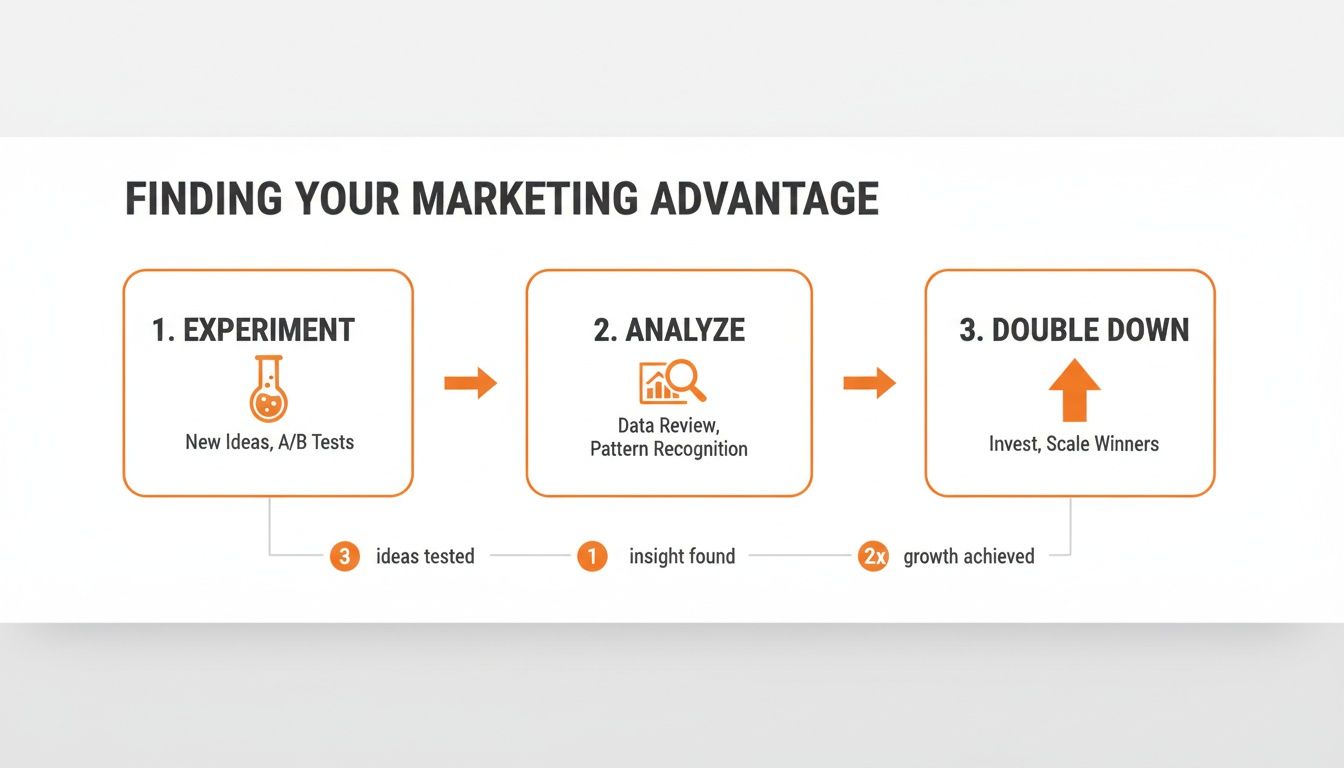
    A diagram outlining a 3-step marketing strategy: experiment, analyze, and double down for business growth.

    Let’s talk marketing. I see so many founders get completely paralyzed by this. They feel the pressure to be everywhere at once—TikTok, Google Ads, a podcast, a newsletter. That's not a growth strategy; it's a direct flight to burnout.

    You absolutely do not need a massive budget to scale your business. What you do need is a ridiculously smart strategy.

    The secret isn’t about being everywhere. It’s about finding the one or two channels that click for your business and pouring everything you have into them. I call this finding your "unfair advantage." It’s the one thing you can do better or differently than anyone else that consistently brings in the right customers.

    Maybe your unfair advantage is creating unbelievably helpful content that answers every possible question your customers have. Or maybe it's building a referral engine that runs on pure customer delight. For some, it’s mastering local SEO so your name is the first thing people see when they search. Forget the noise. Your only job is to find what works for you.

    Discover Your Channel Through Cheap Experiments

    The only way to find your unfair advantage is to experiment. I’m talking about small, cheap, fast tests. This isn't about betting the farm on some huge ad campaign; it’s about putting on a lab coat and being a scientist in your own business. You form a hypothesis ("I bet my customers are on LinkedIn"), run a tiny test to see if you're right, and look at the data.

    Think of it like dating. You don’t propose on the first date. You grab coffee, see if there's a spark, and then maybe plan a second date. Marketing channels work the same way. A little time, a little money, and see what happens before you commit.

    Here are a few ways you can run these experiments without emptying your wallet:

    • Content Marketing: Don't launch a whole blog. Just write one killer article that solves a common customer problem. Send it to your email list. Do people share it? Do they reply with more questions? That’s your signal.
    • Social Media: Pick one platform where your ideal customer actually lives. For one week, just show up. Post, engage, have real conversations. Don't just broadcast your sales pitch. Are you getting any traction? Any leads at all?
    • Referral Program: No fancy software needed. Just email your ten best customers. Offer them something simple—say, a 20% discount on their next purchase—for sending a new customer your way. Does anyone bite?

    The goal here isn't to get a thousand new customers overnight. The goal is to get a signal. You’re just looking for that one channel that shows a spark of life. Something you can pour some fuel on.

    Pouring Fuel on the Fire

    Once you find a channel with some promise, it's time to go all in. This is where focus becomes your secret weapon. You stop messing around with the five other channels that went nowhere and plow 80% of your marketing energy into the one that’s actually working.

    Let’s play this out. Say you ran a little experiment with your Google Business Profile. You updated your info, added some fresh photos, and made a point to ask your last few customers for a review. A week later, your phone is ringing a bit more, and a couple of people mention they "found you on Google Maps."

    Bingo. That’s your signal.

    Now you pour fuel on that fire. You build a simple system to ask every single customer for a review. You start posting weekly updates to your profile with photos of your work. You build out specific pages on your website targeting local search terms.

    See the difference? You're not just "doing marketing" anymore. You’re building a repeatable, predictable system for getting customers. That’s how you scale a small business without a Fortune 500 budget. It's about being focused, not just being busy.

    Your 90/180/365 Day Scaling Action Plan

    All the theory in the world doesn't matter without action. So let's create a practical, no-fluff roadmap for the next three months. Scaling a business can feel like climbing a mountain, but we’re going to tackle it one manageable step at a time.

    I’ve broken this down into a tangible 90-day plan. Think of it less as a to-do list and more as a blueprint designed to build real momentum. You'll see how each phase builds on the last, creating a solid foundation for growth that actually lasts. Let's get to work.

    Your First 90 Days of Scaling

    Here’s a clear, actionable plan to guide your focus and efforts as you begin to scale your business. Each phase builds on the last, creating sustainable momentum.

    Phase Key Focus Actionable Goals Chicago/Midwest Resource Spotlight
    Days 1-30: Solidify Your Foundation Clarity and Process Documentation 1. Calculate Unit Economics (CAC & LTV)
    2. Document one core operational process
    3. Set up a simple financial dashboard
    Check out a workshop at The Polsky Center at UChicago. They have incredible (often free) resources on business fundamentals.
    Days 31-60: Test & Delegate Experimentation and Team Building 1. Run two low-budget marketing tests
    2. Delegate the documented process to someone
    3. Interview three potential hires/freelancers
    Connect with mentors through SCORE Chicago. Getting an outside perspective during the testing phase is invaluable.
    Days 61-90: Ramp Up & Systematize Focused Execution and Optimization 1. Triple the budget on the winning channel
    2. Formalize your hiring process (job descriptions, etc.)
    3. Plan your next 90-day sprint
    For brands with physical products, mHub Chicago is a game-changer for prototyping and scaling production.

    This table is your north star. It's about building habits: measure, document, test, delegate, and repeat. Nail this rhythm, and you're well on your way.

    Days 1-30: Solidify Your Foundation

    The first month isn't about flashy growth hacks. It’s about getting your house in order. We're going to nail down your numbers and document your core processes so you have a stable platform to launch from.

    Think of it as sharpening the axe before chopping down the tree. A little prep here saves a ton of headaches later. If you skip this, you’re just scaling chaos. Trust me.

    Here’s what you need to lock down this month:

    • Calculate Your Unit Economics: Get absolute clarity on your Customer Acquisition Cost (CAC) and Lifetime Value (LTV). Don’t just guess. Dig into the real numbers from the last 3-6 months. This is your single source of truth for every decision you’ll make.
    • Document One Core Process: Start small. Pick one critical task—like how you onboard a new client or fulfill an order—and write down every single step in a simple Google Doc. The goal is to create a recipe someone else could follow perfectly without asking you a single question.
    • Set Up Basic Financial Tracking: Make sure you have a simple dashboard or spreadsheet where you can see your key numbers (revenue, profit, cash on hand) at a glance. You need to know the score to win the game.

    Days 31-60: Test And Delegate

    With a stronger foundation, your second month is all about controlled experiments. This is where we start testing our assumptions and bringing others into the fold. It's about taking small, calculated risks to see what works.

    This is also where you start shifting from being a solo operator to a true leader. It starts by trusting your systems and your people.

    Your focus for the next 30 days:

    • Run Two Small Marketing Experiments: Based on what you learned about finding your unfair advantage, pick two channels and run a small, cheap test. I'm talking no more than a few hundred dollars. You're hunting for a signal, not a home run.
    • Make Your First Key Delegation: Using that process you documented last month, hand it off. Completely. Give it to a team member or a freelancer. Your job is to train them and then get out of the way. This will feel uncomfortable, but it’s a non-negotiable step.
    • Interview Three Potential Hires/Freelancers: Even if you think you aren't ready to hire, start the conversation. Talk to people who could fill a key role (e.g., customer service, marketing assistant). This builds your network and forces you to clarify what you actually need.

    This simple loop is how you find your marketing edge: experiment, check the data, and then hammer down on what’s working.

    Days 61-90: Ramp Up What Works

    In the final month of this plan, we take the winners from your experiments and pour some fuel on the fire. This is where you’ll start to see and feel real, scalable growth. It’s all about focus and execution.

    By now, you should have data, not just ideas. You have a process, not just effort. This is the moment you stop being busy and start being effective.

    Now you can confidently ramp things up:

    • Double Down on the Winning Channel: Take the marketing experiment that showed the most promise and triple the budget. Analyze the results obsessively. Is the CAC holding steady? This focused investment is how you build a predictable customer acquisition machine.
    • Systematize Your Hiring Process: Turn your interview notes into a formal job description and a simple hiring process. Knowing how you'll find and vet people before you're desperate is a total game-changer.
    • Plan Your Next 90 Days: Look back at everything you accomplished. What worked? What bombed? Use this knowledge to map out your next action plan, setting slightly more ambitious goals. This continuous cycle of planning, executing, and learning is the real engine of scaling.

    The Tough Questions About Scaling a Business

    As you get closer to hitting the accelerator, the questions start getting more specific and, let's be honest, a little more stressful. I get it. I've been there. Here are some of the most common questions I hear from founders teetering on the edge of growth. My answers are direct, based on what I've seen work—and what I've seen go horribly wrong.

    How Much Money Do I Really Need to Scale?

    This is the big one, and the answer almost always catches people off guard: it's less about the size of your bank account and more about how your business machine actually works. Believing you need a giant pile of cash before you can make a move is a trap.

    The real answer is buried in your unit economics. If you know, without a shadow of a doubt, that every $1 you feed into marketing spits out $3 in profit, then scaling becomes a simple math problem. The money is just fuel for a system you've already proven.

    Scaling isn't about starting with a massive war chest. It's about building a profitable, repeatable process that you can pour money into with total confidence.

    My advice is always the same: Prove you can grow efficiently on your own dime before you even think about chasing outside funding. Once your LTV is at least 3x your CAC, you have a model that works. Only then should you think about adding external capital to the fire.

    Chasing venture capital too early is like strapping a rocket engine to a go-kart. The frame can't handle the force, and the whole thing just disintegrates.

    What's the Biggest Mistake Founders Make When Trying to Scale?

    The single biggest mistake I see, time and time again, is premature scaling. It’s such an easy and intoxicating trap to fall into.

    You get some early wins, revenue starts to climb, and the excitement is real. So you start acting like a "big" company. You hire people you don't truly need yet, sign a lease on a cool office space, and dump money into ad campaigns you haven't fully tested. You're doing all this without confirming that your initial success is actually a repeatable, scalable model.

    You're just doing more of what you were doing before. That's not the same as scaling.

    Remember, scaling amplifies whatever you already have.

    • If your foundation is solid, it amplifies success and profit.
    • If you have cracks in that foundation—messy operations, fuzzy numbers—it amplifies the chaos and burns through your cash at a terrifying speed.

    Be brutally honest with yourself before you pull the trigger. The pressure to grow is immense, but the discipline to wait for the right moment is what separates the businesses that thrive from the ones that nosedive.

    Should I Find New Customers or Sell More to My Existing Ones?

    In the early days, the answer is almost always the same: sell more to the customers you already have. This isn't just a sales tactic; it's the ultimate stress test for your business's health.

    Think about it. Your existing customers have already voted with their wallets. They've raised their hands and said, "I trust you, and I like what you're selling." Trying to convince a total stranger to take that same leap of faith is infinitely harder and more expensive.

    The data doesn't lie. It's 5 to 25 times more expensive to acquire a brand-new customer than it is to keep a current one happy.

    Before you spend a fortune trying to reach new people, ask yourself: Can you increase your average order value? Can you introduce a new product or an add-on service they would actually want? Nailing this proves your business has real depth, not just a flashy storefront.

    Once you’ve done everything you can to serve your current base and they're sticking around, then you've earned the right to go hunting for new customers. It's a clear signal that your business is built on real value, not just a revolving door of one-time buyers.


    If you’re a founder in the Midwest who values hard work and kindness, you don't have to figure all this out alone. Chicago Brandstarters is a free, vetted community where you can share the real story with other operators who get it. We skip the transactional networking and build real relationships that help you move forward. Join us at https://www.chicagobrandstarters.com.