Tag: startup strategy

  • Prototyping a Product: Turn Your Idea into Something Real

    Prototyping a Product: Turn Your Idea into Something Real

    Let's get one thing straight—that amazing idea rattling around in your head? It's just a thought. Nothing more. At least, not until you make it real. Prototyping a product is how you build the bridge between a dream and an actual business. I think of it as creating a rough draft to see if your assumptions hold any water.

    Honestly, it's the single most important thing you can do to avoid burning through thousands of dollars building something nobody actually wants.

    Why Your Idea Needs to Be More Than an Idea

    I'm here to bust a huge myth: you don't need a massive budget or an engineering degree to get started. Prototyping is just about making your idea tangible.

    Think of it like a movie trailer. You create a short, compelling preview to see if anyone will buy a ticket before you spend millions on the full production. For a founder like you, this is all about getting momentum, and getting it fast. You move from endless "what if" scenarios to hard, real-world data. The process itself forces you to see flaws and uncover opportunities you’d never spot on a spreadsheet.

    The Real Cost of Skipping Prototypes

    It might feel faster to just jump straight to the final product, but trust me, it's the most expensive mistake you can make. You risk pouring months of your life and a ton of cash into something polished, only to launch to the sound of crickets. Prototyping is your insurance policy against building the wrong thing.

    By creating a simple model, you can get it into the hands of real people and just watch. Their confusion, their little moments of delight, their "aha!" exclamations—that's pure gold. It's the kind of raw, honest feedback that turns a good idea into a great product. This early validation is the bedrock of a successful business, and we have a whole guide on how to validate a business idea that dives deeper into these strategies.

    Turning Assumptions into Actionable Insights

    Every new business idea you have is built on a pile of assumptions. You assume people have a specific problem. You assume they'll pay for your solution. You assume your design is easy to use. Prototyping is how you systematically poke holes in those assumptions.

    The goal isn't perfection; it's learning. A rough prototype that generates honest feedback is infinitely more valuable than a perfect plan that lives only in your slide deck.

    This isn’t just some trendy startup advice; it’s a massive economic driver. The global market for product prototyping is projected to jump from US$21.3 billion in 2025 to a staggering US$44.8 billion by 2032. Why? Because it slashes time-to-market by nearly 50% in major industries.

    For you, this means you can test, learn, and pivot quickly without burning through all your cash. It's time to stop thinking and start building.

    Alright, you're fired up and ready to turn that idea into something real. But what does "prototyping a product" actually look like? Your first big decision is choosing your approach, and getting this right will save you a staggering amount of time and money down the road.

    Think of it like building a house. You wouldn't just start pouring a concrete foundation without at least a simple pencil blueprint, right? That napkin sketch is your low-fidelity prototype—a quick drawing, a cardboard mockup, or a basic digital wireframe. Its only job is to test the absolute core concept and see if people even understand what you're trying to do.

    Then, much later, you get to the high-fidelity prototype. This is the fully-staged model home with working lights and running water. It looks and feels almost exactly like the final product, letting you test specific details, aesthetics, and how it feels to use before you sink a fortune into manufacturing.

    This decision tree gives you a simple view of how to think about your starting point.
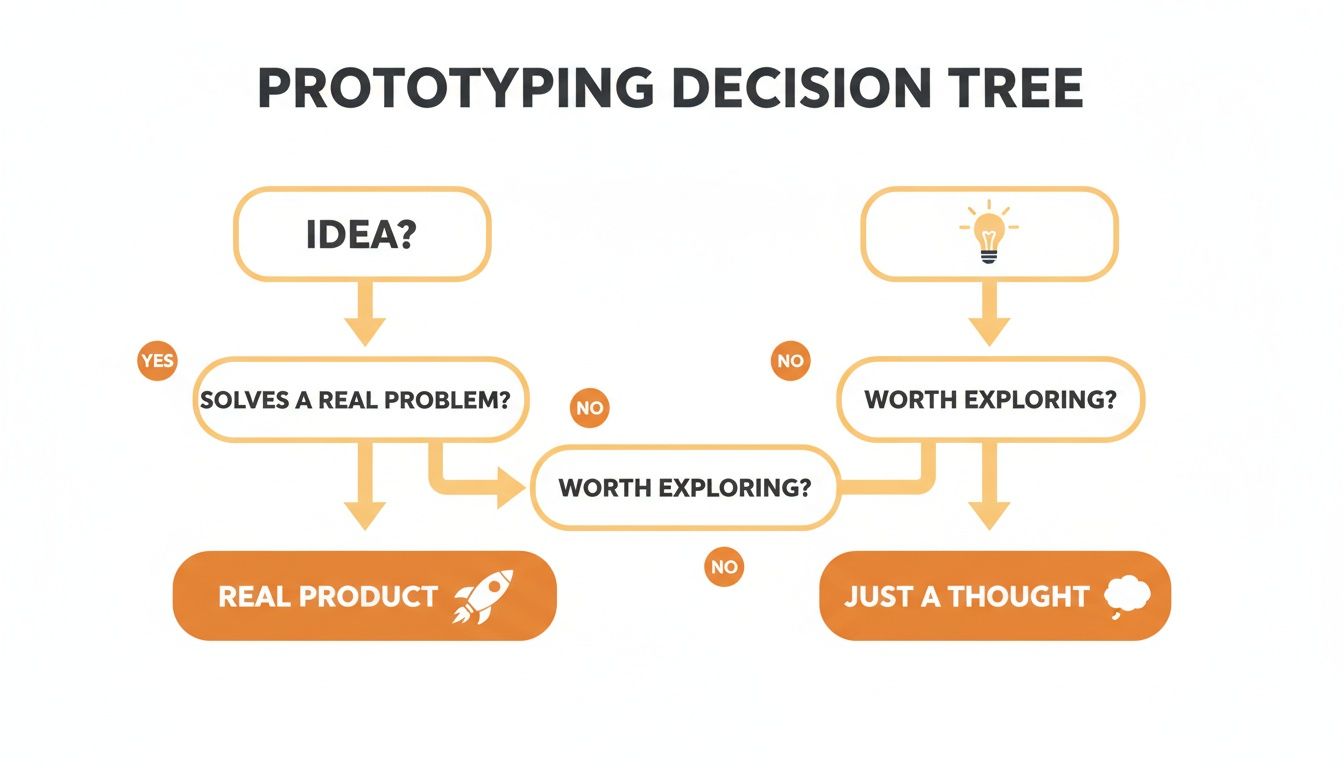
    Flowchart illustrating a prototyping decision tree, guiding ideas to real products or mere thoughts.

    The main takeaway here? Your idea stays just an idea until you start the cycle of building something, showing it to people, and learning from what they do.

    Low-Fidelity When Speed Is Everything

    In the early days, low-fidelity prototypes are your absolute best friend. They're meant to be cheap, fast, and completely disposable. I once used sticky notes on a whiteboard to map out an entire app flow, and it helped our team spot a fatal flaw in our logic in under an hour. That single hour saved us weeks of coding down the wrong path.

    Your goal here isn't to impress anyone. It's to get brutally honest answers to the big, scary questions:

    • Do people even get what this thing is supposed to do?
    • Can you figure out how to get from point A to point B without a manual?
    • Is the main benefit obvious just from looking at the layout?

    A simple paper sketch that reveals a fundamental user misunderstanding is 100 times more valuable than a polished 3D model that just confirms your own biases. You’re buying knowledge, not a pretty object.

    High-Fidelity for Fine-Tuning and Buy-In

    Once you're confident in your core concept, you'll need answers to more detailed questions. This is where you invest in a high-fidelity prototype. This could be a clickable digital mockup made in a tool like Figma or a 3D-printed model that feels just like the final version you'd hold in your hand.

    These slicker prototypes are critical for getting stakeholder buy-in and testing the nuances of your user experience. You can see in our guide on a great product MVP example how a well-defined, higher-fidelity prototype sets the stage for a successful launch.

    High-fidelity models help you answer questions like:

    • Is the button placement actually intuitive, or just what I thought was clever?
    • Does the physical weight and texture feel premium or cheap in your hand?
    • Does the app interface feel snappy and responsive, or sluggish and frustrating?

    Prototype Fidelity: Your Time and Money Tradeoffs

    Deciding which level of fidelity to use can feel overwhelming, but it really just boils down to what question you need to answer right now. This table should help you quickly map your current need to the right tool for the job.

    Fidelity Level What It Looks Like Best For Answering Typical Cost Typical Time
    Low-Fidelity Paper sketches, cardboard mockups, basic wireframes (Balsamiq) "Do people understand the core idea?" "Is the basic flow logical?" $0 – $100 Minutes to Hours
    Medium-Fidelity Clickable digital prototypes (Figma), basic 3D prints "Is the user interface intuitive?" "Does the basic form factor work?" $100 – $1,000 Days to a Week
    High-Fidelity Looks/feels like the final product, functional components "Does this feel premium?" "Are there any usability friction points?" $1,000 – $10,000+ Weeks to Months

    Ultimately, your choice always comes back to one thing: start with the cheapest, fastest method that gets you the feedback you need to take the next step. Perfection is the enemy of progress here. Your only goal is to learn.

    Your Practical Prototyping Toolkit
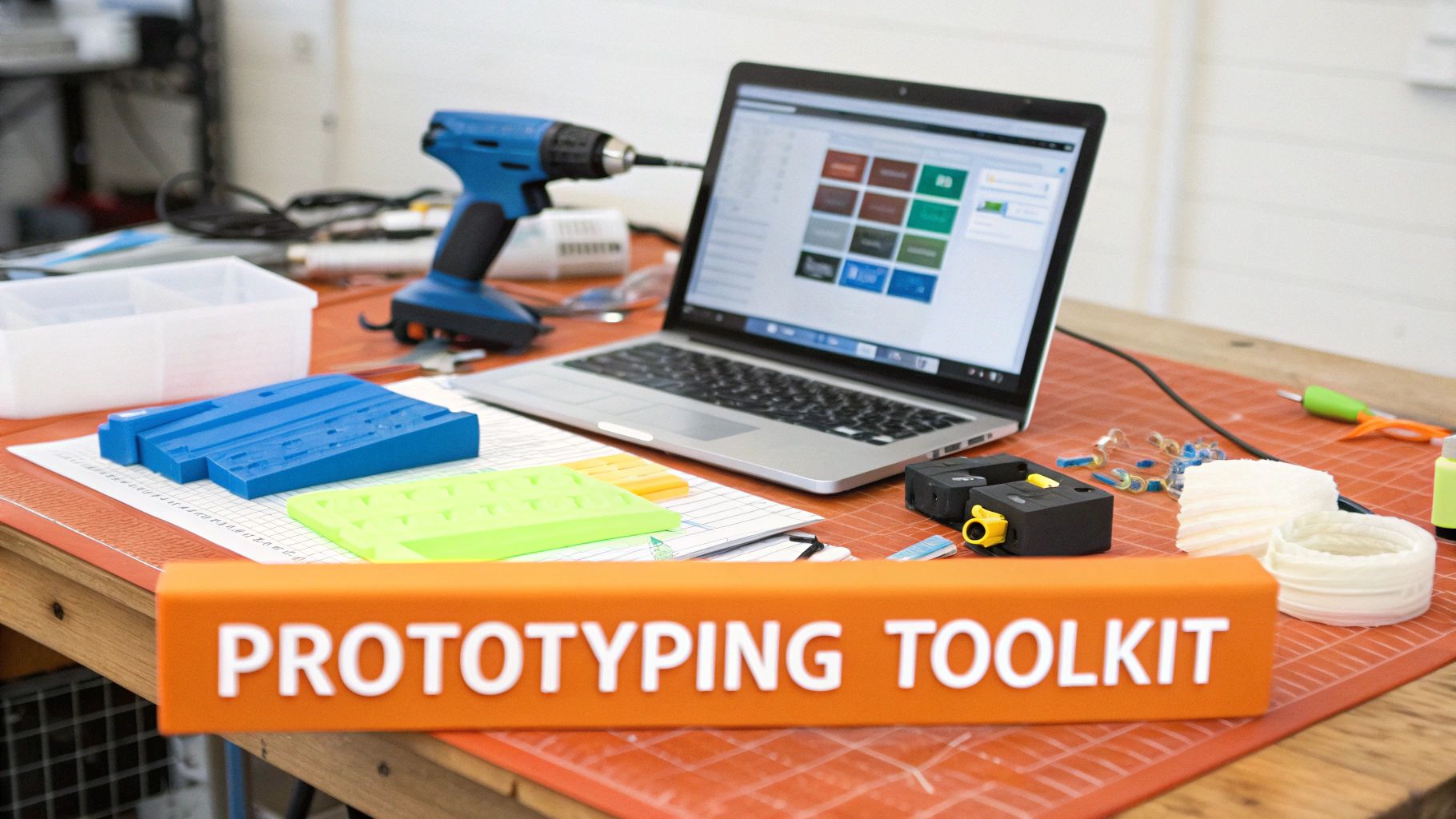
    A prototyping workstation with a laptop, drill, 3D printed parts, and a "PROTOTYPING TOOLKIT" sign.

    Alright, this is where the theory ends and you actually start building something. Forget those endless textbook lists of expensive software and machinery. I’m going to share the tools and materials that I've personally seen founders use to get their ideas off the ground, focusing on being scrappy and resourceful.

    You don’t need a state-of-the-art lab to start prototyping. Not even close. You just need a bit of creativity and the right direction.

    Tools for Digital Product Prototypes

    If you're building an app or a website, your toolkit is digital. The great news is the best tools are often free or have generous free tiers, so you can build incredibly realistic mockups without writing a single line of code.

    For instance, a tool like Figma lets you design all your user interfaces and then link them together to create a clickable prototype. It's a game-changer.

    This means you can visually design a mobile app, moving elements around just like you would in a graphics program. The magic happens when you connect these screens, letting a user tap through a realistic simulation of your app on their own phone.

    My go-to recommendations for digital prototypes are:

    • Figma: This is the industry standard for a reason. It's powerful, collaborative, and has a robust free version that’s more than enough for you to get started. You can build anything from a simple wireframe to a pixel-perfect, interactive demo.
    • Balsamiq: If Figma feels too design-heavy, Balsamiq is your friend. It intentionally creates low-fidelity, sketch-like wireframes. This forces you and your testers to focus purely on layout and user flow, not colors and fonts, which is invaluable early on.

    Materials for Physical Product Prototypes

    For those of you building something you can actually hold, your toolkit looks a lot more like an arts and crafts drawer. Don’t laugh—foam core, hot glue, and cardboard are the secret weapons of many successful physical product founders.

    This is where you can get really creative and save a ton of money. Before you even think about 3D printing, ask yourself: can I mock this up with materials from a hardware store? The answer is almost always yes.

    The goal of your first physical prototype isn't to look pretty; it's to test ergonomics, size, and basic form. A block of wood carved into the shape of your device can give you more valuable feedback on how it feels in the hand than a slick 3D rendering ever could.

    The market for these materials is also getting cheaper and more accessible. The rapid prototyping materials market hit USD 801.43 million in 2024 and is projected to grow significantly.

    This growth, especially in Asia-Pacific, means materials are becoming easier for you to get and more affordable. You can learn more about how these market trends lower costs for founders. Bottom line: building your ecommerce product is cheaper than ever.

    The Art of User Feedback (Without the Awkwardness)
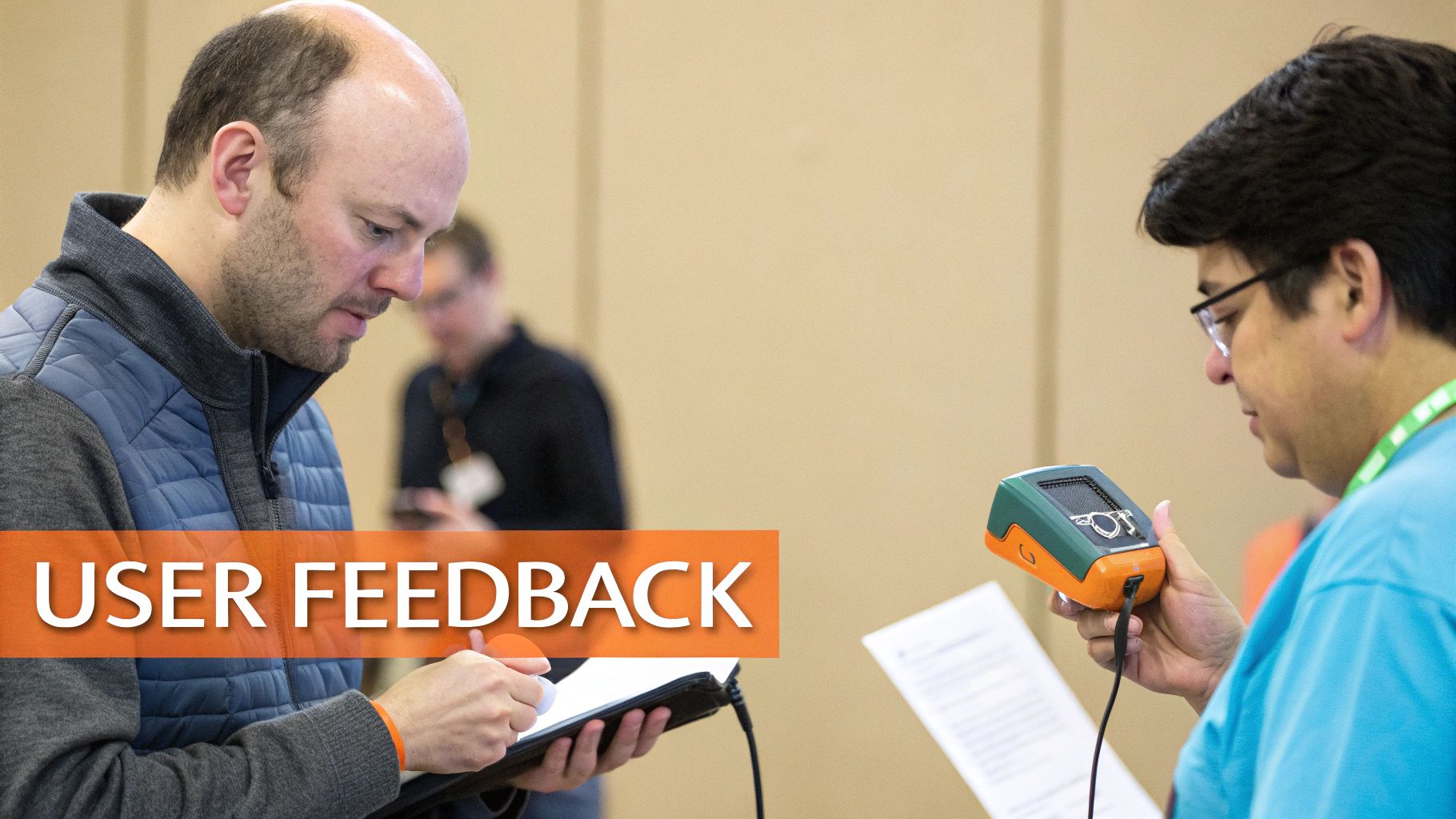
    Two men are engaged in user feedback, one using a tablet and the other an electronic device.

    A prototype sitting on your desk is just a cool-looking paperweight. Its only real job is to get in front of actual human beings for feedback, but this is exactly where I see so many founders stumble. How do you get brutally honest opinions without getting defensive or accidentally leading the witness?

    It’s an art, but one you can get good at fast. Your mindset shift is simple: your prototype is not your baby. It's a science experiment. Your mission is to observe, listen, and learn—not to sell, defend, or explain. Every bit of negative feedback is a potential disaster you just dodged down the road.

    This is the entire point of prototyping a product in the first place—to de-risk your idea before you start spending real money.

    Finding the Right People to Grill Your Prototype

    First things first, your mom is not your target user. Neither is your best friend or your supportive spouse. They love you, and because they love you, their feedback is basically useless. They’ll tell you it’s brilliant because they want you to feel good.

    You need strangers. More specifically, you need strangers who fit your ideal customer profile.

    Here’s where you can find them:

    • Go where they hang out: Building a tool for coffee shop owners? Spend a day at a local cafe and offer to buy someone a coffee for five minutes of their time.
    • Use your network (carefully): Ask friends for introductions to people who fit your demographic, but be crystal clear you need their honest, unfiltered opinions. Tell them, "I need you to tell me why this sucks."
    • Tap into online communities: Find relevant subreddits, Facebook groups, or Slack channels. Offer a small gift card for 15 minutes of feedback. Just be genuine and respect the community rules—no spamming.

    The quality of your feedback is a direct reflection of the quality of your test subjects. Don't you dare cut corners here.

    How to Ask Questions That Get Real Answers

    Your most powerful tool during a feedback session is silence. Seriously. Your job is to hand them the prototype, give them a simple task, and then shut up and watch. What people do, their hesitations, and their frustrations will tell you far more than their words ever will.

    The most valuable feedback comes from what a user does, not what they say. I watch for sighs, confused expressions, or where a finger hesitates. That’s where the gold is buried.

    When you do ask questions, avoid leading them to the answer you want. Instead of saying, "Don't you think this button is easy to find?" try this: "If you wanted to save your work, what would you do next?" See the difference? One begs for agreement; the other prompts an actual, honest action.

    This is even more critical for physical products. Getting something tangible into someone's hands is cheaper and faster than ever, thanks to new tech. The rapid prototyping tools market, valued at $14.25 billion in 2025, is projected to hit $36.01 billion by 2034. A huge driver of this growth is 3D printing, which can slash material waste by up to 40%, making it incredibly affordable for you to spin up testable models. You can learn more about how these innovations are changing product development.

    Turning Vague Comments into Actionable Fixes

    You're going to get feedback like, "I don't know, I just don't like it." This feels like a dead end, but it's actually an invitation for you to dig deeper. Your job is to be a detective.

    Follow up with gentle, open-ended questions like:

    • "Can you tell me more about that?"
    • "What were you expecting to happen when you clicked there?"
    • "What part felt the most confusing for you?"

    By asking "why" in a few different ways, you can translate a vague feeling into a specific design flaw. "I don't like it" might become "I couldn't find the search bar," which is a problem you can actually go and fix. This is how you iterate effectively instead of just guessing.

    How to Iterate, Fast and Smart

    Building a product isn't a straight line. It's a messy, relentless loop: Build, Test, Learn, and Repeat. The founders who make it are the ones who can spin through this cycle faster than anyone else. Your first idea is almost certainly wrong, and iterating is how you stumble your way to what customers actually want and need.

    The mindset here is everything. You absolutely have to fall in love with the problem you're solving, not your first crack at a solution. Think of your prototype as a learning tool, nothing more. Sometimes the most valuable lessons I learn come from watching it crash and burn in a user’s hands.

    The Build-Test-Learn Rhythm

    I like to think of this process like tuning a guitar. You play a note (build), listen to hear if it’s sharp or flat (test), and then twist the tuning peg (learn and iterate). You don’t just tune one string and declare the instrument ready for a concert. You do it over and over until every note sings in harmony.

    Prototyping is exactly the same. Each round of feedback helps you dial in your product. The goal isn't to ship something perfect on day one; it's to ship something that's just good enough to get you the next critical piece of feedback.

    I learned this the hard way on one of my first projects. We were so sure we had it right that we spent weeks building a beautiful, pixel-perfect digital prototype. When we finally put it in front of real people, it was a total disaster. They just didn't get it. We had to scrap the whole thing. It was a painful gut punch, but that early failure saved us from a massive, and very public, flop down the line.

    Figuring Out What to Fix Next

    After a user testing session, you'll be swimming in a sea of notes—some good, some bad, some just plain confusing. So, what do you actually change? You can't fix everything at once. You have to get ruthless with your priorities.

    Here’s a dead-simple method I use to sort feedback into three buckets:

    • Critical Blockers: These are the showstoppers. The issues that literally prevent a user from doing the main thing your product is for. If they can't figure out how to add an item to their cart, your e-commerce app is dead on arrival. You fix these first. No excuses.
    • Major Confusion Points: These are the parts of the experience that cause sighs, furrowed brows, or frustrated clicks. Even if users eventually figure it out, the friction is high. These are your next priority because they kill user satisfaction.
    • Minor Annoyances: Things like weird button colors, a slightly awkward turn of phrase, or a clunky animation. These are "nice-to-haves." Log them so you don't forget, but don't let them distract you from the real fires.

    This simple sorting trick keeps you focused on what truly matters, making sure every new version is a meaningful leap forward.

    Stop getting distracted by shiny objects or tiny aesthetic tweaks. Focus on fixing the one or two things that will most dramatically improve the user’s ability to solve their core problem with your product. That’s it. That’s the whole game.

    Back to Building

    Once you know what to fix, it’s time to get back to building—and you need to do it fast. This is where your choice of prototyping tools really shows its worth. If you’re using something flexible like Figma, you can often knock out the changes from a feedback session in just a few hours.

    The speed of this cycle is your single biggest competitive advantage. While your competitors are stuck in endless planning meetings, you’re already on your third or fourth iteration, getting closer and closer to something people will actually pay for with each loop. This rapid, focused iteration is how you build a product that people genuinely love.

    From Proven Prototype to First Production Run

    You did it. After all the building, testing, and late nights, your prototype is finally getting rave reviews from real people. So, what's next? It's time to move from a one-off model to your first real production run.

    This is the moment your scrappy prototype, maybe held together with a bit of duct tape and a lot of hope, meets the unforgiving world of manufacturing. The whole thing can feel overwhelming, but it's a completely manageable process once you know the steps. You've proven the idea works; now it’s time to actually build the business around it.

    Thinking Like a Manufacturer

    The biggest mental shift you need to make right now is to start thinking about Design for Manufacturing (DFM).

    Here's the best way I can explain it: your prototype was like a custom-built race car, fine-tuned to win a single race. But a production-ready product? That needs to be like a Toyota Camry—reliable, affordable, and easy for you to build over and over again, thousands of times.

    DFM is just the process of designing your product so it’s simple and cheap to make at scale. Fixing a design flaw when you're prototyping costs next to nothing. But one study found that fixing that same issue after you've launched can cost 10 to 100 times more. DFM is your insurance policy against that kind of pain.

    This usually involves a few key things:

    • Simplifying Parts: Can you redesign three separate components into a single piece? Every part you eliminate is a part you don't have to pay for, source, or assemble.
    • Using Standard Materials: Sticking to common, off-the-shelf materials and parts will slash your costs. Don't reinvent the wheel if you don't have to.
    • Designing for Assembly: You have to make sure a person or a machine can actually put your product together without tearing their hair out.

    Finding and Vetting Your Partners

    Once you have a DFM-optimized design, you’re ready to start talking to manufacturers. This isn't just about getting the lowest quote; it’s about finding a real partner who gets what you're trying to do and can grow with you.

    Start by looking for factories that specialize in your type of product and, just as importantly, your production volume. Don't waste your time talking to a massive factory that makes millions of units a year if you only need 500. For a much deeper dive on this, check out our guide on how to find a manufacturer for your product—it has a detailed checklist.

    When you approach a manufacturer, you’re not just buying a service; you're starting a long-term relationship. I pay close attention to their communication, their quality control processes, and how willing they are to work with a startup. A good partner will feel like an extension of your own team.

    Before you even send that first email, get your technical package ready. This usually includes your detailed CAD files, a Bill of Materials (BOM), and crystal-clear specifications. The more prepared you are, the more seriously they’ll take you—and the more accurate your quotes will be.

    Burning Questions About Prototyping

    I talk to founders all the time who are wrestling with the idea of building a prototype. It always feels like this huge, intimidating hurdle, but it's usually not as scary as you think. Let's clear up a few of the questions that I hear over and over again.

    "How Do I Know When My Prototype Is Good Enough to Show People?"

    This is the big one. The answer is simpler than you think.

    Think of your prototype as a key. You don't judge a key on how shiny or beautiful it is—you judge it on whether it opens a specific lock. Your prototype is "good enough" the moment it can unlock the answer to your single most important question.

    • Need to know if people even understand your core concept? A sketch on a napkin is good enough.
    • Need to see if they can actually complete a specific task? You'll need something they can click, tap, or hold in their hands.

    Stop chasing perfection. The only goal here is learning, not launching a finished product. The sooner you get that rough prototype in front of a real human, the sooner you start learning what actually matters.

    "I Can't Afford Fancy Tools. What Are My Options?"

    You have way more options than you realize. I promise you, resourcefulness will always beat a big budget in the early days.

    For physical products, don't you dare overthink it. Start with stuff you can find anywhere: cardboard, foam core, hot glue, and tape. For digital ideas, the free versions of tools like Figma are unbelievably powerful. You can build a surprisingly realistic digital mockup without spending a dime.

    Even better, look for local resources. Most cities have makerspaces where you can get access to industrial-grade gear like 3D printers and CNC machines for a small membership fee. It's a game-changer.

    "What Is the Biggest Prototyping Mistake I Can Make?"

    Hands down, the biggest mistake is waiting too long to start. I see founders get stuck in "analysis paralysis," trying to map out every single detail in their heads.

    Prototyping is all about doing. You can't learn anything until you build something real, no matter how rough and ugly it is.

    The second biggest mistake I see? Getting defensive when you get feedback. Your prototype is not your baby; it's a science experiment. You have to be totally okay with watching it fail, because that's how you learn enough to eventually succeed.


    If you’re a founder in the Midwest looking for honest feedback and a real community of builders, check out Chicago Brandstarters. We’re a free, vetted group for founders who value kindness and hard work. Learn more and apply at https://www.chicagobrandstarters.com.
  • A Practical Roadmap for Business to Turn Your Idea Into Revenue

    A Practical Roadmap for Business to Turn Your Idea Into Revenue

    Got that brilliant idea keeping you up at night? I know the feeling. That’s the spark. But a spark is fleeting. A roadmap for business is what you need to turn that spark into a sustainable fire, guiding your idea from a thought into actual revenue.

    Why Your Great Idea Needs a Real Business Roadmap

    You have an amazing idea. I don't doubt that for a second. But an idea without a clear path forward is just a dream waiting to get lost in the day-to-day chaos.

    Let me be clear: a roadmap for business isn't some rigid, fifty-page corporate document you write once and forget. It’s your personal guide from ‘what if’ to ‘what is.’

    Think of it like planning a cross-country road trip. You wouldn’t just get in the car and start driving west, hoping you end up in California. You'd pick your destination, identify major cities to stop in, and maybe book a few hotels. Your business roadmap does the exact same thing for your entrepreneurial journey.

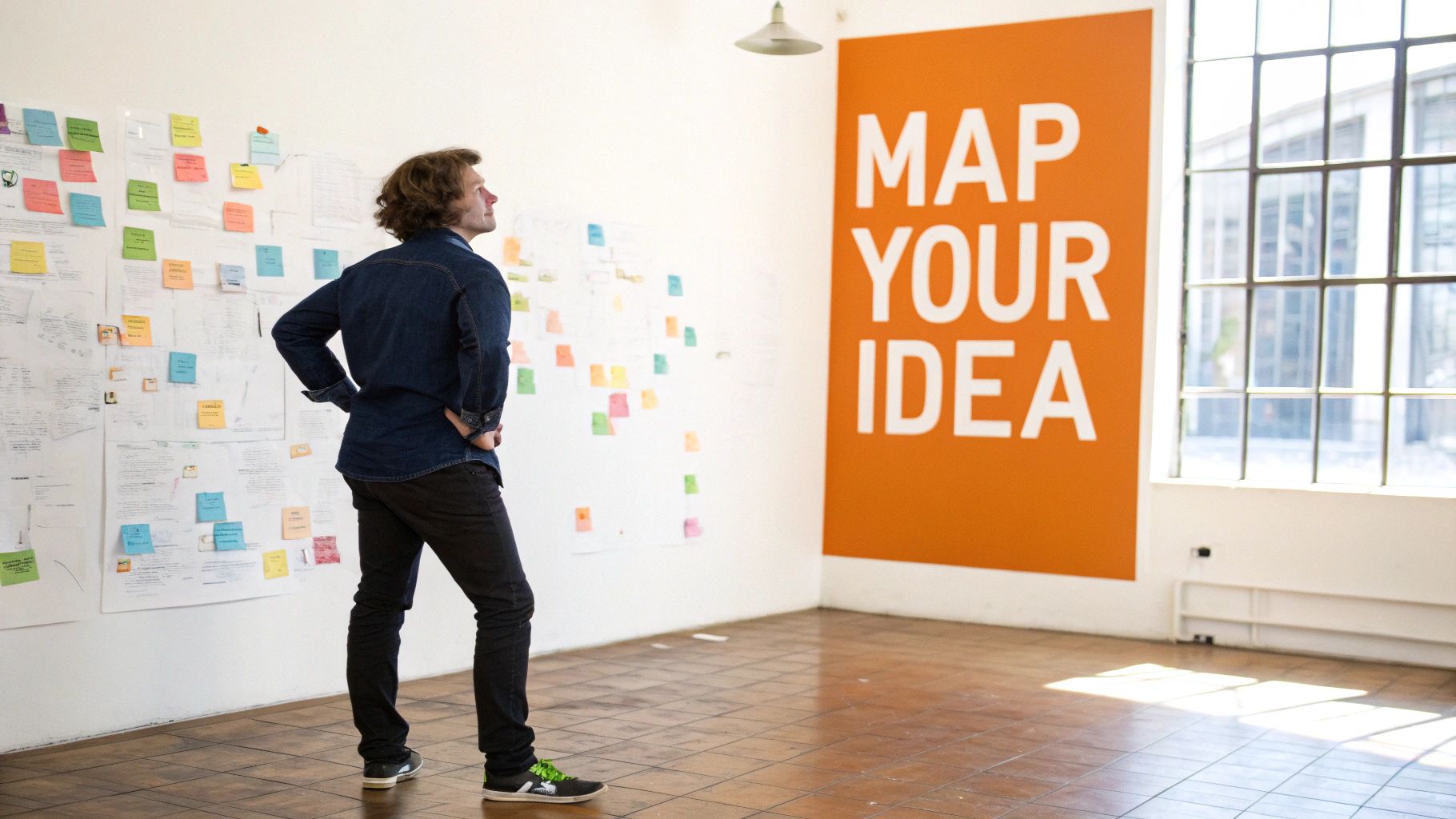
    Man thoughtfully examining a wall filled with notes and an inspiring 'MAP YOUR IDEA' sign.

    From Sticky Notes to Strategic Action

    My first roadmap was just a collection of sticky notes on my bedroom wall.

    That simple act forced me to get honest with myself about my priorities. It turned my abstract dreams into concrete, actionable steps I could take the next day. This isn't about predicting the future with a crystal ball. It’s about you making intentional choices today that build the future you actually want.

    This clarity is your superpower as a founder. It helps you confidently say 'no' to the shiny objects and distractions that constantly pull for your attention. Instead, you can say 'yes' to the opportunities that truly move your business forward.

    A roadmap doesn't just tell you what to do; it reminds you what not to do. It’s your strategic filter for every decision, ensuring you stay focused on the destination.

    Building Your Foundation First

    Imagine trying to build a skyscraper. You wouldn't just show up with a truck full of bricks and start stacking them, would you? Of course not. You'd start with a blueprint—a plan that outlines the foundation, the structure, and every critical system.

    Your business deserves that same thoughtful planning.

    Your roadmap is that foundational blueprint. It provides the structure you need to support your growth and helps you avoid critical mistakes that can derail an otherwise brilliant idea. Without it, you're just building on shaky ground.

    Defining Your Destination and Ideal Customer

    Before you draw a map, you have to know precisely where you’re going. This isn't just some fluffy goal; it's your 'North Star'—your core mission. What change are you trying to create in the world, and why should anyone care?

    Think of your mission as the destination you’d plug into your GPS before a long trip. Without it, you're just driving aimlessly. This mission statement becomes your gut check for every single decision, helping you navigate the endless choices you'll face. It’s what keeps you grounded when things inevitably get tough.

    From Vague Ideas to a Real Person

    But a mission is meaningless without people to champion it. This is where your roadmap for business gets personal. You need to get laser-focused on your ideal customer. I don’t mean a vague demographic like ‘millennial women.’ That’s like trying to find a friend in a crowded stadium by shouting their first name. It's useless.

    You need to know them intimately.

    • Who are they, really? Go beyond age and gender. What do they do for work? What are their passions and frustrations?
    • Where do they hang out? Are they scrolling Instagram, networking on LinkedIn, or lurking in specific Reddit communities? What podcasts do they listen to?
    • What do they actually value? What beliefs drive their buying decisions? Do they prioritize sustainability, convenience, or status?

    Suddenly, 'millennial women' becomes: 'Jessica, a 32-year-old creative professional in Austin who values sustainable products and follows local artists on Instagram.' Now you have a real person to talk to.

    When you know exactly who you're building for, every decision becomes simpler—from product features to marketing copy. It’s the difference between shouting into a void and having an intimate conversation with a friend.

    Why This Focus Is Your Superpower

    When you’re starting out, you absolutely cannot afford to be everything to everyone. Trying to do so dilutes your message and burns through your limited resources. Pinpointing your 'Jessica' is your most powerful asset.

    This intense focus ensures you're building something a specific group of people will absolutely love, rather than something a lot of people will just kind of like. That’s how you build a real brand.

    This deep customer understanding is the first critical stop on your business roadmap. If you need help refining this crucial step, you might be interested in our guide on how to properly validate your business idea. It's the foundation upon which you'll build every other milestone.

    Alright, you've got your grand vision and you know exactly who you're building this thing for. Now for the hard part: how do you actually get from here to there without crashing?

    The secret is to stop thinking about it as one giant, terrifying leap. A real-deal roadmap for business breaks the journey down into smaller, manageable legs. It’s a series of intentional, sequential steps.

    Think of it like building a house. You don't just start nailing boards together. You have to pour the foundation, then frame the walls, and only then do you get to the roof. Your business grows the exact same way, in phases.

    Phase 1: The Hustle (Months 0-12)

    Your first year is all about one thing: validation. I call this the Hustle Phase. Your goal isn't to build a perfect, polished machine. It’s to prove your core assumptions are right and, most importantly, get that first dollar in the door.

    It’s messy. It’s hands-on. And it’s absolutely critical.

    During this phase, your key milestones should be laser-focused on learning:

    • Get a Minimum Viable Product (MVP) out the door. It doesn't have to be pretty, but it must be real enough for your ideal customer to use.
    • Find your first 10 true fans—these are the people who genuinely get what you're doing and are willing to pay for it.
    • Have brutally honest, unfiltered conversations with potential customers. You need to understand their real-world pain points, not what you think they are.

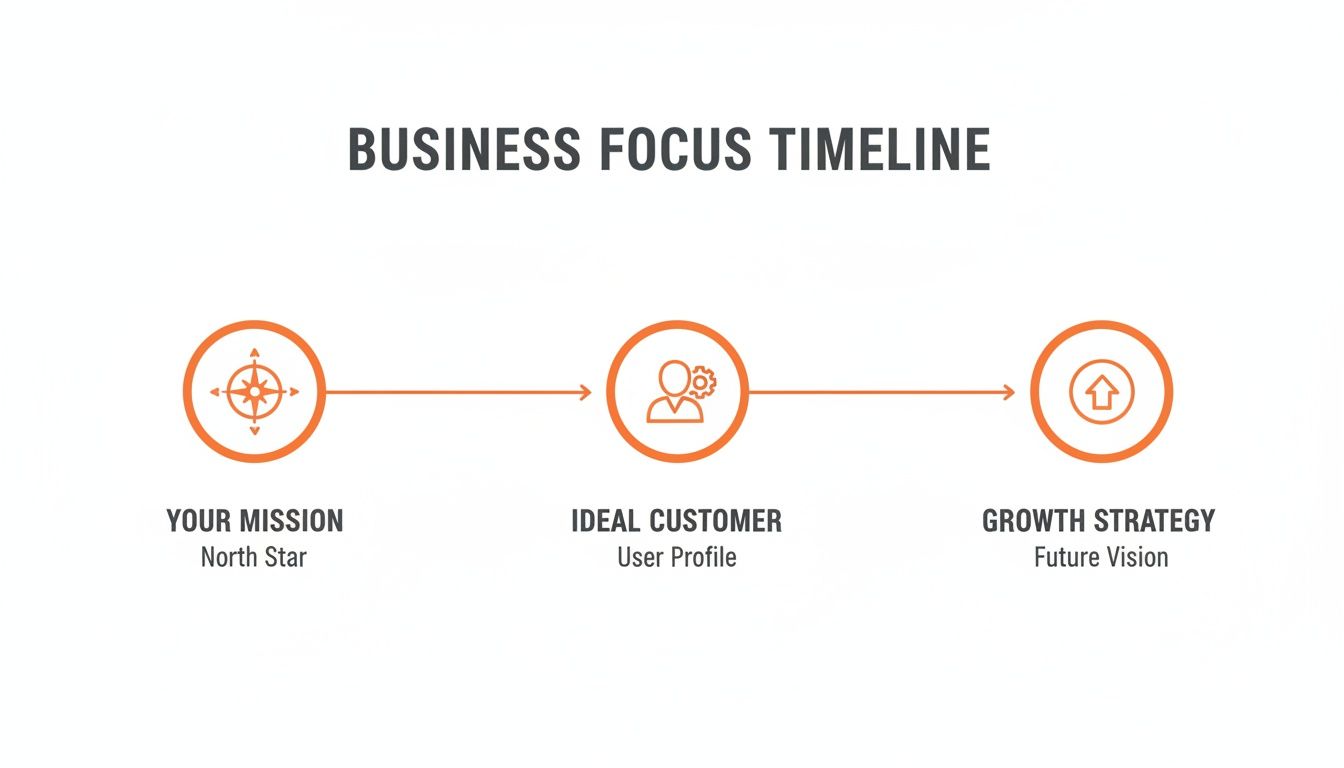
    This initial timeline visualization shows how your mission and ideal customer become the guiding stars for your growth strategy.

    A business focus timeline graphic with three stages: Your Mission, Ideal Customer, and Growth Strategy.

    These aren't just one-and-done tasks. You'll come back to these foundational pillars again and again as you grow.

    Phase 2: The Foundation (Months 12-24)

    Once you've proven that people want what you're selling, year two is about building systems that can run without you. Welcome to the Foundation Phase. You’re graduating from scrappy tactics to sustainable processes.

    The goal here is to create an engine that doesn't require you to manually crank it every single day. This is less about frantic discovery and more about deliberate, solid construction.

    Maybe this means you dial in your marketing funnel, streamline how you deliver your product, or make that crucial first hire to finally get some tasks off your plate. If you want to dig deeper into this stage, our startup business plan template is a great place to start.

    Phase 3: The Scale (Months 24-36)

    By year three, you should have a solid foundation and a predictable way to make money. Now, it's time to pour fuel on the fire. This is the Scale Phase.

    This is where you start looking at those big growth opportunities that were just distractions before. You're no longer in survival mode; you're actively hunting for ways to multiply your impact and revenue.

    This could mean exploring new customer segments, launching a complementary product, or even expanding into different cities or countries.

    This phased approach turns a massive, intimidating goal into a series of achievable checkpoints. You build momentum and confidence with every milestone you hit, making the journey feel possible.

    This table gives you a high-level look at what to focus on during each phase of your business journey, from that first spark of an idea to really scaling up.

    Your 36-Month Roadmap At A Glance

    Timeframe Primary Focus Key Milestones Example
    0-12 Months Validation & Learning Launch MVP, secure first 10 paying customers, achieve initial product-market fit.
    12-24 Months Systemization & Repeatability Document core processes, hire first key employee, reach consistent monthly revenue.
    24-36+ Months Strategic Growth & Expansion Explore new markets, develop a second product line, build out a leadership team.

    Having a structured roadmap makes a massive difference. Think about it: organizations that use them achieve a 73% faster time-to-insight, turning ideas into actionable strategies way quicker than competitors who just wing it. It's about moving smarter, not just harder.

    Choosing The Metrics That Actually Matter

    It’s way too easy to get hooked on vanity metrics. Seeing your social media likes shoot up or website traffic spike feels incredible, but those numbers don't pay the bills. Your roadmap needs to be anchored in metrics that signal real financial health, not just popularity.

    Think of yourself as the pilot of a small plane. The altitude meter is cool to look at, but the fuel gauge is what tells you if you're actually going to make it to your destination. You need to be obsessed with your "fuel gauge" metrics.

    Identifying Your Core KPIs

    The whole game is about picking a handful of Key Performance Indicators (KPIs) that you live and breathe. These are different for every business, but they always, always tie directly to revenue and sustainable growth. Trying to track twenty different numbers is a recipe for confusion.

    • For an e-commerce brand, you're probably looking at Customer Acquisition Cost (CAC) and Customer Lifetime Value (CLV). Bottom line: are you paying more to get a customer than they'll ever spend with you? If so, you've got a leaky bucket.
    • For a software startup, your lifeblood is likely Monthly Recurring Revenue (MRR) and churn rate. How much predictable cash are you bringing in, and how fast are your customers leaving?
    • For a service business, it could be your profit margin per project and your client retention rate. Are your jobs actually profitable, and do clients stick around for more?

    These aren't just numbers on a spreadsheet; they are the vital signs of your business. They tell you what's working, what's broken, and where to point your limited energy.

    You're not trying to become a data scientist overnight. Your goal is to be an informed founder who makes decisions based on reality, not just wishful thinking.

    From Theory to a Simple Dashboard

    Once you’ve locked in your 2-3 core metrics, track them like a hawk. You don't need some fancy, expensive software for this. A simple spreadsheet is all you need to get going.

    Set up a basic dashboard and commit to logging these numbers every single week. This weekly ritual forces you to confront the truth. It makes it impossible to ignore the red flags. From there, you can set realistic targets for these KPIs right inside your roadmap, giving you clear benchmarks to shoot for.

    I've seen it happen time and again. A kind-hearted 9-5er in Chicago dreams of building a side-hustle empire. They turn that dream into a real plan by anchoring their roadmap with clear KPIs. When they review their progress, they're able to make 28% tactic pivots to stay on track. These simple visual tools help you sequence big moves—like a product launch in Q1 or landing two key partnerships by year-end—and can boost team performance by as much as 35%. You can learn more about mastering this kind of strategic planning to ensure your business actually succeeds.

    Choosing the right metrics is what turns your roadmap from a wish list into a practical, no-BS guide. It keeps you focused on what really matters: building a healthy, profitable business that lasts.

    You've got a million ideas swirling around and a to-do list that looks like a novel. So, what do you actually do next? This is the moment most founders freeze up, paralyzed by choice. You end up doing a lot of stuff, but making very little real progress.

    The problem is usually emotional guesswork. We chase the shiny new idea or the task that feels exciting, not the one that will actually push the business forward. To build a roadmap that works, you need a system to cut through the noise.

    Introducing the RICE Framework

    Let me introduce you to a simple but incredibly powerful framework for this exact problem. It's called the RICE model, and it's a way for you to score your ideas objectively, forcing you to think critically instead of just reacting.

    It stands for:

    • Reach: How many people will this actually touch in a given timeframe?
    • Impact: How much will this move the needle on your main goal (like revenue or sign-ups)?
    • Confidence: How sure are you about your estimates? Be honest with yourself here. A wild guess gets a low score.
    • Effort: How much time and how many resources will this really take from you or your team?

    This isn't about getting lost in math. It's about creating a quick, logical filter. You give each factor a score, run a simple calculation (Reach x Impact x Confidence / Effort), and the ideas with the highest scores bubble up to the top. It pulls your ego and emotions right out of the decision.

    RICE in the Real World

    Let's make this tangible. Imagine you're an e-commerce founder trying to figure out your next quarter's focus. You've got three big ideas on the table:

    1. Launch a Company Blog: This is a ton of work, but it could have a huge long-term reach.
    2. Run Targeted Social Media Ads: Much less effort to get started, with a measurable but maybe smaller reach.
    3. Build a New Product Feature: High impact for your current customers, but it won't reach any new people.

    When you score each of these using RICE, the right choice often becomes surprisingly clear. You might realize that while that new feature sounds sexy, the targeted ads offer a much better return on your effort right now.

    A prioritization framework like RICE doesn’t just tell you what to do. It gives you permission to ignore everything else. That's how you build real momentum instead of just staying busy.

    Think about it: a solo e-commerce founder in the Midwest, feeling crushed by the big-city hustle, finds out that building Strategic Business Roadmaps takes moderate effort but delivers massive organizational alignment. We know that getting executive input can lead to 30% better investment prioritization.

    Unlike those rigid, soul-crushing Gantt charts, these high-level maps are about your vision, not micromanaging every single task. That’s perfect for you in the early stages. For more on this, you can discover more insights about project roadmaps and how they drive success. This is how you stop spinning your wheels and start building a business that actually gets somewhere.

    Finding Your Community So You Don't Build Alone

    Let’s be honest: building a business is an incredibly lonely journey. You're constantly wrestling with problems you’ve never seen before, and it’s so easy to trick yourself into thinking everyone else has it figured out.

    I can promise you, they don’t.

    The single greatest accelerator I’ve ever found as a founder is a trusted circle of peers who just get it. This isn’t about superficial networking events. It's about genuine connection with people who are right there in the trenches with you.

    Smiling colleagues chat over coffee at a white table in a bright, orange-walled office.

    Why Peer Feedback Is Your Secret Weapon

    Your roadmap is a living document, not some sacred text you carve in stone. Getting feedback from people who are a few steps ahead or right alongside you is like having a world-class advisory board on speed dial. They’ll spot the potholes in your plan that you’re too close to see.

    This is exactly why I started a group called Chicago Brandstarters. We wanted an intentional space where you can share war stories over dinner, admit you're stuck, and get brutally honest advice from people who have been there.

    This kind of environment is where your roadmap gets pressure-tested against reality. For a deeper dive, check out our thoughts on why mastermind groups for entrepreneurs are so powerful for actually moving the needle. It's all about turning theory into tangible results.

    The Power of Shared Experience

    You’re going to hit walls. You’ll have moments of crippling self-doubt. In those moments, knowing you’re not the only one fighting this battle makes all the difference.

    Your goal isn’t to find people who will tell you what you want to hear. Your goal is to find people who care enough to tell you what you need to hear, even when it’s tough.

    A strong peer community offers more than just tactical advice. It provides you with:

    • Accountability: They’ll call you out when you’re not hitting the milestones on your own roadmap.
    • Perspective: They’ll remind you that the crisis you’re facing today is just a temporary roadblock, not a dead end.
    • Motivation: Their wins will inspire you, and their struggles will normalize your own.

    Whether it's our community or another one, find your people. Your journey will be faster, less stressful, and far more rewarding because you didn't try to do it all alone.

    Alright, let's clear up a few questions that always pop up when I talk to founders about their roadmap. Getting these sorted out is the last step before you can really dive in and start mapping your own journey.

    How Often Should I Update My Business Roadmap?

    Look, your roadmap isn't some sacred text you carve into stone. It’s a living, breathing guide.

    I tell most founders to sit down with it once a quarter. That’s the sweet spot—long enough for you to see real progress, but short enough for you to pivot if the market throws you a curveball.

    But if you're in the super early days, like pre-product or still chasing that first dollar, you need to check in more often. Monthly is probably best. Things move at lightning speed when you're just getting off the ground, and your map needs to keep up.

    Think of your roadmap as a GPS, not a paper map. It’s built to recalculate when you hit a roadblock. It's not there to make you drive off a cliff just because the original plan said to go straight.

    What's the Difference Between a Business Plan and a Roadmap?

    This one’s easy. Imagine you’re building a house.

    The business plan is the massive, formal architectural blueprint. It’s what you show the bank to get your loan. It’s dense, packed with financial projections, market analysis, and all the stuff that proves you’ve done your homework. It’s mostly static.

    Your business roadmap? That's the high-level construction schedule you tape to the wall for your crew. It’s visual. It shows what’s happening and when—foundation in Q1, framing in Q2, plumbing in Q3. It's an internal tool for you, focused purely on action and built for flexibility.

    Can I Create a Roadmap If I Only Have an Idea?

    Yes! In fact, that's the absolute best time to start. Don't overthink it. Your first roadmap will be beautifully simple, and that’s a good thing.

    Your "0-3 Months" milestone might just be:

    • Talk to 20 people who might be customers.
    • Throw up a simple landing page to see if anyone signs up.

    That's it. This simple act takes your dream out of your head and gives it the first, most important thing it needs: an actionable step forward.


    Building a roadmap alone is tough. At Chicago Brandstarters, you'll find a community of kind, hard-working founders in the trenches with you, ready to pressure-test your plan and cheer you on. Join our free community and start building with support.

  • A Founder’s Framework for Making Decisions That Drive Growth

    A Founder’s Framework for Making Decisions That Drive Growth

    A framework for making decisions is just a simple, repeatable process that guides your choices. It's how you move beyond just a gut feeling.

    Think of it like a recipe. You wouldn't toss expensive ingredients in a bowl and hope for a Michelin-star dish. You'd follow proven steps for a great result, every time. A framework does the same for your business strategy, building it on clarity, not chance.

    Why Your Gut Feeling Isn't Enough

    A productive workspace with a laptop, notebooks, and an alarm clock on a desk overlooking a stormy ocean, with text 'BEYOND GUT FEELING'.

    As a founder, I get hit with a firehose of decisions every day. It’s so easy to just go with your intuition. I mean, your gut got you this far, right?

    The problem is, building a business on gut feelings is like sailing through a hurricane without a compass. It feels decisive in the moment, but it's a fast track to getting lost. The hidden costs of bad calls go beyond money—they burn your time, energy, and momentum. Those are your most precious resources.

    This isn't just a startup problem. One study found that huge Fortune 500 companies lose an incredible $250 million in wages every year from broken decision-making. As a startup, you don't have that cash to burn. You need a better way.

    The Power of a Repeatable Process

    I once worked with a founder about to give up. Her main product line was bombing, and her gut screamed at her to shut it all down.

    Instead of panicking, she took a breath. She used a simple decision-making framework to look at customer feedback, market trends, and production costs.

    This structured approach uncovered something totally unexpected. Her customers were obsessed with one tiny feature of her failing product. So, she didn't quit. She pivoted her entire company around that one feature.

    The result? A 300% jump in pre-orders. That simple process didn't just save her business—it showed her a path to massive growth her intuition completely missed.

    This is exactly why having a repeatable process isn't some "nice-to-have" corporate thing. It's the most powerful tool in your arsenal for building a resilient brand. It gives you the clarity to make big, bold moves with real confidence, turning uncertainty into your biggest advantage.

    Start With a Classic: The SWOT Analysis

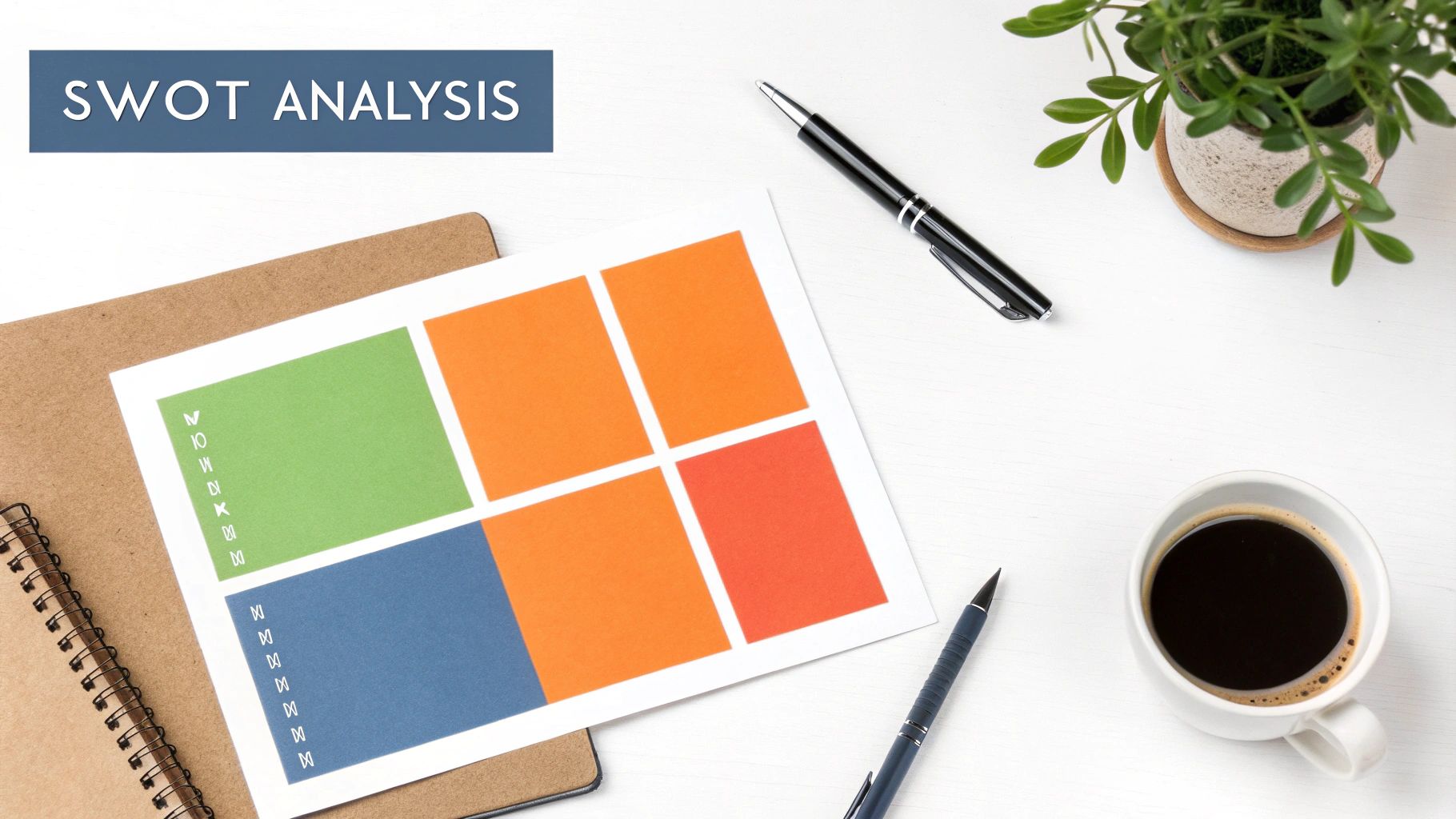
    A top-down view of a SWOT analysis template, pens, coffee, and a plant on a white desk.

    If you're just getting your feet wet with decision-making frameworks, let's start with a classic. The SWOT analysis is still around for a reason: it’s simple, and it works. I use it to map my Strengths, Weaknesses, Opportunities, and Threats.

    Think of it like getting ready for a Chicago winter. Your strengths are your insulated coat and snow tires—internal advantages you already have. Your weaknesses are that drafty old window you keep forgetting to seal; internal things holding you back.

    Opportunities are those rare, sunny winter days perfect for getting things done. Threats are the surprise blizzards that can shut everything down. These last two are external forces—you can prepare for them, but you can’t control them.

    Breaking Down the Four Boxes

    The real magic of a SWOT analysis is how it forces you to separate your thinking into two buckets: internal factors (Strengths and Weaknesses) and external factors (Opportunities and Threats). This gives you a brutally honest snapshot of where you actually stand.

    • Strengths: What do you do better than anyone else? This could be a killer product feature, a deep network in your neighborhood, or a unique skill your team has.
    • Weaknesses: Where are you falling short? Maybe it's a tiny marketing budget, a shaky supply chain, or no brand recognition. Don't be gentle here.
    • Opportunities: What's happening out there that you can jump on? Think new tech, changing customer habits, or a competitor dropping the ball.
    • Threats: What could seriously hurt your business? This is where you list new competitors, rising costs, or a potential economic downturn.

    This simple act of sorting stops you from confusing what you can control with what you can only react to. It’s the first step to building a real strategy instead of just putting out fires.

    By forcing you to look at your venture from these four distinct angles, the SWOT analysis turns a messy cloud of ideas and fears into an organized map. You can’t chart a course until you know your starting point.

    A good SWOT analysis provides clarity. Let’s make this concrete with an example for a local startup here in Chicago. The table below shows how a new apparel brand might fill this out.

    SWOT Analysis Template for a Chicago Startup

    Category Guiding Question Example (For a Local Apparel Brand)
    Strengths What internal advantages do we have over others? Our designs are created by a well-known local artist, giving us an authentic Chicago connection.
    Weaknesses What internal factors are holding us back? We have limited production capacity and rely on a single local manufacturer.
    Opportunities What external trends or events can we exploit? There's a growing "shop local" movement and several upcoming neighborhood festivals.
    Threats What external factors could jeopardize our business? Fast-fashion giants can produce similar styles for a fraction of the cost.

    See how that works? The framework instantly reveals a path. The brand's strength (local artist) directly taps into an opportunity (the "shop local" movement). It also highlights a critical threat (fast fashion) that their weakness (limited production) makes them vulnerable to. Right away, you can see they need to double down on their local story and perhaps find a backup manufacturer. That's a strategy.

    Upgrade Your Decisions with Data

    A laptop on a wooden desk displays various colorful business performance charts and graphs.

    Alright, you've mapped your landscape with a SWOT analysis. Now it's time to add a critical layer to your framework for making decisions: data.

    This isn't about becoming a spreadsheet guru. It's about listening to the story your customers and the market are telling you through numbers.

    So many founders I know have access to powerful tools like Google Analytics or Shopify reports but get overwhelmed. The sheer volume of numbers feels like staring into a blizzard. But here’s the secret: you don’t need to track everything.

    You just need to identify the three to five Key Performance Indicators (KPIs) that truly matter for your business right now. Think of yourself as a ship captain again. Data is your weather forecast, sea charts, and crew reports all in one. It doesn’t replace your judgment, but it gives you the clarity to make confident moves.

    Identifying Your North Star Metrics

    Your KPIs are your business's vital signs. They tell you if you're healthy, growing, or heading for trouble.

    For an early-stage founder, these metrics often revolve around validating your idea and finding your first customers. You can learn more about how to validate a business idea, which is a critical first step.

    Here are a few examples of KPIs that might matter to you:

    • Customer Acquisition Cost (CAC): How much does it cost you in marketing and sales to get one new customer?
    • Customer Lifetime Value (LTV): How much total revenue can you expect from a single customer?
    • Conversion Rate: What percentage of website or store visitors actually make a purchase?
    • Monthly Recurring Revenue (MRR): If you're a subscription business, this is your lifeblood.

    Choosing the right KPIs is about focus. Picking too many is like trying to listen to five radio stations at once—you just get noise. Start by asking, "What are the one or two numbers that, if they moved, would fundamentally change my business?"

    Don't Just Collect Data; Use It

    It's shocking how many companies collect data they never use. One global survey revealed a staggering gap: while 79% of organizations have defined KPIs, only 36% actually use them consistently to drive decisions.

    The study also found that highly data-driven companies are three times more likely to report significant improvements in their decision-making. That's a powerful insight. It means your advantage isn't just in gathering numbers, but in building the habit of acting on them.

    The goal isn’t to drown in data. It’s to find the essential signals that tell you whether you’re on the right track or need to change course.

    I suggest you set up a simple dashboard—it can even be a basic spreadsheet. Review your key metrics weekly. This consistent rhythm turns abstract numbers into a clear, actionable story about your business, empowering every choice you make.

    Making Tough Calls When the Future is a Total Blur

    So far, we’ve looked at frameworks that help you make sense of what you already know. But what about when the data is murky and the future feels like a shot in the dark? This is the exact moment I see most founders freeze up.

    You don't have to get stuck. When you’re staring into the fog of uncertainty, the goal isn't to magically predict the one "right" future. Your smartest move is to have a framework that gets you ready for multiple futures.

    Think of it like building a choose-your-own-adventure story for your company. You map out a few ways things could go, decide what you’d do in each chapter, and then figure out the signs that tell you which story you’re actually in. This turns gut-wrenching anxiety into focused action.

    A Four-Step Playbook for Navigating the Unknown

    This approach is about building strategic flexibility. Instead of betting the farm on a single outcome, you build a main plan with a few backup plans in your back pocket.

    Here's a simple, four-step process you can use for your next big, uncertain decision:

    1. Diagnose Your Uncertainty: First, get painfully honest about what you don't know. Is it a simple unknown with limited outcomes, or true ambiguity where you can't even list all the possibilities? Big difference.
    2. Brainstorm Scenarios: Based on that uncertainty, dream up two or three believable future scenarios. For example, a best-case (hockey-stick growth), a worst-case (the market tanks), and a weird-case (a surprise competitor pops up).
    3. Develop Your Plans: Now, build your primary plan for the most likely scenario. Then, create smaller "pivot" plans for the others. What moves would you make if the worst-case happens?
    4. Set Your Tripwires: This is the most important step. A tripwire is a specific, measurable event that screams, "It's time to switch plans!" It’s a trigger you decide on before things get chaotic, so you pull emotion out of the equation. For example: "If our customer acquisition cost jumps by 50% for two straight months, we immediately activate Plan B."

    This process gives you a clear playbook, no matter how the story unfolds. You’ve already done the hard thinking when you were calm and rational.

    By preparing for multiple outcomes, you're no longer a victim of the future—you're an active player, ready to adapt. Your decision stops being "what do I do?" and becomes "which pre-built plan do I execute now?"

    Experts have pointed out that leaders often get uncertainty wrong. They look for data that confirms what they believe instead of exploring other possibilities. A classic case study looked at three hospital ICUs with the same average infection rate. But when they dug in, the distribution of those infections was wildly different, revealing huge risks the average number hid. If you want to go deeper, you can explore more about how leaders can better handle uncertainty with a structured approach.

    Using this four-step framework helps you sidestep the trap of just going with your gut or relying on simple averages. You end up building a more resilient business—one that can thrive not just in spite of uncertainty, but because of it.

    Putting Your Framework into Practice

    All this theory is great, but let's get our hands dirty. A framework for making decisions is worthless if you don't use it. I'm going to walk you through how to apply these models to three real-world scenarios you will absolutely face as a founder.

    We'll kick things off with a product decision, then tackle hiring, and finally size up a potential partnership. This is where we make abstract concepts immediately useful for your business.

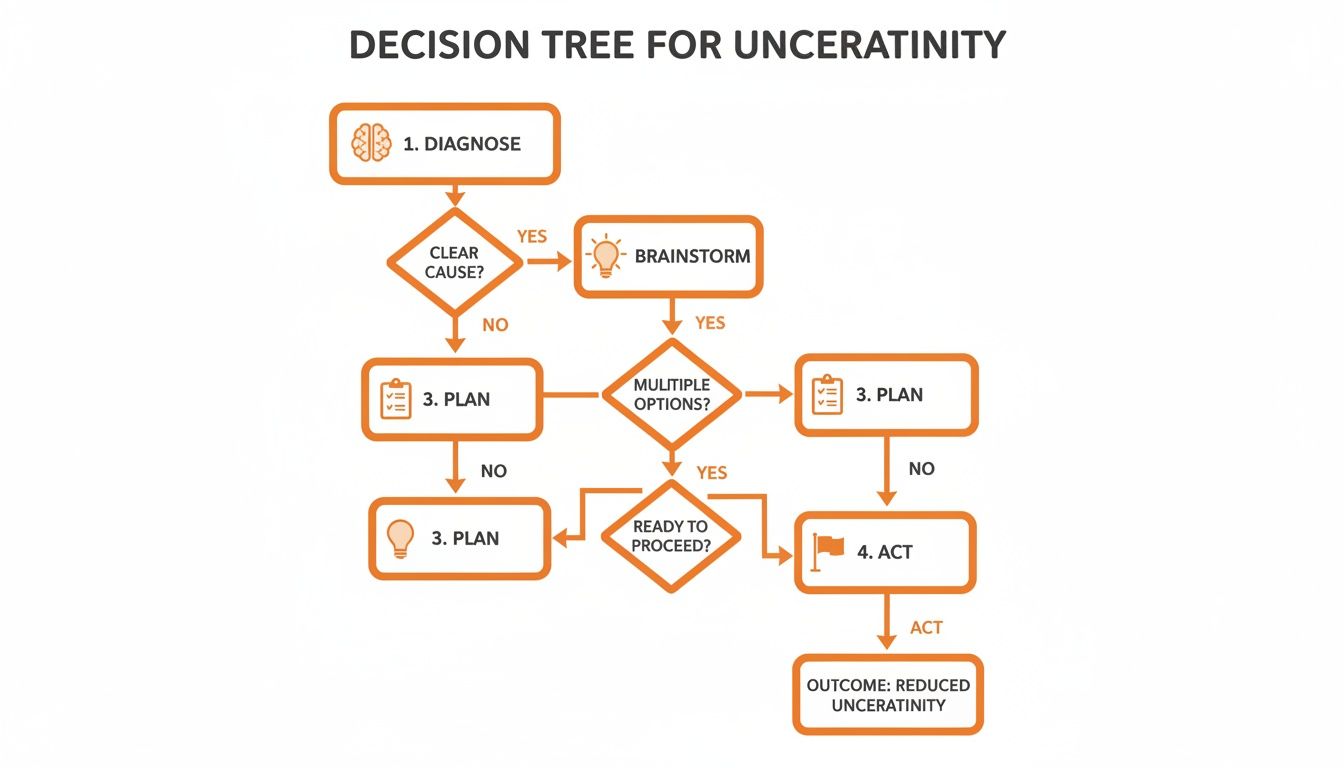
    When you're staring down uncertainty, this simple decision tree can guide your thinking. It breaks the process down into four clear steps: Diagnose, Brainstorm, Plan, and Act.

    Flowchart outlining a decision-making process for uncertainty, including diagnose, brainstorm, plan, and act.

    This visual is a crucial reminder: you can't just jump straight to a solution. You have to move deliberately from understanding the problem to taking action.

    Scenario 1: The Product Feature Debate

    Imagine you run a small e-commerce brand that sells custom notebooks. You have two potential features to build next: an online monogramming tool or a subscription box. Your resources are tight, so you can only pick one.

    In a spot like this, a decision matrix is your best friend. It’s a simple grid that helps you score your options against what actually matters to your business.

    Decision Matrix Example: New Product Feature

    Criteria (Scored 1-5) Monogram Tool Subscription Box
    Customer Demand 4 3
    Revenue Potential 2 5
    Technical Difficulty (Low=5) 5 2
    Brand Alignment 4 4
    Total Score 15 14

    Looking at the scores, the monogram tool squeaks out a win. Sure, its direct revenue potential might be lower, but it’s a heck of a lot easier to build and it’s something customers are already asking for. It’s the lower-risk, faster path to adding real value.

    Scenario 2: The First Hire Dilemma

    Your business is growing, and you’ve accepted you can’t do it all yourself anymore. You need help, but what kind of help? Do you hire a full-time employee or bring on a contractor?

    This decision has massive ripple effects on your cash flow, culture, and legal paperwork. Hiring your first employee is a huge step, especially when you're starting out. It's a common hurdle; I know many founders wonder how to get their business off the ground, which is why we put together a guide on how to start a business with no money.

    Let’s use a simple pros-and-cons list to get some clarity.

    • Full-Time Employee:
      • Pros: Deeper commitment and integration into your company culture. They can take on more tasks as needs pop up.
      • Cons: Way more expensive (salary, benefits, taxes), adds management overhead, and it's much harder to undo if it's a bad fit.
    • Contractor:
      • Pros: Lower financial commitment upfront. You get specialized skills for a specific project, and it’s a more flexible arrangement.
      • Cons: They're less integrated, might be juggling other clients, and their knowledge walks out the door when the contract ends.

    The right choice here depends entirely on your most painful need. If you need a specific skill for a short-term project (like a website redesign), a contractor is perfect. If you need someone to grow with the company and wear multiple hats, an employee is the better long-term investment.

    Scenario 3: The Partnership Opportunity

    A popular local coffee shop approaches you about a collaboration. They want to sell your notebooks in their stores and co-host a community event. It sounds exciting, but is it the right move?

    Before you jump in, dust off your SWOT analysis skills. Let's look at this purely through the lens of Opportunities and Threats.

    1. Opportunity: Does this partnership give you access to a new audience you couldn't reach on your own? Does their brand reputation elevate yours?
    2. Threat: Is there a risk of brand misalignment? What if the partnership flops—could it damage your reputation? What are the real resource costs (your time, your money) to make this happen?

    By walking through these questions, you move from an emotional "yes!" to a strategic one. You can see the real benefits clearly while also creating a plan to handle the downsides.

    Your Go-To Decision Making Checklist

    Okay, you’ve seen the theory. Now it’s time to build the habit. A killer decision-making framework is useless if you don't use it until it's second nature.

    Think of this checklist like a pilot's pre-flight routine. You run through it every time, especially when the pressure is on. It’s a simple, repeatable process that stops you from skipping a crucial step when you’re moving fast.

    The Founder's Go-To Checklist

    1. Define the Real Problem: What question are you actually trying to answer? Get specific. Write it down in one clean sentence.

    2. Gather the Right Intel: Take inventory. What data do you have versus what data do you need? Pinpoint your key metrics and call out any huge knowledge gaps.

    3. Evaluate Your Options: You need at least three viable paths. Don't forget, doing nothing is always an option. Score each one against your core business values.

    4. Pressure-Test Your Choice: Time to play devil’s advocate. What are the biggest risks with your top choice? Seriously, what's the most likely way this could blow up in your face?

    The point isn't to get rid of all risk—that's impossible. It's about making sure you're taking the right risks. A simple process like this turns your blind spots into calculated bets on your company's future.

    1. Commit and Communicate: Make the call. Then, make sure every single person on your team understands the "why" behind it. Getting your team on board is everything.

    2. Review and Learn: Put a date on the calendar to circle back and review the outcome. Did it work? What did you learn? This last step turns one good decision into a compounding advantage over time.

    This checklist is meant to be a living tool. If you're looking to get deeper into structuring your overall strategy, our guide on building a startup business plan template is a great resource for formalizing your long-term goals.

    Common Questions and Sticking Points

    Founders I work with often run into the same questions when they start using a more structured way to make decisions. Here are some of the most common ones, with my straight-up advice.

    What If My Data Is Conflicting?

    This happens all the time. Your customer surveys say people want Feature A, but your analytics show they only use Feature B. It can feel like you're getting pulled in different directions.

    Don't let it paralyze you. Conflicting data isn't a stop sign; it's a signal to dig deeper. Is the survey data from your ideal customers, while your sales data is a mix of everyone?

    This is where your gut as a founder comes back in. A framework for making decisions isn't supposed to spit out the answer for you. It's about giving your intuition better, cleaner information to work with. Pick the data source that points most directly at your strategic goals, make the call, and accept it as a calculated risk.

    How Do I Get My Team on Board?

    You can design the most brilliant decision-making process, but it's useless if your team isn't bought in. Dropping a new spreadsheet on them and expecting cheers won't happen.

    You get them on board by bringing them in from the beginning. It's been shown over and over that when you involve your team, you don't just get better ideas—you build a team that actually cares. People always support what they help create.

    Walk them through the framework on a small, low-stakes decision first. Show them how it leads to a clearer outcome. When they see it works and feel their input is valued, they'll become champions for the process, not roadblocks.

    At the end of the day, your team needs to see that this new way of doing things makes their jobs easier and the company stronger. A shared sense of purpose is a powerful thing.

    What If I Make the Wrong Decision?

    Let’s get one thing straight: you will. It’s not a question of if, but when. The best founders I know don’t make fewer mistakes; they just get incredibly good at catching and correcting them fast.

    A bad decision is only a true failure if you learn nothing from it. When you've used a framework, you have a paper trail—a clear record of your assumptions, the data you looked at, and the logic you followed. This makes it so much easier to go back, see exactly where you zigged when you should have zagged, and fix your approach for next time. This is how you turn a mistake into one of your most valuable business assets.


    At Chicago Brandstarters, we believe that building a great company starts with making great decisions, together. If you're a kind, hard-working founder in Chicago looking for a community that shares honest war stories and real support, not just transactional networking, let’s connect. Learn more about joining our free community at https://www.chicagobrandstarters.com.