
Let’s be real. When you're in the trenches, making payroll and keeping customers happy, planning your exit feels completely backward. It's like planning the retirement party on your first day of work.
But what if I told you that thinking about your exit isn't about giving up? What if it's the single best growth strategy you could implement for your business right now?
An exit strategy is your plan for eventually selling or handing off your company. It’s not about quitting; it’s about making sure all the blood, sweat, and tears you pour into your business actually pay off. You’re designing the blueprint for your final payday from day one.
Why An Exit Strategy Is Your Best Growth Strategy
When you start thinking about your exit from the beginning, something powerful happens. You have to build a company that someone else would actually want to buy. That simple shift in perspective automatically makes you build a stronger, more resilient, and more valuable business for yourself today.

It’s about building an asset, not just a job for yourself.
Building an Asset, Not Just a Job
Let's skip the MBA jargon. For founders like us here in Chicago and across the Midwest, starting with the end in mind protects your hard work and your sanity. You're not just creating a demanding, all-consuming job for yourself; you're building a tangible asset. Let's make sure it's a valuable one.
The alternative is grim. Imagine pouring your life into a business, only to find out nobody wants to buy it when you're ready to move on. Shockingly, only about 30% of small businesses that go to market actually sell. The other 70% either fail to find a buyer or can't execute a successful exit, usually because they never prepared for it. You can dig into the hard numbers in various reports on small business exit planning.
Your business should serve your life, not the other way around. An exit plan is the ultimate tool to ensure that happens. It turns your daily grind into a focused mission with a clear finish line and a defined reward.
The Power of Intentional Design
Thinking like a seller forces you to answer the tough questions early, not when you’re burnt out and desperate.
- Can this business run without me? This pushes you to create systems, document processes, and build a strong team. Suddenly, your business is more resilient and way more attractive to a buyer who doesn't want to buy another job.
- Are my financials clean and defensible? You'll start focusing on real profitability and keeping meticulous records. These are the bedrock of any solid valuation. No more shoebox accounting.
- What makes my business truly valuable? You'll identify—and protect—your competitive advantages. This could be your unique intellectual property, a fiercely loyal customer base in the Loop, or a special niche you've carved out.
This isn’t about some far-off future. It's about making smarter decisions today that lead to more growth, better profits, and a lot less stress. Your exit strategy becomes a compass, guiding every choice you make. It’s the difference between wandering aimlessly in the woods and following a map to buried treasure.
Here’s a quick look at the main roads you can take. Think of this as a map to help you start brainstorming your destination.
The Most Common Exit Paths For Founders
| Exit Path | Who It's For | Key Benefit |
|---|---|---|
| Strategic Acquisition | Founders with unique tech, IP, or a strong market position that a larger company wants. | Often yields the highest valuation and a clean break. |
| Private Equity Sale | Established, profitable businesses with steady cash flow and growth potential. | A significant payday while often allowing for a gradual transition out. |
| Management/Employee Buyout (MBO/ESOP) | Owners who want to reward their loyal team and preserve the company's culture. | Ensures business legacy and continuity with people who know it best. |
| Family Succession | Founders with capable and willing family members ready to take the reins. | Keeps the business "in the family" and protects your legacy. |
| Liquidation (Wind-Down) | Businesses that aren't sellable but have valuable assets to be sold off. | A way to extract remaining value and formally close the chapter. |
Each of these paths requires different preparation, which is exactly why you need to start thinking about it now, not later.
Defining What a Successful Exit Looks Like for You
Before you even think about selling, merging, or passing the torch, you have to answer the most important question of all: what do you actually want?
An exit isn’t just a business transaction; it’s a profound, life-altering event. It’s the moment all your risk, sweat, and late nights are supposed to pay off.
Too many founders I know get hung up on a fantasy number. We chase this vague idea of "getting rich" without ever sitting down to define what that really means for us, personally. It's like planning a massive road trip by just saying, "I want to go somewhere warm," and hitting the highway. You'll burn a lot of gas and probably end up somewhere you don't even like.
Your exit strategy needs a real destination. Clarity is your most powerful tool right now.
Beyond the Bank Account
Let's get brutally honest. Your exit goals are deeply personal and go way beyond the final sale price. You need to sit down and truly marinate on these three core areas of your life after the business is gone.
Financial Freedom: What does "enough" money actually look like for you? I’m not talking about a private jet. I’m talking about the specific lifestyle you want to fund. Do you want to pay off the mortgage, fund your kids' college, travel for six months a year, or just never worry about a restaurant bill again? Calculate it. A financial advisor can help you nail down your "walk-away" number—the net amount you need after taxes and fees to live the life you want. Knowing this number transforms your exit from a lottery ticket into a calculated goal.
Legacy and Impact: What do you want your business to become after you're gone? For some founders, the legacy is everything. Maybe you want the company you built to keep serving the community under new leadership, like a local Chicago brewery that keeps its neighborhood vibe. Others might want to see their brand absorbed by a larger player to reach a wider audience. There's no right answer, but you have to have your answer. Do you care if your company's name disappears? Does it matter if the culture you built is preserved?
Personal Involvement: Do you want a clean break, or do you see yourself sticking around? Maybe you want to transition to a board seat or a consulting role for a couple of years. Maybe the idea of waking up with a completely empty calendar terrifies you. Or maybe you can't wait to hand over the keys and never think about inventory management again. Being honest about this is critical because it will heavily influence the type of buyer you look for. A strategic acquirer might want you gone tomorrow, while a private equity firm might require you to stay on for a multi-year transition.
Your exit strategy isn't just about leaving your business. It's about designing the entry into the next chapter of your life. Get that part right, and the business details fall into place.
The Three Pillars of a Successful Exit
Think of your ideal exit as a three-legged stool. Each leg is equally important for a stable, fulfilling outcome. If one is weak, the whole thing wobbles.
Your Timeline: When do you want this to happen? Are you feeling burned out and need to exit in the next 18 months? Or are you planning for a five-to-seven-year horizon? Your timeline dictates the urgency and the prep work you need to do. A shorter timeline might mean accepting a lower valuation, while a longer one gives you time to really maximize your company's worth.
Your Lifestyle: What does your day-to-day look like after the sale? Are you starting another business, dedicating time to a nonprofit, or mastering the art of the perfect golf swing? This isn't fluff—it's about defining your future purpose. I’ve seen too many founders struggle with a loss of identity post-exit. Planning your "what's next" is just as important as planning the deal itself.
Your Financial Number: This is that concrete figure we talked about earlier. Based on your desired lifestyle, what's the net amount you need to walk away with? Be specific. This number becomes your North Star during negotiations. It helps you distinguish a good deal from a distracting one and grounds your entire strategy in reality.
Getting this clarity upfront prevents you from making emotional, reactive decisions down the road. It ensures every action you take—from cleaning up your financials to building out your team—pushes you directly toward the destination you've consciously chosen for yourself.
The Five Main Exit Routes Explained
Alright, you know where you want to go. Now, let's look at the cars that can get you there. Picking an exit strategy is a lot like choosing a vehicle for a road trip. Each one has a different feel, a different speed, and a different price tag. The best one for you? It all comes down to your personal destination.
Forget the dry, MBA-textbook definitions. I’m going to break down the five most common ways founders cash out, in plain English, with real-world situations you can actually picture yourself in. Let's kick the tires on these options so you can find the right fit for your business and, more importantly, for your life.
This is one decision you absolutely cannot rush. Here's a number that should grab your attention: starting your exit planning 3-5 years ahead of time can boost your company's value by up to 30%. On the flip side, rushed exits can vaporize 20-40% of your potential wealth. That's not just a guess—it's backed by hard data showing that planned transitions bring in way higher profits than sudden shutdowns. You can dig into more of the numbers on how planning your exit increases your business value on eloc.us.
The Outright Sale or Strategic Acquisition
Think of this as selling your prized vintage Mustang to a serious collector who knows exactly what they're looking at. This is the classic route: selling your business to a third party. This could be a bigger company in your space (a strategic buyer) or a private equity firm.
A strategic buyer will often pay a premium. Why? They aren't just buying your profit and loss statement; they're buying your customer list, your proprietary tech, or your foothold in the Chicago market to supercharge their own growth. It's a big fish swallowing a smaller one to get bigger. This is often the path to the biggest check.
A private equity sale is a different beast. These are financial buyers. They're looking for a solid business with predictable cash flow that they can tune up, grow, and sell again in 5-7 years. They're buying a money-making machine.
- Who It's For: Founders with a strong, defensible position in their market, unique IP, or a business that can be easily plugged into a larger company's operations.
- The Trade-Off: You usually get the biggest payday, but you almost always give up control completely. Your brand, your culture, your team's future—it's all in someone else's hands now.
The Management or Employee Buyout
This is like handing the keys to your most trusted road-trip buddies—the ones who helped you navigate every single mile. With a Management Buyout (MBO) or an Employee Stock Ownership Plan (ESOP), you sell the company to the very people who helped you build it.
Your senior management team might pull together financing to buy you out directly. Or, you could set up a more formal ESOP structure to transition ownership to all of your employees. This path is less about a massive, one-time cash-out and more about preserving your legacy. You're rewarding the people who poured their blood, sweat, and tears into the company right alongside you.
This is how you protect the culture you built from the ground up. You’re not just selling a company; you’re preserving a community and rewarding loyalty.
Going this route ensures your legacy lives on with people who actually get the vision. It can be a slower, more complicated process, though. Often it involves seller financing, meaning you get paid out over several years instead of all at once.
Family Succession
This is the classic story: passing the family business down to the next generation. It’s an exit strategy built on tradition, legacy, and a deep, personal connection to what you’ve created.
This path requires years of careful planning and brutally honest conversations. You have to be sure your successor is not only willing but actually capable of taking over. It’s less of a transaction and more of a gradual handoff of leadership, knowledge, and responsibility.
The money side can be tricky, too. It often involves gifting shares or structuring a sale that works for both your retirement and your family's ability to pay. It’s an emotionally rich path, but it's incredibly easy to blur the lines between family and business if you're not careful.
The Graceful Wind-Down or Liquidation
Look, sometimes the road trip just comes to a natural end. A liquidation isn't always a sign of failure. It can be a deliberate, strategic choice to close up shop on your own terms.
Think of it like parting out a car. The car as a whole might not have a buyer, but the engine, the wheels, and the stereo system still have value. You sell off your assets—inventory, equipment, client lists—pay your debts, and pocket what’s left.
This is a really common route for service businesses that are tied to your personal brand, or for companies where a sale just isn't in the cards. It gives you a clean, definite ending and lets you extract the remaining value without the headache of a long, drawn-out sale process. You stay in complete control of the final chapter.
Getting Your House in Order for a Profitable Exit
Any potential buyer is going to want to look under the hood. It’s like a pre-sale inspection for your business, and trust me, you want to be ready for it. Getting your house in order is all about making your financials, operations, and legal docs absolutely spotless.
Think of it like staging a house before you put it on the market. You fix the leaky faucet, throw on a fresh coat of paint, and clear out all the clutter. You want buyers to see the potential, not the messy reality of your day-to-day grind. This is where you roll up your sleeves and add real, tangible value to your exit.
This prep work isn't just about looking good; it's about survival. A staggering 75% of small business owners plan to sell in the next decade, but an equal 75% have no formal plan. That's a huge disconnect, and it puts trillions of dollars in founder wealth at risk simply because a business isn’t ready for a buyer’s hard look when the time comes. If you want to go deeper on this, the Exit Planning Institute's 2023 report has some eye-opening insights.
Your Financial Deep Clean
The very first place a buyer will look is your books. Period. In my experience, messy financials are the number one deal-killer. If a potential buyer can’t get a quick, clean picture of your financial health, they’ll just walk away. It’s too much risk.
You need at least three years of clean, professionally prepared financial statements. That means no more mixing personal and business expenses. Every dollar needs to be accounted for, categorized, and defensible. If your bookkeeping has been more of a "best guess" system, now is the time to bring in a sharp accountant to get it all cleaned up.
These are the non-negotiables:
- Profit & Loss (P&L) Statements: Shows your revenue, costs, and profitability over time.
- Balance Sheets: A clear snapshot of your assets, liabilities, and equity.
- Cash Flow Statements: Lays out exactly how cash moves through your business. This is crucial—our guide on cash flow management for small business can help you nail this down.
This isn’t just busywork. It’s about telling a compelling story with your numbers. Clean financials prove your business is a well-oiled machine, not just a chaotic hobby.
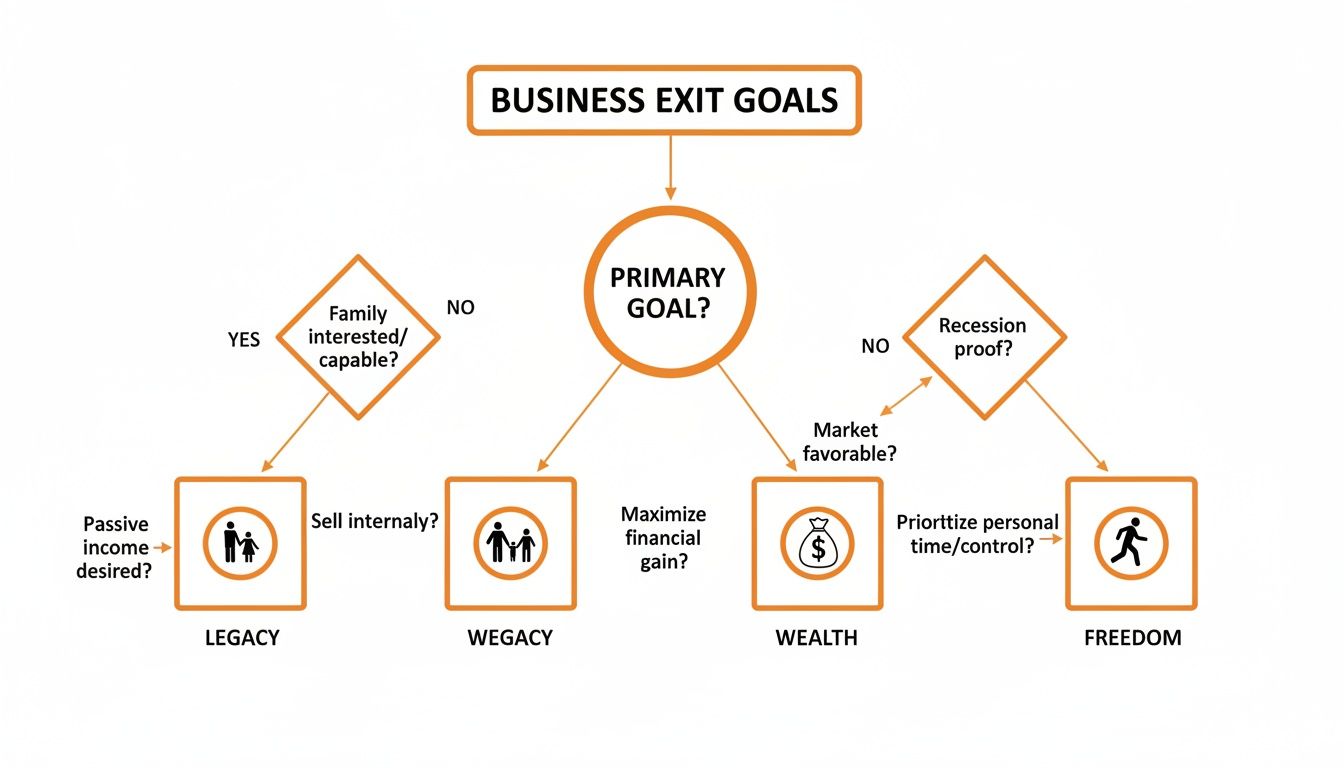
As you can see, figuring out what you want from your exit—legacy, wealth, freedom—shapes every financial and operational decision you make from here on out. It all starts with the endgame.
Making Your Business Run Without You
Let me give you some tough love: if your business can't run without you, you don't actually have a business to sell. You have a job. The entire goal here is to make yourself redundant. A buyer isn't purchasing your personal involvement; they're purchasing a system that generates cash.
Start documenting everything. And I mean everything. Create standard operating procedures (SOPs) for every key task, from how you onboard a client to how you close up at night. This playbook is proof that your business has a life of its own.
A business that depends on its founder is a high-risk investment. A business that runs on well-documented systems is a valuable, turn-key asset.
I know a Chicago restaurant owner who learned this the hard way. His first attempt to sell failed because every supplier relationship and secret recipe was stuck in his head. The second time around, he spent a year creating a detailed operations manual. The business sold for 30% more because the new owner could see exactly how to run it from day one.
Building Your Data Room
A data room is your single source of truth. It's just a secure online folder (think Dropbox or Google Drive) where you organize every single document a buyer will need for due diligence. Having this ready before you even start talking to buyers makes you look incredibly prepared and professional.
It also prevents that last-minute, frantic scramble for documents, which always looks suspicious. It screams confidence and transparency.
Your data room should be meticulously organized into folders. Here’s a basic checklist to get you started:
- Financial Docs:
- Tax returns (3-5 years)
- Financial statements (P&L, Balance Sheets, etc.)
- Bank statements
- Legal Docs:
- Business formation documents (Articles of Incorporation, etc.)
- All contracts (clients, suppliers, leases)
- Intellectual property registrations (trademarks, patents)
- Operational Docs:
- Employee roster and contracts
- Organizational chart
- Your documented SOPs and processes
I once saw a promising deal for a local software company completely fall apart during due diligence. The founder couldn't produce a key client contract, and the buyer got spooked and walked. Don't let a missing PDF cost you millions. Getting your house in order isn't glamorous, but it's where you truly secure your payday.
Navigating the Deal From Negotiation to Closing
You’ve done the hard prep work. Your business is staged, your books are clean, and a serious buyer is sitting across the table, literally or virtually.
Take a deep breath. This is where the game changes, and the emotional rollercoaster really kicks into high gear.
Negotiating and closing the sale of your business is a totally different skill set than running it day-to-day. It’s less about operations and more about psychology, endurance, and keeping your cool when your life’s work is under a microscope. This is the moment you'll be incredibly glad you had a game plan.
Assembling Your Deal Team
The first rule of a high-stakes negotiation? Don't go in alone. Trying to handle this yourself is like trying to perform your own surgery. You need a trusted team of pros in your corner, each with a specific role to play.
This isn't an expense; it's an investment in protecting your final number and your sanity.
Your M&A Attorney: This is your quarterback. They aren't just reviewing documents. They’re structuring the deal to protect you from hidden liabilities and fighting for favorable terms. Trust me, they’ve seen every dirty trick in the book and will keep you from making catastrophic mistakes.
Your Accountant/CPA: Think of them as your financial defender. They’ll work with the buyer's team to justify your valuation, navigate the tangled mess of tax implications, and make sure the numbers in the final agreement actually match what you thought you agreed to.
Your Business Broker/M&A Advisor: This is your strategist and emotional buffer. A good broker keeps the deal moving forward, manages the delicate communication between you and the buyer, and handles the tough back-and-forth so you can stay focused on the big picture.
The Art of Negotiation Beyond the Price Tag
Everyone obsesses over the final sale price, but that's just one piece of the puzzle. Some of the most critical negotiation points have nothing to do with that headline number. Don’t let a big offer blind you to the fine print.
Getting the highest price but losing on key terms is a classic rookie mistake. The details buried in the purchase agreement can be worth hundreds of thousands of dollars, or even more.
I saw this happen to a founder in the Chicago suburbs. He got a fantastic offer but glossed over the "working capital" clause. At closing, he was forced to leave an extra $200,000 in the business account—a gut-wrenching surprise that torpedoed his post-exit plans.
Key terms you need to negotiate fiercely include:
- The Transition Period: How long are you really expected to stay on after the sale? A short, well-defined consulting agreement gives you freedom. A long, vague "transition" can feel like you sold your business only to become a stressed-out employee.
- Employee Retention: What happens to your key people? Negotiating bonuses or employment contracts for your loyal team isn't just a kind thing to do; it protects the value of the business for the buyer and ensures a much smoother handover.
- Non-Compete Clauses: Make sure this is reasonable in scope and duration. You don't want to accidentally sign away your ability to ever work in your industry again.
Surviving the Due Diligence Gauntlet
Once you agree on the main terms, you'll sign a Letter of Intent (LOI). This is when due diligence begins. Prepare yourself, because this part is invasive.
The buyer and their team will comb through everything. It can feel like a full-body audit of your entire professional life. They will question your decisions, poke holes in your projections, and scrutinize every single contract.
Don't take it personally. Their job is to find reasons to lower the price or walk away. Your job is to be organized, responsive, and completely unflappable.
The key to a smooth due diligence process is preparation. If you did the work we talked about in the last section, this will be much less painful. And if you're ever on the other side of the table, check out our guide on the questions to ask when buying a business to understand exactly what buyers are looking for.
Finally, closing day arrives. You'll sign a mountain of paperwork, the funds will be wired, and just like that, it's over. The business you poured your life into now belongs to someone else. It's a surreal, exhilarating, and often bittersweet moment.
Life on the Other Side After You Exit
So, you’ve signed the mountain of paperwork. The wire transfer hits your bank account, and the number has more commas than you’ve ever seen in your life. The business you poured your soul into now officially belongs to someone else.
Now what?
This is the part nobody really talks about. We get obsessed with the deal, the valuation, the negotiation—the finish line. But almost no one is ready for the deafening silence that comes the day after.

The Founder Identity Crisis Is Very Real
Your business wasn't just a 9-to-5; it was your whole identity. You were "the person who runs that cool Chicago coffee shop" or "the founder of that e-commerce brand." When that title disappears, it can feel like you’ve lost a huge part of yourself.
This psychological shift is often way more jarring than the business transition itself. The structure of your days, the problems you were constantly solving, the team you led—it all just vanishes overnight. There's a reason why 29% of founders say emotional attachment is the biggest roadblock to even planning an exit.
An exit strategy for a small business isn't complete until it includes a plan for your personal next chapter. Otherwise, you’re just selling your way into a void.
The goal isn't just to not be bored. It's about consciously designing what comes next so your exit becomes a launchpad, not an endpoint.
Managing Your New Reality
Suddenly having a lot of money is a completely different skill set than earning it. Your first instinct might be to make big, fast moves. But honestly, the smartest thing you can do is just slow down and breathe.
- Assemble a Personal Team: Just like you had a deal team, you now need a life team. This means a good wealth advisor, a tax pro, and maybe even a therapist or coach to help you work through the identity shift.
- Create a "Do Nothing" Period: Give yourself a mandatory six-month to one-year cooling-off period. Don't make any massive investments, don't start a new company, don't commit to anything huge. Just let the dust settle.
- Define Your New "Why": Your purpose can't be tied to revenue goals and employee headcounts anymore. So what actually matters to you now? Is it philanthropy? Mentoring other founders? Mastering a new skill, or just being more present with your family?
This is also a great time to get your personal finances rock-solid. The same principles of disciplined financial management still apply, and you can get a refresher on the fundamentals in our article on how to pay yourself from your business.
Designing Your Next Venture (Even if It’s Not a Business)
Your entrepreneurial journey doesn't just stop with a sale; it just changes. The drive that helped you build something from nothing doesn't just switch off. You just need a new place to point it.
This might mean starting another company, but it doesn't have to. Your next "venture" could be anything that gives you purpose and structure.
For one founder I know, it was training for and completing an Ironman. For another, it was launching a small foundation to support youth arts programs in her Midwest town. That entrepreneurial spirit is an asset you can apply anywhere.
The key is to move from a life of frantic activity to one of intentional action. Your exit isn't the end of your story. It’s the moment you finally get to pick up the pen and write the next, most meaningful chapter yourself.
At Chicago Brandstarters, we know the founder's journey is about more than just the exit. It's about building something meaningful alongside people who get it. If you’re a kind, bold builder in the Midwest, join our free community to find the support, friendship, and honest advice you need for every stage of your journey. https://www.chicagobrandstarters.com