
I get this question all the time: is it cheaper to ship with UPS or USPS? The honest answer? It depends. No single carrier wins every time.
Let me break it down for you. For the small, light stuff most of us start with—like t-shirts or jewelry—USPS is almost always your cheapest option, especially for anything under 2 pounds. But once your packages get heavier, say over 10 pounds, UPS starts to look a lot better.
The Quick Answer: Cheaper to Ship UPS or USPS?
Think of picking between UPS and USPS like choosing a tool. You wouldn't use a sledgehammer to hang a picture, right? In the same way, you shouldn't pay a heavy-freight carrier to ship a pair of socks. Getting this right saves you money on every single package.
For a new brand, those first few dollars saved on shipping can make or break you. Here's a real example: for a 1 lb package, I've found USPS Ground Advantage is roughly 6% cheaper than UPS Ground. That might not sound like much, but when you realize how many of your shipments will be under 2 lbs, those savings stack up fast. You can dive deeper into the rates yourself over at willowcommerce.ai.
I made this decision tree to break it down. Just remember this: if it's light, I use USPS; if it's heavy, I lean toward UPS.
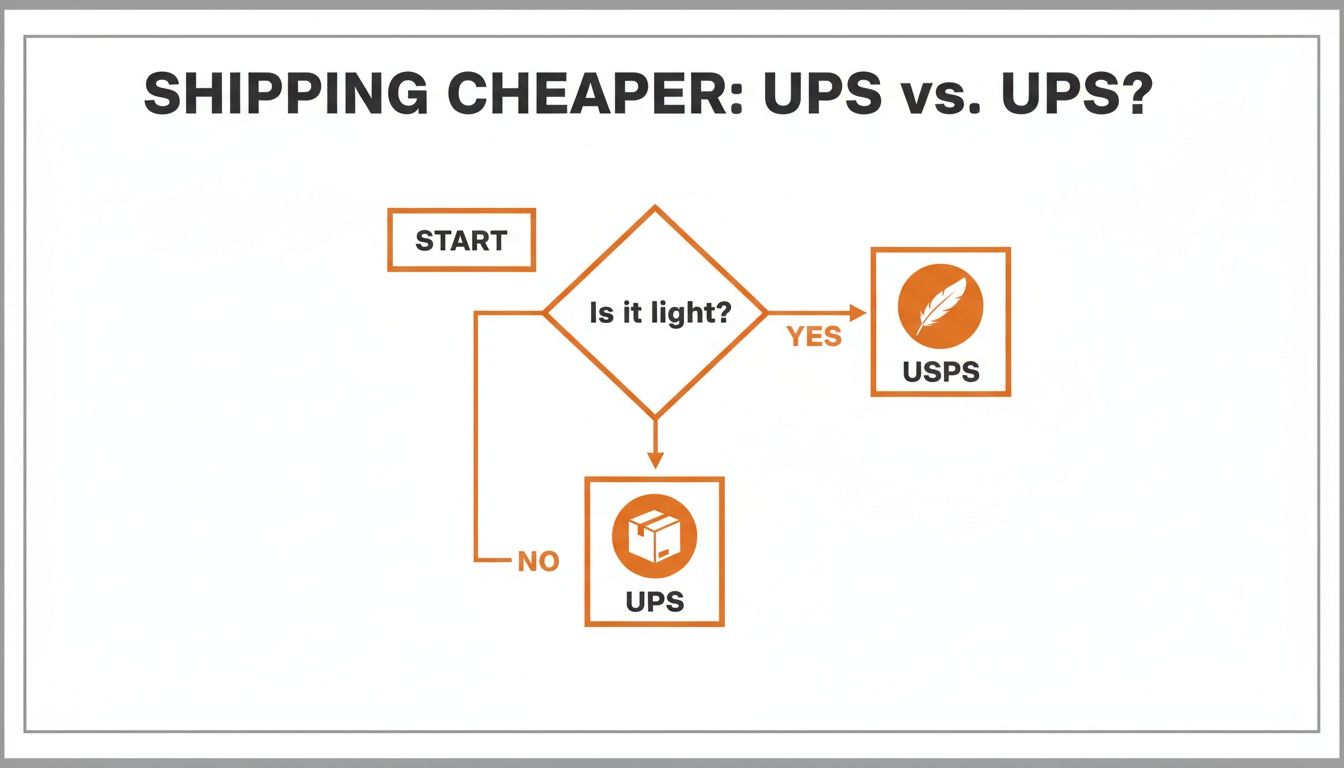
The flowchart makes it simple. It all comes down to that one question about weight. It guides you to the right carrier for most of your shipments without you having to overthink it.
UPS vs USPS: When Each Is Cheaper (Quick Glance)
To make things even clearer, I put together this quick-reference table. Just find your situation, and you'll know who to go with.
| Shipping Scenario | The Cheaper Carrier | Why It's Cheaper For You |
|---|---|---|
| Lightweight Items (Under 2 lbs) | USPS | I use USPS Ground Advantage because it was literally made for small parcels. You get lower base rates and skip the residential and fuel surcharges UPS often adds. |
| Heavy Items (Over 10-15 lbs) | UPS | UPS's ground network is a beast built for heavy stuff. Their pricing gets much better as the weight goes up, saving you a ton of cash. |
| Small, Dense & Heavy Items | USPS | A USPS Priority Mail Flat Rate Box is my secret weapon here. You can stuff it with up to 70 lbs, and the price never changes. |
| Express & Guaranteed Delivery | UPS | It costs more, but when a shipment absolutely has to be there tomorrow, I pay for services like UPS Next Day Air for the peace of mind. |
Think of this table as your cheat sheet. When you're packing orders and need to make a quick decision, a glance here will save you both time and money.
The Ground Shipping Showdown
This is where your brand will live or die. Ground shipping is the workhorse you'll rely on for almost every order. When you're trying to figure out if it's cheaper to ship with UPS or USPS, getting this right is everything.
Let's break down your two main options: USPS Ground Advantage and UPS Ground. On paper, they seem similar, but their pricing is built for totally different things. I like to think of it like this: USPS is a nimble sedan, perfect for zipping small packages around town, while UPS is the heavy-duty truck you need for bigger, long-haul jobs.
The Lightweight Battle: Under 5 Pounds
For any package you ship that's under 3-5 pounds, my money is almost always on USPS Ground Advantage. Their whole system is designed to be cheap and simple for the small, light stuff that makes up most of e-commerce.
Let’s run the numbers for a common item:
Scenario: Shipping a 1 lb T-Shirt in a Poly Mailer
- USPS Ground Advantage: You're looking at around $4.50 – $6.50, depending on how far it's going.
- UPS Ground: The starting rate will probably be closer to $8.00 – $10.00.
It's a no-brainer, right? USPS is the clear winner. But the sticker price isn't even the whole story.
The real killer with UPS for small packages isn't the base rate—it's the surcharges. UPS often slaps on residential and fuel surcharges that can add an extra $5 or more to your bill. That "competitive" rate just ate all your profit.
The Tipping Point: When UPS Takes Over
So, when does the math flip? When should you switch from that USPS sedan to the UPS truck? The tipping point for me usually shows up when my packages hit the 5-10 pound mark.
As the weight climbs, the per-pound cost for UPS Ground starts to drop, and fast. Their massive logistics network is just built for this kind of volume, and the pricing shows it. USPS, on the other hand, starts getting real expensive as packages get heavier.
Let’s look at another classic scenario:
Scenario: Shipping a 5 lb Box of Handmade Candles
- USPS Ground Advantage: This will probably run you $8.00 – $12.00.
- UPS Ground: The rate will be right there with them, around $9.00 – $13.00. If you have decent commercial discounts, it might even be cheaper.
At this weight, they're neck and neck. This is your transition zone.
Anything heavier than this, and UPS pretty much always pulls ahead for me. This is especially true once you start getting commercial rates. Internalize this, and you'll build a shipping model that's predictable and profitable.
Shipping Heavy Items Without Breaking The Bank
As your brand grows, your packages get heavier. This is where the whole shipping game changes. What worked for your first 100 orders—lightweight packages you just slipped into USPS mailers—suddenly eats into your profits. This is the moment UPS steps in as a heavyweight champion.
I want you to think of it like this: USPS is a prizefighter in the featherweight class. Quick, agile, and unbeatable with small packages. But when you need to move real weight, you call in a heavyweight. That’s UPS. Their entire network is built to handle dense, heavy items with incredible efficiency. That efficiency means direct savings for you once your packages cross that crucial 15-20 pound threshold.
When The Math Favors UPS
Let's look at the actual numbers. For a medium-heavy 20 lb box, you might be surprised to learn that USPS is still about 8% cheaper. But the game flips hard as you scale up.
For a 50 lb shipment, I've found that using my optimized UPS account can be a whopping 42% cheaper than sending it with USPS. That’s a massive saving that goes straight to your bottom line.
This is a critical turning point. UPS handles packages up to 150 lbs, while the Post Office maxes out at 70 lbs. That higher weight limit is a lifesaver for my B2B orders, stopping me from having to split a single big order into multiple, more expensive boxes.
Understanding Dimensional Weight
Another area where UPS pulls ahead is with a concept called dimensional weight, or DIM weight. It’s a dirty little secret of the shipping world that I learned the hard way.
Carriers use this for large, light packages. Imagine shipping a big box of pillows—it takes up tons of space on a truck but weighs almost nothing.
Both UPS and USPS use a formula (Length x Width x Height / Divisor) to calculate a "dimensional" weight. They’ll charge you for whichever is greater: the actual physical weight or this calculated DIM weight. The key difference is that UPS often uses a more generous "divisor" in their formula, which can give you a lower billable weight for your bulky items.
This little detail can cost you. A poorly packed, bulky box can easily double your shipping cost. Once you understand this, you can pick the right carrier—often UPS for these items—and choose packaging that avoids these profit-killing surprises.
Comparing Costs For Express And 2-Day Shipping
When your customer needs an order now, you're in the world of express shipping. This is where the "Is it cheaper to ship UPS or USPS?" question gets real, because your costs can shoot up. Let's break down the big players: USPS Priority Mail & Priority Mail Express versus UPS 2nd Day Air & Next Day Air.
I always think of it like this: UPS is your private taxi—it costs more, but they guarantee they'll get you there on time. On the other hand, USPS Priority Mail is like an express train; it's impressively fast (usually 1-3 days) and way cheaper, but it doesn't come with that same money-back guarantee.
The Fast-Shipping Price Breakdown
When you look at the numbers for time-sensitive packages, USPS Priority Mail Express consistently beats UPS Next Day Air on price. For a simple 1 lb overnight package, I've found USPS is about 2% cheaper. That might not sound like much, but the gap widens to almost 9% for a 20 lb parcel. Those savings are a lifeline when you need to offer speed without giving away your profit. You can dig into more of the details in this shipping carrier comparison.
This is where you have to decide what you’re really paying for. Raw speed, or a guaranteed delivery window?
For most brands, the 1-3 day window of USPS Priority Mail is the perfect sweet spot. It feels fast to your customer and keeps your costs from spiraling. I only use UPS when a delivery date is an absolute, non-negotiable promise.
Let's look at a common 2-day shipping scenario.
Scenario: 2-Day Shipping for a 2 lb Package
- USPS Priority Mail: This is your value option. It’ll probably cost you around $10-$15. It's not a guaranteed 2-day service, but for most places, it will get there in that timeframe.
- UPS 2nd Day Air: Here, you're paying for that guarantee. The cost is much higher, often starting around $20-$25 or more, especially after you add surcharges.
The choice is yours: save a solid 40-50% with USPS for "fast enough" shipping, or pay the premium for UPS's ironclad promise.
Your Secret Weapon: USPS Flat Rate Boxes
Now, let me share one of my favorite shipping hacks: USPS Priority Mail Flat Rate boxes. For expedited shipping, these are an absolute game-changer, especially for anything small but heavy.
The logic is simple: if it fits, it ships for one price, up to 70 lbs. It doesn't matter if you're sending a box of dense parts across town or across the country. The price is the same. This lets you offer fast, predictable shipping costs, turning a huge headache into a real competitive edge.
Alright, let's get practical. To make this super clear, I’ve put together a playbook for three common situations you’ll run into. This will help you decide on the spot whether it's cheaper to ship UPS or USPS.
Scenario 1: The Small, Lightweight Product
So you just sold your first product. Congrats! It's a single, 14-ounce bottle of craft hot sauce. You're shipping it from your workshop to a customer a few states away.
- Your Best Bet: USPS Ground Advantage. Hands down.
- The Breakdown: This is a no-brainer. You're looking at a cost of maybe $5 to $7. It’s cheap, reliable for this weight, and you completely avoid the surprise residential and fuel surcharges that UPS loves to add. Seriously, don't even think about UPS for this; you'd just be throwing money away.
Scenario 2: The First Wholesale Order
Things are moving! A boutique just put in a wholesale order. The box weighs 15 pounds.
- Your Best Bet: This one’s a toss-up, but I’d lean toward UPS Ground.
- The Breakdown: Once you hit this weight, you’ve reached the tipping point where UPS gets competitive. Both UPS Ground and USPS will probably quote you somewhere in the $15 to $20 range. But if you’re using a platform like Shopify Shipping, your built-in UPS discounts will likely make it a few bucks cheaper. Plus, you get much better tracking, which is crucial for a valuable B2B shipment.
This is what I call the messy middle of shipping. Your final choice here really comes down to the discounts you have. Without good discounts, USPS might still have the edge. With them, UPS almost always pulls ahead for me.
Scenario 3: The Time-Sensitive VIP Order
An important customer needs their order, fast. It’s a 3-pound package that has to be there in two days.
- Your Best Bet: Go with USPS Priority Mail.
- The Breakdown: USPS Priority Mail will get it there in 1-3 days for about $12. This feels speedy to your customer without wrecking your profit. Sure, UPS 2nd Day Air® offers a money-back guarantee, but at what cost? You’d be paying upwards of $25 for that same package. Unless it’s a life-or-death delivery, I save over 50% just by choosing USPS.
These scenarios cover 80% of what you'll see. If you can internalize this playbook, you'll make smarter, faster decisions that protect your bottom line.
For those of you shipping to third-party warehouses, you can learn more about prepping bigger shipments in our guide for sending products to Amazon FBA.
Your Action Plan to Lower Shipping Costs
Alright, knowing which carrier is cheaper is one thing. Actually shrinking your shipping bill? That’s the real game. This is your playbook for putting money back in your pocket.
First, you should almost never pay retail shipping rates. Seriously. Walking into a Post Office or UPS Store to pay the counter price is like setting cash on fire.
You need to get commercial pricing. Platforms like Shopify Shipping or Pirate Ship are your best friends here. They give you instant access to deeply discounted rates that big companies get. This is the single biggest move you can make to cut your costs, and it’s free.
Master Your Packaging
The next lever you can pull is your packaging. Think of your shipping box like a taxi meter—the bigger it is, the faster the cost runs up, even if your product is light. This is all because of dimensional weight.
Carriers will charge you based on either the actual weight or its dimensional weight, whichever is higher. By finding a smaller box that fits your product snugly, you can often slash your shipping cost by 30-50%.
This is not an exaggeration. I’ve saved hundreds of dollars a month just by finding a better-fitting box. It’s the lowest-hanging fruit in the entire shipping game. Don't ignore it.
Use Each Carrier's Strengths
Finally, get strategic. You don’t need to be loyal to just one carrier. Be a free agent and use their advantages for your own good.
- Free USPS Supplies: USPS gives away free Priority Mail boxes and mailers. You can order them online and have them delivered to your door, for free. This completely wipes out your packaging costs for anything you ship with Priority Mail. It’s a no-brainer.
- Negotiate with UPS: Once you start getting real volume—I’m talking 15-20 packages a day—you’ve got leverage. It’s time to call up a UPS sales rep and negotiate your own rates. Don’t be shy about this. We talk more about how to approach these kinds of business negotiations in our other guides.
Taking these steps is how you go from being a price-taker to someone who actively manages shipping costs. This is how you find real money to put back into growing your brand.
Your Top UPS vs. USPS Questions, Answered
I know how it goes. You're staring at the screen, about to print a label, and a last-minute question pops into your head. Here are some straight answers based on my experience shipping thousands of packages.
Which Is Better For Tracking, UPS Or USPS?
UPS wins this one, hands down. Their tracking is obsessive in the best way, giving you frequent, detailed updates. If I'm sending something high-value and my customer (or I) needs that peace of mind, I go with UPS.
USPS tracking has gotten a lot better, but it’s still more basic. You’ll see the big scans—accepted, sorting facility, and out for delivery. For most everyday shipments, it's perfectly fine.
Who Offers Better Insurance?
Both carriers give you some basic coverage. For USPS Priority Mail and UPS Ground, you're typically covered for up to $100. Frankly, for most of the stuff you'll ship as you start out, this is plenty.
When you need more, you can buy it from both. I’ve found that for incredibly expensive items, UPS's claims process can sometimes be a little less of a headache, but you're paying a premium for that service.
My rule of thumb is simple: for anything worth over $300, I take a hard look at the added insurance cost versus the risk. Don't just assume the base coverage is enough for your expensive products.
Is USPS Really Cheaper For International Shipping?
For sending small, light packages overseas, USPS is almost always my cheapest option. Services like First-Class Package International are practically built for small brands testing the global market.
But here's the catch: once those packages get heavier, or when your international customer needs reliable tracking and a guaranteed delivery window, UPS becomes the clear winner. Their worldwide network and customs brokerage can be a total lifesaver.
This is another classic case where it's not about which is cheaper overall, but which is cheaper to ship for your specific package right now.
At Chicago Brandstarters, we believe in building your brand with the support of a community that gets it. If you're a kind, hard-working founder in the Midwest, we invite you to connect with peers who share honest stories and real tactics. Learn more and join our free community at https://www.chicagobrandstarters.com.