

You know this feeling. One SKU is flying, your ads are working, customers are finally talking about you, and then the product goes out of stock right when demand gets hot. Or you look over at the warehouse and see the opposite problem. Dead boxes. Slow movers. Cash sitting on shelves.
I've been there, and guessing never fixes it.
When founders ask me how to get control of inventory without turning into a full-time planner, I start with one number: Weeks of Supply. It's simple, fast, and good enough to make better buying calls today. You don't need fancy software to begin. You need a repeatable way to answer one question: how long will my current stock last if sales keep moving at their recent pace?
That's why I like calculating weeks of supply. It gives you a time-based view of inventory. Time is easier to act on than raw unit counts. Saying “I have 842 units” doesn't help much by itself. Saying “I have about 5 weeks left” changes how you buy, how you plan launches, and how you protect cash.
Your First Step Beyond Inventory Guesswork
Early-stage brands usually track inventory in one of two bad ways.
The first is pure instinct. You “feel” low, so you reorder. The second is dashboard clutter. You stare at Shopify, Amazon, your 3PL portal, and a spreadsheet, then hope your gut stitches it all together. That works for a while. Then one promo hits, one supplier slips, or one product catches traction faster than expected, and the cracks show.
Weeks of Supply, or WOS, is the fix I reach for first. It turns inventory into something founders can use. Instead of asking, “Do I have enough stock?” you ask, “How many weeks do I have left at my current sales pace?” That is a much better question.
It's like checking how much runway you have left before a plane has to land. You don't need a PhD in aviation. You need a realistic read on what's in the tank and how fast you're burning through it.
Why founders should care
WOS is useful because it connects two things you already care about:
- Cash: Every extra unit ties up money.
- Availability: Every stockout leaves money on the table.
- Focus: A single time-based number cuts through noise.
- Decision speed: You can look at a SKU and act fast.
Practical rule: If you can't say how many weeks of supply you have on your best sellers, you're not managing inventory yet. You're reacting to it.
I like WOS for another reason. It plays well with scrappy systems. You can calculate it in Shopify exports, Google Sheets, Excel, or a lightweight ops stack. If you want a broader look at process and tooling, this B2B inventory guide is a useful companion to the hands-on approach I'm talking about here.
Don't overcomplicate the first step. Start with WOS. Then make it a habit.
The Weeks of Supply Formula Explained
The formula is dead simple.
Weeks of Supply = On-Hand Inventory / Average Weekly Units Sold
That formula comes straight from Cogsy's explanation of weeks of supply, which also makes one important point: WOS estimates how many weeks you'll remain in stock based on current inventory and historical demand, ignoring incoming orders.
That last part matters. WOS is about what you have right now, not what you hope will arrive.
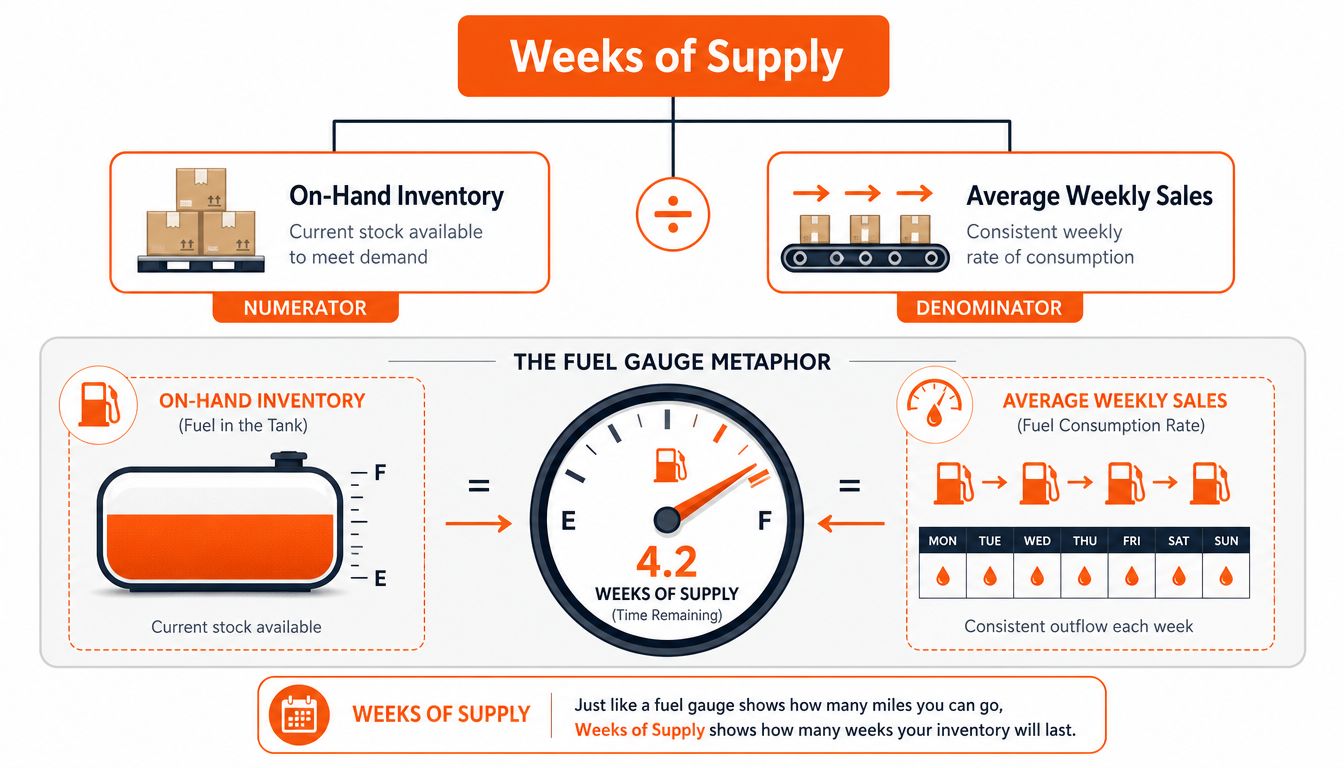
Think of WOS like a fuel gauge
Your on-hand inventory is the gas in the tank.
Your average weekly units sold is how many miles you drive each week.
WOS tells you how many weeks you can keep going before the tank runs dry.
That framing helps because founders often get tripped up by units. They stare at a big stock count and think they're safe. They aren't safe if the sales pace is high. A pile of inventory can disappear fast when the right SKU starts moving.
What each input really means
Here's the plain-English version:
| Input | What it means | What I'd use |
|---|---|---|
| On-hand inventory | Units physically available to sell now | Your current stock count from Shopify, your IMS, or your 3PL |
| Average weekly units sold | Your recent weekly sales pace | A weekly average based on the right historical window |
A clean example helps. Cogsy gives a simple one: 1,000 units on hand with 100 units sold per week equals a WOS of 10 weeks in its weeks of supply formula guide. That means, if nothing changes and no new stock arrives, you run out in 10 weeks.
Inventory counts tell you what you own. WOS tells you how much time you've bought yourself.
What WOS is good for, and what it isn't
WOS is strong when you need a quick operational read. I use it to spot products that need attention now.
It is not a full forecast. It won't magically account for future promos, a TikTok spike, or supplier delays. That's fine. Don't ask a screwdriver to be a hammer. Use WOS for what it does well: fast, clear inventory timing.
Gathering Your Data the Right Way
The formula is easy. The inputs are where founders mess this up.
On-hand inventory is usually the easy part. Pull it from Shopify, your inventory system, or your 3PL report. Just make sure you're using the number that reflects sellable units now, not some bloated figure that mixes in damaged, reserved, or unavailable stock.
The harder part is average weekly units sold. Generic advice often proves inadequate here. If you choose the wrong time window, your WOS number looks clean and still gets you into trouble.
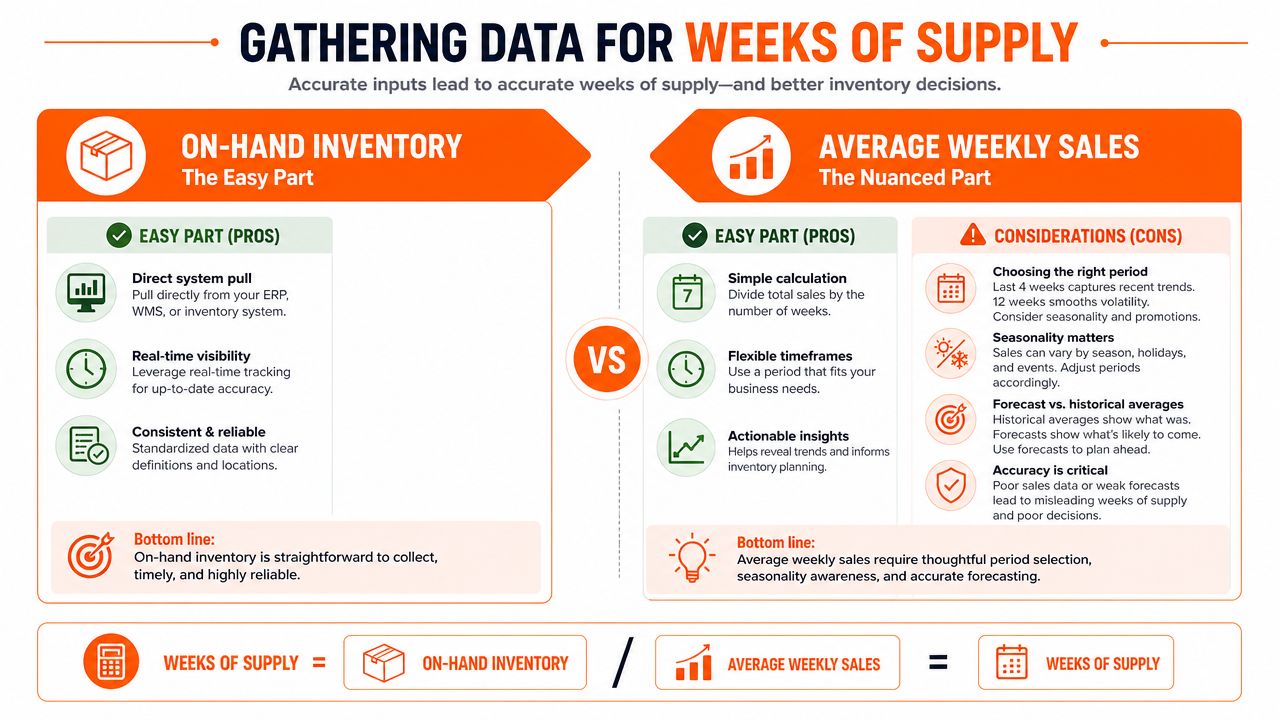
The easy input
For on-hand inventory, I'd keep it boring and disciplined.
- Use one source of truth: Pick Shopify, your IMS, or your 3PL report.
- Check timing: Pull the number at a consistent time each week.
- Exclude noise: Don't mix in units you can't ship.
- Stay at the SKU level when possible: Broad counts hide product-level problems.
If you sell across channels, the operational mess gets bigger fast. A practical overview of that problem lives in this piece on multichannel inventory management.
The input that actually changes your answer
The sales window you choose changes the whole story.
Accelerated Analytics makes this point clearly in its guide to calculating weeks of supply: use a 4-week window for seasonal vendors and an 8-to-10-week window for non-seasonal vendors.
That advice is sharper than the usual “just use average sales” nonsense.
Why? Because averages can lie when demand changes fast.
If you sell seasonal items, a shorter window captures the current burn rate better. If you sell steady products, a longer window smooths out random noise and gives you a more stable read.
How I choose the window
I keep it simple:
| Product pattern | Window I'd use | Why |
|---|---|---|
| Seasonal or spike-prone | 4 weeks | Recent demand matters more than older history |
| Steady, repeatable demand | 8 to 10 weeks | A wider view smooths small fluctuations |
Here's the trap. A founder uses a long average for a product that is suddenly heating up. The spreadsheet says inventory looks fine. Sales keep accelerating. Then stock disappears faster than the model expected.
If demand is moving, your average has to move with it.
That's why I don't use one universal window across the whole catalog. A basic tee with stable reorders and a trend-driven holiday bundle should not use the same lookback.
My recommendation
Use these checks before you lock in your sales window:
- Ask whether demand is stable or lumpy. If it jumps with events, seasons, or launches, go shorter.
- Look at recent weeks first. If recent sales differ a lot from older weeks, don't let old data dilute reality.
- Review buyer logic if wholesale is involved. If a retail buyer thinks in a different demand window than you do, you need to know that.
- Track your misses. If your WOS keeps overstating or understating runway, your averaging window probably needs work.
Founders typically win or lose when calculating weeks of supply. Not the math. The judgment.
Calculating WOS with a Spreadsheet
You do not need fancy software to start. A spreadsheet is enough.
Let's use a fictional SKU: a lavender candle in an ecommerce store. You have one row for the SKU, one cell for current on-hand inventory, and a row of recent weekly sales.
A simple setup
Let's say your sheet has:
- Cell B2 for on-hand inventory
- Cells C2 through J2 for the last several weeks of unit sales
- Cell K2 for average weekly sales
- Cell L2 for weeks of supply
For a steady product, I'd use a wider sales window. For a seasonal product, I'd only average the recent few weeks.
Google Sheets and Excel formulas
If you're using an 8-week window, put your weekly sales in C2:J2.
Use this formula in K2 to calculate average weekly sales:
=AVERAGE(C2:J2)
Then use this formula in L2 to calculate WOS:
=B2/K2
If you're using a 4-week window for a seasonal item, and the recent weeks are in G2:J2, use:
=AVERAGE(G2:J2)
Then keep the same WOS formula:
=B2/K2
That's it.
How I'd structure the sheet
I like a basic layout like this:
| SKU | On-hand units | Week sales data | Average weekly sales | WOS |
|---|---|---|---|---|
| Lavender Candle | Current stock count | One cell per week | =AVERAGE(...) |
=On-hand/Average |
A few practical notes:
- Keep one SKU per row
- Label the weeks clearly
- Don't mix units and revenue
- Separate seasonal SKUs from stable ones if they use different averaging windows
The spreadsheet doesn't need to be pretty. It needs to be consistent.
What founders usually get wrong
I see the same mistakes over and over:
- They average the wrong date range: Old data drags the answer away from current reality.
- They use aggregate sales for a SKU decision: That hides the product you're about to run out of.
- They treat incoming POs like current inventory: WOS is about what's on hand now.
- They stop after one calculation: WOS only helps if you update it regularly.
If you want this to work in under 10 minutes each week, build the sheet once and reuse it. Don't reinvent the setup every Monday. Pull stock, paste sales, scan WOS, act.
Beyond the Basic Formula for a Clearer Picture
One WOS number for the whole business feels comforting. It is also how founders miss problems.
Your total inventory can look healthy while one high-demand SKU is about to vanish. That's why I push people to calculate WOS at multiple levels, not just once at the top.
GoodDay Software says it plainly in its weeks of supply guide: you should calculate WOS at aggregate, category, and SKU level because an aggregate number can hide the fact that a specific high-demand SKU is close to selling out.
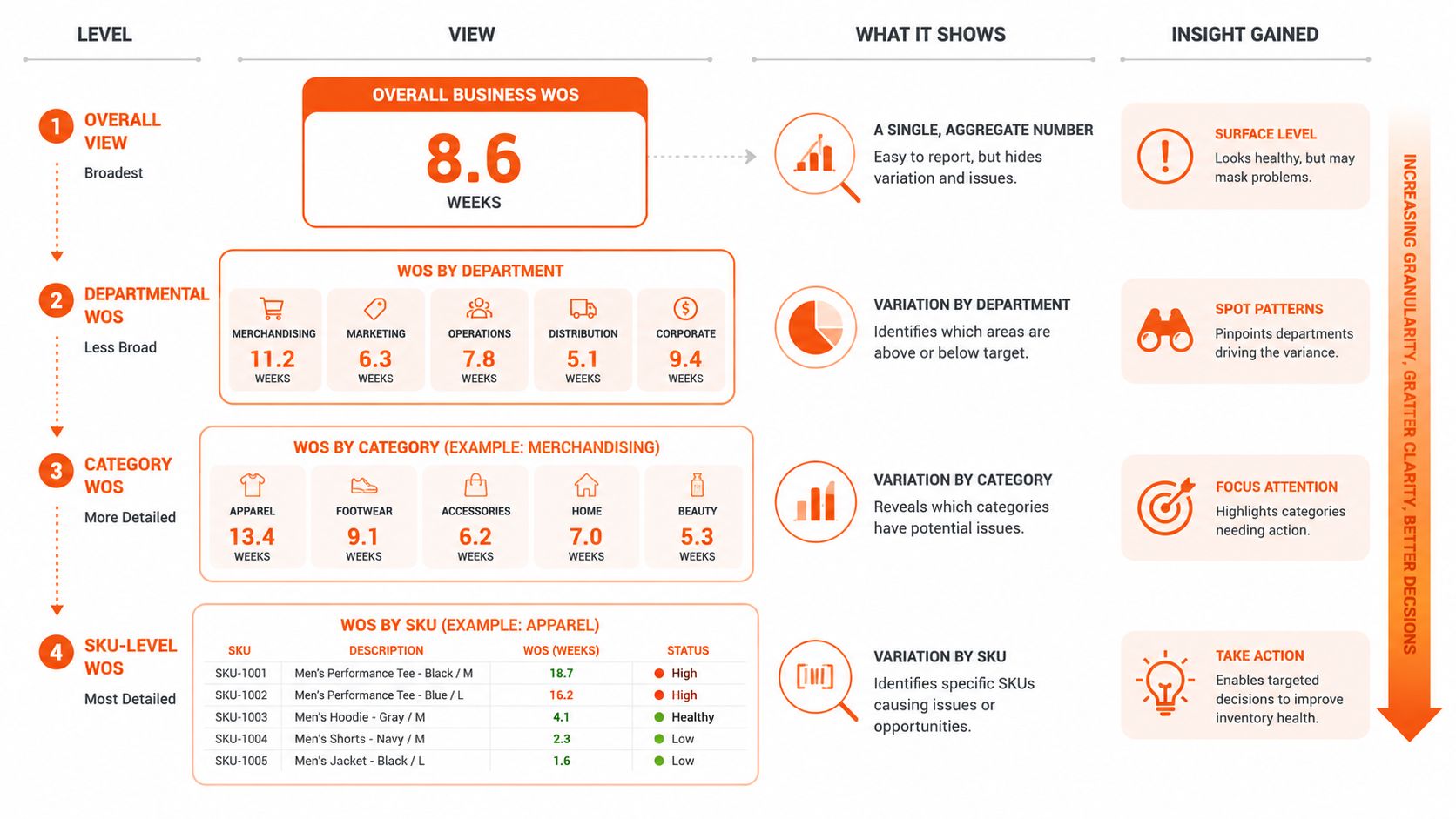
The three levels that matter
Here's how I think about them:
- Aggregate level: Your full business view. Good for a quick pulse check.
- Category level: Product groups like candles, tees, or bundles. Good for spotting broad imbalance.
- SKU level: The actual decision layer. Good for reorders, transfers, and catching stockout risk.
If you only calculate the top line, you're driving with foggy windows. You'll see “inventory is fine” while your bestseller is one good week away from disappearing.
Why SKU-level WOS changes decisions
Let's say your total inventory looks comfortable. Great. That tells you almost nothing about whether your black medium tee, your top candle scent, or your refill pack is about to run dry.
SKU-level WOS is where buying gets real.
It also helps you avoid overreacting. Sometimes founders see one low overall metric and place a broad reorder. Then the wrong products pile up. The answer wasn't “buy more everything.” The answer was “buy more of the SKUs that are moving.”
For a more advanced planning lens, I'd pair this thinking with NanoPIM's supply chain analytics guide. It's useful when you want to move from basic reporting to smarter planning logic.
Keep a small buffer in your head
I also want you thinking about safety stock, even if you don't build a perfect model for it yet.
Safety stock is your cushion. It protects you when demand jumps or inbound inventory lands later than expected. You don't need a complicated formula on day one to use the idea well. You just need to stop treating your full on-hand quantity like all of it is safely available for normal planning.
A simple operator mindset works:
- Fast mover with shaky supply: Hold more buffer.
- Steady seller with reliable replenishment: Hold less buffer.
- Promo item or seasonal SKU: Be more conservative.
If you want to understand the cash tradeoff, this article on inventory carrying cost is worth reading. More stock protects availability, but it also ties up cash. That tension is the whole game.
Broad inventory numbers calm founders down. SKU-level numbers tell them what to do.
Putting Your WOS Number to Work
A WOS number by itself is just a readout. The value comes from the decisions you make after you see it.
I use WOS to answer practical questions. Should I reorder now? Should I wait? Which SKU gets cash first? Which product do I stop feeding because it's moving too slowly?
What to do after you calculate it
Start with these moves:
- Compare WOS to supplier lead time: If your runway is shorter than the time it takes to replenish, you're already late.
- Prioritize fast movers first: Protect the SKUs that customers already want.
- Slow down on laggards: Don't keep sending cash into products that aren't earning it back.
- Review WOS weekly: A stale inventory number is barely better than a guess.
WOS becomes a buying trigger. You stop ordering based on stress and start ordering based on timing.
The cash flow angle
Founders often think inventory problems are warehouse problems. They're cash problems first.
Too much stock chokes flexibility. Too little stock kills momentum. WOS helps you sit in the middle with your eyes open. It won't make every call easy, but it will make your tradeoffs visible.
If you want a practical companion piece on day-to-day execution, these effective stock management tips are worth keeping in your reading stack.
My advice is simple. Start calculating weeks of supply this week. Do it for your top products first. Keep the sheet ugly if you need to. Just make the number real, review it often, and let it guide your next PO instead of your anxiety.
If you're building a brand in Chicago or the Midwest and want more honest operator conversations like this, join Chicago Brandstarters. It's a free community for kind, bold, hard-working founders who want real tactics, real support, and real relationships without the fake networking energy.
Leave a Reply