

You know this feeling.
You've built something real. A product, a brand, a community, maybe even a scrappy MVP in Figma, Shopify, Notion, or Bubble. You've posted about it, pitched it, tweaked the landing page six times, and begged friends for feedback. Still, it feels like you're dragging a boulder uphill.
That's usually the moment founders start asking about the product market fit definition. They want the clean answer. The textbook line. The magic metric.
I think that's the wrong starting point.
The question is simpler. Are people pulling your product toward them, or are you pushing it at them? If you're always explaining, discounting, reminding, chasing, and persuading, something is off. If people come back on their own, tell friends, ask for more, and get annoyed when your product breaks, you're getting warmer.
I've seen founders waste months polishing features when the market was the problem. I've also seen founders blame the market when their product solved a weak problem in a forgettable way. Both mistakes hurt. Both feel busy. Neither gets you fit.
If you want concrete examples of what fit looks like in the wild, this roundup of product-market fit examples is a good place to calibrate your instincts.
That Feeling You Can't Ignore
A lot of founders think no product-market fit means total failure. That's not how I see it. I see it as a diagnosis.
You launch. A few people clap. A few even buy. But the thing doesn't move under its own power. Every sale feels hand-carved. Every customer needs a long explanation. You keep telling yourself the next feature, the next ad, or the next rebrand will fix it.
Usually, it won't.
Pushing a rock versus catching a wave
When you don't have fit, selling feels like pushing a shopping cart with one bad wheel. You can move it, sure, but it fights you the whole way.
When you do have fit, the motion changes. People understand the value faster. Your best users describe it better than your homepage does. They use it in ways that make your roadmap obvious.
Practical rule: If you need heroic effort to get ordinary customer behavior, you probably don't have fit yet.
This matters even more if you're bootstrapped. VC-backed SaaS companies can burn money while they search. You probably can't. If you run an ecommerce brand, a creator-led product, a paid community, or a pre-revenue platform, every wrong move costs time you don't get back.
The gut check most founders avoid
Ask yourself three blunt questions:
- Do buyers “get it” fast: Can they explain what you do without your help?
- Do users come back: Are they forming a habit, or just being polite?
- Do you hear urgency: Do people talk about a real pain, or a nice little preference?
If your answers feel squishy, good. That honesty is useful. You're not trying to win an argument with yourself. You're trying to find out whether demand is real.
That's why I don't treat product-market fit like abstract startup trivia. I treat it like a field test. Either your product fits a painful problem for a real group of people, or it doesn't.
What Is Product-Market Fit Really
Most definitions sound like they were written by someone who has never had to make payroll.
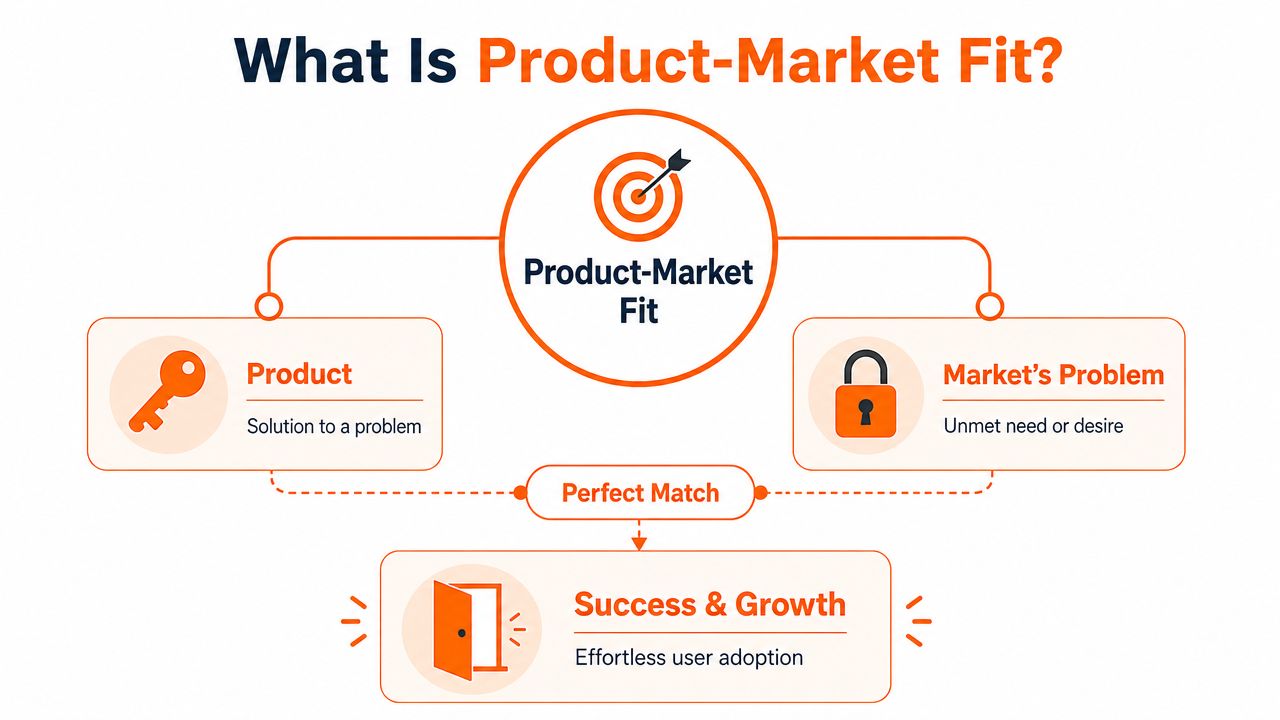
Here's the plain version. Product-market fit is when what you built matches a problem people already care enough to solve. Your product is the key. The market's problem is the lock. If the key fits, the door opens. If it doesn't, no amount of jiggling helps.
The definition I actually use
Marc Andreessen coined the term in 2007 and defined it as the point where a product has features that specifically align with a particular audience's unmet challenges, shifting startup strategy from pure product development to market-aligned validation, as explained in this breakdown of the original product-market fit definition.
That's the clean version. Here's the founder version.
Your product market fit definition should answer two things:
| Question | What you need |
|---|---|
| Does the product solve a sharp problem? | A user should care before you show up |
| Does the market want this badly enough? | Enough people need it, and they act on it |
If one side is weak, fit breaks.
Why bootstrapped founders need a different lens
A lot of PMF talk comes from VC-backed SaaS. It assumes subscriptions, dashboards, funnels, paid acquisition, and neat revenue models. Real life is messier.
You might be building:
- A brand: where repeat purchase and word of mouth matter before broad scale
- A community: where trust and engagement show up before monetization
- A pre-revenue product: where retention matters before pricing does
- A niche tool: where a small but intense market beats a huge indifferent one
That's why I don't like treating PMF as a trophy. It's a condition. It means the business engine finally catches.
Here's a short explainer that gets the core idea across visually.
If customers need your energy to stay interested, the fit is weak. If they bring their own energy, you're close.
The Only Signals That Matter for PMF
Vanity metrics are junk food. They taste good and tell you nothing.
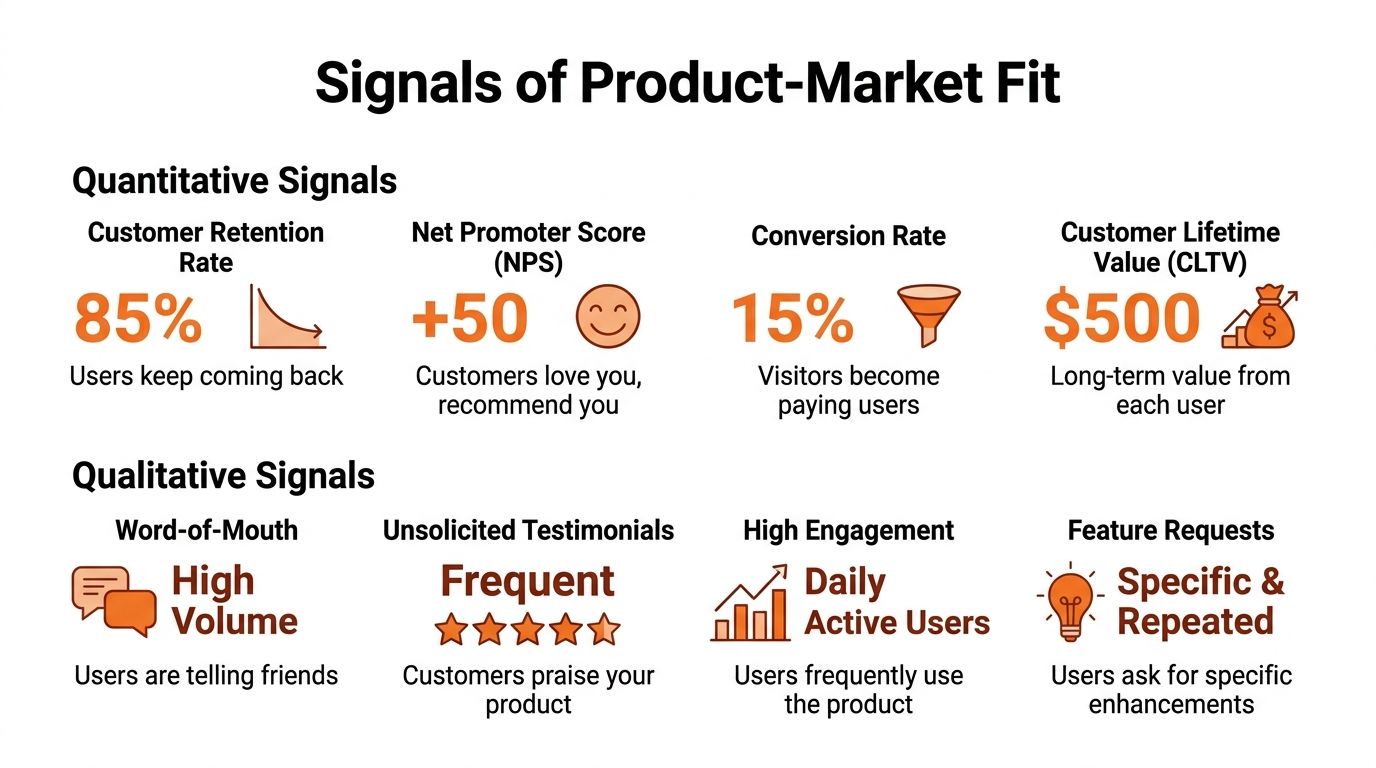
Pageviews. Follower counts. Waitlist hype. Nice comments from friends. Even revenue can mislead you if customers don't stick. If you want a hard read on fit, use signals that show dependency, retention, and economic sense.
The numbers I trust first
Zendesk puts the baseline plainly: to confirm PMF, use signals like the Sean Ellis Test, where 40% of users say they'd be “very disappointed” if they could no longer use the product, a churn rate between 5% and 7%, and customer acquisition cost lower than the price paid. For pre-revenue products, Zendesk says functional PMF shows up through high engagement and retention in its guide to measuring product-market fit.
That gives you a useful scorecard:
- Sean Ellis Test: If 40% or more say “very disappointed,” you have a serious signal.
- Churn: If your churn sits between 5% and 7%, that's a healthy sign.
- Unit economics: If acquisition costs more than what the customer pays, you don't have a business. You have a leak.
I'd add one more filter from the same body of PMF thinking. If you don't have enough real paying customers at a fair price, your story is still early. Hype is not proof.
Retention beats excitement
Early enthusiasm lies. Retention tells the truth.
Boldare frames cohort retention in a very specific way. It measures how many users remain active eight weeks after first use, and says a score between 6% and 20% is a prime PMF indicator in its cohort retention view of product-market fit.
That matters because it separates curiosity from habit.
People trying your product is interesting. People returning without a reminder is evidence.
What if you have no revenue yet
Most PMF advice commonly proves inadequate at this point.
If you run a community, a content-led brand, a B2B free tool, or a pre-launch product, “willingness to pay” is incomplete. You still need proof of value before you press the monetization button.
A Product Marketing Alliance article points out that 45% of early-stage products hit functional PMF before monetization PMF, especially in products where engagement, retention, or network effects show up first, as discussed in its analysis of pre-revenue product-market fit.
So if you're pre-revenue, watch for signs like these:
- Return behavior: People come back because they want to, not because you sent a campaign
- Engagement depth: Users don't just sign up. They participate, contribute, reply, save, share, or invite
- Organic pull: People ask when the next drop, feature, event, or invite is coming
- Repeated use case: The same core job keeps showing up in interviews and behavior
A quick filter for real-world founders
Here's how I'd read PMF by business type:
| Business type | Signal I care about most |
|---|---|
| Ecommerce brand | Repeat purchase and low churn |
| Community | Consistent return behavior and member-to-member interaction |
| B2B tool | Habitual use and clear pain if removed |
| Pre-revenue app | Retention, engagement, and organic referral behavior |
If your strongest metric is attention but your weakest metric is return behavior, don't call it fit. Call it interest.
Three Simple Tests to Diagnose Your Fit
Most founders already have enough data to get started. They just haven't asked the hard questions cleanly.

Run the Sean Ellis survey the right way
CRV says the Sean Ellis Test works like this: if 40% or more of surveyed users say they would be “very disappointed” if they could no longer use the product, you've achieved PMF. CRV also ties that threshold to habitual use and organic word-of-mouth in its explanation of the Sean Ellis benchmark.
Keep the survey simple. Ask active users one question: how would you feel if you could no longer use this product? Give them the standard answer set. Then segment the responses. Don't lump power users in with tire-kickers.
A good result is obvious. A weak result is useful. Both beat guessing.
Use cancellation like an x-ray
If people churn, don't just log the event and move on. Read the reason. Call a few of them. Find the pattern.
Here's what I look for:
- “I didn't need it” means your problem wasn't painful enough.
- “Too complicated” means your value got trapped behind bad onboarding or product design.
- “I found another way” means your differentiation is weak.
- “We only used one part” means your real product may be smaller than you think.
If you sell physical products, subscriptions, or paid memberships, this test gets even sharper. The moment someone leaves, ask what job they hired your product to do, and why it stopped doing it.
If you want a practical outside reference for physical product businesses, this guide to ecommerce product validation is worth reading because it forces you to test demand before you drown in inventory and ad spend.
Try the shut-it-down question
I love this one because it cuts through polite feedback.
Talk to your best users. Ask them this: “If I shut this down tomorrow, what would you use instead?” Then shut up and listen.
Hard truth: If the answer is “I'd probably just use a spreadsheet” or “I'd be fine,” your product is optional.
If they struggle to answer, or they tell you they'd be stuck, that's strong evidence. If they mention hacks, workarounds, or a patchwork of ugly alternatives, that's even better. Pain creates pull.
For a more structured process, you can compare what you learn here with a proper product-market fit validation framework.
PMF Myths That Will Wreck Your Startup
I hear the same bad advice over and over. It sounds smart. It kills companies.
Myth one, PMF is a one-time milestone
This one is dangerous because it makes founders lazy.
LogRocket says 70% of startups that achieved PMF lost it within 18 months because markets changed, competitors moved, or customers evolved, in its discussion of PMF decay.
That means fit isn't a medal you pin on your shirt. It's more like balance on a bike. Stop paying attention and you wobble.
Myth two, happy customers mean you have fit
Nope.
You can have satisfied users and still have a weak business. People can like your product, compliment your design, and say nice things in interviews. Then they forget you exist. Nice feedback is cheap. Repeat behavior is expensive.
I'd rather have a smaller group of users who depend on the product than a larger group who think it's “cool.”
Myth three, more marketing fixes weak fit
Marketing can amplify fit. It can't create it.
If your product solves a dull problem, ad spend just helps more people ignore you. If your offer is muddy, more impressions spread the confusion faster. Founders burn money this way all the time because marketing feels active.
Here's the blunt version:
- Weak demand plus more ads is still weak demand
- Poor retention plus more acquisition is pouring water into a bucket with holes
- Confused positioning plus more content is louder confusion
The fastest way to waste money is to scale a product people don't miss.
You Have the Data What Is Next
Once you've got the signal, make a decision.
If users would miss the product, keep coming back, and your economics make sense, lean in. Tighten the core experience. Improve onboarding. Fix the rough edges. Then scale the channels that already bring you the right people.
If the signal is weak, stop pretending. Talk to customers. Watch them use the product. Kill weak features. Narrow the audience. Change the promise or change the product.
The decision filter I use
Productboard puts the economic test plainly. PMF needs three things: the customer is willing to pay, customer acquisition cost is lower than the revenue the customer pays, and the market is large enough to support the business, as laid out in its economic framework for product-market fit.
So your next move depends on where you fail:
| If this is weak | Do this next |
|---|---|
| Willingness to pay | Rework the offer and sharpen the pain solved |
| CAC versus revenue | Fix your channel, pricing, or buyer targeting |
| Market size | Expand to an adjacent segment or rethink the niche |
Monday morning move
Pick one test and run it this week. Don't build another feature first.
If you want cleaner visibility into what users do once they land, this primer on user behavior analytics is useful because behavior often tells you what interviews miss. And if your issue is getting the right offer in front of the right audience, tighten your go-to-market strategy for startups before you spend harder.
You don't need perfect certainty. You need honest evidence.
If you're building in Chicago or the Midwest and want a room full of founders who'll give you the truth without the networking nonsense, join Chicago Brandstarters. It's a free, vetted community for kind, bold builders who share real war stories, hard lessons, and practical help. If you're stuck on product-market fit, that's exactly the kind of problem worth bringing to the table.
Leave a Reply