
Your 3PL just sent a renewal quote that's higher than last year's, your return rate crept up after the holidays, and you've spent two evenings reading forum threads written by people who've never shipped a pallet. You don't need more contacts. You need one operator who renegotiated a fulfillment contract in the last twelve months and will tell you what number they landed on. That's the whole difference between networking that eats your calendar and networking that fixes something. Most advice about networking for e commerce treats it as a volume game: more events, more messages, more business cards. I'd rather match one stuck problem to one person who already solved it.
Networking Formats Compared at a Glance
| Format | Best for | Typical time commitment | Trust built | Main risk |
|---|---|---|---|---|
| Small peer group of 6-8 founders | Ongoing problem solving | 2-4 hours every two weeks | High | Members stop attending and trust fades |
| Trade conference | Finding suppliers and tools | 2-3 days per event | Low to medium | Hard to follow up after the event |
| Online founder forum or group chat | Quick answers to specific questions | 10-20 minutes most days | Medium | Advice from people who never ran a store |
| Marketplace seller community | Platform rules and fee changes | 1-2 hours a week | Medium | Sellers guard their best tactics |
| Cold outreach on LinkedIn | Finding service providers | About 1 hour per 10 messages | Low | Pitches and ignored messages |
The pattern in that table is simple. Formats that repeat build trust. Formats that happen once build reach. You need both, but not at the same time, and not for the same question.
Say your packaging supplier misses two delivery windows and you need a replacement with real minimums you can afford. A trade conference puts twenty converters in one hall, and you can hold samples in your hand. That's a reach problem, so use a reach format. Now say it's 11pm and your label printer is spitting out blank commercial invoices. A founder chat answers that in four minutes because someone hit the same bug last month.
Where repeat contact earns its keep
A slow quarter is different. Ad costs climb, your best SKU stalls, and you start second-guessing decisions you made confidently in March. No conference fixes that. A small group that meets again and again knows your margins, remembers what you tried, and can tell you when you're repeating a mistake. If you want a sense of how that structure runs locally, the Chicago Brandstarters e-commerce groups show the small-room format in practice.
Conferences have one weak point worth planning around: everyone forgets you by Tuesday. A short video introduction you send afterward gives people a face and a voice to attach to the conversation, and the Unfloppable guide to video business cards covers how to make one without a production crew.
Starting rule: Commit to one repeating format first. Add a reach format only when you can name the specific question you're bringing to it.
Why Peer Support Beats Cold Outreach
A cold contact is a map of the city. A peer is the friend who already drove the route and knows which bridge floods after rain. Both get you there. Only one tells you where the pothole is.

A study of 343 artisan entrepreneurs selling through marketplaces like Etsy and ArtFire, described by Illinois State University, found that sellers gave advice and support to peer sellers, including competitors, rather than treating every other seller as a threat. Entrepreneurs who used peer networks also tended to provide more assistance and achieved greater business success. Competition didn't shut down the help. Shared constraints opened it up.
Why the advice comes with numbers attached
Peers hit the same fee changes, the same factory minimums, the same ad auction. Ask the same question two ways and you'll hear the difference immediately:
- The generic reply: "Post more on social, consistency wins." No cost, no timeframe, no way to test it.
- The peer reply: "Our creator conversions dropped after the fee change, so we moved that budget into email. Here's the rate we're getting now." You can compare it against your own dashboard tonight.
I'd run one test on every new contact before investing more time. Ask for a single number from their last month: their return rate, their blended shipping cost per order, their email revenue share. Someone who runs a store answers with a figure, or tells you they don't track it. Someone selling you something answers with a framework.
That filter shaped how we built our own community. Kevin Tao created the Chicago Brandstarters after helping two of his friends get their brands up to 7 figures, and the useful part of that work was never the introduction. It was the specific decision, made with someone who'd already made it badly once.
Ask for one number. The answer tells you whether you're talking to an operator or a brochure.
Matching Your Problem to the Right Connection
| Problem | Best person to ask | Why they help |
|---|---|---|
| Supplier quality slips | A founder who uses the same factory | Has seen defect rates firsthand |
| Carrier or 3PL costs rising | An operator who renegotiated a contract within the last year | Knows current rates and where room to negotiate exists |
| Returns eating into margin | A founder in the same category with a similar return rate | Can compare return reasons and the fixes that worked |
| Ad spend stops converting | A founder running a similar monthly budget | Shares test results instead of theories |
| Creator contract terms feel unclear | A founder who has signed creator deals | Knows fair rates and which clauses to check |
| Choosing between selling platforms | A seller who moved platforms in the last two years | Has data on fees and traffic changes |
The rule behind every row: the person who solved your exact problem beats the person with the best title. A VP of growth at a company ten times your size has never negotiated a 3PL contract at your volume. A founder shipping the same number of boxes has, and she remembers which line item the rep would move on.
Nathan, one of our members, put it plainly: "This friendly group helped me solve some problems in my business that had been troubling me for a long time." Long-stuck problems usually stay stuck because nobody asked a narrow enough question.
The two-sentence frame
Write your problem in two sentences before you message anyone. Sentence one: what happened, with the direction and the timeframe. Sentence two: what you already tried, so nobody wastes your time suggesting it again. "Our return rate climbed after we switched to a poly mailer. We've already added a sizing chart and rewrote the product description." That frame does two jobs. It proves you did work, and it tells the other person exactly where their experience fits.
Then ask for something they can answer from memory:
I'm reviewing two carriers. What rate and contract length did you land on last year?
Notice what that question doesn't do. It doesn't ask for a strategy, a call, or a favor. It asks for a fact from their own business, which takes thirty seconds to give and is worth more than an hour of general advice.
Asking for Help Without Sounding Like a Pitch
Most networking advice fails because people ask for the wrong thing at the wrong moment. Four mistakes cause most of the damage, and each has a straightforward fix.
- Asking a stranger for an investor introduction in message one. You've asked them to stake their reputation on someone they can't vouch for. Ask for one specific opinion instead: "Would you look at this product page and tell me what's confusing?"
- Sharing exact margins or supplier pricing before trust exists. It reads as either naive or manipulative, and it makes the other person wonder where their numbers will end up. Share a range and the decision you face: "Landed cost is in the low teens as a percentage of price, and I'm deciding whether to switch factories."
- Replying to a request for advice with your own product link. You've turned someone's problem into your funnel. Answer the question first, fully, and mention what you sell only if they ask.
- Asking for help and never reporting back. This one damages more relationships than the other three combined. Send a two-line update within 30 days with the result, including when the advice didn't work.
That last habit is the same muscle you use when asking clients for referrals naturally, which Adwave breaks down well: people say yes to a specific, low-effort request from someone who has already shown they follow through. The same logic runs in reverse when you're the one asking. If you tend to overthink the wording, our notes on how to ask for help cover the framing in more detail.
Three scripts you can send today
Our return rate jumped this quarter. What did you change first?
I'm choosing between two 3PLs. Which one would you avoid, and why?
You suggested a shorter return window. We tried it, and returns dropped. Thank you.
Each one asks for a single short answer. That's why they work. A busy founder can reply between meetings, and a question that costs little effort gets answered far more often than "would love to pick your brain."
Keep one ratio in mind: give one useful answer for every answer you take. Not eventually. In the same week.
How to Build a Founder Circle That Lasts
A circle isn't a mailing list with a dinner attached. It's a small set of people who agree to keep showing up, keep numbers private, and bring something real each time. Here's how I'd build one from nothing.
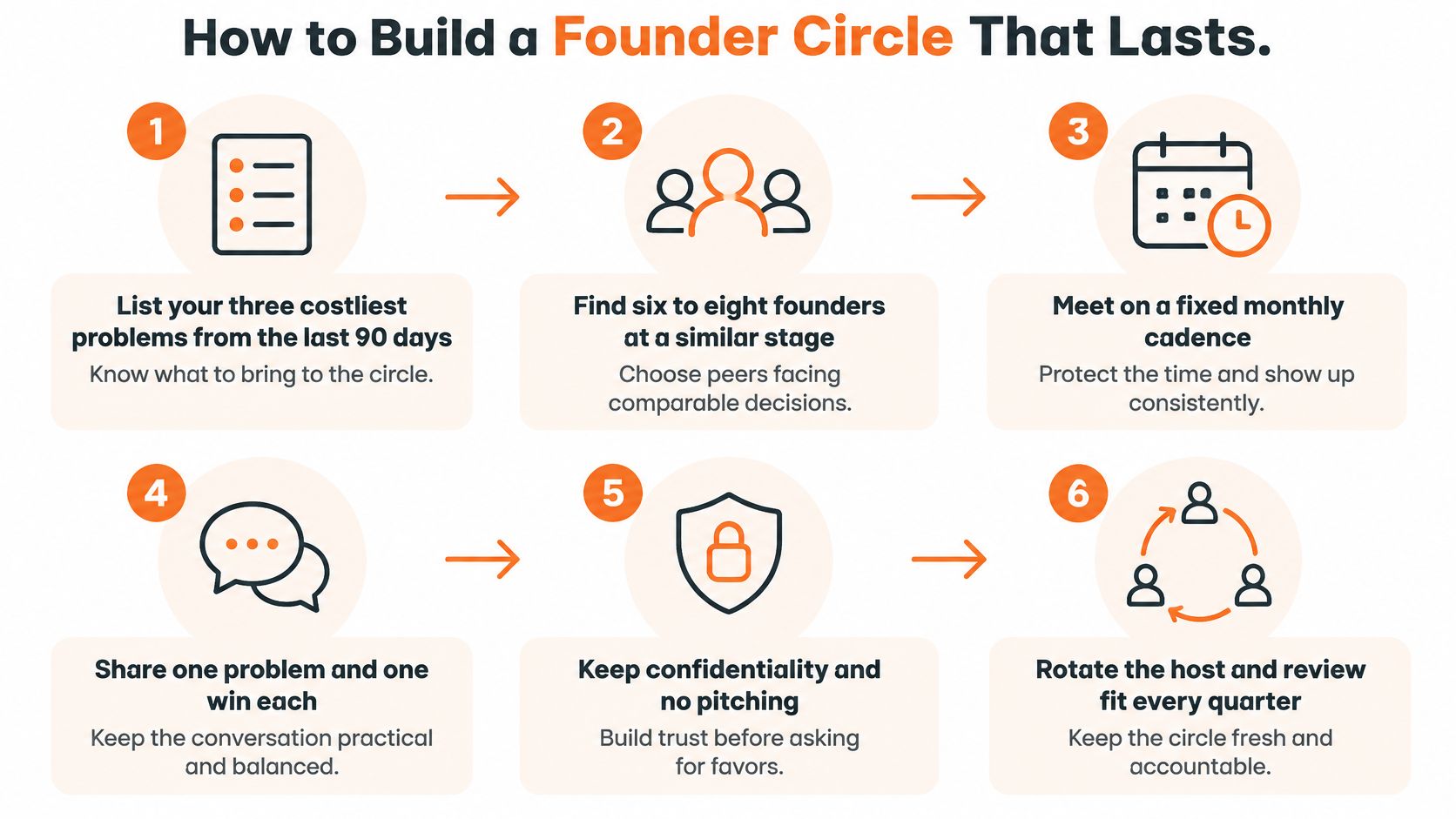
- List your three costliest problems from the last 90 days. Put a dollar figure or an hours-lost figure next to each. You're not looking for conversation topics, you're looking for the leaks worth someone else's experience.
- Find six to eight founders at a similar stage and on a similar sales channel. Local events, marketplace seller groups, and referrals from one trusted operator all work. Stage match matters more than category match, because a founder at your revenue level faces your actual decisions.
- Vet for honesty in the first conversation. Ask what failed last quarter. If they answer with a specific mistake and what it cost, keep talking. If everything is going great, they're performing, and performance is contagious in a small group.
- Set a fixed rhythm and protect it. Every two weeks, we run small private dinner events of 6-8 people, plus a group chat between them. A recurring date does the work that motivation can't. Our mastermind group format notes explain how the room stays small enough for everyone to speak.
- Bring one problem and one result. Every member, every meeting. The result can be a failure. This single rule stops the circle from drifting into either a complaint session or a highlight reel.
- Agree on confidentiality in writing. One paragraph, signed by everyone: numbers, suppliers, and mistakes stay in the room. People share their real margins only after they know where those margins travel.
Why repetition is the whole mechanism
A 2021 report based on firsthand responses from 298 South African ecommerce founders, covered by ITWeb, found that 72% believed peers had created the largest positive impact on their businesses, while 71% reported limited access to networking opportunities. Read those two figures together. Founders already know where the value sits. What they lack is a room that meets again.
That gap is why one-off introductions underdeliver. The first conversation gets you a general answer, because the person doesn't know your business yet. The fourth conversation gets you the specific one, because they remember what you tried in February and can see you're about to repeat it.
The one-month marker
After a month, check one thing: has every member made one change based on advice they received? A changed return window, a renegotiated rate, a killed ad set. If nobody has changed anything, you've built a social club, and you should either tighten the problem-first rule or replace the members who only take.
Start Your First Founder Conversation This Week
Make one decision, not five. Pick one format from the first table, one problem from the second, and one person who has already solved that problem. Then send two sentences: what's happening, and the one question you want answered.
Our return rate jumped this quarter and I can't see why. What did you change first?
You're not short of candidates. The SBA's 2025 Chicago-Naperville-Elgin profile counted 1.1 million small businesses in the metro area, and small businesses made up 97.9% of metropolitan employers. Most of the operators who can help you run warehouses, agencies, and shops, not venture-backed startups. If you want to see how another Midwest market approaches store growth before you reach out, Helbling Digital Media's Cincinnati online store growth tactics is a useful read for framing a sharper question.
Chicago Brandstarters is one option among several. We're a community of founders building from idea stage to seven figures, meeting in private dinners of 6-8 people every two weeks with a group chat in between. Ashley described it as "an incredible community for building real friendships and connecting with other driven entrepreneurs." Once members reach 7 figures, we encourage them to apply to EcomFuel and Million Dollar Sellers.
Send one message this week to the person who solved your costliest problem. Book the conversation within 14 days, before the problem gets expensive again.
We run free, vetted dinners for Chicago and Midwest brand builders who'd rather trade real numbers than business cards, and every room stays at 6-8 people so your actual problem gets airtime. If you're stuck on a supplier, a fulfillment contract, or a quarter that stopped working, bring it to a table of operators who've been there. Visit Chicago Brandstarters and ask about a seat at the next dinner.
Leave a Reply