

Let's be real. As a founder, you often feel like you're fumbling in the dark. So, how do you give and receive feedback without making everyone uncomfortable? I'll tell you the secret: stop thinking of it as criticism. Start seeing it as a conversation about growth. This one shift turns an awkward moment into one of the most powerful tools you have.
Why Feedback Is Your Startup’s Secret Weapon

As a founder, you're constantly making calls with maybe 60% of the information you wish you had. Good feedback is your gut check. It keeps you from veering completely off-course. I've seen it happen again and again in our Chicago Brandstarters community—one honest chat sparks a pivot that totally changes a company’s future.
But it only works if you build a place where people see feedback as a gift, not an attack.
And this isn't some fluffy idea. When your feedback culture is broken, people check out. A recent Gallup report found only 23% of employees feel engaged, and a huge 59% are "quiet quitting." When asked what would fix it, 41% of them pointed to culture and engagement—not pay. That disengagement costs the global economy a mind-blowing $8.8 trillion every year.
You can't afford that.
Shifting Your Mindset
The biggest problem is we’re taught to see feedback as a transaction. You give it during a tense performance review or get it when you’ve messed up. That entire model is built on fear. It puts everyone on the defensive.
Think of it like this: transactional feedback feels like a referee stopping the game to call a penalty. It’s disruptive and puts you on the spot. Relational feedback is more like a coach pulling you aside to quietly suggest a better stance, so you can hit a home run on your next pitch.
One is about judgment. The other is about partnership. In our community, we push for the partnership model because we build it on trust and a genuine investment in each other's success.
To get there, you need to change your whole approach. It’s not about finding fault. It’s about finding a better way forward, together.
Comparing Feedback Mindsets
This table breaks down the two different ways you can think about feedback. The left is where most companies are stuck. The right is where you want to be.
| Mindset | Unproductive (Transactional) | Productive (Relational & Growth-Oriented) |
|---|---|---|
| The Goal | To correct a past mistake or point out a flaw. | To explore future possibilities and unlock your potential. |
| The Tone | Judgmental, critical, and often one-sided. | Curious, supportive, and collaborative. |
| The Focus | What went wrong. "You did X." | What we can do better. "How might we approach Y?" |
| The Outcome | Defensiveness, fear, and a reluctance to take risks. | Trust, psychological safety, and a desire for you to learn. |
You see the difference, right? Moving from the "Unproductive" column to the "Productive" one is how you stop having painful conversations and start building a team that actually solves problems.
What A Better Mindset Looks Like
Here's how my relational, growth-oriented mindset plays out in the real world:
- It’s a two-way street, not a lecture. I ask questions first. I listen to understand your point of view before I even think about sharing mine.
- It’s about the future, not the past. My goal isn't to assign blame for something that already happened. It’s about figuring out how to nail it next time.
- It creates psychological safety. When your team feels safe, they'll be willing to take risks and be honest. That kind of vulnerability is the foundation of any truly great company. If you want to dig into this more, we have a whole guide on vulnerability in leadership.
This isn't just a "soft skill." It's your fundamental business strategy. It’s how you build a team that sticks with you, adapts quickly, and cares deeply about what you're all building. You avoid the hidden costs of disengagement and create a place where your best people actually want to work.
It's not about being "nice." It's about being smart.
The Giver's Playbook: How to Share Feedback That Actually Helps
Giving feedback feels incredibly awkward. You want to be helpful, but you don't want the other person to feel like you're attacking them. The good news is that learning how to give and receive feedback doesn't mean you need a psychology degree—you just need a better playbook.
First, let's all agree to throw the "feedback sandwich" in the trash. We all know the move: sandwiching a piece of criticism between two flimsy compliments. It’s an old trick, and everyone sees right through it.
Instead, I want you to shift your mindset. Think of yourself as a co-pilot for a fellow founder. Your job isn’t to grab the controls, but to help them spot turbulence they might not see on their own.
Your goal is to make your insight feel like a helpful observation, not a personal judgment. It’s about partnering up to get a better outcome.
Get Your Head Straight First
Before you even open your mouth, check your own intentions. Are you giving this feedback to vent, prove you're smarter, or genuinely help them win? Trust me, your real intent will leak out in your tone and body language, so make sure you're coming from a place of support.
When your goal is truly to help, the entire conversation shifts from a confrontation to a collaboration. It becomes two people trying to solve a problem together.
Your intention is the starting point for all good feedback. If you enter the conversation with a genuine desire to help, you're already halfway to a successful outcome. The words matter, but the "why" behind them matters more.
Get super clear on what you hope to achieve. Do you want to help them fix a specific slide, rethink a pricing tier, or improve how they pitch their story? A clear goal is the first step to delivering a clear message.
How to Start the Conversation
The way you kick things off sets the tone for everything that follows. If you just jump in with criticism, you’re basically begging for a defensive reaction. A little finesse goes a long way here.
The first step is simple: always ask for permission. This small act shows respect and gives the other person a moment to prepare to actually listen. I use phrases like this all the time: "Hey, are you open to a quick thought on the new landing page?" It works wonders.
Once they say yes, ground your feedback in what you observed, not what you think. This is the huge difference between "Your pitch was confusing" and "When you explained the pricing model, I had a hard time following the different tiers." One is an attack; the other is just you sharing your experience.
Here are a few scripts I've used to get a conversation started:
- "I really see the effort you put into [the project]. Have you considered [an idea] to make the [specific outcome] even stronger?"
- "I had a thought while you were presenting. Is now a good time to share it?"
- "I'm cheering for you on this, and I have an idea that might help. Can I share it?"
Phrases like these frame your feedback as a supportive suggestion from a partner, not a critique from a judge.
Give Feedback That Is Specific and Actionable
Vague feedback is useless feedback. Hearing "be more strategic" or "your presentation needs work" is frustrating because it gives you nothing to work with. To be truly helpful, you have to be specific and point toward a solution.
A great framework for this is the SBI Model—Situation, Behavior, Impact. It’s a simple way to keep your feedback grounded in facts.
- Situation: "During this morning's team meeting…"
- Behavior: "…when you presented the new feature mock-ups…"
- Impact: "…I felt it was hard for the team to grasp the full potential because the data wasn't included."
After you've laid out the facts, pivot to the future. I'll offer a concrete suggestion or ask a question that helps them find a solution. For example, "For the next design review, would it help to lead with the user data that inspired the changes?"
This isn’t just for redirecting someone. It's incredibly powerful for positive reinforcement, too. For instance: "In the client call yesterday (Situation), the way you walked them through the onboarding process was incredibly clear (Behavior). I could see they felt much more confident afterward (Impact). Keep doing that!" That’s so much more powerful than a lazy "good job."
As you build your startup, you'll realize these small communication shifts are everything. In fact, if you're thinking about growing your team, you might find our guide on how to hire your first employee useful. Giving great feedback is a core leadership skill. When you focus on clarity, partnership, and actionable next steps, you turn a potentially awkward exchange into a powerful moment of growth.
The Receiver’s Toolkit for Turning Criticism Into an Advantage
Let's be real—hearing tough feedback can feel like a gut punch. It’s especially hard when you’ve poured your heart and soul into your startup. But learning how to give and receive feedback without getting defensive is a genuine superpower. It’s what separates the founders who stall out from the ones who build something truly great.
Your ability to take a hit, absorb the useful bits, and turn it into fuel for growth is a massive advantage. I think of it like a blacksmith forging a sword. The feedback is the hammer. Every strike is jarring, but it’s what ultimately sharpens the blade. If you resist the process, you just end up with a dull piece of metal.
This is the toolkit I've built over the years to build that resilience. I’ll show you how to actually hear criticism, process it without letting your ego get bruised, and use it to your advantage.
Why Your Brain Hates Criticism
First off, if feedback stings, you're not broken. It's totally normal. Your brain is literally wired to react to social threats—like a harsh critique—the same way it reacts to physical danger. It can trigger your survival instincts, making you want to either fight back or just shut down. This isn't just a feeling; it's neurobiology.
This is exactly why creating a space where you feel safe is so critical. The 2026 Work in America Survey found that a staggering 77% of U.S. workers are dealing with work-related stress. This leads to burnout and emotional exhaustion for 31% and a total lack of motivation for 26%.
The good news? A hopeful 92% of people said they value organizations that support their emotional wellbeing. This tells us a safe space to get feedback isn't a "nice-to-have"—it's non-negotiable for you to grow. You can dive into more of the data in the full APA report.
The key is to build a mental wall between your identity and your business. Your startup is something you do, not who you are. This separation gives you the breathing room you need to hear feedback about your work without feeling like it’s a personal attack.
A Simple Process for Receiving Feedback
I use a simple three-step process to handle feedback in the moment. It helps me turn a potentially painful critique into a productive conversation.
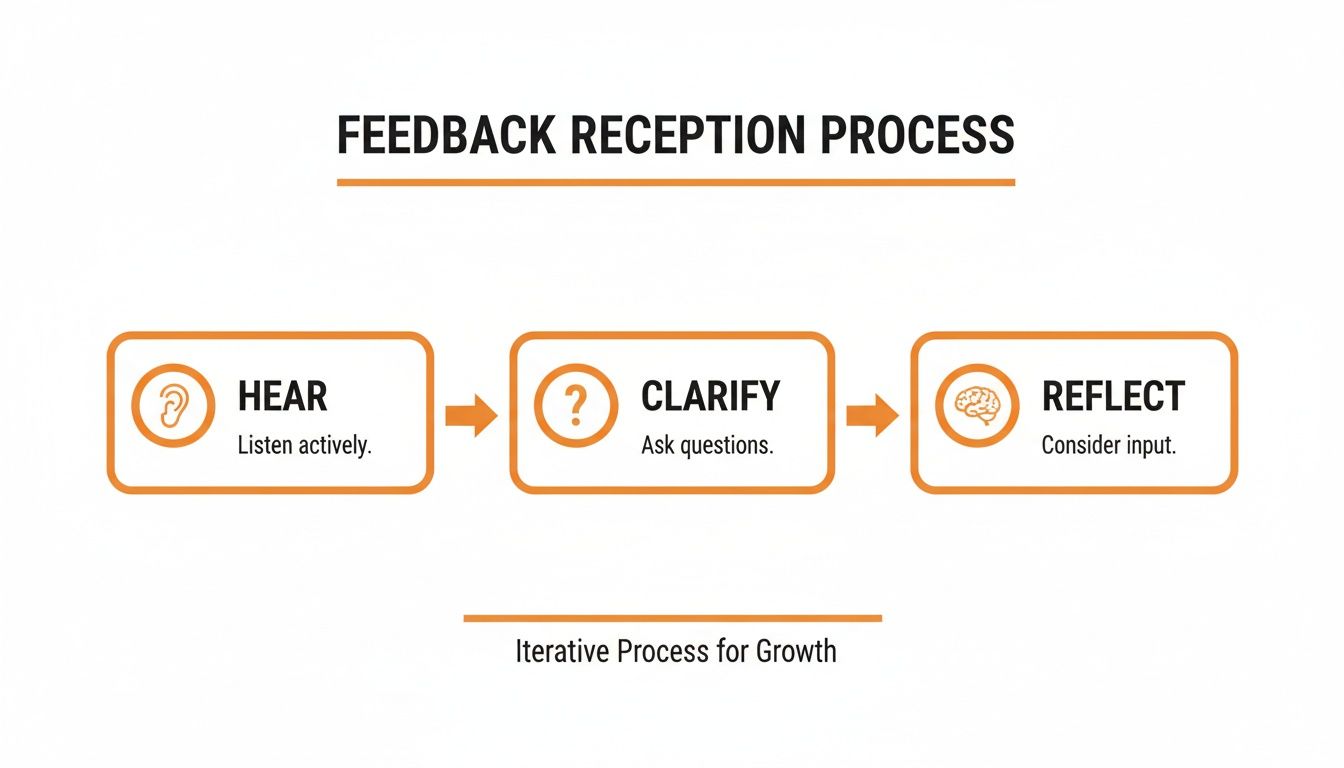
This little loop—Hear, Clarify, Reflect—shifts you from being reactive to being proactive. It puts you in control of the conversation so you can actually pull out the valuable stuff.
Phrases to Use in the Moment
When you’re on the receiving end, your only job is to listen and get curious. Don't defend. Don't justify. Just listen. Your goal is to understand their world, not to win an argument.
The most powerful thing you can do when receiving feedback is to ask a clarifying question. It buys you time to process, shows the other person you're listening, and almost always uncovers a deeper, more useful insight.
Here are a few phrases I keep in my back pocket. They help me stay in control and encourage the other person to go deeper:
- "Thank you for sharing that. Can you tell me more about [the specific point]?"
- "That's an interesting perspective. What did you see that led you to that conclusion?"
- "Could you walk me through an example of what you mean?"
- "To make sure I understand, you're suggesting that [paraphrase their point]. Is that right?"
These phrases do three things at once. They make the other person feel heard, which dials down any tension. They get you more specific information to work with. And most importantly, they stop you from getting defensive.
Turning Feedback into Action
Once you've heard them out and asked your questions, the final step is to reflect and decide what to do. You don't have to act on every piece of feedback you get. You're the founder. The final call is always yours.
Your job is to weigh what you heard against your own vision and data.
- Does this feedback reveal a blind spot? Sometimes other people see things we're just too close to notice.
- Does it align with or contradict your core goals? A critique might be valid, but if it's irrelevant to your current strategy, you can set it aside.
- Is there a pattern? If you hear the same thing from multiple trusted people, pay very close attention. That's usually a signal.
After you've had time to think, thank the person again and let them know you'll consider their input. This closes the loop and shows them their contribution was valued, making them more likely to help you again in the future. This is how you turn every single conversation into a tool to sharpen your company—and your own leadership.
How to Run an Effective Peer Group Feedback Session

Sometimes the best advice you'll ever get won't come from some overpriced consultant or a business book. It comes from the handful of people who are right there in the trenches with you. Running a peer group feedback session is one of the most powerful things you can do, but you need a real plan to stop it from turning into just another complaint-fest.
This isn’t your average coffee chat. A proper session turns your good intentions into an engine for actual growth. It’s all about creating a space where you feel safe enough to be vulnerable, knowing it will lead to real, actionable help.
First, Set the Ground Rules for Trust
Before you even think about diving into someone's business, you have to build a foundation of trust. The whole thing falls apart if you don't feel safe enough to get brutally honest about what's really going on. At Chicago Brandstarters, our peer groups live and die by this.
Here are the non-negotiables we use. They aren’t suggestions; they’re requirements.
- What's shared here, stays here. This is the golden rule. No exceptions. You need total confidentiality to feel comfortable sharing sensitive numbers, personal struggles, or half-baked ideas that might sound crazy.
- Use "I" statements to give feedback. This is crucial. Instead of saying, "Your marketing is all wrong," you say, "When I look at your marketing, I get worried about the customer acquisition cost because…" This frames feedback as your perspective, not a universal truth.
- Challenge ideas, not people. You're here to attack a business problem, not the founder's character. This simple distinction is what keeps the conversation helpful instead of hurtful.
Without these rules, you'll hold back your best stuff. The whole thing becomes a waste of time.
How to Structure the Session for Real Impact
An unstructured meeting always, always turns into a venting session with no clear takeaways. I’ve been in a lot of these, and the most effective format I’ve found is the “hot seat” model. This ensures one person gets the group’s complete, undivided attention.
Think about focusing sunlight with a magnifying glass. When the light is spread out, it's just warm. But when you focus it, you can start a fire. The hot seat focuses your group’s collective brainpower on a single, pressing problem.
Here’s a simple agenda that just works:
- Founder’s Challenge (10 minutes): The person in the hot seat lays out a specific, current problem. Not a vague complaint, but something real like, "My customer churn rate just doubled, and I don't know why," or "I'm totally burning out and need to figure out what to delegate first."
- Clarifying Questions (10 minutes): Now, the group’s only job is to ask questions to understand the situation better. No advice allowed. Seriously. The goal is to dig deep and find the root cause, not jump to solutions.
- Group Feedback (25 minutes): Now it's time for advice. The group shares insights, personal stories, and direct suggestions. The person in the hot seat just listens. No defending, no justifying, no explaining. You just shut up and take notes. This part can be hard, but it’s critical.
- Founder's Reflection & Action Steps (5 minutes): To close it out, you share what resonated most and commit out loud to 1-2 specific action items you will take.
This strict timing keeps the energy high and makes sure you actually get through the process. If you want to go deeper on this, you can learn more about how mastermind groups for entrepreneurs are structured.
Your Job as the Facilitator
If you're running the show, your primary job is to be the guardian of the process. You're the referee, the timekeeper, and the person who makes sure the room feels safe.
Your main goal as a facilitator is to protect the structure. I keep the conversation on track, enforce the ground rules with kindness, and ensure the person in the hot seat feels supported, not attacked.
Here’s what you need to do:
- Keep the time. Use a timer on your phone and be firm (but friendly!) about moving to the next segment. It's the only way to respect everyone's time and get to a real conclusion.
- Enforce the "no advice" rule during the question phase. When someone inevitably jumps the gun, I gently cut in: "That's a great thought. Let's hold that for the feedback round in a few minutes."
- Encourage "I" statements. If feedback starts sounding judgmental ("You should have…"), I guide the speaker back to their own experience. "Can you rephrase that from your perspective?"
Running a peer session like this transforms a group of solo founders into a powerful, collective brain. It’s where some of the best learning happens, turning messy, overwhelming problems into clear, actionable next steps.
Common Feedback Pitfalls and How to Avoid Them
Giving and getting feedback is a superpower for founders. But man, I've seen even the best intentions blow up in people's faces, torching trust and just leaving everyone confused. Let's walk through the potholes I see people fall into all the time so you can steer clear.
Getting this wrong isn't just awkward—it's expensive. A wild 51% of workers are actively looking for a new job, mostly because of stress and feeling disconnected. A huge part of that comes from fuzzy expectations and not feeling seen, which are direct results of bad feedback. You can go deeper on this by checking out the State of the Global Workplace report.
The "Good Job!" That Means Nothing
This is the classic feel-good comment that’s totally useless. It’s like a stranger giving you a thumbs-up. It's nice for a second, but it tells you zero about what you did right, so you can't do it again.
- What it sounds like: “Great job on that presentation!”
- What it should sound like: “When you used that specific customer story in your presentation, I saw the client’s face light up. That personal touch really landed the point and built a connection.”
See the difference? The second one gives you a concrete play you can run again. It turns an empty compliment into a real piece of strategy.
Jumping In With a "Solution"
This one really stings. It’s when someone swoops in with their brilliant idea before even asking what you’re trying to do. It feels dismissive because it assumes you haven't already been wrestling with the problem yourself.
It’s like a doctor writing you a prescription before you even tell them your symptoms. It's way more likely to cause problems than to actually help.
Your first job in giving feedback isn't to provide answers; it's to ask better questions. Understand the context, the constraints, and what the other person has already tried before you ever dream of offering a solution.
Start by being curious. I ask questions like, "What's the main goal here?" or "What have you already tried?" This instantly changes the dynamic from you being a know-it-all to being a true partner in figuring it out.
Making It Personal
This is the most dangerous one. This is where trust goes to die. It’s when you criticize the person's character instead of their actions.
- What it sounds like: “You’re so disorganized. Your project updates are always late.”
- What it should sound like: “I’ve noticed the last two project updates have come in a day after the deadline. This impacts the marketing team’s schedule. Can we talk about what might be causing the delays and how I can help?”
The first one is a direct hit on their identity, and all it does is make them defensive. The second one focuses on a specific, observable thing and its impact, then opens the door to a conversation instead of a fight.
Avoiding these traps isn't about memorizing lines. It's a mindset shift. You have to move from judging to partnering. Once you make that change, you’ll find that feedback stops being about fear and starts being about actual growth.
Your Questions on Feedback Answered
Over the years, I've had tons of conversations with founders who are wrestling with how to actually do feedback. The books make it sound simple, but when you're in the trenches, it's messy and awkward. I’ve pulled together answers to the most common questions I get, using real-world stuff that actually works.
What If I Disagree with the Feedback I Receive?
This is going to happen. A lot. And that’s a good thing. The point of learning how to give and receive feedback isn't to blindly follow every piece of advice you get. It's about collecting data points so you can make better decisions. You're still the one flying the plane.
Think of it like getting directions. Someone might suggest a shortcut, but you know from driving that route a hundred times that it's a traffic nightmare. Their advice isn't wrong, it's just based on a different map. You're the only one with the complete picture of your business.
Your first job is to just listen. Seriously. Turn off the part of your brain that's already building a counter-argument and just try to understand where they're coming from.
The most powerful thing you can do is get curious. When you disagree, your first goal isn't to win the argument. It's to figure out why they see it differently. That's where the real gold is hidden.
Once you’ve actually listened, it’s time to think. Ask yourself:
- Is this a blind spot? Are they pointing out something I'm just too close to see?
- Is this a values thing? Does their feedback clash with the core mission of what I’m building?
- Is this just a matter of taste? Sometimes, especially with creative stuff, there's no "right" answer.
After that, you make the call. It's totally fine to thank them for the input and then decide to stick to your guns. You can be grateful for the gift of perspective even if you decide not to use it.
How Do I Give Feedback to Someone Who Gets Defensive?
This feels like trying to play catch with someone who keeps swatting the ball away. It's tricky, but you can do it. The secret is making them feel safe, not attacked. Defensiveness is almost always about fear.
First, I ask for permission. This one tiny step changes everything. I say, "Hey, I had a thought about the new landing page. Are you open to hearing it?" This gives them control. They get to opt in, which makes them way more receptive.
Next, you have to use "I" statements that are about your experience. This is so important.
- Don't say: "Your headline is confusing."
- Instead, say: "When I read the headline, I got a little confused about the main benefit."
One is a judgment. The other is a report of my own experience, and it’s a lot harder to argue with that. I frame the whole thing around our shared goal. Something like, "I'm so excited about what you're building and I want to see you win. My thought is just aimed at helping you get there faster."
If they still get defensive, I don't push. Don't get sucked into a debate. I just back off gracefully, say I support them, and let it go. You planted a seed. Often, that’s all you can do. The idea might click for them later when they've had time to think it over on their own.
How Often Should an Early-Stage Founder Seek Feedback?
You should think of feedback as a constant, low-level hum, not a rare, dramatic event. The right cadence is "always," but what it looks like will change depending on what you're working on.
It’s like drinking water. You don't just chug a gallon once a week and call it good. You sip throughout the day. Feedback is the same.
Here’s a simple way I break it down:
- Major Strategic Decisions: For huge choices like a pivot or a key hire, you need a formal feedback session. This is when you pull in your trusted peer group for a proper "hot seat."
- Medium-Sized Projects: For things like a new feature mockup or a marketing campaign idea, get feedback from a few trusted advisors or post it in a specific channel in your group chat.
- Small, Everyday Things: For ad copy, a social media post, or a quick email, a quick poll or message in a trusted Slack or group chat is perfect.
As a general rule, you should be having at least one meaningful feedback conversation every single week. This does two things. First, it stops you from building in a bubble and getting way off track. Second, it makes feedback a normal part of your rhythm instead of some scary, high-stakes thing you dread.
Is Anonymous Feedback a Good Idea?
In a word: no. I strongly advise against it, especially in a small team or a trusted community like the one we're building at Chicago Brandstarters.
I get the appeal. It feels like a shortcut to get "brutally honest" feedback without the awkwardness. But it almost always blows up in your face. Anonymity doesn't create honesty; it creates a lack of accountability. It lets you lob harsh, context-free grenades without owning the impact.
This just kills the psychological safety you need for a healthy culture. When you get feedback, knowing who it's from is crucial context. Is it from your biggest power user or someone who signed up yesterday? Is it from a fellow founder who just went through this exact same problem or an advisor with a totally different background?
Building a culture of direct, kind, and open feedback is definitely harder. It takes courage. But it creates a foundation of trust that's way more valuable in the long run. When you have to put your name on your feedback, you deliver it with more thought. And that’s the only kind of conversation that actually helps you grow.
At Chicago Brandstarters, we believe that kind, hardworking founders like you deserve a community that genuinely has your back. We help you build these crucial feedback skills in a trusted environment, connecting you with peers who are committed to helping you win. If you're building a brand in the Midwest and are tired of going it alone, find your people at chicagobrandstarters.com.
Leave a Reply