
If you want to stop people from taking advantage of you, you first have to get really good at spotting when it's happening.
I’m talking about re-tuning your gut instinct to know the difference between a real partnership and a one-sided deal. This isn't about changing who you are. I’m showing you how to protect what you've built by learning to be both kind and firm.
Your Kindness Is an Asset, Not a Weakness
Let me get one thing straight: your empathy and generosity are your superpowers in business. Don't let anyone tell you otherwise. But if you're reading this, I'm guessing you feel like that kindness is being treated like a doormat for everyone else to wipe their feet on.
I've been there. It's a lonely, draining place. This guide isn't about you becoming ruthless or cynical. It's about protecting your energy so you can keep doing what you do best—building great things.
The Kind Founder's Dilemma
As founders, you and I are wired to give. We pour our time, expertise, and passion into our work and into helping others. It’s what makes us successful. But it also paints a target on our backs.
People see that generosity and mistake it for a weakness they can exploit.
You start seeing the signs. The client who keeps adding "just one more thing" to the project scope. The co-founder who's all talk and disappears when it's time to actually do the work. The mentor whose "advice" starts to feel a lot like you giving them free consulting.
This is the kind founder's dilemma—your greatest strength becomes your biggest vulnerability. You end up doing all the work for others, which lets them get away with doing nothing, and it slowly chips away at your own progress and sanity.
"Many of us try to control others into meeting our own needs. Instead of taking responsibility for their own happiness, which would be empowering, codependents’ focus is external…They think, ‘I’ll change him (or her) to do what I want, and then I’ll be happy.’ This behavior is based on the erroneous belief that we can change others.”
From Welcome Mat to Shield
The real shift isn't about you building walls; it’s about building a fence with a gate. You decide who comes in and what the terms are.
It all starts with a mindset shift: your kindness is a valuable asset, not an infinite resource. You have to protect it. Imagine your kindness is like a unique, rare spice. You use it to make your dishes amazing, but you don't just dump the whole jar into every meal for anyone who asks. You use it wisely, where it will have the most impact.
This picture nails the journey: you start by seeing your kindness as a superpower, then you realize it’s being exploited, and finally, you learn to defend it with firm boundaries.
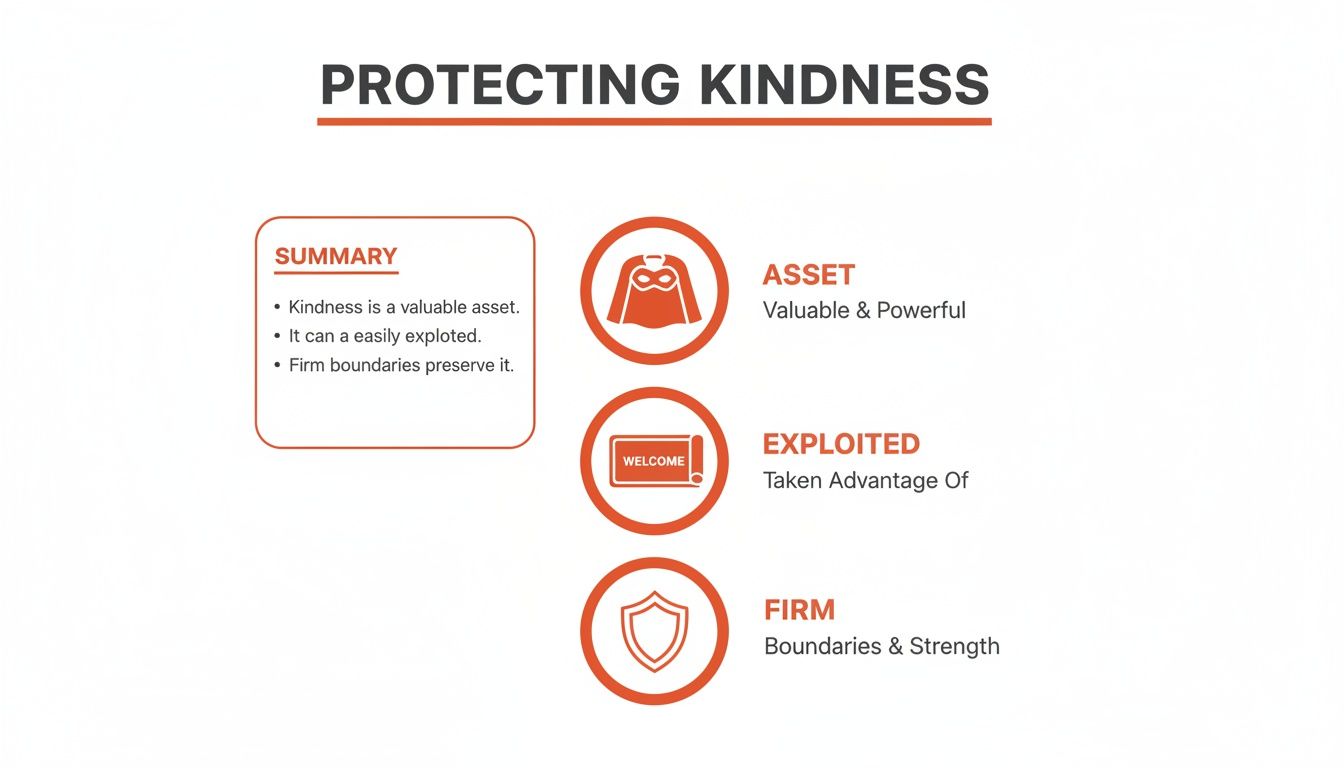
It shows that your kindness is something you should guard, not something to get rid of. It’s about you being helpful and having a protective mindset at the same time.
It’s a tough balance to strike, and it touches on the real emotional challenges I know we face as leaders. I've talked before about embracing vulnerability in leadership, and this is a big part of it. My goal for you is to be both kind and unshakably firm.
Quick Guide to Spotting Exploitation
Sometimes the red flags are subtle, especially when you're in the thick of it. Here’s a quick table to help you tell the difference between a healthy relationship and an exploitative one.
| Scenario | Healthy Collaboration (Green Flag) | Being Taken Advantage Of (Red Flag) |
|---|---|---|
| Client Feedback | Asking for specific, in-scope revisions to improve the final product. | Constant requests for "just one more little thing" that falls outside the agreed-upon scope (scope creep). |
| Partner Contribution | Partners contribute their agreed-upon share of work, capital, or expertise. The load feels balanced. | You're consistently doing the heavy lifting while they handle "big picture" ideas with no execution. |
| Vendor Relationship | The vendor delivers what was promised, on time, and communicates transparently about any issues. | Late deliveries, poor quality, and constant excuses. They expect full payment for partial work. |
| Mentor Advice | A mentor offers guidance and opens doors, respecting your time and asking for nothing in return. | "Mentorship" sessions feel like free consulting calls where they get strategic advice for their own business. |
Use these examples as a gut check. If your relationships consistently fall into that right-hand column, it's time for you to start setting some boundaries.
Recognizing the Early Warning Signs
The best way for you to stop getting screwed over is to see it coming from a mile away. But as founders, you and I are hardwired optimists. We want to see the good in people, so we give them the benefit of the doubt for way too long.
That little voice in your gut telling you something feels off? That’s your most valuable asset. Don’t you ignore it.
Think of your gut feeling as a smoke detector. It’s not there to put out the fire. Its job is to scream its head off at the first whiff of smoke, long before your whole business is engulfed in flames. The problem is, you and I have been taught to hit the snooze button, especially when we’re dealing with a big-name client, a partner we like, or a mentor we look up to.
My goal here is to help you fine-tune that alarm. Forget waiting for some dramatic betrayal. I want you to get good at spotting the tiny, subtle red flags that show a one-sided relationship is taking root. These are the small things that, if you ignore them, turn into huge, expensive problems.
The Slow Creep of Uneven Exchanges
Nobody comes out on day one and says, "I plan to exploit you." It never starts with a big, obvious moment. It starts with a hundred tiny, uneven exchanges that slowly chip away at what’s fair.
This is the classic scope creep disguised as a "small favor" from a client. Or the business partner who’s a genius in the brainstorming session but somehow vanishes when it’s time for you to actually build the spreadsheet.
A client I had early in my career was a master of this. He’d end every single call with, "Hey, while you're in there, could you just quickly…?" It always sounded like nothing, but those "quicklys" added up to almost 20% more work over the project. All of it unbilled and, frankly, unappreciated.
At first, I told myself I was just being a good partner. But a partnership is a two-way street. I was on a one-way road to burnout city.
These little imbalances are easy for you to miss because they seem so minor on their own. Here’s what you should watch for:
- Verbal agreements over written ones: If someone constantly dodges putting things in an email or contract, they’re probably creating wiggle room they can use against you later.
- "Flattery" instead of payment: They shower you with praise about your work but are mysteriously slow to pay invoices or complain about your rates. Compliments don't pay the bills.
- Constant "urgency": Suddenly, everything is a five-alarm fire. Their poor planning becomes your emergency, forcing you to drop everything. This isn't collaboration; it's a power play that says their time is more valuable than yours.
You are not responsible for managing someone else’s feelings when you enforce a boundary. The discomfort they feel when you say "no" is theirs to handle, not yours to fix.
This is a huge mental shift for you. You and I avoid saying "no" because we don't want to make things awkward or have the other person feel bad. But by shielding them from the consequences of their asks, you’re just teaching them that they can keep doing it.
The Talkers vs. The Doers
In the startup world, you meet two kinds of people: those who talk about doing things and those who actually do them. A massive red flag, especially with co-founders and partners, is a gap between their words and their actions. They can sell you the dream like nobody’s business, but they’re ghosts when the real work starts.
I once partnered on a project with a guy who could mesmerize an entire room. He was brilliant, connected, and had a million amazing ideas. But when our first real deadline hit, his contribution was a single, half-assed slide deck. Meanwhile, I had pulled three all-nighters to get my part of the work done.
His excuse? He was "focusing on the high-level strategy." That’s a classic line from a talker. You end up doing 100% of the execution while they get 50% of the credit.
How You Can Spot a Taker Early On
Takers run the same plays over and over. They count on your goodwill and your eagerness to be helpful. Learning to stop them means you recognize the playbook before the game is already lost.
You need to watch for these moves:
- They test your boundaries immediately. They'll make a small, slightly out-of-line request right at the beginning. It's a test. If you cave, they know they can push for much more later on.
- They use guilt as a weapon. When you finally push back, they’ll hit you with something like, "I thought we were a team," or, "I'm in a really tough spot, I thought you'd understand." This is pure manipulation, designed to make your perfectly reasonable boundary feel like a personal attack.
- They are allergic to reciprocity. A healthy relationship has a natural give-and-take. With a taker, the flow of time, energy, and resources only goes one way: toward them. I want you to pay close attention to who is always asking and who is always giving.
Trusting your gut isn’t some mystical power—it’s just data processing. It’s your brain recognizing patterns that don't add up. Start listening to it.
Building Your Armor With Ironclad Agreements
Hope is not a business strategy. Once you get good at spotting the red flags, it's time for you to get practical. This is where you stop getting pushed around.
Clear, well-defined agreements are your absolute best line of defense. Think of your contracts and scope-of-work documents as your armor. A vague agreement is like leaving your front door wide open and hoping for the best. I’ve seen it happen a hundred times. It’s an invitation for misunderstandings at best and outright exploitation at worst.
Let me help you fix that.
Your Contract Is Your Shield
Your contract is the rulebook for your relationship with a client, partner, or vendor. It’s not about being difficult or mistrustful; it’s about being a professional. I see it as a tool for total clarity that protects everyone involved.
Too many founders, especially when you're just starting out, sign contracts that are completely one-sided. Or worse, you work without a contract at all, running on a handshake and a prayer. I’ve done it, and trust me, I’ve paid the price. It's time for you to draft agreements that actually protect you.
Your armor needs these non-negotiable plates:
- Crystal-Clear Deliverables: You must define exactly what you will deliver. Just as importantly, you should define what you won't deliver. Don't be vague. Instead of "social media management," get specific: "Creation and posting of 12 static feed posts and 8 stories per month to Instagram."
- Payment Terms with Teeth: Don't just list the project fee. You have to spell out when and how you get paid. And you absolutely need to include late fees. A simple clause like, "Invoices are due NET 15. A late fee of 5% will be applied to all invoices outstanding after 30 days" works wonders. Seriously.
- A Clear "Kill Fee": Sometimes, projects just die. It happens. A kill fee ensures you're paid for the work you've already put in and the time you blocked off for them. A standard fee is 25-50% of the remaining project cost.
A contract isn’t about mistrust. It's about professional respect. I find it creates a system where fairness is the default, freeing you up to do your best work without constantly looking over your shoulder.
Vetting Your Global Supply Chain
Now, for those of you building e-commerce or physical product brands, the risk goes way beyond your immediate clients. It can be baked right into your supply chain, often on a global scale. As a founder, your brand's reputation is tied to every single supplier you use.
Doing your homework here isn't just a "nice to have"—it's critical. You don't want to accidentally build your brand on the back of unethical labor. The reality is grim.
Migrant workers and other vulnerable people in global supply chains face systematic exploitation at alarming rates. There were 665 documented cases of migrant worker abuse recorded globally in 2026 alone. The bigger picture is even worse: an estimated 152 million children are still in child labor, while 27.6 million people are trapped in forced labor worldwide. Agri-food supply chains are the biggest offenders, accounting for 32% of all migrant worker abuse cases. This is a massive issue, and you can learn more from the full findings about labor rights in global supply chains at impactpolicies.org.
How to Vet International Suppliers
You don't need a massive corporate budget to do your due diligence. It really just comes down to you asking the right questions and looking for proof.
Here’s a practical checklist to get you started:
- Request Certifications: You should ask to see copies of their third-party certifications like Fair Trade, SA8000, or WRAP (Worldwide Responsible Accredited Production). They aren't foolproof, but they are a solid starting point.
- Conduct Video Tours: Ask them for a live, unscheduled video call to tour the factory. You should look for clean, safe working conditions. Do the workers seem stressed or overly managed? Trust your gut.
- Ask Direct Questions About Labor: Don't be shy about this. Ask them about their hiring process, wage standards, working hours, and how they verify the age of their employees. A legitimate supplier will have these answers ready for you.
- Start with Small Test Orders: Before you go all-in with a massive order, run a smaller test batch. This lets you check the product quality, sure, but it also shows you how they communicate and how professional they really are.
Building a brand with integrity means you look at every single link in your chain. Ironclad agreements and careful vetting aren't just about protecting your bottom line—they're about making sure your business practices actually line up with your values.
The Art of Pushing Back (With Scripts You Can Steal)
You and I both know we should set boundaries. But actually doing it? That’s a whole different story. I get it. Your stomach ties itself into a pretzel, and you're terrified of being called "difficult" or worse, "not a team player."
That fear is real, especially for those of us who are natural pleasers. It feels like you're going against your own programming.
This is why you need a game plan—and the right words—before you even get into the situation. It’s not about faking a new personality. It’s about you adding a new skill to your toolbox: the skill of advocating for your own damn business.
Think of it this way: at first, it feels awkward. You’ll probably overthink it and maybe even screw it up a few times. That’s okay. With a little practice, it becomes second nature. These scripts are your training wheels.
How to Shut Down Scope Creep
Scope creep is the death of your profits by a thousand tiny cuts. It’s the endless parade of "just one more thing" or "this will only take a second" that piles up into hours of free work. The secret is for you to respond with a smile, but redirect them straight back to the contract.
Here’s how you handle it in an email or on a call:
- When they ask for something new: "That's a fantastic idea. It's not covered in the current scope, but I'm happy to price it out for you as a separate project. I can get a quote over to you by the end of the day."
- When they say it's a 'quick fix': "I hear you. To make sure we get this done right without breaking anything else, it needs to be handled as a formal revision. Let me check our agreement on the revision process, or I can quote it for you."
This does two things. First, you’re not shooting down their idea, which keeps the mood positive. Second, you’re immediately reinforcing the idea that new work means a new invoice. It’s business, not a personal favor.
Pushing back isn’t about you picking a fight; it’s about creating clarity. You’re just reminding them of the game rules you both agreed to play by. You're not being difficult—you're being a professional.
Saying 'No' to a Bad-Fit Client
Sometimes the smartest move you can make is walking away before you even get started. Your gut is waving a giant red flag, but your bank account (and your people-pleasing side) is trying to talk you into it. Don’t listen. A nightmare client will cost you way more in sanity than you’ll ever make in cash.
Here are a few firm but polite ways for you to turn down a project:
- "Thanks so much for reaching out. After looking over the project, I don’t think I’m the right person to help you hit your goals. I can refer you to someone in my network who might be a better fit."
- "I appreciate you sharing this with me. Right now, I’m fully booked with my current clients and can’t give your project the focus it really deserves. I wish you the best of luck finding the right partner."
Notice you aren’t giving a 10-page essay of excuses. You’re direct, professional, and you're out. Offering a referral is a classy touch that keeps your reputation solid. If this is a weak spot for you, our guide on dealing with difficult customers has more battlefield-tested advice.
Renegotiating a Lopsided Partnership
What if the bad deal is coming from inside the house? Maybe your co-founder has checked out and you’re doing all the work, or a partnership deal that seemed fair a year ago is now completely out of whack. This is the heavyweight championship of pushback, but you have to do it.
Get a meeting on the books with a clear, no-nonsense agenda:
"Hey, can we schedule some time to review our partnership structure? I've been thinking about our progress, and I want to make sure we're aligned on roles and expectations so this thing is sustainable for both of us long-term."
When you meet, you should stick to facts and "I" statements, not accusations. For example: "I'm feeling concerned about how the work is distributed. I tracked my time last month and spent about 80 hours on execution tasks, and I want to talk about how we can make that feel more balanced."
Most importantly, you need to know what you want before you walk in. Do you want to rewrite roles? Change the equity split? Or is it time for you to blow the whole thing up? Having a clear goal will keep the conversation from turning into just another argument.
Protecting Your Digital Assets From Bad Actors
As founders, you and I are used to being taken advantage of by bad partners or shady clients. But there’s another threat that’s a lot quieter and can do way more damage: digital exploitation. We pour our hearts and souls into building our brands online, and that makes us a prime target.
Cybercriminals love to go after small businesses and solo operators like you. They know we're juggling a million things and cybersecurity probably isn't at the top of our list. They bet on you being too busy or too trusting.
I’m no security genius, but I’ve learned the hard way that you don’t need to be one to protect yourself. This isn't about writing fancy code; it's about you locking your digital doors with a few smart, simple habits.
Just imagine getting locked out of your own business by a ransomware attack, with all your customer data held hostage. It's the stuff of nightmares for a founder, and it’s happening all the time.
These threats are real, and they cost a fortune. By 2026, nearly 63% of businesses globally have been hit by ransomware. There are about 1,700 DDoS attacks hitting organizations every single day. And for e-commerce brands like yours, payment fraud is projected to cost us a mind-boggling $343 billion between 2023 and 2027. If you want to go down the rabbit hole, you can see more data on these business security threats at Statista.com.
Your Simple Security Checklist
You don't need a massive corporate security budget to keep your brand safe. You just have to be consistent. Think of it like locking your front door at night—it’s a basic habit you just do.
Here’s the simple checklist I run through for my own business every quarter. It’s not complicated, but it works.
Use a Password Manager: Seriously, you have to stop reusing passwords. Get a password manager like 1Password or Bitwarden. They create and remember a unique, strong password for every single site you use. This is the single biggest security upgrade you can make, period.
Turn On Multi-Factor Authentication (MFA): You’ve seen this before—it’s also called two-factor authentication (2FA). You need to turn it on for everything: email, social media, bank accounts, cloud storage. It’s like a second lock on your digital door. Even if someone steals your password, they can't get in without the code from your phone.
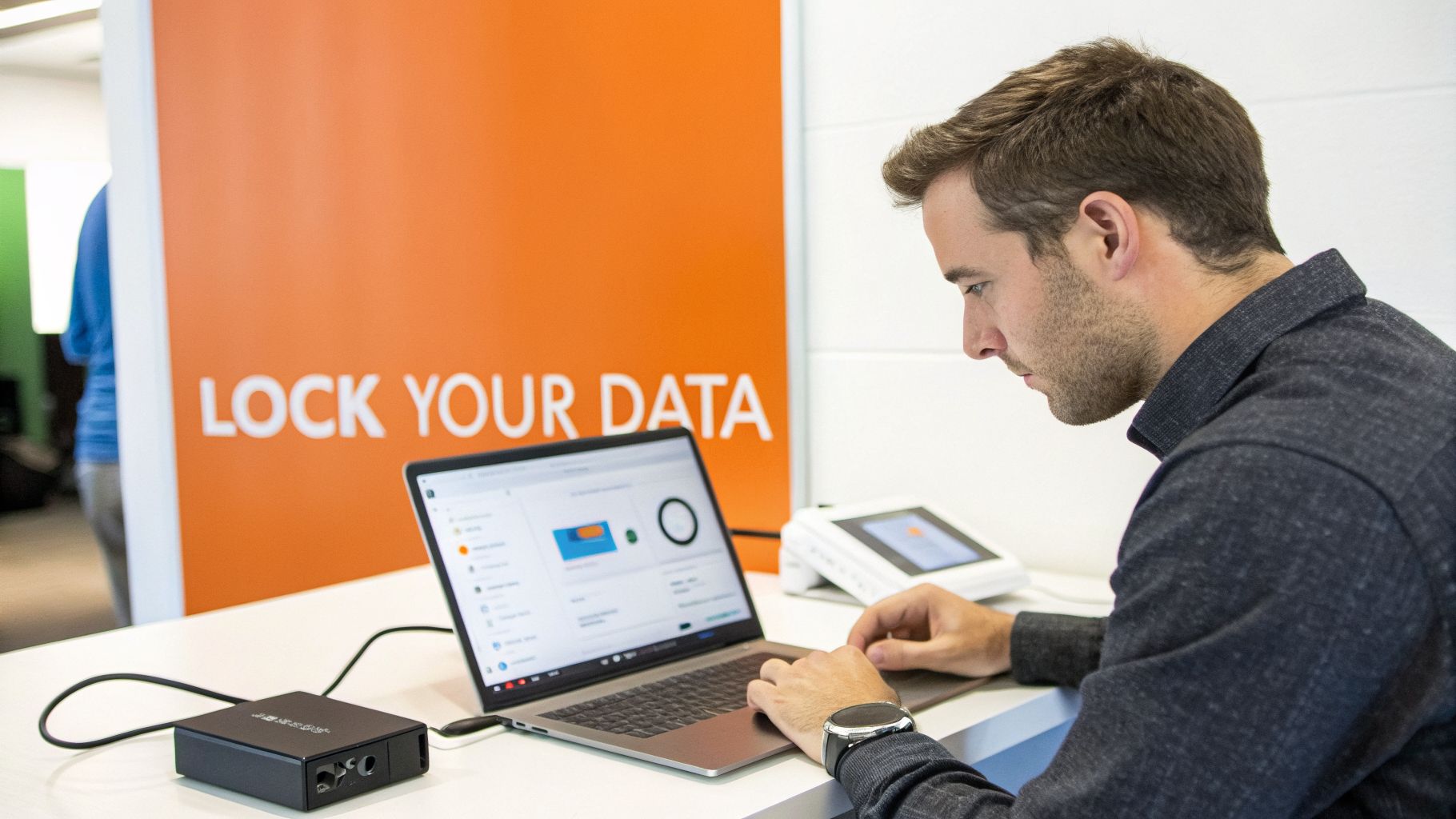
Back Up Your Data Religiously: Ask yourself: what would I do if all my business data just disappeared tomorrow? You should set up automatic backups. I have a cloud service that backs everything up daily, and I also keep a separate physical hard drive with my most critical files that I update once a week. You need to be redundant.
Your brand's reputation is built on trust. A single data breach can shatter that trust instantly, wiping out years of your hard work. Protecting your customer data isn't an IT task; it's a core business responsibility I want you to take seriously.
Vet Your Software and Apps
Every time you install a new app or plugin, you’re potentially opening a new door for someone to walk right into your business. You have to vet your software just like you’d vet a new hire.
Before you install any new tool, just run through these quick questions:
- Who actually made this? Is it a well-known company with a track record of updates and real support? Or is it from some random developer who might disappear tomorrow?
- What permissions is it asking for? Don’t just click “accept.” I want you to read the fine print. Does that simple photo editor really need access to your entire contact list? If it feels weird, you deny the permission.
- When was the last update? Software that hasn't been updated in a year is a massive security hole. If it looks abandoned, you need to find a better alternative.
Taking these common-sense steps isn’t glamorous, but it drastically cuts down your risk. It’s about building a culture of security into your daily grind so all your hard work stays yours.
Find Your People, Find Your Shield
Let’s be honest: building a brand is lonely as hell. That isolation is the perfect hunting ground for people looking to take advantage of you. You start second-guessing every decision. Is this client's scope creep normal, or am I being a pushover? Is getting screwed over just the "cost of doing business"?
No. It’s not. The single best defense you have against getting exploited is a solid community. It’s the entire reason I started my own peer group in the first place. When you're flying solo, every shady partnership offer or sketchy contract feels like a landmine you have to disarm alone. But with a sounding board? Everything changes.
Build Your "Is This Crazy?" Hotline
Forget a formal board of advisors. What you need is a personal, vetted crew of fellow founders who just get it. This is your "Is this crazy, or is it just me?" hotline.
Think of it this way: you’re a ship captain navigating treacherous waters. By yourself, all you have is your own map. With a community, you have a fleet of other captains to radio. You can ask, "Hey, I've got a weird storm on the horizon that looks a lot like a client ghosting on an invoice. Seen this before?" Suddenly, you have the collective wisdom of a dozen other journeys to pull from.
A good community is your reality check. When you’re stuck in your own head, it’s frighteningly easy for you to normalize bad behavior from others. Your people are the outside voice that says, "Nope, that’s not normal. And you don’t have to tolerate it."
This is how you stop playing defense and start building a real shield. You're not just reacting anymore; you're building a system that makes you less of a target.
How to Find the Right Crew
Finding the right group is everything. You're looking for givers, not takers—people who get that the real value comes from sharing war stories and helping each other win.
- Look for Curation: You should find groups that actually vet their members. This is crucial for filtering out the desperate salespeople and self-promoters who ruin these things.
- Vulnerability is Key: The best communities are where people share their losses, not just their wins. You need a space where it's safe to be brutally honest about the struggle.
- Test the Vibe: Before you jump in, see if the group's values match yours. Do they actually practice the collaborative, supportive spirit they preach?
For founders, these groups are usually called masterminds. I've talked before about the power of mastermind groups for entrepreneurs and how to find one that's a good fit for you. Giving back to a community like this doesn't just help others. It makes you smarter, tougher, and way less vulnerable to the sharks who prey on lone wolves.
A Few Questions You're Probably Asking
Once you start drawing these lines, a lot of questions will bubble up. Learning to stand your ground is a muscle you build over time, and every founder stumbles. Here are a few common hurdles I’ve seen (and jumped over myself).
What if I Lose a Client by Setting a Boundary?
This is the big one, the fear that keeps me and you up at night. But you have to change how you think about it. It’s not a loss; it’s a filter.
If a client bails because you did something completely reasonable—like holding them to the scope we all agreed on or, God forbid, asking to be paid on time—they were never a real partner. You didn't lose a client. You dodged a bullet and freed up your time and energy for the people who actually see your worth.
How Do I Tell a Real Ask From Someone Trying to Get Free Work?
It comes down to respect and what’s in it for both of you. A genuine request usually comes with an offer, a recognition that your time is valuable. Think: "Hey, can I buy you a coffee and pick your brain for 20 minutes about this?"
Someone fishing for freebies, on the other hand, will downplay the ask ("This should be a quick fix for you!") and will keep coming back to the well without ever offering anything in return.
My personal rule is simple: if it feels like someone is trying to get a free consulting session disguised as "quick advice," they probably are. I'll offer a free 15-minute chat, but after that, I clearly state my rates.
I Hate Confrontation. How Can I Set Boundaries Without a Panic Attack?
I get it. Most of us aren't looking for a fight. The key is for you to start small, and do it in writing. Sending an email is way less nerve-wracking than a face-to-face showdown. I want you to use the scripts in this guide to get comfortable.
For example, when a client asks for something extra, your first instinct might be to just say "no." Don't. There's a better way.
You should try responding with something positive but firm, like: "That's a fantastic idea! I can put together a separate quote for that as an add-on. I'll get that over to you this afternoon." You sound helpful, you sidestep any awkwardness, and you reinforce the simple truth: more work means more pay.
Building a brand is tough, but you don't have to go it alone. Chicago Brandstarters is a free, vetted community for kind, bold founders in the Midwest who are tired of transactional networking. We believe in vulnerability, real support, and giving back. If you want to connect with peers who get it, you can learn more and apply at https://www.chicagobrandstarters.com.
Leave a Reply