
I've seen countless startup business plan templates. They're all useless without one thing: the right mindset. Most founders treat a business plan like homework—a boring document to please investors.
That's a huge mistake.
Why Your Business Plan Is More Than Just a Document
Think of your business plan as your startup's operating system. It’s the blueprint that turns an idea into a real company. This planning process is your first competitive advantage.

Imagine you're building a custom race car. You wouldn't just start welding pieces together, would you? Of course not. You’d start with a schematic—a blueprint showing how every part works together to hit top speed.
Your startup business plan is that schematic. It’s where you engineer success before you write a line of code or place your first order.
A Framework for Clarity and Confidence
Writing a business plan forces you to confront the tough questions. It’s an exercise in structured thinking that brings incredible clarity. Vague ideas become concrete strategies.
This blueprint helps you:
- Uncover Blind Spots: Spot weaknesses in your model or cash flow problems before they become expensive disasters.
- Align Your Team: Ensure everyone—from your co-founder to your first hire—is rowing in the same direction.
- Make Confident Decisions: A clear plan simplifies daily choices. You can weigh opportunities against your core goals and stay focused.
A business plan is your business's story—where it is, where it’s going, and how you'll get there. It’s less about predicting the future and more about creating it on purpose.
Turning Hope into a Tangible Game Plan
Hope is not a strategy. A great idea is a starting point, but the path from idea to impact is paved with deliberate planning. The data is clear.
Entrepreneurs who write a formal business plan are 152% more likely to launch their companies. Better yet, businesses with plans grow 30% faster than their competition. This isn't just theory. Nearly 7 out of 10 VCs won't invest in a startup without a plan. Those that have one secure 133% more investment capital. You can explore more business plan statistics and see for yourself.
At the end of the day, this document is for you. It’s your guide, your reality check, and your roadmap for building something that lasts. It turns your vision into an actionable game plan.
Crafting Your One-Page Executive Summary
Before anyone reads your full business plan, they read this. The executive summary is your startup's first handshake. Think of it as your movie trailer. Get it right, and doors open. Get it wrong, and the conversation is over.

Picture this: an investor gets dozens of pitches a week. They don't have time to wade through a 30-page document. Your summary is their filter. In just a few hundred words, you must convince them your idea is worth their most valuable asset—their attention.
This single page is a test. It proves you can distill complexity into a clear, compelling story. It shows you know what matters. Pro tip: write it last, after you’ve wrestled with every other section.
The Anatomy of a Winning Summary
Your goal isn't just to list facts. It's to tell a story that makes your startup feel inevitable. A great one-pager from your startup business plan template must hit four key points with absolute conviction.
Here’s the breakdown:
- The Problem: Paint a vivid picture of a real, painful problem. Who is struggling? Why do current options fall short? Make the reader feel the urgency.
- Your Solution: Introduce your company as the hero. How do you uniquely solve this problem? Ditch the jargon and focus on the "magic" of what you do.
- The Market Opportunity: Zoom out. Show them how big this problem really is. Prove there's a significant market ready for what you've built.
- The Vision and Ask: End with a glimpse of the future. Touch on your business model, traction, team, and what you need to hit the next milestone. State your "ask" with confidence.
Your one-page summary is the heart of your plan. It’s not about cramming in every detail; it’s about connecting the most important dots into a picture of inevitable success.
Putting It Into Practice: A SaaS Example
Let's make this real. Imagine a Chicago SaaS startup called "ConnectLocal" that helps small retail shops compete with e-commerce giants. Their plan is solid, but it all hinges on this summary.
Here’s how they could lay it out:
ConnectLocal Executive Summary
| Section | Content Snippet |
|---|---|
| The Problem | Main Street retailers lose $200 billion annually to e-commerce. They lack the tools to offer the personalized, on-demand service modern customers expect, leaving them unable to compete. |
| Our Solution | ConnectLocal is a simple mobile platform giving independent shops big-box power. Our app lets them manage inventory, offer same-day local delivery, and run text campaigns—all from one dashboard. |
| Market Opportunity | The target market includes over 300,000 independent retailers in the Midwest, a $1.2 billion addressable market for our software. We're initially focused on the 15,000 shops in the Chicago metro area. |
| Traction & Team | We have 50 shops on our waitlist and a successful pilot with 5 boutiques, driving a 15% average sales increase. Our team is led by a former Shopify product manager and a logistics expert. |
| Financials & Ask | We project $1M in annual recurring revenue within 24 months. We are raising a $500,000 pre-seed round to expand our sales team and onboard our first 500 customers. |
This example works. It's specific, data-packed, and tells a complete story. It flows from a massive problem to a clear solution, a defined market, and a tangible ask. This is the kind of summary that gets you a meeting.
Defining the Problem You Uniquely Solve
Every great startup begins with a painful problem, not a cool product. Get this right, and your business plan falls into place. Your goal is to define the problem with such clarity that anyone who reads it instantly gets it.
Think of yourself as a doctor. Your patient doesn’t care about your fancy medical device; they just want a diagnosis. They need to feel you understand their pain completely before they trust your cure. Your plan must diagnose a market pain point with that same precision.
You want the reader nodding, thinking, "Yep, I know exactly what that feels like."
Stop Building Solutions in a Vacuum
The biggest mistake founders make is falling in love with their solution before confirming anyone has the problem. You might build the world’s most elegant key, but if it doesn't fit a single lock, it’s worthless.
This is where you shift from assuming to gathering evidence. Get out of your head and talk to real people. This process, customer discovery, is non-negotiable. It’s the difference between building something people will pay for and building a hobby.
Your mission is to validate that the problem is real, urgent, and widespread enough to build a business around. Before you sketch your product, you need answers:
- Who is your customer? Get specific. "Small businesses" isn't an answer. "Independent coffee shop owners in Chicago struggling with unpredictable foot traffic" is.
- What are they trying to do? What outcome are they trying to reach?
- How do they solve this now? Map their current workarounds. Clunky spreadsheets? Duct-taped tools? This is your real competition.
- What does this problem cost them? Put a number on the pain. Wasted time? Lost revenue? A problem that costs someone $10,000 a year is one they'll gladly pay to solve.
Your solution doesn't have to be perfect on day one, but your understanding of the problem absolutely does. The deeper you dig here, the more you de-risk your entire venture.
This initial research is everything. For practical advice, see our guide on how to validate a business idea before you commit serious time and money.
Frame Your Solution as the Perfect Key
Once you've defined the problem with clarity, introduce your solution. This isn't about listing features. It's about showing how your solution makes your customer's life better.
Your solution should be the perfect key for the specific lock you just described. It’s not a Swiss Army knife; it's a specialized tool that does one thing incredibly well. This focused story is your value proposition.
Let’s use a Chicago example.
The Problem: Local breweries in neighborhoods like Logan Square waste hours manually tracking keg inventory in messy spreadsheets. This leads to lost kegs (costing over $100 each) and missed sales when they can't restock fast enough.
The Solution: We're building "KegFlow," a simple QR-code app that lets brewers track every keg. With a quick scan, they know where their assets are, get alerts for returns, and can forecast demand. This saves them an average of 10 hours a week and cuts keg loss by 90%.
See the difference? The solution isn't just "an inventory app." It's the direct, powerful answer to the painful problem you just laid out. This problem-solution fit is the foundation of a compelling startup business plan template.
Mapping Your Market and Proving Traction
A brilliant solution is useless without a hungry market. Too many founders build something incredible, only to realize nobody was waiting to buy it. This section proves your idea isn't just clever, but necessary.
Think of yourself as a chef. You can craft the most exquisite dish, but if you open your restaurant in a town where everyone is allergic to your main ingredient, you're going out of business. This section is you confirming that the town is starving for what you're cooking.
First, map out the size of your opportunity. Show investors you're not just chasing a niche hobby but a massive market.
Demystifying Your Market Size
You’ll hear investors use acronyms like TAM, SAM, and SOM. It sounds like jargon, but it's just a simple way to zoom in on your real customer base.
Let’s use an analogy. Imagine you're launching a new cold brew in Chicago:
- Total Addressable Market (TAM): This is the biggest pie. It's the entire global coffee market. It’s a huge number, but you're not going to capture all of it.
- Serviceable Available Market (SAM): Now we're zooming in. This is the slice of the market you could realistically serve—perhaps all coffee drinkers in the Chicago metro area.
- Serviceable Obtainable Market (SOM): This is your real-world target for the next few years. It’s the piece of the Chicago market you can realistically win with your current team and resources. This is the number that truly matters.
Your goal isn't to present the biggest number, but the most believable one. A well-researched SOM shows you’re a realist with a concrete plan, not just a dreamer.
This diagram shows how a deep understanding of the customer problem is the real starting point.
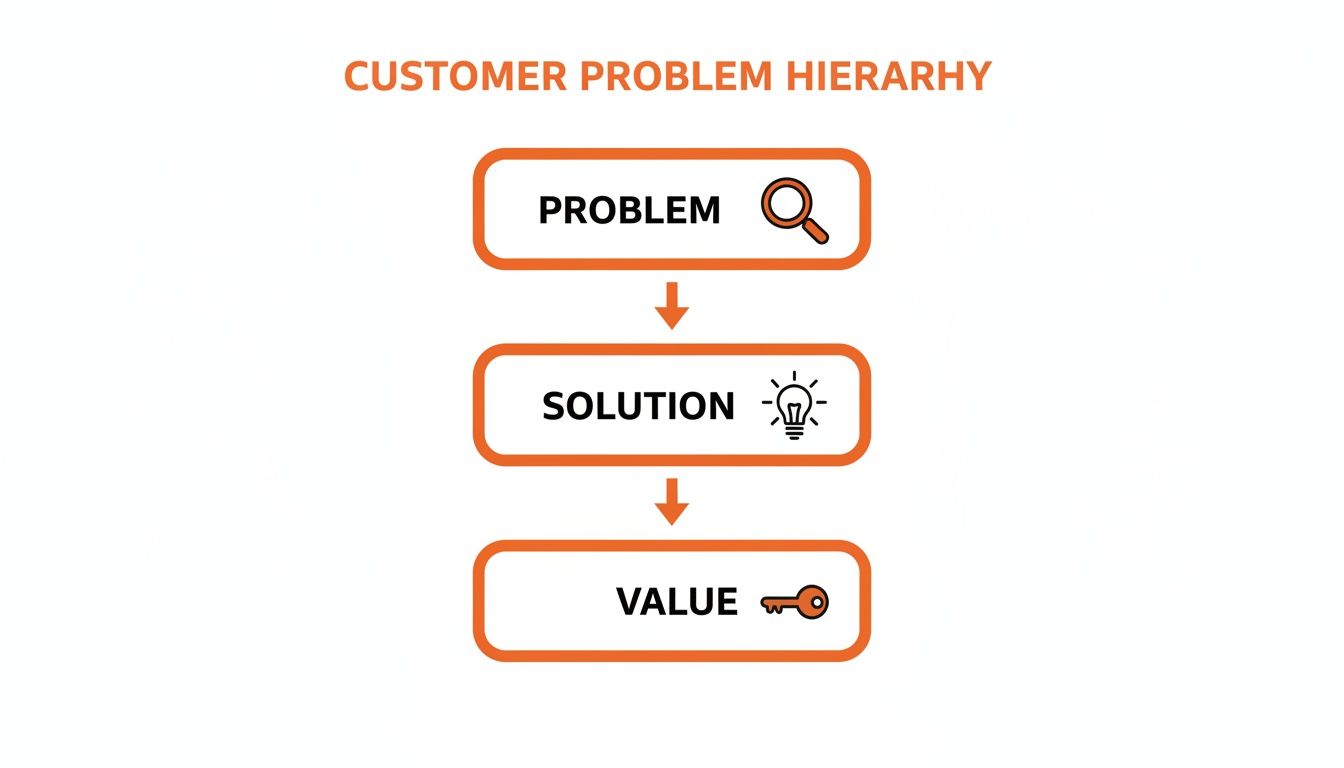
It all flows from the problem. Nail that, and you can create a solution that delivers real value.
Proving You Have Traction
Market size is theory. Traction is proof. It's the most powerful thing you can have in your business plan because it turns your story from "this could work" to "this is working."
Traction is early evidence that people want what you’re building.
For early startups, traction isn't always revenue. Investors look for signals of momentum—proof you're making real progress. If you need help getting those first sales, our guide on how to start a product business is a great place to start.
Traction is the story of your progress told through data. It's tangible evidence that you're building something with momentum in the real world.
So what counts as traction? Here are powerful examples:
- A Growing Waitlist: Showing that 500 people have signed up to be notified when you launch is huge. It demonstrates real demand.
- Successful Pilot Programs: Ran a test with a small group? Share the results. "Our 10 pilot users reported a 40% reduction in time spent on weekly inventory." Numbers talk.
- Letters of Intent (LOIs): Have potential customers signed non-binding agreements saying they intend to purchase your product? An LOI from a known company is gold.
- Key Strategic Partnerships: Landing a partnership with an established player in your industry is a massive validator.
- Positive User Feedback: Glowing quotes from your first users provide social proof. They tell a human story that makes the opportunity feel real.
Your job is to connect the dots. Start with the big-picture market, then bring it down to earth with tangible signs of progress that prove you're the right team to win.
7. Showcasing Your Team and Financials
Investors bet on people, not just ideas. I’ve seen brilliant concepts fail under a weak team and scrappy founders pivot a mediocre idea into a massive success. This section is where you prove you have the right crew to win.
Think of your team as seasoned sailors and your idea as the ship. Investors know that even the best ship will sink in a storm without a capable crew. They're looking for proof that your team has the skills, grit, and insight to handle whatever comes.
This is your chance to go beyond resumes.
More Than Just Resumes
Forget just listing job titles. Tell the story of why this specific group is uniquely qualified to solve this problem. What’s your origin story? What led you to this mission?
A great team section connects the dots, showing a clear line between each founder's background and the company's future success.
- Highlight Complementary Skills: Show how your team covers the critical bases. Maybe one founder is a product genius, while the other is a marketing pro. That's the balance investors love.
- Demonstrate Industry Experience: Have you lived the problem you're solving? If you’re building a tool for restaurant owners and a co-founder managed a busy Chicago restaurant for a decade, that’s a massive advantage. Mention it.
- Showcase Grit: Early-stage startups are a grind. Share a brief story of how your team overcame a tough obstacle. This proves your resilience.
For solo founders, this section is just as crucial. Highlight your advisory board, mentors, or early hires who fill your knowledge gaps. If you're still looking, our guide on how to find a co-founder has practical steps for finding the right partner.
Your team slide isn't just about who you are. It’s about why you—and only you—are the team that will make this venture succeed. It’s a statement of capability and shared purpose.
Your Financial Sketch Not a Full-Blown Audit
Let's talk financials. Many founders get spooked here, picturing complex spreadsheets. Relax. At this early stage, nobody expects a perfect five-year forecast.
The real goal is to provide a clear, honest financial sketch.
Think of it this way: you're not creating detailed architectural plans for a skyscraper. You're making a simple floor plan that shows the basic layout and how the rooms connect. It proves you've thought through how your business will make and spend money.
Your financial sketch in the startup business plan template should clearly outline three core things.
- Your Business Model: In one sentence, how will you make money? A monthly subscription (SaaS)? A one-time product sale (e-commerce)? Be direct.
- Key Revenue Streams and Major Costs: What are your top 1-3 ways to generate income? On the flip side, what are your 3-5 biggest expenses? Usually, this includes salaries, marketing, and software.
- Your Use of Funds: If you're raising money, be explicit about how you'll use it. Break down your ask (e.g., "$500k") into key buckets like "40% for two engineers, 30% for marketing, and 30% for inventory."
This simple sketch gives investors confidence. It shows you understand the economic engine of your business and that you'll be a responsible steward of their capital. It's about demonstrating thoughtfulness, not predicting the future perfectly.
Pitching Your Plan and Building Momentum
Think of your business plan as a living document, not a final exam. It's a conversation starter—a key you’ve forged to open important doors. Once you’ve nailed it down, the real work begins: turning that plan into powerful conversations.
This is especially true in the Midwest. Investors in hubs like Chicago value a practical, grounded mindset. They want a real story backed by a sustainable business model. Your plan isn't a script; it's the foundation for a genuine dialogue.
The startup journey is tough. More than two-thirds of new companies fail within 10 years, and 21.5% don't make it past their first year.
But here’s the flip side: businesses with detailed plans grow 30% faster. That’s a critical edge, especially when 82% of business failures come from cash flow issues—a problem a good plan tackles head-on. A solid startup business plan template is your lifeline. You can read more about these entrepreneurship statistics and how to beat them.
Adapting Your Story for the Room
Your pitch is never one-size-fits-all. A formal VC meeting is different from a casual coffee with an advisor. Learn to read the room and adapt your narrative while staying true to your core mission.
For a VC, you might lead with traction and market size. When talking to a mentor, you might focus more on the problem and your team.
Your business plan gives you the core components of your story. Your job is to be the storyteller, reassembling those components to connect with whoever is across the table.
Getting Connected in the Midwest
Building a company is a community sport. You need to get out there and connect with people who can help. Here in Chicago and across the Midwest, the ecosystem is incredibly supportive, but you have to show up.
Here are a few places to start:
- Incubators and Accelerators: Programs like 1871, mHUB, and MATTER in Chicago offer incredible mentorship and resources.
- Local Events: Keep an eye on Built In Chicago and local tech meetups for pitch nights, founder panels, and networking.
- Peer Groups: Joining a community of fellow founders, like Chicago Brandstarters, provides a confidential space to get honest feedback on your plan.
A Few Common Questions About Startup Business Plans
When you’re facing your first business plan, a few questions always pop up. Let's get them out of the way. Don’t be afraid to ask the tough questions—that’s how you get to the good stuff.
How Long Should This Thing Be?
Clarity beats length. Every time.
There’s no magic number, but a sharp 15-page plan destroys a rambling 50-page one. For most early-stage startups, 15-25 pages is the sweet spot.
Your one-page summary gets your foot in the door. After that, make every page count.
Think of it like a great presentation. It needs to be long enough to tell a compelling story but short enough that no one's eyes glaze over.
Should I Write It Myself or Hire Someone?
You need to hold the pen. Writing the plan isn't just about putting words on paper; it's the process of wrestling with every detail of your business. It forces you to think strategically. You can't outsource that.
Sure, bring in a pro to help with financial modeling or deep market research. That’s smart. But the core vision, strategy, and story? That has to come from you. Investors bet on your brain, not a consultant's.
How Often Should I Update My Business Plan?
Your startup business plan template isn't a historical document you frame on the wall. Treat it like a living guide for your business. It's your map, not a museum piece.
Give it a refresh:
- Quarterly: Check your progress against your goals and tweak what isn't working.
- Before a new funding round: Show off your latest traction and lay out what you need next.
- After a major pivot: If you're changing direction, your plan needs to change with you.
Keeping it current transforms the plan from a simple document into your most valuable strategic weapon.
Ready to build your brand alongside founders who actually value kindness and hard work? Join Chicago Brandstarters, a free, vetted community for Chicago and Midwest founders. We skip the transactional networking and focus on real support. Learn more and apply at https://www.chicagobrandstarters.com.
Leave a Reply