Your business probably didn’t start in a warehouse. It started on a laptop, a folding table, or a corner of your apartment. Then sales came in. Good problem. Then the boxes came. Less good.
At first, packing your own inventory feels scrappy and noble. After a while, it becomes a trap. You’re not building a brand anymore. You’re doing repetitive labor and calling it entrepreneurship.
That’s where prep center fba stops being a logistics detail and starts becoming a growth decision. If you’re a Midwest founder, this choice matters even more than many realize. It affects cash flow, landed cost, restock speed, tax exposure, and your ability to stay sane while you scale.
Stop Drowning in Boxes and Start Building Your Brand
I know this stage well. Your living room starts to look like a loading dock. You’ve got tape guns on the couch, cartons by the door, labels on the kitchen table, and a constant low-grade fear that you forgot one barcode.
You tell yourself it’s temporary. Then a shipment arrives late, one SKU needs relabeling, and your entire week disappears.
The founder bottleneck is real
Many promising founders stall out at this point. Not because the product is weak. Not because demand vanished. They stall because they’re spending their best hours on the worst use of their time.
You should be refining your offer, improving conversion, talking to customers, and building repeat purchase. Instead, you’re counting units and fighting with box labels.
That’s why prep centers matter. They take over the repetitive, compliance-heavy work that keeps inventory moving into Amazon. And for Amazon sellers, this isn’t some niche service. With many active Amazon sellers globally and a large majority using FBA, prep centers have become a core part of the ecosystem. They can cut prep turnaround from 1 to 2 weeks when you do it yourself down to 2 to 5 days, which helps you restock faster and keep inventory flowing (MDS on Amazon prep centers).
What changes when you outsource prep
The first real win isn’t operational. It’s mental.
You stop waking up thinking about whether a supplier carton arrived damaged. You stop burning evenings on FNSKU labels. You stop pretending that your apartment, basement, or garage is a scalable system.
You don’t win on Amazon because you can tape boxes faster than everyone else. You win because you make better decisions than everyone else.
A prep center provides an advantage. It gives you back time, space, and attention. That’s the stuff that builds a brand.
If you’re still in the “I’ll keep doing this myself a little longer” phase, I’d push you to think bigger. The shift from operator-everything to real founder starts when you remove yourself from low-value tasks. If you need help thinking through the bigger brand side of that transition, I’d also spend time on how to build a brand from scratch.
What Exactly Is a Prep Center and Why You Need One
A prep center is your backstage crew.
Your product is the performer. Amazon is the venue. If your product shows up dressed wrong, labeled wrong, packed wrong, or boxed wrong, it doesn’t go on stage. It gets delayed, rejected, or flagged.
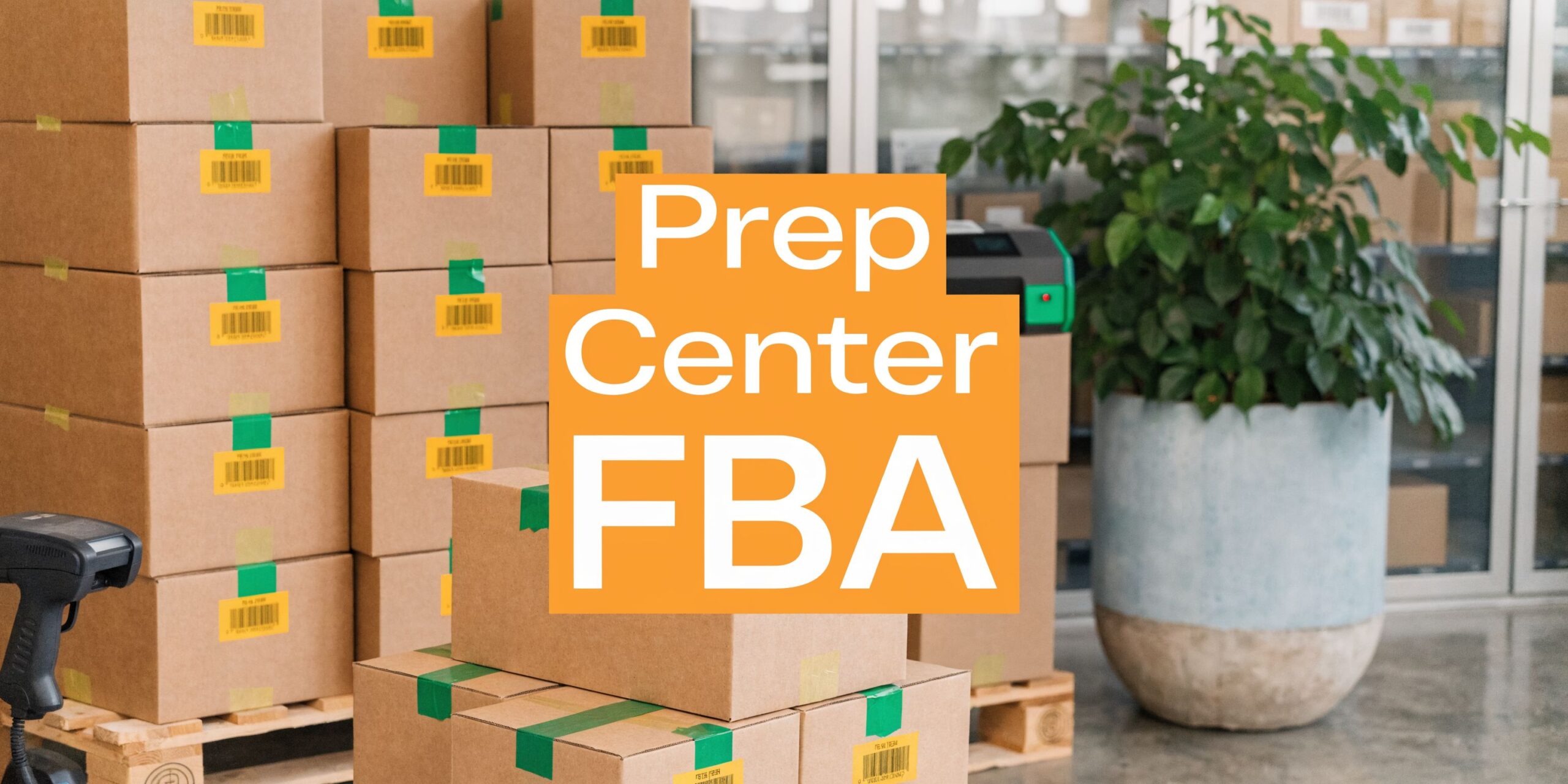
That’s the job of a prep center fba partner. They receive inventory from your supplier, inspect it, label it, bundle it if needed, box it correctly, and send it to Amazon in a form Amazon will accept.

What they do
The core workflow is simple:
- Receive your inventory from a supplier, manufacturer, or another warehouse.
- Inspect the shipment for missing units, damage, or obvious errors.
- Apply Amazon-required prep, like FNSKU labels, polybagging, bundling, or protective packaging.
- Pack cartons to Amazon specs so the shipment doesn’t get kicked back.
- Ship to the assigned fulfillment center on your shipping plan.
That sounds basic until you remember Amazon is picky. And I mean picky in a way that can hurt your account.
Why you can’t treat compliance casually
Amazon requires boxes to be six-sided, under 25 inches on any side, and under 50 lbs. If you miss those rules, Amazon can reject the shipment, delay it by 3 to 7 days, and repeated violations can hit your Inventory Performance Index, reducing your storage limits by up to 50% (Amazon FBA prep requirements summary).
If you’re trying to scale, that’s not a small mistake. That’s a self-inflicted chokehold.
A lot of founders act like prep is a clerical task. It isn’t. It’s a compliance function tied directly to inventory flow. If your inventory doesn’t move cleanly into Amazon, your marketing work doesn’t matter because you can’t sell what isn’t available.
The right way to think about prep
Don’t think of a prep center as “someone to put labels on my products.”
Think of them as the layer between your product and Amazon’s rules.
Practical rule: If a mistake at the prep stage can delay sales, trigger penalties, or hurt your account health, it’s not admin work. It’s mission-critical work.
A good prep partner saves you from amateur mistakes. A bad one creates them for you.
That’s why this decision deserves more thought than “Who gave me the cheapest quote?”
The Full Menu of FBA Prep Center Services
Many founders start by thinking they only need receiving and labels. Sometimes that’s true. Often it isn’t.
A strong prep center fba partner gives you options. That matters because product complexity grows faster than many expect.

The core services most sellers use
Here’s the menu I’d expect any serious prep center to offer:
Receiving and check-in
They log inbound cartons, compare what arrived against your purchase order, and flag obvious shortages or damage.Inspection and quality control
Here, they catch crushed packaging, wrong colors, bad seals, or supplier mistakes before Amazon sees them.FNSKU labeling
They apply the barcode Amazon uses to identify your units as yours.Polybagging
Needed for certain products that need sealed outer protection.Bubble wrapping
Useful for breakable items or products with delicate packaging.Carton forwarding
They move finished inventory into the right shipment plan and warehouse destination.
The services that enable better offers
Through these services, prep centers become more than a compliance vendor.
Kitting and bundling
Want to sell two products as one offer? A prep center can assemble them into a single unit.
That might be a shampoo and conditioner set, a starter kit, or a multi-item gift bundle. If you’ve ever wanted to raise perceived value without changing your hero product, this service matters.
Expiration date labeling
If you sell products with shelf-life requirements, you need accurate date handling. Food, supplements, some beauty products, and other consumables can get messy fast if this part is sloppy.
Suffocation warning labels
If your item goes into a poly bag, you may need the proper warning label. This is the kind of detail small operators miss and pros don’t.
Returns and removals processing
Amazon returns don’t magically sort themselves into “resell” and “trash.” A prep center can inspect returned units, determine what’s salvageable, and help you avoid wasting inventory that still has value.
A quick visual helps if you want to see how operators think through the service side of this:
Match services to your actual business model
Not every seller needs the same setup.
If you’re doing straightforward wholesale or online arbitrage, your needs may stay pretty basic. If you’re building a private label brand, you may need more quality control, more custom packaging oversight, and more process documentation.
I’d sort it like this:
| Seller type | Usually needs | Nice to have |
|---|---|---|
| Wholesale seller | Receiving, labeling, carton forwarding | Fast SKU onboarding |
| Private label seller | Inspection, labeling, protective packaging | Kitting, returns review |
| Bundle seller | Kitting, relabeling, quality control | Custom packaging checks |
| Fragile product seller | Bubble wrap, inspection, careful outbound handling | Photo confirmation |
The mistake I see all the time is founders buying the cheapest basic service when their product clearly needs a more careful workflow. Then they act surprised when reviews mention damaged packaging or Amazon flags inbound problems.
Your prep setup should fit your product. Not the other way around.
Benefits and Drawbacks The Honest Truth About Outsourcing
Outsourcing prep can absolutely help you scale. It can also create a different kind of mess if you do it carelessly.
I’m pro-outsourcing, but I’m not naïve about it. Handing your inventory to another company changes your business. You gain an advantage. You also take on a new dependency.

What you gain
The obvious benefits are real.
You get your time back. You stop using your home as overflow warehouse space. You can send more volume through a professional operation than you’ll ever handle from a spare bedroom.
There’s also the compliance advantage. Good prep centers build repeatable systems around Amazon’s rules. That lowers the odds of sloppy mistakes that cause avoidable delays.
And speed matters. Faster prep means faster restocks. Faster restocks mean better inventory flow. For some sellers, that’s the difference between momentum and stockouts.
What you lose
You lose direct touch.
That matters more than people admit. When you prep your own inventory, you see packaging defects, supplier inconsistency, and damaged units firsthand. Once you outsource, you only know what your prep center tells you.
That’s why weak communication is deadly. If they don’t report issues quickly, you’ll learn about problems after the damage is done.
You also lose some flexibility. If you want to test an odd packaging change, inspect a questionable lot, or quickly split inventory a new way, you now need another team to execute your plan correctly.
The dependency risk got bigger in 2026
This part deserves blunt language.
Since Amazon discontinued its own in-house prep services on January 1, 2026, sellers are now fully dependent on third-party providers for that function. At the same time, prep centers often operate on tight 10 to 25% margins, and capacity can get squeezed during peak periods. That means your inventory can get stranded at the exact moment you need speed most (Amazon policy context and dependency risk).
That’s the hidden cost people skip when they talk about prep centers. They talk about convenience. They don’t talk enough about concentration risk.
If one prep center touches all of your inbound inventory, that prep center is now part of your core infrastructure whether you admit it or not.
My honest take
I still think most growing founders should outsource prep. But I think you need to do it like an operator, not like a tourist.
Here’s how I’d handle the risks:
Demand proof of process
Ask how they receive, inspect, label, escalate issues, and close shipments. If the answer is vague, walk away.Get communication rules in writing
You need to know when they notify you, how they notify you, and who owns exceptions.Start with a controlled test
Don’t send your most important reorder first. Send a manageable batch and inspect their work product through photos, timing, and shipment accuracy.Have a backup path
Even if you don’t actively use a second prep center, know who your fallback is.Model the margin impact
Prep fees look small per unit. They add up fast if your margins are thin.
Outsourcing is a strategic move, not a convenience move
The right prep center can free you up to run the company. That’s why I’d never frame this as “Should I pay someone else to do my box work?” The question is, “Can this partner help me scale without introducing more risk than they remove?”
If the answer is yes, move. If not, keep looking.
How Much Does an FBA Prep Center Cost
You get a quote for $0.60 a unit and feel like you found a bargain. Then the invoices start stacking up. Receiving fees. Polybag fees. Expedited turnaround fees. Storage. Problem-unit handling. Suddenly the cheap option is chewing through your margin and slowing down replenishment.
That is how founders misread prep center pricing.
Basic prep often lands around $0.50 to $1.00 per unit, and more involved prep usually falls in the $0.75 to $2.00 per unit range, based on the pricing ranges published by Prep Center Search. Use that as a starting point, not a decision rule.
Total cost beats unit cost
I care about one number. What does it cost to get sellable inventory into Amazon, on time, with low error rates?
A prep center that charges a little more per unit can still be the cheaper option if it cuts receiving mistakes, gets cartons turned faster, and keeps your best-selling SKUs in stock. That matters even more now that Amazon ended its own prep services in 2026. Your outside prep partner is no longer a convenience vendor. It is part of your operating system.
If you are a Midwest founder, pricing has a second layer. Geography changes the math. The right location can reduce freight waste, shorten inbound routes, and in some cases improve your tax position depending on where inventory is received and held. I would rather pay a prep center in the right state with cleaner execution than save a few cents with a partner that creates friction.
Cheap prep is often expensive inventory.
Sample pricing scenarios
Use a table like this to pressure-test quotes before you sign.
| Scenario | Tasks | Est. Cost Per Unit | Total Cost (200 units) |
|---|---|---|---|
| Basic standard item | Receive, label, forward to Amazon | $0.50 to $1.00 | $100 to $200 |
| Standard item with inspection | Receive, inspect, label | $0.75 to $1.00 | $150 to $200 |
| Polybag-required item | Receive, inspect, polybag, label | $0.75 to $2.00 | $150 to $400 |
| More complex prep | Receive, inspection, protective prep, labeling | $0.75 to $2.00 | $150 to $400 |
Those ranges are useful. They are not enough.
I want the full fee sheet before I commit, and you should too.
What I would ask for in writing
Everything included in the base rate
I want to see exactly what “standard prep” means.Every add-on fee
Polybagging, bubble wrap, carton forwarding, removals, relabeling, photo documentation, expiration labels, and urgent requests should all be listed.Receiving and storage rules
Ask when storage starts, how they bill partial months, and what happens if Amazon delays your shipment creation.Exception handling fees
Damaged cases, missing units, carton content mismatches, and supplier errors create real work. Make them price that work upfront.Turnaround commitment
A low fee means very little if your inventory sits for days during a stockout window.
The Midwest angle founders miss
If your brand is based in Illinois, Indiana, Wisconsin, Michigan, or Ohio, prep center cost is not just a warehouse question. It is a network design question.
I look at three things together. Where your supplier ships from. Where the prep center receives inventory. Where Amazon usually routes your inbound freight. That is where geographic arbitrage shows up. A slightly higher prep fee can be the right call if it lowers total landed cost or improves cash conversion through faster turns.
Run the numbers against your replenishment rhythm, not just your gross margin. If you want a sharper way to evaluate that, use this breakdown of the inventory turnover formula before you compare providers. The founder who understands turnover will usually pick the better prep partner, even when the quote looks higher on paper.
How to Choose the Right Prep Center A Midwest Founder's Guide
If you’re in Chicago or anywhere in the Midwest, you have an edge that a lot of sellers don’t use well.
Many choose a prep center like they’re picking a storage locker. They look at price, maybe turnaround time, and stop there. That’s lazy thinking.
I’d choose a prep center fba partner the same way I’d choose a small but important operating base. Location changes cost. Location changes speed. Location can even change tax exposure.
Location is a financial decision
For Midwest founders, geography isn’t cosmetic. It provides a strategic advantage.
Choosing a prep center in a tax-free state and near major fulfillment hubs can reduce landed costs by 3 to 8% annually, according to the verified guidance for this topic (BQool on prep centers and location strategy).
That’s a real lever. Not a convenience perk.
If your supplier can ship into a tax-advantaged state and your prep center can still move inventory efficiently into Amazon’s network, you may improve your economics without touching ad spend, conversion rate, or product cost.
What Midwest founders should prioritize
I’d evaluate prep centers in this order.
First, map your product flow
Don’t start with “Which center is popular?”
Start with your actual chain:
- Supplier location
- Port or inbound freight path
- Prep center location
- Amazon destination patterns
- Any non-Amazon channels you also need to support
If your inventory keeps zigzagging across the country, your system is dumb even if the prep fee is low.
Second, look for geographic arbitrage
A prep center in a tax-free state can be useful. So can one close to the fulfillment regions you hit most often.
For Midwest operators, I’d look hard at whether the location gives you one or both of these advantages:
- Tax efficiency
- Shorter, cleaner freight movement into Amazon
If it gives you neither, it better be exceptional at service.
Third, test communication like you’re hiring a key employee
Many founders face challenges at this point.
Ask them:
- How fast do you check inventory in
- How do you report shortages or damage
- Do you provide a portal
- Who answers urgent questions
- Do you support repeatable SOPs for your account
If the sales call feels loose, operations will feel worse.
A prep center doesn’t need great marketing. It needs boring, disciplined execution.
My Midwest vetting checklist
Use this before you commit:
| What to check | What good looks like | Why it matters |
|---|---|---|
| Location fit | Near your supply path or a strategic tax location | Cuts waste in freight and handling |
| Turnaround discipline | Clear stated window and consistent updates | Protects restock speed |
| Software and visibility | Clean portal, shipment status, issue tracking | Reduces surprises |
| Communication | Fast replies, named contact, clear escalation | Prevents small problems from growing |
| Service match | Handles your exact prep needs | Avoids awkward workarounds |
| Scalability | Can support higher volume and seasonal swings | Keeps you from switching too soon |
Don’t hire the cheapest warehouse with a barcode printer
That’s really the trap.
A good prep center helps you scale. A mediocre one adds friction everywhere. You’ll feel it in delayed shipments, vague updates, missing units, and endless little “one-off” problems.
As a Midwest founder, I’d press your geographic advantage hard. Use tax strategy where it makes sense. Use proximity where it improves freight flow. And only work with operators who communicate clearly enough to be trusted with your inventory.
Your First Shipment A Step-by-Step Workflow
The first shipment feels bigger than it is. Once you’ve done one, the process becomes routine.
The key is to stay organized and keep permissions tight. Your prep center needs enough access to do the work. They do not need broad access to everything in your business.
The clean first-shipment sequence
Open your prep center account
Set up your profile, product records, and basic operating preferences inside their portal.Give limited Seller Central access
Grant only the permissions needed for shipment-related work. Keep finance and other sensitive areas restricted.Load your product information
Make sure the prep center knows exactly what’s inbound, how it should be prepped, and what to flag.Create the shipment plan
In Seller Central, build the shipment using the prep center as the ship-from location.Send labels and instructions
Provide carton labels, prep notes, bundle rules, and any special handling requirements.Tell your supplier where to ship
Your supplier sends inventory directly to the prep center.Monitor intake and exceptions
Once inventory arrives, confirm counts, issue reports, and prep status before outbound shipment to Amazon.
Keep the first one simple
Don’t make your first shipment a giant mixed-SKU science experiment.
Start with a straightforward batch. Fewer moving parts mean you can judge the prep center on the basics: receiving accuracy, communication speed, issue handling, and outbound execution.
The first shipment is an audit. Treat it that way.
If you want a deeper walkthrough on avoiding common inbound mistakes, keep this guide to shipping to Amazon FBA without mistakes close when you build your first workflow.
What I’d watch closely
On shipment one, I care about four things:
- Did they receive accurately
- Did they communicate exceptions fast
- Did they prep exactly as instructed
- Did the final shipment move cleanly
If they fumble those basics, don’t rationalize it. Early sloppiness usually gets worse under volume, not better.
Your Next Steps and Common Questions
A good prep center does more than get boxes into Amazon. It buys back founder time, protects margin, and gives you options if one channel, one warehouse, or one policy change goes sideways. That matters a lot more now that Amazon no longer offers its own prep services. If you are a Midwest founder, you also have a real advantage here. You can use geography, warehouse location, and tax setup to lower freight waste and keep your operation less fragile.
When should you hire a prep center
Hire one when prep work starts crowding out the jobs only you can do. If you are spending afternoons labeling cartons instead of improving listings, negotiating with suppliers, or fixing cash flow, you waited too long.
I usually tell founders to make the switch before chaos becomes normal. Once your garage, office, or small warehouse becomes the bottleneck, growth gets expensive fast.
Can a prep center help outside Amazon
Yes. Many prep centers also support Shopify orders, FBM, wholesale routing, kitting, and returns.
Ask about that early, because it changes the economics. A center that can handle multiple channels can reduce storage duplication, shorten transfer times, and give you a backup path when Amazon creates a problem. That kind of operational flexibility has financial value. Treat it that way.
What mistake do founders make most often
Choosing based on price is a common mistake.
I care more about receiving accuracy, response time, exception handling, and clean outbound execution. A cheap prep center that loses units, misses labels, or stays silent when inventory arrives damaged will burn margin fast. You pay in reimbursements you never recover, stockouts you could have avoided, and wasted founder attention.
Midwest founders should look one step further. Do not just compare per-unit prep fees. Compare total landed cost, inbound routing, state tax exposure, and how dependent you become on one operator in one location. Geographic arbitrage is real. The right prep center location can cut freight cost and transit friction. The wrong one can erase your margin.
What should you do next
Pick three centers. Ask each one the same hard questions. Where are they located, how do they handle exceptions, what systems do they use for receiving, what happens during peak periods, and how quickly do they escalate problems?
Then run a small paid test. Use one straightforward shipment and score them like an operator, not a hopeful buyer. I would judge them on accuracy, speed, communication, and whether their location improves your freight and tax position.
Choose the partner that makes your business stronger, not just cheaper.
If you’re a kind, ambitious Midwest founder who wants honest feedback, practical tactics, and real operator conversations, join Chicago Brandstarters. It’s a free community for people building brands the hard way, with integrity, and it’s the kind of room that can save you years of avoidable mistakes.