
When you're first getting a brand off the ground, all your energy goes into the product, the marketing, the pretty website. Shipping feels like a problem for another day. I'm telling you right now, that's a huge mistake.
For Amazon FBA sellers, a great freight forwarder isn't just another line item on your P&L—they're your single most critical partner. Full stop.
Why Your Freight Forwarder Is Your Most Important Partner
I know, logistics isn't sexy. But in the trenches of Amazon FBA, your freight forwarder is what separates a smooth, profitable launch from a cash-burning nightmare. They do so much more than just move your boxes from one side of the world to the other.
Think of them as your logistics quarterback. You’re laser-focused on making sales. Meanwhile, your forwarder is on the field, running the entire international supply chain playbook for you.
They're the ones talking to your factory in China at 3 AM their time, wrestling with a mountain of customs paperwork, and making sure your inventory shows up at Amazon's fulfillment center perfectly prepped and ready to sell. Messing this up isn't an option.
The Real Engine of Ecommerce
This isn't just about making your life easier; it's about tapping into the global infrastructure that millions of sellers like you rely on to build their businesses. By 2025, Amazon had over 9.7 million registered sellers, and a staggering 82% of them use FBA. That's a massive number of businesses, many right here in the Midwest, all depending on these same international freight systems.
Industry data shows that 65% of the top-earning Amazon sellers use FBA. It’s not a secret strategy; it's the standard operating procedure for modern ecommerce. You can dig into more of these key Amazon seller statistics on Forceget.com.
Your forwarder's real job is to protect your cash flow. A delayed shipment doesn't just mean you lose a few sales. It means your capital is stuck in a steel box in the middle of the ocean instead of working for you.
A good freight forwarder is your advocate in a ridiculously complex system. Here’s what I mean:
- They handle the bureaucracy so you don't have to. Customs clearance is a minefield of codes, forms, and constantly changing regulations. One tiny typo can get your entire shipment flagged and stuck in port for weeks.
- They get you space on the boat (and better prices). Forwarders have deep relationships and massive volume discounts with ocean and air carriers that you, as a small brand, could never dream of getting on your own.
- They master Amazon's crazy rules. Amazon is notoriously strict about how inventory must be labeled, palletized, and delivered. A forwarder who specializes in FBA knows these rules cold, preventing costly rejections and chargebacks.
Choosing the right freight forwarders for Amazon FBA frees you up to focus on what you do best—growing your brand. You can sleep at night knowing your most valuable asset, your inventory, is in expert hands.
Freight Forwarder vs DIY Logistics: The Real Score
For anyone thinking, "How hard can it be? I'll just manage the shipping myself," I've put together a little reality check. Here's a quick look at why going it alone can be a recipe for disaster for a growing FBA brand.
| Task | Using a Freight Forwarder | Going It Alone (DIY) |
|---|---|---|
| Booking Freight | Leverages volume discounts and relationships for better rates and secured space. | You're a tiny fish in a huge ocean. Expect high spot rates and getting bumped off vessels. |
| Customs Clearance | An expert handles all the complex paperwork, duties, and taxes, avoiding costly delays. | A single mistake on a form can get your shipment seized for weeks or months. |
| Amazon Prep | Ensures every carton and pallet meets Amazon's ever-changing, strict FBA requirements. | Risk of entire shipment being rejected by Amazon for incorrect labels or palletizing. |
| Problem Solving | Manages port congestion, customs inspections, and trucking issues on your behalf. | You're on your own, making frantic calls at 3 AM to people who don't care about your business. |
| Time Investment | You send a few emails and get back to selling. | Becomes a second full-time job you didn't sign up for and aren't getting paid for. |
At the end of the day, the time, money, and sanity you save by partnering with a pro far outweighs the fees they charge. Trying to DIY international logistics is a classic case of being penny-wise and pound-foolish.
Your Shipment's Journey From Factory to FBA
The path from your supplier's factory to an Amazon FBA warehouse can feel like a total black box. You send a pile of money overseas, and weeks later, your inventory just magically appears in Seller Central. I'm going to pull back the curtain and show you exactly what happens in between.
This isn't just trivia; understanding this process lets you spot problems before they snowball and cost you thousands. It all starts with the most important term you'll learn in this business: Incoterms.
Incoterms: Who's Responsible for What?
Think of Incoterms as the rules of engagement for your shipment. They define the exact moment when responsibility for your precious cargo transfers from your supplier to you. You'll hear two terms thrown around constantly: EXW and DDP.
- EXW (Ex Works): You are on the hook for everything. Imagine you have to arrange a tow truck for your car from the manufacturer's parking lot, handle its export paperwork, ship it across the ocean, deal with import customs, and then drive it to your house. It looks cheap upfront, but you're holding all the risk and doing all the legwork.
- DDP (Delivered Duty Paid): Your supplier handles the entire journey, customs duties included, all the way to a designated address. It's like buying a car and having it delivered right to your driveway, ready to go. It's more expensive, but it's infinitely simpler if you're just starting out.
For your first few shipments, I strongly recommend a DDP arrangement, even if it costs a bit more. Let the pros handle the complexity while you're still learning the ropes.
From Cartons to Pallets: The FBA Prep Checklist
Once you've nailed down the Incoterms with your supplier, the real physical prep work begins. Amazon has brutally strict rules for how inventory must arrive at their warehouses. Getting this wrong means your shipment gets rejected, and rejection means painful delays and surprise fees.
This journey starts long before the ship even leaves the port. For a deeper dive into getting this right from the beginning, check out our guide on how to find a manufacturer for your product.
Your main job here is to make sure every single item and every single box is labeled and packed perfectly.
- FNSKU Labeling: Every individual unit needs an Amazon FNSKU barcode sticker. Your supplier can usually apply these for you during production. You absolutely must triple-check that they're using the correct FNSKU for the correct product variation. A mix-up here is a nightmare to fix.
- Case Pack Requirements: The larger boxes that hold your individual units (I call them "case packs" or "master cartons") also need specific labels. These tell Amazon what's inside, how many units there are, and the expiration date if you're selling consumables.
- The Carton vs. Pallet Decision: You have two ways to send in your goods: as loose cartons (Small Parcel Delivery or SPD) or stacked and wrapped on pallets (Less Than Truckload or LTL). For bigger shipments, LTL is almost always cheaper per unit, but it requires more coordination.
This diagram breaks down how these pieces fit into the larger puzzle of getting your products from the factory floor to Amazon's door.
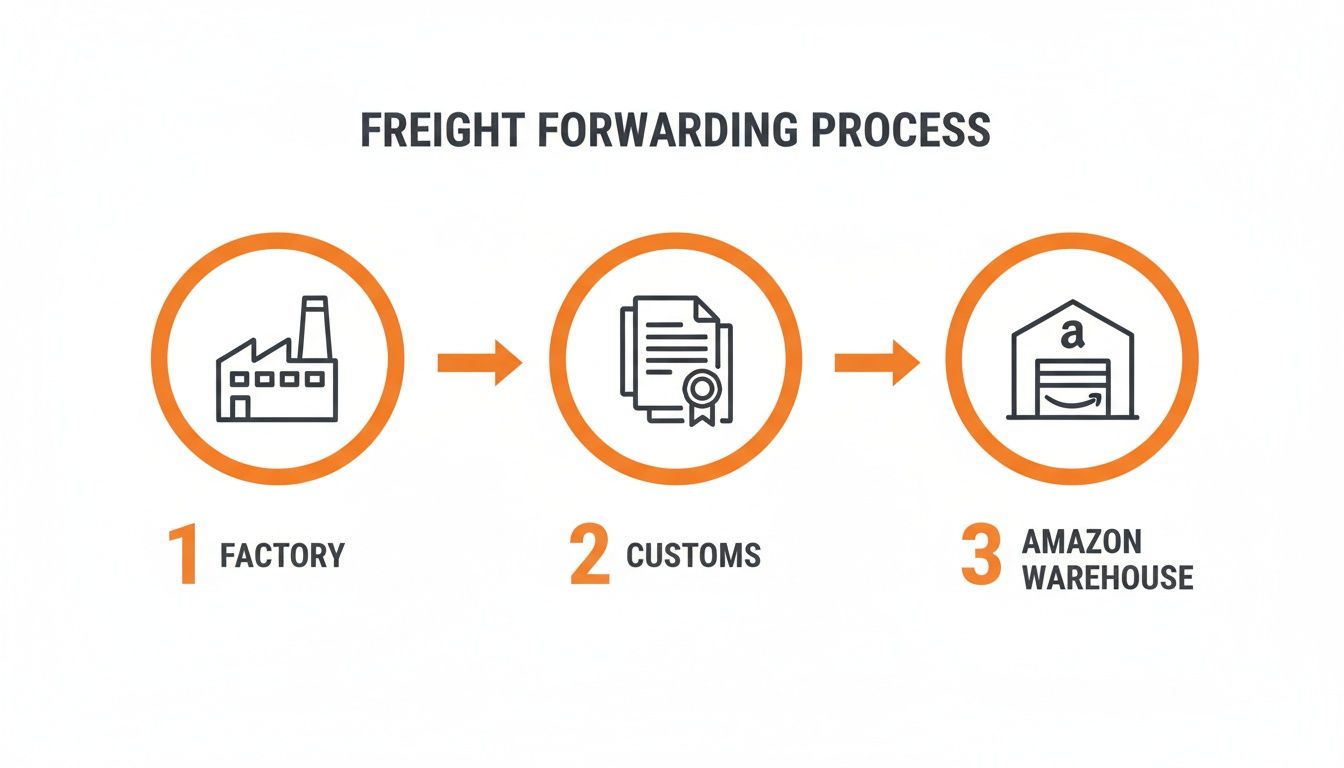
As you can see, the physical prep at the factory is the critical foundation. A smooth customs clearance and final delivery process depend entirely on getting this first step right.
Mastering the Final Mile into Amazon
The final leg of the journey happens not on a truck, but inside your Amazon Seller Central account. This is where you create the "digital handshake" that connects your physical shipment to your online listing.
You'll create a Shipping Plan, which is where Amazon generates the specific FBA box labels and pallet labels your shipment needs. You must send these PDF files to your supplier or forwarder so they can stick them on the cargo before it leaves. No labels, no entry.
The most overlooked step is the Advance Ship Notice (ASN). Once your freight forwarder confirms the shipment is on its way, you have to go back into your shipping plan and click the button to mark it as "Shipped." This sends the ASN, which is Amazon's digital heads-up. Forgetting this simple click can cause massive check-in delays at the warehouse.
A good freight forwarder will walk you through all of this. They'll know exactly what labels they need from you and when. Their expertise here is what keeps your inventory from getting lost in Amazon's massive, chaotic logistics network.
How to Find and Vet the Right Freight Forwarder

Choosing a freight forwarder feels like a huge commitment because it is. You're basically handing over a small fortune's worth of inventory and just… trusting them to navigate a global obstacle course. This isn't a decision you make with a quick Google search. You need a real vetting process to separate the pros from the pretenders.
Think of it like hiring a critical employee, not just buying a service. You need someone who gets the specific, often frustrating, world of Amazon FBA. A generalist forwarder might be great at moving construction equipment, but they'll get shredded by Amazon's picky receiving docks.
Where to Look for FBA Specialists
Forget generic logistics directories. Your best leads are going to come from places where other FBA sellers hang out. You want a partner who already speaks the language of FNSKUs, ASNs, and pallet requirements without you having to teach them.
Here are the places I've found my best partners:
- Niche Facebook Groups & Online Communities: Find groups dedicated to Amazon FBA sellers. Use the search function before you post. Look for threads where people recommend forwarders they've actually used for recent shipments.
- Referrals from Other Founders: This is the gold standard. Ask founders in your network—especially those in communities like Chicago Brandstarters—who they trust. A warm introduction from a happy client is the best signal you can possibly get.
- Supplier Recommendations: Your factory ships products out every single day. Ask your sales contact if they have forwarders they recommend who have experience shipping to the U.S., specifically for Amazon FBA. They’ll know who is reliable and who isn’t.
Finding a forwarder is like dating. You’re looking for a long-term partner, not just a one-time transaction. The goal is to find someone whose communication style and problem-solving skills match your needs.
Asking the Right Questions
Once you have a shortlist of three or four potential forwarders, it’s time to interview them. Your goal here isn't just to get the lowest price. In fact, price should be one of the last things you focus on.
Recent benchmark data on the popular Shanghai to California FBA lane shows just how experienced sellers think about this. While quotes for a 40-foot container clustered around $3,850–$4,300, the top-ranked forwarder wasn't the absolute cheapest. They won because of their consistency, low FBA prep rejection rates, and smooth customs performance. You can find more details in this in-depth 2026 freight forwarder analysis.
This confirms what I’ve learned the hard way: reliability is worth paying a premium for. A cheap quote doesn't save you any money when your shipment is stuck at the port for three weeks racking up storage fees.
Your Vetting Interview Checklist
Treat your calls with potential forwarders like a job interview. Here are the pointed questions that will tell you what you really need to know:
- "What percentage of your shipments go to Amazon FBA warehouses?"
You want to hear a confident, high number like 70-80% or more. If they hesitate or say "we can handle it," that’s a red flag. FBA is a specialty. - "Can you walk me through your process for creating an FBA shipping plan and getting the labels from me?"
Listen for specific terms. Do they mention Seller Central, shipping plans, FBA box labels, and pallet labels? A pro will describe a clear, familiar workflow. - "What happens if my shipment gets flagged for a customs exam?"
This will happen eventually. A good forwarder won’t panic. They should have a standard operating procedure for communicating with you, handling the paperwork, and keeping you updated. - "Who will be my single point of contact?"
You don't want to be bounced around a customer service call center. You need a dedicated agent who knows you and your business. Get their name and their direct contact info. - "Can you provide a reference from another Amazon FBA seller you've worked with for over a year?"
The best forwarders will happily connect you with a long-term client. This is the ultimate proof that they deliver on their promises.
By focusing on FBA-specific experience and their process for handling problems, you move beyond price shopping and start building a real partnership. This is how you find one of the best freight forwarders for Amazon FBA who will help you scale, not just ship.
Decoding Freight Costs and Shipping Timelines
Let's get right to it—the two things that keep every founder I know up at night are money and time. Getting your first freight quote can feel like you’re trying to read a foreign language, a dizzying list of acronyms and fees. I'm going to help you make sense of it all so you can protect your cash and avoid stockouts.
Think of a freight quote like a car repair bill. There's the big-ticket item (the new transmission), but also a dozen smaller line items for labor, fluids, and shop fees. Ignoring those little fees is exactly how you get a nasty surprise at the checkout counter.
What You Are Actually Paying For
Your freight forwarder's quote bundles together a bunch of different services. Your job is to understand what's included so you can spot hidden costs and compare different forwarders fairly.
Here's what a typical DDP (Delivered Duty Paid) quote should cover:
- Origin Charges: This is the trucking from your factory to the port and the handling fees on that end.
- Main Freight: The big one. This is the actual cost of space on the ship (ocean freight) or plane (air freight).
- Destination Charges: Covers handling fees at the U.S. port, trucking to a local warehouse, and sometimes unloading fees.
- Customs Clearance & Duties: The fee for the customs broker to file your paperwork, plus the actual import taxes (duties) you owe the government.
- Final Mile Delivery: The last truck ride from your forwarder's warehouse to the designated Amazon FBA fulfillment center.
I can't stress this enough: confirm every single one of these is included. Some forwarders will send a cheap-looking "port to port" quote that leaves you on the hook for all the expensive and complicated stuff on the U.S. side. Don't fall for it.
The Big Trade-Off: Sea Freight vs Air Freight
Choosing between sea and air really boils down to a simple trade-off between your budget and your deadline. There’s no single right answer; the smart choice changes based on your situation.
Sea freight is your workhorse. It's dramatically cheaper—sometimes 8-10 times less expensive than air—but it's slow. You're typically looking at 30-50 days from a factory in China to an Amazon warehouse in the Midwest.
Air freight is your emergency lever. It's incredibly fast, often taking just 7-12 days, but the cost is punishing.
A great freight forwarder doesn't just book your shipment; they act as a strategic advisor. They help you blend shipping methods—sending a small, initial batch by air to get sales going while the main bulk of your inventory follows by sea. This is a pro move.
To help you decide, here’s a quick-and-dirty guide I use.
Air Freight vs Sea Freight: When to Use Each
This table breaks down the decision-making process based on what's most important for your business right now. Are you racing against a deadline, or are you trying to protect your profit margins?
| Factor | Choose Air Freight When… | Choose Sea Freight When… |
|---|---|---|
| Urgency | You're about to run out of stock and need inventory now to avoid losing sales momentum. | You've planned your inventory well in advance and have weeks of buffer stock available. |
| Product Value | You're shipping small, lightweight, high-margin items where the expensive shipping cost is a small percentage of the retail price. | You're shipping larger, heavier, or lower-margin items where air freight would destroy your profitability. |
| Launch Timing | You're launching a new product and need to get your first units live on Amazon quickly to start generating reviews and sales data. | You are placing a routine replenishment order for a product that is already selling consistently. |
Ultimately, the goal is for you to use sea freight for 95% of your shipments and only use air when you absolutely have to.
Building a Bulletproof Shipping Timeline
The real secret to winning with international logistics isn't just picking the right shipping method. It's about mastering your timeline to avoid the single most costly mistake in e-commerce: stocking out.
Running out of inventory doesn't just mean you lose sales. It kills your sales rank on Amazon, which can take weeks for you to claw back.
To prevent this, you have to work backward from your "stock out" date. Add up your manufacturing lead time, your shipping transit time, and a healthy buffer for unexpected delays (like customs exams or port congestion). This total time is your reorder point. Planning this way is essential for a healthy business, and you can dig deeper into managing this by understanding your inventory turnover formula.
Always account for things like Chinese New Year, when factories shut down for weeks, or Golden Week in October. A good freight forwarder for Amazon FBA will proactively remind you of these blackout dates, helping you plan your production and shipping schedules so you don't get caught in a massive backlog. This kind of foresight is what saves you money in the long run—not by finding the cheapest quote, but by preventing the catastrophic cost of lost sales.
Common Shipping Pitfalls and Red Flags to Avoid
I've made just about every shipping mistake in the book over the years. I’ve also watched fellow founders right here in my Chicago community make some real face-palm errors that cost them dearly.
My goal here is to help you skip that painful—and expensive—learning curve. Think of this section as your shield, a collection of war stories and hard-won lessons about what can and will go wrong with international freight. Getting this wrong doesn't just delay your shipment; it can torpedo your entire cash flow for months.
The Most Common FBA Shipping Traps
It's almost never one big catastrophe that sinks a shipment. It's usually a series of small, preventable mistakes that cascade into a massive problem. If you can sidestep these common traps, you're already ahead of 90% of new sellers.
The first major pitfall is messing up your product classification. Every single product has a specific HS Code, a universal number customs uses worldwide to identify what you’re importing. Guessing or using the wrong code is a recipe for disaster. It can get your shipment held for inspection, causing weeks of delays and potential fines. Don't guess.
Another classic mistake is underestimating duties and taxes. Your forwarder will give you an estimate, but if your commercial invoice is filled out wrong or undervalues your goods, you’re in for a nasty surprise. U.S. Customs will correct it and send you a bill for the difference, often long after you thought you were all paid up.
Finally, so many sellers underestimate the final-mile delivery time. Just because your container has landed in a U.S. port doesn't mean it will be at Amazon the next day. It still needs to be unloaded, trucked to a warehouse, and then scheduled for an FBA delivery appointment—a process that can easily add another one to two weeks.
Red Flags to Watch for When Vetting a Forwarder
Just as important as avoiding your own mistakes is learning to spot a bad partner before you ever sign a contract. Some freight forwarders for Amazon FBA are experts who will save your butt, but others are just slick salespeople.
Here are the warning signs that tell me to run the other way.
- Guaranteed Delivery Dates: This is the biggest red flag of them all. International freight is packed with variables—port congestion, customs exams, weather. Anyone who promises you a guaranteed delivery date is either lying or inexperienced. A pro gives you a realistic estimate and communicates proactively when things inevitably go sideways.
- Unbelievably Low Prices: If one quote is dramatically cheaper than all the others, be suspicious. This almost always means they’ve left out critical fees—like destination charges or customs duties—that they’ll spring on you later when you have no choice but to pay.
- Poor Communication: During the quoting process, are they slow to respond? Are their emails unclear or full of jargon they don't explain? If they’re a bad communicator when trying to win your business, imagine how bad they'll be once they have your money and your inventory.
A great freight forwarder is a pessimist. They don't sell you a dream; they sell you a realistic plan that anticipates potential problems. They're transparent about what can go wrong because their job is to get ahead of it.
Recent years have shown just how fragile global supply chains are. Average global shipping delays have increased by 37%, with FBA sellers seeing an average of 23 extra days in transit. It's gotten so bad that 78% of Amazon sellers reported shipping delays directly hurt their profits, and 42% said freight-related stockouts caused them to lose the Buy Box. A 40-day shipment can easily become a 70-day nightmare. You can dig into more of the data on these critical FBA shipping delays.
Mistakes in this part of the business can have serious consequences beyond your cash flow. If customs finds issues or you fail to pay duties correctly, it can even lead to account problems. I’ve seen founders have to learn about the painful process of handling Amazon account suspensions due to logistics errors.
Your best defense against these costly pitfalls is a proactive, transparent, and realistic freight partner.
Your Freight Forwarding Questions Answered
Let's get into the nitty-gritty. I want to tackle some of the most common questions that pop up when you're just starting out with freight forwarders. These are the things people are often afraid to ask because they think it's a "dumb question," but I guarantee you, everyone is wondering about them. Here are some straight, no-nonsense answers from my own experience to help you move forward with confidence.
What is the Difference Between a Freight Forwarder and a Customs Broker?
This is a big one, and it’s actually pretty simple when you break it down.
Think of it like building a house. Your freight forwarder is the general contractor. They manage the entire project from the ground up—they hire the plumbers, the electricians, and the roofers. In shipping terms, they book the space on the ship, arrange the trucking, and make sure all the different pieces of the puzzle fit together and stay on schedule.
A customs broker, on the other hand, is a specialist, like the electrician. Their one and only job is to handle the complex legal paperwork required to get your goods cleared through U.S. Customs. They ensure your import is legal and that you pay the right taxes.
So, while they are different, any good freight forwarder will have an in-house customs broker or a very tight partnership with one. It's part of the package deal. You should never have to find your own separate customs broker; a full-service freight forwarder for Amazon FBA handles this for you.
Do I Really Need Cargo Insurance?
Yes. Full stop. You absolutely, 100% need cargo insurance.
This is probably the single most common and costly mistake I see new sellers make. They try to save a few hundred dollars by skipping it, and it's a catastrophic gamble. Here's why: the carrier's liability—the amount the shipping line is legally required to pay you if your container falls off the ship—is shockingly low. We're talking as little as $500 per container.
If your container with $50,000 of your inventory ends up at the bottom of the Pacific, the shipping company will send you a check for $500 and a sympathy card. Your business would be toast.
Cargo insurance is a separate policy, usually purchased through your forwarder, that covers the full commercial value of your goods. It’s incredibly affordable, often costing around 0.5% of your invoice value. Skipping it isn't a calculated risk; it's a foolish one.
How Far in Advance Should I Book a Shipment?
You need to start this process way, way earlier than you think. The biggest mistake you can make is waiting until your production is finished to start looking for a shipper. By then, it’s already too late.
Here's a good rule of thumb for your timeline:
- Start Vetting Forwarders: Reach out to potential partners at least 4-6 weeks before your production is scheduled to be complete. This gives you plenty of time to interview them, compare quotes, and gather the necessary documents without feeling rushed.
- Book the Actual Shipment: Once you’ve chosen your forwarder, you should officially book the shipment with them about 2-3 weeks before your "cargo ready" date. This allows them to secure space for you on a vessel at a competitive rate.
- Peak Season Planning: During busy times like the lead-up to Q4, you might even want to book 4 weeks or more in advance. Space gets tight and prices skyrocket.
The worst thing you can possibly do is email a forwarder on a Monday and say, "My goods are ready at the factory. I need to ship this now!" You’ll pay a fortune and get terrible service. Plan ahead.
Should I Use Amazon Global Logistics Instead?
Amazon Global Logistics (AGL) is Amazon's own freight forwarding service. You can use it, but you need to be very aware of the trade-offs before you jump in.
The main benefit of AGL is that it's deeply integrated into Seller Central, which can make creating a shipment feel a bit simpler. Everything is in one place, which seems nice on the surface.
However, the downsides are significant. I've found AGL is often more expensive than independent forwarders, and their customer service can be a real headache. When something goes wrong—and something always goes wrong in logistics—you're often stuck dealing with a generic support ticket system. You can’t just pick up the phone and call your dedicated agent who knows you and your business.
For most sellers, especially when you're starting out, I strongly recommend using an independent forwarder. You're not just buying a shipping service; you're buying expertise, guidance, and a human partner you can actually talk to when you need help. That personalized support is priceless.
Finding the right partners is the hardest part of building a brand. If you’re a founder in the Midwest looking for a community of peers who get it, check out Chicago Brandstarters. We’re a free, vetted group of kind, hard-working builders who help each other solve these kinds of problems every day. Learn more and apply to join at chicagobrandstarters.com.