Tag: premium pricing

  • Define Premium Pricing to Build Your High-Value Brand

    Define Premium Pricing to Build Your High-Value Brand

    So, you’re trying to figure out your pricing. The big question on your mind is: do I have to be the cheapest to win?

    Let me tell you right now, the answer is a hard no. In fact, for many brands, it’s the exact opposite. This is where premium pricing comes in. I'm not talking about slapping a higher price tag on your product and calling it a day. It’s a deliberate strategy I use to make your brand the only one your ideal customer would ever consider.

    What Is Premium Pricing and Why It Matters

    Let's ditch the textbook definitions. Think of premium pricing like building a house. You build so much value and desire around your product that people are actually happy to pay more for it. It's why I sometimes call it prestige or image pricing.

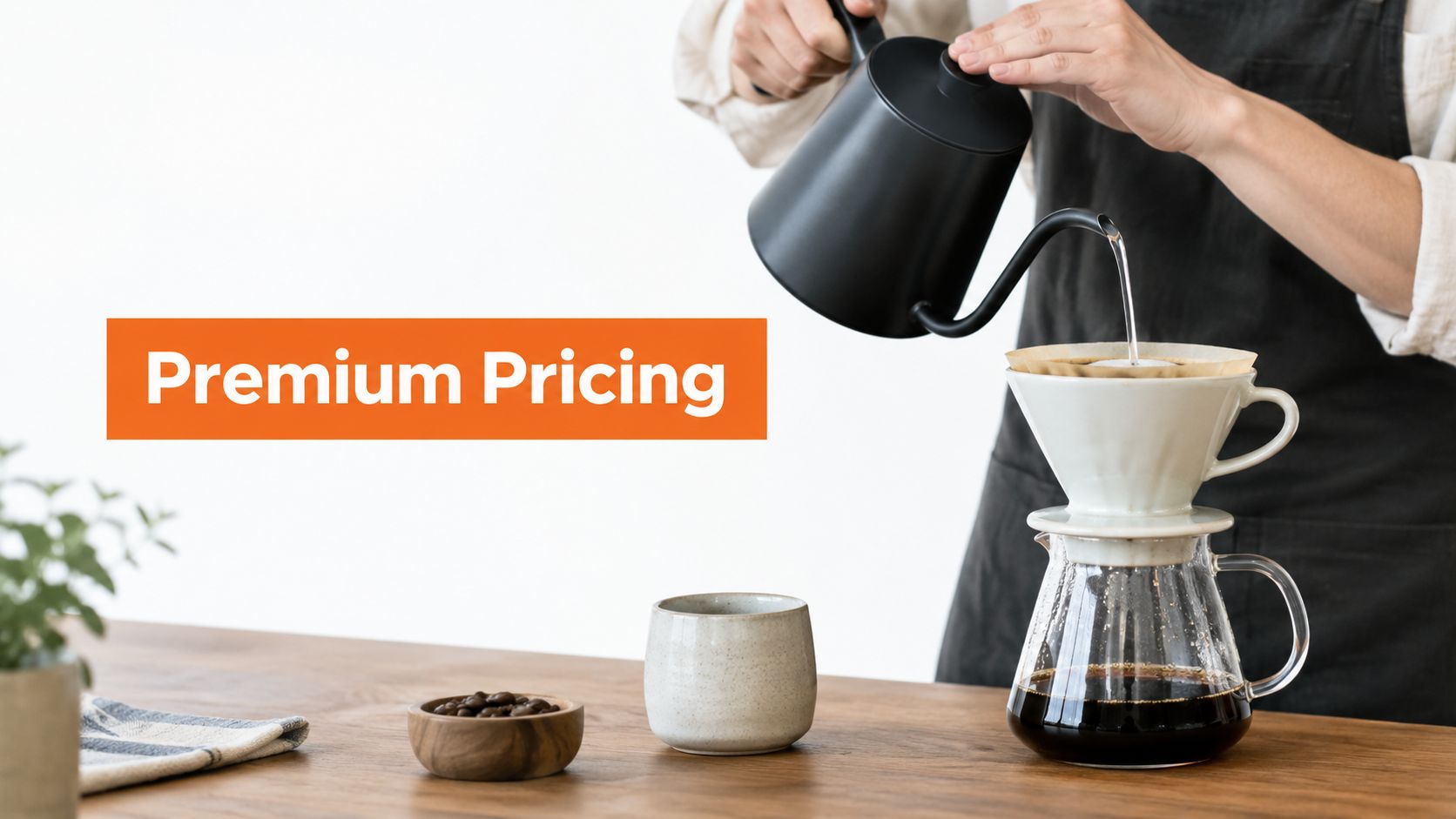
    Picture two coffee shops on the same block. One sells a generic cup for $1. The other offers a "hand-poured single-origin roast" for $6. They both technically sell coffee, but the $6 shop sells a completely different story—one about craftsmanship, quality, and a unique experience. That's the essence of premium pricing.

    The Power of Perceived Value

    At its heart, this strategy taps into a simple piece of human psychology: we often believe that a higher price means higher quality. You aren't just selling an item; you're selling a promise. A promise that your product delivers on at least one of these fronts:

    • Superior Performance: It just plain works better, solves the problem more effectively, or lasts a whole lot longer.
    • Exclusive Status: Owning your product makes you feel like you're part of a special group. It's a badge of honor.
    • An Exceptional Experience: From the moment you see the packaging to the follow-up email I send, every interaction makes you feel seen and valued.

    The goal isn't to be the cheapest option available. The goal is to be the only option your ideal customer would ever consider.

    This isn't some niche strategy; it’s what the world’s leading brands are built on. Just look at Apple. In a recent year, their iPhone lineup—priced 20-50% higher than comparable Android phones—pulled in over $200 billion in revenue. That was more than half the company's entire income, all because people gladly pay more for what they perceive as top-tier innovation and brand prestige.

    To dig into this a bit more, you can get more details on how premium pricing works for these massive brands from a high-level perspective.

    Ultimately, premium pricing is what frees you up to build a truly great business. It gives you fatter profit margins, which you can then pour back into making your product even better and creating an amazing customer experience. This creates a powerful upward spiral. Instead of a race to the bottom, it's a climb to the top. To see how other brands have pulled this off, check out our guide on compelling examples of prestige pricing.

    The Psychology Behind Why You Pay More

    Ever wonder why you'd gladly drop $1,000 on a new phone when a $300 model does basically the same thing? It’s not about logic. Not even close. It’s all about the psychology of what makes a price feel right.

    When you set a premium price, you aren't just pulling a number out of thin air. You're actually tapping into some powerful mental shortcuts that you use every single day. If you can get a handle on these, you can make a higher price feel like a smart investment, not a ripoff.

    The Veblen Effect and Price-Quality Heuristic

    One of the wildest ideas in pricing is the Veblen effect. This is where a higher price actually makes more people want to buy something. It sounds backward, I know. But think of a luxury watch or a high-end sports car—the ridiculous price tag is a huge part of the appeal. It signals status and exclusivity.

    For these kinds of products, the price isn't a barrier; it's a feature. It whispers to you that you're part of an exclusive club.

    Then there’s the price-quality heuristic. Your brain is lazy. It loves shortcuts to make decisions easier. One of the most common shortcuts you use is thinking, "if it costs more, it must be better."

    This is your brain's go-to move for figuring out value on the fly. A higher price tag can do the selling for you, signaling top-notch materials, better craftsmanship, or a more dependable result, all without you having to say a word.

    This flowchart breaks down how these ideas work together to build that premium feeling.

    Flowchart illustrating the Premium Pricing Strategy: Superior Quality justifies Premium Pricing, which drives a Higher Price resulting in increased value.

    You can see it right there: you start with real quality, which lets you justify a premium price. That high price then reinforces the idea that what you're selling is incredibly valuable. It’s a loop that feeds itself.

    Aligning Price With Perceived Value

    Now, this isn't about fooling you. Using these psychological triggers only works if you actually deliver the goods. Your product, your story, and your customer service have to be so good that the high price feels completely fair and justified.

    My job is to line up my price with the value I provide so perfectly that you feel smart for choosing me. For any founder trying to nail this, checking out some brand positioning with real-world examples is a great way to see how it’s done.

    Ultimately, I want you to be proud you bought from me. That's when I know I've got it right.

    Is Premium Pricing Right for Your Brand?

    Deciding to slap a premium price on your product isn't a move you can make on a whim. Seriously. Forcing it when your brand isn't ready is a quick way to crash and burn. So, how do you know if you're actually ready? Let’s get real for a minute.

    Think of your brand like a house I'm building. I wouldn't put a beautiful, expensive roof on a shaky foundation and just hope it holds. It won’t. Premium pricing is that roof, and your unique value is the foundation. It's not optional.

    Assessing Your Brand's Foundation

    Before you even dream of raising your prices, you have to be brutally honest with yourself about what you’re selling. Do you have a real, undeniable edge over everyone else?

    Can you look at your brand and confidently say you have at least one of these?

    • A Genuinely Superior Product: Does your stuff solve a problem way better, last a lot longer, or use materials your competitors can only dream of? For instance, Spotify recently gave its Premium users Lossless audio at up to 24-bit/44.1 kHz FLAC quality. That's a clear, measurable upgrade that makes the subscription feel worth it compared to the free version.
    • An Unbeatable Customer Experience: Is your service so good that you feel like royalty? This can be anything from hyper-personal support to packaging that makes the unboxing feel like a special event.
    • A Unique and Compelling Story: Does your brand have a mission or a founder story that you can connect with? You don't just buy products; you buy into stories and what a brand stands for.

    A premium price tag is a promise. If I can’t back that promise up with real, undeniable value, you won’t just be disappointed—you’ll feel like I lied to you. This is how I lose your trust, and I lose it fast.

    Checklist for a Premium Position

    If you're still on the fence, run through this quick gut-check. You need a clear "hell yes" for each one.

    1. Audience Alignment: Is there a real group of people out there who are actively looking for—and willing to pay more for—the quality or status you’re offering?
    2. Market Differentiation: Are you obviously different from the cheap alternatives? Can you explain why that difference actually matters to your customer? If you're stuck on this, our guide on how to price a new product can help you get some clarity.
    3. Brand Consistency: Does every single thing you see—from my website to my social media—scream "quality"?

    If you can't confidently check all these boxes, it’s not the right time. Go back and work on your foundation. Get that solid first.

    Real-World Examples of Winning Premium Strategies

    A sophisticated chronograph watch with a black dial and leather strap displayed on a wooden stand.

    Talking about pricing strategy is one thing. Seeing how other founders pull it off—the real war stories—is where you actually learn something useful. If you want to define premium pricing with action, you need to study the masters. And I'm not just talking about the obvious luxury giants; I'm talking about the playbooks you can actually rip off and use yourself.

    Let's look at a classic. Rolex didn't just get lucky and become a status symbol. They engineered it, brick by brick, for over a hundred years. Their entire empire is built on two simple pillars: being the best and making you wait for it.

    The Rolex Playbook of Scarcity and Quality

    From day one, Rolex tied its name to performance in places where failure wasn't an option. They developed the first real waterproof watch, the "Oyster," way back in 1926. They weren't just selling to rich guys; they were selling to rich adventurers who needed a tool that wouldn't die on them.

    They didn't just make a better watch—they created a whole new standard of what a watch could be.

    This is the OG premium pricing strategy. Since the 1920s, Rolex has priced its watches 10 to 20 times higher than other solid mechanical watches. By 2026, the average price tag shot past $10,000, and they keep production insanely tight at just 1.2 million watches a year. This isn't bad planning; it's a deliberate move. It creates a feeding frenzy where watches can resell for 50-100% more than you paid at the store. You can dig into the data behind this strategy and its modern impacts.

    The Rolex lesson is powerful: become the absolute best at something your customer actually cares about. Then, don't be afraid to make it scarce. Scarcity backed by real, undeniable quality is one of the most powerful things in business.

    The Modern E-Commerce Storyteller

    But listen, you don't need a century of history to make this work. I've watched modern e-commerce founders—people just like you—use this exact same thinking to build seven-figure brands from their laptops. I know one founder who sells a simple product, but she wraps it in a story that’s impossible for you to ignore.

    Her "About Us" page isn't some corporate garbage. It's a raw, personal story about why she had to start her company, the problem that kept her up at night, and the absolute nightmare she went through to find the right materials. This story does two things perfectly:

    • It builds a real connection: You aren't just buying a thing; you're buying a piece of her mission. You're rooting for her.
    • It makes the price a non-issue: Once you read about her struggle and commitment to doing things the right way, the higher price just clicks. It feels fair.

    That premium price tag is what allows her to keep using the best ingredients and offer incredible customer service, which just keeps proving her brand's worth. Her story isn't some marketing tactic they teach in business school; it's the entire foundation of her business. And that's a playbook you can start writing today.

    Your Step-by-Step Guide to Implementing Premium Pricing

    Flat lay of a desk with a laptop, documents, a plant, and a prominent 'PRICING ROADMAP' banner.

    Okay, enough theory. Let's get our hands dirty.

    A word of warning: slapping a high price tag on your product is not a premium strategy. It’s a recipe for disaster. Going premium is a total commitment that touches every single part of your business.

    To make this feel less like climbing a mountain, I’ve broken it down into a simple, four-step roadmap. Follow this, and you'll be able to confidently define premium pricing for your own brand.

    Step 1: Solidify Your Unique Position

    First things first: you have to know, without a shadow of a doubt, why you deserve to charge more. This can’t be a vague feeling or a guess. It has to be a concrete, undeniable advantage.

    Your job here is to get brutally honest about your unique selling proposition (USP).

    Ask yourself: what is the one thing I do better than anyone else in my space? Is it my insane material quality? My one-of-a-kind origin story? My fanatical customer service? Nail it down and write it in a single, clear sentence. This sentence is now your north star. Every decision from here on out gets measured against it.

    Step 2: Signal Value at Every Single Touchpoint

    A premium price tag creates an expectation. If you charge like a luxury brand but your website looks like it was built in 2005, you’ve got a problem. That disconnect shatters trust instantly.

    Premium is not just a price point; it's a promise that is either kept or broken at every single interaction you have with my brand.

    It’s time for me to do a brand audit. I look at every customer-facing asset with fresh, critical eyes and ask if it whispers "quality."

    • Website Design: Is my site clean, professional, and dead simple for you to use? Or is it a cluttered mess that looks dated?
    • Product Photography: Are my images sharp, beautifully lit, and aspirational? Do they make you need my product?
    • Packaging: Is the unboxing experience something special? Or am I just stuffing my product in a cheap poly mailer and calling it a day?
    • Customer Communication: Are my emails and DMs to you personal and thoughtful? Or do they sound like they were spat out by a bored robot?

    Every little detail sends a signal. Even something as small as your app icons can communicate a shift. Microsoft recently did this by updating its classic icons to reflect the integration of its AI, Copilot. It was a subtle change that immediately made the whole suite feel more modern and connected.

    To help you with your own audit, I've put together a checklist. Run through this and be honest with yourself about where you're dropping the ball.

    Your Premium Value Signals Checklist

    Use this checklist to ensure every aspect of your brand consistently communicates the premium quality your price reflects.

    Brand Element Action Item Why It Matters
    Website & UX Audit your site for speed, mobile-friendliness, and a clean, modern aesthetic. A slow, clunky site screams "amateur." A premium experience must be seamless for you.
    Visuals Invest in professional product photography and consistent brand creative. You buy with your eyes first. Your images must look as valuable as your product.
    Packaging Design an unboxing experience that feels like a gift, not just a delivery. Your physical interaction with the brand starts here. Make it memorable.
    Copy & Tone Refine your brand voice to be confident, clear, and expert-led. Your words need to match your price. No wishy-washy language.
    Customer Service Map your customer support flow. Is it fast, personal, and helpful for you? Poor service will torpedo a premium reputation faster than anything else.
    Social Proof Feature high-quality testimonials, reviews, and user-generated content prominently. Let other happy customers justify the price for you. It’s powerful.

    Fixing these weak spots isn't just about looking good—it's about building the deep trust required to make you feel great about paying my premium price.

    Step 3: Craft Your Premium Offer

    Now we get to what you actually buy. A premium offer should feel like a complete solution, not just an isolated product. This is your chance to bundle in so much value that the higher price feels like a steal.

    Instead of just selling you a thing, I think about what I can wrap around it.

    1. Exclusive Access: Maybe a private community for you or early access to new drops.
    2. Personalized Support: A 1-on-1 onboarding call or a dedicated, priority support line for you.
    3. Enhanced Features: Higher limits, better performance, or pro-level tools that free or basic users can't touch.

    Look at how Microsoft structured its Microsoft 365 Premium tier. They didn't just add one little feature. They bundled their most powerful AI, the highest usage limits, and exclusive access to new tools into one beefy package for a single monthly price. It makes the value proposition crystal clear and the upgrade a no-brainer for their target users.

    Alright, let's get down to the brass tacks: the money. The biggest reason for you to even think about premium pricing is the massive, direct hit of cash to your bottom line. This is about building a business that’s healthier and can actually last, not just one that looks fancy.

    When you price with real confidence, you’re not just crossing your fingers. You’re setting up your business to win financially.

    Fill Your Tank with Higher Margins

    Think of your profit margin as the gas in your company’s engine. A low-price strategy might keep you sputtering along, but you’re basically running on fumes. Premium pricing is like filling up the tank. Brands that get this right often pull in gross margins of 40-60%, while their competitors are just scraping by at 20-30%.

    That extra cash isn't just for you to take home—it’s your war chest for growth. It's the money you pour back into the business to:

    • Make your product even better: You can afford better materials, more R&D, and new features that keep you miles ahead of everyone else.
    • Actually market your brand: Run the big campaigns you've been dreaming of, create killer content, and finally reach the right people.
    • Create an insane customer experience: Build a support team that people rave about and create those "wow" moments that turn you from a one-time buyer into a lifelong fan.

    This isn't just some theory I cooked up. The numbers don't lie. One study on new e-commerce brands found that the ones with premium prices grow 2.5x faster and see a 25% bump in customer lifetime value. If you want to dig deeper, you can read more on why premium pricing delivers such outsized profits.

    Higher margins create a flywheel that’s almost unstoppable. You make more money, which lets you invest in better quality, which in turn justifies your higher price. It’s the secret sauce for how great brands stay great.

    This whole approach flips your business model on its head. You stop chasing volume and start focusing on value. Sure, you might sell fewer items than the discount shop down the street. But each sale is so much more profitable that your business ends up stronger, tougher, and way more rewarding for you to run for the long haul.

    The Big Questions About Premium Pricing

    You’ve got questions about making premium pricing work in the real world. I’ve got answers, pulled from hundreds of honest conversations I've had with founders figuring this out. These are the questions that always come up when we start talking about going premium.

    How Do I Justify a Higher Price Without Looking Greedy?

    You have to get obsessed with value. Forget about your costs. This is a small mental shift I want you to make, but it changes everything.

    Stop saying things like, "It costs more because the materials are expensive." That’s your problem, not your customer's.

    Instead, flip it so it’s all about them: "We chose these specific materials so this will last you twice as long and work perfectly every single time." Your reason for a higher price must always, always be about the benefit they get.

    Can a Small or New Brand Really Use Premium Pricing?

    Absolutely. In fact, it's way easier for a new brand like yours to start out premium than it is for an old budget brand to suddenly jack up its prices. Your newness is a blank slate.

    You don’t have to undo years of customers seeing you as the "cheap option." You get to set the expectation from your very first sale.

    This is your chance. Come out of the gate with a powerful story, undeniable quality, and a point of view nobody else has. That's how you build a premium brand from day one.

    What if My Competitors Are All Cheaper?

    That is fantastic news. I'm serious.

    If everyone else is in a race to the bottom, they’ve left a massive, wide-open field for you at the top. You get to stand out by competing on value, not price.

    Your job isn't to convert their price-obsessed customers. Your job is to find a totally different type of customer—one who is actively looking for better quality, a better experience, or the status your brand provides. Let your competitors fight over the scraps while you build a loyal, profitable following that actually loves what you do.


    If you're a Chicago or Midwest founder building a brand and value real talk over networking, Chicago Brandstarters is your community. We skip the trial-and-error by sharing honest war stories and creating durable friendships. Learn more and join our free community at https://www.chicagobrandstarters.com.

  • 8 Powerful Examples of Prestige Pricing You Can Steal in 2026

    8 Powerful Examples of Prestige Pricing You Can Steal in 2026

    I get it. You've poured your heart into creating something amazing, and you know it’s worth more. But how do you convince your customers to see that same value? It’s not about just slapping a high price tag on your product; it's about making people want to pay it.

    Think of it like a Michelin-star restaurant. You aren't just paying for the food. You're paying for the story, the chef's expertise, the ambiance, and the feeling of being somewhere special. That is the core of prestige pricing. It's the art of building a brand so desirable that the price becomes a feature, not a bug, signaling quality and exclusivity. The high cost is part of the appeal.

    In this breakdown, I'm going to walk you through real-world examples of prestige pricing from brands that have mastered this strategy. I'll dissect exactly how companies like Apple, Hermès, and even specialized coffee brands command premium prices. We'll look at the psychology behind their tactics and pull out actionable lessons you can apply to your own business, even if you're just starting out. You will learn not just what they did, but how you can do it, too.

    1. Apple Premium Product Ecosystem

    Apple offers one of the most compelling examples of prestige pricing by turning technology into a status symbol. Instead of just selling you a phone or a computer, Apple sells you an identity built on design, innovation, and perceived quality. They command prices often 2-3x higher than competitors with similar specs, yet they maintain an iron grip on market share and your loyalty.

    A flat lay of various tech devices including smartwatches, a smartphone, and a laptop with text 'PREMIUM ECOSYSTEM'.

    Their strategy hinges on an interconnected ecosystem where each product works seamlessly with the others. This creates high switching costs; leaving their "walled garden" means giving up the convenience of iMessage, AirDrop, and iCloud syncing. It’s a brilliant way to justify a premium.

    Strategic Breakdown

    • Price Point: The iPhone 15 Pro Max starts at $1,199, while comparable Android flagships often sit in the $700-$900 range. Similarly, the MacBook Air starts around $1,199, a price where you could get a Windows laptop with more powerful internal hardware.
    • Positioning Cues: Apple uses minimalist design, premium materials (like titanium), an exclusive retail experience, and aspirational marketing to signal superior value. Unboxing an Apple product is an event in itself.
    • Why It Works: Apple taps into our desire for status and simplicity. Owning Apple products signals that you value design and are willing to pay for a premium, hassle-free experience. The ecosystem lock-in makes each purchase a deeper investment into their world.

    Key Insight: Prestige pricing isn't just about the product; it's about the entire experience and the brand story you buy into. Apple's brand is so powerful that it justifies the price tag in your mind, regardless of specs.

    Actionable Takeaways for Founders

    1. Build Your Walled Garden: Create products or services that work better together. This increases the value for your customers who own multiple items and makes it harder for them to leave.
    2. Invest in Visible Differentiators: Focus on design, user experience, and packaging. These are tangible cues that immediately communicate quality and justify a higher price.
    3. Master Your Brand Story: Don't just sell features. Sell a vision, a lifestyle, or a commitment to craftsmanship. This emotional connection is what truly supports premium pricing.

    If you are developing your own approach, understanding your product's unique value is crucial for setting the right price from the start. You can explore more on this by reviewing a detailed guide on the pricing strategy for new products to build a solid foundation.

    2. Luxury Fashion Brands (LVMH, Hermès, Gucci)

    Luxury fashion houses give us classic examples of prestige pricing, mastering the art of selling a story, not just a product. When you buy a Gucci handbag or an Hermès scarf, you aren't just paying for leather and silk. You are buying into decades of heritage, perceived exclusivity, and a powerful status symbol. These brands price their goods at 5-10x multiples of mass-market alternatives, successfully disconnecting price from production cost.

    A beige leather handbag and olive fabric on a white display stand at an exhibition with a 'HERITAGE CRAFT' sign.

    The strategy relies on creating artificial scarcity and immense desire. By limiting production, instituting multi-year waitlists, and cultivating an aura of unattainability, these brands make their products Veblen goods: demand actually increases as the price goes up.

    Strategic Breakdown

    • Price Point: An Hermès Birkin bag can range from $10,000 to over $300,000, with a production cost I've seen estimated around $800. A Gucci handbag costs $2,000, while a functionally similar unbranded leather bag might cost you just $300.
    • Positioning Cues: These brands use heritage storytelling, iconic designers, opulent flagship stores, and highly selective influencer marketing. The experience of shopping in their boutiques is as much a part of the product as the item itself.
    • Why It Works: Luxury fashion taps directly into our psychological need for status, belonging, and self-expression. Owning one of these items signals success and taste to the world, making the high price a key feature, not a bug.

    Key Insight: For luxury brands, the price is the marketing. A high price reinforces the perception of exclusivity and superior quality, creating a virtuous cycle where the cost itself drives desire.

    Actionable Takeaways for Founders

    1. Manufacture Scarcity: Even if you can produce more, consider using limited edition "drops," waitlists, or exclusive collections. This transforms a purchase from a simple transaction into a rewarding achievement.
    2. Invest in the Experience: Create a signature unboxing ritual, offer exceptional customer service, and design a retail environment (physical or digital) that makes your customers feel special. The purchase journey should reinforce the premium price.
    3. Build Your Legend: Consistently tell your brand's story of craftsmanship, origin, or unique mission. This narrative is what separates a premium product from a commodity. Exploring successful brand positioning examples can give you a clearer roadmap for building your own legacy.

    3. Premium Coffee and Specialty Beverage Brands (Starbucks Reserve, Blue Bottle)

    Premium coffee brands provide stellar examples of prestige pricing by elevating a daily commodity into an artisanal experience. Instead of just selling caffeine, brands like Starbucks Reserve and Blue Bottle sell you a story of origin, craftsmanship, and a sophisticated taste profile. They successfully command prices 3-5x higher than standard coffee by transforming the act of drinking coffee into a sensory ritual.

    A barista pours coffee from a gooseneck kettle into a pour-over dripper next to a 'Specialty Coffee' bag.

    The strategy is rooted in creating perceived value far beyond the raw ingredients. It’s about the meticulous pour-over technique, the single-origin beans from a specific micro-lot in Ethiopia, and the minimalist, almost lab-like cafes that signal this isn't just your regular cup of joe. You are paying for the expertise, the story, and the elevated environment.

    Strategic Breakdown

    • Price Point: A pour-over at a Starbucks Reserve Roastery can cost you $7-$12, while a standard Pike Place roast is under $3. Blue Bottle charges a similar $7-$8 for a single-origin pour-over, a stark contrast to a $2 Dunkin' coffee.
    • Positioning Cues: These brands use origin storytelling, sustainable sourcing narratives, highly trained baristas, and architecturally distinct retail spaces. The brewing process itself becomes a form of theater, reinforcing the product's special status.
    • Why It Works: It taps into your desire for authenticity and affordable luxury. For a few extra dollars, you get to participate in a culture of connoisseurship. The experience feels exclusive, educational, and far more memorable than a quick grab-and-go cup.

    Key Insight: Prestige pricing can turn a commodity into a luxury by wrapping it in a compelling narrative and an elevated experience. The price becomes a reflection of the craftsmanship and story, not just the product.

    Actionable Takeaways for Founders

    1. Tell Authentic Origin Stories: Connect your product to its source. Whether it's coffee beans or handcrafted leather, transparently sharing the "how" and "where" builds a narrative that justifies a premium.
    2. Turn Process into Performance: Showcase the skill and craftsmanship behind your product. This could be a live demonstration, an open-kitchen concept, or detailed content about your manufacturing process, making the invisible value visible.
    3. Design a Premium Environment: Your physical or digital storefront should reflect your price point. Invest in design, atmosphere, and customer service to create an experience that feels as premium as the product you're selling.

    4. High-End Hospitality and Boutique Hotels (Four Seasons, Rosewood)

    High-end hospitality gives us one of the clearest examples of prestige pricing, where the product isn't a physical good but an intangible experience. Brands like Four Seasons and Rosewood don't just sell you a room; they sell you an escape into a world of flawless service, exclusivity, and personalized comfort. They justify nightly rates 3-5x higher than standard hotels by making you feel like a VIP.

    The strategy relies on creating an emotional connection through impeccable service. From remembering your favorite drink to anticipating your needs before you ask, these brands build a reputation that transcends the physical amenities. You’re not just paying for a bed; you’re paying for the feeling of being completely cared for.

    Strategic Breakdown

    • Price Point: A standard room at the Four Seasons might cost you $1,500 per night, while a room at a standard chain hotel in the same city could be $250. This premium is justified entirely by the service and brand promise, not just the location or room size.
    • Positioning Cues: These brands use prime real estate, stunning architecture, world-class spas, Michelin-starred dining, and, most importantly, intensively trained staff who deliver unparalleled personal service. The brand itself becomes a signal of your own status and discerning taste.
    • Why It Works: Luxury hospitality taps into the desire for recognition, comfort, and hassle-free indulgence. The price acts as a filter, ensuring an exclusive environment. You are paying for the guarantee that your experience will be perfect, removing the stress and uncertainty that can come with travel.

    Key Insight: When you're selling an experience, prestige is built on consistency and personalization. The premium price is a promise of perfection, and every touchpoint, from the doorman to the concierge, must reinforce that promise.

    Actionable Takeaways for Founders

    1. Operationalize Empathy: Invest heavily in training your team to not just follow scripts but to anticipate your customer's needs and personalize interactions. A guest history system that tracks preferences is a powerful tool for scaling this.
    2. Create Signature Moments: Develop unique, memorable experiences that customers can't get anywhere else. This could be a private tour, a unique welcome amenity, or a signature scent in your establishment that becomes synonymous with your brand.
    3. Design for the Senses: Go beyond function and focus on aesthetics, ambiance, and comfort. Your physical space is a powerful marketing tool that signals quality and justifies your premium before a customer even interacts with your staff.

    5. Premium Fitness and Wellness (Peloton, Equinox)

    The fitness industry gives us some of the clearest examples of prestige pricing, where brands like Equinox and Peloton sell you transformation and identity, not just a workout. Instead of offering simple gym access, they cultivate an aspirational lifestyle built on community, expert guidance, and exclusivity. They charge prices 5-10x higher than mass-market gyms because they aren't selling you a treadmill; they're selling you membership into an elite club of high-performers.

    This strategy works by turning a commodity (exercise) into a luxury experience. The high price becomes a feature, acting as a barrier to entry that preserves the brand's exclusivity and reinforces its value to you. You're not just paying for a gym; you're investing in a version of yourself that aligns with the brand's affluent, disciplined image.

    Strategic Breakdown

    • Price Point: An Equinox "All-Access" membership can cost you over $300 per month, compared to a Planet Fitness membership at around $10. Similarly, a Peloton Bike+ package starts at over $2,495 plus a $44 monthly subscription, while you can find free workout videos on YouTube.
    • Positioning Cues: These brands use immaculate, beautifully designed facilities, celebrity-like instructors, high-end amenities (like Kiehl's products in Equinox locker rooms), and powerful community-building technology to signal superior status. The message is clear: "It's not a gym. It's a lifestyle."
    • Why It Works: Premium fitness taps into our fundamental desire for self-improvement and belonging. The high cost creates a strong psychological commitment, making you more likely to show up. The community and social proof from being part of an exclusive group provide powerful motivation that a basic gym membership simply cannot replicate.

    Key Insight: When you sell an outcome or an identity instead of a service, you escape commoditization. I've found people will pay a significant premium for a brand that helps them become the person they want to be.

    Actionable Takeaways for Founders

    1. Build Your Gurus: Elevate your experts (instructors, coaches, trainers) into personalities. Create a platform for them to build a following, as this creates a "tribe" of loyal customers who are connected to a person, not just your brand.
    2. Manufacture Exclusivity: Use your pricing and membership structure to create a sense of an "in-group." Offer member-only events, exclusive content, and premium tiers to reinforce the value of being part of the community.
    3. Sell the Transformation, Not the Tool: Frame your marketing around the end result your customer desires. Whether it's confidence, status, or health, focus on the emotional and psychological benefits, not just the physical features of your product or service.

    6. Luxury Automotive Brands (Tesla, Porsche, Lamborghini)

    Luxury car makers give us textbook examples of prestige pricing, selling not just transportation but an identity defined by performance, heritage, and exclusivity. Brands like Porsche and Lamborghini justify enormous price tags through decades of engineering excellence and aspirational branding. More recently, Tesla disrupted this space by blending technological innovation with a similar prestige model, proving that heritage isn't the only path to a premium.

    This strategy allows these companies to command gross margins of 30-40%, double that of mass-market automakers. They achieve this by turning a vehicle into a statement piece, where the price itself is a key feature that signals your success and taste.

    Strategic Breakdown

    • Price Point: A Porsche 911 starts over $114,000, while a Chevrolet Corvette with comparable performance begins around $68,000. A Tesla Model S Plaid can reach $90,000, significantly higher than other electric sedans. The Lamborghini Revuelto sits in an ultra-luxury tier above $600,000.
    • Positioning Cues: These brands use powerful engines, iconic designs, premium materials, and exclusive owner communities to signal superiority. Tesla built its prestige on a narrative of technological disruption and a direct-to-consumer sales model that feels more modern and exclusive to you.
    • Why It Works: Driving a Porsche or Lamborghini is a public display of achievement. Tesla ownership signals your commitment to innovation and sustainability. You are buying into a powerful story and a community, whether it's one of racing heritage or forward-thinking technology.

    Key Insight: Prestige pricing in the auto world is about selling an experience far beyond the drive itself. It leverages emotional triggers like status, performance, and belonging to make the high price feel not just justified, but desirable to you.

    Actionable Takeaways for Founders

    1. Build a Founder Mythos: Associate your brand with a visionary leader or a powerful origin story. Elon Musk's narrative is central to Tesla's brand, much like Ferdinand Porsche's engineering legacy is to his.
    2. Create an Exclusive Community: Offer ownership experiences that money can't buy, like private track days, factory tours, or members-only events. This transforms your customers into loyal brand ambassadors.
    3. Use Scarcity to Your Advantage: Develop limited-edition models or offer extensive customization options. This creates a sense of rarity and allows customers to express their individuality, justifying a higher price tag.

    7. Premium Skincare and Beauty (Estée Lauder, La Mer, SK-II)

    The luxury beauty industry offers some of the clearest examples of prestige pricing, where perceived value and brand story are far more influential than raw ingredients. Brands like La Mer sell moisturizers for over $300 an ounce by crafting an aura of exclusivity, scientific breakthrough, and aspirational results that transcend simple hydration. You aren't just buying a cream; you're buying hope in a jar.

    This strategy relies on turning a commodity into an experience. Through meticulous branding, opulent packaging, and an air of scientific authority, these companies create a psychological justification for prices that are often 10x higher than mass-market products with functionally similar ingredient lists.

    Strategic Breakdown

    • Price Point: La Mer's Crème de la Mer sells for $200 for 1 oz, while a highly-rated drugstore moisturizer from Cetaphil costs you about $15 for 16 oz. SK-II's Facial Treatment Essence is priced around $190, whereas comparable essences are available for $20-30.
    • Positioning Cues: These brands use heritage storytelling (La Mer's "Miracle Broth"), clinical-sounding language, selective retail partnerships (Saks Fifth Avenue, Neiman Marcus), and luxurious, heavy packaging to signal superior efficacy and status.
    • Why It Works: It taps into your psychology and desire for self-care and transformation. The high price itself becomes a feature, implying potency and creating a placebo effect. Using an expensive product feels like a ritual, reinforcing your belief that it must be working.

    Key Insight: In prestige beauty, the story is the active ingredient. The brand narrative, packaging, and retail experience are just as critical as the formula itself in justifying the premium price to you.

    Actionable Takeaways for Founders

    1. Craft Your Founder Narrative: Develop an authentic, compelling story behind your brand or product's discovery. Emotional resonance can be a powerful justification for a premium price point.
    2. Invest in Aspirational Aesthetics: Your packaging and branding must communicate luxury at first glance. Make the unboxing experience worthy of being shared on social media to build organic buzz.
    3. Use Science-Forward Marketing: Frame your product's benefits using language that sounds authoritative and exclusive. You don't need to mislead, but you do need to build a perception of advanced, high-performance formulation.

    8. Premium Direct-to-Consumer Brands (Warby Parker, Glossier, Everlane)

    The rise of direct-to-consumer (DTC) brands gives us a modern twist on examples of prestige pricing by cutting out the middleman to offer "affordable luxury." Brands like Warby Parker, Glossier, and Everlane built their empires by directly managing their brand story, customer experience, and supply chain. They command a premium over mass-market goods while undercutting traditional luxury, creating a powerful value proposition for you if you want quality and transparency without the outrageous markup.

    This strategy hinges on creating a direct, authentic relationship with you, the customer. By controlling the narrative from manufacturing to your front door, these brands build a cult-like following that justifies a price point well above generic alternatives, proving that prestige can be accessible.

    Strategic Breakdown

    • Price Point: Warby Parker's frames typically cost you $95-$155, a fraction of the $300-$600 you might pay at a traditional optometrist but more than a budget online retailer. Similarly, an Everlane cashmere sweater at $150 feels like a steal compared to a $400 department store equivalent, yet it’s far from fast-fashion pricing.
    • Positioning Cues: These brands lean heavily on minimalist aesthetics, transparent pricing models ("Radical Transparency"), and a strong founder-led narrative. They use social media and user-generated content to build a community, making you feel like part of an exclusive, in-the-know club.
    • Why It Works: DTC prestige taps into your desire for authenticity, value, and a direct connection to the brands you support. By making you feel smart for finding a high-quality product at a fair price, they build fierce loyalty and turn you into an advocate.

    Key Insight: Prestige isn't just about being the most expensive option; it's about delivering the highest perceived value. DTC brands win by reframing luxury as a combination of quality, transparency, and a direct-to-you story.

    Actionable Takeaways for Founders

    1. Own Your Narrative: Control your brand story from day one. Use your "About Us" page, social media, and packaging to communicate your mission, values, and what makes your product special. I believe a strong story is a core pillar of your brand.
    2. Build a Community, Not Just a Customer List: Engage directly with your audience through social media, exclusive product drops, and feedback channels. Making your customers feel heard and valued is a powerful way to justify a premium price.
    3. Use Transparency as a Weapon: Break down your costs, explain your sourcing, or show behind-the-scenes content. This honesty builds trust and helps you and your customers understand the true value of what you're buying. This is just one of many examples of product differentiation you can leverage.

    Prestige Pricing: 8-Brand Comparison

    Example 🔄 Implementation Complexity ⚡ Resource Requirements 📊 Expected Outcomes 💡 Ideal Use Cases ⭐ Key Advantages
    Apple Premium Product Ecosystem High — integrated HW/SW, annual refresh cadence Very high — R&D, manufacturing, retail, elite talent Strong market share + high margins (35%+); repeat upgrades Consumer electronics seeking lock‑in and cohesive UX Design excellence, ecosystem lock‑in, pricing power
    Luxury Fashion Brands (LVMH, Hermès, Gucci) Very high — craftsmanship, heritage curation, limited runs Very high — artisans, flagship stores, long brand build Extremely high margins (60–80%); brand value appreciation Heritage goods, status-driven luxury categories Scarcity, resale value, powerful status signaling
    Premium Coffee & Specialty Beverage (Starbucks Reserve, Blue Bottle) Moderate — sourcing, barista expertise, retail design Moderate — supplier partnerships, retail fit‑outs, skilled staff Higher per-unit margins (50–70%); recurring daily purchases Food & beverage with high-frequency consumption Storytelling, recurring revenue, experiential retail
    High‑End Hospitality & Boutique Hotels (Four Seasons, Rosewood) Very high — property build, service systems, personalization Extremely high — real estate, intensive staff training High ADR and margins (40–60%); strong guest LTV Luxury travel, events, experience-driven stays Personalized service, premium ancillary revenue, prestige
    Premium Fitness & Wellness (Peloton, Equinox, Barry's) High — instructor talent, tech integration, community ops High — facilities, instructor pay, platform development High recurring revenue and retention; strong upsell potential Membership/subscription fitness and lifestyle brands Habit formation, community effects, ancillary sales
    Luxury Automotive (Tesla, Porsche, Lamborghini) Very high — advanced engineering, long development cycles Extremely high — R&D, manufacturing, complex supply chains High gross margins (30–40%); strong resale values Performance vehicles, tech‑led mobility, prestige cars Performance narrative, customization, brand mythology
    Premium Skincare & Beauty (Estée Lauder, La Mer, SK‑II) Moderate — formulation, selective distribution, branding High — marketing, packaging, influencer partnerships Very high margins (70–85%); strong emotional attachment Aspirational personal care with social visibility Packaging/unboxing, aspirational branding, expandability
    Premium Direct‑to‑Consumer (Warby Parker, Glossier, Everlane) Moderate — digital ops, CX, supply transparency Moderate — marketing, fulfillment, customer support Good margins (40–60%); fast iteration and loyalty Digital-first brands targeting value-conscious affluent buyers Transparent pricing, direct feedback loops, scalability

    Your Turn: Price With Confidence, Not Arrogance

    We've journeyed through a landscape of premium brands, from the sleek ecosystems of Apple to the handcrafted legacy of Hermès. You've seen how Starbucks Reserve turns a simple cup of coffee into an event and how La Mer bottles exclusivity into a tiny, expensive jar. Each of these diverse examples of prestige pricing tells me the same core story: a high price is not the cause of luxury, but the result of it.

    This strategy is built on a foundation of value, perception, and unwavering commitment. It's a strategic conversation with your customer, one where price becomes a powerful signal of quality, status, and the experience you promise to deliver. It’s not just about slapping a high number on your product; it’s about earning the right to do so.

    Recapping the Core Principles

    Let's distill the lessons from these titans of industry into actionable truths for your own venture:

    • Value is a Trinity: The price you command is a reflection of three things working in harmony: the functional value (it solves a problem well), the emotional value (it makes you feel a certain way), and the symbolic value (it signals something about you to the world). Neglect any one of these, and your pricing strategy will feel hollow.
    • Experience is the Product: For Peloton, the bike is just the entry ticket; the real product is the community and the feeling of accomplishment. For the Four Seasons, a room is just a place to sleep; the true offering is flawless, anticipatory service. You are not just selling a thing; you are selling an experience wrapped around that thing.
    • Scarcity Creates Desire: Whether it’s a limited-edition Porsche, a seasonal Starbucks brew, or an appointment-only boutique, creating controlled scarcity is the fastest way to amplify desire. What you hold back is often as powerful as what you offer. This is a fundamental lesson I see in nearly all successful examples of prestige pricing.

    Building Your Pricing Foundation

    So, what's your next move? It's not about picking a number out of thin air. It's about building a brand that can justify the price you want to charge. Start by asking yourself the tough questions. What unique story are you telling? How are you obsessing over the details that your competitors ignore? What community are you building around your work?

    Your price is a direct reflection of the confidence you have in your own creation. It’s a testament to your hard work, your vision, and the value you bring to your customers. Don't fall into the trap of pricing based on fear or what everyone else is doing. You should price based on the brand you are building and the promise you are making. Honor your work with a price that reflects its true worth.


    If you're a founder in Chicago wrestling with these exact questions, you don't have to do it alone. At Chicago Brandstarters, we bring together kind, hardworking builders to share these challenges and help each other build brands that can command the price they deserve. Join a community that understands the journey: Chicago Brandstarters.