You've got the product idea. Maybe you've got a Shopify draft, a logo you kind of like, and a friend who already said, “You should just launch.”
Then somebody asks, “Did you get your business license yet?”
That's when the mood changes.
I've seen smart founders freeze right there. They can source packaging, build a landing page, and talk to suppliers, but the phrase business license requirements hits like a wall of forms, clerks, and weird government websites from 2009. It feels like you need a law degree just to sell candles, hot sauce, vintage tees, or a few boxes of cold brew at a weekend market.
You don't.
You do need a system. And you need to stop treating licensing like one giant mystery. It's more like assembling IKEA furniture. Annoying, yes. Impossible, no. You follow the order, use the right parts, and don't skip the boring steps because you're “pretty sure it's fine.”
Most founders get in trouble for one simple reason. They handle the fun stuff first and the legal stuff last. That's backwards. If you want to build a real business, get legal early. It saves money, saves stress, and keeps you from learning the hard way when a city inspector, event organizer, bank, or tax agency asks for paperwork you don't have.
That "Oh Crap" Moment with Business Paperwork
A founder in Chicago once told me she had everything lined up for a small launch. Product ready. Labels printed. Friends ready to buy. She'd even booked a booth for a local market. Then the organizer sent a short email asking for her license and permit documents.
That email ruined her afternoon.
She'd registered a name on Instagram and thought that counted as “starting a business.” It doesn't. A cool brand name is not legal permission to operate. A logo is not compliance. Your LLC filing alone doesn't mean you can open your doors, sell at an event, or collect tax.
Why this feels worse than it is
The reason this stuff feels so heavy is simple. In the United States, more than 30,000 government entities can issue licenses, permits, and registrations a business may need to operate legally, according to Avalara's licensing overview. That's why founders feel like they're walking into a maze with no map.
And the maze changes by city, county, state, and industry.
A restaurant has one path. An online apparel brand has another. A booth at a weekend market has another. A mobile service business crossing suburb lines has another. You're not confused because you're bad at business. You're confused because the system is fragmented by design.
Practical rule: Don't ask, “Do I need a business license?” Ask, “Which agencies care about what I sell, where I sell it, and where I physically operate?”
That question gets you somewhere.
The fix is smaller than you think
You don't need to solve all of compliance in one night. You need to answer a few basic questions in the right order:
- What is my business entity?
- Do I have an EIN?
- Where am I physically operating?
- Do I sell taxable goods or services?
- Am I in a regulated category like food or alcohol?
- Am I selling temporarily at events or across multiple towns?
Once you answer those, the fog clears fast. The rest is paperwork, deadlines, and follow-up. Annoying, yes. But manageable.
The Four Layers of Government Licensing
Business license requirements make more sense when you stop thinking about “the government” as one thing. It's not one thing. It's a layer cake. Each layer has its own job, its own forms, and its own way to waste your Tuesday.
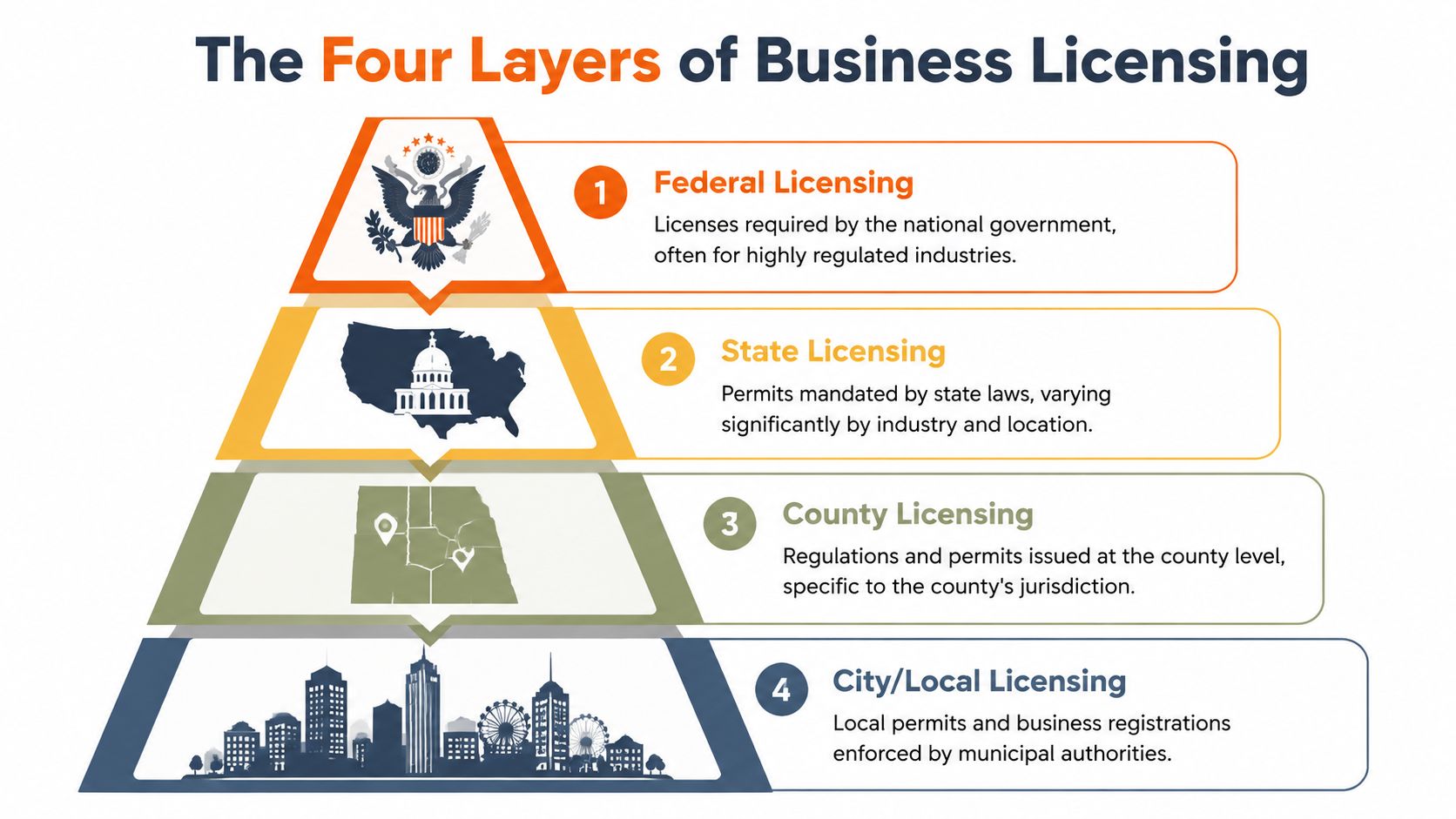
Federal is the top layer
Most founders obsess over federal paperwork more than they need to. The federal government usually doesn't care about your normal small business unless you're in a tightly regulated area.
If you sell alcohol, broadcast to the public, or handle firearms, federal licenses can be mandatory, and Stripe's guide on U.S. business licenses notes that alcohol businesses must deal with the Alcohol and Tobacco Tax and Trade Bureau before local or state approval. If you run a normal consulting shop, apparel brand, or design studio, federal licensing usually isn't your main issue.
Think of federal licensing like airport security for special-risk businesses. Many businesses walk past that gate because it doesn't apply to them.
State handles entity and tax-related filings
Your state is where your business starts to become real on paper. There you register the entity and often deal with sales tax obligations if you sell taxable goods or services.
If you sell taxable goods or services in a state with sales tax, you need a sales tax license, also called a seller's permit, so you can legally collect that tax, as explained by the U.S. Chamber's permit guide. For product sellers, this one matters a lot. If you collect tax without the permit, you're playing with fire.
County has its own lane
County rules trip up founders because they sit in the awkward middle. You might have a city address, an unincorporated location, or operations that touch county-level filings like DBA statements, health matters, or land-use rules.
Counties are like the middle manager you forgot was in the approval chain. Ignore them and the whole process can stall.
City or local is usually where the real permission lives
This is the layer most early founders miss. In the majority of cases, the city or county where your business is physically established is the place that requires the general business license, according to Mosey's explanation of local licensing. That local filing is often the thing that gives you permission to operate.
If you've got state paperwork but skipped the city license, you may still be operating illegally.
That's why two founders doing the same thing can need different paperwork just because one is in Chicago and the other is one suburb over.
The simple way to think about it
Here's the practical model I use:
| Layer | What it usually cares about |
|---|---|
| Federal | Special regulated activities |
| State | Entity registration and sales tax permissions |
| County | Location-specific filings and some local oversight |
| City | General permission to operate where you are |
If you remember one thing, remember this. Your LLC is not your business license. Your EIN is not your business license. Your seller's permit is not your business license. They're separate pieces.
Your Practical Checklist to Get Legal
Stop wandering around government portals and hoping one page magically lists everything. It won't. Use a checklist and move in order.
Start with the foundation
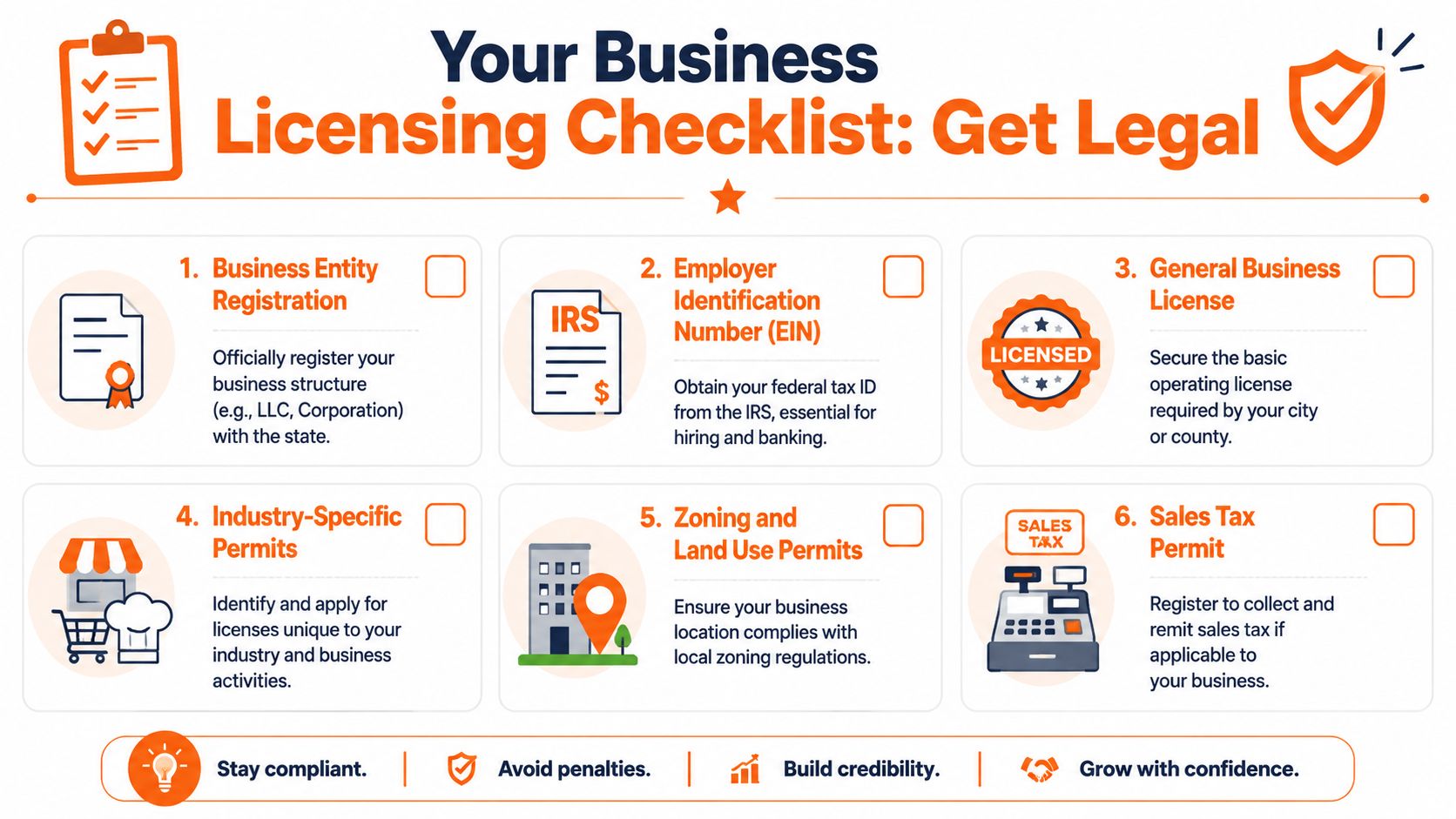
First, register your business entity with your state. Then get your Employer Identification Number, or EIN, from the IRS. Globalfy's business license overview is clear on this point. You must register the entity and obtain an EIN before applying for most licenses, and if you hire even one employee, the law requires you to get an EIN.
Your EIN is like a Social Security number for the business. Banks want it. Tax agencies want it. Licensing systems want it.
If you skip this step, everything after it gets harder.
Then run this decision list
Use this in order. Don't jump around.
Register the entity first.
Pick your structure and file it with the state. If you haven't done this, stop here and do that.Get the EIN.
Even if you're small, I'd do this early. If you plan to hire, this is not optional.Figure out your physical operating location.
Home office, shared kitchen, studio, storefront, warehouse, market stall, or no fixed spot. Your location drives local filings.Check for a local general business license.
Your city or county usually handles this piece. Many founders miss it because they assume the state took care of everything.Ask whether you sell taxable goods or services.
If yes, you likely need the state seller's permit or sales tax registration before charging tax.Look for industry permits.
Food, childcare, construction, alcohol, healthcare, and similar categories usually trigger extra approvals.Check zoning and land use.
If you're making products at home, running customers through a residential property, or changing how a space gets used, zoning can become the hidden blocker.
Here's a solid visual if you want a quick reset before you start filing:
Use plain-English if-then logic
I like compliance better when it sounds like code.
- If you hire people, get the EIN.
- If you sell products, check seller's permit rules.
- If you have a location, check city or county license rules.
- If you sell food, alcohol, or regulated services, expect more than one permit.
- If you'll appear at events, ask about temporary vendor permits before you pay for the booth.
- If you move across city lines, assume the rules may change.
Keep one folder with your entity docs, EIN letter, lease or address info, receipts, permit copies, and renewal dates. You want one source of truth, not six random PDFs in your downloads folder.
Don't copy another state blindly
A lot of founders Google their way into bad assumptions. Florida, Illinois, Missouri, and California don't run the same playbook. If you want to compare how another state handles startup setup, this checklist for Florida business setup is useful because it shows how state-specific the sequence can be.
That's the lesson. Generic advice gets you halfway there. Local requirements finish the job.
Permits for E-commerce, Food, and Pop-Ups
A general license is the floor, not the ceiling. Once you get into real-world selling, business license requirements split fast by business model.

E-commerce is simple until tax enters the room
A lot of online founders think “I sell from home” means “I don't need much.” Sometimes that's true for storefront permits. It is not true for tax rules.
If you sell goods or taxable services in a state with sales tax and you're required to collect it, you need the seller's permit. That applies to online and offline sellers with a physical presence or nexus in that state, as covered earlier from the U.S. Chamber source. If you're building an online store, don't stop at permits. Protect the operation too. This guide on business insurance for online store owners is worth reading before your first serious sales push.
Food businesses have extra gates
Food is where founders get humbled fast. Once you touch preparation, storage, handling, sampling, or public sale, more agencies care. Health departments care. Event organizers care. Local governments care. If you're trying to open a food business, this guide for legal restaurant operations is a useful companion because it lays out the permit stack in plain English.
Food is like operating with extra referees on the field. More rules. More inspections. Less room to wing it.
Pop-ups are where generic advice fails
This is the gap that drives me nuts. Most national guides act like every founder has a permanent storefront. That's not how a lot of Chicago and Midwest brands start. They start at farmers markets, weekend events, holiday markets, street fairs, and one-day booths.
And those setups often need different paperwork than a permanent business. Arizona Commerce notes this problem directly. Existing content rarely defines the short-term permits for a 3-day event or weekend booth, like a Temporary Food Permit versus an Event Vendor License, even as the Midwest sees a 25% increase in pop-up markets from 2024 to 2025.
That means one question matters more than founders think:
“What is the exact permit name for this event?”
Ask the organizer that before you pay for the table.
Here's the shortlist I'd verify for any pop-up:
- Temporary vendor approval from the event or local authority
- Food-related temporary permit if you're selling anything edible
- Sales tax setup if you're collecting taxable sales
- Local business registration if the jurisdiction requires it
- Insurance proof if the organizer asks for it
Don't accept vague answers like “you should be fine.” Fine is not a permit.
Applying in Chicago and the Midwest
Chicago founders need to stop using national blog posts as their whole legal strategy. They're fine for orientation. They're weak for execution.
Your actual move is local research, local filing, and local follow-up. If you're in Chicago, start with the city's small business portal and local guidance. This roundup on the City of Chicago small business process is a good starting point because it puts the city-specific path in one place.
Chicago is one thing. The suburbs are another thing.
A founder based in Chicago but delivering, installing, vending, or servicing customers in nearby suburbs can run into a mess fast. At that point, business license requirements stop being theoretical and start costing money.
Nevada Bar material on multi-jurisdiction licensing points out the exact problem that generic guides miss. Businesses operating across border areas may need to file in 3 to 5 jurisdictions simultaneously, with cumulative fees of $45 or more per city and extra compliance lag.
That matters in the Chicago region because suburban boundaries are tight. You can cross municipalities without feeling like you went anywhere.
The Midwest founder trap
Here's the trap. You assume one metro area means one permit set.
Wrong.
If you clean homes, run mobile car detailing, do event vending, install signage, cater events, or provide recurring services across suburb lines, you need to ask each jurisdiction some version of the same question:
- Do I need a local business license to perform work here?
- Do I need a separate vendor registration?
- Do I need a temporary permit for events?
- Do I need local tax registration?
This is boring, but it's cheaper than finding out after you've booked work.
The founder mistake is treating “greater Chicago” like one city. It isn't. It's a patchwork quilt of local rules.
A realistic cost snapshot
The fee picture changes a lot by place and industry. Still, seeing rough examples helps founders budget for the first wave of paperwork.
| Jurisdiction | Initial Fee | Typical Renewal |
|---|---|---|
| Chicago area general business license | $50 to $400 | annual renewal often applies |
| Regulated permit in food, construction, healthcare, alcohol sales, or childcare | $200 to $5,000 or more | renewal requirements vary |
| Cross-suburb local filings for regional operators | $45+ per city in some multi-jurisdiction setups | separate local renewal may apply |
Those ranges come from the verified cost guidance already covered, plus the multi-city filing issue in the earlier source on border-area licensing.
My recommendation for Chicago-area operators
Don't research “all Illinois business licenses.” Research your actual route to market.
If you're opening one location, focus on your city or county first, then state permits tied to what you sell. If you're mobile or regional, make a spreadsheet with every suburb or town you plan to enter. Put contact info, filing type, fee, renewal date, and approval status in one place.
That one spreadsheet can save you from the classic Midwest founder headache. Getting booked in five places and legally cleared in two.
Costs, Renewals, and Staying Out of Trouble
Founders love launch. They hate maintenance. Licensing punishes that attitude.
A license is not a trophy you hang once and forget. It's more like a parking meter. If the time runs out and you ignore it, somebody eventually notices.
Budget for more than the first filing
The money part catches founders off guard because they budget for logo, packaging, rent, and ads, then treat compliance like pocket change. It isn't always pocket change.
Startup Owl's licensing guide says a typical general business license costs $50 to $400, while regulated industries can face extra permits from $200 to $5,000 or more. The same source also warns that failure to renew can lead to fines or criminal charges.
That means your launch budget needs a compliance line item. Not someday. Now.
Renewals are where people get clipped
A lot of founders don't get punished for failing to apply. They get punished for forgetting to renew.
Use a dead-simple system:
- Create one compliance calendar with every filing and renewal date
- Save every receipt and approval PDF in one folder
- Assign one owner for renewals, even if that owner is just you
- Set reminders early so you have time to fix problems
- Update licenses after changes like address, ownership, or business activity
If your books are messy, your renewals usually get messy too. Clean records make this easier. If you're behind, getting help with catchup bookkeeping services can save a lot of scrambling before renewal season.
Don't separate tax from licensing in your head
A lot of early founders put licenses in one mental box and taxes in another. Bad move. They overlap all the time, especially for product brands and online sellers. If that part still feels muddy, this explainer on the taxation of electronic commerce helps connect the dots.
The expensive mistake isn't paying for compliance. The expensive mistake is rebuilding compliance after you've already started selling.
That rebuild usually means backtracking through missing forms, unpaid fees, and rushed explanations to agencies that aren't in a forgiving mood.
You Got This A Final Pep Talk
I know a founder who got her first real traction through local events. She made a food product people loved. The first market went great. The second one did too. Then she got hit with the paperwork problem she should've handled before event one.
She had enthusiasm, hustle, and customers. What she didn't have was the right temporary permit stack.
It rattled her. For a week, she talked like the whole business might be dead. But she fixed it. She filed what she needed, got cleaner about records, and stopped treating compliance like optional admin work for “later.” That business kept moving.
That's the mindset I want you to keep.
You are not dumb because this feels confusing. The system is messy. The websites are messy. The terms are messy. But founders get through it every day by doing the next right thing. File the entity. Get the EIN. Check the local license. Check sales tax. Check industry permits. Check event rules. Track renewals.
Do it one hill at a time.
And if you mess something up, fix it fast. Shame is useless here. Progress wins. The founders who build durable companies are not the ones who never make paperwork mistakes. They're the ones who stop pretending the paperwork will solve itself.
If you want honest advice from people who've wrestled with this stuff while building real companies, join Chicago Brandstarters. It's a free community for kind, bold, hard-working Chicago and Midwest founders who want real conversations, small private dinners, and practical help from operators who don't posture.
Leave a Reply