
Most advice on how to ask for help is weak.
It tells you to “just put yourself out there,” as if the hard part is typing the email. It assumes you already know the right people. It assumes the stakes are low. It assumes the person you ask won't waste your time, sell to you, or size you up for what they can take.
That's not founder reality.
If you're early, solo, pre-revenue, or still carrying your idea around in your head, asking for help can feel like walking into a room without shoes on. You feel exposed. You feel like you should wait until you've earned the right to ask. I think that instinct is wrong. I also think blind optimism is wrong. The move is to ask boldly and protect yourself while you do it.
The Founder Dilemma You Never Talk About
Founders get told to ask for help early. Bad advice. Ask too vaguely, ask the wrong person, or ask from a place of panic, and you train people to see you as needy instead of serious.
The underlying dilemma is sharper than that. Kind founders, especially the ones starting with no network, often hesitate because they can feel the risk. Some people help. Some people extract. Some offer “advice” so they can get close to your idea, your time, or your emotional energy. If you've felt that tension, your instincts are working.
What hurts you is turning that caution into silence.
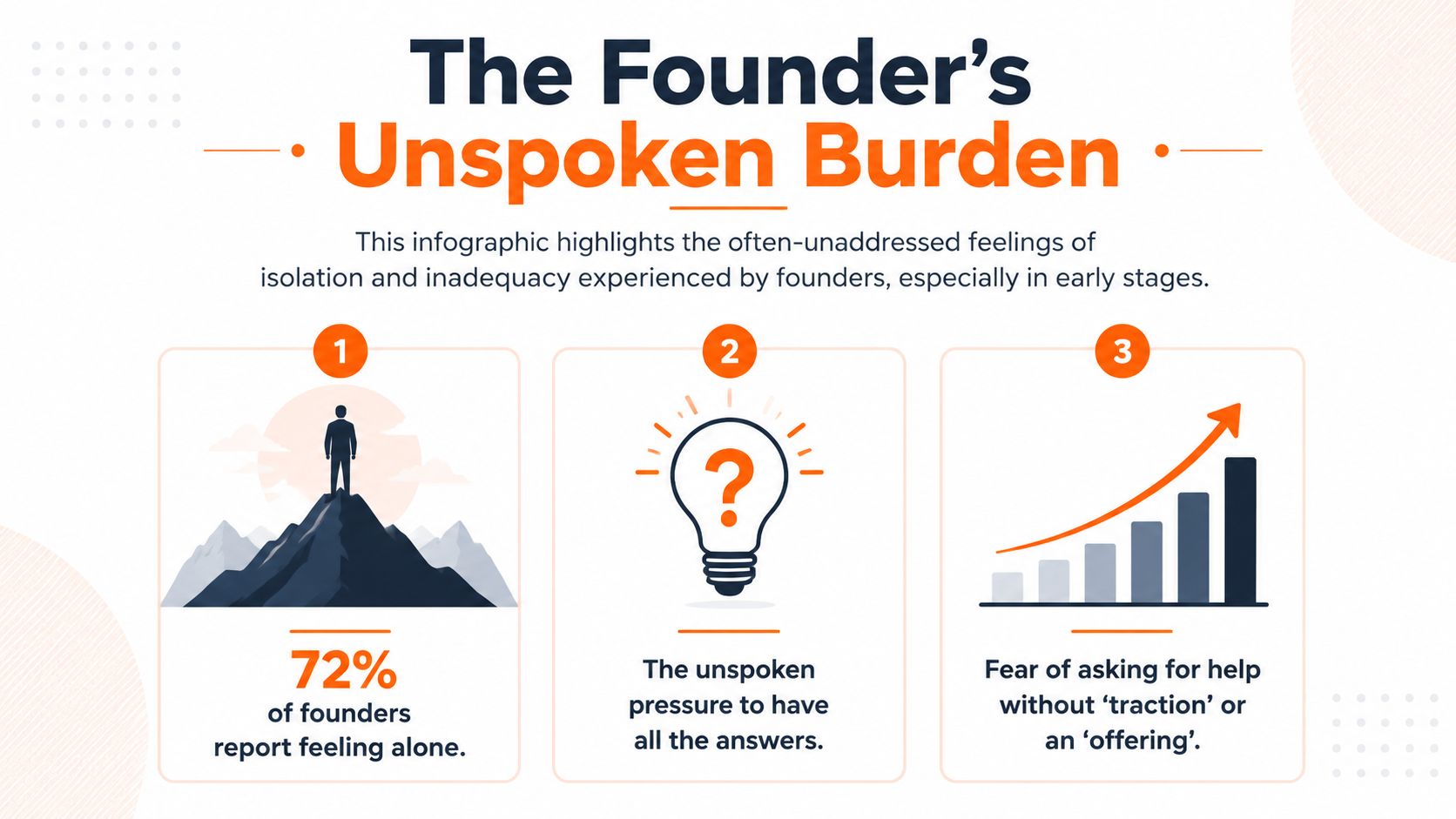
Fear makes you a bad judge
Early founders often assume they need traction, proof, or something to trade before they can ask for a conversation. That belief keeps people isolated long past the point where outside input would help.
Research covered in ReachLink's summary of why asking for help feels difficult points to a consistent problem. People anticipate more rejection than they experience. In one help-seeking study, participants guessed only 48% of others would agree to help, while the observed compliance rate was 84%.
That gap matters.
Your first prediction about how an ask will land is often fear dressed up as strategy. Do not treat it like insight.
Shame looks responsible. It isn't.
A lot of founders call their silence discipline. They say they are waiting until they are more prepared, more polished, more worthy of attention. Usually they are avoiding the discomfort of being seen before the business looks impressive.
That pattern shows up far beyond startups. The Poverty Speaks 2023 survey results found that 58% of respondents felt badly or ashamed when asking for help, and 30% of people who needed assistance did not receive it. Different context, same human problem. Shame does not protect you. It cuts you off from support you could have used.
I've watched founders lose months this way. They needed a supplier referral, a pricing gut check, a warm intro, or ten honest minutes from someone who had already made the mistake they were about to make. They stayed quiet because they did not want to look small.
That is not self-reliance. That is expensive avoidance.
If this lands hard, read this piece on why vulnerability in leadership builds trust instead of weakening authority. The point is simple. You do not need to hide your need for help. You need to ask with judgment.
First Know Exactly What You Need
Most bad asks fail before they reach another person.
They fail when you say, “I'm stuck,” but you can't name the problem. That's like walking into a doctor's office and saying, “I feel weird.” Maybe true. Useless.

Diagnose before you request
Write your problem down in one sentence. Then force it into one of these buckets:
- Information: You need an answer, explanation, or reality check.
- Introduction: You need access to a person, company, or community.
- Feedback: You need someone to react to your pitch deck, landing page, product idea, or offer.
- Skill help: You need real execution help with design, sourcing, legal structure, copy, operations, or tech.
- Decision support: You already know the options. You need help choosing.
If you can't sort your need into one bucket, your ask is still muddy.
Shrink the ask
People say yes more often when the request feels finite.
Compare these two:
“Can you mentor me?”
That's heavy. It sounds open-ended, expensive, and vague.
Now compare it to this:
“Can you spend 15 minutes telling me whether my product positioning is too broad for a first launch?”
That feels answerable.
Use this quick filter before you ask anyone anything:
| Question | Bad ask | Better ask |
|---|---|---|
| What is the problem? | “My business is a mess” | “I can't tell which customer segment to start with” |
| What do you need? | “Any advice helps” | “I need feedback on my homepage message” |
| How much time? | “Whenever you can” | “Ten minutes by voice note or one short call” |
| What outcome? | “Help me grow” | “Help me choose between two launch directions” |
Write the ask in plain language
Use this fill-in-the-blank:
- I'm dealing with
- I need
- By when
- In what format
- Why this matters
Example:
I'm dealing with a pricing problem for a new service. I need a quick opinion on whether my first offer is too cheap or too confusing. If you're open to it, I'd love 15 minutes this week or even a short voice note. I'm trying to launch without spending another month second-guessing.
That works because it sounds like a real person talking. No jargon. No fog.
If you want to learn how to ask for help, start here. Clarity is half the job.
Find Your Helpers Not Your Exploiters
Founders starting from zero get terrible advice here.
A lot of “ask for help” content assumes you already have warm contacts, generous mentors, and a professional setting where people respect boundaries. Early-stage founders, especially generous ones, know better. Some people will help you think. Some will try to get access to your time, ideas, customers, or confidence.

Fear of being used is real
If you hesitate to ask, that does not mean you lack confidence. It often means you've learned the cost of being too open with the wrong person.
A 2025 National Association of Minority Business Owners report found that many minority founders avoid asking for help because they fear being used, as noted in the association's 2025 report. That fear is rational. Kind founders often attract people who confuse generosity with availability.
So use a simple rule.
Ask for proof of judgment before you offer trust.
Screen for behavior, not status
Do not get dazzled by titles, follower counts, or polished “mentor” branding. Watch what people do in a small interaction.
Good helpers usually show a few clear signals:
- They answer the actual question. They do not dodge into a sales pitch.
- They respect the size of the ask. Fifteen minutes stays fifteen minutes.
- They name their limits. Serious operators will tell you when something is outside their lane.
- They reduce confusion. You leave with a clearer next step, not a foggier head.
- They do not manufacture obligation. Help is help. It is not a hook.
Exploiters also follow patterns:
- They push for private details too early. Revenue, roadmap, contacts, passwords to your thinking.
- They create social debt. One tiny favor becomes a long emotional invoice.
- They keep steering toward access. Your audience, your customer list, your calendar.
- They make everything transactional. Even a basic question turns into an offer.
- They enjoy proximity to founders. Your progress matters less than their chance to attach themselves to it.
If you want a clean example of support that gets to the point, the BuddyPro platform help center is useful to study. It solves the stated problem without turning the interaction into a maze.
Test small before you trust big
You do not need to reveal the full story on first contact. In fact, you should not.
Start with a low-cost test. Ask one narrow question. Share one contained problem. See how they respond when there is nothing big for them to gain. That tells you more than any bio ever will.
Use this filter:
- Check their trail. Look at what they've built, how they speak to people, and whether others describe them as generous or extractive.
- Make a small ask first. A quick opinion is enough to test judgment and boundaries.
- Watch for scope creep. Helpful people stay inside the request unless you invite more.
- Notice the aftertaste. You should feel clearer, calmer, and more capable.
If you need help separating a real mentor from a polished taker, read this guide on how to find a business mentor.
Trust grows slowly. Keep it that way.
Craft an Ask They Can't Ignore
Polite but blurry asks get ignored. Clear asks get answered.
Founders who start from zero make the same mistake over and over. They try to sound easygoing so they do not look needy. That instinct costs them. A useful ask is specific, bounded, and simple to answer. The person reading it should know what you want, why it matters, and how much effort you are asking for in under 20 seconds.
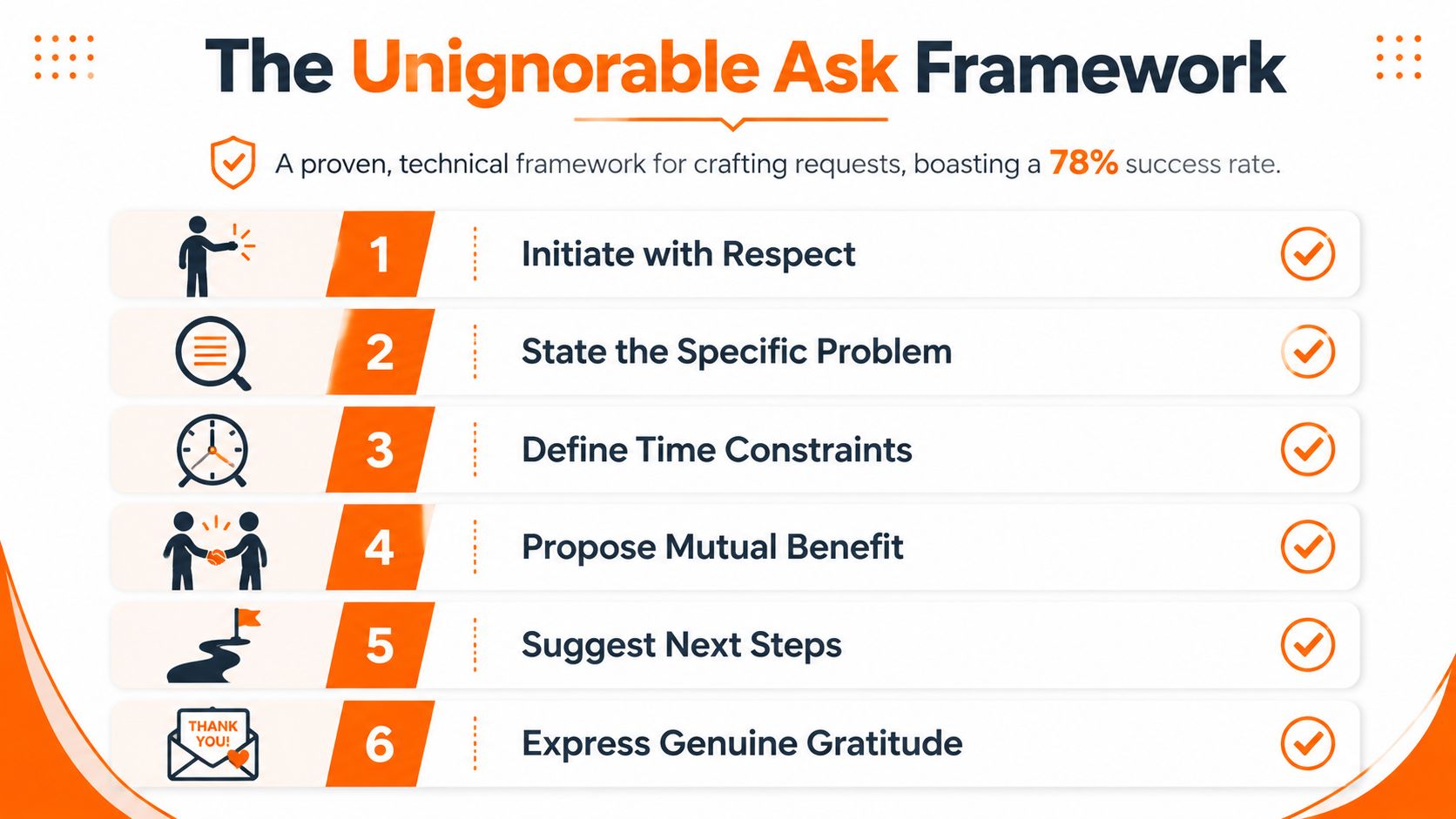
Use this structure:
“I'm dealing with [specific problem]. I'm asking for [specific action]. It matters because [specific consequence or decision].”
That formula works because it removes guesswork. It also protects kind people from being too open-ended. You are not inviting someone into your whole life or company. You are giving them a defined job.
The parts that make an ask work
- Choose the best channel you can reasonably get. Warm, direct communication beats a vague public post. If you already have a real connection, send a direct message or email. If you can ask in person, do it.
- Name one concrete problem. “I need help with fundraising” is lazy. “I need feedback on whether slide 7 explains the market clearly” is usable.
- Set the scope. Say how long this will take, what format works, and what a helpful response looks like.
- Give the reason. People are more likely to help when they understand the decision in front of you.
- Leave room for a smaller yes. A full intro, a quick reply, or one name to look up are different levels of effort. Make those options visible.
- Write for an easy reply. The best ask can be answered with yes, no, or a short redirect.
Do not shrink the request just to appear low-maintenance. If it matters, say that it matters.
Bad:
“Sorry to bother you. This is probably silly, but if you maybe had a second to glance at this whenever, no worries at all.”
Good:
“I'm revising my deck and need a blunt read on whether the problem slide is clear. Would you be open to 10 minutes this week, or two comments by email?”
The second version respects time. It also respects your own work.
A strong ask has four traits. It is brief. It is concrete. It has a boundary. It gives the other person a fair off-ramp. That is how you ask boldly without handing strangers unlimited access to your time, product, or emotional energy.
If you want more reps at making direct, useful asks in real conversations, study these business networking strategies for entrepreneurs.
A short walkthrough can help you hear the difference in tone:
Copy-paste scripts for founders
Use these. Edit the details. Keep the edges sharp.
For an introduction
Hi [Name], I'm trying to speak with someone who owns [specific problem] at [company or type of company]. Would you be willing to introduce me to [specific person or role], or point me to the right title if an intro is too much? I'm validating whether this problem is painful enough to build around.
For pitch deck feedback
Hi [Name], I need a blunt read on slides [X] through [Y]. I'm too close to the story and need to know whether the offer and customer problem are clear. Would you be open to 10 to 15 minutes, or a few direct comments by email?
For a short brainstorm
Hi [Name], I'm deciding between [option A] and [option B] on [specific issue]. I'd value 15 minutes of your perspective because this choice affects my next move. If a call is inconvenient, I can send the question in writing.
Two habits that weaken your ask
Do not apologize for existing.
Do not offer a favor before they have even answered.
“Sorry to bother you” signals that your request is a burden before they have judged it for themselves. “Happy to return the favor” can also backfire, especially when the other person did not ask for a trade and now has to process one more social obligation. Clean requests work better than guilty ones.
You are not asking for rescue. You are making a clear request with a clear limit.
What to Do After You Hit Send
The send button is not the hard part. The hard part is acting like a serious person after the ask leaves your inbox.
Kind founders frequently lose ground at this point. They finally get the courage to ask, then they over-explain, over-send, over-thank, or chase. A good ask can still die in the follow-through.
If they say yes
Reward the yes with discipline.
Reply fast. Send only what they agreed to review. If they offered 15 minutes, give them a tight problem, a small set of materials, and a clear question. Do not turn their generosity into cleanup work.
Example:
“Thanks for saying yes. I attached the three slides I need help with. I'm looking for a blunt read on two things. Is the offer clear, and does the customer problem feel sharp enough?”
That works because it gives them a defined job. Busy people help faster when they know where to aim.
Then do the rare thing. Use the advice. If you ignore it, defend against it, or keep asking the same question without changing anything, you train people not to help you again.
If they say no
Take the no with self-respect.
Do not argue. Do not ask them to justify it. Do not slip into a second pitch after they already declined. That behavior does not signal persistence. It signals that you do not honor boundaries.
Send a short reply and move on.
“Thanks for the clear answer. I appreciate the reply. If someone else comes to mind who knows this problem well, I'd value the pointer.”
That keeps the door open without begging to be let in.
If they say not right now
Treat “maybe later” as neutral. Nothing good comes from pretending it was a yes.
Wait. Then follow up in the same thread with less friction than before. Offer one specific question by email. Offer a short voice note they can answer when convenient. Make the next step smaller, not heavier.
Use this rule: every follow-up should make it easier for them to help, or easier for them to decline.
A lot of founders miss one more point here. You do not need to rush into repayment language. “I owe you” and “I'll make it up to you” can turn a clean interaction into a ledger. Early-stage founders with no network often do this because they are afraid of being seen as takers. Stop. Gratitude is enough in the moment.
The better pattern is simple. Be prepared. Be easy to help. Say thank you. Apply what they gave you. Then send a real update later.
People remember that. It proves you were worth helping.
From Asker to Giver
Asking for help is not a temporary skill for broke, unknown founders. It is part of the job.
Founders who start from zero often treat asking as a phase they need to outgrow. That is backward. The right goal is not to stop asking. The goal is to ask well, build discernment, and then become a person who helps without turning into an easy mark.
That shift matters. Kind founders usually fear two things at once. They fear rejection, and they fear being used once they become generous. So they either stay silent or overgive. Both are expensive.
A better standard is simple. Receive help cleanly. Use it well. Then give from strength, not guilt.
When you do help someone else, copy the behavior you respected when you were the one asking. Be clear about what you can offer. Set limits. Answer the underlying question if you can. Decline fast if you cannot. Do not create fake warmth to soften a no. Honest boundaries are kinder than vague availability.
This is how a real network starts for founders who did not inherit one. One useful ask. One thoughtful reply. One person who follows through. Over time, you stop chasing access and start becoming a trusted node in the room.
The point is not to keep score. The point is to become valuable without becoming depleted.
Ask clearly. Protect your time. Help where you can. Refuse what drains you.
Then earn the kind of reputation that makes good people want to answer when your name shows up again.
If you want a place to practice this with kind, bold founders who tell the truth, join Chicago Brandstarters. It's a free, vetted community for Chicago and Midwest builders who want real conversations, not transactional networking.
Leave a Reply