Most advice on how to launch a brand is backward.
It tells you to get louder, post more, fake confidence, and build a personal brand before you've built any real trust. I think that's bad advice. It trains kind people to act like street performers when what they need is clarity, proof, and a few honest relationships.
I've watched founders burn months on logos, taglines, and content calendars while avoiding the harder work. Talk to real people. Find peers who tell you the truth. Build something small. Launch with intent. Measure what matters. Keep your character intact.
If you want to know how to launch a brand without turning into a self-promoter, start there.
Launching a Brand Is Lonely But It Does Not Have to Be
The lone wolf founder story is nonsense. It sounds strong. It usually hides fear.
When you're at the idea stage, silence can get loud fast. You don't have customers yet. Your friends may not get it. Your family might be supportive but confused. So you sit with your idea alone and start mistaking isolation for discipline.
That isolation is real. 60% of early-stage entrepreneurs report emotional isolation as a primary barrier to progress, founders with peer support networks have a 35% higher survival rate at 18 months, and 75% of aspiring founders feel taken advantage of by traditional networking. That is why I push founders to find a real peer circle early, not after burnout hits. You can read one practical way to do that in this guide on how to find your tribe.
You don't need more networking. You need a room where you can tell the truth.
The pressure to become a loud self-promoter is a trap. It rewards performance over substance. It also pushes kind founders into a costume that doesn't fit. If you hate chest-thumping, don't force it. Build a brand that earns trust the old-fashioned way. By listening well, solving a real problem, and showing up consistently.
Kindness is not weak
A lot of founders think kindness makes them easy to ignore. I think the opposite is true. Kindness with standards is a filter. It helps you choose better customers, better collaborators, and better ways to grow.
Here is the move I want you to make first:
- Find peers, not spectators: Pick people building their own thing, not people collecting contacts.
- Choose confidential spaces: If you can't be honest, the group is useless.
- Avoid service-seller rooms: If every conversation turns into a pitch, leave.
Launching a brand is hard enough. Don't add fake community to the list.
Before You Build Find Your People
Before you name the brand, build your personal board of advisors. I don't mean formal advisors with titles and decks. I mean peers who are close enough to the pain to spot your blind spots.
A good founder group works like trail markers on a dark hike. You still have to walk. You stop wasting time wandering in circles.

What the right group looks like
Most networking groups are built for volume. More intros. More cards. More shallow follow-up. That model is terrible for early founders.
You need a smaller room with better rules. The groups I trust have a few traits in common:
| What to look for | Why it matters |
|---|---|
| Vetting | It keeps out random pitch-slappers and people who only want leads. |
| Confidentiality | You can admit what's broken before it gets expensive. |
| Peer quality | Builders give better feedback than spectators. |
| Regular cadence | Trust grows through repetition, not one big event. |
I like the small-group model because it creates pressure in the right place. You stop trying to sound impressive. You start trying to be clear.
One example is target audience definition for early founders, which is useful because founders usually don't need another branding worksheet. They need sharper thinking from people who understand the early mess.
Build your own peer advisory board
If you can't find the perfect group today, make a simple version yourself.
- Start with 4 to 6 builders: Pick people with different strengths. One operator. One marketer. One product-minded person. One person who asks hard questions.
- Set one rule early: No pitching inside the group.
- Meet on a real schedule: If you leave it vague, it dies.
- Bring one live problem each time: Pricing, packaging, channels, messaging, fulfillment. Keep it concrete.
Practical rule: If a group makes you feel like you need to perform, it's the wrong group.
I also want you to stop chasing "connected" people too early. A founder with one real scar from a launch mistake is often more helpful than a polished person with a giant following. You need signal, not status.
What to ask your peers
Don't show up and ask, "What do you think?" That's lazy and too broad. Ask narrower questions.
Try prompts like these:
- On the customer: Who exactly is this for, and who is it not for?
- On the pain: What part of this problem sounds urgent versus mildly annoying?
- On trust: What would make you hesitate to buy from me?
- On focus: If I could only test one thing this month, what should it be?
That kind of group won't just make you feel better. It will make you better.
The No-Nonsense Guide to Validating Your Idea
Most founders don't fail because they lack passion. They fail because they confuse interest in their idea with proof of demand.
Don't build the full thing yet. Don't order inventory too early. Don't spend weeks polishing a homepage that sells a guess. Start with evidence.
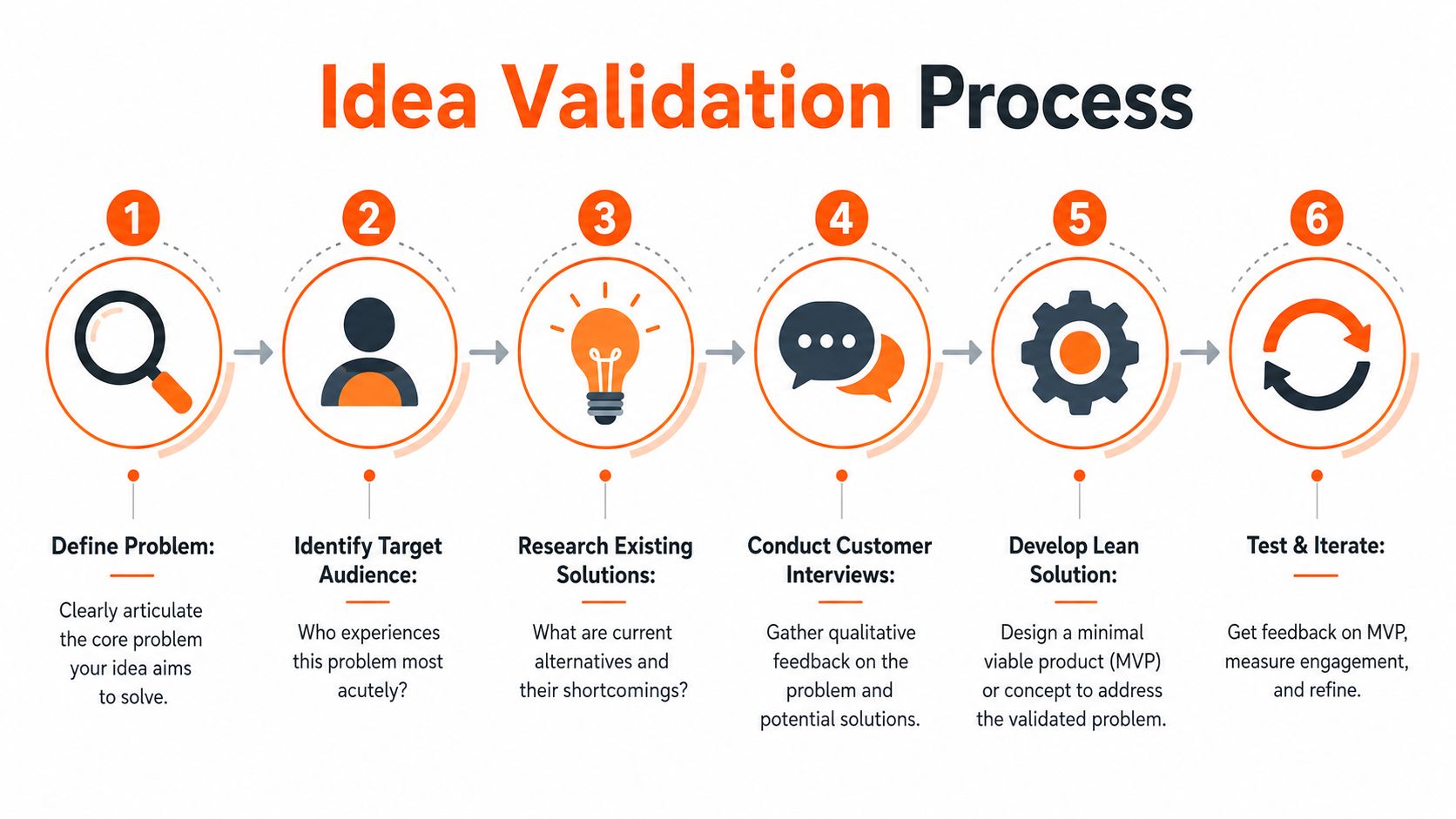
Step one. Run problem interviews fast
I want you to do 15 to 20 customer interviews within 2 weeks, focused on the problem, not your solution. Then, if the problem is real, run a beta with 10 to 50 users who fit your ideal customer profile. Brands that skip pre-launch validation face a 70% higher risk of market rejection, while those with validated beta programs achieve 40% higher initial adoption rates, according to the Product Marketing Alliance visual guide to product launches.
That means your first job is simple. Shut up about your product idea and ask about their current pain.
Ask questions like:
- Walk me through the last time this happened.
- What did it cost you in time, money, stress, or missed sales?
- What do you use now instead?
- What annoys you about that workaround?
- How often does this problem happen?
Notice what isn't on that list. "Would you buy my thing?" That question gets polite lies.
If you want another grounded walkthrough on effective business idea validation, that resource pairs well with this approach because it keeps the work practical.
Step two. Build the smallest useful beta
Your beta is not a miniature masterpiece. It's a test rig.
For a product brand, that might be a tiny batch, a preorder page, or a manual concierge version. For a software brand, that might be a click-through prototype, a no-code workflow, or a stripped-down feature set. If you need examples, this page on a product MVP example is a good reference point.
Use a short table to keep yourself honest:
| Beta element | Keep it simple |
|---|---|
| Who gets access | Only people who clearly fit the problem |
| What they try | One use case, not five |
| What you watch | Usage, retention, repeat behavior |
| What you ask | What confused you, what helped, what you'd miss if it disappeared |
Step three. Decide what counts as proof
A lot of founders gather feedback like tourists gather postcards. Nice memories. No decision.
You need to define success before you launch the beta. Pick a few signals. Did people use it more than once? Did they come back without being chased? Did they describe the value in language you can reuse?
If users only compliment the idea but don't change their behavior, you don't have validation. You have encouragement.
That distinction saves months.
Craft a Brand That Is Actually You
Branding is not picking a font and acting confident on the internet. Branding is deciding what kind of person your company will be when money is involved.
I care less about your mood board and more about your standards. If you're a kind giver, make that visible in the way you sell, write, price, and respond. Don't say your brand is human. Prove it in tiny repeated actions.
Use three filters
I like a simple framework here. Your brand needs a promise, a personality, and principles.
Your promise is the result you help create. Keep it plain. No poetry. Your personality is how you sound while doing that. Calm, direct, warm, witty, spare. Pick a lane. Your principles are the lines you won't cross to get growth.
Here are examples of principles that shape behavior:
- No manipulation: You don't use fake urgency if the deadline isn't real.
- No vanity positioning: You don't pretend the product is for everyone.
- No disrespectful sales tactics: You don't pressure confused people into buying.
Translate values into choices
Most founders get soft. They say they value kindness, then write copy that sounds like a nightclub bouncer.
Your values should show up in concrete decisions:
| Value | Real brand action |
|---|---|
| Kindness | Clear refund language and respectful support replies |
| Boldness | A sharp point of view instead of vague copy |
| Hard work | Better onboarding, better packaging, better follow-through |
| Honesty | Saying what the product doesn't do yet |
You don't need a fake founder persona. You need consistency. The data point I do care about here is this: consistent branding across channels can increase revenue by up to 23%, as noted in the GrowthHit launch roundup. That doesn't mean sameness. It means your voice, visuals, and promise stop contradicting each other.
Drop the trend-chasing
A brand built on trends ages fast. A brand built on principles gets sharper over time.
If your voice online sounds nothing like you in a room, fix that now. If your sales process makes you feel slimy, rebuild it now. Learning how to launch a brand starts with self-respect. People can feel when a business is wearing a borrowed face.
Your First Launch Playbook From Zero to Revenue
Launch week is where vague founders get punished. The answer isn't more hustle. It's tighter execution.
More than 25% of total revenue and profits across industries globally are generated exclusively from the launch of new products, and McKinsey says the single most important driver of launch success is team collaboration. McKinsey also argues that launch ROI, calculated as gross margin divided by launch investment, should be the main metric for judging whether launch activity created value. That same piece is worth reading because it pushes teams to decide early who the target customer is, what message matters, and which few decisions matter most in the launch plan. You can find that in McKinsey's article on making your next product or service launch drive growth.
Start with the boring stuff. It isn't glamorous, but it saves you later.
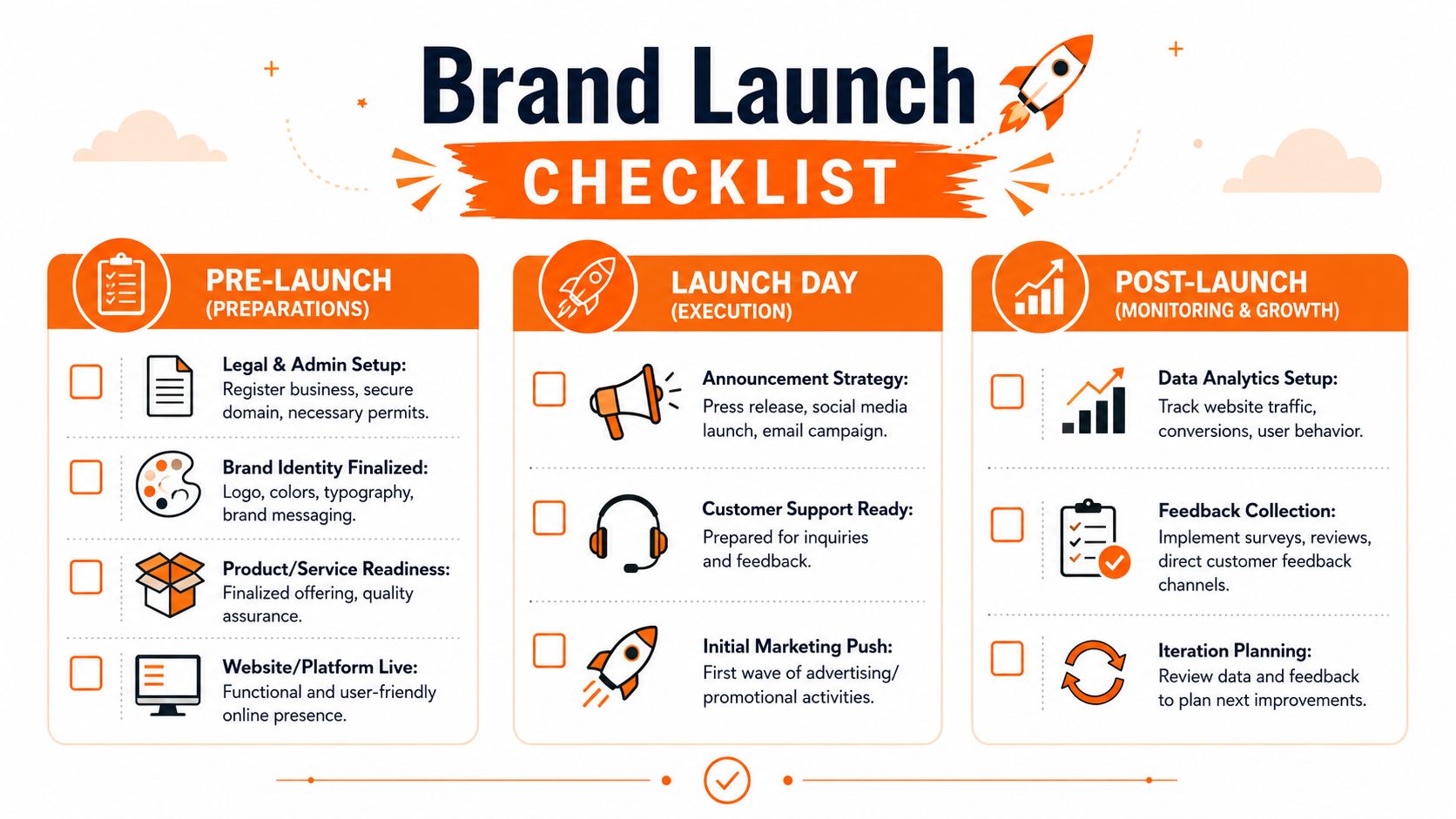
Pre-launch checklist
Before anyone hears your brand name, lock down your identity. A lot of founders skip this because it feels administrative. That's a mistake.
- Secure the basics: Domain, trademark path, and social handles first.
- Write one message: Say what the brand is, who it's for, and why now.
- Choose only 2 or 3 channels: Go where your buyers already pay attention.
- Prep your assets: Landing page, email, short-form social posts, founder note, product images, and FAQ.
Atlassian notes that 60% of new brands run into cybersquatting issues that delay entry and raise legal costs by an average of $15,000, and that coordinated rollouts across website, social, and press in a single 24-hour window generate 3x more initial traction while keeping first-quarter churn 25% lower in its guide to brand launch planning. That is why I push founders to get coordinated, not scattered.
Launch day needs one window
Don't drip this out for a week unless you have a real reason. A launch should feel like opening the curtains, not leaking a rumor.
Here is the simple version:
- Send the email first: Your warm audience is the highest-trust group.
- Publish your landing page: Make the action obvious. Buy, sign up, book, join waitlist.
- Post across your chosen channels: Use the same core message, adapted to each format.
- Activate your peers: Ask trusted builders to share, reply, and introduce.
- Respond fast: Questions on launch day are buying signals.
If video fits your brand, use it. The same GrowthHit roundup already cited earlier notes that many consumers buy after watching a product video and that video marketers get more qualified leads, which matches what I see in practice. A short product walk-through or founder video often explains trust faster than six paragraphs of copy. If you want help producing launch assets quickly, tools that generate cinematic AI videos can be useful for short promos, demos, or social teasers, as long as you keep the message grounded in your real brand voice.
Here is a useful walkthrough to think visually about launch assets:
Keep the ask simple
Your launch dies when you ask people to do too much.
Pick one primary action. If you're early, that might be preorder, sign-up, or book a call. Don't make people decode the next step. Good launches feel like a straight hallway. Bad launches feel like an airport.
A launch rule I trust: one audience, one promise, one action.
That discipline is how you get to revenue faster.
What to Measure and When to Pivot
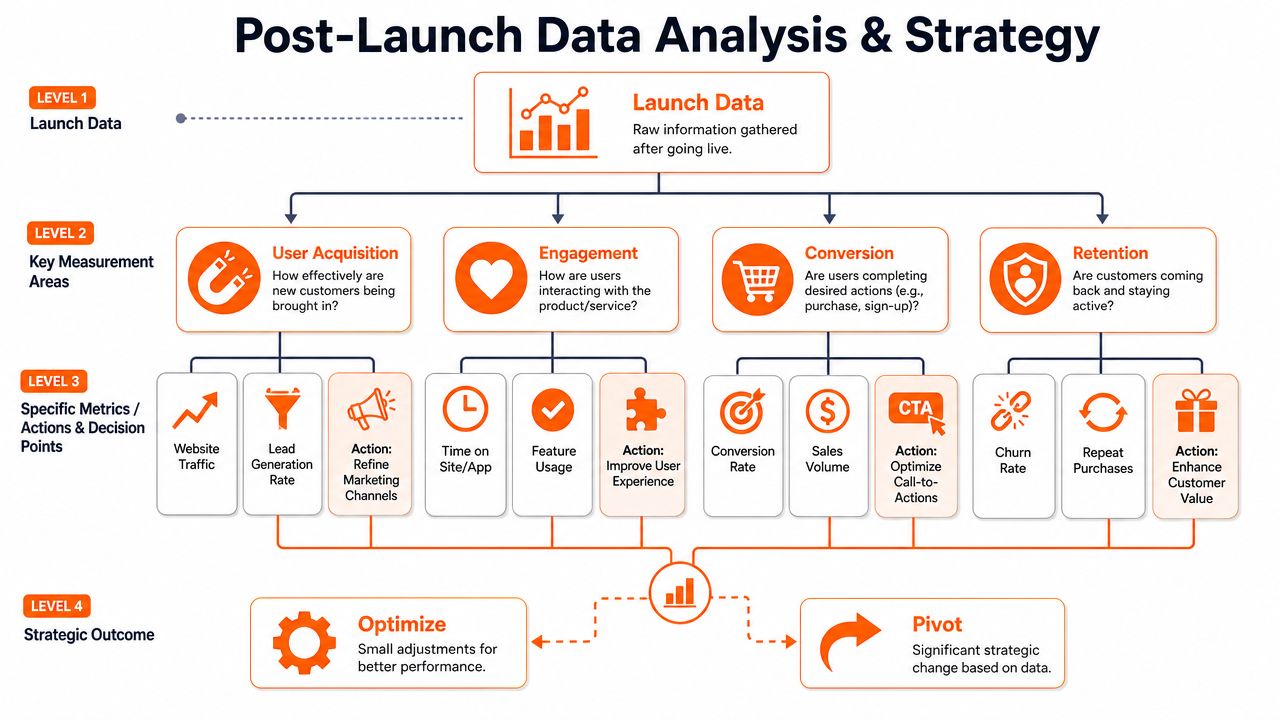
Most founders track too much and learn too little. They stare at likes, impressions, and random dashboard confetti while missing the one number that tells the truth.
I want one North Star metric tied directly to revenue. Then I want 3 to 5 secondary metrics that cover the path from acquisition to referral. That keeps the team focused on business outcomes instead of trivia, which is the point made in this post about choosing a North Star metric that links to revenue.
Start with sign-up rate
For most early-stage brands, your first serious metric is sign-up rate, which is number of sign-ups divided by number of visitors to the sign-up page. Gainsight makes that case clearly in its guide to product launch metrics. I agree with it because sign-up rate is the first clean signal that your message and offer work well enough for someone to act.
After that, I look at a short stack of supporting signals.
- Traffic quality: Are the right people visiting, or just curious people?
- Engagement: Do they stay, click, reply, or use the product?
- Conversion: Do they take the next step you asked for?
- Retention: Do they come back or disappear?
- Referral behavior: Do satisfied early users tell anyone else?
Use the first 45 days well
The first 45 days matter because early customer behavior gives you the raw truth. Track website traffic, social engagement, and sales. Then get direct customer feedback while the experience is fresh.
I don't mean a giant survey deck. I mean a handful of short conversations and a few written questions:
| Ask this | Why |
|---|---|
| What made you try us? | This reveals your real hook |
| What almost stopped you? | This shows friction |
| What did you expect? | This exposes messaging gaps |
| What happened after you used it? | This shows whether value appeared fast enough |
Small changes beat dramatic identity crises. Fix the message, fix the page, fix the offer. Pivot only when the pattern is obvious.
When I would pivot
I don't pivot because a few people shrug. I pivot when I see the same resistance from the right audience again and again.
Here are signs I take seriously:
- The wrong people love it: Interest comes from people you can't profitably serve.
- The right people don't care: They understand it and still don't move.
- Users need too much explanation: Your offer has to fight for basic comprehension.
- Retention is weak: They try it once and vanish.
Optimization is a tune-up. A pivot is a different road. Know the difference.
Build a Brand and a Life You Are Proud Of
Learning how to launch a brand is not about becoming louder. It's about becoming clearer.
Find people who tell you the truth. Validate the problem before you romanticize the solution. Build a brand from your real values, not borrowed startup theater. Launch in a tight coordinated burst. Watch the numbers that connect to revenue. Then adjust without losing your center.
I care a lot about kindness and hard work because they age well. They make you easier to trust, easier to work with, and harder to shake when things get messy. That's a better foundation than hype.
You don't need to turn into a self-promoter to build something real.
You need proof. You need peers. You need standards.
And then you need to do the work.
If you want a quieter, more honest way to build, Chicago Brandstarters is a free, vetted community for kind, bold, hard-working founders in Chicago and the Midwest. It brings early builders together in small private dinners and group chat conversations where people share real problems, real tactics, and real support without the usual networking theater.
Leave a Reply