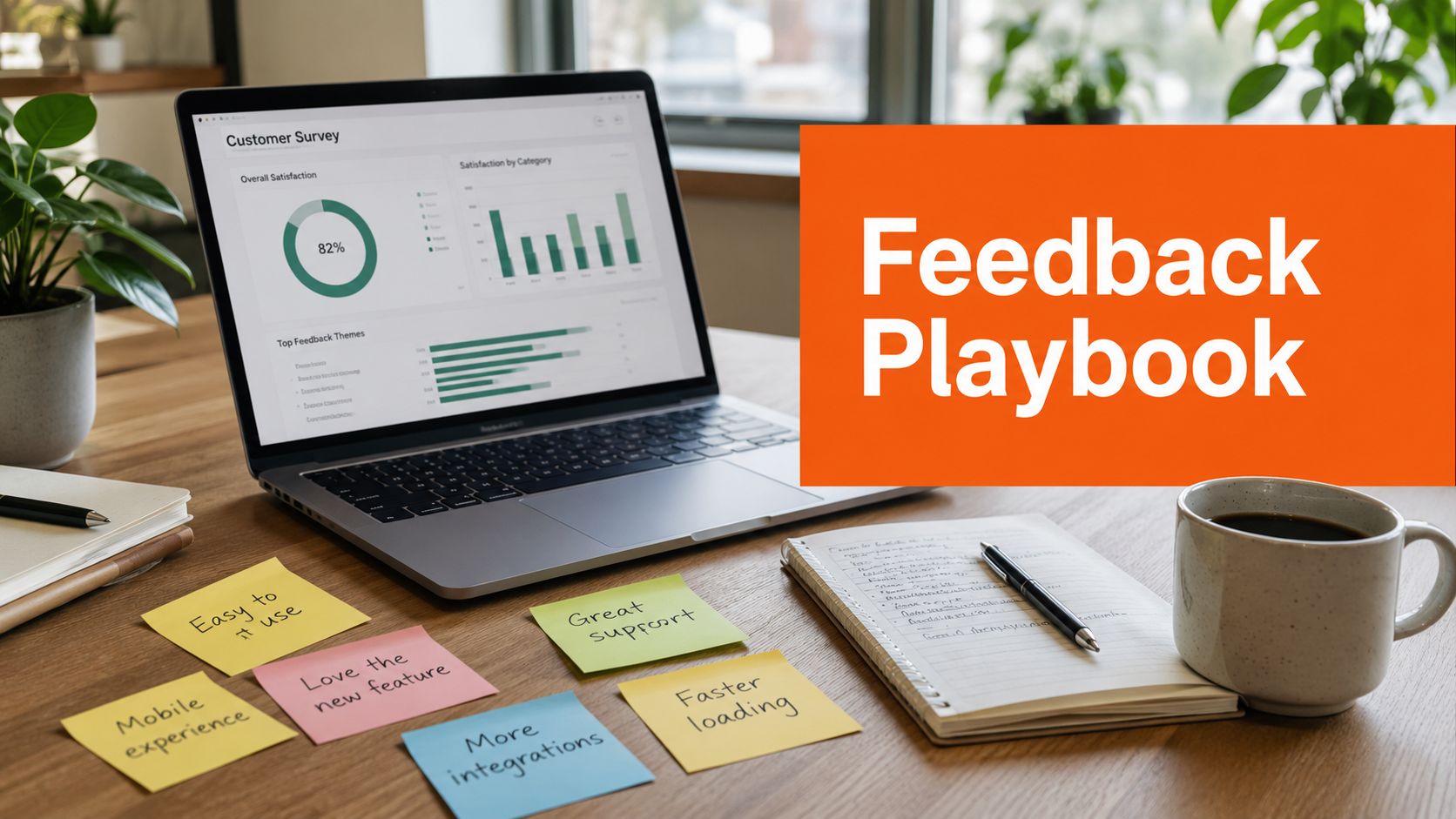
You can ship a feature, watch it flop, and still miss the true reason if all you collect is a pile of polite survey scores. I've done that more than once. The fix came from a single blunt customer interview, the kind where someone tells you what they did, not what you hoped they felt.
That was the day I stopped treating customer feedback collection like a box to check. I started treating it like a decision tool. If the input can't change a product call, a pricing call, or a channel call, I don't want it.
The Feedback That Finally Changed My Product
I shipped a dashboard update that looked clean, sounded smart in the spec, and failed the moment customers touched it. The survey comments were useless, mostly short complaints and a few nice notes from people who never used the feature in the first place. The answer came from one customer who walked me through what they clicked, what they ignored, and where they got stuck.
What I learned the hard way
That call changed my view of customer feedback collection. I had been collecting volume, not signal. I had a lot of input, but I didn't have a way to turn any of it into a decision.
The mistake was simple. I asked for feedback before I knew what I'd do with it. So I got a mix of opinions, praise, and random frustration. None of it told me whether to keep the feature, kill it, or rewrite it.
Practical rule: If a piece of feedback can't change a decision, it's noise dressed up as insight.
That lesson got sharper once I saw how hard it's become to get responses through old-school email surveys. Typical external survey response rates now sit in the 5% to 15% range, with email-only surveys often below 10% in 2026, according to the 2026 customer feedback benchmark report. That means a company sending 1,000 surveys may only hear back from 50 to 150 people under normal conditions. If you're building your whole system on broad outreach, you're building on a weak base.
The better play is to decide first, then collect. Once I started doing that, feedback stopped feeling like a pile of comments. It became a way to make hard calls with less guessing.
Decide What Decision You're Trying to Make
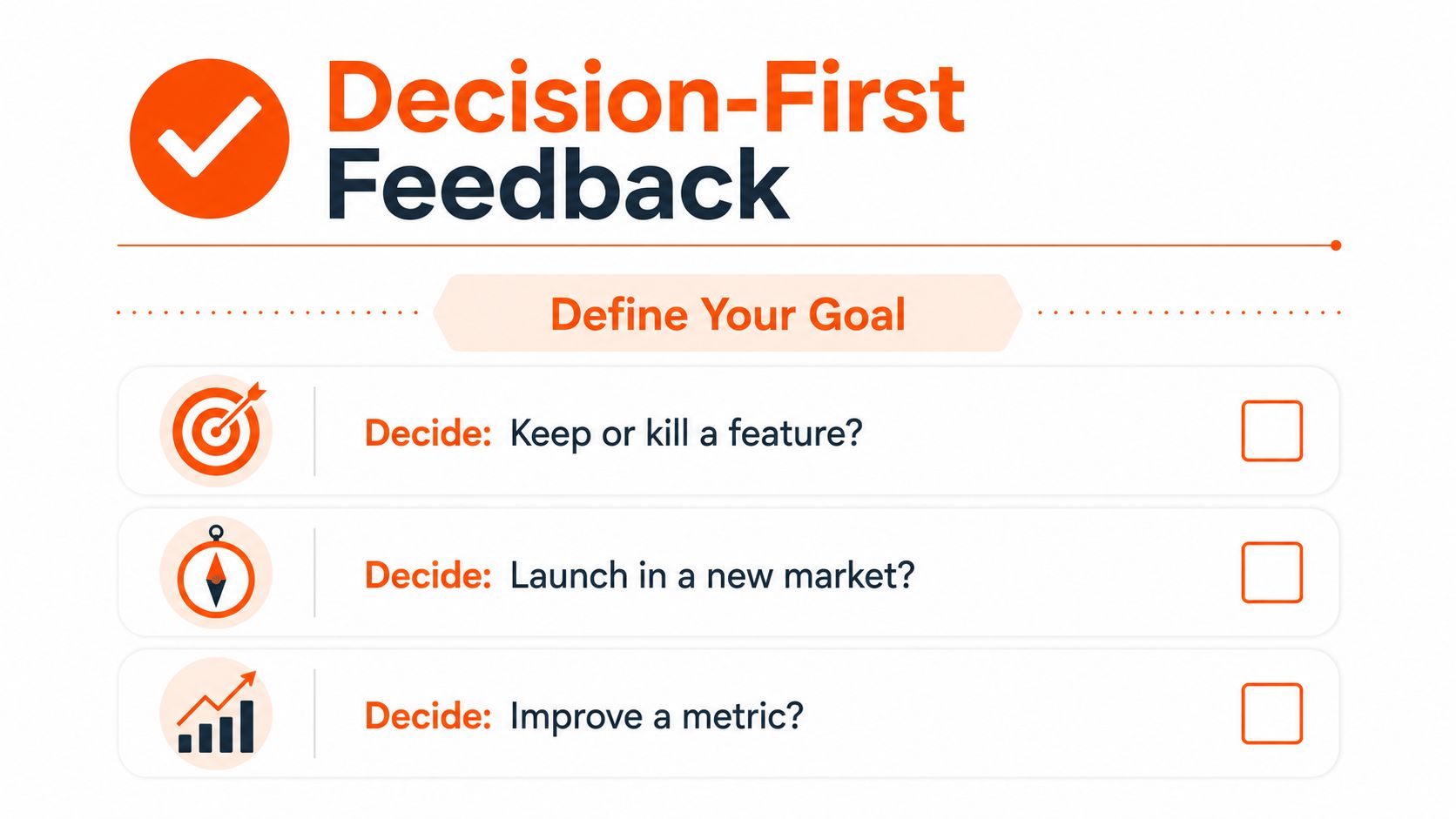
Before you write a survey question or book an interview, name the decision. I ask myself three things now, in this order. What decision does this inform, who has the answer, and how recent does their experience need to be?
Start with the decision, not the channel
If I want to know whether to keep a feature, I need people who used it. If I want to know whether to launch in a new market, I need feedback from the audience I'd sell to there, not my existing power users. If I want to raise prices, I need people who understand the value enough to react, not just complain because the number changed.
That filter saves me from collecting opinions I can't use. It also keeps me from asking everyone the same thing. A pricing decision needs a different audience and a different moment than a support decision or a feature decision.
The blunt version is this. A founder who skips the decision step turns feedback into a junk drawer. Every comment lands there, and nothing comes back out.
Use a one-page brief before every collection push
I keep a short brief now. It fits on one page and forces discipline:
- Decision: What do I need to decide this week?
- Audience: Who can answer that question from direct experience?
- Freshness: How recent does that experience need to be for the answer to matter?
- Action: What will I change if the signal points one way?
- No action: What will I leave alone even if people dislike it?
That last line matters. If I can't name what I'll ignore, I'm too open-ended.
A useful collection plan usually starts with one of three jobs. Keep or kill. Launch or pause. Change or leave alone. Once I know the job, the rest gets easier.
Ask for the answer you can actually use, not the answer that makes you feel informed.
Pick the Channel That Matches the Decision
I've made the wrong channel choice more times than I'd like. I once used a long survey to test a pricing page. I got a small pile of responses, most from people who were already warm to us, and the result looked clearer than it was. Five short interviews would've told me more in less time.
Match the channel to the call you need to make
Surveys work well when I need pattern-level input from a group that can answer the same question. Interviews work better when I need detail, sequence, and the “why” behind a behavior. In-product prompts are good when the moment matters. Support tickets and community chat help me catch friction people mention on their own.
Here's the simplest way I consider it:
| Channel | Best for | Watch out for |
|---|---|---|
| Surveys | Comparing responses across a group | Leading wording and thin context |
| Interviews | Learning why people behaved a certain way | Small sample bias if I treat anecdotes like proof |
| In-product prompts | Feedback tied to a live moment | Asking too often |
| Support tickets | Repeated friction and service gaps | Treating them like random complaints instead of grouped signals |
| Community chat | Fast sentiment and candid language | Loud voices steering the whole roadmap |
If you want a broader methods map, I'd pair this with the market research methods guide so you don't confuse collection tactics with decision tactics.
For support-heavy teams, I've also found it helpful to look at streamlining social support feedback so public complaints don't stay trapped in one person's inbox.
When 5% is fine and when it's a problem
A low response rate is only fine if the people who reply are the right people for the decision. If I'm trying to learn from a narrow, highly engaged audience, a small but relevant sample can be enough to spot a direction. If I'm trying to make a broad product call and the only people answering are superfans, that's a problem.
So I don't ask, “Which channel is best?” I ask, “Which channel gives me the cleanest answer for this decision?” That shift saves time and cuts a lot of fake certainty.
Write Questions That Don't Lead the Witness
A bad question can ruin a good audience. I've sent surveys with wording so upbeat that the only useful answer left was a complaint. Customers can feel when you want them to say yes.
Rewrite the question around a real moment
“Did you love the new dashboard?” is a trap. It asks for a judgment, and it nudges people toward the answer you want. “What's the first thing you checked when you opened the dashboard this week?” is better because it points to behavior, not flattery.
That difference matters. Specific moments produce cleaner memory. General feelings produce mush.
Use these three rules:
- Ask about a moment: Focus on what happened, not on a broad opinion.
- Keep an escape hatch: Give people an other option so they don't force-fit their answer.
- Skip future prediction: People are poor at telling you what they'll do later.
The most useful question I've used in this area is simple. “What did you tell a friend about the product?” It gets closer to honest sentiment than a polished satisfaction score because people talk differently to friends than they do to a survey form.
A few rewrites that changed my response quality
Bad: “Did our onboarding feel smooth?”
Better: “Where did you pause, if anywhere, during onboarding?”
Bad: “Would you buy this again?”
Better: “What would have to change for this to feel worth buying again?”
Bad: “How satisfied are you?”
Better: “What was the most useful part of the experience, and what was the most frustrating part?”
I also keep questions short and neutral because biased wording kills both response rate and answer quality, which matches the practical guidance in how to create customer discovery interviews.
A survey should feel like a clean flashlight, not an interrogation lamp.
Sample the Right People at the Right Moment
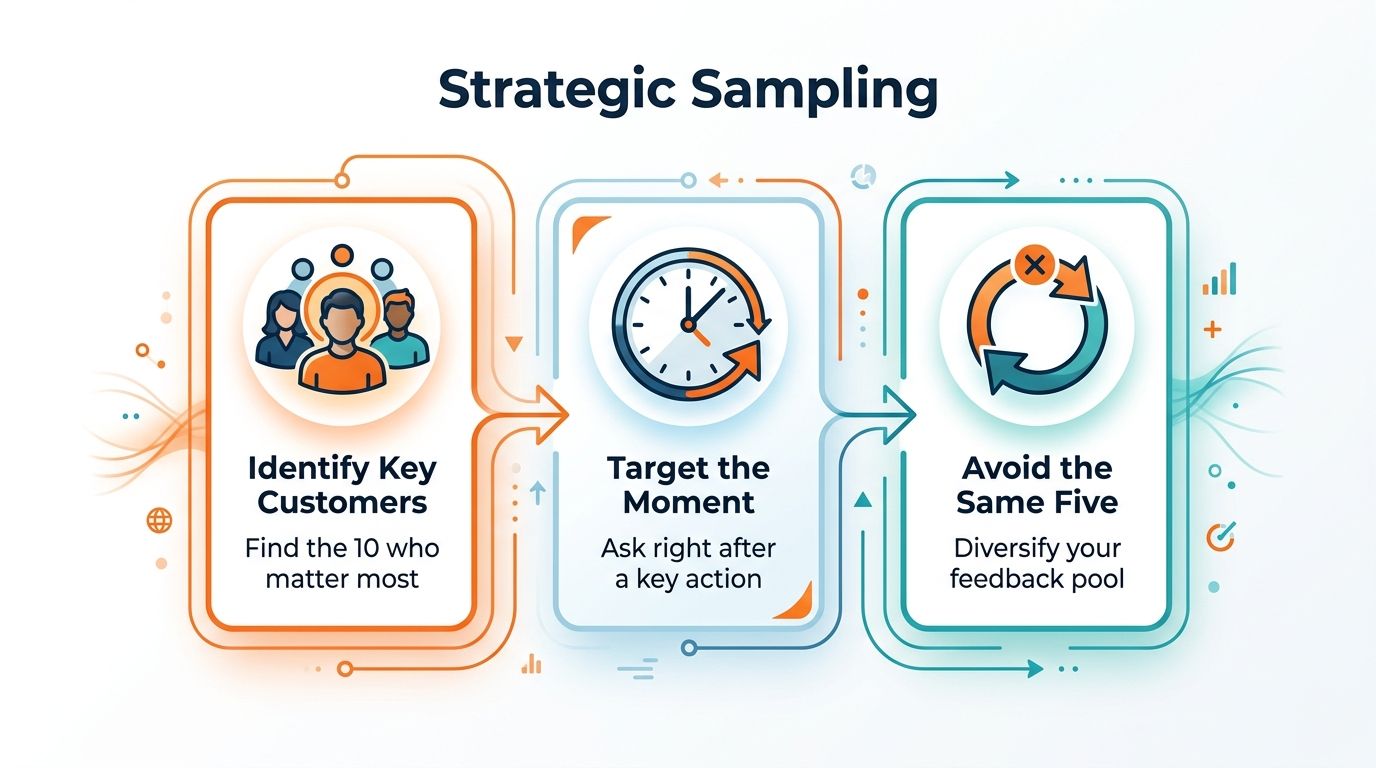
I stopped thinking about sampling as a statistics problem and started thinking about it as a timing and audience problem. Early on, the ten people who matter beat the hundred who barely remember the experience.
Choose the smallest useful audience
I don't ask the same five superfans every month unless I want a self-congratulatory echo chamber. Their answers tilt the roadmap. They know how to work around friction, which means they often stop seeing it.
The practical move is to segment without fancy tooling. I use simple buckets, like new users, repeat users, churned users, and customers who just hit a specific moment in the product or service journey. That's usually enough to avoid sampling the same people over and over.
Timing matters just as much. Descartes says to ask shortly after the job or delivery is complete, and to keep questions short and non-leading. That's the difference between getting a sharp memory and getting a fuzzy story.
Use cadence as a guardrail
I also pay attention to feedback fatigue. Qualtrics warns about it directly, and the broad rule it gives is simple, quarterly surveys for B2B and more frequent prompts for B2C depending on interaction volume. I use that as a ceiling, not a target.
My rule set looks like this:
- Ask soon after the event: Within 48 hours of the experience I want to understand.
- Do not repeat too often: Never hit the same user twice in the same week.
- Respect the channel: Use event-triggered prompts when the action is fresh, not random blasts.
- Widen the pool: Rotate audiences so the same voices don't dominate.
A useful framing is to ask for feedback like you'd ask for a quick read on a meal right after it lands on the table, while the details are still fresh. Wait too long and the memory goes soft.
For teams trying to collect more signal from forms without annoying people, I'd also look at optimizing lead form conversions, because the same friction lessons show up there.
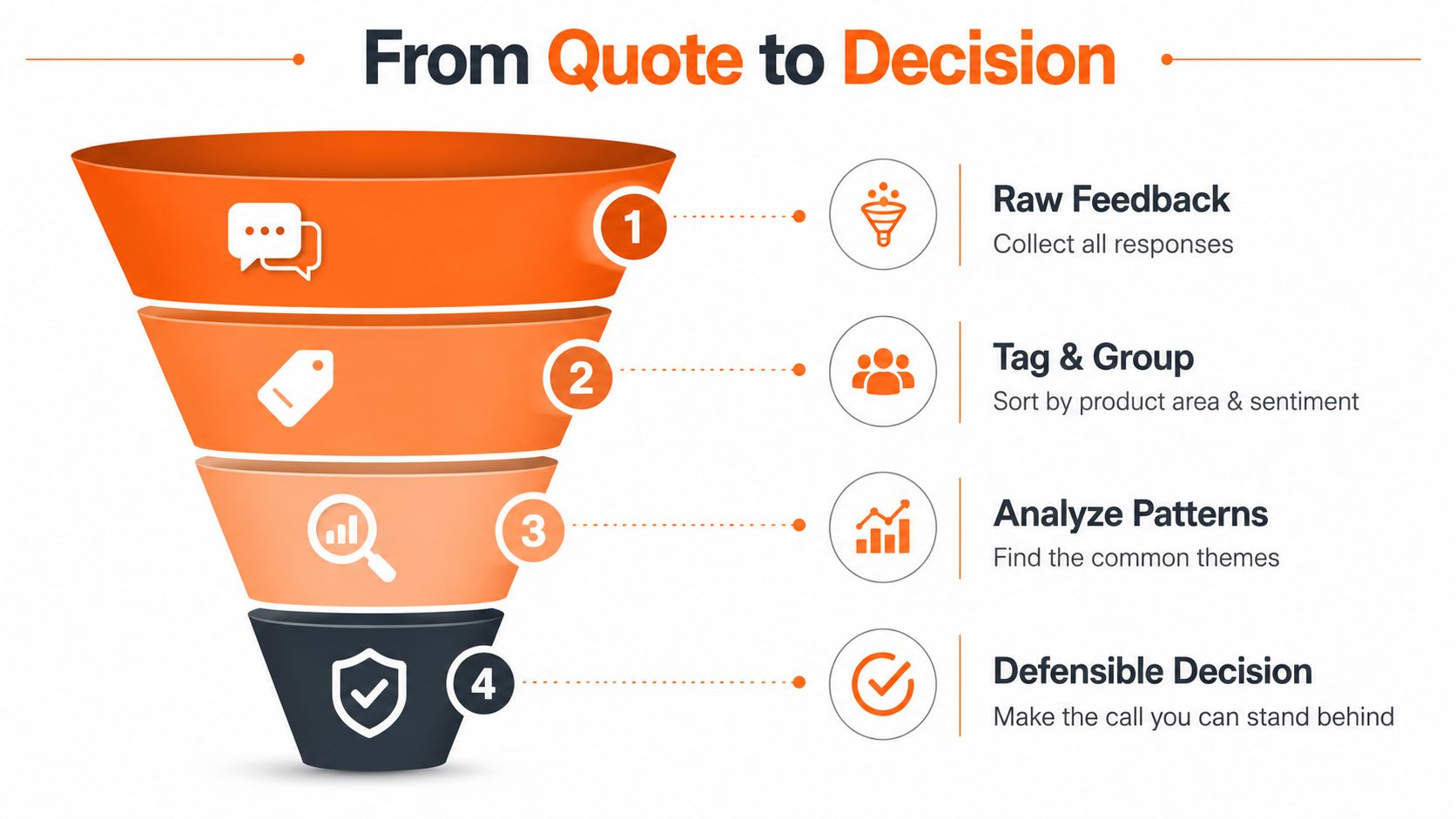
Turn Quotes into a Decision You Can Defend
A quote is only useful after I sort it, tag it, and count how often it shows up. If I jump straight from one loud comment to a roadmap change, I'm just reacting to whoever typed fastest.
Tag first, then look for patterns
My workflow is boring on purpose. I tag every response by product area, sentiment, and urgency. Then I group the tags into recurring themes. Only after that do I count how often each theme appears and look at the top ones.
That sequence keeps me honest. It turns “three people complained” into “this issue keeps appearing across different users in the same place.” That's a stronger case.
If the same issue shows up in a few support tickets, a survey comment, and a chat thread, I treat that as one signal, not three separate fires. The source mix matters because it keeps me from overreacting to one channel.
Weight what people do against what they say
This gets messy when customers say one thing and do another. I've seen people claim they want a feature and then ignore it after launch. In those cases, I trust usage data more than the quote, because behavior is harder to fake.
Zendesk's guidance on gathering both qualitative and quantitative feedback matches that instinct. I treat feedback as one input, then I check it against actual usage. If the comment says one thing and the product data says another, I dig into the mismatch before I decide.
Practical rule: One loud quote can start a question. It can't end the discussion.
For broader social sentiment workflows, I've found this guide for developers on social listening useful because it shows how to separate noise from patterns across public channels.
Make the call you can explain
Once I've got the themes, I ask three final questions. Which theme affects the most people, which one blocks the next step in the journey, and which one I can fix soon. That gives me a defendable decision, even when the team disagrees.
A spreadsheet is enough here if you keep the tags simple and consistent. The goal is not perfect analysis. The goal is a clear reason for the next move.
Close the Loop So Customers Tell Their Friends
Most feedback systems fail after the analysis. You ask, you sort, you decide, and then the customer hears nothing. That turns the whole thing into a polite complaint bin.
The fix is simple. Thank them within 48 hours. Send a “we heard you” update within two weeks. Send a “we shipped it” note when the change goes live.
I've seen this matter in places that had nothing fancy behind them. A spreadsheet, a group chat, and a founder who wrote the follow-up are enough to start. If you want to turn the loop into something customers talk about, pair it with a referral habit, like the one described in how to create a referral program.
What I tell founders is simple. If customers see their feedback land, they come back more willing to answer again. Some of them also tell other founders about you, because they've felt the loop work on them personally.
Chicago Brandstarters helps founders build honest peer loops like this, with small private dinners and a group chat where people trade real feedback, not performative advice. If you want a room that treats customer feedback collection like a decision-making skill, visit Chicago Brandstarters and see whether the community fits the stage you're in.
Leave a Reply