

71.9% of 715 freelancers across multiple industries reported feeling isolated or lonely sometimes or frequently during 2024, according to Leapers' survey. If you're starting a peer support group, start with that problem: people need somewhere to admit they're stuck without turning the admission into a sales pitch.
I would build a dinner table, not a networking mixer. Give a small group a dependable place to talk, then write down who holds the room when the conversation gets difficult. Peer-led doesn't mean leaderless.
Pick Six to Eight People and One Cadence
Size, cadence, and membership for a new peer group
| Choice | Use this | Why it works | Change it when |
|---|---|---|---|
| Founding cohort | 6 to 8 people, closed | Everyone gets airtime and one absence still leaves a conversation | The pilot holds and a waitlist is real |
| Viable peer group | About 5 to 15 people | Big enough when someone misses, small enough to be heard | You pass 15 or regulars stop talking |
| Weekly | Every 7 days | You build familiarity quickly | Attendance slips or the calendar load shows |
| Every other week | Every 2 weeks | You keep contact steady without a weekly obligation | Members ask for more contact or less |
| Monthly | About every 30 days | You make scheduling easier | People stay lonely or stuck between meetings |
| Closed membership | Same people for the pilot | Members can build on earlier conversations | You reopen later with the same vetting |
| Open membership | New people may join a meeting | You reach more people | Stories leak or regulars stop sharing |
Use this as a planning menu, not a growth ladder. The University of Kansas Community Tool Box recommends roughly 5–15 participants and lists weekly, every-other-week, and monthly meetings as workable options. I'd choose the smaller founding cohort in the table for a founder pilot.
Circle a choice under size, another under cadence, and another under membership. Put those decisions on your invitation before you contact anyone. Otherwise, you'll recruit people who expect different rooms.
Choose a table you can actually host
Think about the difference between dinner and a reception. At dinner, you notice when someone hasn't spoken. At a reception, you can spend the evening introducing yourself without saying anything that matters.
With too few people, an absence can leave you without enough conversation. With too many, you'll spend your attention moving people along instead of asking the follow-up question that gets beneath a polished update.
You also need to choose between continuity and access. A closed pilot gives members familiar faces and shared context. Open membership makes entry easier, but you'll spend more time explaining the agreement and helping newcomers catch up.
Practical rule: Choose the smallest room you can sustain, not the largest room you can fill.
Weekly meetings can help members get comfortable quickly, but you're asking for a serious calendar commitment. Monthly meetings require less scheduling effort, but someone struggling between sessions may need contact sooner. I'd start every other week and ask members whether that rhythm fits their lives.
At Chicago Brandstarters, we run small private dinner events for 6–8 people every 2 weeks. That's our operating choice, not a promise that the same schedule fits every group.
Use this image as a reminder to arrange the room for conversation rather than presentations.

Recruit for the conversation you want
If you want a crowd, this is the wrong format. If you're building something and need to say that you don't know what to do next, a small peer group makes more sense.
Look for compatible needs rather than identical businesses. A product founder and a service founder might both struggle with hiring, but someone seeking casual social contact may feel uncomfortable in a tightly structured problem-solving session.
For the practical work of invitations, recurring gatherings, and host responsibilities, keep Listava tips for hobby club leaders nearby. Borrow the organizing habits while keeping your group's purpose specific.
Your circled choices are your recruiting brief. Anyone considering a seat should understand the group's size, rhythm, and membership model before agreeing to join.
How to Launch Before the First Story
Finish the launch sequence before anyone shares a hard story. You don't want to negotiate privacy, attendance, or the group's purpose while someone waits for a response to a painful disclosure.
Use this visual to keep purpose and preparation ahead of personal discussion.
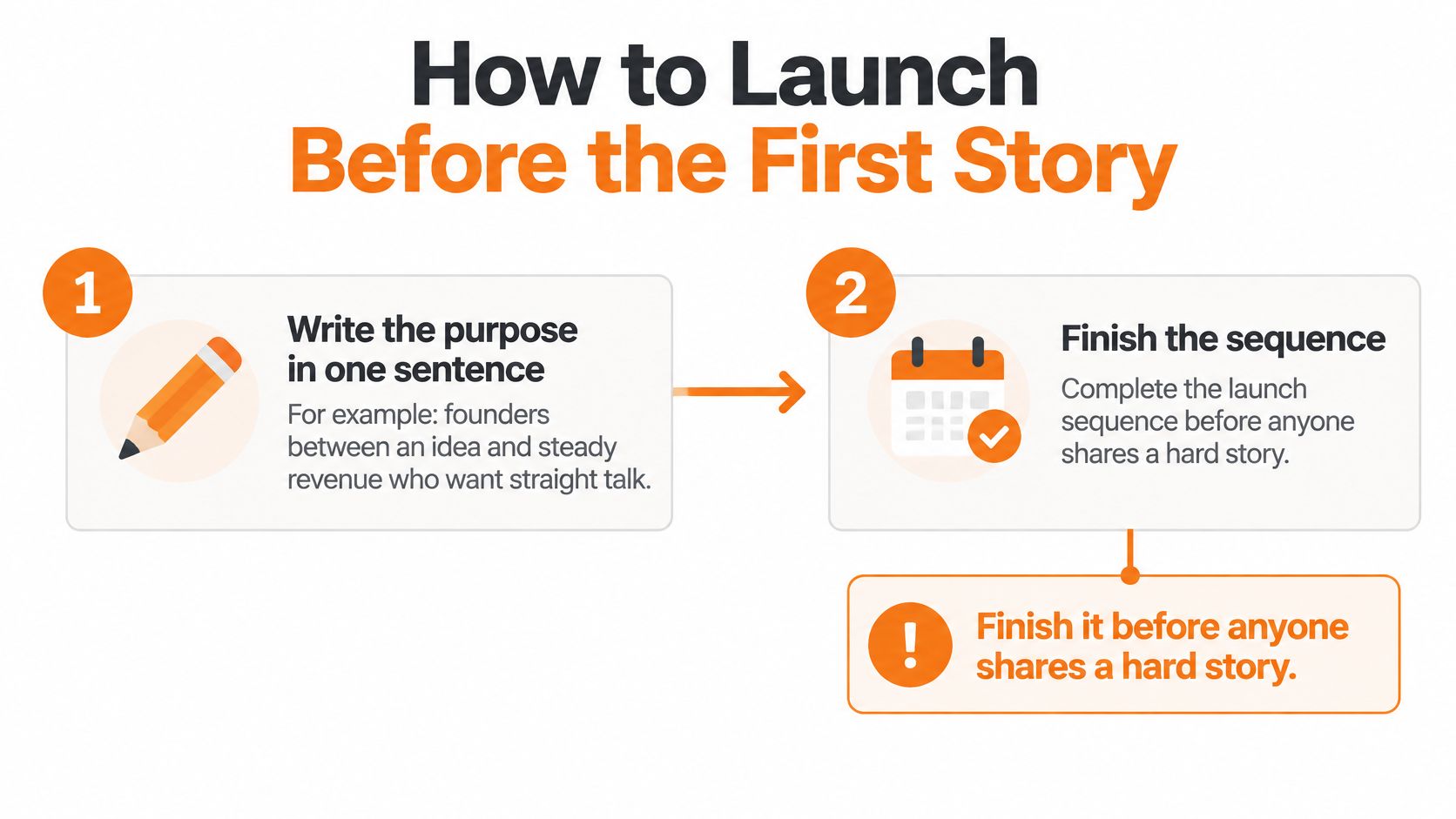
Complete the launch sequence
Write the purpose in a sentence. For example, you might bring together founders between an idea and steady revenue who want straight talk about their next business obstacle. A clear purpose helps you decline people who want a different kind of gathering.
Write who may join and who may not. Describe the stage, needs, and behavior you want, then exclude prospecting and self-promotion. Someone who treats the group as a lead list will change what everyone else feels comfortable saying.
Recruit your founding cohort deliberately. Start with people you've worked with, hired, or watched finish something, then hold a short screening call. For a sample pilot, I'd use a fifteen-minute call, ask whether each person could attend three of four trial dates, and keep four interested names on a waitlist.
Publish the operating agreements. Cover membership, attendance, voluntary participation, access needs, respectful communication, and confidentiality limits. Give people a chance to decline before they disclose anything personal.
Set the meeting mechanics. Write down the time, duration, venue or meeting link, and topics, then let members confirm the frequency. The World Health Organization's guidance recommends agreeing on these arrangements and allowing a trial period so members can adjust them.
Protect contact details. Keep the roster in a password-protected file that only the host can open, and ask members not to pass anyone's details along. Collect what you need to run the group, not a dossier.
Call the pilot a trial. For example, schedule four meetings before deciding whether to continue. That gives members permission to suggest changes without treating the original format as a permanent contract.
Log behavior after every session. Record the date, attendance, who spoke first, participation balance, usefulness, introductions, commitments, and completion. Update the sheet while you still remember the meeting rather than reconstructing it later.
Screen for fit, then make entry easier
During the screening call, ask what the person feels stuck on right now and what they want from the room. Tell them plainly that you're organizing neither a pitch night nor a substitute for therapy. Listen for whether they can support someone else without immediately selling a solution.
Identity checks and LinkedIn vetting help us establish who joins Chicago Brandstarters. They don't replace judgment about conduct. You still need to notice whether someone listens, respects a boundary, and leaves room for others.
For help preparing the host's response to uncertainty and disagreement, consult the Acheloa Wellness psychological safety playbook from Acheloa Wellness, Inc. For a gentler opening than an immediate business confession, choose a prompt from our networking conversation starters.
Count conduct, not enthusiasm: A warm first meeting tells you less than reliable attendance, respectful questions, and completed commitments.
Use the Community Tool Box's launch guidance to keep purpose, eligibility, agreements, and a repeatable format together. Don't turn attendance or a pleasant evening into a claim that the group improves business results.
If you prefer a video alongside your planning checklist, you can watch this before preparing your invitation.
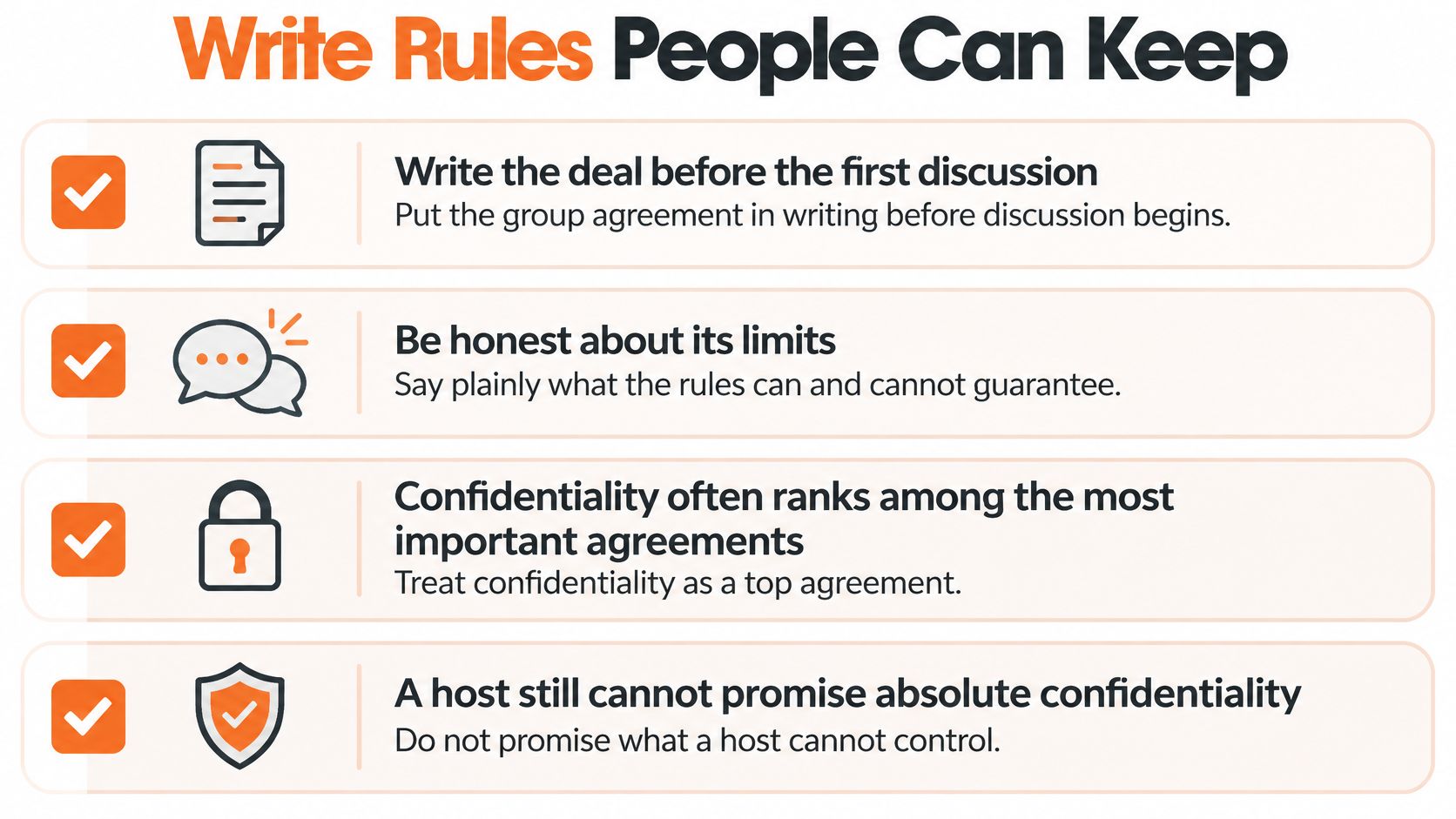
Write Rules People Can Keep
Write the deal before the first discussion. You can ask members to protect each other's stories, but you can't control every conversation after they leave.
The World Bank's Peer Group Facilitator Guide tells facilitators to explain consequences for confidentiality breaches and repeat expectations at every meeting, even when nobody new attends. Treat that repetition as ordinary hosting, not a warning aimed at a particular person.
Put the agreement in plain language
What you may share: Your own numbers, fears, and half-built plans.
What you must not repeat: Another member's name, identifying details, or story outside the group.
What happens after a breach: The host addresses it, the person takes responsibility, and a second breach means leaving the pilot.
That last line is a proposed pilot policy. Agree on it before using it, and keep discretion to remove someone immediately after a serious breach. Don't force an affected member to retell the private information while the group debates what happened.
Contact the affected person privately first. Establish what you know, stop further sharing where possible, and address the conduct without repeating the disclosure. Explain any legal or organizational exceptions in advance, including how you'll respond to immediate safety concerns.
Use this checklist when preparing the written agreement.
Separate honesty from authority
Let members explain what they did with a supplier, accountant, or difficult employee. Don't let anyone prescribe legal, financial, or medical action outside their competence. Experience gives someone a story to share, not authority over another person's decision.
Give members a private route to raise concerns. A short note or a conversation with the host can reveal a problem that someone won't name in front of the group. Don't require a public confrontation as the price of getting help.
At Chicago Brandstarters, we bias toward vulnerability over toxic positivity. I'd rather hear that a launch scared you than spend dinner applauding an update that hides the actual problem.
Our explanation of what confidentiality means and why it matters can help you distinguish an expectation from a guarantee. Keep your final agreement short enough to read aloud, and give every member access to the same copy.
Hold the Room for 90 Days
You risk losing the room when nobody owns the difficult moments. Kind intentions won't tell you who interrupts a fight, corrects a dangerous claim, or helps someone find professional support.
A qualitative study of peer-support engagement and moderation identified 20 themes, including 4 barriers to moderation and 6 barriers to engagement. Treat moderation as work you assign, rather than something a confident member will naturally handle well.
Give the host a charter
Write a short charter that names verified membership, confidentiality limits, the current host, a private escalation route, and a correction procedure. Include the boundary between business experience and professional advice.
For a sample rotation, I'd change hosts after four meetings. Have the outgoing host brief the incoming host on open commitments and who might need a quieter invitation to participate. Don't circulate sensitive disclosures as part of that handover.
Use this roadmap to review ownership throughout the pilot, but establish referral and escalation procedures before the opening meeting.
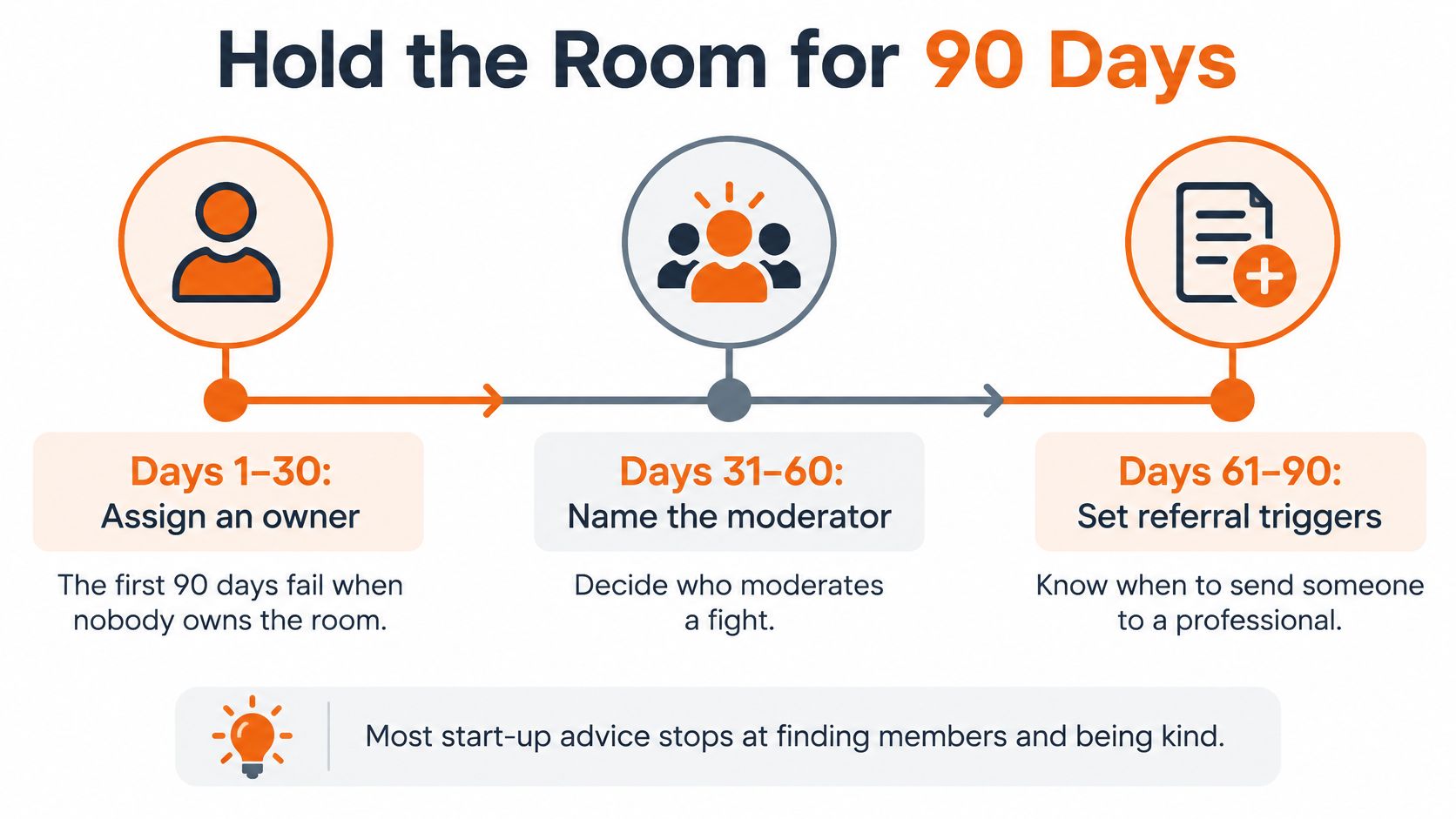
Name referral triggers aloud: talk of harming oneself or someone else, a medical symptom that needs assessment, a dated legal threat, or financial distress that prevents sleep. These situations call for different responses. For immediate danger, contact appropriate emergency or crisis support rather than waiting for a routine referral.
For non-emergency concerns, tell the member that the issue exceeds the room's scope. Help them identify an appropriate professional contact and check in afterward. Log that you made a referral without recording the personal details.
You can stay beside someone without pretending you can solve what they're facing.
Run a clock, not a contest
Use a check-in, a structured problem round, questions before advice, commitments, and closing feedback. Keep the clock visible so you don't have to negotiate airtime whenever someone gets animated.
One 90-minute meeting, segment by segment
The following is a sample agenda, not a tested formula.
| Segment | Minutes | What the host does | What a member leaves with |
|---|---|---|---|
| Check-in | 10 minutes | Ask about the last two weeks; invite brief answers without cross-talk | A heard start |
| Problem round | 25 minutes | Help a member state a problem, then take clarifying questions before advice | A clear problem statement |
| Experience round | 20 minutes | Ask members to explain what they did in a similar situation | Options instead of orders |
| Break | 10 minutes | Privately invite the quietest member to contribute without pressure | Another way into the conversation |
| Commitments | 15 minutes | Ask each person for an action and a date before the next meeting | A written next step |
| Close | 10 minutes | Ask what to keep and change; note absences | A reason to return |
When someone makes a shaky claim, identify it as personal experience rather than a general rule. Ask for a reliable source or help from an appropriate professional. Correct the claim without turning the person into the evening's problem.
Our mastermind group format guide provides another way to think about structured founder conversations. Choose a format you can explain and interrupt politely.
Between dinners, our active groupchat lets members share thoughts, advice, strategies, and support. Members who've made early-stage mistakes willingly share those experiences with others. Apply the same boundaries there so the loudest message doesn't become the final answer.
Fix a Quiet Room or a Loud One
I watch for weak boundaries, oversized groups, uneven airtime, and the assumption that conversation alone will grow a business. Treat those as design problems you can work on, rather than evidence that members lack motivation.
Use the table to choose a change. Don't redesign the entire group after an awkward evening.
Peer group problems and the fix to try next
| What you see | Usual cause | Fix to try |
|---|---|---|
| One person talks most of the hour | No airtime rule | Timed turns, and questions before advice |
| Attendance falls after the third meeting | The format was never written down | Reset the trial, send reminders, and ease the time or place |
| Advice sounds like legal, tax, or medical counsel | No line between experience and a profession | Correct it in the room and point to a professional |
| A story shows up outside the group | Confidentiality was a vibe, not a rule | Restate the agreement and use the breach response |
| The group feels leaderless | No host and no escalation path | Name a rotating host and a private escalation route |
| You cannot tell if it helps | You only track the mood | Log attendance, who spoke, retention, and a finished commitment |
These are working diagnoses, not proof of a cause. Someone may miss meetings because of caregiving, transport, cost, or a private difficulty. Ask before you decide that the format caused the absence.
Measure participation separately from progress
The NCBI-hosted group-development guidance recommends keeping revolving groups at about 15 or fewer members so leaders can know individuals and participants can feel heard. Keep the host's attention on people rather than filling spare chairs.
Explain the format before attendance, invite members to shape early sessions, and send reminders with clear location details. Check access needs privately. A trial meeting lets someone assess the fit without committing to an arrangement they don't understand.
Define success before the pilot. I'd look for return attendance, balanced opportunities to contribute, and completed actions. A busy chat and cheerful feedback don't tell you whether anyone moved through a stated obstacle.
Use a protected spreadsheet with separate fields:
- Entry: Invitations, acceptances, and first-session attendance.
- Continuity: Session attendance and retention at your planned review points.
- Participation: Who contributed verbally or in writing, without grading the disclosure.
- Connections: Member introductions and referrals to the group.
- Progress: Completed commitments and before-and-after ratings of belonging, confidence, and the business obstacle each member named.
Keep the denominator visible when you calculate rates. Count first-session attendees against invitations, for example, rather than against everyone who once expressed interest.
If participation falls, change recruitment, group composition, or facilitation before blaming members. If people return but never finish commitments, help them choose smaller actions. Engagement and business progress are different questions.
Send the Invites or Apply This Week
Choose a move and give yourself a deadline this week. You don't need a perfect name, a logo, or a landing page to find out whether people want a useful conversation.
Start your own table
Write the purpose, circle the names you'd like to invite, and attach the trial dates. Tell each person why you thought of them and what participation requires. Don't ask for a vague expression of interest when you need a calendar decision.
Send something simple:
I'm putting together a small founder peer group for honest problem-solving. Would you look at the purpose, agreement, and trial dates and tell me by Friday whether you'd like to join?
Before sending it, make sure you can answer the awkward questions. Who handles a breach? Can someone pass during a discussion? Where will you direct a concern beyond the group's scope?
Join an existing room
If you build brands in Chicago or the Midwest, apply to Chicago Brandstarters through our application, the only entry route, for free membership at $0. Kevin Tao created the community after helping two friends get their brands to seven figures.
Choose a regular table with honest people over another stack of business cards. You still need to show up, listen, and bring a real problem.
By Friday, send your invitations or submit your application. Then put the meeting on your calendar and prepare a sentence about where you're stuck.
At Chicago Brandstarters, we have small private founder dinners and an active groupchat for practical advice and support. Visit Chicago Brandstarters this week to apply and take a step toward a regular room where you can speak about building your brand.
Leave a Reply