
You've been to the mixer. Warm white wine, a name tag curling at the corner, forty people in a room all scanning past each other for someone more useful. You came home with a stack of cards and no answers.
A business networking dinner works on different machinery. A handful of people, one table, a couple of hours, and a conversation with a beginning, a middle, and an end. You eat, you talk about the actual state of your business, and you leave with something you didn't have when you walked in.
What a Business Networking Dinner Is
A business networking dinner is a planned meal where a small group of professionals sits together and talks about real work. Someone hosts it, someone seats the table, and the conversation has a shape from the first minute to the last.
Think of a potluck where people bring problems and help instead of dishes. Everyone puts something on the table, everyone takes something away, and nobody stands in the corner balancing a plate while waiting for a better offer.

Three parts make the format work. The meal does the softening, because a shared plate drops the temperature of a room faster than any icebreaker. The structured conversation does the sorting, with a round that gives each person a turn so the loudest voice can't set the agenda. The follow-up does the converting, with names, dates, and a check-in later.
What the research actually measured
Does the food itself change the business outcome? In Lakshmi Balachandra's negotiation study at Babson College, 132 MBA students negotiated a joint-venture agreement under three conditions: at a restaurant, in a conference room with food, and with no food at all. The dining groups did better on the money. The conference-room group with food generated approximately 11% greater profits, and the restaurant group about 12% greater profits, than the group that ate nothing.
Read that carefully and you'll see what it does and doesn't say. The experiment measured negotiation profit under three conditions. It did not measure long-term networking outcomes, and it doesn't promise that any dinner turns into revenue. What it shows is narrower and still useful: when people share a meal while they work through a deal, they tend to reach better joint outcomes.
If one of your requests is an investor introduction, working from a curated investor network list for pre-seed founders beats cold emailing a dozen firms.
So treat a business networking dinner as a relationship tool, not a sales pitch. The dinner opens the door. The follow-up work is what walks through it.
Small-Group Dinners Versus Traditional Networking
At a mixer, each conversation lasts until someone glances over your shoulder for the next introduction. At a small dinner, you get the same six to eight faces for the whole evening. That difference in time and attention shapes everything else, from how people introduce themselves to what they're willing to admit out loud.
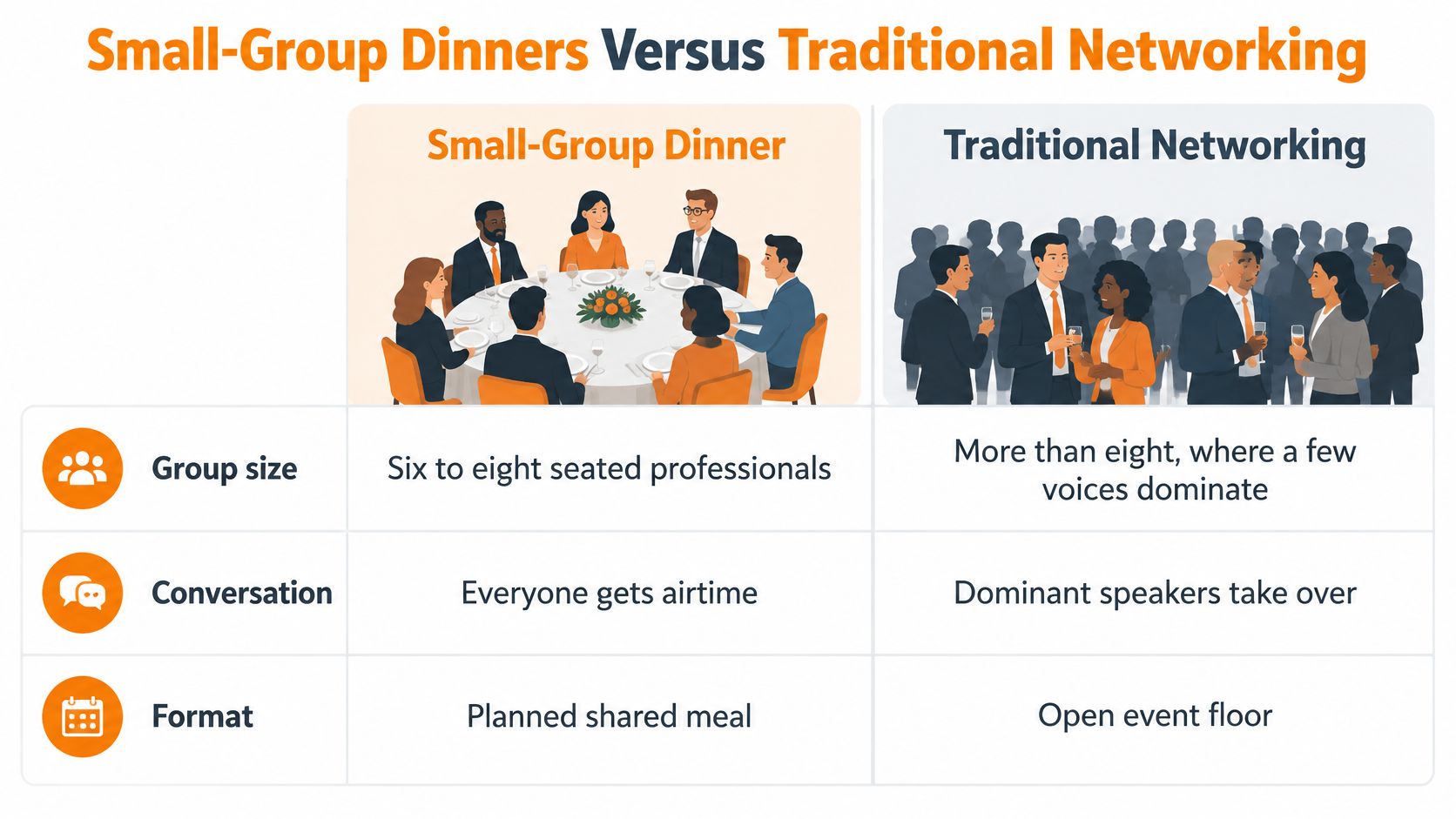
| Feature | Small-group dinner | Traditional networking event |
|---|---|---|
| Group size | 6 to 8 people | More than eight, where a few voices dominate |
| Setting | One seated table | Standing room with drinks |
| Length | About 2 to 3 hours | Usually 1 to 2 hours |
| Conversation | Long talks with every person | Short chats, then moving on |
| Introductions | Host-led or round-robin | Self-introduction and business cards |
| Vetting | Often screened, with confidentiality rules | Usually open to anyone with a ticket |
| Follow-up | Named commitments and a later check-in | Contact exchange, often no follow-up |
| Typical goal | Solve problems and build trust | Meet many people quickly |
Group size is the row that changes everything else. Research on team size and group dynamics puts psychologically safer discussion in smaller groups, with roughly four to eight participants as a workable range. Past eight, participation tilts: a few people talk and the rest mainly listen. At six to eight, everyone gets enough airtime to be remembered.
Setting and length run together. Standing room with a drink in your hand limits any conversation to a few minutes before someone excuses themselves. One seated table holds a topic for an hour, and the meal stretches the evening without anyone having to manufacture reasons to stay.
Introductions matter more than they look. A host who seats people deliberately can put the founder stuck on supplier pricing next to the operator who solved it two years ago. At an open event, you introduce yourself to strangers with no reason to trust you yet, and the business card you hand over carries no endorsement behind it.
Vetting produces the honesty. Dinners often screen attendees and set confidentiality rules up front, while open events let anyone with a ticket walk in. A screened table lowers the cost of saying something real, because everyone in earshot agreed to the same ground rules before they sat down.
Follow-up and goal split the same way. A mixer optimizes for breadth: meet many people quickly, collect cards, sort them later. A dinner optimizes for depth: the evening ends with named commitments, and someone checks back. One format leaves you with a stack of contacts to work through alone. The other leaves you with a small working group that already knows your problem.
The practical difference: a mixer is a market where you collect cards. A dinner is a kitchen table where you build relationships.
Some hosts keep improving the format by recording a short debrief after each dinner and publishing it for members who missed the evening. If your group does that as a podcast, mastermind podcast editing services can take the editing off the host's plate.
Why Trust Grows at One Table and the Rules That Protect It
A rowing crew of eight notices the moment one oar goes slack. A crowd of two hundred doing the same exercise notices nothing. Group size is the mechanism, and it explains why a small dinner produces follow-through a big room can't.
Social research on small groups and cooperation finds that people free-ride less, trust more, and feel more responsible for helping when they belong to smaller groups. Fewer people means each contribution is visible, and the cost of sitting silent while someone struggles gets higher. A promise made at a table of six has six witnesses. A promise made in a crowd has none.
The safety that lets people say the hard thing
Psychological safety is widely linked to stronger team performance and individual well-being. It means you can raise an idea, a question, or a worry without expecting punishment or humiliation.
Bring that idea to a dinner table. A founder needs permission to say the cash runway is nine weeks, the last hire didn't work out, or the launch flopped. Without that permission, you get a table of polished updates and zero useful information. Candor is what turns a meal into a problem-solving table.
There's a second obstacle. Harvard Business School research on networking discomfort, drawn from a program with 2,522 participants, found that networking focused on practical goals can trigger feelings of moral impurity, which makes people do less of it. The fix is simple to state: give something before you ask for anything. At a table of six, everyone sees who gave first.
The four rules a host sets at minute two
- No unsolicited selling. Pitching turns peers into prospects and shuts down candor.
- Personal stories stay in the room. What's said about cash flow, partners, or mistakes doesn't leave the table.
- Advice comes only when asked. Unsolicited fixes feel like judgment, so ask "do you want ideas or do you want me to listen?"
- Judge the problem, never the person. A founder describing a stalled hire needs a diagnosis, not a verdict.
Confidentiality supports trust; it doesn't guarantee it. Explicit rules just make candor easier to choose. That's why Chicago Brandstarters vets every member's ID and LinkedIn profile, and why members agree to the group's confidentiality expectations. Knowing who is sitting across from you lowers the reputational risk of speaking plainly about a failed experiment.
If someone breaks a rule, don't police it across the table. Raise it privately with the host, who can handle it without turning dinner into a tribunal.
How a Typical Dinner Runs From Start to Finish
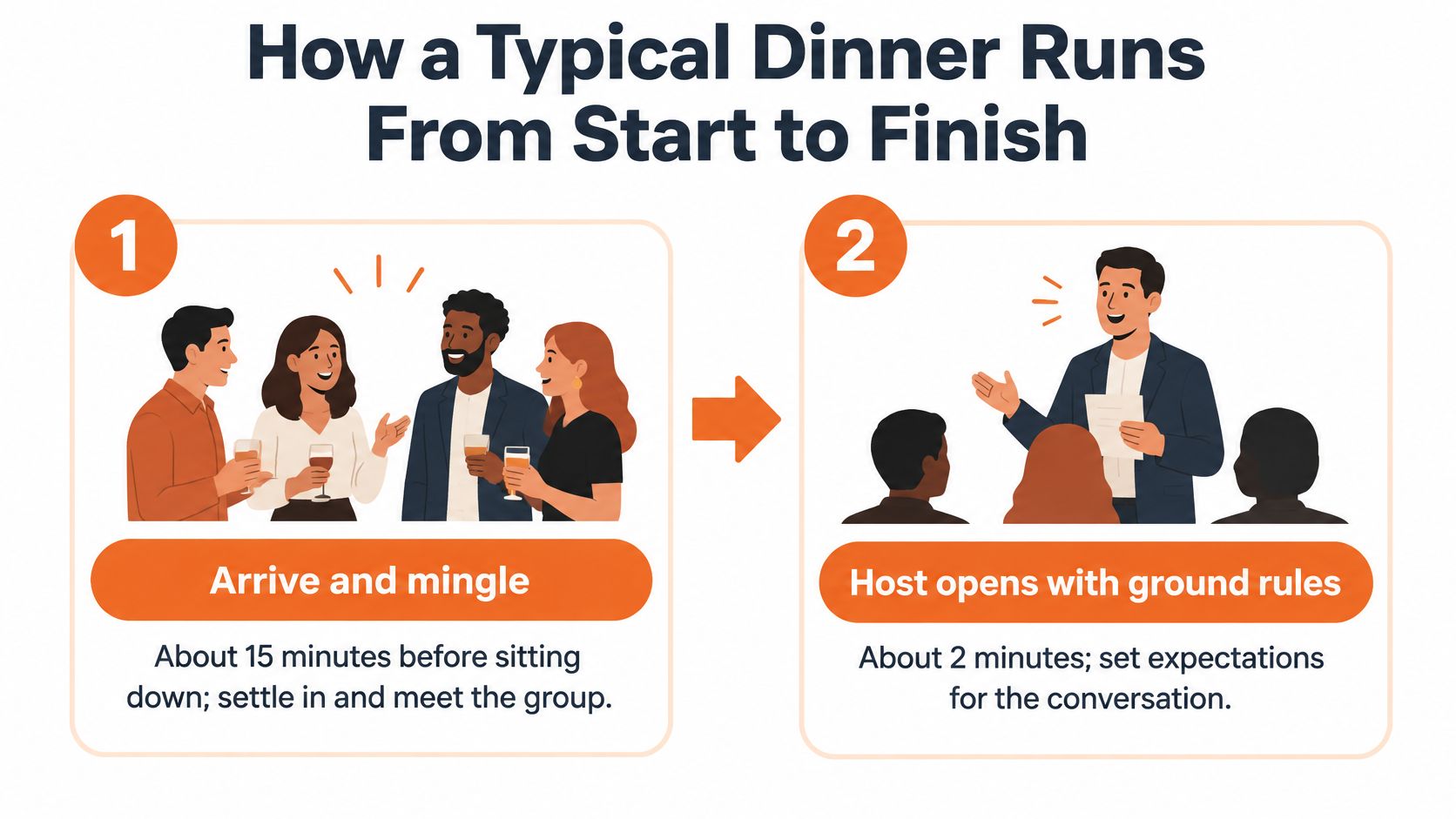
A good dinner has a rhythm, and once you've seen it twice you can feel the beats. Here's the sequence, with the timing and the reason for each part.
- Arrive and mingle, about 15 minutes. You settle in, get a drink, and meet the two people you'll sit near. Purpose: take the pressure off the first introduction.
- The host opens with ground rules, about 2 minutes. No selling, stories stay private, advice on request. Purpose: name the rules before anyone has to guess them.
- Round one, roughly 3 minutes a person. Name, what you do, and one current constraint. Purpose: everyone speaks in the first twenty minutes, so nobody stays a stranger.
- Round two, roughly 3 minutes a person. One request (an introduction, a supplier lead, a test to run) and one resource you can offer. Purpose: turn a status update into an exchange.
- Open conversation, about 60 minutes. Members respond, ask follow-ups, and trade specifics across the table. Purpose: reserve this time for actual problem-solving.
- The close. The host reads each commitment aloud and names an owner. Purpose: an unassigned promise is a wish.
- Follow-up at 30 days. The group counts introductions made, experiments launched, and problems resolved.
Total: about two to three hours including the meal.
Why the rounds exist
A study of peer networking in accelerator programs found that networking support had a strong, statistically significant direct relationship with venture growth. The benefit came from peer interaction, not from being in a room with impressive people.
That's the whole argument for structure. Ask each person to bring one current problem, one concrete request, and one useful resource for someone else, and the conversation stops being mingling and starts being trade. An idea-stage founder can ask for customer or supplier introductions, while a founder with revenue can hand over tested tactics and contacts.
We run these dinners for six to eight people every two weeks, and the format holds because the round happens whether or not anyone feels like sharing.
If you're new, aim for this: speak once in each round, listen hard in between, and leave with at least one commitment you own.
Preparing for Your First Business Networking Dinner
Twenty minutes of prep changes the whole evening. A table of six to eight people runs on specifics, so walk in with yours already written down. Work through this checklist one item at a time, with the reason attached to each.
Write your one-line description and say it out loud twice, so people remember what you do without a follow-up question.
Write down one current problem in specific terms, such as a supplier who keeps missing delivery dates or a pricing test that stalled at 40 customers, because a specific problem gives the table something to answer.
Decide your one request and one resource before you arrive. The rounds move quickly, and an offer you cannot name is an offer nobody can use.
Pick one question for each person you want to know better, because a real question earns more goodwill than a clever answer.
Bring a notebook or your phone to log commitments, because memory fades fast once the evening ends, so write commitments down before you leave the table.

A stack of business cards, a pitch deck, and a sales sheet all belong at home. Nobody at a table of six wants a deck, and pulling one out signals that you mistook the format for a conference. Prep for this dinner works like packing for a potluck, not a trade show: you bring one thing others can use, and you arrive ready to receive.
If you're pre-revenue, you still belong. Your questions sharpen other people's thinking, and your experience from a previous job or a first failed product is exactly the kind of detail a founder two years ahead has forgotten they need. Your questions and your experience earn the seat, not your revenue.
When the small talk stalls, a few networking conversation starters do more work than any pitch.
Your story is usually already in what you've done. The FameBoost insight for consultant visibility makes the same point: describe the work, not the label.
Deciding If a Small Dinner Group Fits You
Run the fit test before you run the calendar. A small-group dinner suits you if you want depth, honest advice, and a table you return to. It suits you less if you need twenty leads in one night or you're looking for a fast sales conversation.
Here's the test. Can you name one problem and one request right now? If yes, a dinner can help you this month. If you can't, a mixer or a one-to-one coffee will serve you better until you can.
Read that test twice. The problem is what gets you help, and the request is what gets you movement.
If you're a kind, bold, hard-working Chicagoan or Midwesterner starting a brand, our business network group is built for exactly this. We ask people to apply so we can keep the table serious, and membership costs $0.
After you apply, come to one dinner with your prep list in hand, then review your progress at 30 days. Count the introductions completed, the experiments launched, and the problems solved. That's how you'll know whether the format works for you, and no honest host will promise you more than that.
Chicago Brandstarters runs small, private business networking dinners for six to eight founders every two weeks, and membership is free. If you're building a brand in Chicago or anywhere across the Midwest and you'd rather trade real problems than business cards, we'd like to meet you. Apply at Chicago Brandstarters and come to your first table with one problem and one request in hand.
Leave a Reply