

I believe knowing when to quit your job boils down to one simple truth: you pull the trigger when the pain of staying is greater than the fear of leaving. It's about listening to your gut feeling and then making a strategic plan, not an impulsive leap. You’re not just running from something; you're building toward something better.
Is It The Right Time to Quit Your Job?

If you're reading this, that little voice in your head is probably getting louder. The Sunday Scaries hit harder than ever, meetings feel like a criminal waste of your talent, and you catch yourself daydreaming about what you could be building instead. I’ve been there. This isn’t just a bad week—it’s a signal.
And you're not alone. Employee turnover is through the roof, and disengagement is a silent epidemic. A recent Gallup report found that U.S. employee engagement is at an 11-year low. A jaw-dropping 50% of job-seekers said their manager was the main reason they left.
For you, an aspiring founder, this is the key takeaway: an estimated 40% of employees are actively considering quitting right now. This isn't just you; it's a massive trend.
The Real Reasons You're Ready to Leave
It’s almost never about one big, dramatic blow-up. It's usually a slow burn—a thousand tiny cuts that finally become too much. Think of it like a leaky faucet. One drop is nothing, but leave it long enough, and it floods the whole house.
Your reasons probably fall into a few common buckets:
- A Lack of Autonomy: You feel micromanaged, with no real ownership. Every day is just about following a script someone else wrote for you.
- Misaligned Values: The company’s mission, its culture, or its ethics just don't feel right anymore. You feel like you're compromising a piece of yourself every time you log on.
- Stagnant Growth: You've hit a ceiling. There's nothing new to learn, no clear path forward, and your own development has completely flatlined.
Your job should be a platform for your growth, not a cage. When you spend more time navigating internal politics than doing real, meaningful work, it’s a flashing red sign that your energy is being wasted.
From Frustration to Foundation
Many of the most successful founders I know in Chicago started right where you are. They didn’t just quit because they hated their jobs; they channeled that frustration into fuel.
The anger over clunky, inefficient processes became the fire to build a better system. The annoyance with a terrible boss inspired them to become the kind of leader they always wished they’d had.
This decision isn't just about escaping a bad scene. It's about realizing your dissatisfaction is actually powerful data. It's pointing you directly toward a problem you are uniquely qualified to solve. Your desire to leave isn't a failure—it’s the first step toward building something that truly matters to you.
Before you make the final call, it’s smart to walk through a solid framework for making decisions to make sure your choice is both logical and emotionally sound.
So, you're thinking about quitting your job to go all-in on your business idea. Let's talk about that.
Quitting without a plan is like jumping out of a plane and hoping you’ll sprout wings on the way down. It's a bad idea. Before you even think about writing that resignation letter, we need to do a brutally honest self-audit.
This isn't just about money. It's about stress-testing your idea and getting your head right for the insane pressure that’s coming. We're going to skip the generic advice and build your parachute, piece by piece. This is your no-nonsense checklist to make sure you're taking a calculated risk, not a blind gamble.
Your Pre-Launch Financial and Mental Checklist
Calculating Your True Financial Runway
That old advice to "save six months of expenses" is dangerously outdated for a founder. It just doesn't work.
Your 9-to-5 job is a predictable paycheck, like a steady IV drip of cash. Entrepreneurship is completely different. It’s more like hunting for your own food—some days you’ll feast, and many others you’ll go hungry.
Your founder's runway isn't just about covering rent and groceries. It has to cover the hidden costs that ambush you the second that W-2 income disappears. You're not just trying to survive; you're trying to build a business from ground zero.
Let’s get specific. You need to budget for:
- COBRA or ACA Premiums: Your employer is probably subsidizing 70% or more of your health insurance. That cost is now 100% on you, and trust me, it can be a shocking monthly bill.
- Self-Employment Taxes: Say goodbye to your employer covering half of your FICA taxes. You're now on the hook for the full 15.3% on your earnings, and that's before federal and state income taxes.
- Business Startup Costs: Even a super-lean business has expenses. Think software subscriptions, legal fees to set up your LLC, a new laptop, or those first few marketing experiments. They add up fast.
- The 'Oh Sh*t' Fund: This is for when life happens. A surprise car repair or an unexpected medical bill can completely derail you if your margins are razor-thin.
Think of your savings as the fuel in a rocket ship. You need enough to not only get into orbit but also to handle course corrections and unexpected turbulence without crashing back to Earth. Aim for 9-12 months of your total runway, not just personal expenses.
To get a clearer picture, let's map it out. Use this simple calculator to figure out exactly how much cash you need in the bank before you make the leap.
Your Financial Runway Calculator
Use this table to calculate the minimum savings you need before quitting your job, factoring in both personal and early business expenses.
| Expense Category | Monthly Cost | Recommended 9-Month Total | Notes and Considerations |
|---|---|---|---|
| Rent / Mortgage | |||
| Utilities | (Gas, Electric, Water, Internet) | ||
| Groceries / Food | |||
| Health Insurance | (COBRA or ACA Marketplace plan) | ||
| Car Payment / Transit | |||
| Phone Bill | |||
| Student Loans / Debt | |||
| Personal Spending | (Entertainment, etc.) | ||
| Personal Subtotal | $0 | $0 | |
| Business Software (SaaS) | (Email, CRM, Accounting, etc.) | ||
| Legal / Accounting Fees | (LLC formation, CPA advice) | ||
| Marketing / Ad Spend | (Initial test budget) | ||
| Inventory / Supplies | |||
| 'Oh Sh*t' Fund | (Aim for 15-20% of total expenses) | ||
| Business Subtotal | $0 | $0 | |
| GRAND TOTAL | $0 | $0 | This is your target savings number! |
Seeing the final number in black and white can be a real wake-up call. It's not meant to scare you—it's meant to prepare you. Now you have a real, tangible goal to work toward.
Pressure-Testing Your Business Idea
Having a cool idea is not the same as having a business. I'll say it again: a cool idea is not a business.
Before you quit, you have to prove that people other than your mom will actually pay you for what you're building. The great news is your day job provides the perfect, low-risk laboratory to do just that.
First, ask yourself: are you solving a real, painful problem? A "vitamin" is a nice-to-have. A "painkiller" is something people desperately need and will happily pay for. You need to be a painkiller.
Here’s how you can test your concept while you still have that steady income:
- Build a 'Minimum Viable Audience': Start a newsletter, a blog, or a social media account focused on the problem you solve. Can you attract 100 true fans who are genuinely into your topic?
- Conduct Customer Interviews: This is non-negotiable. Talk to at least 20-30 people in your target market. Don't pitch them. Just listen. Ask about their problems and use their exact language to describe their pain points.
- Presell Your Idea: This is the ultimate test. Can you get someone to pay you before the product even exists? A simple landing page with a "Pre-Order Now" button can tell you everything you need to know about market demand. For more on this, check out our guide on how to start a business with no money.
The Mental and Emotional Readiness Audit
The financial leap is scary, but the mental grind is what truly breaks most founders.
Entrepreneurship is lonely. The predictable structure of a 9-to-5—colleagues, regular feedback, a clear career path—is gone overnight. Suddenly, you're the CEO, the intern, the salesperson, and the janitor, all at once. The highs are higher, but the lows are crushingly lower. Are you really prepared for that emotional rollercoaster?
Ask yourself these hard questions:
- Can you handle solitude? You'll spend countless hours working alone. Do you have a solid support system—a partner, friends, or a community like Chicago Brandstarters—who actually gets what you're going through?
- How do you react to failure? You will face rejection and setbacks every single day. Can you treat failure as data and a lesson, or will it just crush your motivation?
- Are you self-disciplined? There's no boss looking over your shoulder. Can you stay focused and execute consistently, even on the days you have zero motivation?
This checklist isn't meant to talk you out of it. It's designed to make sure you walk in with your eyes wide open. Quitting your job is a massive step, but with the right financial cushion, a validated idea, and a resilient mindset, you’re not just quitting—you’re launching.
Crafting Your Strategic Exit Plan
Once you've pressure-tested your finances and got a solid gut-check on your idea, the next big piece of the puzzle is timing your exit. This isn't just about blurting out "I quit." It's a strategic move, like a well-played chess game, designed to protect your hard-earned reputation and give you the maximum runway for what’s next.
You need to become a student of your company's internal rhythm. Think of it like a surfer reading the ocean. You don’t just paddle out into chaos; you wait for the right wave to carry you smoothly to shore. That means watching for the signs inside your own workplace.
Is your department about to wrap up a massive, year-long project? That's a natural exit point. Are whispers about restructuring or layoffs getting louder? It might be smarter to make your move before the company makes it for you. Your goal is to leave on a high note, not in the middle of a dumpster fire.
This visual breaks down the core checkpoints—finances, idea validation, and your own mental state—that signal you're truly ready to pull the trigger.
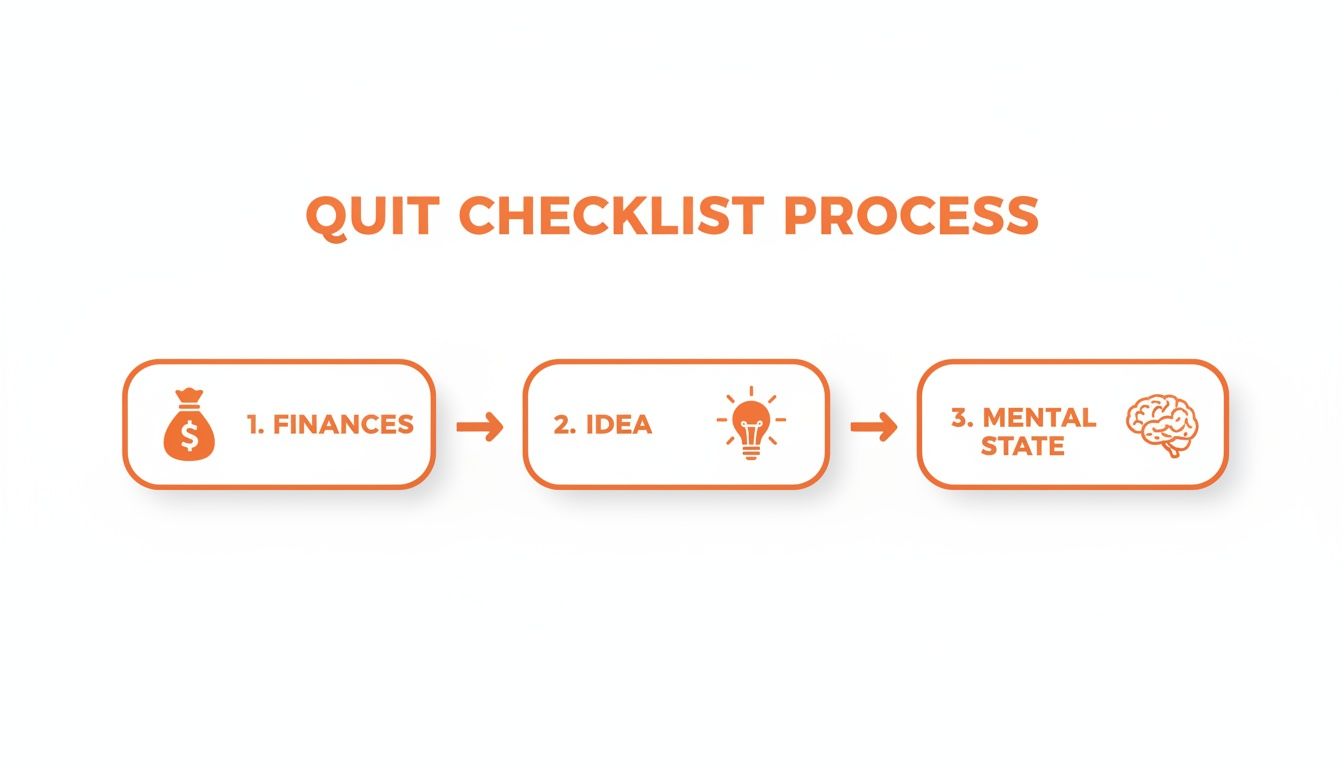
This flow shows how your financial runway, a validated idea, and mental preparedness aren't just separate boxes to check—they build on each other, forming the foundation of your decision to leave.
Align Your Exit With Your Wallet
Timing isn't just about office politics; it's about your bank account. Quitting a week before your annual bonus hits or your stock options vest is a rookie mistake. It's like leaving the game in the final inning right before your team scores.
Get your hands on your company's bonus policy and your stock grant agreement. Find the exact dates for these key events:
- Bonus Payouts: Know when the money actually lands in your bank. Don't resign the day you're told the amount; wait until that direct deposit clears.
- Stock Vesting: Vesting usually happens on a specific date or your work anniversary. Bouncing even one day early could cost you thousands.
- 401(k) Matching: Some companies have a vesting schedule for their matching funds. Make sure you've been there long enough to keep all the free money they gave you.
See your last few months at the job as your first angel investment in your new venture—funded entirely by your old employer. Stay focused, collect what you've earned, and then make your graceful exit.
Don't be surprised by how common it is for people to quit. Across the U.S., quits have stabilized around 3.0 million per month, a big slice of the 5.1 million total monthly separations. In sectors like retail, turnover can be as high as 59.8%, and for most companies, only 38% can accurately predict who is going to leave next. Your departure might be less of a shock than you think. You can dig into these U.S. labor turnover statistics on BLS.gov.
Translate the Legal Jargon in Your Contract
Before you even think about giving notice, you need to go on a treasure hunt for your original employment agreement. Tucked away in that dense legal document are potential landmines that could sabotage your new business before it even gets off the ground.
You’re looking for a few key clauses. The big one is the non-compete agreement. This can restrict you from working in the same industry or even the same city for a set period. While they're often tough to enforce, you absolutely need to know if you signed one and what it says.
Also, keep an eye out for clauses on "inventions" or "intellectual property." Some contracts state that anything you create while employed—even on your own time—belongs to the company. This is exactly why it's so critical to build your side project on your own equipment and strictly outside of work hours.
If any of this legal language feels like gibberish, this is not the time for guesswork. Spend a few hundred bucks to have an employment lawyer look over your contract. It's a small price to pay to avoid walking into a legal battle later. This clarity is also essential as you formalize your new venture's strategy; you can find more guidance in our startup business plan template.
Leaving with your professional reputation—and your future business—intact is the whole point. By carefully timing your departure and understanding your legal obligations, you set the stage for a clean, powerful launch.
How to Have The Resignation Talk
This is it. The conversation you’ve probably been rehearsing in the shower for weeks. I know it can feel like a huge, dramatic scene is about to unfold, but I promise you, it doesn’t have to.
Think of your resignation as the final project you’ll deliver for this company. Your goal isn’t to burn bridges or launch into a monologue about everything that’s wrong. It’s to execute a clean, professional, and graceful exit that leaves everyone feeling respected.
Let's walk through exactly how to handle this conversation with confidence, no matter who's on the other side of the desk.
Preparing for the Conversation
Walking into this meeting prepared is the difference between a calm discussion and an awkward, rambling mess. You need to have your key points locked in before you even schedule the meeting.
Your message should be simple, direct, and completely unshakable. Don't leave any room for ambiguity. This isn't a negotiation; it's an announcement.
Here’s your pre-meeting checklist:
- Decide Your Last Day: Have a specific date in mind. Two weeks is the standard notice, but it's smart to double-check your contract for any specific requirements.
- Write Your Resignation Letter: Bring a printed and signed copy with you. Keep it brief and professional. All it needs to say is that you're resigning and what your final day of employment will be.
- Anticipate Questions: Your manager is almost guaranteed to ask why you're leaving and where you're going. You don't owe them a detailed explanation. Prepare a concise, positive, and generic answer you can deliver without flinching.
Your resignation talk is a notification, not a conversation. Your job is to deliver the news clearly and professionally, not to justify your decision or get drawn into an emotional debate.
Scripts for Different Scenarios
The dynamic of this conversation is going to feel different depending on your relationship with your manager. You can’t use the same script for a boss you genuinely admire as you would for one you can’t stand.
Let’s role-play a few common situations so you have the right words ready to go.
Scenario 1: The Manager You Admire and Respect
This is often the hardest conversation to have. You feel a sense of loyalty and don't want to let them down. The key here is to express genuine gratitude while remaining firm in your decision.
- You: "Hi [Manager's Name], do you have a few minutes to talk privately? I wanted to let you know that I've decided to move on from my role here. My last day will be [Date]."
- Them: "Wow, I'm really surprised to hear that. Is there something we can do?"
- You: "I've really appreciated the opportunity to work with you and learn from you. This was a difficult decision, but I’ve accepted another opportunity that aligns with my long-term career goals. I’m committed to ensuring a smooth transition over the next two weeks."
Scenario 2: The Manager You Don't Get Along With
It's so tempting to use this moment to air all your grievances. Don't do it. It will only make you look unprofessional and burn a bridge you might not realize you need later. Keep it brief, factual, and completely devoid of emotion.
- You: "Hi [Manager's Name]. I’m here to let you know that I am resigning from my position. My last day will be [Date]. Here is my formal letter of resignation."
- Them: "Okay. Why are you leaving?"
- You: "I've found a new opportunity that is a better fit for my career path. I am happy to help create a transition plan to wrap up my projects before I leave."
Handling the Inevitable Counteroffer
Once you resign, there's a good chance your company will suddenly find the budget for that raise you've been asking for. This is the counteroffer, and it's a trap.
Accepting a counteroffer is almost always a mistake. Think about it: why did they only value you this much when you had one foot out the door?
The money might be a temporary fix, but the underlying reasons you wanted to leave—the bad culture, the lack of growth, the toxic management—will still be there. Studies have shown that a majority of employees who accept a counteroffer end up leaving within a year anyway. Politely, but firmly, decline.
Here’s how to say no without burning the bridge:
- "I genuinely appreciate the offer. It means a lot. However, my decision isn't about the money. I’m really excited about this new direction and have already committed to it."
Your resignation is your final act as an employee. By staying professional, direct, and gracious, you close this chapter on your own terms and set yourself up for a clean start on your next big adventure.
Managing Your Final Two Weeks and Beyond

How you navigate your last two weeks says everything. You can either quietly fade out or you can finish strong, leaving behind a reputation for professionalism that will follow you for years.
This is your last chance to make a good impression.
The mission here is simple: execute a smooth, responsible handover. Tie up every loose end you can and set your team up to succeed without you. After that, it's time to pivot to the administrative maze that is your new life.
Create an Invaluable Transition Document
Your single most important task during your notice period is building a rock-solid transition document. Seriously, think of it as the ultimate user manual for your job. The goal is to make it so unbelievably thorough that your replacement could step in and get moving with almost zero hand-holding.
This document isn’t just a nice thing to do; it’s a strategic move. It makes you look incredibly organized and responsible. More importantly, it dramatically reduces the frantic emails and calls you'll get weeks after you’ve already checked out.
Your handover guide has to include:
- Project Status: A clean summary of all your current projects. What's the status, who are the key contacts, what are the next steps, and what are the potential roadblocks?
- Key Responsibilities: Break down your daily, weekly, and monthly tasks. Don't assume anything is obvious. If you do it, write it down.
- Essential Contacts: A list of vendors, clients, and internal stakeholders, with a quick note on your relationship dynamic with them.
- File Locations: Direct links to important documents, reports, and templates on the company server. Don't make them hunt for things.
Your transition document is your legacy. It’s the final proof of your competence and the ultimate act of goodwill that ensures you leave on the best possible terms.
The Art of the Exit Interview
Sooner or later, you'll get that calendar invite from HR for an exit interview. It's incredibly tempting to use this as a final opportunity to unload every frustration you've ever had.
Don't do it. You have to resist that urge.
The exit interview is not a therapy session. Anything you say gets noted in your employee file, forever. The smart play is to be polite, constructive, and strategically vague.
Keep your feedback high-level. Instead of saying, "My manager was a micromanager who made my life miserable," try something more diplomatic like, "I'm looking for a role with more autonomy over my projects." Focus on the pull of the new opportunity, not the push from the old job.
Remember, in some industries, leaving is just part of the game. In hospitality, total turnover is a massive 75.2%, while retail sees 59.8%. In these fields, your professional exit is just business as usual. This is a sharp contrast to the 84% of employees in the 'Eggshell Economy' who feel trapped and are afraid to make a move. For the company, remember that 66% of HR executives say retention is their biggest challenge, which is why they take these interviews seriously. You can learn about the latest employee retention statistics to get the full picture.
Your Post-Resignation Logistics Checklist
Once your last day is officially in the rearview mirror, the real work begins. You're no longer just an employee; you're the CEO of your own life and your new business. That means you're on the hook for all the administrative stuff your old employer used to handle.
Here’s your immediate to-do list for Day One of your new life:
- Tackle Health Insurance Immediately: You’ll get paperwork for COBRA, which lets you keep your old health plan… but you'll be paying the full, often shocking, premium. Get on the ACA Marketplace immediately. Losing your job is a qualifying life event, so you can enroll outside the standard window.
- Roll Over Your 401(k): You've got a few options here. You can leave it with your old company (if the balance is high enough), roll it into an IRA, or potentially move it into a new Solo 401(k) for your business. Whatever you do, don't just cash it out. You'll get crushed by taxes and penalties.
- Understand Your New Tax Situation: Welcome to the world of self-employment tax. You're now responsible for paying the full 15.3% yourself. You'll likely need to start making estimated tax payments to the IRS every quarter. Skip this, and you'll face a monster bill plus penalties at the end of the year. This is the perfect time to find a CPA who specializes in small businesses.
Your Toughest Questions Answered
Alright, let's get into the tricky questions, the ones that probably keep you up at night. Quitting your job to go all-in on an idea is a massive leap, and it's totally normal to have these doubts circling. Here are my straight-up answers to the questions I hear most often from founders planning their escape.
How Much Money Should I Really Save Before I Quit My Job?
Forget the old "6 months of expenses" rule. That's for someone looking for another 9-to-5. For a founder, that’s barely scratching the surface. You need to think in terms of a founder's runway. This isn't just about survival; it's about giving your business a real chance to breathe and grow.
First, get brutally honest about your personal survival budget—the absolute bare-bones minimum you need for rent, groceries, and essential bills. Next, map out a realistic guess for your initial business costs for the first nine months. Add those two numbers together.
The real goal here is to have 9-12 months of that total runway socked away. This cushion is your single biggest advantage. It lets you build, test, and even mess up without making desperate choices because your bank account is screaming at you.
What If My Boss Makes a Huge Counteroffer to Keep Me?
I get it. It feels amazing to be wanted, and that huge number can be incredibly tempting. But trust me on this: accepting a counteroffer is almost always a mistake. It’s like slapping a new coat of paint on a house with a busted foundation.
You have to ask yourself one simple, critical question: Why did they only decide you were worth that much when you were already one foot out the door?
The real reasons you wanted to leave—the toxic culture, the dead-end projects, the micromanaging boss—those things aren't going anywhere. They'll still be there in a month. The stats don't lie: the vast majority of people who take a counteroffer are gone within a year anyway. Just politely decline. Explain that your decision is about chasing a new opportunity you're truly passionate about, not just about the money.
Can I Work on My Business While I Am Still Employed?
Yes, absolutely. In fact, you should. This is your golden opportunity to de-risk the entire venture before you take the final plunge.
Think of it as running a secret lab on the side. The rules of this lab are non-negotiable:
- Never use company time. Not for a minute.
- Never use your work laptop or any company software.
- Never use company resources. Period.
This has to be done on your own time, with your own gear. The most important thing you can do right now is dig up your employment agreement and read it carefully. Look for any nasty clauses about “inventions” or non-compete agreements. These can be serious traps. Your goal is to build a prototype and validate your idea quietly, so when you do quit, you’re hitting the ground sprinting, not starting from a standstill.
How Do I Handle Health Insurance After I Quit?
This is the big, scary one for a lot of people in the U.S., but you've got options. It’s not as bad as you think.
Your most immediate path is COBRA. This lets you keep your old health plan, which sounds great until you see the bill. You have to pay 100% of the premium yourself, and it's often shockingly expensive.
For most new founders, a much better route is the ACA Marketplace (you know it as Healthcare.gov). The beautiful thing is that losing your job is a “qualifying life event.” This means you can enroll for a new plan right away, even outside the normal open enrollment period. And because your income as a founder will likely be much lower, you might qualify for subsidies that make your monthly premium surprisingly affordable. Do your research on this before your last day so you have a plan ready to execute.
At Chicago Brandstarters, we believe Chicago's spirit of kindness and hard work makes for the best founders. If you’re ready to build something meaningful and want a community that has your back, we're here for you. Join our free, vetted community to connect with peers who get it. Learn more and apply to join at chicagobrandstarters.com.
Leave a Reply