
You have a killer idea but an empty wallet. Perfect. Let's get one thing straight: you don't need a VC's blessing or a trust fund to build a real, profitable business. Especially not here in Chicago.
I'm not here to just shift your mindset from "I can't afford it" to "How do I make this happen?" I'm here to show you the proven, scrappy path that thousands of founders have walked before you. We're going to dismantle the myth that you need a huge pile of cash to get started.
The tech blogs obsess over the twenty-something who raises millions. That's a tiny fraction of the story. For most of us, the real game is bootstrapping. You build a business on a foundation of actual revenue, not just an investor's speculative hype.
Startup Funding Realities Bootstrap vs VC
Here’s a no-fluff comparison of the two main paths. This is what really matters when you're just starting out.
| Factor | Bootstrapping (Your Path) | Venture Capital (The Hype) |
|---|---|---|
| Control | You own 100%. Every decision is yours. | You give up equity and board seats. You now have a boss. |
| Speed | Move as fast as you can. No need to ask for permission. | Slowed down by board meetings, reporting, and investor approvals. |
| Focus | Solving a customer's problem to generate revenue. | Hitting growth metrics to raise the next round. |
| Pressure | Internal pressure to stay profitable and serve customers. | External pressure to become a "unicorn" or die trying. |
| Initial Capital | Your own savings, hustle, and early sales. | Other people's money, in exchange for a piece of your dream. |
When you bootstrap, you answer to your customers, not a board of directors. You get to build the company you want to build, on your terms. It’s a path that values your grit and resourcefulness over a fancy pitch deck.
Start Where You Are, With What You Have
That idea you have for a new brand? That bit of money in your savings account? That’s not a dead end. That's your starting line.
Bootstrapping isn’t some niche path; it's how most real businesses are built. A massive 77% of small businesses start using the founder’s personal savings. You don’t need a fat wallet. In fact, one-third of small businesses launch with less than $5,000, and 58% get off the ground with under $25,000.
These numbers aren't just statistics; they're your permission slip to begin. It’s a core philosophy we live by in our Chicago Brandstarters community, where real founders share the unglamorous war stories of making it work on a shoestring.
The most powerful asset you have as a bootstrapper isn't money. It's the ability to make decisions instantly without asking for anyone's permission. You own 100% of your company and 100% of your destiny.
This simple flow chart nails the process. It's not just about the idea; it's about what you do next.
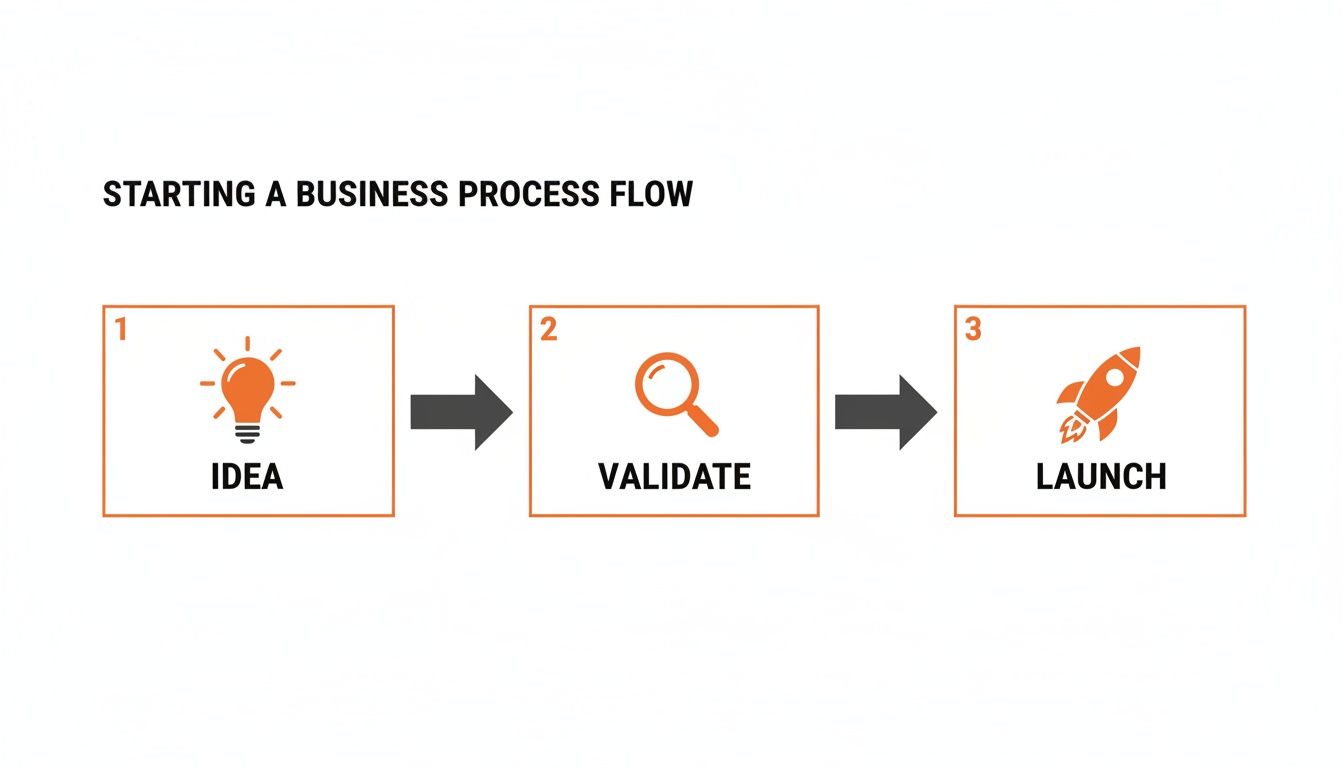
Look closely. The most important step—the one that saves you from catastrophic failure—is right in the middle: Validate.
Why You Must Validate Before You Build
I've seen it happen too many times. A founder pours their life savings and sleepless nights into building the "perfect" product, only to launch to the sound of crickets. It's a heartbreaking and completely avoidable mistake.
The secret to smart bootstrapping is proving people will actually pay you for your idea before you spend a dollar building it. This validation phase is your shield.
It’s not complicated. You just have to get out of your head and do a few things:
- Talk to potential customers. I mean real conversations. What are their biggest headaches? What have they tried to fix it? Shut up and listen.
- Throw up a simple "offer" page. Use a tool like Carrd or Unbounce to create a one-page site explaining what you do. Add a "Pre-Order Now" button. See if anyone clicks.
- Pre-sell it. This is the ultimate validation. If you can get someone to give you their hard-earned money for something that doesn't exist yet, you're onto something big.
This feels completely backward to most people, but it’s the key to de-risking your entire venture. We dive deeper into these scrappy tactics in our guide on how to start a business with no money.
This is how you earn the freedom to build a business that actually lasts.
Building a Lean MVP Without Going Broke

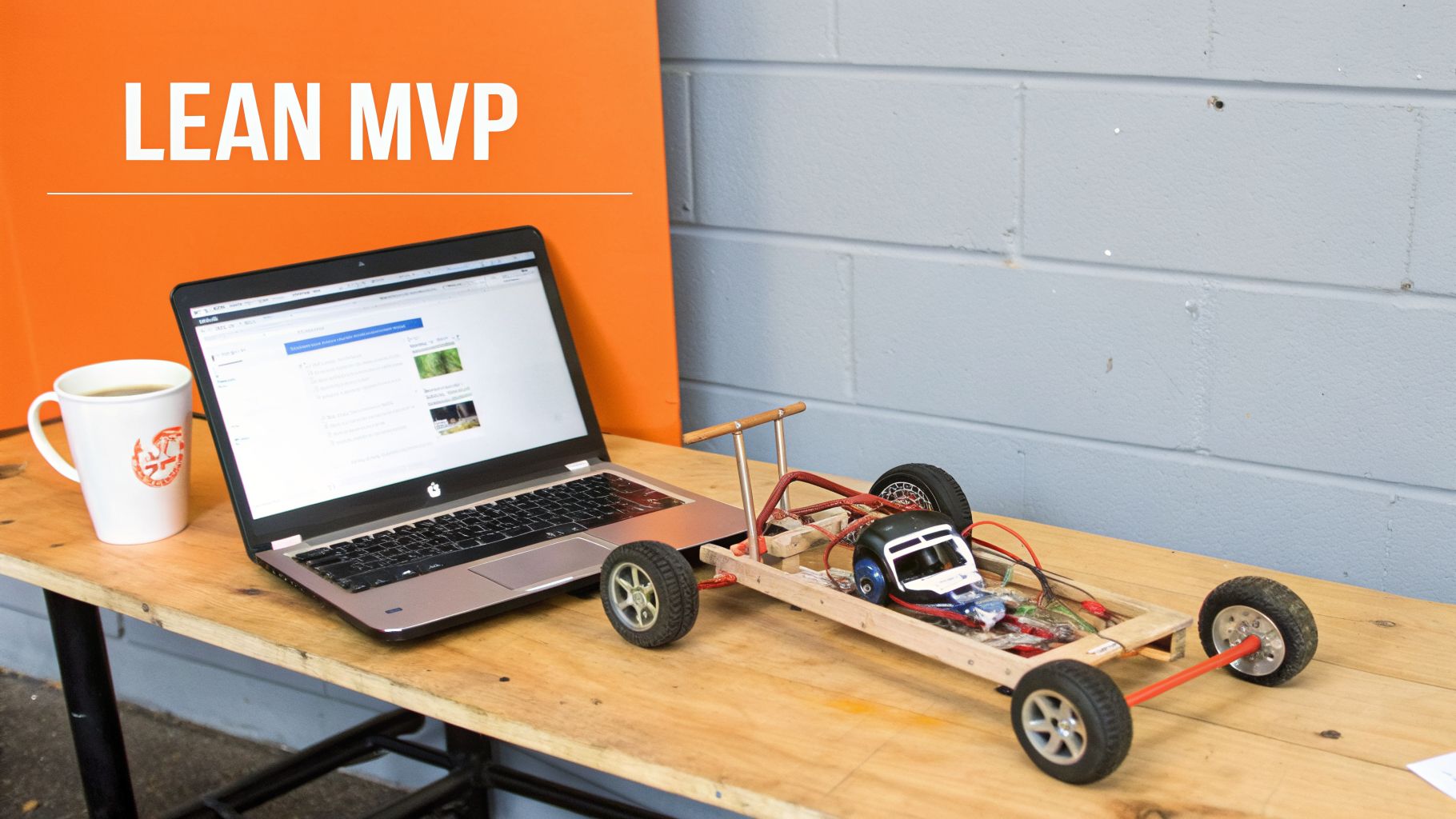
Your Minimum Viable Product (MVP) is just the simplest version of your idea that proves someone will pay you for it. Think of it this way: you’re building a functional go-kart before you even dream of designing a sports car. This isn't about perfection. It’s about speed and learning.
The point is getting something—anything—that works into a real customer’s hands fast. This is how you learn from their actions, not your own wishful thinking. Every hour you spend polishing a feature nobody asked for is an hour you’re not getting the feedback that actually matters.
Your MVP Doesn't Have to Be Software
So many people hear "MVP" and immediately think of a stripped-down app. That’s one route, but it's usually the most expensive one. You can test almost any business idea without writing a single line of code.
An MVP is a promise to solve a customer’s problem. You don't always need slick tech to deliver on that promise at first.
I’ve seen fellow Chicago founders launch entire businesses with a simple landing page and a Google Form. A friend of mine wanted to start a custom meal-prep service. Instead of dropping thousands on a developer, he threw up a one-page site on Carrd, embedded a Google Form for orders, and took payments through Venmo. That was his MVP, and it proved he had a real business.
The goal of your MVP is to maximize learning while minimizing risk. You're not building your final product. You're just trying to prove your core idea is right with the least effort possible.
This approach lets you test the single most critical question: will someone pull out their wallet for this?
The Power of No-Code and Freelancers
The thought of building a website or an app stops most people. But here’s the thing: you have superpowers now. No-code tools are your secret weapon for building powerful platforms without a technical background.
- For Websites: Tools like Webflow or Framer let you build professional sites visually.
- For Apps: Platforms like Bubble or Adalo allow you to create complex apps with a drag-and-drop interface.
- For Automation: Think of Zapier and Make as the digital glue connecting your tools so they work together automatically.
For anything truly out of your wheelhouse, hire a freelancer. But be surgical about it. Find someone on Upwork for one, single, well-defined task. Instead of hiring a "developer," you hire someone to "set up a Stripe payment gateway on my Webflow site." It keeps costs down and gets you exactly what you need.
The Barter System Is Alive and Well
Never underestimate your own skills. As a bootstrapper, your time and expertise are currency.
Are you a great writer? Offer to write blog posts for a designer in exchange for a logo. Can you run social media in your sleep? Trade your services with a photographer for product shots.
Of course, this only works if you’re part of a community—you can’t barter in a vacuum. This is where knowing other founders, especially locally in groups like Chicago Brandstarters, becomes so important. When you build real relationships, you find ways to help each other that don't involve money. A friend in our group traded his financial modeling skills for help with video editing. Both got something they desperately needed without draining their bank accounts.
Bootstrapping is all about being resourceful, and trading skills is one of the best ways to do it.
Mastering Your Money and Extending Your Runway
When you're bootstrapping, cash isn't king. Cash is oxygen. The second you run out, the business dies. Simple as that.
But here’s the secret: being broke forces you to be smart. You build a discipline that funded startups, with their bloated budgets, will never understand. You don't need a fancy financial model. You just need a simple budget and the guts to look at it every day.
Calculating Your Cash Runway
Your cash runway is the single most important number you need to know. It's how many months you have left until your bank account hits $0. It’s a scary number, but not knowing it is far scarier.
The math is dead simple. Take your total cash in the bank and divide it by how much you spend each month.
Runway (in months) = Total Cash in Bank / Monthly Burn Rate
Your monthly spend is your burn rate—think software, hosting, any contractor fees. If you have $6,000 in the bank and your burn is $1,000 a month, you have a six-month runway.
Now that anxiety has a number, you can do something about it.
Extending Your Runway One Decision at a Time
Okay, you have your runway number. The game is simple: make that number bigger. You either cut costs or make more money. Early on, cutting costs is the lever you control most.
This isn’t about being a cheapskate. It’s about being absolutely ruthless. Every dollar must get you closer to making money.
I see new founders bleed cash in the same dumb ways over and over:
- Buying Fancy Tools Too Soon: You don't need the enterprise version of anything. The free tier of most tools will get you to your first 100 customers. That $50/month subscription might feel small, but it’s $600 a year. In our example, that's nearly a whole extra month of life.
- Wasting Money on "Vanity" Crap: Nobody cares about your custom email domain, branded hoodies, or slick business cards when you have zero customers. A Gmail account works. Your first customers only care if you can solve their problem.
- Outsourcing a Job You Can Do (Poorly): Before you pay a freelancer, ask yourself: can I do a "good enough" version myself? Learning basic design on Canva or tracking money in a spreadsheet saves cash. More importantly, it forces you to learn how your business works.
These small, painful choices are how you buy yourself more time.
The Daily Financial Check-In
The most successful bootstrappers I know have a five-minute morning ritual. They open their bank account. They open their budget spreadsheet. That's it.
This isn't about accounting. It's about getting a gut feel for the pulse of your business. It makes the pain of spending real and the joy of a new sale even better. We cover these habits in more detail in our guide to effective cash flow management for small business owners.
You wouldn't start a road trip without checking the gas tank. Why would you start your workday flying blind?
This habit stops quiet leaks from sinking your ship. It makes sure you, the founder, are never in the dark about the one resource that matters most.
You’ve built a lean MVP and you're watching every penny. Now for the hard part: getting paying customers. Forget a marketing budget. You don't have one. And that's okay. This is where the real, roll-up-your-sleeves hustle begins.
This is the stuff business school can't teach. We’re talking about finding your first 100 customers using grit, community, and pure human connection. And if you’re in Chicago, you’ve got a home-field advantage. We know how to build real relationships here.
Finding Your First 100 Customers for Free
Go Where Your Customers Already Live
Your perfect customers aren't waiting for a magical ad. They’re already out there, gathered in online forums and real-life groups, complaining about the exact problems you solve. Your job is to find those places and join the conversation.
Seriously, don’t just launch a new Instagram account and post into the void. It’s a waste of time.
If you’re launching, say, a new line of durable bike bags, spend your time in Chicago-based cycling Facebook groups or jumping into threads on r/chibike. Don’t pitch. Just answer questions, share your expertise, and become a helpful, known person. The sales will follow your reputation.
Forget fancy marketing spreadsheets for now. Your first marketing plan is just a list of communities. Find out where your people hang out, show up consistently, and be genuinely helpful. Your reputation is your best marketing tool.
This flips the script. You stop shouting "buy my product!" and start asking "how can I help?" People listen when you give value before you ask for a sale. It’s a game-changer.
Get Offline and Meet People
Everyone is obsessed with digital marketing that scales. That’s your advantage. Do things that don't scale. Your first customers will almost always come from face-to-face contact.
- Local Markets: A booth at the Logan Square Farmers Market is more than a few sales. It’s a firehose of customer feedback. You'll have hundreds of real conversations, see people’s reactions firsthand, and put a human face to your brand.
- Team Up with Other Locals: Find a non-competing business with your ideal customer. If you sell artisanal dog treats, why not partner with a popular dog groomer in Lincoln Park? You can offer an exclusive discount to their clients. It’s a win for them, a win for you, and it costs you nothing but hustle.
- The Coffee Shop Pitch: Yes, I'm serious. If you see someone who looks like your ideal customer, start a conversation. Ask them about their work, their problems. It’s terrifying at first, but one honest conversation is worth more than a thousand empty website clicks.
These hyper-local tactics are your foundation. They say 85% of small businesses get customers from word-of-mouth. These real-world interactions are where those crucial first conversations begin.
Start Building for the Long Haul
While you’re grinding, you need to plant some seeds that will grow later. That means starting two things on day one: your content and your email list.
Don't think of your blog as a way to go viral. Think of it as a resource library. Just write articles that answer the top questions your customers always ask. If you sell eco-friendly cleaning supplies, write a post called "How to Deep Clean a Studio Apartment in Under an Hour." This is how you start building a base for SEO without paying for ads.
Finally, and this is critical, start your email list from day one. It's the only marketing channel you will ever truly own.
- First, create a simple, valuable freebie, like a one-page checklist.
- Next, sign up for a service like MailerLite. Their free plan is more than enough to start.
- Then, put that sign-up link everywhere: your website footer, your email signature, your social media bios.
Your email list is your direct line to your biggest fans. It's where you'll announce new products and turn those first 100 customers into a thriving community.
When to Outsource, Hire, or Just Hustle Harder

Once you start making real money, a new panic sets in. You physically can't do everything yourself anymore. Orders are piling up, emails are getting buried, and your big vision is lost under a mountain of tedious tasks.
This is a dangerous spot. Your first thought might be to hire someone to stop the bleeding. But hiring too soon is a classic, cash-draining trap that can sink your business.
So how do you make the right call?
I’m going to share a simple way to decide when to outsource, when to hire, and when you just need to grind. This is how you build a team that grows with your revenue, not ahead of it.
Your Time is Now a High-Interest Loan
You have to think about your time differently now. When you were starting out, you had time but no money, so you "spent" your time on everything. Now that real revenue is coming in, your time has become your most valuable asset.
Every hour you spend on a $20 task is an hour you didn't spend on a $200 task, like closing a new client.
Don't ask yourself, "Can I do this?" The answer is almost always yes. Instead, ask, "What am I giving up by doing this myself?"
That mental shift changes the game. It forces you to see boring work as an active financial decision.
The Outsource vs. Hire vs. Hustle Framework
Okay, you've found a task eating up your precious hours. Here’s a simple way to figure out what to do. The goal is to only move from left to right on this chart when your revenue forces you to.
| Task Category | What You Should Do | A Real-World Example |
|---|---|---|
| Repetitive & Low-Skill | Outsource to a Freelancer | You're manually entering sales data for three hours a week. A virtual assistant from Upwork can do it for $15/hour, freeing you up for sales calls. |
| Specialized & One-Time | Outsource to a Specialist | You need a logo. Instead of wasting 20 hours trying to learn design, you hire a freelance designer for a single project. |
| Ongoing & Core Function | Hire Part-Time | Customer support emails now take 15-20 hours a week and directly impact sales. This is when you bring on a part-time person who gets your product and brand voice. |
| Strategic & Vision-Critical | Hustle Harder (This is YOUR Job) | Defining the product roadmap, building key partnerships, setting the company vision. No one else can or should do this for you. Ever. |
How to Find Good People Without Recruiters
Forget expensive recruiters and job boards. When you’re bootstrapping, your network is your secret weapon.
Start right here in communities you trust, like our own Chicago Brandstarters group. Just ask for referrals. A recommendation from another founder is worth its weight in gold because they get the hustle.
When you’re looking for freelancers, you need to be painfully specific.
- Bad: "I need some help with marketing."
- Good: "I need someone to create three Pinterest pins per week for my blog posts and schedule them using Later."
This clarity attracts the right people and makes it simple to know if they're doing a good job. You’re not just hiring a person; you’re buying a specific, measurable result. That's how you stay lean and ensure every dollar you spend helps you grow.
Scaling Your Hustle Into a Lasting Brand
You’ve got money coming in. You’re past the early-day terror. Congrats. Now the real work begins: turning your scrappy hustle into a brand that actually lasts.
This is the shift from just staying alive to building something with a solid foundation. It's about smart, sustainable growth, not just surviving until next month.
Finding Your North Star Metrics
First, you need to get obsessed with the right numbers. I'm not talking about Instagram followers. Those are vanity metrics that don't pay the bills.
The health of your self-funded business boils down to just a few key things. Think of it as your business's compass—the one or two numbers that tell you if you're heading in the right direction. For an e-commerce store, that’s probably Customer Lifetime Value (LTV). For a SaaS tool, it's almost always Monthly Recurring Revenue (MRR).
If you only had ten seconds a day to check on your business, what would you look at? It should be these:
- Profit Margin: Are you actually keeping the cash you make?
- Customer Acquisition Cost (CAC): How much does it really cost you to land one new paying customer? Be honest.
- Cash Flow: Is more money coming into your bank account than going out? This is the lifeblood.
Tracking these isn't a boring accounting task. It’s about making smarter decisions. These numbers tell you where you're strong and where you’re bleeding. They are your vital signs.
The media loves to talk about the 90% of VC-backed startups that fail. But the reality for us bootstrappers is even harsher. An estimated 82% of self-funded companies die, usually because they run out of cash. The ones who make it, though? They keep 100% of their company and their freedom. Check out more of these startup failure statistics and learn how to beat them.
This is exactly why you have to master your numbers. You don’t have a VC's checkbook to save you when things get tight.
The Big Question: Should You Ever Raise Money?
Sooner or later, every founder I know hits this wall. You’ll ask yourself: should I take outside money?
For a lot of the successful bootstrappers I have dinner with here in Chicago, the answer is a hard no. They've built incredible, seven-figure businesses on their own terms, and that is the dream. They answer to no one.
But for some, a strategic investment isn't giving up—it's like strapping on a jetpack. It could be the cash you need to scale manufacturing, break into a new market, or blow a well-funded competitor out of the water.
The trick is to only consider it when you're strong, not when you're desperate.
Before you even think about taking a check, ask yourself these three things:
- Is my business already profitable and growing on its own?
- Do I have a crystal-clear, specific plan for how every single dollar will be used to grow?
- Am I truly ready to give up a chunk of my company and answer to a board?
If you can't scream "YES!" to all three, just keep bootstrapping. The real reward for all this hustle is building a durable company where you call the shots. That's the ultimate prize.
Frequently Asked Questions About Bootstrapping
When you’re starting out, a ton of questions pop into your head. I get it. I’ve heard them all and asked most of them myself. Here are the real answers to the ones probably keeping you up at night.
Can I Realistically Bootstrap While Working a 9 to 5?
Yes. Not only can you, but you absolutely should. Think of your day job as your first and best angel investor. It’s the steady paycheck that covers your rent, freeing up every dollar your new business makes to be reinvested right back into growth.
Look, it’s a grind. It means sacrificing your Netflix binges for late nights hunched over a laptop. But doing it this way takes a massive amount of financial pressure off you. You get to build without the constant fear of your personal bank account hitting zero.
I like to think of your 9-to-5 as the engine on a ship. Your startup is the sail you're just starting to hoist. That engine guarantees you’re always moving forward, even when there's no wind, giving your sail the time it needs to finally catch a gust.
What Is the Biggest Mistake Bootstrappers Make?
The single most fatal mistake is building something nobody wants to pay for. I’ve seen so many founders fall in love with their own idea, burn through their savings perfecting a product in a vacuum, and then launch to the sound of crickets. It’s a completely avoidable tragedy.
You have to prove people will open their wallets for your solution before you sink serious time and money into it. A close second is not watching your cash flow and running out of money when you least expect it.
How Do I Know if My Idea Is Good for Bootstrapping?
The best ideas are the ones that can make money almost immediately with little upfront cash. You’re looking for a business where the main ingredient is your own skill or time, not a pile of money.
Some ideas are practically built for this:
- Service Businesses: Think consulting, freelance design, or virtual assistant services. You're selling your expertise.
- Lean E-commerce: Use models like dropshipping or print-on-demand. You don’t have to buy a warehouse full of inventory.
- Simple Digital Products: An ebook that solves a painful problem or a focused online workshop can be created with just your time and knowledge.
If your big idea requires tons of R&D, expensive equipment, or a massive inventory purchase out of the gate, you’re in for a much tougher climb.
At Chicago Brandstarters, we believe in building real businesses on your own terms. Our community is a free, vetted group for hardworking founders in Chicago and the Midwest who value kindness and hustle. We help you skip the common mistakes and connect with peers who get it. Join us and start building with the right people.
Leave a Reply