
Most advice on how to find a mentor for your startup is bad.
It tells you to “network harder,” “ask successful people for coffee,” or send a bunch of chirpy LinkedIn messages and hope one lands. That advice creates a pile of shallow conversations with people who like talking about startups more than helping founders build them.
I don’t think you need more networking. I think you need better humans.
A mentor is not a trophy. A mentor is not a famous founder screenshot in your texts. A mentor is a guide on a rough trail. They don’t hike for you. They point at the loose rocks, tell you when your map is wrong, and keep you from wandering off a cliff because your ego got loud.
That matters more in Chicago and the Midwest. A lot of founders here don’t want to peacock their way through rooms full of self-promoters. They want honest help, operator stories, and relationships that still hold when things get messy.
The ugly truth is this. A bad mentor can do more damage than no mentor. They can waste your time, push generic advice, steer you toward what benefits them, or disappear the second your startup gets hard.
So stop chasing status.
Find someone with judgment, generosity, and the guts to tell you the truth without treating you like a project.
Forget Everything You Know About Finding a Mentor
The “just ask people out for coffee” playbook fails because it treats mentorship like dating by volume.
You don’t need ten half-interested chats. You need one person who can help you think better, decide faster, and stay sane when your startup punches you in the throat.
Most founders start with credentials. They look for big exits, fancy logos, and polished LinkedIn bios. That’s backwards. Credentials matter, but alignment matters first.
A mentor who built something impressive but has zero patience, zero curiosity, and zero care for your values will become friction. You’ll censor yourself around them. You’ll hide the ugly parts. Then the relationship turns into performance.
That is not mentorship. That is theater.
The harder truth is that values mismatch breaks a lot of these relationships. A 2025 Startup Genome report says 52% of mentee-founder pairings fail because of a values mismatch, and the practical fix is to test for alignment by asking how a mentor supported a founder through a pivot or failure, not just a win (Alloy Development guide on finding a startup mentor).
That lines up with what I’ve seen. Founders do not usually get burned by a lack of smart advice. They get burned by the wrong person sitting in the advisor seat.
What bad advice sounds like
You’ve heard it before:
- “Just hustle your way into rooms.” Great way to meet people. Terrible way to judge character.
- “Any mentor is better than none.” False. Some people drain your confidence and sell confusion as wisdom.
- “Find the most successful person you can.” Success without empathy is often useless in the room.
The right mentor should make you clearer, not smaller.
What to replace it with
Use a simple filter.
| What to chase | What to avoid |
|---|---|
| Real operator experience | Pure personal branding |
| Kindness with honesty | Empty hype |
| Listening skills | Monologues |
| Shared values | Impressive but incompatible resumes |
If you remember one thing, remember this. Don’t look for the most impressive mentor. Look for the one you can trust when your launch fails, your cash gets tight, or you need to admit you have no idea what you’re doing.
First Define Your ‘Why’ and ‘Who’
Before you search, get specific.
Most founders ask for mentorship way too early and way too vaguely. “I’d love a mentor” is not an ask. It’s fog. Busy operators do not respond to fog.

The strongest mentorship relationships start with clear goals. Research on startup mentorship says founders should define specific challenges and desired expertise before they engage a mentor, and startups with mentors who help set clear goals are 3.5x more likely to scale successfully (M Accelerator’s guide to startup mentorship).
That makes sense. If you can’t name the problem, you can’t find the right guide.
Write the job description first
Take a blank doc and answer these three questions.
- What problem is hurting me right now
- What kind of help do I need
- What kind of person can give that help well
Keep it short. One page max.
Here’s what I mean.
Bad version
“I need a mentor for my startup.”Good version
“I’m building an early-stage product brand. I need help validating customer demand, tightening my offer, and avoiding a sloppy first manufacturing decision.”
That second version gives you something to work with.
Pick your top one to three problems
Do not list twelve.
Your mentor search gets stronger when you focus on the few issues that matter most right now. Usually that means one of these buckets:
Clarity problem
You don’t know who the customer is, what they need, or whether your idea deserves another month of your life.Execution problem
You know what to do, but you keep stalling, second-guessing, or making avoidable mistakes.Access problem
You need introductions, supplier insight, channel knowledge, or industry context you do not have.
If you need help tightening those goals, this guide on setting business goals is a solid place to sharpen your thinking before you contact anyone.
Decide what kind of mentor you need
Not every mentor plays the same role.
The accountability mentor
This person helps you keep promises to yourself. They are useful when you know what to do but keep drifting.
The subject-matter mentor
You bring this person in for a specific knot. Pricing. Retail. Paid social. Supply chain. Packaging. Amazon. Wholesale. One sharp tool for one sharp problem.
The operator mentor
This is the founder who has lived through the stage you’re entering. They help you with judgment, not just tactics.
Define your core requirements
This part gets skipped too often.
Write down the values you want in the relationship. If kindness and boldness matter to you, say that. If you want someone who can challenge you without turning every conversation into a flex, say that too.
You are not hiring a biography. You are choosing a thinking partner.
If you can describe your problem clearly, you stop chasing random mentors and start attracting relevant ones.
Where to Look for Mentors Who Get It
The best mentor in Chicago is usually not the loudest person in the room.
A lot of founders chase status first. They want the founder with the big exit, the huge LinkedIn following, the packed keynote. That search burns time. Visibility does not equal generosity. Credentials do not tell you whether someone is kind, honest, or willing to tell you the truth without making you feel small.
Look for rooms where people act like humans.

Start with rooms that screen for character
In the Midwest, your best opportunities often come from smaller circles where people know each other well enough to drop the act. Founder dinners. Operator groups. Tight industry meetups. Private communities with moderation. Places where somebody notices if a person keeps dominating, posturing, or handing out fake warmth.
That matters more than founders admit. A mentor can have a sharp resume and still be a bad fit if every conversation turns into a performance. You do not need performative positivity. You need someone who can say, “Your pricing is off,” or “You are playing too small,” and still leave you steadier than they found you.
Chicago Brandstarters is one example of that kind of environment. It hosts small private dinners and group chats for vetted founders in Chicago and the Midwest. The format matters because it pushes people toward real conversation instead of speed networking.
Use formal mentor networks if you need traction fast
Organic mentorship is overrated.
If you need a clean place to start, use a structured network and get on with it. SCORE mentor matching is practical, free, and built for founders who need guidance now, not someday. You can search by location, answer a few questions, and get matched with someone who fits the stage or problem you are dealing with.
Will every match be great? No.
But a formal network gives you reps. It helps you practice asking sharper questions, explaining your business clearly, and noticing what kind of guidance helps you.
Use Chicago and Midwest channels that reward substance
Coastal startup culture gets a lot of attention. It also rewards polish. Chicago tends to reward people who know how to build. That is an advantage if you use it.
I would look in these places first:
Industry associations
Category experience beats generic startup advice. If you sell food, beauty, CPG, software for logistics, or anything else with real operating complexity, go where people know the business, not just the buzzwords.Local chambers and business groups
These groups are less flashy and often more grounded. You will meet owners, operators, and longtime builders who understand how money moves in your city.Incubators and small business programs
Some are mediocre. Some are excellent. The useful ones give you access to operators, alumni, and mentors who have already worked through the stage you are entering. This roundup of small business incubators is a solid starting point.Curated networking communities
Skip giant free-for-all events when you can. Groups with a clear host, a clear purpose, and some standards usually produce better conversations. If you want a practical way to find and work those rooms, these business networking strategies for founders will help.
Judge the room before you judge the person
A bad room will hand you bad mentor options.
After any event or community, ask yourself three questions:
| Question | Good sign | Bad sign |
|—|—|
| Are people sharing real problems? | Specific challenges, honest misses | Vague wins, polished speeches |
| Do builders outnumber sellers? | Founders, operators, investors with context | Service providers hunting leads |
| Does the warmth feel earned? | Curiosity, listening, direct feedback | Instant praise, fake intimacy, image management |
That last one matters. A lot of younger founders get pulled in by people who sound supportive but never say anything concrete. That is not kindness. It is avoidance wearing a nice outfit.
The right mentor room feels calm, candid, and useful. You leave with clearer thinking, not a stack of business cards.
How to Reach Out Without Getting Ignored
Most outreach fails because it asks for too much trust too fast.
If your message sounds copy-pasted, flattering, or vague, busy people smell it instantly. They ignore it because they should.
Respect gets replies. Precision gets replies. Restraint gets replies.

Ask for a conversation, not a relationship
Do not open with “Will you be my mentor?”
That is like proposing on the first date. You have not earned that ask yet.
Open with one specific reason you picked them, one specific problem you’re working on, and one small ask.
Bad outreach sounds like this:
“Hi, I admire your journey and would love to pick your brain sometime.”
That message says nothing. It gives them work. It smells lazy.
A better message sounds like this:
Hi Maya, I’m building an early-stage skincare brand in Chicago. I saw you talk about retail readiness and wholesale timing, and that hit a nerve because I’m deciding whether to keep selling direct or start pitching small retailers. Would you be open to a 15-minute call next week on that one decision? I’ll come prepared and keep it tight.
That works because it is specific, respectful, and easy to answer.
Use the warm path whenever you can
Cold outreach still has a place. Warm introductions are better.
That is not just etiquette. It provides an advantage. As covered earlier, structured networks that create warm connections outperform pure cold chasing. If you need a practical primer on building those relationships, these business networking strategies are worth a look.
When you ask for an intro, make it easy for the connector. Write the blurb for them. Include who you are, why you want to meet, and what the ask is.
Keep your message to four parts
Specific context
Show you know who they are and why you chose them.One real problem
Not your whole startup saga. One knot.Time-boxed ask
Fifteen minutes. Twenty max.Low-pressure close
Give them an easy out.
Here’s a plain template I like:
Hi [Name], I’m building [brief description] in [city]. I’m reaching out because your experience with [specific thing] seems directly relevant to a decision I’m making around [specific issue]. If you’re open to it, I’d love to ask you three focused questions on a 15-minute call. If now isn’t a fit, no pressure either way.
That’s enough.
Here’s a useful breakdown of the mindset behind strong outreach.
What to never do
Don’t send a wall of text
Nobody wants your life story in a first message.Don’t fake intimacy
“I’ve followed your journey for years” feels creepy when it’s not true.Don’t ask vague questions
“Can I pick your brain?” is a tax, not an invitation.Don’t hide the ball
If you want guidance, say so plainly.
Good outreach feels like you’ve done your homework and value their time. Bad outreach feels like homework you assigned them.
The Founder’s Guide to Vetting Mentors
A famous mentor is not automatically a good mentor.
Chicago founders learn this faster than coastal founders do, because the Midwest is small enough that reputations travel and real character eventually shows. You do not need someone with the loudest resume. You need someone who tells the truth, stays kind under pressure, and cares more about your growth than their own image.
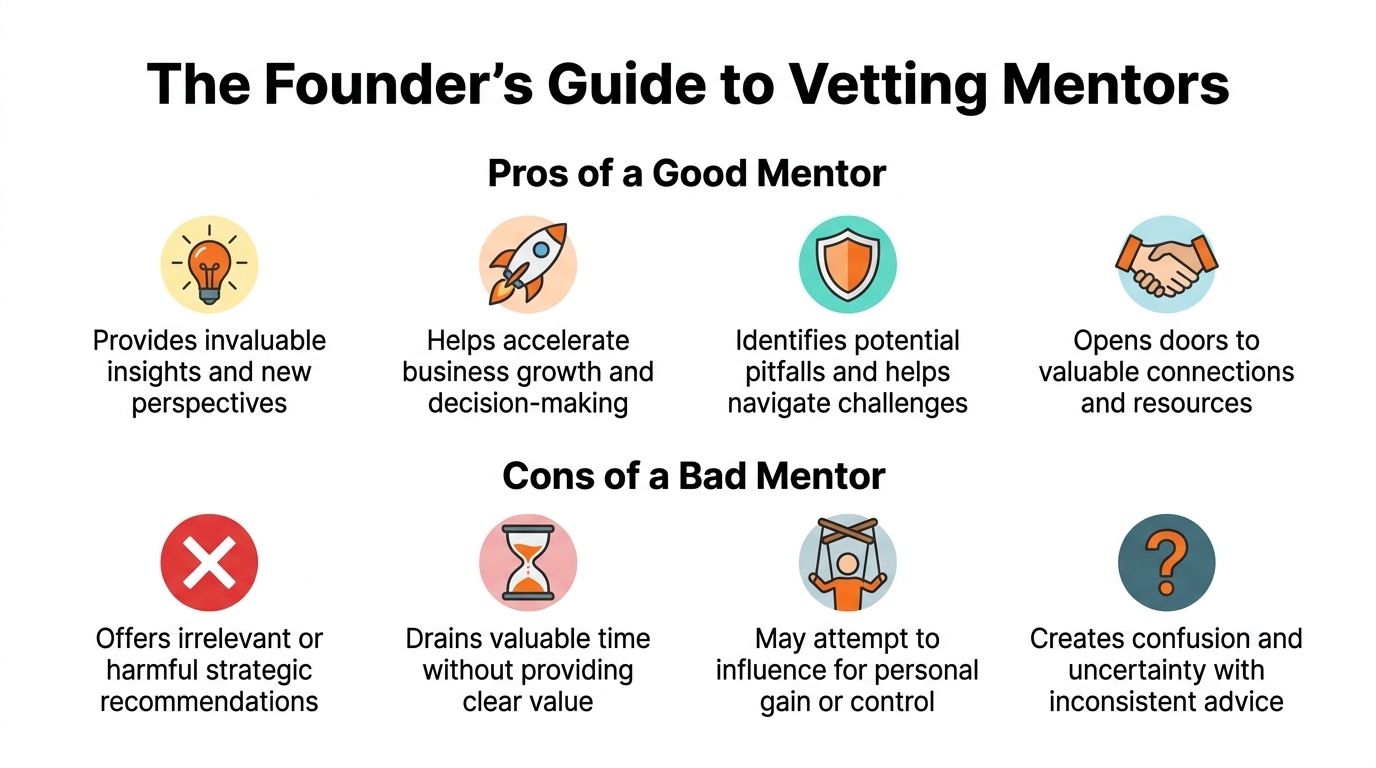
Bad mentors rarely announce themselves. They show up polished, encouraging, and generous with their time. Then, a few conversations in, you notice the pattern. They love sounding wise. They love being around founders. They do not help you make better decisions.
That kind of relationship gets expensive fast. It can drain months of momentum and train you to second-guess your own judgment.
Use an alignment and verification filter
Vet mentors in this order. Values first. Experience second. Conversation fit third.
Founders often reverse that. They start with credentials, get impressed, and only later ask whether this person is honest, grounded, and safe to learn from. That is backward.
Charisma covers a lot of sins.
Step one checks values before expertise
Kindness and boldness are not soft traits. They shape the quality of every hard conversation you will have.
A mentor with boldness but no kindness can become cruel, performative, or controlling. A mentor with kindness but no boldness can become pleasant and useless. You want both. Someone who can look you in the eye, tell you your pricing is broken, and leave you feeling clearer instead of smaller.
Ask yourself:
- Do they tell the truth without humiliating people?
- Can they challenge me without making me guarded?
- Are they trying to help me grow, or trying to make themselves important?
- Would I trust them with a mistake I am embarrassed to admit?
If the answer is no, keep looking.
A good mentor lowers the cost of honesty. If you feel like you need to impress them, the relationship is already off.
Step two verifies what they know
LinkedIn is a highlight reel. Treat it that way.
Read the bio, then get specific. A person who advises late-stage SaaS companies may be the wrong guide for a pre-seed consumer founder in Chicago trying to get customers, not vanity metrics. A founder who raised a lot of money is not automatically good at helping you build a durable business in a market that rewards substance over hype.
What to verify
Stage fit
Have they helped at your stage, with your level of mess and uncertainty?Model fit
Do they understand your kind of business, or are they forcing every company into the same playbook?Decision fit
Can they explain specific problems they have helped solve, not just outcomes they were near?Incentive fit
Are they mentoring cleanly, or steering you toward their fund, firm, service, or ego boost?
You are not being cynical by asking this stuff. You are being responsible.
Plenty of younger founders get pulled in by proximity. Someone knows investors, posts smart threads, or hangs around startup circles, so they must be credible. Not true. Proximity is not operating experience.
Step three uses conversation as a stress test
The first meeting is not a ceremony. It is a test.
Pay attention to how they think, how they listen, and how they handle uncertainty. The strongest mentors do not rush to perform intelligence. They work to understand the problem in front of them.
Ask questions that force real answers.
Ask for failure stories
Skip the polished wins for a minute. Ask these instead:
- Tell me about a time you gave advice that turned out wrong.
- Tell me about a founder problem that looked small at first and became expensive.
- Tell me about a company you should have challenged harder.
Those answers reveal far more than a victory lap ever will. You learn whether they can admit limits, own mistakes, and speak plainly about messy situations. That is what an operator sounds like.
A mentor who cannot talk clearly about failure is usually protecting an image.
Green flags and red flags
Here is the short version.
| Green flags | Red flags |
|---|---|
| They ask thoughtful questions | They dominate the conversation |
| They explain their reasoning | They hand down opinions like rules |
| They share mistakes without theatrics | They only tell stories where they look brilliant |
| They respect your boundaries | They push for influence too early |
| They say “I don’t know” when needed | They have a ready-made answer for everything |
Watch for performative positivity
This matters a lot in founder circles.
Some mentors sound supportive because they never create tension. They praise your vision, tell you to keep going, and wrap every conversation in upbeat language. Founders mistake that warmth for care. It is often avoidance.
Performative positivity is support theater. It protects the mentor from discomfort and leaves you alone with the decision.
You will hear lines like:
- “You’ve got this.”
- “Just stay consistent.”
- “It’ll all work out.”
None of that helps when you need to decide whether to cut a product line, fire a contractor, change your offer, or admit the market is not responding.
Real support sounds more like this:
- “What evidence says this customer wants the product?”
- “What would make you stop doing this?”
- “Which fact are you avoiding because it might force a hard call?”
That is the kind of mentor you want. Honest. Calm. Useful.
Midwest founders should be extra alert here. In Chicago, people often know how to be pleasant in a room. Pleasant is not the same as sincere. Learn the difference.
Test whether they listen
I care less about how smart a mentor sounds than how accurately they hear you.
A strong mentor usually does three things early:
- They ask clarifying questions.
- They reflect your problem back in a way that feels accurate.
- They resist making the conversation about themselves.
If they jump into advice before they understand your business, be careful. Fast advice can feel impressive. It is often lazy.
Protect yourself from soft manipulation
Some mentors do not want to mentor you. They want access.
It starts in ways that seem harmless. More check-ins than you asked for. Pressure to include them in decisions. Suggestions that they should meet your team, review your deck, join investor calls, or stay closer to the business. A little later, the relationship starts to feel like unpaid consulting, shadow management, or a pipeline into their own business interests.
Notice the pattern early.
That does not mean every paid advisor is bad. It means motives matter, and clean motives are easier to work with than tangled ones.
Questions that reveal motives
Ask directly:
- What kinds of founders do you enjoy helping most?
- What makes a mentorship relationship useful for you?
- What boundaries do you prefer?
- When should a founder ignore a mentor’s advice?
That last question does real work. Good mentors know where their judgment stops. They do not need to be right all the time to be valuable.
Run the first three meetings like experiments
Do not make a long-term decision because one conversation felt good.
Use the first few meetings to judge four things:
Clarity
Do I leave thinking better?Energy
Do I feel steadier and more honest, or more scrambled?Trust
Can I say the ugly truth here?Relevance
Does their advice fit my business, my market, and my values?
Give it a little time, then call it cleanly. If you feel confused, managed, indebted, or subtly diminished after a few conversations, end it.
You do not owe anyone a permanent seat in your head.
The right mentor helps you become more capable, not more dependent.
Turn a First Meeting into a Lasting Partnership
A good first conversation means almost nothing if you never build a rhythm. Founders often get sloppy at this point. They have one strong call, say “we should stay in touch,” then let the relationship drift into occasional texts and vague goodwill. That is not mentorship. That is a pleasant memory.
Good mentorship needs some structure. Not bureaucracy. Structure.
Put the relationship on one page
Keep it simple.
After a strong first or second meeting, send a short note that covers:
- what you’re working on
- the one to three areas where their guidance helps most
- how often you’d like to connect
- what kind of communication works best
- any obvious boundaries
That is enough. You do not need a contract. You need clarity.
This fits the broader rule that effective mentorship works better when you define needs early, use compatibility conversations, and check whether the person is willing to talk about both wins and failures (StartupNV on structured mentorship).
Run cleaner meetings
If you show up rambling, your mentor has to do too much sorting.
Send a short agenda before every meeting. Mine would look like this:
- Wins since last time
- Current challenge
- One decision where I want your input
That format forces focus. It also respects their time.
A sample pre-meeting note
Hey Sam, for tomorrow I’d love your take on one decision. I can share a quick update on customer interviews, then spend most of the call on whether I should test wholesale now or wait until the offer is tighter. I’d also value your gut check on what I may be missing.
That sets the table well.
Give value back
A lot of founders treat mentors like one-way fountains.
Bad move.
You may not have money or influence yet, but you still have ways to contribute:
- share a useful article or customer insight
- follow up on advice and report what happened
- make a thoughtful introduction when relevant
- say thank you in a way that is specific, not gushy
Mentors like seeing that their time changed something. Close the loop.
Know when to graduate
Not every mentorship should last forever.
Some mentors are right for a season. Maybe they helped you get your first product out. Maybe they helped you survive the leap from idea to revenue. Then your needs changed.
That is healthy.
You can end the active rhythm without ending the relationship. A simple note works:
I’m grateful for how much your guidance helped me through this stage. I’m moving into a different set of challenges, so I’m going to pause our regular calls. I’d still love to keep you posted from time to time if that works for you.
Clean. Respectful. Adult.
The point of mentorship is not permanent dependence. It is growth.
Answers to Your Toughest Mentorship Questions
Should I ever pay for a mentor
Sometimes, yes. But be honest about what you’re buying.
A mentor usually offers judgment, perspective, and relationship. A coach helps you perform better through structure and accountability. A paid advisor or consultant should bring specialized expertise and do work with a clear scope.
Problems start when people blur those lines.
If someone is charging you, ask what the arrangement is. If it is paid, make sure the deliverable is clear. Do not pay for vague access to someone’s aura.
What if my mentor gives advice that feels wrong
Do not obey just because they are older, richer, or louder.
A mentor gives you input. You still own the decision.
Push back respectfully. Say something like:
I want to test that thinking. My concern is that this may not fit my customer or stage. Can I walk you through what I’m seeing?
A good mentor will welcome that. A bad one will get defensive.
How do I end it if it is not a fit
Do it early.
You do not need a dramatic speech. You need honesty and respect.
Use a note like this:
I appreciate the time you’ve given me. I’ve realized I need a different kind of support for this next stage, so I’m going to pause our mentoring relationship. I’m grateful for your help and wanted to say that directly.
That is enough.
What if I feel intimidated by someone I admire
That feeling is normal. It is also useful.
Admiration becomes a problem only when it stops you from evaluating the person clearly. If you feel yourself shrinking, hiding, or trying to impress them, slow down. Mentorship works when you can bring the messy truth into the room.
How many mentors should I have
Usually fewer than you think.
One strong operator mentor and maybe one specialist can be enough. Too many voices create strategic soup. You start outsourcing judgment instead of sharpening it.
What if nobody replies
That does not always mean your ask was bad. Timing matters. People get busy.
But before you send more messages, check the basics:
- Was your ask specific?
- Did you choose someone relevant?
- Did you make it easy to say yes?
- Did you ask for a conversation instead of a title?
If the answer is no, fix the message. If the answer is yes, keep going.
A thoughtful founder with a clear ask will eventually find the right door.
If you want a less transactional way to build founder relationships in Chicago, Chicago Brandstarters is a free, vetted community for kind, bold, hard-working founders and aspiring founders. You join small private dinners and an active group chat built for honest war stories, practical advice, and real support, not performative networking.
Leave a Reply