
The most common advice about tech startups in Chicago is lazy. It goes like this: build here if you want lower costs, then move to a coast when things get serious.
I think that advice is backwards.
If you're building a company that needs hype, constant social proof, and a room full of tourists calling themselves operators, Chicago might frustrate you. If you want to build something durable, hire sane people, and solve real business problems, Chicago is a very good place to start. A lot of founders confuse noise for momentum. Chicago has less noise. That's an advantage.
I've found that the biggest mistake early founders make here isn't lack of opportunity. It's copying the playbook from somewhere else. Chicago has its own rhythm. It rewards substance, consistency, and people who can ship without acting like every coffee meeting is a TED Talk.
Why Build Your Tech Startup in Chicago
Chicago is a better city for starting a company than a lot of founders want to admit.
Not because it is cheap. Not because it is underrated. Build here because the city rewards the habits that matter early. Talk to customers. Ship useful product. Hire adults. Stay in the work long enough to become hard to kill.
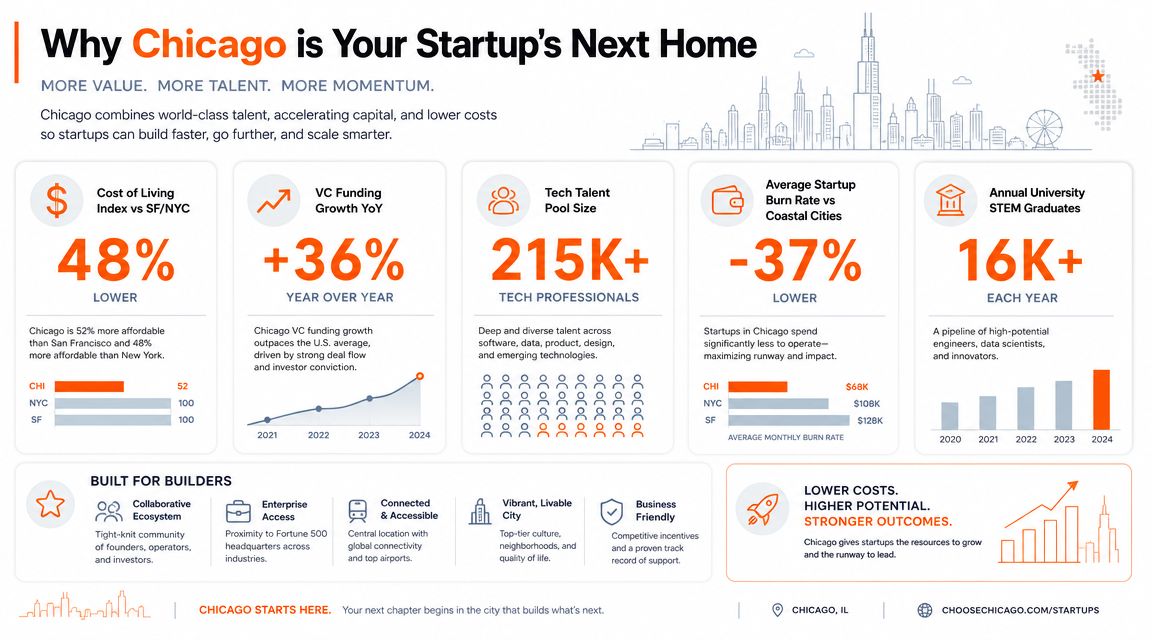
Analysts behind the Chicago Tech Effect report found the local tech sector grew much faster than the broader Chicago economy over the past decade, and the sector now accounts for a meaningful share of the city's workforce. As noted earlier in that report, Chicago also stands out for the share of startups founded by women. That matters if you are trying to build in a city where access is not reserved for the same recycled circle.
Chicago has builders, not tourists
The best reason to build in Chicago is cultural, not promotional.
Chicago does not hand you a neat founder pipeline. It is more fragmented than that. You will not stumble into one single scene that solves hiring, customers, capital, and community for you. Good. That forces you to get specific about what you need and find people who are useful, not just visible.
That is the opportunity here for early-stage founders who are not coming from elite networks. You can still find generous operators, niche communities, and customers who will give you honest feedback. You usually have to work for it. But when you find the right people, the relationships tend to be real. Less transaction. More trust.
My advice: pick Chicago if you want to build a company with the same values the city respects. Hard work, competence, and basic decency.
A lot of ecosystems are optimized for signaling. Chicago is better for execution.
What that means for you
At the early stage, that shows up in a few practical ways:
- You can build without constant posturing. Buyers and peers care more about whether the product solves a painful problem.
- You can find grounded talent. Many people here want meaningful work, stable teams, and a life outside the pitch circuit.
- You can pressure-test your business in a tougher, healthier way. Chicago customers are usually direct. That saves time.
- You can find community without buying your way into it. The support system is scattered, but there are good people in it if you show up consistently and help first.
Chicago is not ideal for every founder. If your plan depends on hype, social climbing, or looking funded before you are, this city will feel slow.
If you want to build something durable with people you respect, Chicago gives you a strong place to do it.
Mapping the Chicago Tech Ecosystem
Chicago tech is fragmented. That is a strength if you stop expecting one central scene to hand you the right people.
Early-stage founders waste time here for a simple reason. They go to the visible events, meet polished service providers, collect a few LinkedIn connections, and mistake that for traction. Chicago does not work like that. You need a map based on customers, operators, and communities that spend time together.
World Business Chicago points to real scale in the region, with thousands of startups, a top-10 U.S. innovation ranking, and a large local talent base, according to its innovation overview. The Chicagoland Chamber's Tech Effect report adds another useful point. Tech reaches far beyond a small startup bubble here. It shows up across industries that already matter to the city.
The sectors that make sense in Chicago
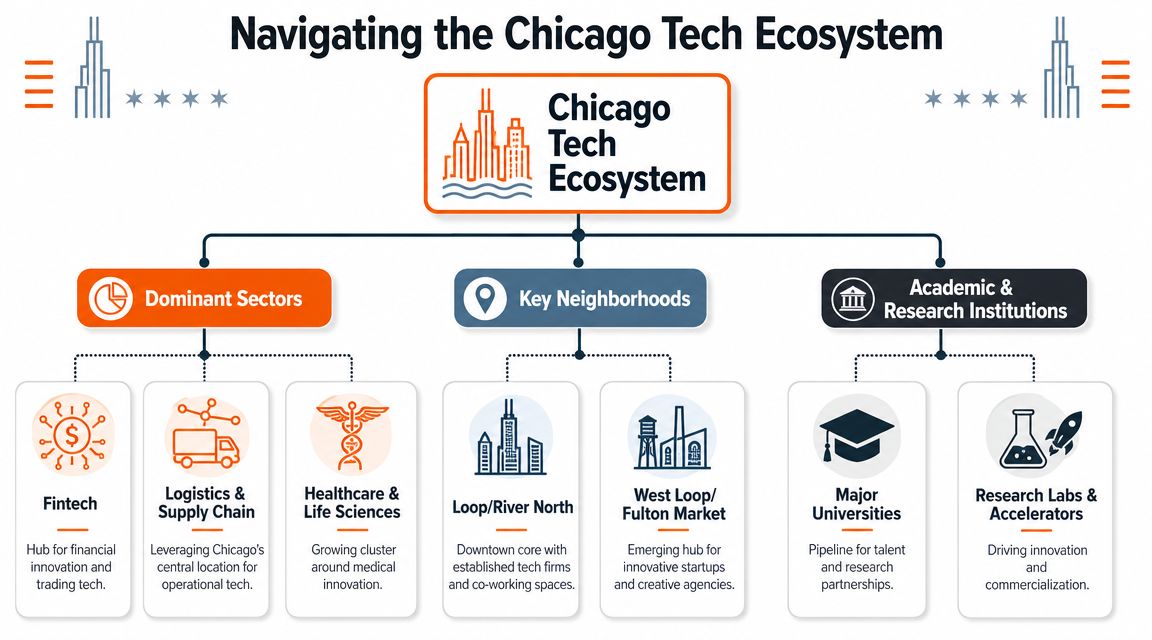
Chicago is strongest where software meets actual work. If your product helps people move money, goods, patients, inventory, claims, schedules, or approvals, you are in the right city.
Here is the practical version.
| Sector | Why it fits Chicago | What founders often miss |
|---|---|---|
| Fintech | Chicago has real depth in markets, risk, insurance, and financial operations | Buyers want trust, accuracy, and clean workflow fit. Pretty UX helps, but it does not close the deal by itself. |
| Logistics and supply chain | The city sits in the middle of freight, warehousing, routing, and distribution networks | Winning products reduce delays, mistakes, and manual work. Founders who have never seen the floor usually build the wrong thing. |
| Healthtech | Big provider systems, research institutions, and complex care operations create real demand | Slow buying cycles kill impatient teams. You need proof, champions inside the system, and respect for compliance. |
| CPG and foodtech | Chicago has long-standing strength in food, manufacturing, retail, and commerce | Brand matters less than repeat purchase, margin control, and operational discipline. |
| B2B SaaS for traditional industries | Local operators understand how boring, profitable businesses run | Founders often ignore these markets because they sound dull. That is a mistake. The pain is clear and retention is usually better. |
My advice is simple. Start with painful workflows in old industries. Chicago is full of them.
Think in neighborhoods, not just sectors
A founder in River North can spend months around recruiters, agencies, consultants, and sponsored networking without getting much closer to customers. A founder who spends that same time near the right operators will learn faster, sell faster, and build better.
The geography matters.
- Loop and River North attract larger companies, professional services, and higher-volume networking. Useful if you sell into established firms, less useful if you need honest founder community.
- West Loop and Fulton Market tend to have more startup operators, product people, and founder energy. You will still need to filter for signal.
- University-linked spaces make sense if your company depends on research access, technical collaboration, or student talent.
- Industry-specific pockets across the city and suburbs often matter more than startup hotspots. If your customer is in logistics, healthcare, manufacturing, or retail, go where those buyers and operators already spend time.
That last point matters most for non-elite founders. Chicago's support system is scattered, so the best path is usually narrower and more human than people expect. Find the niche meetup, operator group, coworking cluster, or customer-adjacent community where people remember your name. Show up consistently. Help first. Ignore the rooms built around status.
Chicago rewards founders who can speak plainly with real operators. If you can sit with a warehouse manager, clinician, finance lead, or local business owner and get to the actual problem fast, you will have an edge.
When seeking tech startups in Chicago, use this map instead. Ask which part of the city already understands your customer, your pace, and the kind of company you want to build. That question gets you much farther than chasing the loudest version of the scene.
Real Startups and What You Can Learn
A dense ecosystem is useful because you can study companies nearby instead of learning everything from Bay Area folklore. Built In lists 4,955 tech companies in Chicago, and StartupBlink ranks 2,070 startups in the city, according to Built In Chicago's company directory. That tells me one thing: if you can't find peer examples here, you're not looking hard enough.
The trick is to stop treating startup lists like trading cards. A logo wall won't help you. You need to ask what kind of founder behavior these companies reward.
Learn the city through company patterns
I'd break the lessons into a few buckets.
Logistics-minded companies teach you that Chicago likes operational clarity. If your business touches fulfillment, inventory, routing, returns, or messy backend coordination, this city will make more intuitive sense to you. You'll meet more people who understand the pain without a long explanation.
Marketing, analytics, and data-heavy companies show another Chicago pattern. Buyers here usually want proof, workflow fit, and a business case. That's good discipline. It forces founders to build products people can justify internally.
Consumer and commerce startups face a tougher but useful test. Chicago won't hand-wave weak unit economics just because a brand is trendy. I like that filter. It pushes founders to understand repeat behavior, margin pressure, and operational friction earlier.
What early founders should copy
Don't copy branding. Copy decision quality.
Here's what I'd borrow from strong Chicago startups:
- Solve an ugly problem. The less glamorous the pain point, the better the opening is for a real company.
- Get close to the buyer's workflow. Founders win here when they understand how work gets done.
- Build for durability. Chicago companies often improve through steady execution, not dramatic reinvention.
- Use the city as a testing ground. If your product can survive practical, skeptical customers here, it has a shot elsewhere.
The best Chicago startups usually make a hard job easier. They don't rely on magic.
That mindset is useful even if you're building something creative. You still need to reduce friction, save time, or create a better buying experience.
The wrong lesson to take
A lot of first-time founders look at successful startups and think, “I need a hotter idea.” Usually you need a sharper one.
Chicago has enough peer companies, partners, and operator examples around you. Use them like a gym, not a gallery. Study how local founders sell, hire, and survive hard quarters. That will help you more than scrolling another list of unicorn mythology.
The Money Map for Chicago Founders
Chicago money is real. But if you show up expecting people to fund a fantasy, you're going to have a rough time.
That's a good thing.
I like Chicago's capital culture because it tends to ask adult questions. Who is the buyer? Why now? What makes this painful enough to pay for? How long is the sales cycle? What breaks when you grow? Those questions can feel annoying when you're pitching. They're much more annoying after you've raised money and still don't have a business.
Failory's 2026 Chicago startup list points to companies that reached serious scale, including Circana at $1.2 billion raised and Kin Insurance at over $708 million raised, according to Failory's Chicago startup roundup. Big checks can happen here. So stop telling yourself Chicago can't support large outcomes.
How I'd approach fundraising here
I'd treat fundraising in Chicago like dating in a small but grown-up town. People talk. Reputations travel. Bluffing has a short shelf life.
Start with this sequence:
- Know your burn before you pitch. If you're building software, get clear on product scope, contractor costs, and maintenance before you ask anyone for money. A lot of founders need to first understand app budgeting so they stop asking for a random number that doesn't match the work.
- Raise for the next proof point. Don't build a giant story around a tiny company. Raise enough to hit the milestone that enhances your position.
- Use local intros carefully. Warm intros still matter, but sloppy ones hurt. Ask people who know your work well.
- Talk like an operator. Revenue logic, sales friction, customer pain, retention signals. Keep it concrete.
If you want a practical overview of local investors, this guide to venture capital in Chicago is a useful starting point.
Bootstrapping is not a consolation prize
A lot of founders act like venture is the default. It isn't. For many Chicago founders, bootstrapping is the better first move because it buys you time to learn what business you're in.
Use outside money when it helps you compress time against a real opportunity. Don't use it to subsidize confusion.
Here's the blunt version:
- Raise if speed changes the outcome.
- Bootstrap if you still need to prove demand.
- Use angels when you need trusted early believers, not just cash.
- Avoid “strategy” investors who mostly want updates and ego calories.
What investors here usually respect
You don't need to cosplay a Silicon Valley founder. In fact, that can work against you.
Chicago investors usually respond better when you show:
| What you say | What they hear |
|---|---|
| “We talked to users” | basic diligence |
| “We know exactly who feels this pain” | sharper GTM |
| “We have a narrow wedge” | discipline |
| “We can explain our margins and costs” | maturity |
| “We know why this market buys” | less founder delusion |
That's the money map. Be credible. Be specific. Know your numbers, even if they're small. Chicago will fund ambition. It just prefers ambition attached to reality.
Finding Your Launchpad Accelerators and Coworking
Most founders use the words incubator, accelerator, and coworking like they mean the same thing. They don't. Picking the wrong one is like wearing skates to a construction site. You can do it, but you're making life harder than it needs to be.
Know what problem you need solved
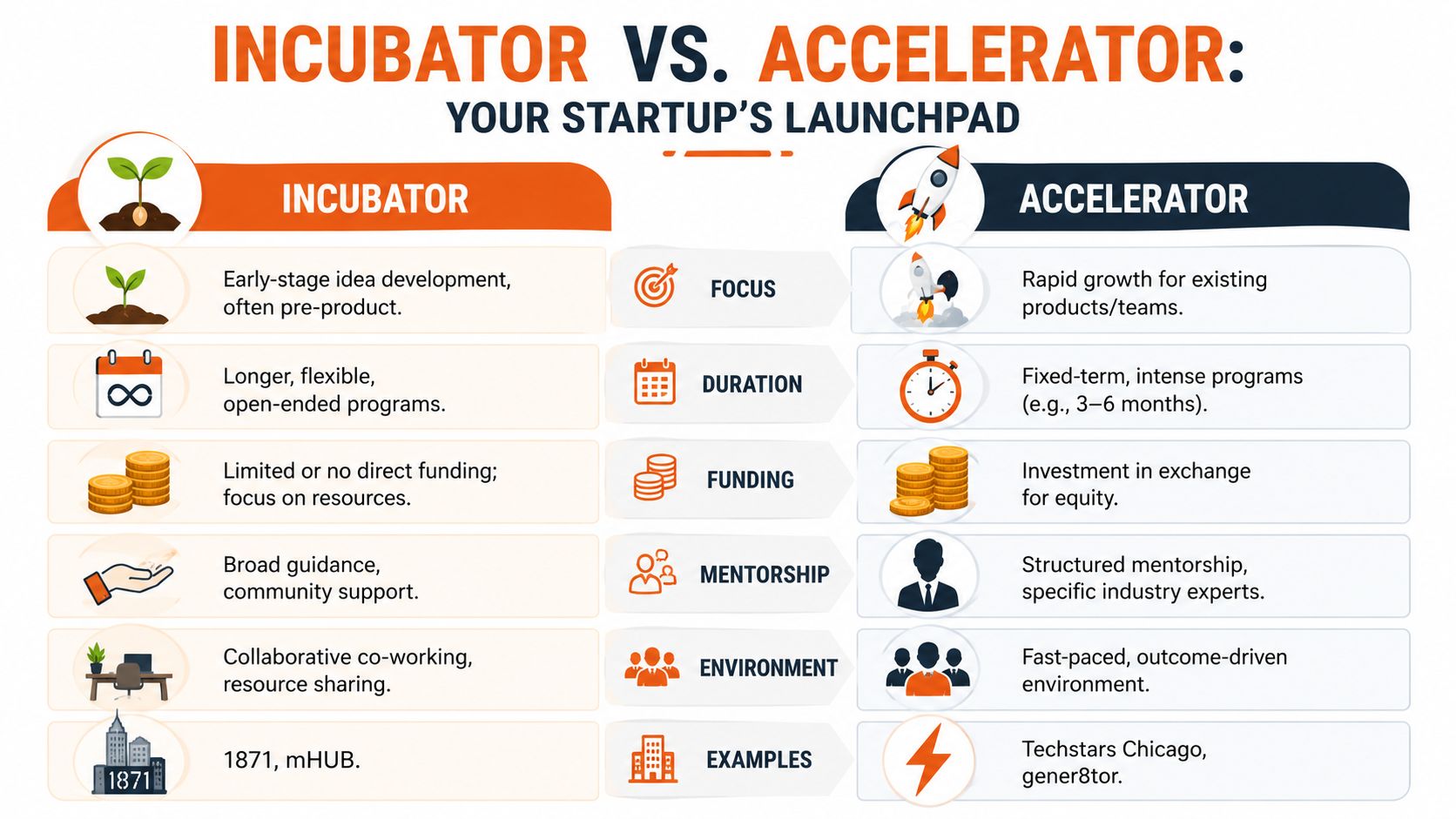
An incubator makes sense when your idea is still mushy. You need feedback, peers, maybe some structure, maybe access to tools or advisors. You're still trying to turn a hunch into something testable.
An accelerator makes sense when you already have motion and need compression. You've got a product, a team, or some traction, and now you want sharper mentorship, tighter timelines, and possibly investment.
Coworking is simpler. It's a place to work, meet people, and get out of your apartment before your brain turns into soup. Don't expect it to fix your company. It can still fix your week.
Here's the clean comparison:
| Option | Best for | Bad fit when |
|---|---|---|
| Incubator | Early ideas, first-time founders, product shaping | You already know your market and need speed |
| Accelerator | Existing product, traction, fundraising prep | You're still guessing at the core problem |
| Coworking | Routine, energy, casual collisions, work environment | You expect community to happen without effort |
A useful local overview of startup spaces lives in this guide to startup hubs in Chicago.
Don't outsource judgment to a brand name
Founders get hypnotized by logos. They assume the best-known program is automatically the best fit. That's rarely true.
Ask harder questions:
- Who else is in the room? If the cohort is full of people unlike your business, the advice may stay generic.
- What do they do weekly? Mentorship sounds nice. Structure matters more.
- What do they take? Equity, time, attention, relocation, reporting burden. None of that is free.
- What happens after the program? If support disappears right after demo day, be honest about that.
This walkthrough gives a useful visual frame before you start applying.
Choose the program that fixes your current bottleneck, not the one that sounds best when you say it out loud.
Place still matters
Chicago is a neighborhood city. Your environment affects your pace.
If you want polished access, meetings, and downtown convenience, spend time around the Loop and River North. If you want more founder energy and creative spillover, West Loop and Fulton Market often feel better. If your work touches hardware, research, or specialized lab access, university-linked and sector-specific spaces can make more sense than generic coworking.
My advice is simple. Don't commit from a website. Spend time in the space. Talk to people who are already building there. See if the room gives you energy or drains it.
A launchpad should make you clearer, faster, and less alone. If it only makes you busier, skip it.
Building Your Team in Chicago
Your startup is your hiring decisions with a logo attached. Most early problems are people problems in disguise.
Chicago gives you a real advantage here, but only if you recruit the right way. This city has a broad talent base, and the people you meet often care more about doing meaningful work than playing startup roulette. That changes how you should pitch the job.
Sell the mission, then sell the role
A lot of founders hire badly because they pitch a dream and ignore the daily work. Good people in Chicago usually want both. They want to know what you're building, but they also want to know what they'll own, what success looks like, and whether you'll waste their time.
When I talk to candidates here, I don't oversell glamour. I sell clarity.
Tell them:
- what painful problem you're solving
- why your team has a right to solve it
- what the first six months of the role look like
- what kind of company you're trying to become
That works better than pretending your startup is a rocket ship when it's still a canoe.
Where to look
You don't need some secret list. Start local and stay specific.
- University programs can help if you need interns, technical talent, or research-minded people.
- Built In Chicago is useful when you need visibility with candidates already interested in startups.
- Founder networks and meetups are good for referrals, especially for early hires.
- Industry communities matter more than generic startup circles if you're building in healthcare, fintech, logistics, or commerce.
The best early hires often come through trusted side doors, not polished job posts.
Hire people who like building in ambiguity, but don't confuse ambiguity with chaos.
What wins candidates here
Chicago candidates usually respond to a few things.
A sane culture helps. So does honesty about stage risk. People can handle risk if you explain it cleanly. They don't like being sold a fantasy.
I'd lean into these points:
| What to emphasize | Why it works |
|---|---|
| Real ownership | Strong candidates want influence, not just tasks |
| Useful work | People like solving clear customer pain |
| A grounded culture | Adults want less posturing and more trust |
| A long-term home | Many candidates want continuity, not constant churn |
The Midwest piece matters too. A lot of builders here value steadiness. They care about work, but they also want a life outside work. That doesn't make them less ambitious. It usually makes them better teammates.
If you're searching for talent around tech startups in Chicago, don't copy the loudest recruiting language from coastal companies. Speak plainly. Respect people's time. Make the job real. That's how you build a team people stick with.
Your First Steps and Finding Your People
The hardest part of starting in Chicago usually isn't the idea. It's navigation.
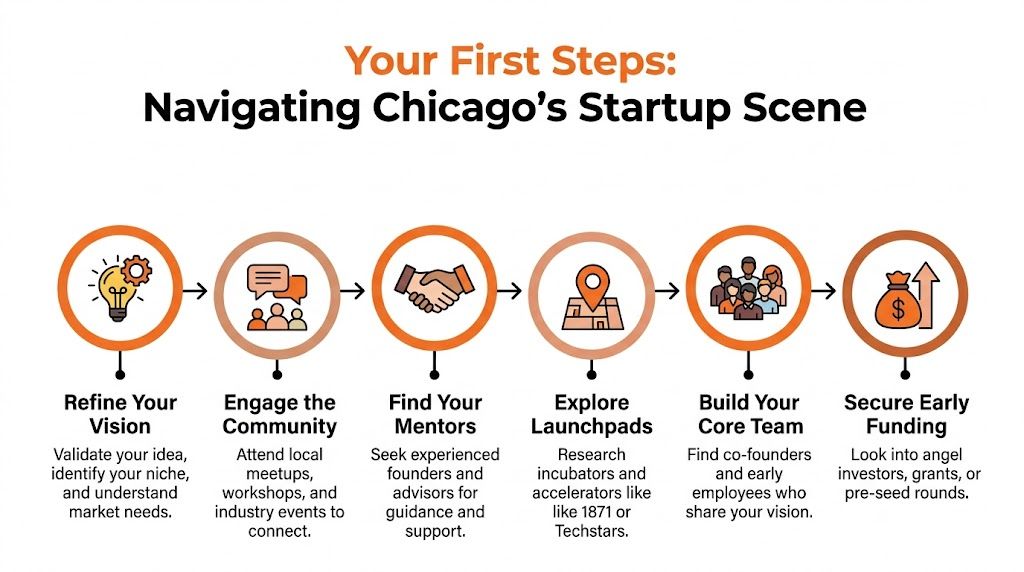
People talk about “the ecosystem” like it's one room. It isn't. It's a maze of small rooms, niche programs, founder pockets, university circles, coworking hubs, and public resources. Northwestern's founder resource guide points to that fragmented setup through programs like The Garage, 2112, BLUE1647, 1817, Sunshine Enterprises, and SBA-linked support in its Chicago startup resource list. That's useful, but it also means first-time founders can burn a lot of energy just figuring out where to begin.
Start with people, not prestige
Most founders think they need the “best” program first. Usually they need the right people first.
You need a few relationships that do four things:
- Tell you the truth
- Understand your stage
- Aren't trying to sell you something
- Will still answer when things get messy
That last one matters. Startup life gets weird fast. Product confusion. Co-founder tension. Burnout. Bad hires. Customers who ghost. You need people you can talk to when you don't have a polished update.
If you're trying to build distribution early, you also need better feedback loops. For example, if AI search is becoming part of how buyers find products in your category, it helps to start tracking AI search performance before your visibility becomes another mystery.
A simple plan for your first months
Don't overcomplicate the opening move. I'd do this:
- Pick one problem worth caring about. Don't chase five ideas at once.
- Choose one founder community and show up repeatedly. Repetition builds trust.
- Book a few customer conversations before building much. Clarity beats speed.
- Find one mentor who has lived your next problem. Not your dream outcome. Your next problem.
If you need help finding that person, this guide to finding a startup mentor is worth reading.
The founders who last in Chicago usually find a small circle before they find a spotlight.
What kind of community actually helps
I'm skeptical of broad networking events for early founders. Too much performance. Too little truth.
The better setup is a non-transactional, identity-vetted peer group where people can be honest. Small rooms beat giant mixers. Confidentiality beats posturing. You want people who will tell you your pricing is weak, your landing page is muddy, your co-founder issue is real, or your fear is normal.
That kind of group helps because Chicago has many entry points, but not one obvious on-ramp for everyone. If you're a non-elite founder, side hustler, first-time builder, or someone without family money and insider connections, your first win is often social clarity. Once you know where you fit, the rest gets easier.
The city has enough talent, enough sectors, enough support, and enough opportunity. Your job is to stop wandering and start belonging.
If you want that kind of room, Chicago Brandstarters is a strong next step. It's a free, vetted community for kind, bold, hard-working founders and aspiring founders in Chicago and the Midwest. Instead of transactional networking, you join small private dinners and an active group chat where people share real problems, real tactics, and real support. If you're tired of performative startup culture and want honest peers who are building, it's worth checking out.
Leave a Reply