

You probably don't need “more help.” You need one person to stop your business from running through your inbox, your phone, and your memory.
If you run a service business, you've likely become the default answer for everything. A client has a complaint, you jump in. A job needs scheduling, you do it. An invoice is late, you chase it. A tech breaks, a vendor misses a deadline, a team member has a question. It all lands on you.
That setup works until it doesn't. Then growth starts to feel like punishment.
The right service business manager fixes that. I don't mean a paper-pusher. I mean the first person who builds the operating system for your company so you can stop acting like human duct tape.
What Is a Service Business Manager Really

Most founders hire too late and hire the wrong profile. They look for an “admin manager,” then wonder why nothing gets smoother.
A real service business manager is the person who turns scattered work into a repeatable machine. They take your customer requests, job scheduling, team handoffs, vendor follow-up, billing friction, and daily fire drills, then build a system that handles them with less founder involvement.
This role is a systems job
If your business is growing, this role isn't just about office oversight. Current job postings already point that way. Employers ask these managers to handle inbound and outbound call workflows, organize work orders, run daily office operations, implement policies, and improve processes across customers, vendors, and internal teams, as seen in current business services manager job listings.
That's why I think the old definition is too small.
You're not hiring someone to “keep things organized.” You're hiring someone to design how work moves from request to delivery to payment to repeat business.
Practical rule: If the person can't map how work flows through your business, they're not a service business manager. They're office support.
Think architect, not helper
I think founders get this wrong because they hire for relief instead of for amplified impact. Relief is someone who takes tasks off your plate. Amplified impact is created by someone who redesigns the plate.
A helper asks, “What do you need me to do today?”
A systems-builder asks, “Why does this keep breaking, and how do we stop it from breaking?”
That second question is where scale starts.
Here's the blunt version of the job:
- Customer flow: Make sure requests don't disappear, stall, or get mishandled.
- Work flow: Make sure the team knows what happens next, every time.
- Information flow: Make sure notes, status, and decisions live somewhere besides your head.
- Money flow: Make sure completed work turns into invoices, renewals, and actual cash.
If you're the founder, this person becomes the operator who builds roads between all those points.
A good service business manager gives you fewer surprises, fewer bottlenecks, and fewer decisions that only you can make.
That is the main job. Everything else is job-description wallpaper.
What a Service Business Manager Actually Does
A service business manager is your company's air traffic controller. Planes are taking off and landing all day. Clients call. Jobs shift. Technicians run late. Vendors miss things. Payments get stuck. If nobody is directing the flow, you get delays, collisions, and angry people.
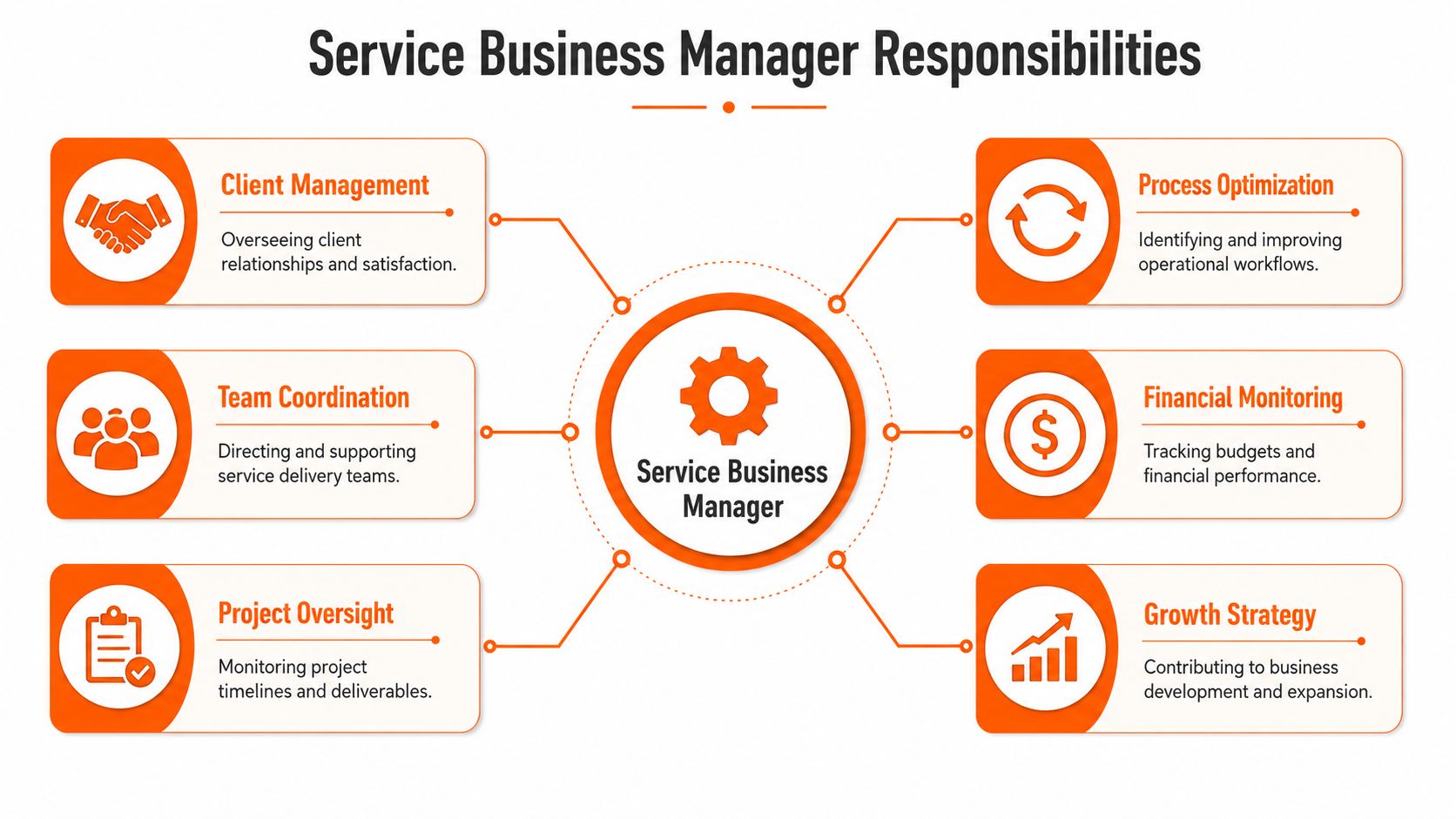
Client delivery ownership
This person owns the path between a customer asking for help and your business delivering it well.
That usually includes:
- Intake control: Managing calls, emails, messages, and work requests so nothing gets lost.
- Work order flow: Turning messy requests into clear next steps for the team.
- Expectation management: Telling clients what's happening, when, and why.
- Escalation handling: Jumping in when a delivery problem needs adult supervision.
If customers keep saying, “I didn't know what was going on,” your service manager is either weak or absent.
Internal operations ownership
Here, the role earns its keep.
A strong service business manager runs the daily rhythm of the business. They coordinate staff, vendors, scheduling, and the little handoffs that kill momentum when nobody owns them. In IT service terms, this kind of role is tied to service levels, incident handling, issue resolution, vendor coordination, budget control, and continuous improvement, according to APMG's IT service manager role description.
That same logic applies outside IT. You need response targets. You need clear handoffs. You need someone watching backlogs before customers feel them.
Here's a useful gut check. If your business has recurring “small” failures, your real problem is usually weak operating control.
A short explainer helps:
Financial tracking ownership
This role also needs a scoreboard.
Interplay Learning's KPI guidance for service managers points to revenue generation, costs, profitability, and service contract renewal rate as core measures. I agree with that framing because service businesses live or die on margin discipline and repeat business.
I'd group the KPIs into three buckets:
Financial health
- Revenue generation: Is delivered work turning into billed work?
- Costs: Are labor, equipment, and materials staying under control?
- Profitability: Is the work worth doing after delivery costs hit?
Client delivery
- Renewal rate: Are customers staying with you?
- Resolution discipline: Are issues getting closed cleanly?
- Service consistency: Are customers getting the same quality every time?
Internal efficiency
- Backlog visibility: Does the team know what is waiting?
- Handoff quality: Do jobs move cleanly between people?
- Process adherence: Does everyone follow the same playbook?
If your service manager can't tell you where jobs are stuck, where money is leaking, and which customers are at risk, they're managing activity, not the business.
The Skills Your Service Manager Must Have
Your calendar is full, clients are waiting, and your team keeps asking the same questions. That is the moment you find out whether a candidate is just organized or can build order.
I would not hire for software first. I would hire for judgment, process discipline, and the habit of fixing the same problem once instead of five times. Your first service business manager is not a glorified admin. This person is your first real systems-builder.
The traits I'd require
Systems thinking comes first.
I want someone who sees the full chain, intake, scheduling, delivery, follow-up, billing, and renewal, and immediately spots where work gets stuck or dropped. They should ask who owns each step, where the handoff breaks, and what should be standardized. If they only know how to keep up with chaos, they will preserve chaos.
Clear communication is next. In a service business, bad communication creates rework, missed expectations, and frustrated clients fast. Your manager needs to give crisp instructions, confirm ownership, and keep clients and staff aligned without turning every issue into a meeting.
If you want a practical primer on this part of management, read WeekBlast's take on effective communication and delegation. It's useful because this role rises or falls on whether someone can transfer ownership cleanly.
Calm problem solving matters more than charm. Clients get upset. Staff miss details. Vendors miss deadlines. The right manager handles the issue, protects the client relationship, and fixes the root cause instead of performing urgency.
Then there's follow-through.
A lot of candidates interview well. Fewer close loops, update the system, document the fix, and make sure the same issue does not come back next week. I trust the person who finishes boring operational work without reminders.
The technical skills that actually matter
Founders often underestimate how technical this role gets. I do not mean you need an engineer. I mean you need someone comfortable with tools, reporting, documentation, and process control.
The City of Woodland data services manager description is a good reminder of what real management work looks like in practice. It includes monitoring systems, handling maintenance, improving processes, and keeping project plans, risks, and issues visible. That level of operational discipline shows up in service businesses too, even if the software stack is simpler.
Here's the split I use:
- Required: systems thinking, sound judgment, communication, ownership
- Useful on day one: CRM familiarity, scheduling tools, reporting, documentation, workflow design
- Strong bonus: comfort with dashboards, data hygiene, service software, and basic troubleshooting
Documentation deserves its own mention. If your manager improves a process but never writes it down, you still have founder-dependent operations. That is fragile. A good service manager turns tribal knowledge into repeatable steps. If your SOPs are weak, start with this guide on creating standard operating procedures. Then make your new manager improve them.
Hire the person who asks, “Show me how work moves from request to completion,” before they ask which software you use.
Service Manager vs Ops vs Project Manager
A lot of bad hires happen because founders use the wrong title for the pain they have.
If you hire a project manager when you need a service business manager, you'll get someone who can push a timeline but not run the machine. If you hire a broad operations manager too early, you may get a smart generalist who never fully owns delivery.
The simple difference
I think of these roles like parts of a restaurant.
- A project manager gets one table's meal out correctly.
- An operations manager makes sure the kitchen can run all night.
- A customer success manager checks whether the guest liked the experience and comes back.
- A service business manager owns the whole path from order to service to repeat business, with one eye on customer experience and the other on profit.
Here's the clean comparison.
| Role | Primary Focus | Key Metric | Analogy |
|---|---|---|---|
| Service Business Manager | End-to-end service delivery and its profitability | Delivery consistency, renewal health, margin discipline | Restaurant floor manager who also watches the P&L |
| Operations Manager | Internal business operations across the company | Process reliability | Kitchen manager keeping the whole back of house running |
| Project Manager | Completion of a defined project | Timeline and deliverables | Event coordinator making one event happen |
| Customer Success Manager | Client satisfaction and retention | Account health and renewals | Host making sure guests want to return |
When you need each one
You need a service business manager when customers, team coordination, and daily delivery all feel tangled together.
You need an operations manager when the business is bigger, more cross-functional, and less centered on one delivery engine.
You need a project manager when you already have a functioning operation but need someone to drive a defined implementation, launch, or client project.
If you want a broader explainer on how operations work in practice, MakeAutomation has a solid overview of operations management. It's useful for understanding where this role overlaps with ops and where it doesn't.
Don't hire by title. Hire for the bottleneck.
If your bottleneck is day-to-day service delivery, client coordination, and repeatable execution, the service business manager is usually the right call.
How to Hire Your First Service Business Manager
You know you need this hire when your day starts with three customer emails, two schedule changes, one billing question, and a technician waiting for direction. By noon, you are still the glue holding everything together. That is the problem.
Your first service business manager is not an admin with a nicer title. I'd hire this person as your first systems-builder. Their job is to get work out of your head, tighten the handoffs, and make daily service delivery run without you policing every detail.
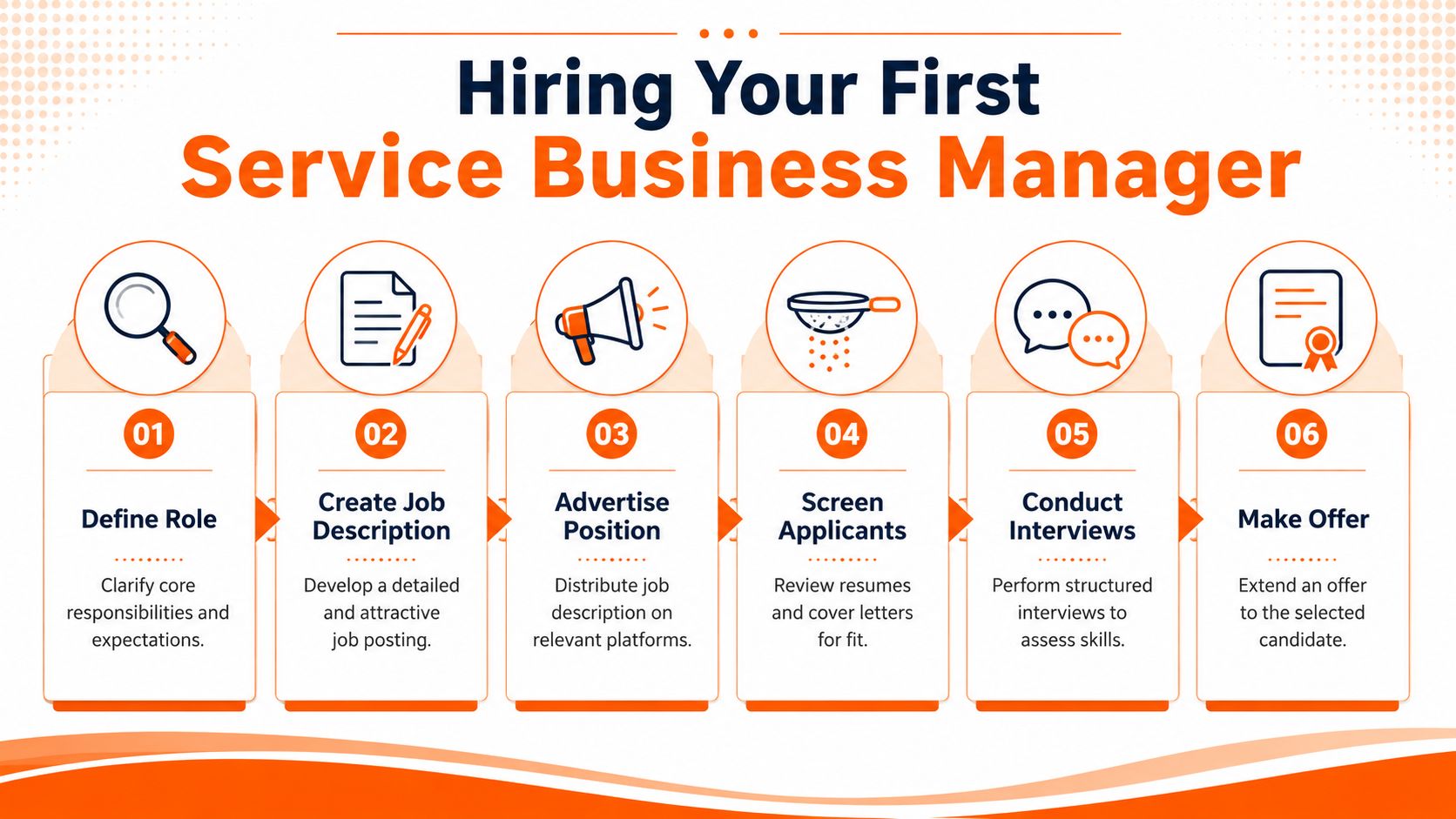
Write the role for the business you have next
A weak job post attracts professional helpers. You want an operator who can walk into disorder and leave with a cleaner system.
Use a job description like this:
Service Business Manager
We need a hands-on operator to run and improve our service delivery engine. You'll own daily workflows across customer requests, scheduling, team coordination, work orders, vendor follow-up, and process improvement. You'll fix bottlenecks, build repeatable systems, and make sure completed work turns into satisfied customers and clean billing.
What you'll own
- Daily service operations and team coordination
- Customer communication and issue escalation
- Work order flow and scheduling discipline
- Process documentation and SOP improvement
- Vendor coordination and follow-up
- Basic KPI tracking across delivery, costs, and renewals
What we need from you
- Strong communication and office management ability
- A track record of improving messy processes
- Good judgment under pressure
- Comfort using software tools for scheduling, communication, and reporting
- Willingness to build systems, not just manage tasks
What success looks like
- Fewer dropped balls
- Clearer workflows
- Better team coordination
- Better customer follow-through
- Better visibility into service performance
I'd also add one plain line near the top: “You will be expected to document, improve, and standardize how work moves through the business.” That sentence filters out people who want to maintain chaos instead of fixing it.
Screen for builders, not coordinators
You do not need the prettiest resume. You need evidence that the candidate has taken messy service work and made it repeatable.
As noted earlier, research on related business services manager roles found that employers consistently value communication and office management. That matches what I've seen in real companies. If a candidate cannot communicate clearly and run the administrative spine of service delivery, they will stall out fast.
Use this screen:
- Resume clues: process improvement, scheduling ownership, service coordination, vendor follow-up, dispatching, billing handoffs, SOP creation
- Writing clues: clear, direct sentences with specific examples instead of generic claims
- Career clues: signs they improved flow, reduced confusion, or created a better operating rhythm
- Reference clues: proof they closed loops, followed through, and made managers less necessary in daily fire drills
If this is your first true management hire, read this guide on how to hire your first employee. First-time hiring mistakes are expensive, and this role touches too many parts of the business for guesswork.
My filter
I pass on candidates who describe themselves as “highly organized” but cannot explain what they built, fixed, or documented.
I pay attention when someone says, “I'd map your intake process, scheduling handoffs, customer updates, and billing flow in week one. Then I'd show you where work gets stuck.”
That person understands the job.
Hire the manager who makes your business easier to run, not the one who sounds polished in a vague interview.
Interview Questions and Tools for Your New Manager
Your interview should feel a little uncomfortable. Good. This hire is not here to sound polished. They are here to walk into a week of missed handoffs, buried customer requests, unclear priorities, and a founder who is still acting like the backup operating system, then start putting order around it.
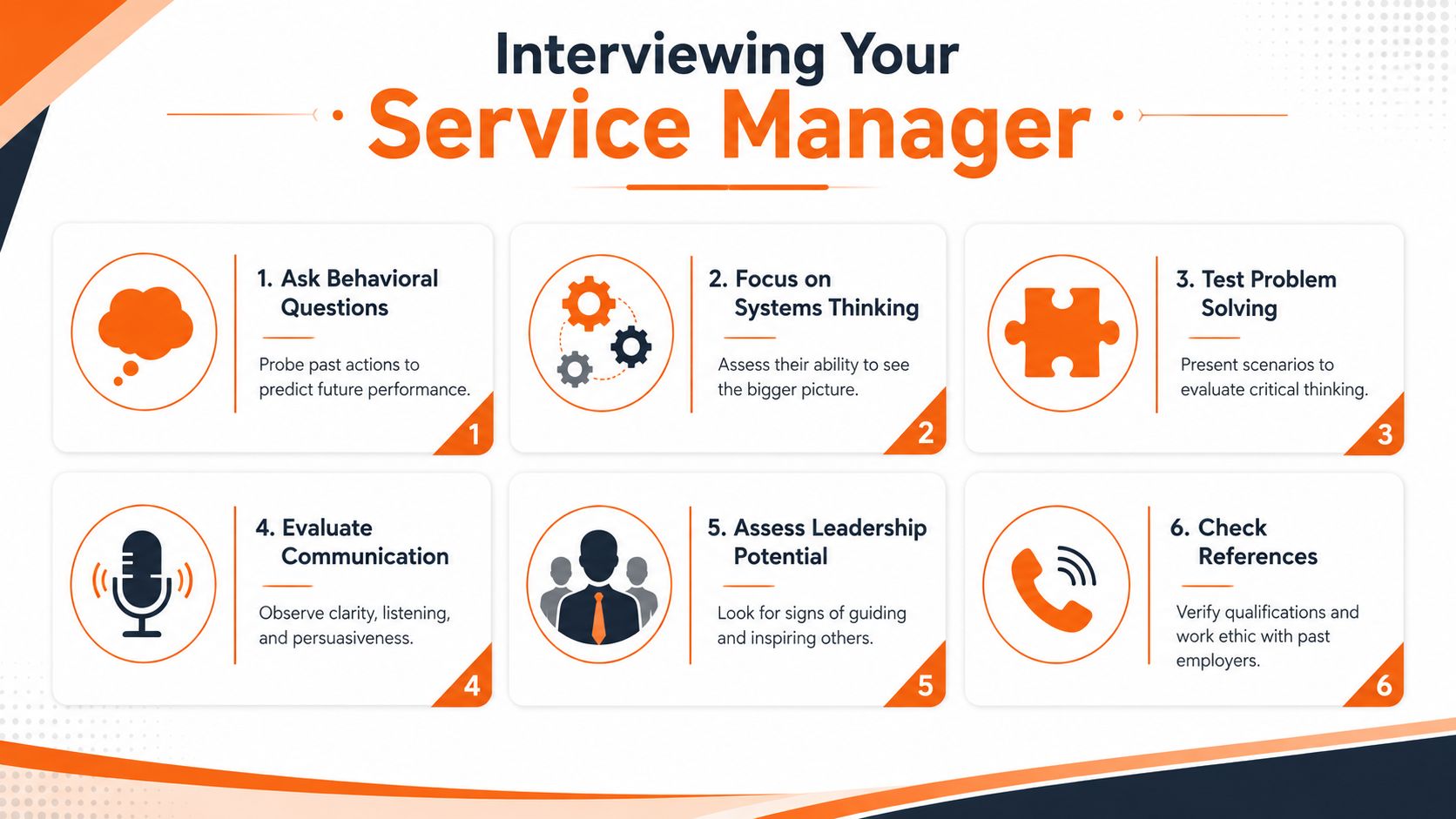
Questions that expose how they think
I ask questions that force people to show me how they build systems, not how well they talk about them.
- Tell me about a broken process you inherited. What was happening, what did you change first, and what stuck?
- Walk me through a day when everything went wrong. How did you triage, who did you update, and what did you document so the same mess did not repeat?
- Tell me about a customer issue that revealed an internal problem. What did you fix behind the scenes?
- How do you decide whether a recurring issue needs a process change, a staffing change, or just tighter follow-up?
- Describe a time you had to coordinate staff, vendors, and customers at the same time. Where did the handoff break, and how did you fix it?
- How do you keep work out of your head and visible to other people?
- What would you audit in your first two weeks here, and in what order?
Listen for sequence. Listen for ownership. Listen for whether they can explain cause and effect without rambling.
The best candidates answer like operators. First I checked intake. Then I looked at scheduling. Then I found the billing lag. Then I wrote the handoff. Weak candidates hide behind generic language and never name the actual fix.
Ask for specifics every time. If someone says they improved communication, ask what changed. Meeting cadence, shared board, status template, response-time expectation, escalation rule. I want the tool, the habit, and the result.
A simple starter stack
Your first service business manager does not need a giant tech stack. They need a small set of tools they can run. The goal is simple. Make work visible, assign ownership, and stop important details from dying in text threads.
I'd start with:
- ClickUp, Asana, or Trello for tasks, deadlines, and recurring workflows
- Slack or Microsoft Teams for internal communication and quick escalations
- Google Workspace for docs, forms, shared files, and basic reporting
- A CRM or shared service inbox so customer requests land in one place
- Notion or Google Docs for SOPs, checklists, and training notes
That is enough to start.
Do not hire a systems-builder, then trap them in scattered inboxes and verbal instructions. If you want this person to make your company easier to run, give them one source of truth and permission to clean it up.
Manager feedback is another place founders get lazy. New managers often spot problems quickly but handle the conversation badly, which creates more friction than the original issue. Give them a clear method for giving and receiving feedback as a manager so they do not avoid hard conversations or botch them.
Outside help can speed this up
I would not force a new manager to figure out everything alone, especially if your business is already messy. Use outside support where it helps. Local small business programs, industry groups, and practical advising can give your manager templates, training, and a sounding board while they build your operating rhythm.
A good example is California's directory of small business resources, which points founders toward advising and support programs. The lesson is broader than California. Your manager does not need more theory. They need examples, frameworks, and real operator input they can put to work fast.
Your Questions on Service Business Managers Answered
When should I hire one
Hire when you are still spending too much of your week routing work, answering status questions, fixing preventable mistakes, and being the backup brain for every process. If customers, team coordination, and billing all keep bouncing back to you, you waited long enough.
Can I hire one part-time
Yes. I like this path if your business is still proving demand or if your workflow is messy enough that you need someone to build order before you commit full-time. Just be careful. A fractional person can design systems, but they can't babysit a chaotic team all day. Give them clear authority and a narrow scope first.
What should I expect to pay
You should expect pay to vary a lot by experience, complexity, and market. I'm not going to invent a salary range for you. Budget based on the fact that this is a management hire with process, communication, and delivery ownership. If you try to underpay, you'll usually attract a coordinator when you need a builder.
If you're building in Chicago or the Midwest and want honest founder conversations instead of fake networking, check out Chicago Brandstarters. It's a free, vetted community with small dinners and ongoing chats for kind, hard-working builders who want practical help, real relationships, and fewer avoidable mistakes.
Leave a Reply