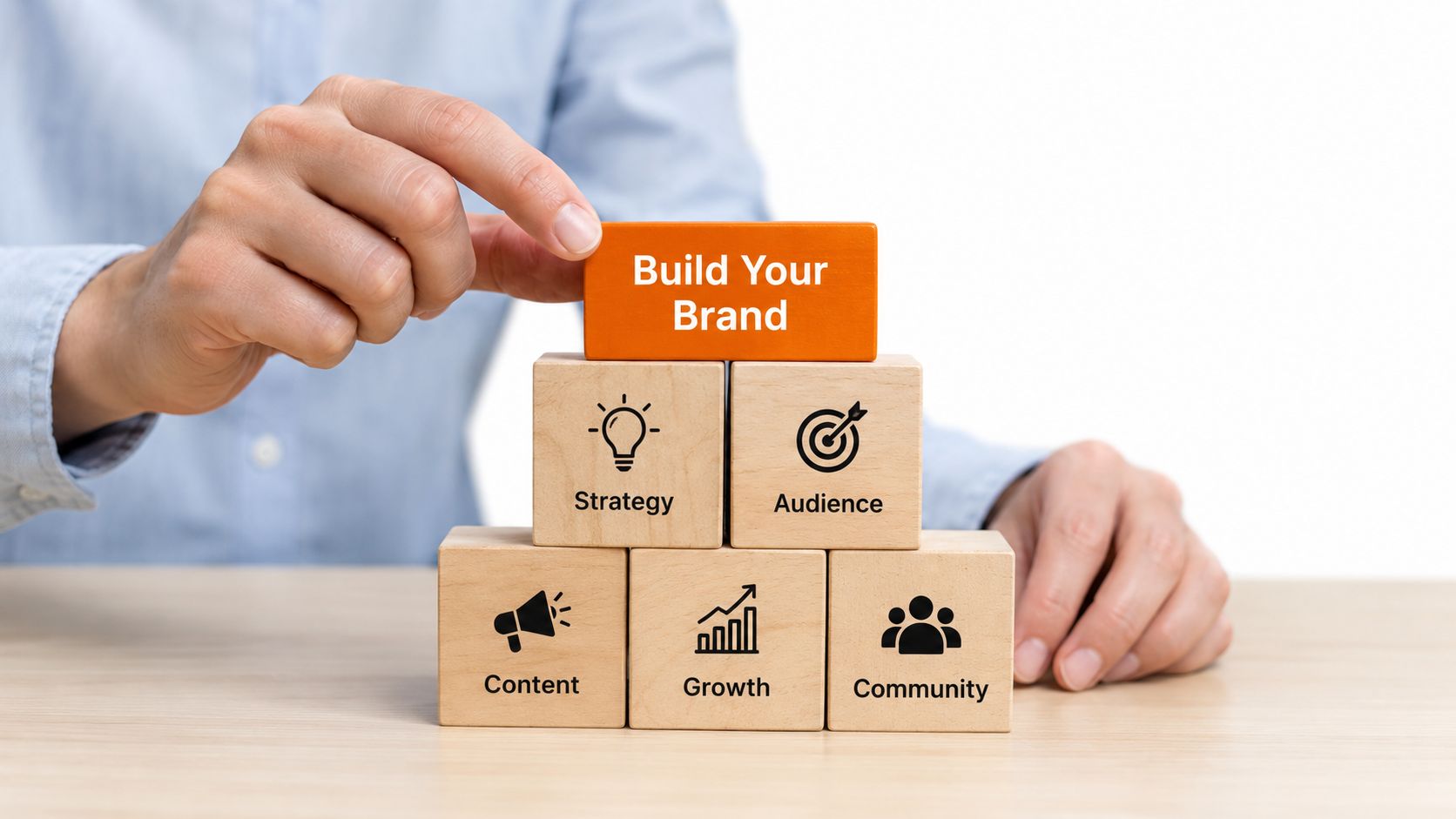
You can have a useful product, happy early customers, and a website that looks polished, yet still watch sales move slowly. People may understand what you sell, but they don't know whether they can trust you, remember you later, or explain your value to someone else. That gap is where brand building does its work.
I think of a brand as the expectation people carry before they buy. Brand building gives that expectation a dependable shape through your product, words, design, customer service, proof, and repeated behavior. It helps a buyer choose you when several products look similar, accept your value without endless explanation, and return after the first purchase.
This guide starts with the plain definition, then moves into trust, a practical five-stage process, channel tactics, common mistakes, and a focused roadmap. I'll use the perspective I'd share with a founder over coffee: start early, keep your promises visible, and treat every customer interaction as evidence.
If you're working through the first version of this system, learn how to build trust with customers alongside the ideas below. Trust doesn't arrive after the “real marketing” begins. You build it while you write the first product page, answer the first question, and fix the first problem.
Introduction Why Your Great Product Still Needs Trust
A founder I know had a product that solved a real problem. The packaging worked, the onboarding made sense, and the first customers gave useful feedback. Still, growth felt stuck. Prospects asked whether the company was established, whether support would respond, and whether the product would keep delivering after the purchase.
The founder kept polishing the product. That helped, but it didn't answer the buyer's private question: “Why should I believe this company will do what it says?”
Brand building answers that question through a system of repeated proof. Your name, visual identity, message, reviews, product experience, policies, community activity, and customer conversations all teach people what to expect. A logo can help someone recognize you. It can't prove that you keep your promises.
Practical rule: Every public claim should have a customer experience behind it.
That rule changes how I approach the work. I don't start by asking which color looks attractive or which slogan sounds clever. I ask who needs the product, what they fear before buying, what evidence would reassure them, and which parts of the experience we can control today.
What you'll learn
You'll see how I define brand building, why trust affects buying, and how I connect research to positioning, identity, activation, and measurement. You'll also get channel-specific tactics for discovery through creators, communities, marketplaces, and AI-generated summaries.
The process works for a founder with a small team because it doesn't require a huge campaign. You can begin with a clear promise, a consistent visual system, honest proof, and a way to learn from customers. Then you repeat what works and remove friction where people hesitate.
Your product earns the first chance. Your brand helps people understand, trust, remember, and choose it.
What Brand Building Really Means Beyond Logos
A buyer finds your product through a creator, a community post, a marketplace, or an AI summary. They may never see your homepage first. In that scattered path, brand building helps each touchpoint answer the same question: what can I expect from this company?
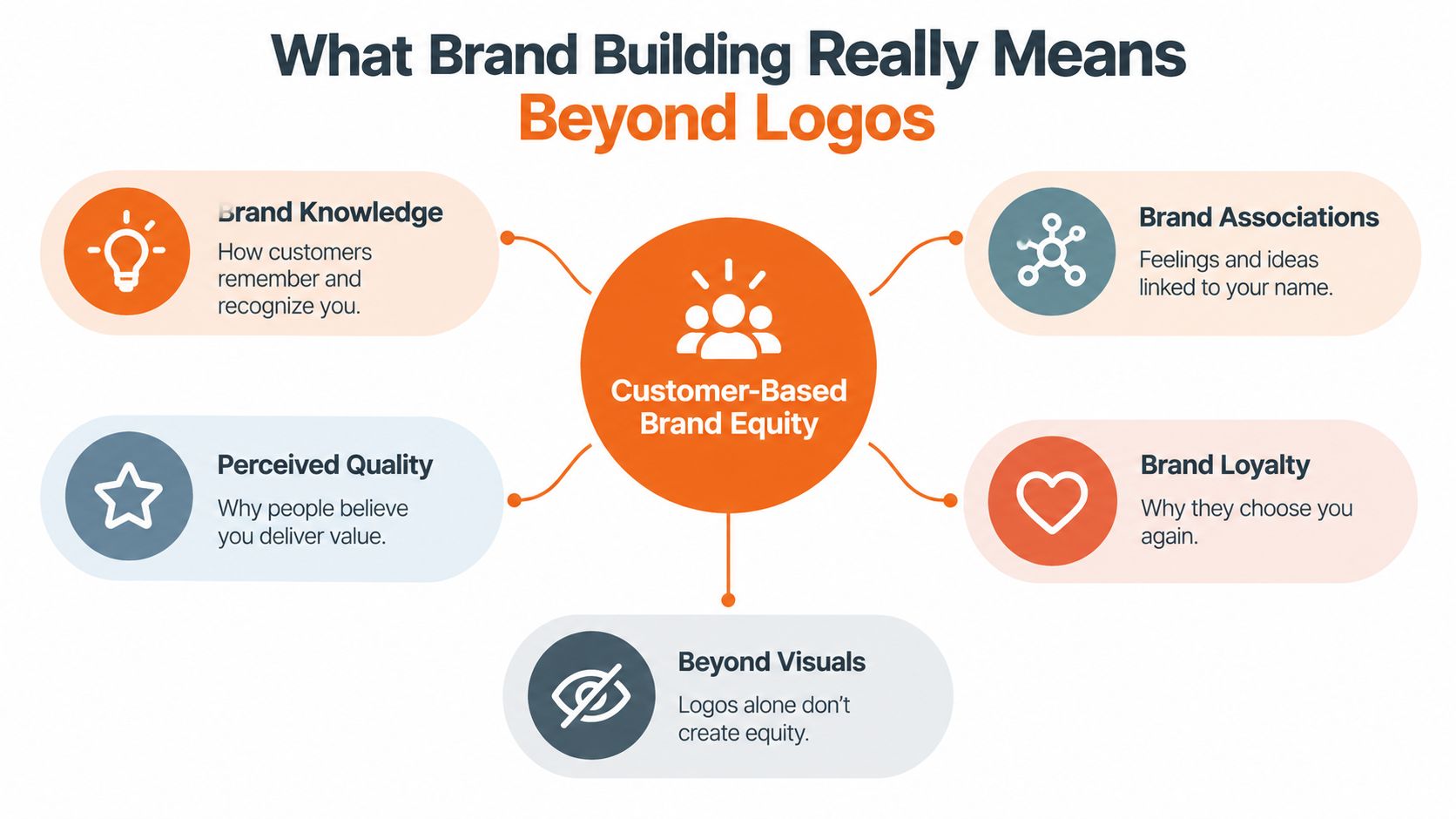
I define brand building as increasing customer-based brand equity, the added preference people give your product because they know your brand and connect it with meaning. Keller's customer-based brand equity framework explains how brand knowledge changes consumer responses. Awareness helps people recognize you, while associations shape how they evaluate and choose you.
Your customer's mind works like a set of folders. Brand awareness helps them find your folder when a need appears. Brand image fills it with associations such as dependable, easy to use, premium, local, or made for people like them. Clear, favorable information can make a known product feel like a safer choice than an unnamed alternative.
Brand building has two jobs:
- Help people remember you. Your name, category, design, message, creators, community presence, and distribution make recognition easier.
- Give that memory useful meaning. Your product, proof, service, policies, and behavior show people what choosing you feels like.
From creative work to measured discipline
Brand work includes logos, slogans, and consistent messages, but it also includes the experience those signals point toward. Kantar's BrandZ system tracks brand perceptions across regions and categories, using research from 4.6 million consumers, 22,392 brands, 545 categories, and 54 markets (Kantar BrandZ). That scale gives teams a way to compare perception instead of relying only on a founder's instinct.
Kantar connects brand meaning with demand and willingness to pay. Its framework says about 70% of brand equity globally usually comes from experience, exposure, functionality, and convenience. I read that as an operating brief: make the product work, make the promise visible, make delivery repeatable, and remove avoidable effort from buying and using it.
For a practical look at branding beyond logo design, connect strategy, experience, and customer memory rather than treating identity as the whole job.
Brand building is the repeated work of making your product easier to remember, easier to trust, and easier to choose.
Why Trust Is the Engine That Makes Brand Building Work
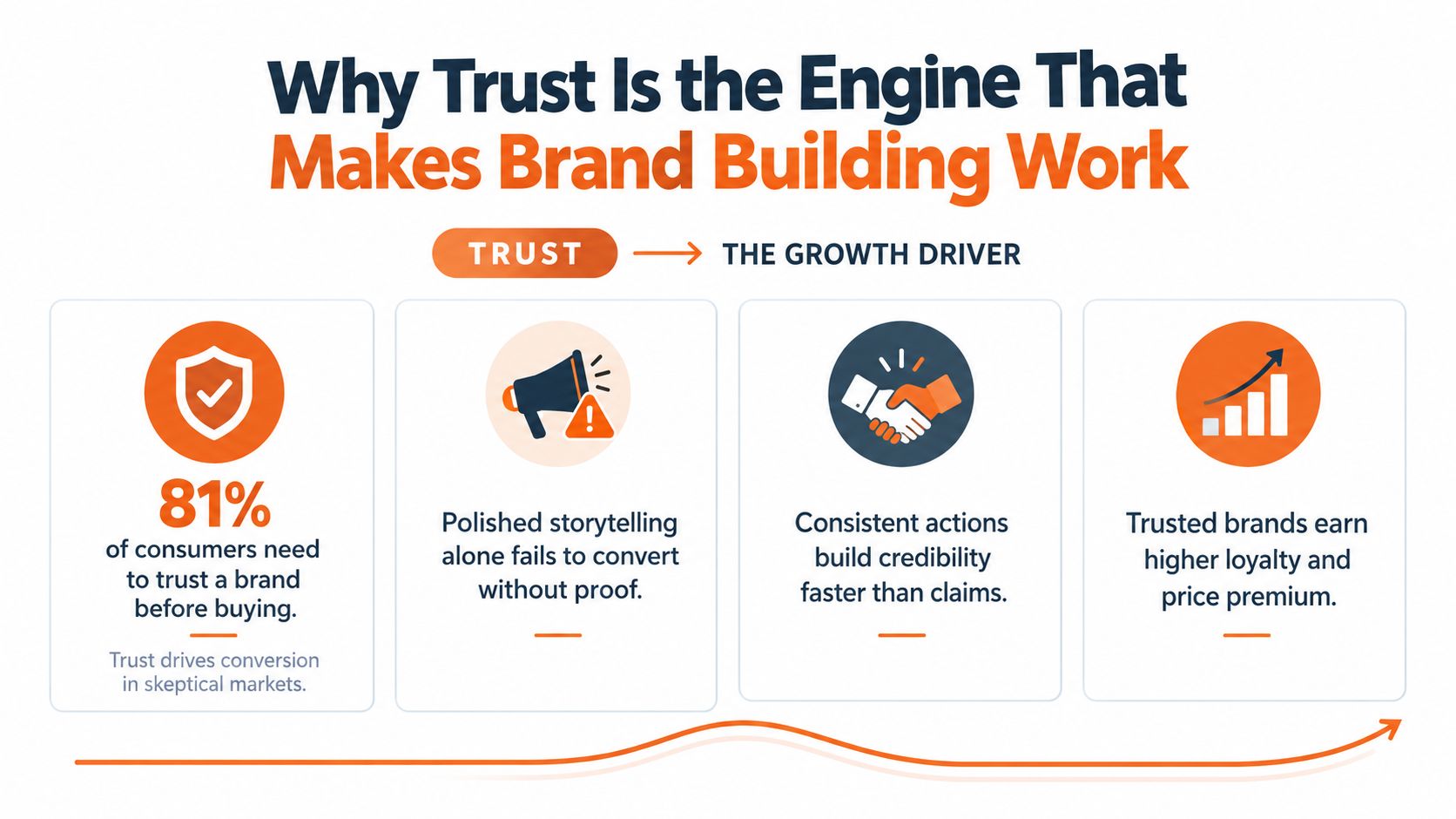
A polished story can earn attention. Trust earns the next action. Buyers want evidence that your product works, your team will respond, and your promises won't disappear after payment.
Edelman's Trust Barometer Special Report found that 81% of people said trust was a deciding factor when considering a purchase, while only 34% said they trusted most of the brands they buy or use. The report drew on 16,000 people in eight countries (PPAI's summary of the Edelman report). That gap gives early-stage founders a plain operating lesson: you can't leave trust until after product-market fit.
Edelman's 2025 Brand Trust report also says 80% of people trust the brands they use to do what is right more than traditional institutions. It reports that trust in brands reached 68% since 2022, while trust in institutions stayed at 55% (Edelman 2025 Brand Trust report). These figures don't mean customers believe every brand. They show why brands must earn credibility through behavior that people can check.
What trust looks like in practice
Trust grows when your claim and your conduct match. If you promise fast support, show the response process and follow it. If you claim simple pricing, remove surprise fees and confusing conditions. If you say your product is built for a specific customer, make the workflow feel made for that person.
Marketing Charts, summarizing Edelman findings, reports that 88% of adult consumers worldwide consider trust important when buying a brand, 71% say it matters more than it did in the past, 59% are more likely to purchase a trusted brand, and 67% are more likely to stay loyal to and advocate for one (Marketing Charts). Trust therefore affects more than the first click. It can shape purchase, loyalty, and advocacy.
I audit trust with four questions:
- Can a new visitor verify our main promise?
- Do reviews and customer stories describe the same experience we advertise?
- Does the product deliver the tone our design suggests?
- Can a disappointed customer reach a real person and get a clear answer?
Customer service carries much of this work. If you run a Shopify store, compare your process with these best practices for Shopify stores and turn support into visible proof rather than a hidden back-office task.
How I Move Through the Five Stages of Brand Building
I don't treat brand building as five disconnected assignments. Each stage gives the next stage better raw material. Skip discovery, and positioning becomes guesswork. Skip positioning, and identity becomes decoration. Skip measurement, and you keep opinions instead of learning.
1. Discovery
I start with conversations, reviews, support tickets, competitor pages, and buying objections. I write down the language customers use, especially when they describe frustration or the result they want.
The output is a short discovery brief:
- Who buys first
- What problem creates urgency
- What alternatives they use
- What makes them hesitate
- What proof changes their mind
2. Positioning
Next, I decide where the brand belongs in the buyer's mind. I state the audience, problem, promise, proof, and meaningful difference in plain language.
For example, a meal-planning product might position itself for busy parents who want fewer weekday decisions. “Healthy meal planning” sounds broad. “A five-day dinner plan for parents who want one grocery trip and fewer nightly choices” gives the team a sharper direction.
Use this brand positioning for startups when you need help turning customer language into a usable position.
3. Identity
I then translate the position into a visual and verbal system. I choose a small color palette, type styles, logo treatment, image rules, vocabulary, and tone. The system should help a customer recognize the brand and understand its personality without requiring a design explanation.
4. Activation
Activation puts the system where discovery happens. I select channels based on customer behavior, then adapt the same promise to each setting. A product page needs proof and clarity. A creator needs a useful story. A community post needs participation before promotion.
5. Measurement
I track signals that connect memory and trust to demand. I look at branded search, direct visits, qualified inquiries, repeat purchases, review themes, support questions, conversion behavior, and willingness to pay. I don't treat any single number as the brand. I use the pattern to decide what to clarify, repeat, or repair.
The five stages form a loop. Customer feedback updates discovery, discovery sharpens positioning, and positioning keeps future creative work from drifting.
Tactics and Channels That Turn Strategy Into Everyday Proof
Customers may meet your brand through a creator video, a private community, a marketplace listing, your store, or an AI-generated summary. Each channel gives you a different job. I keep the promise stable, then change the proof to fit the setting.

| Discovery point | What the buyer needs | Proof I provide |
|---|---|---|
| Creator video | A credible explanation in a human voice | Clear demonstration, limits, and an honest use case |
| Community post | Evidence that I understand the group | Helpful answers, useful examples, and no hard sell |
| Marketplace listing | Fast comparison and low uncertainty | Specific benefits, accurate images, reviews, shipping details, and returns |
| AI summary | Clear facts that survive compression | Consistent product information, accessible policies, and plain language |
| Website or store | Confidence before action | Product details, customer evidence, support access, and a simple next step |
Keep the visual uniform steady
A consistent visual identity helps people recognize a brand more readily. Research on visual identity reports that consumers recognize brands faster when color, typeface, and design elements stay consistent, while frequent style changes can confuse them (published study on consistent visual identity).
I use a compact brand kit rather than a giant rulebook. It includes approved colors, typefaces, logo spacing, image direction, headline patterns, and examples of good and bad usage. Think of it as a uniform. If the uniform changes every week, customers don't know who just walked in.
For product education, a demo video maker can help you turn a workflow into a short visual explanation. I'd still check every frame against the product. A smooth video that shows a feature inaccurately creates doubt later.
Finally, review the full customer path through an omnichannel marketing strategy. Your creator script, listing, email, checkout, package, and support reply should feel like parts of one conversation.
Mistakes That Quietly Break Your Brand and How I Fix Them
Waiting until the product feels finished
Founders often treat brand building as decoration for later. That delays the work that helps early buyers understand the product and trust the team.
Before: The founder explains the product differently in every call.
After: The founder writes one clear promise, three proof points, and a short answer to the most common objection.
Start with the smallest useful system. You don't need a perfect identity to create a dependable experience.
Chasing awareness without evidence
A growing audience won't repair a weak promise. If people see your name but can't verify the result, attention turns into questions rather than action.
Before: The homepage says “better,” “faster,” and “premium.”
After: The page shows who the product helps, what it does, what it doesn't do, and what customers experienced.
I ask every campaign to carry proof. That proof might be a demonstration, review, comparison, policy, sample, or transparent explanation.
Redesigning every time results feel slow
A new logo can distract the team from a positioning problem. Frequent visual changes also make recognition harder when customers encounter the brand in different places.
Pick a visual system and give it enough time to become familiar. Change it when customer understanding or business direction requires a change, not because a new template looks exciting.
Tracking activity instead of equity
Followers, impressions, and clicks can inform decisions, but they don't tell me whether people trust the brand. I also track the questions buyers ask, the reasons they hesitate, repeat behavior, review language, referrals, and whether customers accept the product's stated value.
Run this audit before your next campaign:
- Promise: Can a stranger repeat what you do?
- Proof: Can they verify the claim?
- Experience: Does the product match the message?
- Consistency: Do your channels look and sound connected?
- Repair: Can customers get help when something goes wrong?
Your Actionable Roadmap From Idea to Seven Figures
I'd run brand building in three 30-day blocks. Keep the scope narrow, assign an owner for each task, and review evidence every week.
Days 1 through 30, learn and choose
Interview customers and prospects. Read reviews for competing products. List buying objections, desired outcomes, and the words people use. Turn that material into one positioning statement, three proof points, and a short “why us” explanation.
Choose a simple visual system during this block. Set your colors, typefaces, logo use, photo style, and writing tone. Create a shared document so every person making content works from the same source.
Days 31 through 60, publish and test
Update the website, product pages, marketplace listings, email messages, and support replies. Ask a creator or community member to test the product and describe the experience in their own words. Give them facts and access, not a script that hides limitations.
Track qualified inquiries, conversion behavior, review themes, support questions, repeat purchases, and direct customer language. Your first goal is learning which proof removes uncertainty.
Days 61 through 90, repeat and repair
Keep the messages that customers understand. Fix the pages that create confusion. Turn useful answers into guides, demonstrations, comparison pages, or onboarding material. Review the visual system for drift and remove inconsistent versions.
If you want peer feedback, Chicago Brandstarters is a free community where vetted Chicago and Midwestern founders discuss ideas, tactics, and real operating problems through private dinners and a group chat. A trusted peer can spot a confusing promise faster than another round of solitary editing.
Brand building grows from repeated choices. Start with one audience, one promise, one proof system, and one weekly review. Then let customer behavior teach you what deserves more attention.
Chicago Brandstarters gives kind, hardworking builders a free peer community for testing positioning, sharing honest business problems, and building accountability through private dinners and group conversation. Visit Chicago Brandstarters to meet founders who are building from idea stage toward seven figures.
Leave a Reply