
The best angel investor in Chicago isn't the most famous name on a directory. It's the group that fits your stage, sector, round size, geography, and preferred type of help. Think of the investor as a co-pilot. You need someone who can handle the route you're taking, not someone whose name looks impressive in your contact list.
I'll compare seven Chicago-area groups by investment focus, available check guidance, application route, likely trade-off, and the next move you should make. You'll also see how Illinois tax incentives, organized syndicates, and local founder communities affect your outreach. For practical AI tools that can support research and preparation, browse this directory for AI apps.
Chicago Brandstarters can help you build trusted local relationships before you pitch. It's a free, vetted community with small dinner groups and a private group chat. It isn't an investor and it doesn't promise funding. It gives you a place to practice your story, meet serious operators, and ask for sharper feedback.
1. HPA formerly Hyde Park Angels
HPA fits founders who want more than a wire transfer. The Chicago-based angel group brings together operator-investors who can help with hiring, partnerships, customer introductions, and later fundraising. Its sector appetite includes consumer, logistics and ecommerce enablement, SaaS, and health, so you won't need to force a narrow story if your company fits one of those areas.
HPA uses a structured path from submission to internal champion and diligence. That process creates a real filter. You should apply with a clear company summary, evidence that customers want the product, and a specific reason HPA members can help.
HPA doesn't publish a standardized check size in the supplied guidance, so don't build your round around an assumed ticket. Ask about current participation after you establish fit.
Practical rule: Apply when you can explain both why the business can grow and which HPA operators can help you grow it.
Your next move is simple. Visit HPA, identify members connected to your sector, and request a focused introduction rather than sending a broad message to the entire group. Before outreach, tighten your pitch deck around the problem, customer proof, economics, round, and use of funds.
The trade-off is selectivity. You may spend time answering diligence questions before a member champions the deal. That effort makes HPA a better choice for founders who want a hands-on Midwest network, not a quick application lottery.

2. IrishAngels
IrishAngels gives you unusually clear planning guidance. The Chicago-headquartered network invests at pre-seed and seed across SaaS, fintech, digital health, consumer, logistics, AI, analytics, and other early-stage categories. It has a Notre Dame connection, but you don't need a school tie to apply.
The group publishes check guidance that can help you design the round. Its stated minimum is about $150,000, with an average around $400,000, according to IrishAngels' founder information. Those figures are guidance, not a promise, so confirm the current terms before you submit.
IrishAngels runs quarterly diligence cohorts. That cadence gives you a predictable process, but it can create a waiting period if you miss the current cycle.
Choose IrishAngels when round planning matters
IrishAngels makes the most sense if you're raising $1 million to $3 million at pre-seed or seed and can explain exactly how much you need, why you need it, and what milestone the money will buy. Your materials should make the round easy to understand.
Include:
- Round structure: State the total raise, instrument, target close, and amount you want from the group.
- Traction proof: Show customer activity, revenue, retention, pilots, or another concrete sign of progress.
- Investor fit: Explain which members can help with distribution, hiring, product, or partnerships.
The trade-off is timing and selectivity. A quarterly cohort rewards preparation, but it won't suit a founder who needs an immediate decision. Submit through the group's stated process, then use Chicago founder connections to find a member who can give your application context.
3. West Suburban Angels
West Suburban Angels is a practical choice for founders who want suburban access and Midwest operating experience. The Naperville and Chicagoland group connects early-stage companies with executives and mentors who understand local businesses, regional sales, and relationship-driven growth.
The group combines capital with mentorship and can syndicate with other Midwest investors. That matters if your round needs more money than one local group can provide. Treat it like a bridge, not a one-stop capital source.
Make proximity part of your pitch
Your application should explain why suburban and Midwest relationships can help the company. A founder selling to manufacturers, healthcare operators, logistics businesses, local retailers, or regional service providers can make that connection concrete.
Use the group's application route and prepare a short explanation of:
- Your local advantage: Name the customers, partners, suppliers, or mentors you want to reach.
- Your syndication plan: State whether you're already speaking with other investors and what remains open.
- Your support request: Ask for introductions or operating advice tied to a specific milestone.
The group's public materials provide less detail on check sizes and sector boundaries than some peers. You'll need to ask direct questions early. Confirm whether the members can meet your target alone or whether they expect a syndicate.
The trade-off is reach. West Suburban Angels may give you a more accessible forum and stronger proximity to suburban operators, while a larger network may give you more capital density. Choose this group when local mentorship and Midwest collaboration matter as much as the first check.
4. Cornerstone Angels
Cornerstone Angels suits founders who can handle a formal screening process and want experienced entrepreneurs and executives around the table. The private, membership-based group operates from Northbrook and the greater Chicago area, reviews opportunities nationally, and focuses heavily on the Midwest.
Cornerstone uses Gust for submissions. The group also has an ACA “Established Angel Group” designation and EAG verification status, which gives you a clear signal that it follows a structured group-investing model. Those labels don't replace your own diligence. They do tell you to expect a process rather than an informal coffee chat.
Use Cornerstone for a syndication-ready round
Cornerstone is comfortable working with peer groups to complete rounds. That makes it a good target when you have a credible lead or a round that needs several aligned investors.
Your submission should answer three questions quickly:
- Why this stage: Explain what you've built, what customers have done, and what the next milestone requires.
- Why these members: Connect your needs to specific operator experience.
- Why this round: Show the total target, current commitments, remaining allocation, and planned use of funds.
Start with Cornerstone Angels, review the Gust flow, and confirm any application fee before you invest time in the process. An application fee and multiple screening steps can discourage idea-stage founders who lack customer evidence.
The trade-off is friction. Cornerstone may demand more preparation than a casual angel introduction, but its willingness to syndicate can help you assemble a complete round. Apply when you can present a fundable company, not only an interesting concept.
5. VITALIZE Angels
VITALIZE Angels is the clearest specialist on this list. Its thesis centers on WorkTech, including B2B and B2B2C companies. If your product helps people work, manage teams, sell, recruit, train, or operate more effectively, this group deserves attention. If your company sits outside WorkTech, skip it.
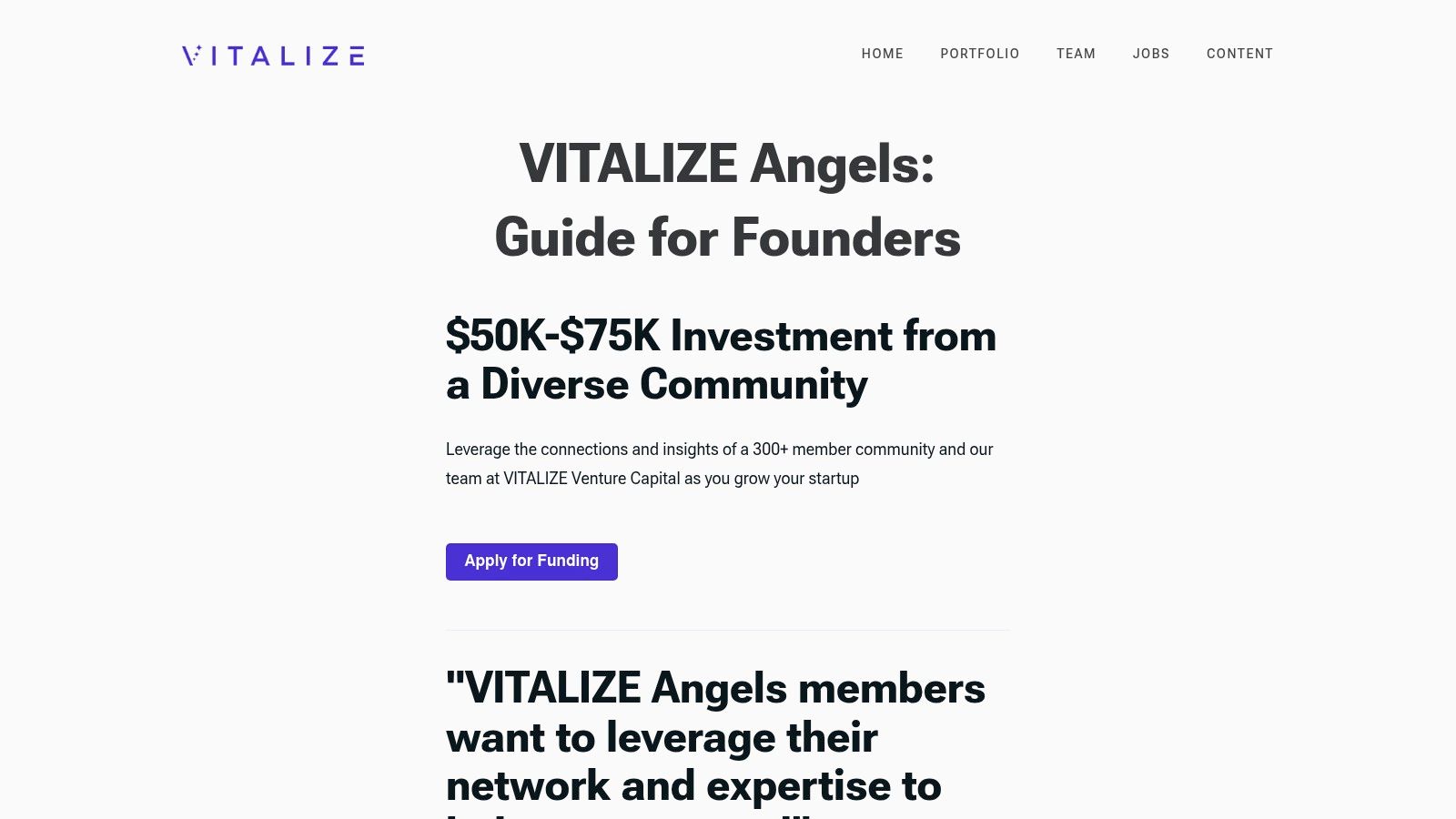
The community uses a fast process with a stated typical investment of $50,000 to $75,000 per deal and a 30 to 60 day close, according to VITALIZE's founder page. It uses a Wefunder backend, lets founders invite their own network, and places the angel participation into a single SPV line on the cap table.
Pick VITALIZE for thesis clarity and cap-table simplicity
VITALIZE has a 500-plus member angel community and a monthly pitch cadence. Those details can help you plan your timing, but confirm the current schedule and terms before you apply.
Prepare a short, WorkTech-specific case:
- Workflow pain: Name the expensive or slow task your customer needs to fix.
- Buyer proof: Show who pays, who uses the product, and how the buyer found you.
- Round gap: Explain how VITALIZE's check range fits into the full raise.
The SPV structure can reduce the administrative burden of managing many individual investors. The trade-off is that the stated check range may not cover a larger round by itself. You'll likely need co-investors, and you should understand the SPV economics before accepting money.
Apply through the VITALIZE process, then ask for a specific next step, such as a pitch slot or a fit conversation. Don't send a generic “we're changing work” note. Show the exact WorkTech problem you solve.
6. Chicago Booth Angels Network CBAN
CBAN works well for founders who want a repeatable pitch cycle and access to experienced University of Chicago Booth alumni investors. It's an alumni-run nonprofit affinity network with Chicago and New York chapters, but you don't need to have founded the company through the University of Chicago to apply.
The network runs seasonal pitch cycles through Gust, with Chicago programming and public event dates. Members can review deals together, which gives you a defined path into the network instead of relying only on a one-to-one introduction.
Match your raise to the calendar
CBAN is a poor fit for a founder who needs a decision tomorrow. It's a good fit if you can plan around a cycle and want alumni access, mentoring, and a structured presentation.
Use CBAN to confirm the current application window. Then prepare:
- A concise company case: Explain the customer, problem, product, and early evidence.
- A clear capital plan: State the amount you're raising and what the money will accomplish.
- A follow-up path: Ask whether the next step is a pitch event, diligence call, or member introduction.
Check sizes vary by deal, so plan to combine CBAN with other investors if the round requires more capital. That makes your broader Chicago investor strategy important. You can also track local venture capital activity in Chicago to identify potential co-investors and warm connectors.
The trade-off is timing. The seasonal model gives you structure, while a direct angel relationship may move faster. Choose CBAN when community access and a clear presentation process outweigh speed.
7. Keiretsu Forum Midwest and Northeast Chicago hub
Keiretsu Forum works best when your round benefits from investors across several cities. The Chicago hub acts as the Midwest center for a larger angel network, with monthly forums, investor networking, and exposure to accredited investors, family offices, and micro-funds.
The process uses standardized applications through Dealum and a repeatable presentation and diligence format. That structure can help you reach beyond Chicago, especially when your customers, market, or syndicate already crosses state lines.
Bring a multi-market financing plan
Go to Keiretsu Forum Midwest and Northeast with a clear reason for the broader network. Explain which investors you want, what role they could play, and how the round benefits from geographic reach.
Your presentation should include:
- Syndicate logic: State why one city cannot provide every relationship or check you need.
- Investor relevance: Connect the company to family offices, micro-funds, or angels with sector knowledge.
- Diligence readiness: Keep financials, ownership records, customer evidence, and legal documents organized.
Presentation and processing fees can apply, and the multi-step diligence process can consume time. Confirm current terms before you submit. The format makes less sense for a very small round with a short deadline.
A broad forum only helps when you can explain why each additional investor belongs in the round.
Use Keiretsu when you want a repeatable roadshow and multi-market syndication. Choose a smaller Chicago group when you need close operator feedback or a faster, more personal conversation.
Comparison of 7 Chicago Angel Investor Groups
| Network | 🔄 Process / Complexity | ⚡ Resources (check size & speed) | 📊 Expected outcomes / ⭐ Effectiveness | Ideal use cases | 💡 Key advantages |
|---|---|---|---|---|---|
| HPA (formerly Hyde Park Angels) | Structured submission-to-champion workflow; member-driven diligence; competitive intake | Check sizes variable and not publicly standardized; timelines vary; syndication common | Strong brand signaling and downstream fundraising benefits; high post-investment mentorship ⭐⭐⭐⭐ | Early-stage Midwest founders seeking operator mentorship and credibility | Operator-heavy investor bench, deep Midwest network, strong mentorship |
| IrishAngels | Collaborative quarterly diligence cohorts; repeatable review cadence | Publishes guidance: min ≈$150k, avg ≈$400k; ~$70M deployed across 200+ members | Clear round-planning guidance and credible introductions; reliable seed-stage support ⭐⭐⭐ | Pre-seed/seed founders planning $1–$3M rounds who want transparent sizing | Large member network, transparent check guidance, regular Chicago interactions |
| West Suburban Angels | Simple application path; member-led local review; community-oriented | Smaller pool of capital; often requires syndication for larger rounds | Local mentorship and suburban executive connections; modest capital impact ⭐⭐ | Suburban Chicagoland founders valuing proximity to mentors and local syndication | Accessible forum, community-minded orientation, bridge to other Midwest angels |
| Cornerstone Angels | Gust-based application with multi-step screening and selection | Member capital plus syndication; application fee may apply | Well-established diligence and advisory support; good syndication capability ⭐⭐⭐ | Founders comfortable with formal review process and modest application requirements | ACA EAG designation, experienced entrepreneur/executive members, syndication-friendly |
| VITALIZE Angels | Fast monthly cadence; Wefunder backend; SPV one-line cap table; streamlined process | Typical checks $50–$75k; 30–60 day close; SPV simplifies cap table | Quick closes and clear process; potential VC follow-on from operator fund ⭐⭐ | WorkTech (B2B/B2B2C) startups needing fast capital and simple SPV structure | Clear thesis, transparent timing, operated by seasoned VC team |
| Chicago Booth Angels Network (CBAN) | Seasonal pitch cycles via Gust; alumni-run nonprofit review process | Check sizes vary by deal; membership/affinity-driven capital | Access to alumni mentors and repeatable pitch process; good network effects ⭐⭐ | UChicago alumni-affiliated founders or Chicago startups seeking alumni investors | Strong local alumni network, visible programming calendar, repeatable cycles |
| Keiretsu Forum Midwest + Northeast (Chicago hub) | Monthly forums and roadshows; standardized Dealum applications; multi-step diligence | Access to angels, family offices, micro-funds across cities; presentation/processing fees common | Broad multi-market exposure and large-syndication potential; high reach for bigger rounds ⭐⭐⭐ | Founders seeking multi-city investor syndication and family-office access for larger raises | Global network, structured roadshows, multi-market investor access |
Turn Investor Research Into Warm Outreach
Start by sorting the seven groups into a short list. Use five filters: stage, sector, round size, geography, and process timing. A WorkTech company should start with VITALIZE. A founder planning a larger pre-seed or seed round should examine IrishAngels. A Midwest operator network may point you toward HPA, West Suburban Angels, or Cornerstone. A multi-city syndication plan makes Keiretsu more useful, while CBAN suits founders who can work around seasonal cycles.
Chicago's market rewards targeted outreach. One investor database lists about 1,038 investors in Chicago, including 345 angel investors, while another dataset tracks 670 verified angel investors and VCs in the Chicago metro area and 796 across Illinois. The same AngelSearch data estimates that 74% of Chicago investors are quiet and 17% are active, so a giant contact list won't replace a focused plan. Review the Chicago investor database and target active, stage-aligned people rather than sending the same message to everyone.
Prepare five items before you ask for an introduction:
- One-page company summary: State the problem, customer, product, traction, market, and team.
- Round details: Name the amount, instrument, target close, current commitments, and minimum allocation.
- Traction proof: Use customer activity, revenue, pilots, retention, or product usage that you can verify.
- Use of funds: Tie each major spend to a milestone.
- Direct ask: Request an introduction, fit call, pitch slot, or application review.
Illinois can make the capital stack more attractive for eligible deals. The Angel Investment Tax Credit Program had placed more than $424,405,841 into early-stage Illinois businesses by 2024, across 2,815 investments, in exchange for $105,463,468 in tax credits according to the Illinois Department of Commerce and Economic Opportunity report. In the 2024 reporting year, $4,317,662 in credits generated $16,194,649 in private investment in the state program.
For eligible investors, Illinois allows a 25% credit on a direct investment in a Qualified New Business Venture, or 35% if the company qualifies as a Set-Aside QNBV. The credit base caps at $2 million per business, and the minimum eligible investment is $10,000 under the Illinois Angel Investment Tax Credit. The higher credit can apply to a minority-owned, women-owned, or disability-owned company, or a business located in a county with a population of 250,000 or less, subject to the program rules outlined by the Illinois Department of Revenue. Ask an advisor to confirm eligibility before you mention the credit in an investor conversation.
Use this warm-introduction request:
“Hi [Name], I'm raising [round amount] for [company], a [sector] company at [stage]. We've [specific proof of progress], and I'm looking for an introduction to [group or investor] because of their experience with [specific fit]. Would you be comfortable connecting us? I can send a one-page summary and deck.”
Use this direct message when you don't have a connector:
“Hi [Investor], I'm building [company], a [sector] business at [stage]. We're raising [round amount], and we've reached [specific proof of progress]. I'm contacting you because your group focuses on [sector, stage, geography, or model]. Would you be open to a short fit call or the correct application route?”
Before you apply, confirm current check guidance, fees, process timing, investment structure, and sector fit. Terms change, and a page that helped you plan the round may no longer describe the current process. If you want peer support while you prepare, connect with the free, vetted Chicago Brandstarters community, and use practical revenue-based financing insights as you assess funding options.
Chicago Brandstarters gives founders free access to vetted small dinner groups and a private chat where members share practical problems, tactics, and support. Visit Chicago Brandstarters to meet thoughtful Chicago and Midwest builders before your next investor conversation.
Leave a Reply