
Most startups fail at positioning because they begin with visuals instead of answering four questions: who they serve, what alternative they replace, what value they deliver, and why buyers should believe them. A 2025 study of 300 startups found that all four measured dimensions of brand positioning correlated significantly with startup success, so positioning belongs in the operating plan, not at the end of a logo project. The study gives founders a useful reason to take this work seriously.
You launch the product, choose a polished typeface, approve a logo, and write a tagline that could describe twenty competitors. Then sales calls stall because prospects still can't explain what you do. Your team keeps changing the homepage, your founder pitch wanders, and every new marketing idea pulls the brand in another direction.
I've watched founders spend weeks polishing a visual identity before speaking with a single buyer. One founder I worked with had a beautiful brand deck and no clear answer to who would switch, what they would switch from, or why the new product deserved trust. Once we forced those four questions onto one page, the business became easier to explain almost overnight.
Why Most Startup Positioning Fails Before It Starts
A startup can have a polished logo, a memorable name, and a fast product, yet still lose the buyer in the first conversation. The problem usually starts earlier than the design. Brand positioning for startups defines where the company competes, who should care, what alternative it replaces, and why the promise deserves trust. It must work for humans making a judgment and for AI systems summarizing, comparing, or recommending products.
Founders often treat identity as positioning. Identity is the visible and verbal system. Positioning is the commercial decision that system communicates. Startup Fundraising's brand playbook organizes that decision around four questions: who the product is for, what alternative it replaces, what unique value it delivers, and why the buyer should believe it.
Practical rule: If a salesperson needs a long explanation before a buyer understands the product, the position is not doing enough work.
The four questions that remove the fog
Write the answers before approving a tagline, homepage, or pitch deck.
- Who is it for? Name a buyer in a recognizable situation, not “everyone who wants better results.”
- What does it replace? Include competitors, spreadsheets, manual work, internal hires, and doing nothing.
- What value does it deliver? State the result in words buyers already use.
- Why should buyers believe you? Point to product behavior, evidence, expertise, access, or a repeatable process.
“We help modern businesses grow through advanced technology” fails because it identifies no buyer, alternative, outcome, or proof. A clearer version is: “We help independent ecommerce operators replace scattered campaign reporting with one weekly view of profitable acquisition, backed by direct connections to the tools they already use.” Buyers can evaluate that claim, and search systems can extract its audience, problem, outcome, and evidence.
Why visual-first branding wastes scarce attention
Early-stage teams have limited time and limited evidence. Spending that attention on colors before deciding what the company should own in the buyer's mind creates a polished container for an unclear idea. A redesign cannot repair a weak category choice, an unfocused audience, or a promise the product cannot prove.
Brand research examines awareness, perception, associations, consideration, and comparisons with competitors. Drive Research's overview of brand positioning explains how unaided and aided awareness contribute to total awareness. A startup does not need a large research department to apply the principle. It needs a clear position, real people to question, and real alternatives for comparison.
A useful position guides product choices, pricing conversations, sales qualification, content, hiring, and the language machines use to classify the company. Treat it as foundational infrastructure, then let visual identity express the decision instead of pretending to make it.
Defining Your Target Audience and Category
Start with behavior, not demographics. “Small businesses” tells you almost nothing. “Independent agencies whose founders still assemble client reports by hand before monthly reviews” gives you a situation, a pain, and a place to ask better questions.
Build an audience profile from observed behavior
Interview people who recently experienced the problem. Ask what happened before they searched for a solution, what they tried, what failed, who approved the purchase, and what made the problem urgent. Avoid asking whether they like your idea. Polite encouragement can hide weak demand.
Record the words they use for the pain and the workaround. You're looking for repeated patterns:
- Trigger: What event makes the problem impossible to ignore?
- Workaround: What do they use today, even if they dislike it?
- Cost of delay: What gets slower, riskier, or harder when they wait?
- Buying constraint: Who controls access, budget, security, or implementation?
- Proof standard: What evidence would make the product believable?
For a more structured approach, Crescade's guide to performance marketing buyer personas can help you organize audience information around buying behavior rather than surface-level description. You can also compare your draft against this target audience definition resource before you turn research into copy.
Choose the category buyers already understand
Your category gives buyers a mental shelf. If you refuse to name it, they'll place you beside whatever sounds closest, which may attract the wrong comparisons. A startup can create a new category later, but early buyers still need a frame of reference.
List three columns on a whiteboard:
- Direct alternatives: Products a buyer would shortlist for the same job.
- Indirect alternatives: Adjacent tools, agencies, internal work, or manual processes.
- Your credible edge: The specific job you can perform better or differently.
Then write one sentence for each competitor: “They help [buyer] do [job] through [approach].” Write the same sentence for your company. If your version sounds interchangeable, don't rush to invent a clever category name. Narrow the buyer, sharpen the job, or find proof for a difference you can defend.
Know when to narrow
A broad audience can create broad traffic and weak conversion. A narrow audience can reduce reach while improving relevance, referrals, and sales conversations. Early founders should usually choose the smallest group with an urgent problem and a reachable buying path, then expand when the product earns permission to do so.
Crafting Your Positioning Statement and Value Proposition
Your positioning statement isn't a slogan. It's an internal decision that should help a buyer understand your offer and help your team reject distracting opportunities. Keep it in one paragraph, then turn the same logic into shorter messages for your homepage, pitch, product, and sales calls.
Use this structure:
For [specific audience] who [recognizable problem], [product] is a [category or frame of reference] that [unique value]. Unlike [main alternative], it [credible difference], because [proof].
The statement can sound plain. Plain language gives you something to test. “The intelligent future of connected growth” sounds polished and tells a buyer almost nothing.
Give every sentence a job
| Question | Purpose | Example |
|---|---|---|
| Who is this for? | Defines the buyer and situation | Independent ecommerce operators with scattered acquisition reporting |
| What category are you in? | Gives the buyer a familiar frame | A weekly acquisition reporting workspace |
| What benefit do you deliver? | States the practical outcome | Helps operators see which campaigns produce profitable growth |
| Why should buyers believe you? | Supplies a reason to trust the claim | Connects directly to the tools they already use and shows source data |
Your unique value proposition should describe a difference that matters to the buyer. “Easy to use” rarely creates separation because every competitor can claim it. “Built for operators who need a weekly profit view without waiting for an analyst” gives the phrase a user, a moment, and a standard.
Pressure-test the draft
Read the statement to a buyer without explaining it. Ask what they think the product replaces, who they think it serves, and what claim they would need to verify. If their answer differs from your intent, believe their interpretation.
Run the statement through four tests:
- Specificity: Could a competitor copy the sentence without changing a word?
- Proof: Can your product, team, or customer experience support each claim?
- Trade-off: Does the position exclude a buyer or use case on purpose?
- Repeatability: Can a salesperson say it naturally without memorizing a speech?
Naming affects discovery too. If you're choosing a product name, this product naming framework for visibility gives you a useful way to think about clarity, recall, and how people or systems may interpret the name. For a fill-in structure you can adapt with your team, use this marketing positioning statement template.
A position becomes real when it changes decisions. If every audience still qualifies, every feature still belongs, and every channel still carries a different promise, you've written copy rather than chosen a position.
Building Messaging and Validating With Research
A positioning statement can look precise in a strategy document and still fail in a buyer's inbox. Messaging makes the position usable across a homepage, demo, product interface, review, or founder conversation. Keep the underlying promise stable, but change the emphasis and vocabulary to fit each context. Clear language also helps AI systems classify your company, so name the audience, problem, category, and outcome directly rather than relying on clever phrasing.
A homepage should state the buyer, problem, and outcome quickly. A sales deck can explain the cost of the current alternative. A product screen should express the same idea through functional language. A founder post can add personal proof and explain why the team chose the problem.
Turn claims into proof
Write the supporting evidence beside every important claim. “Faster onboarding” needs a defined experience and a way to verify it. “Made for finance teams” needs product behavior, security decisions, workflow knowledge, or customer language that supports the statement.
Use four proof types:
- Product proof: A workflow, capability, integration, or constraint buyers can inspect.
- Customer proof: A direct customer account, review, interview, or observed behavior.
- Founder proof: Experience that explains why you understand the problem.
- Operational proof: A delivery process that makes the promise believable after purchase.
Do not borrow a competitor's vocabulary merely because it feels familiar. That may make the copy easier to write while making the startup harder to remember and harder for search systems to distinguish. Guidance on B2B positioning pitfalls cautions against rushing research, blending in, serving broad preferences, and treating positioning as a tagline. Your position must survive contact with the product and operations.
Validate before you scale distribution
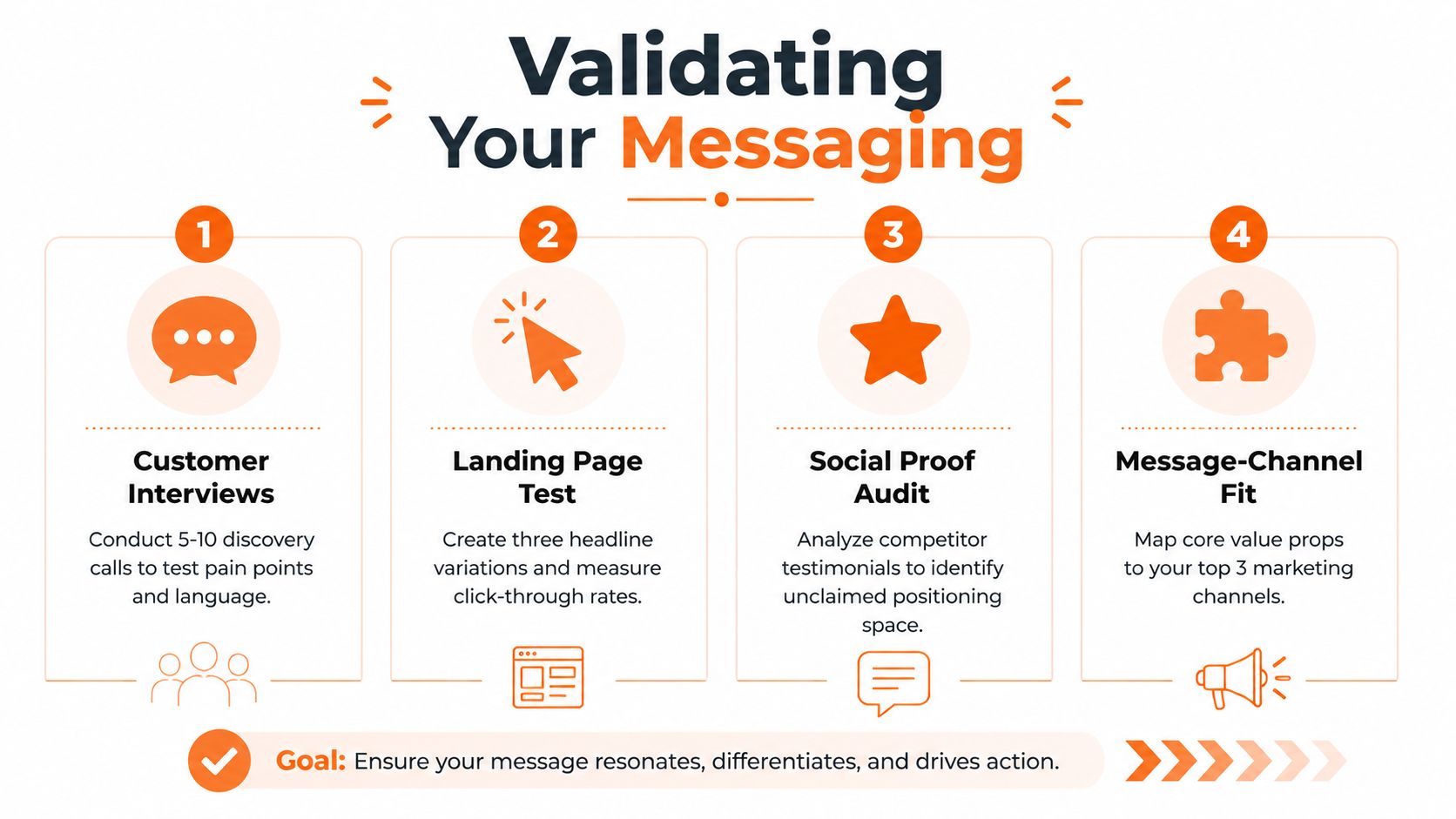
Run interviews with buyers who fit your audience. Show them the statement without coaching, then ask what they think it means, what alternative they use, and which part they distrust. Record exact phrases, including confusion and objections. Those words often reveal the language buyers use naturally, while also exposing terms that an AI system may interpret too broadly.
Use a survey when you need broader comparison across the audience. Ask respondents to rate relevance, distinctiveness, consideration, and associations against named alternatives. Combine those responses with competitor benchmarking and sales-call notes. The research process should compare what people say in interviews with how they respond at scale, rather than treating either method as sufficient on its own.
Use this validation checklist:
- Comprehension: Can the buyer explain what you do in their own words?
- Relevance: Does the problem belong to their current priorities?
- Distinctiveness: Does your difference separate you from familiar alternatives?
- Credibility: Can you show evidence without adding a long explanation?
- Action: Does the message give the buyer a clear next step?
A landing page test can show which wording earns attention, but it cannot explain every reason behind the result. Pair behavior with conversation. Otherwise, you may optimize a headline that attracts the wrong audience.
The following video offers another perspective on turning strategy into usable messaging:
Implementing Positioning Across Channels and Measuring Results
Once you choose a position, put the same strategic idea wherever buyers meet you. Consistency doesn't mean repeating one sentence everywhere. It means your website, LinkedIn profile, sales call, product experience, review pages, and founder communication all describe the same company, audience, category, and promise.
Create one source of truth
Write a short messaging document with the approved positioning statement, audience description, replacement category, value proposition, proof points, words to use, and claims to avoid. Give it to anyone who writes, sells, designs, supports customers, or represents the company publicly.
Your brand identity should include the visual system, voice, customer experience, and story. Stripe's guide to startup market positioning describes elements such as the logo, colors, typography, design, voice, messaging, touchpoints, and narrative, with consistency across surfaces. Let those elements express the position rather than compete with it.
Use your channels differently:
- Website: State the buyer and outcome above the fold, then prove the claim.
- LinkedIn: Make the founder and team intelligible through repeated topics and clear expertise.
- Sales: Qualify against the alternative you replace, not only against company size.
- Content: Answer the questions that buyers ask before they trust your category.
- Reviews and profiles: Keep the company description, audience, and use case consistent.
PostSyncer's resource on how to create content that converts can help turn a positioning decision into a repeatable publishing system. You can also use this omnichannel marketing strategy guide to map messages across customer touchpoints.
Make the company readable to machines
Human clarity now needs a machine-readable layer. AI systems, search engines, and recommendation tools need consistent information about who you are, what you do, and who you serve across your site, LinkedIn, review platforms, and third-party mentions. If those descriptions conflict, a buyer may receive a distorted summary before visiting your website.
This doesn't mean stuffing pages with keywords. It means naming the category plainly, describing the customer precisely, using concrete evidence, and keeping company facts stable across profiles. Recent AI-era positioning guidance cites research summaries in which adding statistics increased AI citation likelihood by 30.6%, while adding quotes increased it by 40.9%. Decoded Strategies' report provides that specific finding and the surrounding discussion.
Founder visibility can support this clarity when it matches the product reality. The 2025 Edelman Trust Barometer special report examined brand trust through a more personal relationship lens, and one consumer startup ranking used 40,000 consumer interviews in Germany to assess awareness, sympathy, and relevance rather than investor opinion. The Edelman report gives founders a useful reminder to test perception with customers, not only with internal stakeholders.
A small peer group can expose positioning gaps quickly because founders hear where your explanation loses them. Chicago Brandstarters is one option, with private founder dinners and a group chat for practical discussion. Small founder groups often use 6 to 10 or 6 to 12 members, plus confidentiality expectations and vetting, according to this peer network guide.
Track whether your position works through qualitative and behavioral signals: qualified inquiries, recurring objections, search language, sales-cycle friction, review wording, and the questions prospects ask before they buy. Don't change the position because one campaign underperforms. First identify whether the problem sits in the audience, promise, proof, channel, or conversion experience.
Chicago Brandstarters gives founders a free, vetted community for testing ideas, sharpening positioning, and trading honest operating lessons with kind, hard-working builders from Chicago and the Midwest. Visit Chicago Brandstarters to meet a small peer group that can challenge vague language before it reaches your next launch.
Leave a Reply