
You're staring at a half-finished product, a cash-flow question, or a decision that could cost you weeks. You've searched for answers, messaged a few contacts, and still don't have a trusted operator to call. Early-stage building can feel like making expensive bets alone, especially when remote work removes the casual conversations that used to happen around an office.
A well-run mastermind group format gives you a repeatable room for those decisions. Six to eight founders meet on a fixed cadence, bring real problems, and leave with specific commitments. The format works when the group protects confidentiality, gives everyone equal time, and treats follow-through as part of participation.
Why Most Founder Groups Fail and What Works Instead
A founder leaves a networking event with a pocketful of contacts, then faces the same product, hiring, or cash-flow decision alone. Introductions are easy to collect. Trust takes repeated contact and proof that private problems will stay private.
A mastermind group format uses a different operating agreement. Six to eight founders meet on a fixed cadence, bring live decisions, and report on commitments from the previous meeting. The group works when preparation, confidentiality, and equal airtime are treated as requirements rather than good intentions.
Napoleon Hill popularized the modern mastermind idea in 1925 and described it more fully in Think and Grow Rich in 1937. He defined it as coordinated knowledge and effort from two or more people pursuing a definite purpose in harmony, as summarized in this historical overview of mastermind groups.
Networking trades attention for access
Transactional networking rewards polished introductions and fast exchanges. A peer advisory group rewards preparation, candid questions, and useful follow-through. Those incentives produce different conversations.
At a dinner, I want a founder to explain why a launch stalled, which hire is failing, or what decision keeps getting postponed. A specific constraint gives the room something to examine. Five elevator pitches give it very little to work with.
Practical rule: If members cannot discuss a mistake safely, the group will produce advice theater.
Confidentiality needs a rule members can apply without interpretation: no summarizing another member's problem in a Slack channel without that member's explicit permission. A breach should trigger a direct conversation and, if trust is not restored, removal. Without that enforcement, founders will bring polished updates instead of the facts that require help.
The group also needs a clear boundary. A mastermind is not therapy, legal counsel, accounting advice, or clinical care. Peer-support research concerns mental-health recovery, not founder performance, so it should not be used as proof that a founder group improves business outcomes. The practical takeaway is narrower: keep the room focused on decisions, experiments, and commitments, and refer problems outside that scope to qualified professionals.
A useful operating reference is Chicago Brandstarters' guide to mastermind groups for entrepreneurs, which emphasizes small private meetings, honest operating stories, and members contributing as well as receiving. In practice, that means assigning a hot seat before the meeting, protecting time for questions, and ending with one owned next action. The room should function like a workshop, not a stage.
Vetting and Onboarding the Right Members
The wrong person can change the tone of a small group in one meeting. A service-seller turns every problem into a pitch. A chronic self-promoter consumes airtime. A careless member repeats private details outside the room. Vetting protects the group before those habits become expensive to fix.
A practical cohort usually has 5 to 8 members, while published case literature also describes groups of 3 to 6 participants and an upper ceiling around 8 to 10 in its discussion of mastermind structure. I prefer six to eight for a dinner or video room. You get enough perspective without turning every hot seat into a conference panel.
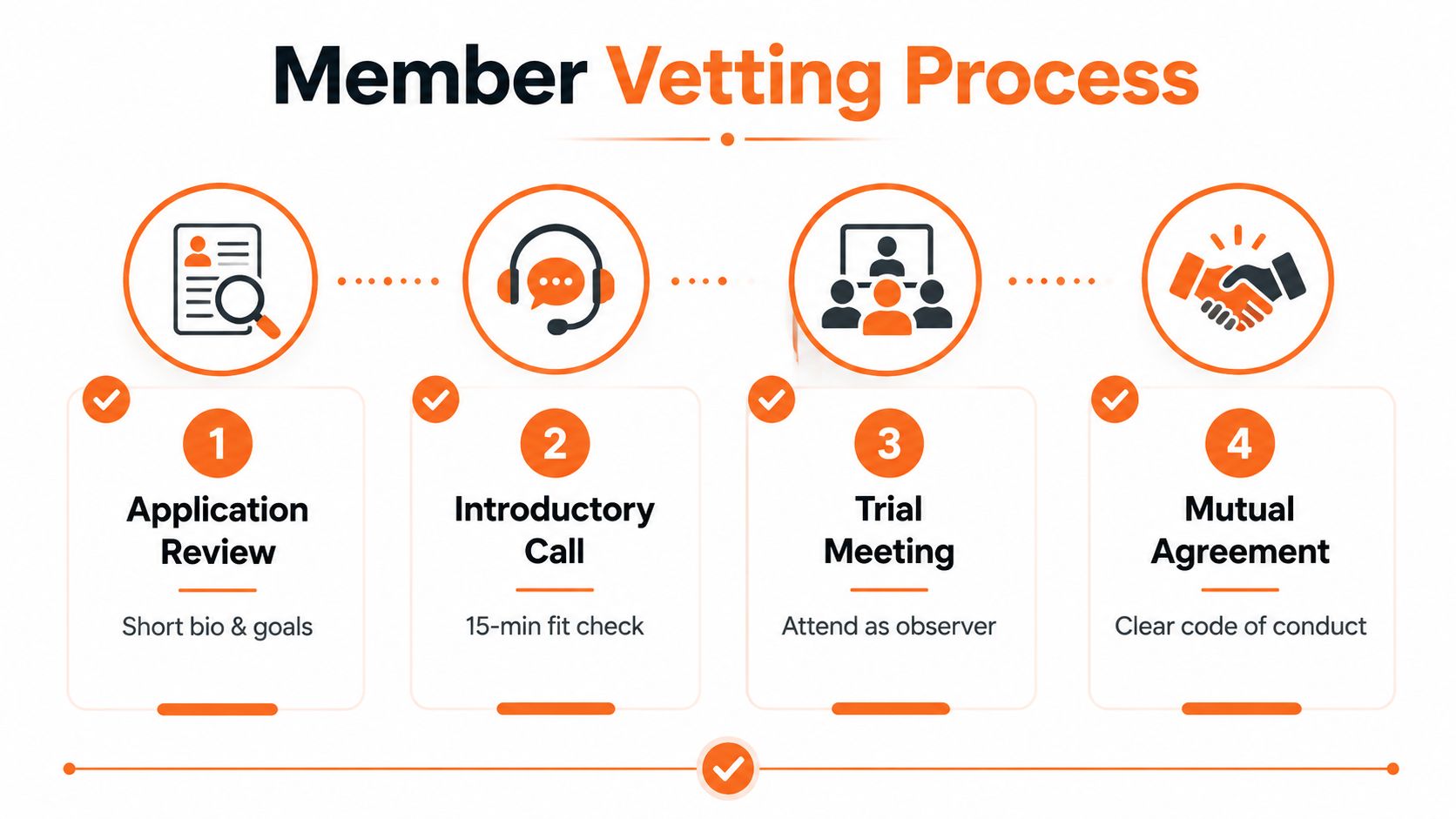
Use four filters before you invite anyone
Review a short application. Ask what the person is building, what they're working through, and what they can help other members with. Look for a working problem, not a vague desire to “meet ambitious people.”
Verify the person's professional context. Check LinkedIn, the company website, and the consistency between the application and public profile. You're checking identity and fit, not judging polish.
Hold a brief introductory call. Ask how they respond to direct feedback, what confidentiality means to them, and whether they can attend consistently. Listen for curiosity. A good candidate asks about the group's rules and the other members.
Use a trial meeting when uncertainty remains. Let the candidate observe or join one session under the same confidentiality rules. Watch whether they listen, ask useful questions, and resist pitching.
The group should publish a written agreement before the first official meeting. Include attendance, confidentiality, equal participation, no unsolicited selling, the difference between advice and questions, and a review point. A six-month or twelve-month review can give the group a clean opportunity to renew its agreement or change its membership, as recommended in this mastermind group structure guide.
Handle problems early
When someone misses meetings, contact them privately and ask what changed. When someone pitches, name the behavior without attacking the person: “This room doesn't allow unsolicited sales. Can you commit to that rule?” A second breach needs a clear consequence, usually a pause or exit.
For more ideas on choosing communities with compatible values, use this guide to finding your tribe. Fit matters more than impressive titles. You want kind, hard-working builders who can give direct help without turning every conversation into a transaction.
The 90-Minute Meeting Agenda You Can Copy
A dinner mastermind needs a clock. Without one, the first founder gets a generous conversation and the last founder gets a rushed nod. The facilitator owns the sequence, the timekeeper protects the schedule, and the scribe records decisions rather than every sentence.
The format below follows a 90-minute meeting structure described in a facilitator manual, including updates, coaching, and a wrap-up in this mastermind mentors guide. That guide also requires confidentiality unless the speaker gives express permission.
Run the room by the minute
| Minutes | Activity | Facilitator Prompt |
|---|---|---|
| 0–12 | Check-in and current state | “Give us your headline, current energy, and one issue you may bring today.” |
| 12–22 | Commitments review | “What did you commit to, what happened, and what blocked you?” |
| 22–52 | Hot seat one | “What decision do you need to make, and what kind of help do you want?” |
| 52–82 | Hot seat two | “What facts should we clarify before we offer a view?” |
| 82–88 | Commitments | “State one action, owner, and deadline you'll report back on.” |
| 88–90 | Closure | “What did you take from today, and is there anything the group must protect?” |
For a larger group, rotate hot seats across meetings. If everyone needs a turn, shorten the opening updates and choose 1 to 2 issues for focused discussion, a format described by the LEAP Foundation mastermind guide.
Teach members how to use a hot seat
The member starts with a precise request. “Should I hire?” is too broad. “I have two qualified candidates and need to choose between a generalist and a specialist for our next product milestone” gives the room a workable question.
Use three phases:
- Context: The member explains the facts, constraints, and desired outcome.
- Clarification: The group asks questions only. No advice yet.
- Response: Members share an observation, relevant experience, or question. The person in the seat chooses what to use.
The timekeeper gives a quiet warning before each transition. The scribe records the decision and next action. If one member dominates, the facilitator can say, “Let's hear from someone who hasn't spoken,” then move on. Equal airtime matters because a mastermind creates value through several informed perspectives, not one person's performance.
A shared meal needs its own operating plan, especially if you're hosting in a private venue. This guide for pop-up chefs can help with supper-club logistics, while Chicago Brandstarters' in-person workshop information gives you another reference for planning a structured room.
Dinner Table vs Virtual Screen Format Trade-Offs
The right format depends on what your group needs to protect. A dinner creates physical separation from daily work. A video call makes attendance easier. Neither format fixes a weak agreement or a poorly moderated conversation.
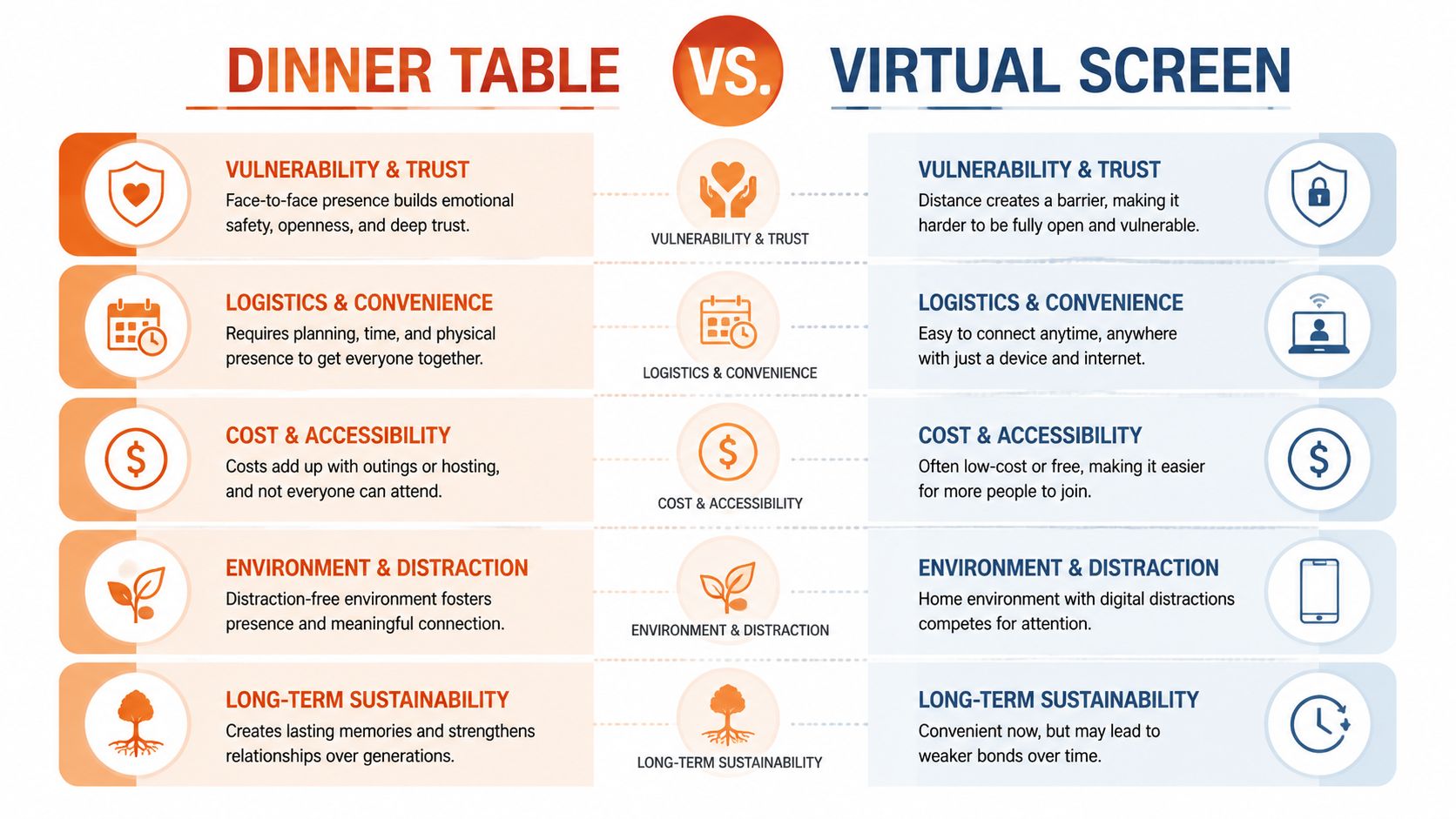
Compare the trade-offs
| Dimension | Dinner table | Virtual screen |
|---|---|---|
| Vulnerability and trust | Shared food and informal pauses can make difficult stories easier to tell. | Members may speak more directly when they can join from familiar surroundings. |
| Logistics and convenience | Travel, venue choice, dietary needs, and late arrivals require planning. | Scheduling works across cities, and members can join without travel. |
| Cost and access | A private meal may create hosting and food expenses. | Members can join from different locations with fewer physical constraints. |
| Group chemistry | Side conversations and body language help members build familiarity. | The host must create connection through prompts, cameras, and deliberate pauses. |
| Long-term sustainability | A recurring dinner can become a ritual people protect. | A recurring call often survives busy seasons because the friction stays low. |
A dinner works well when members live near one another and need deeper trust. I'd use a private table, seat people where everyone can see one another, and keep laptops away. The meal should support the meeting, not replace it. Serve simple food, start on time, and put the hot seat before dessert makes everyone sleepy.
Virtual meetings need stronger facilitation. Ask members to join from a quiet room, use gallery view, and keep a shared document open for commitments. Start with a personal check-in rather than a business update. You can also mail or suggest the same meal theme, which gives the group a small shared ritual without pretending a screen feels like a table.
Hybrid meetings sound inclusive, but they often create two rooms, one physical and one remote. Use hybrid only when the equipment and facilitator can give remote members equal access to voices and visual cues. Otherwise, choose a full dinner or a full virtual session. The group can switch formats at its review point when attendance patterns or member locations change.
Failure Modes and How to Prevent Them
A six-to-eight-person mastermind can contain capable founders and still deliver weak meetings. The pattern usually starts with a small exception: one member gets extra time, a commitment goes unrecorded, or a private story leaves the room. Correct it at the first sign, before the exception becomes the group's operating rule.

Watch for these warning signs
Therapy drift: Members spend the meeting retelling frustration without naming a decision or request. Acknowledge the feeling, then ask, “What would you like from this room today?” If the issue needs professional care, say so plainly and return the group to business.
One-person dominance: The same founder answers first and last. Use a round-robin, cap response times, and invite quieter members before giving the frequent speaker another turn.
Vague commitments: “Work on marketing” gives the group no useful follow-up. Record the action, owner, and deadline. At the next meeting, review what happened before opening a new issue.
Confidentiality breaches: A member shares another founder's situation in a chat or repeats it as gossip. Pause the discussion, restate the confidentiality rule, and speak privately with the person. A dinner group cannot build trust around casual exceptions.
Member churn: Repeated absences make the group repeat context and weaken its shared history. Ask whether the cadence still fits the member's situation. If it does not, release them respectfully and invite a replacement who matches the original agreement.
The operating lesson is simple: track follow-through, not the number of encouraging comments. Peer-support findings show that outcomes vary, so a founder group should judge its meetings by completed commitments and useful decisions rather than enthusiasm alone.
Facilitator script: “I'm going to pause you there. We have the context. Please state the decision you want help with.”
Use a written agreement to clarify attendance, confidentiality, hot-seat limits, and how members challenge missed commitments. That supports building a culture of accountability without turning the dinner into a disciplinary session. Address breaches promptly, privately where possible, and apply the same rule to every member.
This short video can give facilitators another visual reference for group dynamics:
Your Launch Plan and Biweekly Rhythm
You can launch a useful group without building a large community first. Start with a clear purpose, recruit carefully, and put the first meeting on the calendar before enthusiasm fades.
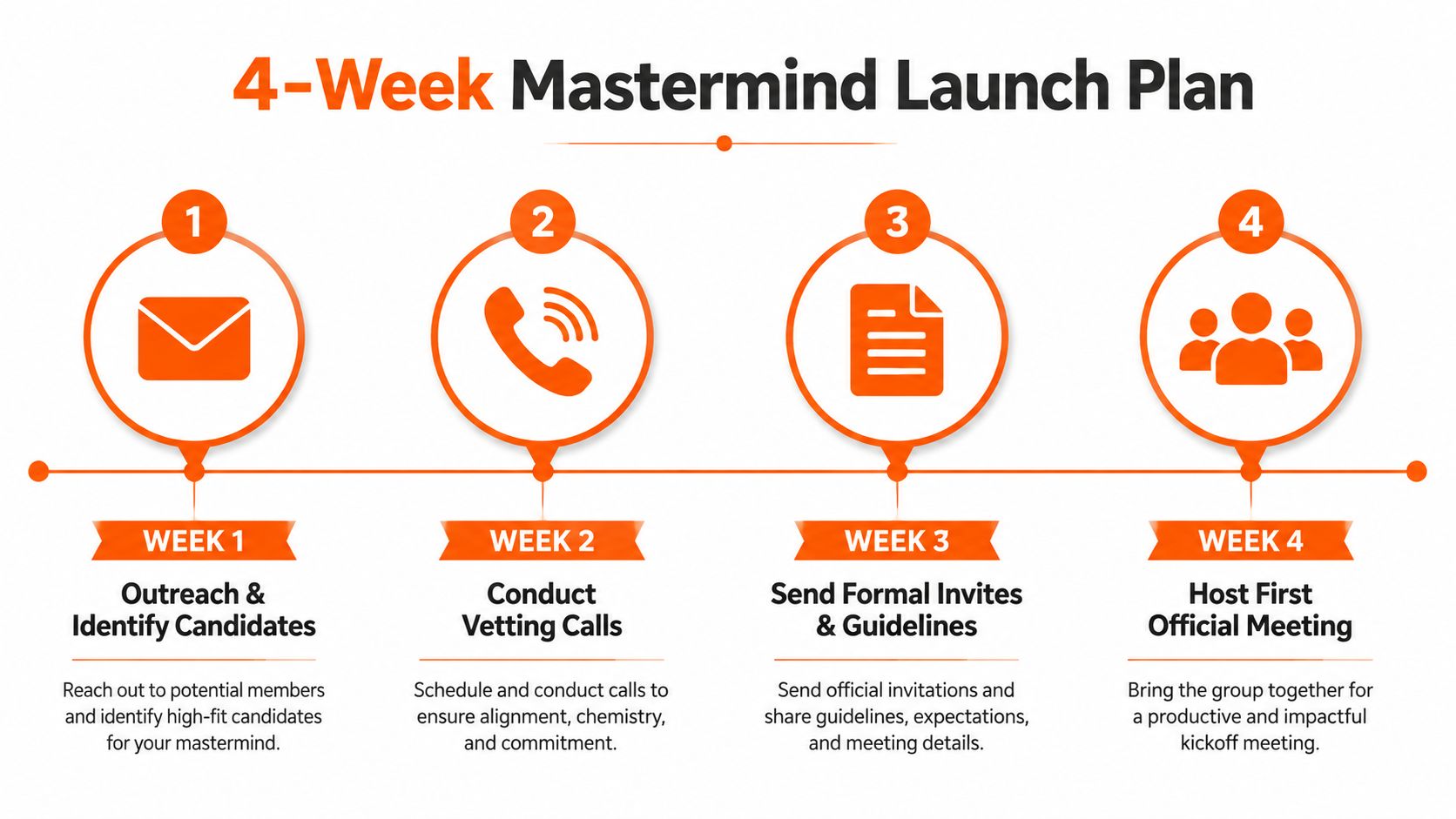
Use a four-week launch sequence
- Week 1: Contact prospective members and identify builders with compatible goals.
- Week 2: Hold fit calls, verify professional context, and test expectations around confidentiality.
- Week 3: Send invitations, the written agreement, meeting dates, and the agenda.
- Week 4: Run the first official meeting, record commitments, and ask for format feedback.
A biweekly rhythm keeps the room active without turning every week into another meeting. Use one session for two full hot seats, then use the next for shorter updates, commitment review, and one focused issue. Rotate the facilitator, timekeeper, and scribe after members understand the format.
At the review point, ask three questions: Are members attending? Are they completing commitments? Does each person still receive and give useful help? A group can renew, adjust its membership, change from dinner to virtual sessions, or close cleanly when the work no longer fits.
Chicago Brandstarters runs free, vetted community gatherings with private 6 to 8 person dinners every two weeks and a group chat for founder support. If you want a ready-made peer setting rather than building a cohort from scratch, visit Chicago Brandstarters to learn how the community connects early-stage builders around confidential, practical problem-solving. Bring one real business question, review the participation expectations, and decide whether the room matches the way you want to build.
Leave a Reply