Most conference advice is backwards. People tell you to show up open-minded, wander the floor, and “network.” That's how you burn cash, lose three days, and come home with a tote bag full of flyers you'll never read.
I treat an electronic commerce conference like a field operation. You have a target, a budget, and a short list of outcomes that make the trip worth it. If you can't name those outcomes before you book the ticket, stay home.
That sounds harsh. Good. It should. Ecommerce is too competitive for conference tourism.
Stop Wasting Money on Conferences
The lazy advice is “just get in the room.” I don't buy it.
Global retail e-commerce sales reached $6.42 trillion in 2025 and are projected to hit $6.88 trillion in 2026, with online sales accounting for 20.5% of global retail, according to UNCTAD's e-commerce data summary. If you're building in a market that big, you don't get to treat travel, tickets, and time away from the business like a casual outing.
The real cost is attention
The money matters. The bigger cost is focus.
Every day you spend at an event is a day you're not fixing conversion issues, calling suppliers, reviewing ad creative, or cleaning up your inventory mess. So the event has to beat what you would have done with that time at home.
Use a simple test:
- Go if the conference can solve a problem you already have.
- Skip if you're going because you feel behind.
- Run if the main pitch is vague inspiration.
Practical rule: If you can't answer “what will I fix next month because I went?” you're not ready to attend.
What founders get wrong
I see the same mistakes over and over:
- They confuse motion with progress. Busy halls feel productive. They often aren't.
- They chase volume. More badges scanned doesn't mean more deals.
- They overvalue stage talks. A flashy keynote rarely fixes your shipping costs.
- They underprepare. They wait until the night before to pick sessions and reach out.
An electronic commerce conference is a tool. Use it like a wrench, not like entertainment. You're there to remove friction from the business. If the trip doesn't do that, it was expensive theater.
What an Ecommerce Conference Really Is
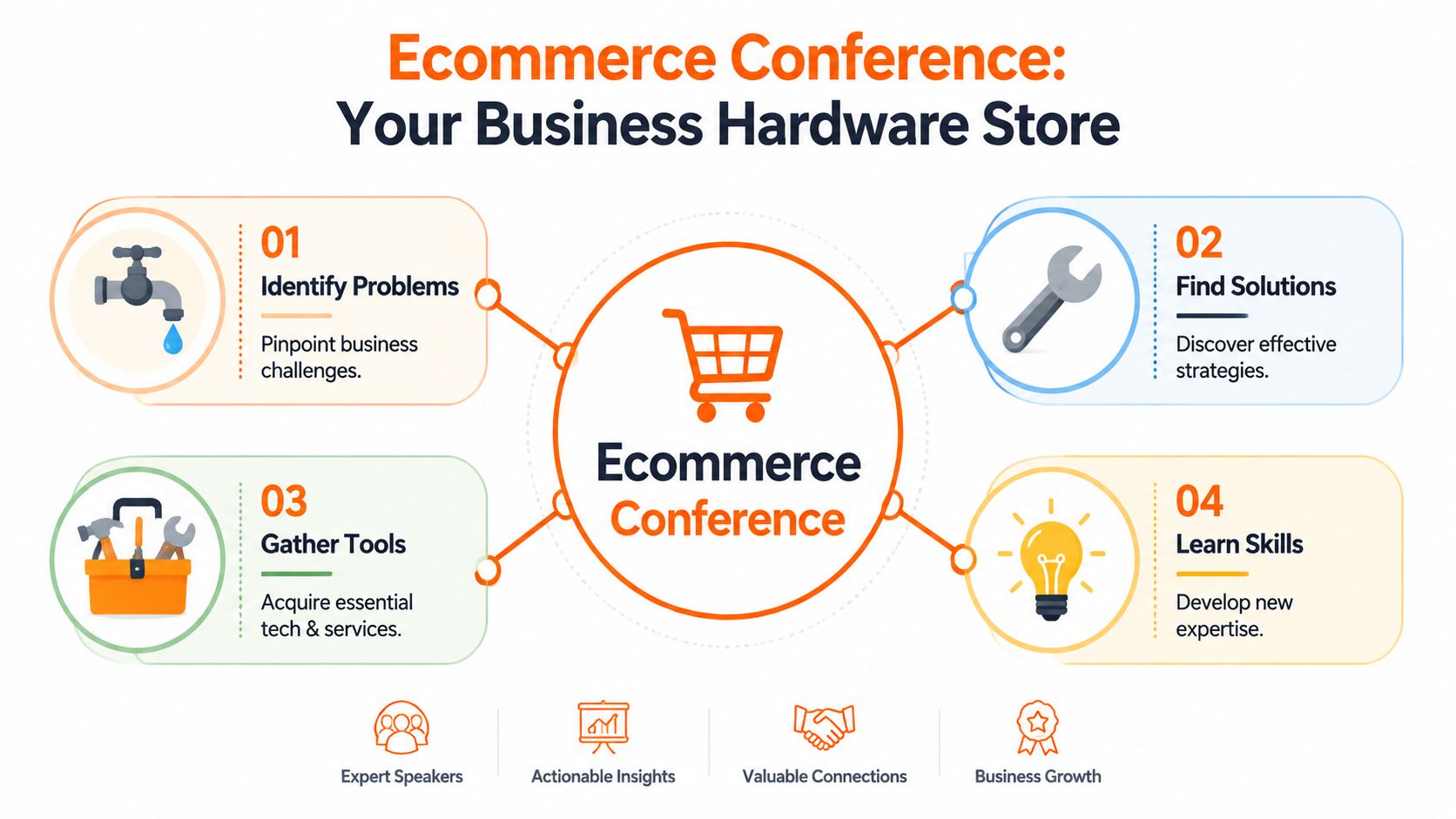
An ecommerce conference is a hardware store for your business.
You don't walk into a hardware store and buy one of everything. You walk in because something is broken. The sink leaks. The shelf is sagging. The outlet is dead. Same thing here. You go because your business has a problem and you need the right tool, person, or answer.
Think in problems, not programming
Forget the glossy session names for a minute. Translate everything into operating issues.
A panel on fulfillment is about missed delivery windows, damaged packages, and bad 3PL fits. A payment session is about failed checkouts, fraud headaches, and cross-border friction. A booth from a platform partner is about whether your stack will break when traffic spikes or when you launch wholesale.
That's the right mental model. Every hallway chat, booth demo, and roundtable should connect to a problem on your list.
Here's how I bucket conference value:
| Conference element | What it actually does |
|---|---|
| Sessions | Gives you tactics, warnings, and decision frameworks |
| Expo floor | Lets you compare vendors fast |
| Side events | Helps you test chemistry with possible partners |
| Speaker Q&A | Gets you edge-case answers you won't find on a landing page |
These events were built to solve real problems
This isn't some fluffy invention cooked up by event marketers. E-commerce has had structured academic and technical gatherings for a long time. The 11th ACM Conference on Electronic Commerce (EC'10) took place in 2010, and the OECD first established a formal definition of e-commerce in 2001, later revising it in 2009, as reflected in the ACM proceedings for EC'10. That tells me something simple. Serious people have treated this field as a real operating discipline for years.
So when you attend an electronic commerce conference, act like a builder entering a supply room.
- If logistics is your pain, hunt 3PLs, packaging vendors, and operators who've switched warehouses.
- If acquisition is the pain, find people running Meta, Google, retail media, influencer, or marketplace channels.
- If systems are the pain, spend time with platform reps and integration partners.
- If compliance is the pain, prioritize cross-border, payments, and tax sessions.
Go in with a punch list. Leave with fixes, names, and next steps.
That's what a conference is. A temporary concentration of tools. Your job is to pick the ones you will use.
Choosing Your Mission Trade Shows vs Summits
Picking the wrong conference type is like showing up to a construction site with a salad fork. You may be sincere. You still won't get much done.
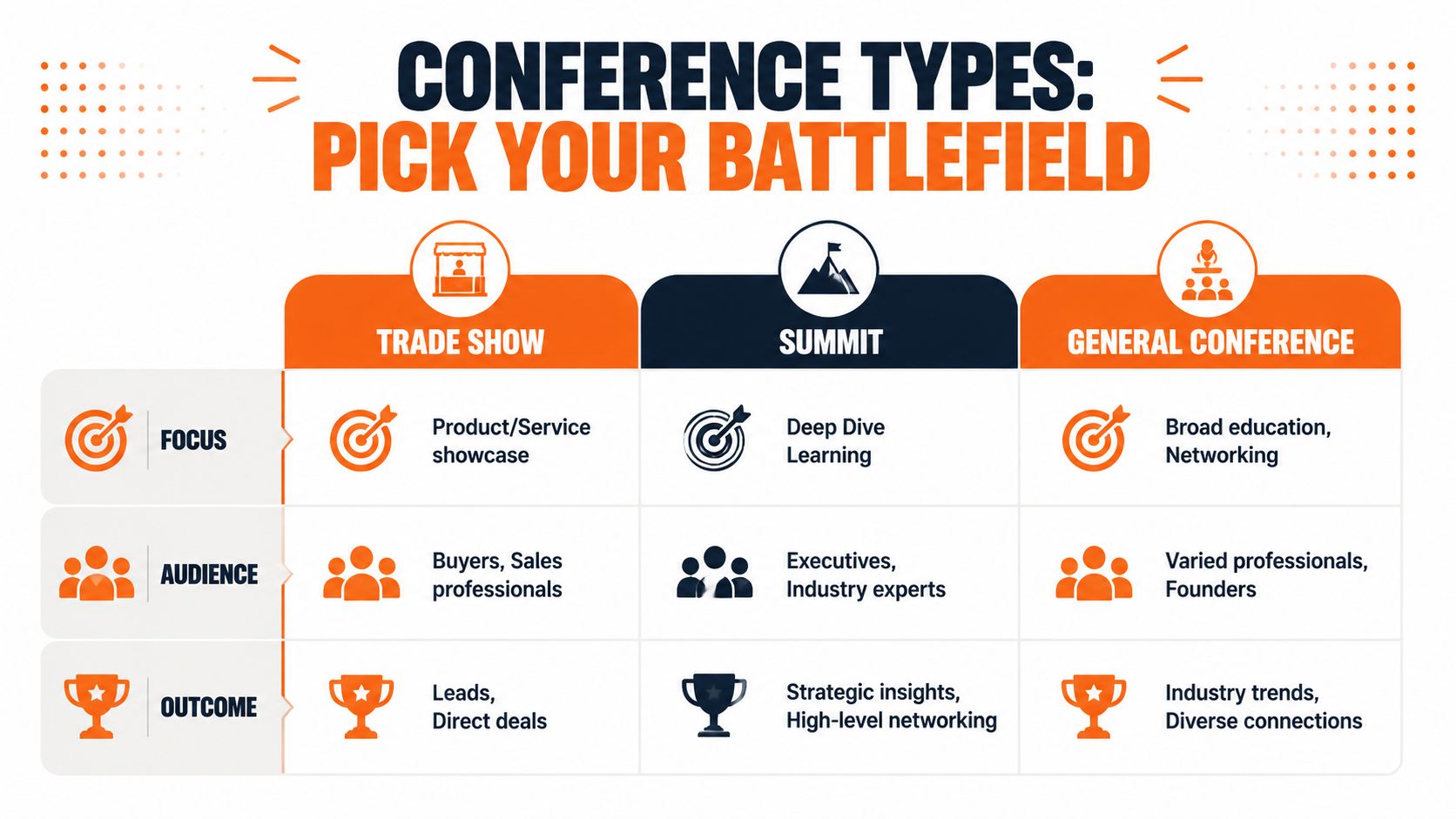
The right event depends on the job in front of you. I break them into three buckets.
Trade shows
Trade shows are for speed and comparison.
If you need to evaluate packaging vendors, shipping software, returns tools, agencies, marketplaces, or payment providers, a trade show is efficient. You can see a lot in one place, ask pointed questions, and quickly figure out who understands your business and who just memorized a script.
Good fit if you need:
- Vendor selection
- Channel partnerships
- Wholesale or retail buyer conversations
- A fast scan of what's available
Bad fit if you need long, thoughtful founder conversations. Trade shows are noisy. Great for shopping. Weak for depth unless you book meetings in advance.
Summits
Summits are for depth.
These are smaller, tighter, and usually more useful for founders who already know the category they need help in. You go to a summit when you don't need fifty vendor pitches. You need one strong operator conversation about margin pressure, retail expansion, or whether your current content strategy is dead.
The room is usually better curated. The downside is obvious. If the topic misses your actual problem, the whole trip misses too.
Best fit when you want:
- Real operator talk
- Smaller-room discussion
- Higher-quality peer relationships
- Deeper context on one problem
General conferences
General conferences sit in the middle. They have education, networking, and some expo action. That sounds safe. It also means they can become mushy if you're not disciplined.
Founders often drift into “trends and strategies” mode and forget why they came. That's why I use a simple filter borrowed from how serious operators think about event ROI. The best event is the one that answers: what can I fix in my business next month because I came here? That practical lens matches the UNCTAD framing around implementation gaps in e-commerce gatherings.
Quick decision table
| Event type | Best for | Weak spot | Who should go |
|---|---|---|---|
| Trade show | Vendor search, buyer meetings, channel scouting | Surface-level conversations | Brands with active ops needs |
| Summit | Deep learning, founder talk, strategy choices | Narrow topic range | Founders with a defined problem |
| General conference | Broad exposure, mixed networking | Easy to waste time | Early builders who plan hard |
Don't buy a pass because the brand name impresses people. Buy it because the format matches your current bottleneck.
If you're pre-revenue, avoid giant events unless you've got a sharp agenda. If you're sorting out fulfillment, marketplaces, or platform migration, a trade show can save you weeks of scattered calls. If you're trying to sharpen judgment, a summit usually beats a giant hall every time.
Top Ecommerce Conferences for Midwest Builders
Most “best ecommerce conferences” lists are junk. They lump every event together and act like your stage, budget, and geography don't matter. They do.
If you're a Midwest builder, I'd bias toward events you can drive to, fly to without wrecking your week, and use to solve physical-world problems. Shipping, inventory, packaging, retail relationships, and channel mix matter a lot more when you're running a real product business instead of a Twitter persona.

What I'd prioritize
I'd split your shortlist into three kinds of events.
First, regional business expos and commerce events close to home. These aren't sexy. That's part of the appeal. You often get more practical conversations with local operators, service providers, and buyers who understand your shipping zones, freight headaches, and hiring market. If you want a local starting point, review this list of conference options in Chicago, IL.
Second, category-specific retail or commerce events where people talk tactics instead of slogans. If you sell physical goods, look for agendas heavy on fulfillment, merchandising, marketplaces, retention, and retail execution.
Third, platform-centered events when your stack is changing. If you're deciding between Shopify apps, marketplace tools, CRM workflows, or paid social systems, a platform-heavy event can be worth it because you get direct access to partner managers and implementation people.
My filter for saying yes
I'd go if the agenda has these signs:
- Concrete sessions on channels. I want talks that deal with the mess of selling across DTC, marketplace, and social.
- Operator-heavy speakers. Founders, heads of ecommerce, and people who own a P&L beat polished motivational speakers.
- Useful hallway traffic. I want merchants, vendors, and actual decision-makers, not a room full of people trying to get clients.
A modern conference also has to deal with how discovery keeps moving inside platforms. Research on social e-commerce points to the rise of platform-based shopping such as Facebook commerce and Instagram commerce, which is why I push founders to favor agendas with concrete channel tactics over hand-wavy futurism in this overview of social e-commerce.
What I'd probably skip
I'd skip events that are too broad, too expensive for your stage, or too packed with “future of retail” theater.
That includes conferences where:
- The agenda is all celebrity keynotes
- The expo floor dominates and the education is thin
- Nobody can tell you who attends besides “leaders”
- The sessions sound like LinkedIn posts turned into panels
A conference should give you names, tactics, and decisions. If it mainly gives you vibes, pass.
For Midwest founders, practical beats prestigious. I'd rather attend a less famous event that helps me fix packaging, wholesale outreach, or paid social creative than fly across the country to hear recycled slides about innovation.
Your Pre-Conference Operations Plan
Most conference wins happen before the badge prints. Show up cold and you'll drift. Show up with a plan and the event gets smaller, simpler, and more useful.
Start with role-tied goals
BigCommerce gives advice I agree with. Set specific, role-tied objectives before the event, and remember that five meaningful conversations are more valuable than 25 rushed introductions, as noted in BigCommerce's conference planning guide.
That means your goal shouldn't be “network more.” It should sound like this:
- Find one 3PL candidate and get a follow-up call booked
- Meet two founders selling through the same channel mix
- Get one answer on a platform or integration risk
- Leave with three session notes you can turn into decisions
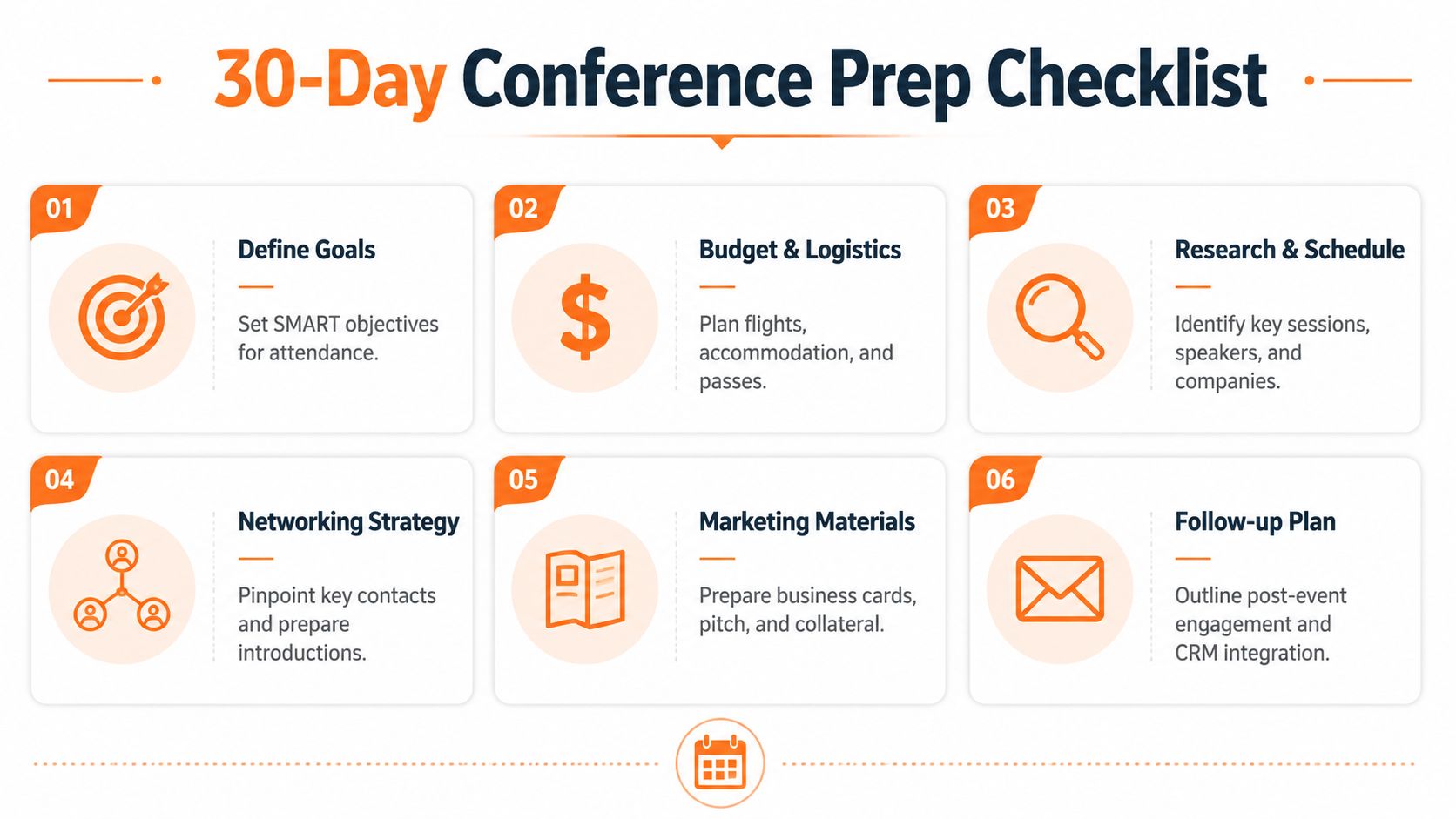
Your 30-day prep list
Use this sequence.
- Write the mission. One sentence. “I'm going to solve X.”
- Build a hit list. Pick the people, brands, vendors, or speakers you most need to meet.
- Book the calendar early. Reach out before the event. Don't rely on luck.
- Prepare your short pitch. Say what you sell, who it's for, and what problem you're working on.
- Create capture systems. Use notes, tags, and a simple follow-up sheet.
- Pack proof, not clutter. One-pager, QR code, product photos, tight demo, clean LinkedIn.
A lot of founders also forget the content side. If your team wants to post during and after the event, sort that workflow before you leave. This guide on optimizing social media content workflows is useful because it forces you to decide what you'll capture, who will post it, and how it fits your week.
For local founders, I'd also review a city-level event page like the City of Chicago small business expo roundup to practice this planning process on a smaller stage before you spend bigger money elsewhere.
Here's a quick video if you want a visual reset before your next event:
The founder who prepares like an operator usually beats the founder who “likes meeting people.”
How to Get Real Value During and After the Event
Once the conference starts, your job is simple. Protect your time. Ask better questions. Leave with commitments.
Use better conversation starters
Skip “what do you do?” You'll get canned answers.
Try these instead:
- What are you trying to fix right now?
- Which channel is giving you the most trouble?
- Did you hear anything today that changed your mind?
- Who here has been useful to talk to?
Those questions get you to the core topics fast. You'll learn more in five minutes than you would from twenty shallow intros.
If a conversation is going nowhere, exit cleanly. I usually say, “I'm trying to meet a few operators before the next session, but I'm glad we connected.” Polite. Direct. Done.
Run a simple note system
Don't trust your memory. It's awful by the end of day one.
I keep a basic structure for each person:
| Field | What to capture |
|---|---|
| Name | Who they are |
| Context | Where you met |
| Business issue | What they're working on |
| Next step | Call, intro, quote, sample, follow-up |
| Personal detail | Anything human you can reference later |
That last line matters. People remember warmth. They also remember who followed through.
The 48-hour rule
Follow up fast. Not eventually. Within two days, while they still remember your face.
Use a short message:
Great meeting you at the conference. I liked our conversation about [topic]. You mentioned [specific issue or opportunity]. I'd love to continue the conversation. Are you open to a short call next week?
That's enough. No essay. No fake enthusiasm. Just context and a next step.
One more move most founders miss: turn the best insights into content while they're fresh. Good post-event notes can become LinkedIn posts, email ideas, founder memos, and customer education. If you want a practical system, these content repurposing strategies are useful for turning conference conversations and talks into assets your team will publish.
The event ends. The work starts. A conference only pays off when the notes become actions, the intros become calls, and the calls become decisions.
Build Your Brand and Your Circle
A good electronic commerce conference can speed things up. It can't build the company for you.
You still have to make the hard calls. You still have to test the channel, fix the offer, clean up the ops, and follow through when the adrenaline wears off. The conference just compresses time. It puts people, tools, and hard-earned lessons closer together.
That's why I don't chase the loudest room. I chase the room where kind, serious builders tell the truth. Those people save you from dumb mistakes and help you recover faster when things go sideways.
If you want a stronger network, act like the kind of person others want in theirs. Share notes. Make intros. Keep your word. Follow up. Stay useful. That's how you build a real circle, and that's what makes business networking work over the long haul. For more on that mindset, read these strategies of business networking.
Go to conferences with a mission. Leave with a punch list. Then do the work.
If you're a kind, bold Midwestern founder who wants honest operator conversations instead of fake networking, join Chicago Brandstarters. It's a free community built for people who are building. You'll meet founders who share real tactics, real problems, and real support.
Leave a Reply