
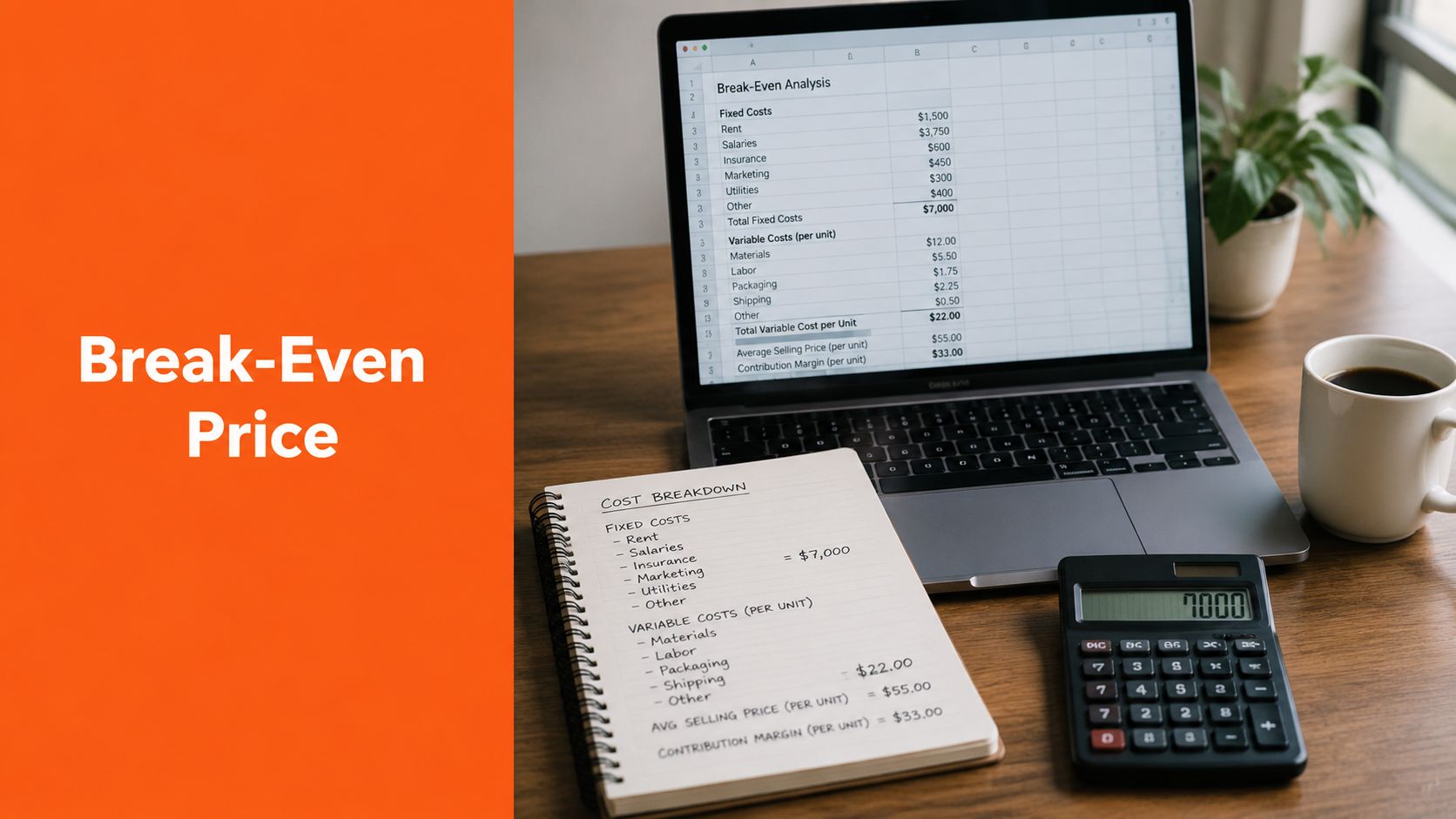
You're probably staring at a spreadsheet right now, bouncing between tabs, trying to pick a price that won't scare buyers away or slowly erode your margin. I know that feeling. The cursor blinks in the price cell, and suddenly every guess feels expensive.
Most founders treat pricing like a branding decision. It isn't. It's math first, positioning second. If you don't know your floor, you're negotiating against yourself before the first sale.
That's where the formula for break even price earns its keep. It tells you the minimum price that covers your costs at a given sales volume. Not your dream price. Not your competitor's price. Your floor.
If you want a fast way to sanity-check margin after that floor is clear, use a tool that helps you calculate your retail profitability. I like anything that forces founders to look at profit in plain English instead of hiding from the spreadsheet.
Stop Guessing Your Price and Start Knowing It
I've watched a lot of early founders make the same mistake. They ask, “What should I charge?” when the better question is, “What price keeps me from bleeding cash?”
Those are not the same thing.
A break-even price is your line in the sand. It's the price where total revenue equals total cost for a given level of sales. Below that line, you're paying customers to take your product. At that point, growth can make things worse, not better.
The lonely spreadsheet moment
Maybe you have a handmade product, a private-label item, a paid workshop, or a side hustle that's starting to get traction. You know some costs. You sort of know the rest. Shipping is fuzzy. Packaging keeps changing. Payment fees nibble at each sale. Then there's software, storage, design work, maybe a small ad budget.
That mess is normal. But “normal” doesn't excuse guessing.
Your first real pricing win is not charging more. It's knowing the lowest price you can survive on.
When I talk with founders, I push them to stop treating price like a popularity contest. The market matters, of course. But if your internal math is broken, market validation won't save you. You'll just get busy losing money faster.
What this number actually gives you
Your break-even price gives you three things:
- A floor: You stop making offers that look exciting but don't cover your costs.
- Confidence: You can explain your pricing to yourself, your partner, or a wholesale buyer.
- Control: You can test promos, bundles, and channels without flying blind.
This isn't glamorous work. It is useful work. And useful work is what keeps founders alive long enough to build something good.
The Simple Math Behind Not Losing Money
The cleanest way to think about this is a concert venue.
You rent the hall, pay insurance, and keep the lights on whether one person shows up or a thousand. Those are fixed costs. Then each attendee creates extra cost. A ticket gets processed, a cup gets used, maybe security needs to scale with the crowd. Those are variable costs.
Your business works the same way.
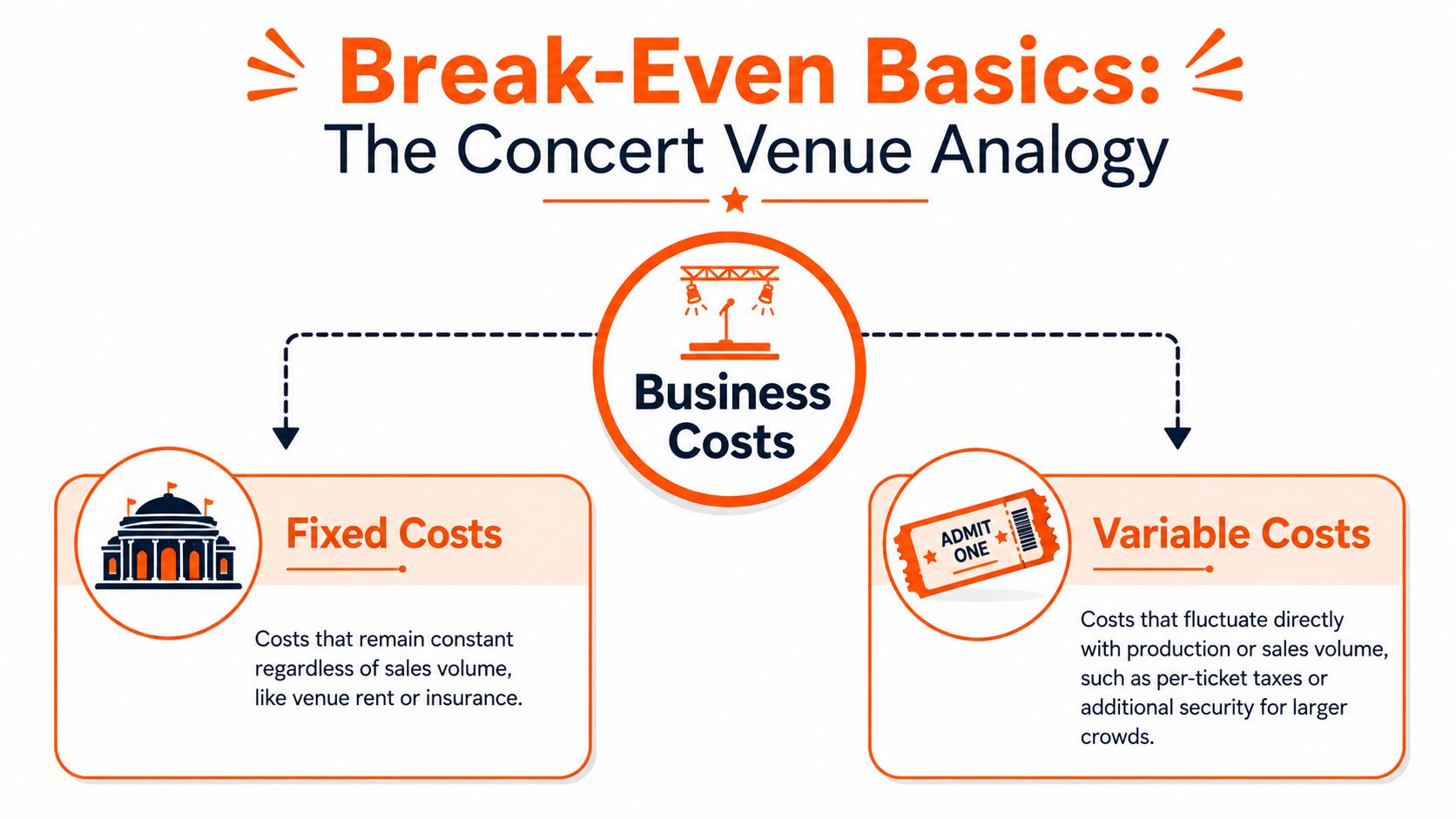
Fixed costs and variable costs
Fixed costs are the bills you pay even if sales are slow. Think Shopify, your Adobe subscription, a small studio lease, bookkeeping software, or warehouse rent.
Variable costs show up each time you make and ship a unit. Think product cost, packaging, transaction fees, inserts, and outbound shipping.
If you haven't mapped those carefully yet, start with a cost breakdown before you touch price. This guide on how to calculate production costs is a good place to clean up the mess.
The formula founders actually use
The standard break-even relationship is:
Break-Even Point = Fixed Costs ÷ (Price per Unit – Variable Cost per Unit)
That version tells you how many units you need to sell. Square explains it that way, and gives a plain example: with $100,000 in fixed costs, a $12 selling price, and $2 variable cost per unit, the contribution margin is $10, so the business must sell 10,000 units to break even, as shown in Square's break-even explanation.
But when founders ask about the formula for break even price, they usually want to solve for price, not units. Rearranged for price at a chosen volume, the practical version is:
Break-Even Price = (Fixed Costs ÷ Expected Units Sold) + Variable Cost per Unit
That's the version I use in real conversations because it answers the question founders care about. “If I think I can sell this many units, what's the minimum price that keeps me whole?”
A simple way to use it
Here's the logic in plain terms:
- List fixed costs for the period you're planning.
- Estimate units sold in that same period.
- Divide fixed costs by units to get fixed cost per unit.
- Add variable cost per unit.
- You now have your break-even price for that volume.
Practical rule: If your sales estimate is fantasy, your break-even price is fantasy too.
That last part matters. Founders often use optimistic volume to justify a low price. Don't do that. Use a sober sales estimate. Price from reality.
Pricing for Profit Not Just Survival
Breaking even is fine if your goal is to keep the lights on and earn stress. I'm guessing that's not your plan.
You need profit. Profit pays for reorders, better packaging, a photographer who knows what they're doing, ad tests, and eventually your own paycheck.

Your floor is not your target
A lot of founders find their break-even price and stop there. Bad move. That number is your floor. It is not the price you should feel good about charging.
If you want a working business, build profit into the formula:
Target Price = ((Fixed Costs + Desired Profit) ÷ Expected Units Sold) + Variable Cost per Unit
I like this version because it forces honesty. You stop pretending that “we'll make it up later” is a strategy. It isn't. Later usually brings more costs, more complexity, and more reasons to wish you had priced better from day one.
Service founders need the same discipline
Product founders aren't the only ones who mess this up. Service businesses do it too. A café owner, consultant, agency founder, or freelancer often prices from gut feel, then wonders why revenue looks decent while cash feels tight.
If you run a service business with different teams, offers, or departments, this breakdown of financial management for service businesses is worth your time because it helps you see where profit comes from.
The same logic applies when you track your gross margin percentage. Margin is the breathing room in your business. Without it, every surprise hurts more than it should.
Here's a quick gut check:
- Break-even price keeps you alive.
- Target price gives you room to operate.
- Strategic price leaves margin for mistakes, growth, and negotiation.
A lot of founders undercharge because they want to be “fair.” I get it. But fair to whom? If your price doesn't leave room for the business to function, you're being unfair to yourself.
This short video gives a useful overview if you want a second angle on the thinking:
When Your Business Gets Complicated
The textbook version of break-even math assumes one product, one price, and one clean sales path. Real businesses laugh at that.
You might sell a core product, a bundle, and a lower-priced intro item. You might sell on your site, through a marketplace, at pop-ups, and maybe wholesale. Each path has different fees, different margins, and different buyer behavior. That means there usually isn't one neat break-even price.
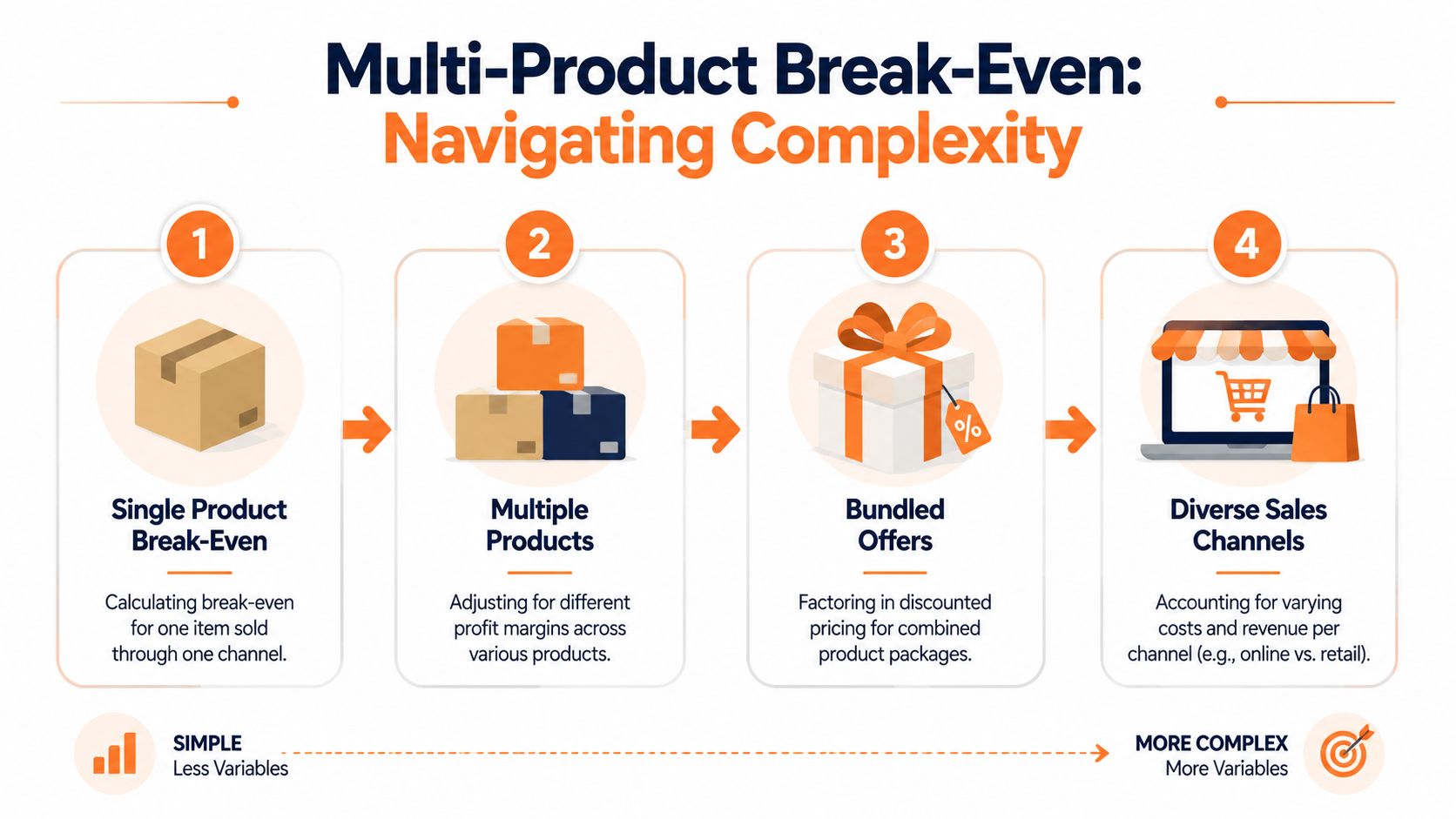
One business can have several break-even floors
Wall Street Prep points out a gap that most beginner articles ignore. Real businesses with multiple products, bundles, or sales channels often need to use average selling prices and average costs, or calculate a revenue-based breakeven, as explained in their break-even overview.
That's the practical version.
If your direct-to-consumer site has lower fees than a marketplace, your break-even floor on your site is different. If your bundle raises average order value but trims per-item margin, that changes the math too. If a service business mixes retainers with one-off projects, unit math may not even be the right frame. Revenue-based breakeven may fit better.
Use a weighted average, not wishful thinking
Don't try to force one universal number where it doesn't belong. Use a weighted-average view based on your expected sales mix.
A simple way to understand this is:
| Situation | What to use |
|---|---|
| One product, one channel | Unit-based break-even price |
| Several products with similar sales patterns | Average selling price and average cost per unit |
| Bundles and promos | Blend bundle economics into your average margin |
| Mixed service and product revenue | Revenue-based breakeven |
Founders frequently get tripped up. They price one hero product carefully, then let bundles, discounts, and marketplace fees insidiously chew through margin.
If your sales mix changes, your break-even math changes with it.
What I'd do in practice
I'd build a simple sheet with a few columns:
- Offer or channel
- Average selling price
- Average variable cost
- Contribution margin
- Expected share of sales
Then I'd look at the weighted average. Not because it's elegant, but because it's honest.
This is also the point where founder community helps. If you want peers to pressure-test messy pricing assumptions, Chicago Brandstarters is a free founder community built around small dinners and candid operator conversations. That kind of room is useful when your spreadsheet says one thing and your gut says another.
Your Break Even Price Is a Moving Target
The break-even price is often discussed as if it's carved in stone. It isn't. It moves with volume.
That's the part too many founders miss.
If you spread fixed costs across more units, the fixed-cost portion inside each sale drops. That means your minimum viable price changes as your expected volume changes. Iowa State's guidance makes this point clearly: break-even price should be computed across a range of sales quantities because the fixed cost per unit falls as volume rises, which makes the minimum viable price volume-dependent, as explained in their break-even planning resource.
Think in curves, not a single number
I don't want you asking, “What's my break-even price?” I want you asking, “What's my break-even price at this volume?”
Those are different questions. The second one leads to better decisions.
A simple scenario table helps:
| Expected volume | Fixed cost per unit | Variable cost per unit | Break-even price |
|---|---|---|---|
| Lower volume | Higher | Same or changing | Higher floor |
| Mid volume | Lower | Same or changing | Lower floor |
| Higher volume | Lower again | Same or changing | Lower floor, if costs hold |
No invented numbers needed. The pattern is the point.
This is where strategy starts
This dynamic view helps when a wholesale buyer asks for a lower price, when a promo cuts margin, or when input costs change. You can test the tradeoff instead of reacting emotionally.
Maybe a bigger order lowers your per-unit fixed cost enough to make a thinner margin acceptable. Maybe it doesn't. Maybe a lower introductory price works for one quarter because volume rises and overhead is already covered. Maybe that move creates a cash crunch instead.
Good pricing decisions come from scenario planning, not courage.
If cash timing is tight, pair this with a basic cash flow management plan for small business. A profitable price on paper can still hurt you if the timing of cash in and cash out is ugly.
Avoid These Pricing Mistakes and Take Action
Most pricing mistakes are boring. That's why they're dangerous.
Founders forget costs. They copy a competitor. They set a price once and treat it like a tattoo. Then they wonder why revenue feels busy but the bank balance feels rude.
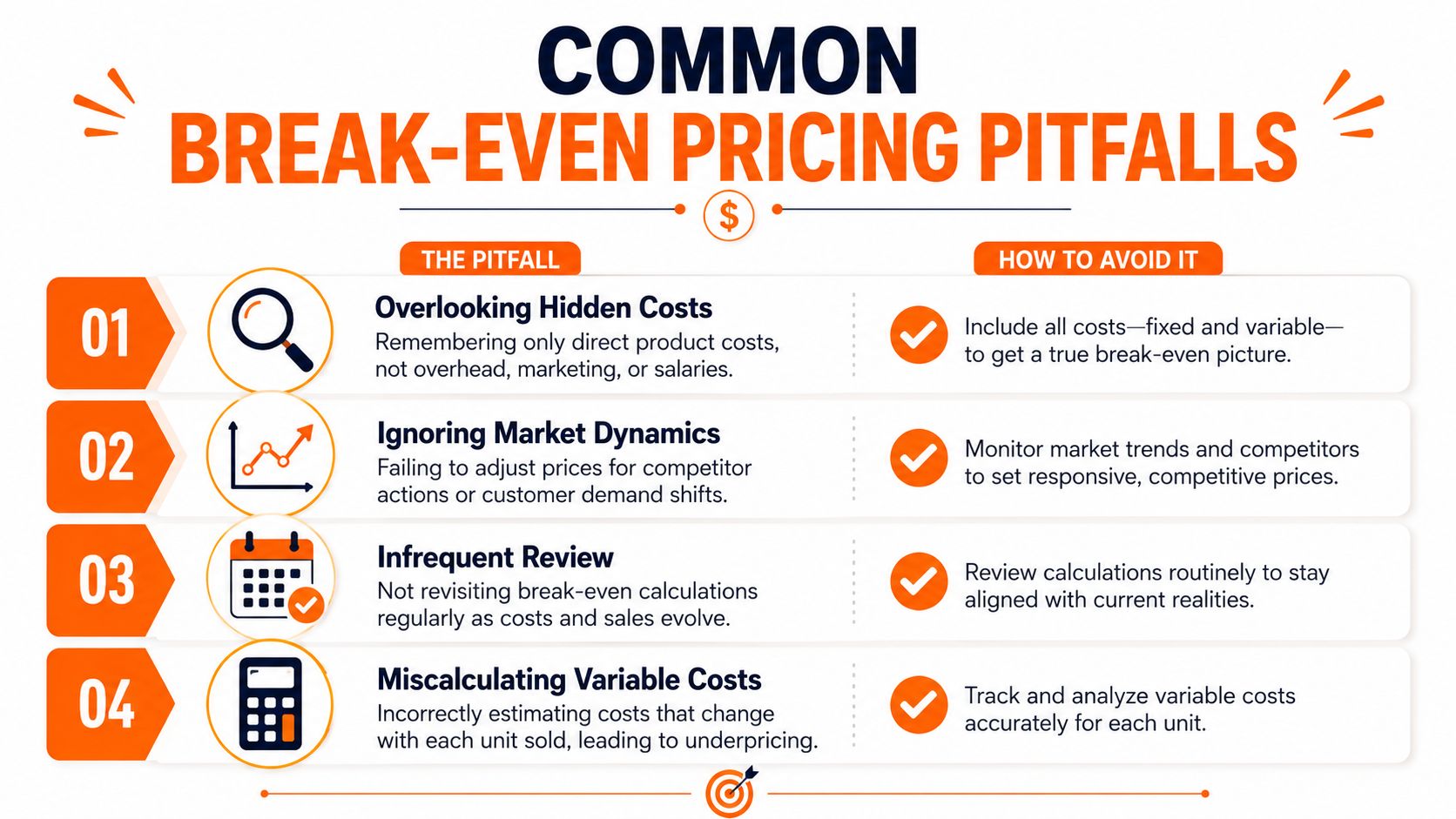
The mistakes I see most
Missing “small” variable costs
Packaging, payment fees, inserts, shipping materials, and returns can wreck your assumptions if you leave them out.Using fake volume assumptions
Optimistic forecasts make weak pricing look acceptable. They also create painful surprises.Pricing from competitors
Your competitor's cost structure is not your cost structure. Their price might be smart for them and stupid for you.Ignoring legal and policy shifts
If you're experimenting with segmented or dynamic pricing, keep an eye on the latest on personalized pricing regulation so you don't build tactics that create compliance headaches later.
What to do this week
I'd keep it simple and move fast.
- List every cost you can find and split them into fixed and variable.
- Pick one planning period such as a month or quarter.
- Estimate realistic unit volume for that period.
- Calculate your break-even price for that volume.
- Add a profit goal and calculate your target price.
- Run a few scenarios for lower volume, higher volume, bundles, and channel mix.
- Review it regularly when costs or sales patterns shift.
The formula for break even price isn't fancy. It's useful. That's enough. Founders who know their floor make calmer decisions, negotiate better, and stop chasing revenue that doesn't pay them back.
If you're building a brand in Chicago or the Midwest and want honest founder conversations about pricing, margin, and the messy stuff behind growth, check out Chicago Brandstarters. It's a free community where founders meet in small dinners and share what's working.
Leave a Reply