
Most advice about how to build a company from scratch starts in the wrong place. It tells you to form an LLC, design a logo, write a pitch deck, and post about your vision. Those tasks feel productive because they produce visible work. They don't tell you whether anyone has a painful problem, a budget, or enough trust to buy from you.
I've watched first-time founders burn months polishing a business that never earned the right to exist. The better sequence is less glamorous: protect your emotional energy, test a narrow problem, ask for money early, track cash, and build a support system that keeps you honest when the work gets lonely. Chicago Brandstarters' focus on vulnerable peer support fits that reality better than hustle slogans do.
Why Most First-Time Founders Fail Before They Start
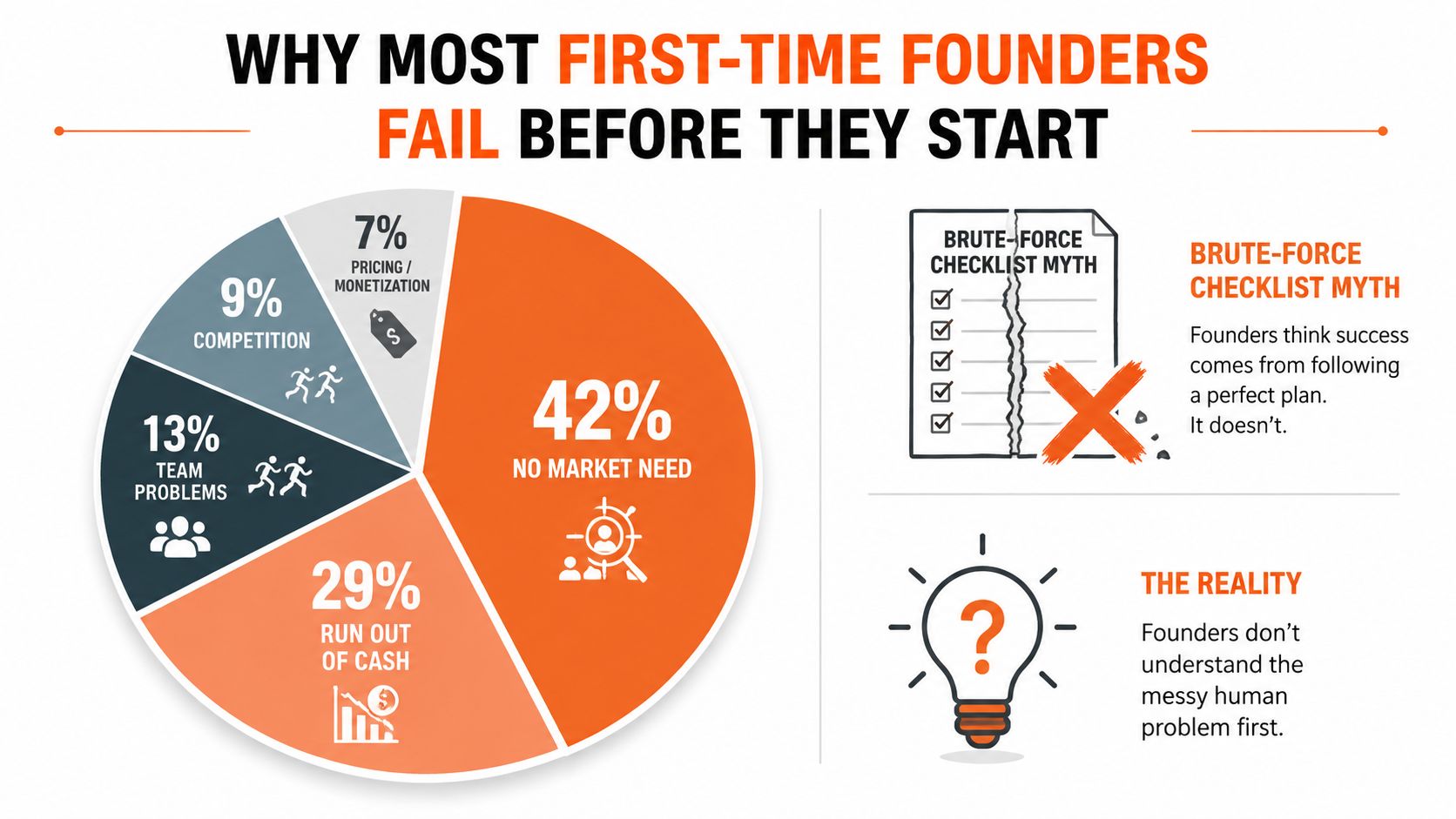
The popular founder myth says execution wins. Work harder, move faster, and keep adding tasks to the board. That advice ignores the first-time founder's actual problem: you must make many high-stakes decisions with little evidence, while carrying financial and emotional pressure alone.
Broad business survival data gives a more useful picture than the “90% fail” headline. About 20% of new businesses close within their first year, roughly 50% close by year five, and around 65% close by year ten, based on a widely cited U.S. Bureau of Labor Statistics-based pattern summarized by WorldMetrics' business failure analysis. The first twelve to twenty-four months therefore demand cash discipline, customer discovery, and speed to first revenue.
That pattern doesn't mean every founder needs more grit. It means you need fewer unsupported decisions. Isolation turns ordinary uncertainty into paralysis. You start treating a name choice like a strategy problem, a polite compliment like customer research, and a busy calendar like traction.
Isolation creates expensive mistakes
A 2025 survey of 227 entrepreneurs across 46 countries found that 87.7% reported at least one mental-health issue, 26.9% cited loneliness or isolation, and more than half reported anxiety or high stress, according to The Lonely Entrepreneur's founder isolation research. Those figures don't diagnose every founder, but they describe the operating conditions many people face.
Hustle culture makes that condition worse. “Move fast and break things” sounds bold when you have capital, a team, and a safety net. For a solo founder, it can become permission to skip reflection, avoid difficult conversations, and mistake exhaustion for progress.
Practical rule: If nobody knows what decision is keeping you awake, your support system is too weak.
Build a small circle before you need rescue. You want peers who can question your assumptions, share useful contacts, and admit when they've made a mistake. You also need confidentiality. Performative networking rewards polished updates. Honest founder relationships make it easier to say, “I don't know what to do next,” before confusion becomes an expensive commitment.
Replace the checklist with a decision rhythm
Use a weekly rhythm built around three questions:
- Evidence: What did a real customer do, not merely say?
- Cash: What did the company spend, collect, and commit to?
- Capacity: What decision or relationship is draining your ability to think?
This rhythm keeps emotional health connected to operating reality. You don't need to solve every problem before launch. You need a way to notice when fear, vanity, or isolation has started making decisions for you.
Validating Your Idea Before You Build Anything
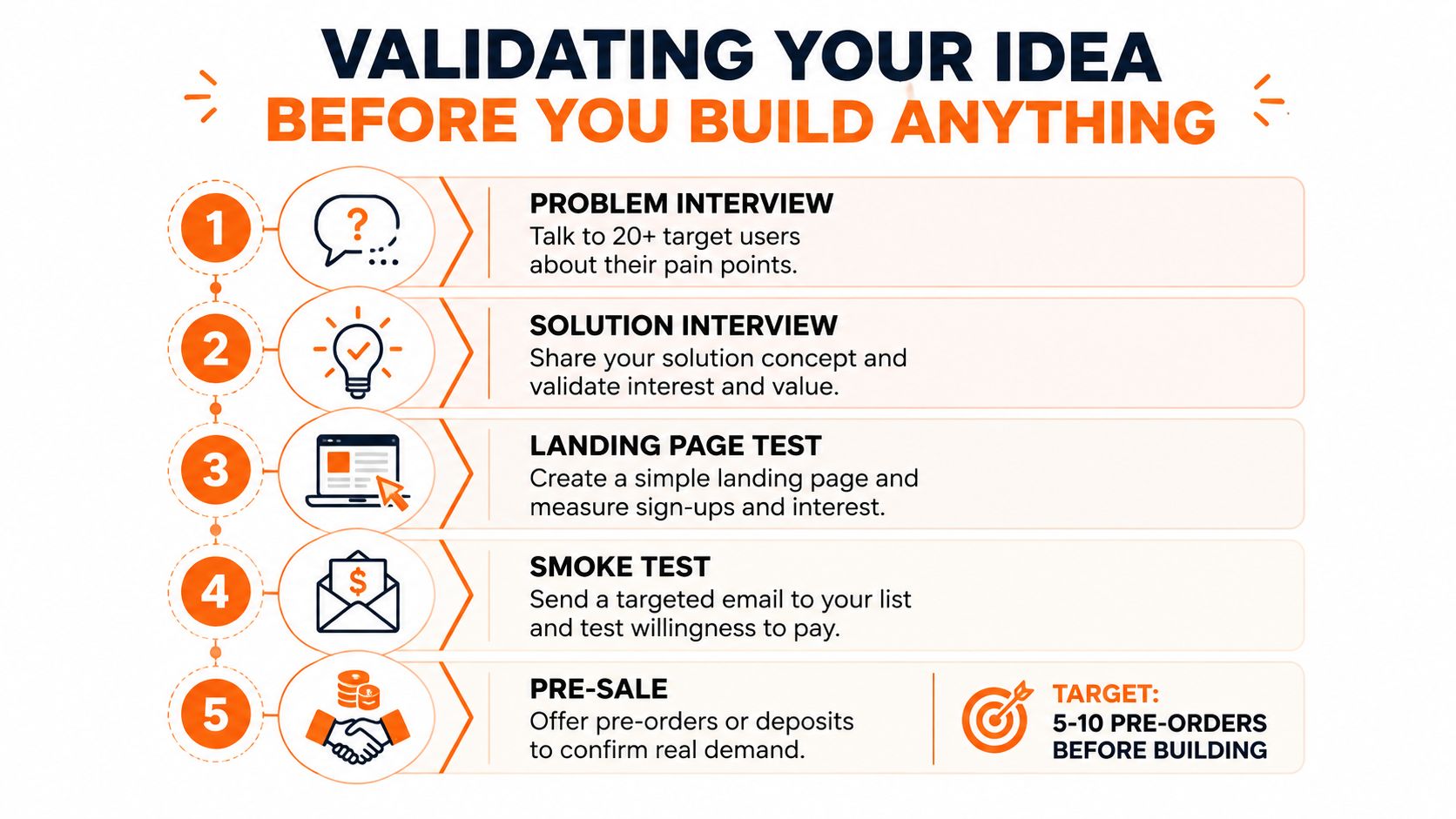
Your first job isn't building a product. It's proving that a specific group of people experiences a costly problem and will take action to solve it. Startup guidance from Startup Science on finding and validating a problem treats demand validation as an early risk-control step, especially because market mismatch often kills companies before execution can matter.
Start with conversations, not solution demos.
Ask about the last real incident
Recruit people who match the customer you intend to serve. Don't ask, “Would you use an app that does this?” People answer hypothetical questions generously. Ask about behavior instead:
- “Tell me about the last time you encountered this problem.”
- “What did you do to solve it?”
- “What did that workaround cost in time, money, or missed opportunity?”
- “Who else had to approve the solution?”
- “What have you already tried?”
- “Why didn't that option work?”
Write down exact words, current workarounds, buying authority, and urgency. Look for repeated pain attached to current spending or repeated manual effort. “That sounds interesting” means almost nothing. A referral, calendar commitment, data handoff, deposit, or introduction to the budget holder means much more.
You can use this guide to confirm demand for your idea if you want a second practical framework. Chicago founders can also compare their interview plan with the Chicago Brandstarters guide to validating a business idea.
Test payment before product development
Move from interviews to a concrete commitment. Create a simple description of the proposed outcome, then ask for one of these actions:
- Paid pilot: Define a narrow result, a start date, and a payment request.
- Pre-sale: Describe what the buyer receives, when you'll deliver it, and what happens if you don't.
- Deposit: Ask for a refundable or nonrefundable deposit only after you state the terms clearly.
- Letter of intent: Use this as evidence of interest, while remembering that it isn't payment.
A landing page can test whether people understand your promise, but a click isn't a customer. A smoke test can reveal curiosity, but it doesn't prove willingness to pay. Your standard should rise with every step.
Demand test: Build only after a defined group has shown repeated pain and enough buyers have taken a concrete commercial action to justify your time.
Don't turn that into a rigid universal number. The right threshold depends on your price, sales cycle, buyer risk, and delivery model. A service business may validate through a signed engagement. A software company may need design partners who agree to a paid pilot. A physical brand may need deposits or purchase commitments before inventory.
Use the attached video as a conversation starter, then return to customer behavior rather than inspiration.
Treat failed validation as useful information. A weak response lets you narrow the customer, change the problem, or stop before you spend heavily. That isn't failure. It's the cheapest form of strategic clarity you can buy.
Getting to Your First Paying Customer
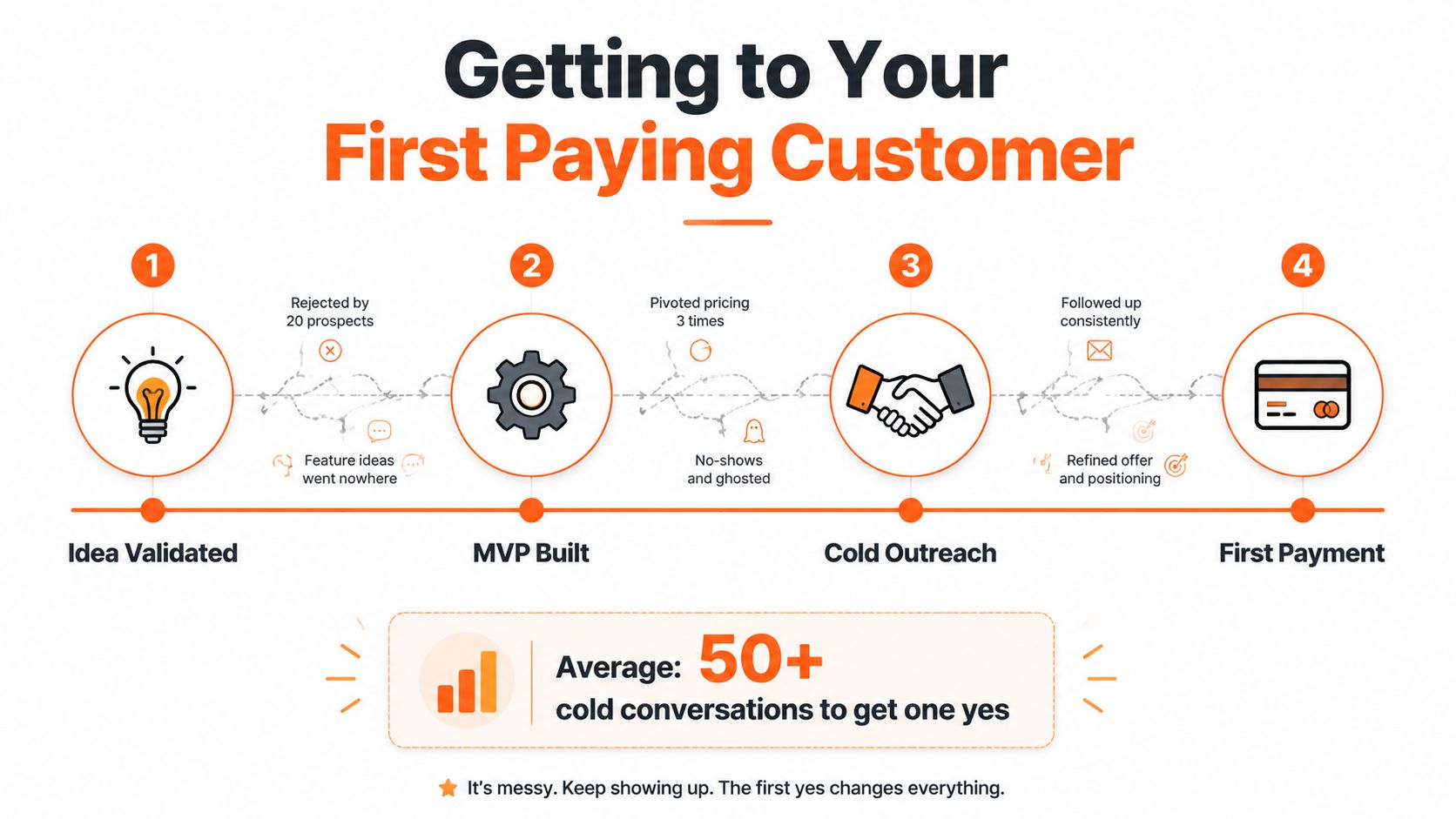
A founder I mentor once had a validated idea, a tidy prototype, and a folder full of positive interview notes. Then the first buyer asked a simple question: “What exactly do I get, and when will I get it?” The founder couldn't answer without adding more features. That hesitation delayed the sale.
The first customer doesn't need your finished company. They need a clear result, a credible delivery plan, and a reason to trust you. Your MVP should feel like a narrow bridge, not a miniature version of the final city.
Cut the product until delivery feels uncomfortable
Keep the part that produces the promised outcome. Remove the dashboard, automation, extra integrations, advanced settings, and anything you can't connect to a buyer's immediate problem. You can manually perform work behind the scenes when the customer cares about the result rather than the machinery.
For example, you might deliver a service through email and a spreadsheet before building software. You might use a no-code form instead of an account system. You might personally conduct onboarding rather than create a training library. Be transparent about the process, but don't spend scarce cash automating work you haven't proved people value.
A beta user gives feedback. A customer gives money and expects delivery. Keep those categories separate in your notes, forecast, and self-image.
Sell through conversations, not broadcasts
At zero budget, start with people who already have a reason to hear from you:
- Warm introductions: Ask a trusted contact to introduce you to one specific buyer, with a short explanation of the problem you solve.
- Niche communities: Answer questions in places where your target users already discuss the problem. Don't drop links into every thread.
- Direct outreach: Write a short message that names the observed problem, explains why you're contacting that person, and asks for a brief conversation.
- Manual follow-up: Record objections and next steps in a simple CRM or spreadsheet. Memory is unreliable under pressure.
Expect rejection. A prospect can like you and still decline. They may lack budget, authority, urgency, or trust. Ask which factor blocked the decision, then use the answer to revise your offer.
The Chicago Brandstarters B2B sales process resource can help you turn informal outreach into a repeatable conversation. Keep the script short. Your aim isn't to sound like a sales department. Your aim is to learn whether the buyer will exchange money for the outcome.
Charge before you feel ready
First revenue changes your thinking. It turns an idea into an obligation, which can feel uncomfortable because the buyer now has a legitimate claim on your time. That discomfort contains useful information. It forces you to define scope, payment terms, delivery, and the result you'll measure.
Start with a written proposal. State the problem, deliverables, exclusions, schedule, price, payment timing, revision policy, and cancellation terms. Ask for payment directly. Don't hide behind “Let me know what you think” when you want a decision.
The messy middle may include changing your offer, losing prospects, and delivering manually. That's normal. Keep the feedback loop tight, protect the customer experience, and improve only what blocks the next sale or the promised result.
Cash Discipline and Legal Basics That Keep You Alive
A company can have enthusiastic customers and still die from poor cash timing. One startup-failure dataset attributes 38% of failures to running out of cash, making liquidity management its most common listed failure mode, according to Stealth Agents' startup failure statistics. Fundraising won't repair weak demand, poor retention, or uncontrolled spending.
Track three numbers every week: cash in the bank, monthly burn, and runway. Add gross margin once you have revenue. Your forecast should show when invoices arrive, when suppliers require payment, and which expenses you can pause. A founder who knows the next cash pinch can negotiate early. A founder who checks the account only after payroll panic has already lost options.
The long-run survival pattern stays harsh. Around 65.3% of new U.S. businesses had closed by year ten in the dataset summarized by Stealth Agents. Treat survival as an operating discipline, not a personality trait.
Build a simple financial control system
Separate personal and business finances before money starts moving. Use a dedicated bank account, a business card, consistent invoice numbering, and a weekly reconciliation habit. Keep receipts and contracts in a shared folder with clear names. A bookkeeper can keep records clean. A fractional CFO belongs later, when forecasting, pricing, financing, or hiring decisions require deeper analysis.
Read Jumpstart Partners' guide on cash flow for startups for a practical cash-management reference. You can also use the Chicago Brandstarters cash-flow guide for small businesses to build a recurring review process.
Handle legal structure before complexity arrives
An LLC can fit many small operating companies because it creates a formal business entity without the same corporate administration burden as a C corporation. A C corporation may fit a venture-backed company that needs a standard stock structure and institutional investment. Choose based on tax advice, liability, ownership plans, hiring, and financing. Don't copy the structure of a famous startup without understanding why it chose that structure.
Get founder agreements in writing. Cover ownership, roles, decision rights, what happens when someone leaves, vesting, intellectual-property assignment, confidentiality, and dispute resolution. A handshake feels friendly until the company has customers and competing ideas about control.
Use contracts for customer work. Define scope, payment, delivery, ownership of work, warranties, limitations, and termination. Ask a qualified Illinois attorney and tax professional to review documents that affect your specific situation. Legal templates can save time, but they can't understand your business without context.
| Milestone | Timing | Estimated Cost | Why It Matters |
|---|---|---|---|
| Business entity review | Before signing material contracts | Varies by provider | Separates personal and business decisions and clarifies ownership |
| Founder agreement | Before co-founders contribute substantial work | Varies by provider | Reduces disputes about ownership, roles, departures, and intellectual property |
| Separate bank and card accounts | Before the first business transaction | Varies by bank | Keeps records, taxes, and cash reporting cleaner |
| Customer contract | Before delivery begins | Varies by provider | Defines scope, payment, ownership, and exit terms |
| Bookkeeping setup | As soon as transactions begin | Varies by tool or professional | Gives you a reliable view of cash and obligations |
| Illinois tax review | Before selling taxable goods or services | Varies by provider | Helps you identify registration and collection duties |
Bootstrapping Versus Fundraising and the Third Option
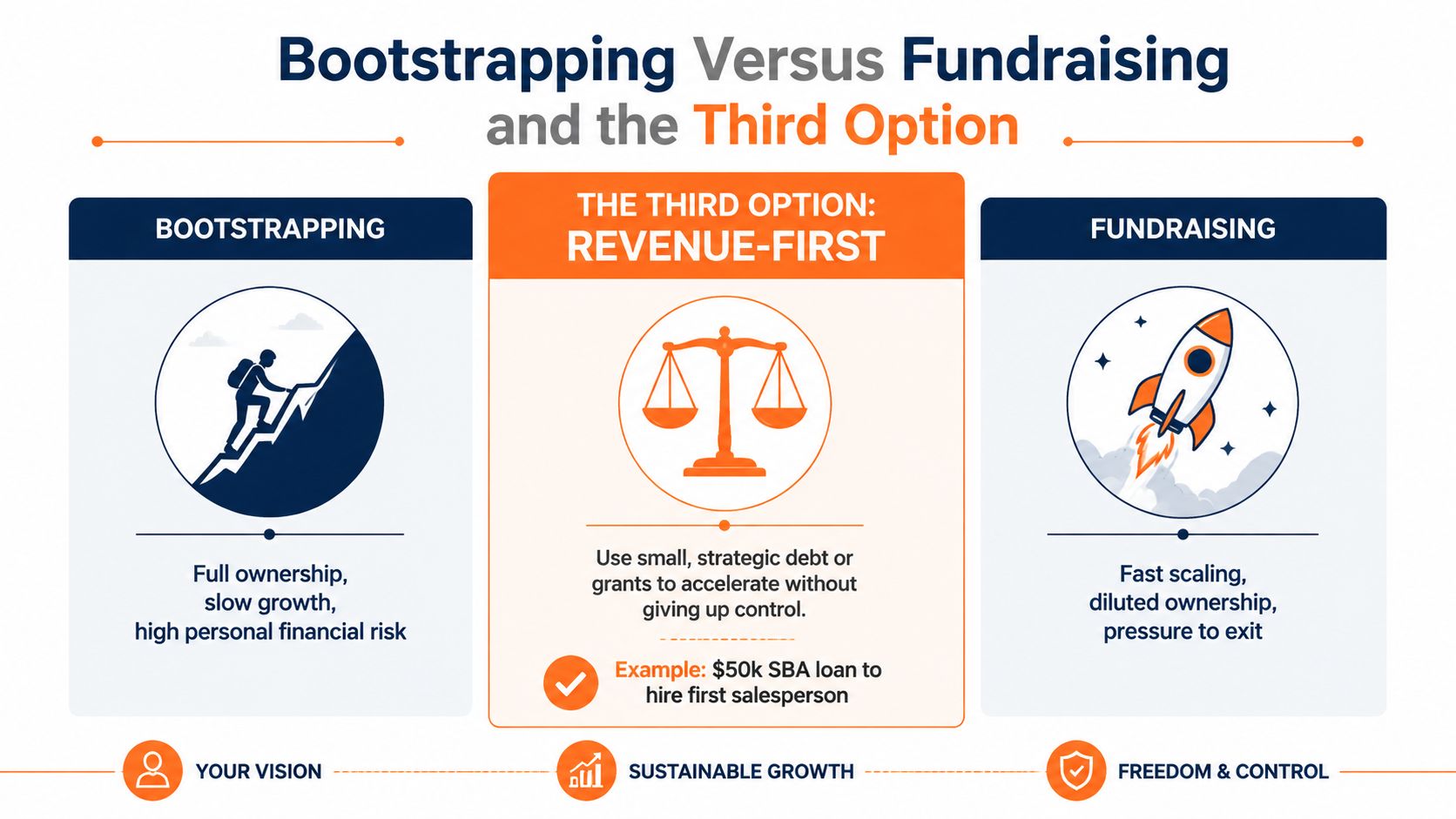
Capital strategy isn't a morality test. Bootstrapping can protect ownership and force careful selling, but it can also limit hiring, inventory, and speed. Fundraising can buy time and talent, yet it brings dilution, investor reporting, growth expectations, and pressure to pursue an exit that may not fit your goals.
Choose based on the business you're building, not the identity you want to perform online.
Compare the trade-offs honestly
| Path | What you gain | What you risk | Best fit |
|---|---|---|---|
| Bootstrapping | Ownership, customer-driven priorities, revenue discipline | Personal financial exposure and slower capacity growth | Businesses that can sell before heavy spending |
| Fundraising | Capital for hiring, product development, and distribution | Dilution, investor obligations, and pressure for rapid growth | Companies with large markets and a credible path to venture-scale returns |
| Revenue-first growth | Customer proof, controlled spending, and optionality | Slower experimentation when revenue remains small | Founders who can sell a narrow offer and reinvest cash |
Don't borrow to avoid selling. Don't raise because investors validate your ego. Debt creates repayment obligations, while equity creates a long-term relationship with owners who may influence decisions. Grants can reduce repayment pressure, but applications take time and awards aren't guaranteed.
For a grounded overview of funding routes, read Fundl's fundraising approach. Then build a financing plan around milestones, not vague ambition.
Use community to reduce the capital burden
A community can give you resources money doesn't automatically provide. A peer can catch a pricing mistake, introduce a buyer, explain a vendor problem, or challenge a forecast. That support can reduce wasted spending and shorten the path to a decision.
Chicago founders can look at Chicago Brandstarters for small private dinners and an active group chat where members share practical advice, setbacks, and support. 1871 can provide mentorship and startup programming. Chicago Ventures and industry-specific accelerators may fit founders who need investor access or specialized guidance. Evaluate each program by the people you'll meet, the decisions it helps you make, and the obligations it creates.
The third option doesn't mean avoiding capital forever. It means earning the right to use it. Sell a focused offer, reinvest carefully, and add modest debt, grants, or equity only when you can explain exactly what the money will provide.
Building the Support System That Gets You to Seven Figures
Revenue growth tests your operating system and your emotional stamina. As sales increase, you face harder hiring choices, customer escalations, co-founder tension, and decisions that affect people beyond yourself. A founder who handles all of that alone eventually becomes the bottleneck.
Build support before the crisis. You need three different relationships, and one person rarely fills all three roles.
Create three feedback loops
Peers understand the emotional texture of the work. Meet regularly with founders who will question your assumptions without turning every conversation into a pitch. Share actual numbers when trust allows, along with the decision you're avoiding.
A mentor two steps ahead can help with a specific transition, like moving from founder-led sales to a repeatable sales process or hiring a first senior operator. Pick someone who has faced the problem you have now, not someone whose résumé looks impressive.
Specialists handle areas where guessing creates legal, financial, or technical risk. That may include an attorney, accountant, insurance professional, or industry advisor. Pay for narrow expertise when the cost of a mistake exceeds the cost of advice.
A small-business network study found that belief, diagnostic, and boundary control systems can work against trust, while interactive control tools can work with trust to support knowledge transfer, as described in the Springer study on trust and knowledge transfer. The practical lesson is simple: create spaces where people can discuss evidence together rather than report polished wins.
Run a 90-day support plan
During the first month, join one peer group and schedule recurring conversations. State the rules clearly: confidentiality, direct feedback, no unsolicited selling, and no pretending everything works.
During the second month, choose one mentor and define a narrow question. Bring a short operating snapshot, your current constraint, and the decision you need to make. Respect the mentor's time by returning with what happened.
During the third month, install a weekly dashboard. Track sales conversations, conversion, cash, gross margin, retention, delivery capacity, and customer complaints. Separate these measures from vanity signals such as likes, follower counts, and praise from people who never buy.
Use milestones to decide what support you need next. First revenue calls for selling discipline and delivery quality. $10K MRR calls for repeatable acquisition, retention, and cash forecasting. Hiring a first senior executive calls for role clarity, management habits, and a compensation plan. Institutional capital or sustainable profitability calls for clean books, dependable metrics, and a strategy that doesn't depend on your personal heroics.
Don't wait until you feel confident. Confidence usually follows repeated evidence and honest support. Build both on purpose.
Chicago Brandstarters gives Chicago and Midwestern founders a free, vetted community with private dinners every two weeks and a group chat for practical advice, honest setbacks, and peer support. If you're building from an idea toward first revenue or seven figures, visit Chicago Brandstarters and apply to meet founders who value kindness, hard work, and candid decisions.
Leave a Reply