
An acqui-hire is when a company buys another company mainly to recruit its employees, not to keep the business or use its products. In many deals, pricing gets discussed on a per-person basis, and practitioner guidance puts that range from a few hundred thousand dollars to about $2 million per retained person.
If you're reading this, there's a decent chance your runway is ugly, your investors are tense, and an inbound "acquisition" email just landed with suspicious timing. The buyer says they love what you've built, but every question keeps drifting back to your engineers, your founders, and who would stay after close.
That usually tells you what this really is. They don't want your ship. They want your crew.
That Strange Offer You Just Received
You take the call expecting the usual acquisition talk. Revenue quality. Customer churn. Gross margin. Pipeline. Instead, the other side wants to know who wrote the core systems, which engineers can lead a pod, whether your designer can ship inside a big org, and whether your CTO would sign an offer quickly.
I've seen this movie before. It doesn't feel like a normal company sale because it isn't one.
An acqui-hire usually shows up when your company still has strong people but the business itself isn't likely to keep going on its own. That's why founders call it a soft landing. It can save jobs, avoid a chaotic shutdown, and give your team a cleaner next chapter. It can also leave you grieving the company you tried to build.
What the call is really telling you
The buyer is answering the acqui hire meaning for you through their questions. They are telling you, "We don't want to buy your storefront. We want to hire the people behind the counter."
That matters because it changes how you should hear every sentence that follows.
- If they ask about your team first: they're valuing execution talent.
- If they barely care about customers or product roadmap: your business may be secondary.
- If they ask who is likely to stay after close: retention is the deal.
Practical rule: If the buyer spends more time on org charts than product demos, assume you're in acqui-hire territory.
Why this hits founders so hard
This kind of offer messes with your head because it sounds flattering and painful at the same time. Someone sees value in what you've built, but they may be saying the value lives in the people, not the company.
For a founder, that's brutal. You have to make peace with two truths at once. Your team did something worth buying. Your standalone business may still be over.
Don't romanticize it. Don't demonize it either. Treat it like what it is: a high-pressure choice about people, time, and damage control.
What an Acqui-Hire Really Means
An acqui-hire is a company acquisition done primarily to obtain people, not products. The target is bought mainly for its team's human capital, while the business itself may be secondary or even shut down afterward. The term was coined in 2005, as noted in Wikipedia's acqui-hiring entry.
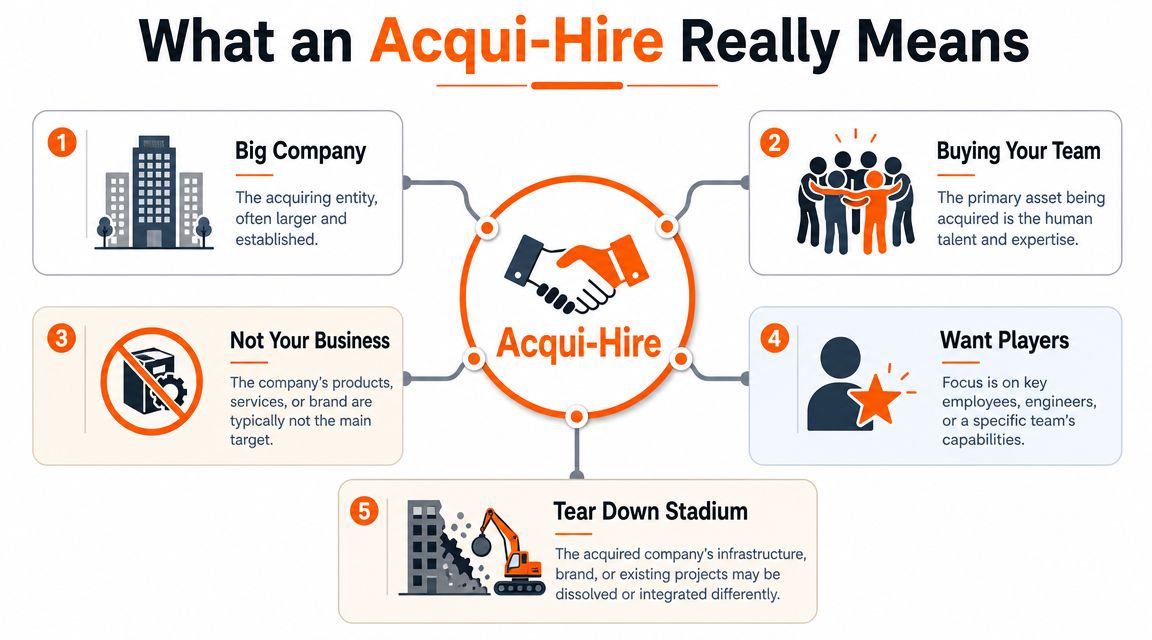
The cleanest analogy is sports. The buyer wants your players. They may not want your stadium, team name, or last season's playbook. They want a group of people who already know how to work together under pressure.
That's why a big company chooses this route instead of posting jobs and waiting. Hiring one engineer at a time is slow. Hiring a whole proven team in one move is faster and often simpler.
What the buyer actually wants
Most founders overestimate how much the acquirer cares about the product. In an acqui-hire, the product is often a side dish. The main course is your team chemistry.
The buyer is usually looking for a few things:
- A team that already ships together: They don't need to guess whether these people can collaborate.
- Specialized skills: Maybe your engineers know a stack or problem space the buyer needs right now.
- Founder energy inside a larger machine: Sometimes they want the people who can start from zero and move fast.
What this means for your identity as a founder
This is the part nobody likes saying out loud. In an acqui-hire, your company may be more like a wrapper around talent than an asset package with lasting standalone value.
That doesn't mean your work failed. It means the market may value your team's ability more than your current business model.
Your startup can be worth buying even if your product isn't worth preserving.
That distinction matters because it should change how you negotiate. If they're buying talent, then job titles, reporting lines, retention terms, and team continuity matter as much as headline price. Maybe more.
The simple test
Ask yourself one blunt question: if your product disappeared tomorrow, would the buyer still want the team?
If the answer is yes, you're looking at the acqui hire meaning. They are buying a shortcut to talent.
How an Acqui-Hire Deal Actually Works
The mechanics are weird the first time you see them. A normal acquisition feels like haggling over a house. An acqui-hire feels more like a coach recruiting your entire starting lineup.
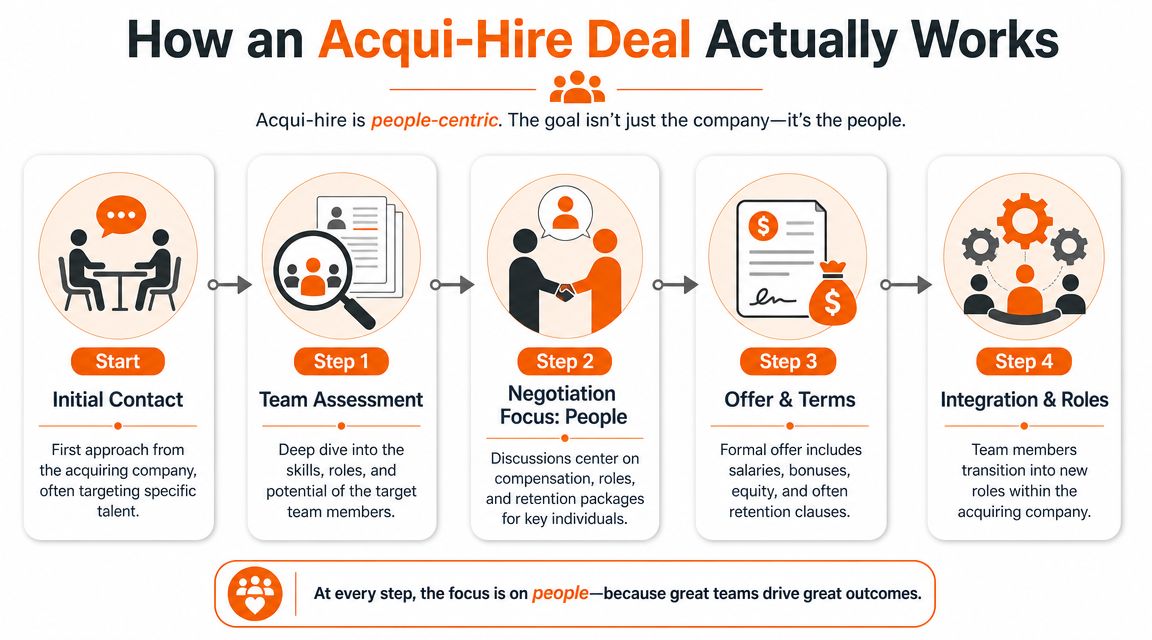
The legal shell can be a stock purchase or an asset purchase. But don't get distracted by labels. The center of gravity is almost always the same. Who is joining, what they get, and whether they'll still be there after close.
The usual flow
Here's the pattern I see most often:
Initial contact
The buyer reaches out discreetly. Sometimes through the founder, sometimes through investors, sometimes through a talent leader who already knows your team.Team review
They study your org chart hard. They want to know who built what, who leads, who manages conflict, and who they'd regret losing.Employment talks
Key negotiations often unfold here. Roles, compensation, equity, vesting, retention packages, and start dates move to the front.Acquisition paperwork
The purchase agreement gets drafted, but in many acqui-hires it can be lighter on classic acquisition issues because the retained employees are the main value.Post-close integration
Your team joins the buyer. Some projects get folded in. Some are discontinued. Some people thrive. Some leave once the honeymoon ends.
A useful broad checklist sits inside this guide to successful M&A for businesses. Use it to keep your head straight while your deal lawyer handles the documents.
The condition that matters most
Many acqui-hires happen only after the buyer locks in commitments from critical staff. Andreessen Horowitz notes that a deal may require 100% of key employees to accept post-closing offers as a closing condition in its acqui-hire guide.
That line should wake you up.
If one or two people matter a lot, the whole transaction can rise or fall based on whether they sign. So before you spend weeks arguing about purchase price, figure out who the buyer considers essential. Then find out what those people want.
If your buyer can't keep your best people, your "deal" may evaporate in a weekend.
What you should prepare before diligence gets messy
Don't wait for the acquirer to discover your paperwork problems. Clean them up fast. A founder-friendly startup due diligence checklist can save you from dumb delays.
Focus on the boring files nobody wants to open until a deal is already on fire:
| Area | What to review |
|---|---|
| Employment documents | offer letters, IP assignment, confidentiality terms |
| Equity records | cap table, option grants, approvals |
| Contractor issues | who built what, and whether ownership is clear |
| Shareholder approvals | who must consent and how fast they can act |
| Retention planning | who must stay and what they need to hear |
An acqui-hire deal works when the paper matches the people story. If either side is sloppy, somebody walks.
A short explainer can help if you want another lens on the process:
The Good and The Bad for Founders and Employees
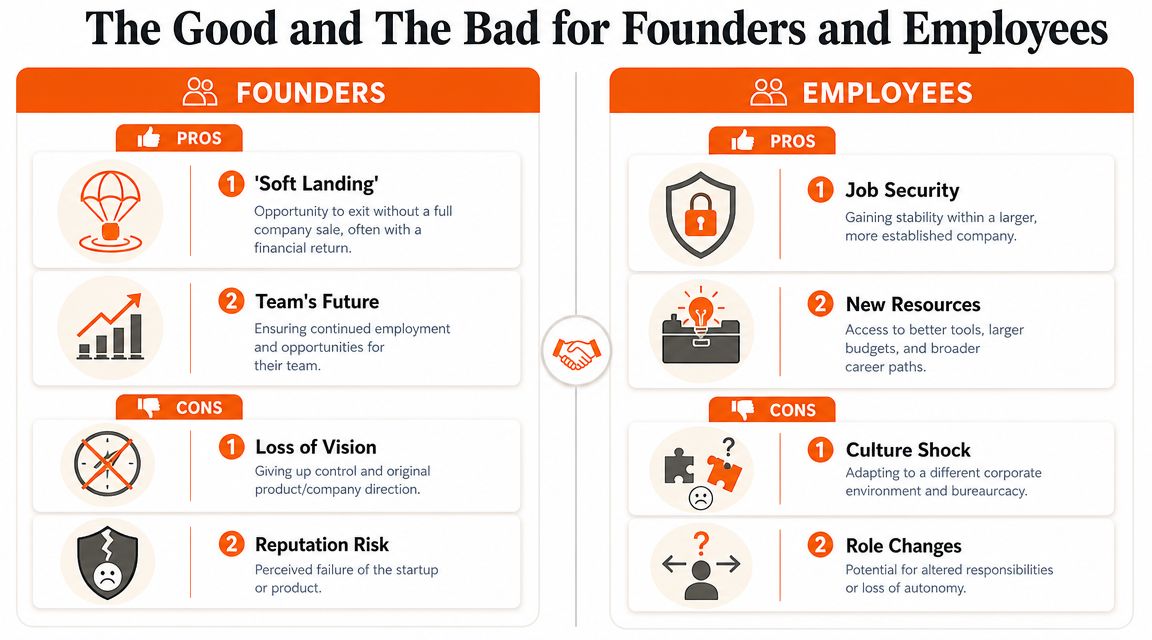
Founders need honesty, not pep talks, about acqui-hires. An acqui-hire can rescue people. It can also flatten morale, kill the mission, and leave investors disappointed.
The money side often feels clinical because it is. Pricing in an acqui-hire is often benchmarked on a per-engineer basis, with a typical range from a few hundred thousand dollars to about two million dollars per retained person, according to BetterUp's overview of acqui-hiring. When your company is distressed, that can mean your team gets a future while your cap table gets a rough ending.
What founders gain and lose
Founders usually gain relief first. Payroll pressure ends. The shutdown spiral stops. Your team gets a landing spot instead of a Slack message and a severance scramble.
But here's the bill you pay:
- Your vision may end: The product you obsessed over can get shelved fast.
- Your identity takes a hit: You may become a manager inside someone else's system.
- Investor dynamics get tense: In distressed outcomes, investors may recover less than they hoped, or little at all.
- Your own compensation gets complicated: Salary, retention, and equity at the new company can look better than the sale proceeds.
This is why founders should also think about personal finances during a sale process. If you're shaky on basics like cash flow and compensation, this guide on how to pay yourself from your business is worth reading before you negotiate from panic.
What employees gain and lose
For employees, the upside is often real. They may get stronger pay, better benefits, and a brand name on the resume that opens doors later. They may also get access to better tools, stronger managers, and projects with more resources.
The downside is emotional and immediate.
People don't mourn the job title. They mourn the team they thought they were building with.
A lot of employees joined your startup for speed, trust, and ownership. A larger company can replace that with process, layers, and politics. Some will like the trade. Some will hate it.
Side-by-side reality check
| Group | Upside | Downside |
|---|---|---|
| Founders | team gets jobs, shutdown avoided, possible personal landing | loss of mission, investor pain, less control |
| Employees | stability, benefits, bigger platform | culture shock, project shutdown, less autonomy |
My opinion is simple. If the acqui-hire protects the people who bet on you, it can be a good outcome even when it bruises your ego. If it saves only the founders and strands the rest, it's a bad deal dressed up in polished language.
Real-World Acqui-Hire Examples
You don't need theory once you've seen a few of these play out.
FriendFeed is one of the cleanest examples people still point to. Facebook acquired the company, and the deal was widely understood as bringing in a talented team. The service itself was eventually shut down. That's the pattern in plain English. Team goes in. Original product fades out.
Another familiar example is Drop.io. Facebook acquired it, and the founder joined Facebook. The product did not continue in its old form. Again, that's the blunt reality of many acqui-hires. The badge changes. The business you knew disappears.
You can also look at Posterous, which Twitter acquired. The team moved over. Posterous itself later shut down. Same pattern. Talent was portable. The standalone product was not.
What these examples teach founders
The lesson isn't "never do it." The lesson is "believe what the structure is telling you."
If the buyer wants the team, assume the product has a short life unless they say otherwise in writing and have a plan for it. Founders get in trouble when they hear "we love the product" and ignore every operational sign that the product won't survive.
Questions to ask when you study past deals
Use past examples to sanity-check your own situation:
- Did the team stay together, or get scattered?
- Did the product live, get integrated, or die?
- Did the founders keep any autonomy?
- Did employees seem excited after the first few months, or did they bolt?
Those are better questions than "Was it called an acquisition?" Labels are cheap. Outcomes are what count.
Is an Acqui-Hire Your Best Move?
Here's my answer. Sometimes yes. Sometimes it's the least bad option. Sometimes it's a trap that burns months while your company gets weaker.
The right question isn't whether the offer sounds prestigious. The right question is whether it is fair, clean, and humane for the people who trusted you.

A practical framework from mastering your business exit plan can help you compare this path against other exit choices. You need that wider lens because an acqui-hire is only one option. A bridge round, a hard pivot, or an orderly shutdown may be better.
Ask the hard questions fast
Remote People puts the founder's dilemma well: an acqui-hire can be a rescue, a recruiting shortcut, or a value-destroying distraction, and success depends on retention, compensation design, and post-close integration, not just the headline price in its acquihire glossary.
That's exactly right. So ask these questions before you sign anything:
Who on my team is getting offers?
If the answer is vague, slow down.Are the compensation and retention terms strong enough to keep people from regretting this in 60 days?
A weak package creates instant buyer's remorse.What happens to the people who aren't wanted?
This question tells you a lot about the buyer's character.Am I taking this because it's good, or because I'm exhausted?
Founder fatigue makes bad deals look merciful.
Compare it against the alternatives
Don't let urgency make the decision for you. Put the options side by side.
| Option | Usually best when |
|---|---|
| Acqui-hire | the team is strong, the business is stuck, and the buyer has real roles for people |
| Bridge round | you still have a believable path to a healthier company |
| Orderly shutdown | no clean buyer exists and dragging things out would hurt everyone |
| Asset sale | some IP or contracts have standalone value apart from the team |
If you need a broader founder-level lens, this article on an exit strategy for small business is a good companion read.
My blunt recommendation
Take the acqui-hire seriously if it does three things. It protects most of your team. It gives the strongest people roles they prefer. It closes fast enough to beat the chaos of a drawn-out decline.
Walk away, or renegotiate hard, if the buyer is cherry-picking a few stars and leaving everyone else to absorb the blast. That's not a soft landing. That's a selective extraction.
A good acqui-hire is a people deal with honest terms. A bad one is a recruiting raid wearing acquisition clothes.
Your job as founder is simple, even if it feels awful. Protect the humans first. Then protect your sanity. Then worry about the story you'll tell later.
If you want a room full of founders who'll give you the truth on tough calls like this, take a look at Chicago Brandstarters. It's a free, vetted community for kind, bold builders who want honest conversations, sharp feedback, and real relationships instead of fake networking.
Leave a Reply