
Most advice about early stage companies is built for a tiny slice of founders. It assumes you're raising VC, building software, and chasing the same milestones as everyone on startup Twitter. That's bad advice for many founders.
If you're building a product brand, an ecommerce business, or a practical service company in Chicago or the Midwest, you need a different map. You need customer proof, cash flow, clean numbers, and people who'll tell you the truth before you waste six months. Fundraising might matter later. It is not the first job.
What Are Early Stage Companies Really
Most definitions of early stage companies are wrong because they start with investors. I start with reality.
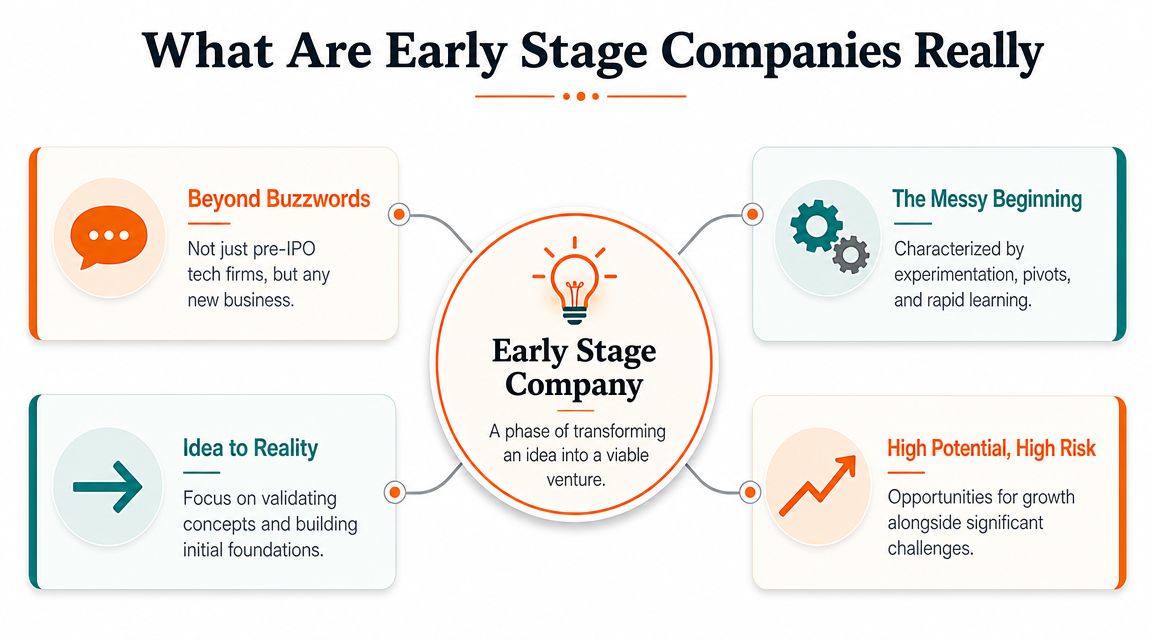
An early stage company is any business in the messy phase between idea and something people reliably pay for. You might have a Shopify store, a prototype in Figma, a batch of handmade samples, or a service offer you're testing through cold outreach. If the business still depends on learning fast, talking to customers, and fixing obvious holes, you're early stage.
The useful definition isn't about whether you've raised pre-seed money. It's about whether you've earned customer proof.
Stop using investor labels as your identity
A lot of startup content treats early stage as a pre-seed tech label. That's too narrow. Most founders are building in capital-light businesses like ecommerce or services, and a more useful approach is to optimize for customer proof and cash flow rather than fundraising optics, because only a tiny fraction of businesses are venture-scale, as discussed in this piece on early-stage businesses beyond the VC frame.
If you sell coffee gear online and get repeat buyers, you're building a real company.
If you run a productized design service and clients keep renewing, you're building a real company.
If you have a slick deck and no one pays you, you're still guessing.
Practical rule: Your stage is defined by what the customer has proven, not by what your pitch deck promises.
A better way to know your stage
I use a simple test. Ask yourself these questions:
- Can strangers understand it fast: If people need a long explanation, your offer is still foggy.
- Will anyone pay now: Interest is cheap. Payment is the vote.
- Do buyers come back: Repeat purchase, renewed contracts, or continued usage matters more than compliments.
- Can you deliver without chaos: If every sale breaks your process, you don't have traction yet.
Early stage companies are like boats built close to shore. You don't need a giant engine first. You need a hull that doesn't leak. For Midwest founders, that's usually a healthier mindset anyway. Build something sturdy. Sell it. Learn. Tighten the operation. Then decide whether you need outside capital.
The Four Seasons of an Early Company
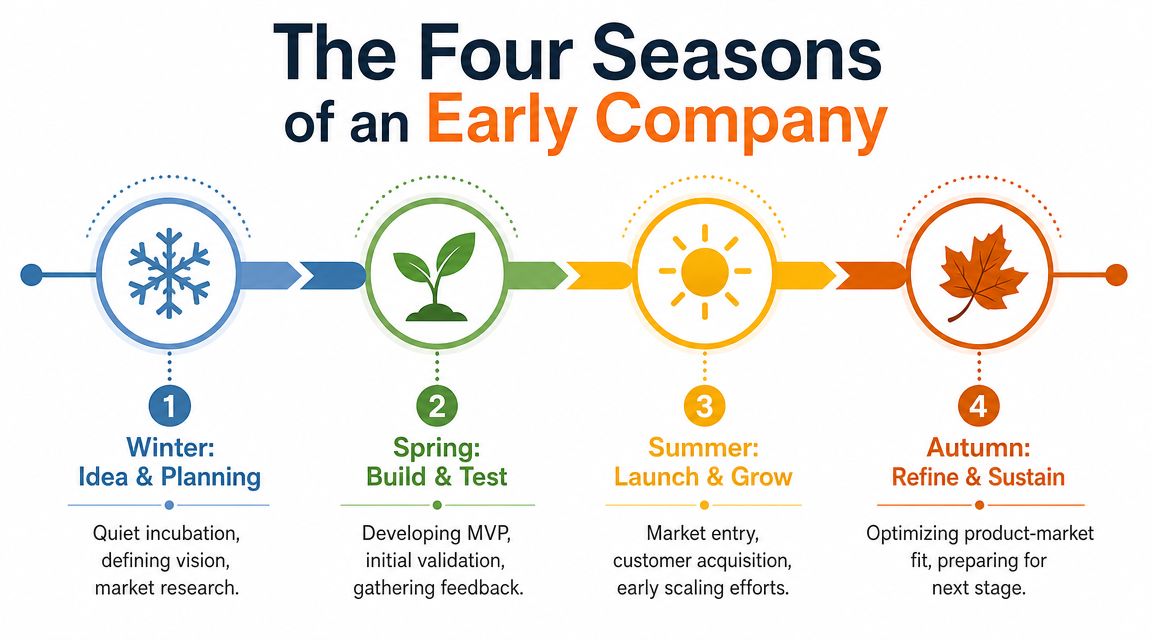
Founders get stuck when they use startup stage labels like status symbols. The labels sound impressive and hide the core question: what work is currently in front of you? A better way to read an early company is by season.
Winter is for proving the problem
Winter is quiet on the outside and demanding underneath. You are still close to the customer, still shaping the offer, still learning whether the pain is real enough to earn money.
This is the season where practical founders separate themselves from performative ones. The practical founder runs small tests, gets on calls, ships samples, takes preorders, and keeps costs low. The performative founder spends six weeks picking a name and tells friends the company is "in stealth."
That is a waste.
Early entrepreneurship is not some coastal media fantasy. Analysts at Kauffman found that new business creation and opportunity-driven entrepreneurship remained a meaningful part of the U.S. economy in their Indicators of Entrepreneurship national report. For Midwest product and ecommerce founders, the lesson is simple. You do not need to look fundable in winter. You need to find a problem people care enough to pay you to solve.
Spring is for getting something sellable into the market
Spring starts when you stop explaining and start shipping.
Your first version can be ugly. It can be a preorder page, a paid pilot, a limited run, a scrappy Shopify store, or a service wrapped around a product idea. What matters is that someone can say yes with a credit card, not just with a compliment.
A useful walkthrough sits here if you want another founder's take on the journey:
Spring is also where you learn whether the unit economics are workable. If you sell a physical product and do not know your margins, you are flying blind. Get clear on your gross margin percentage for each sale before you chase volume that makes you poorer.
Summer is for surviving your own momentum
Summer feels exciting. Orders come in. Customer questions pile up. Fulfillment problems show up fast. So do returns, delays, and the little cracks you could ignore when volume was low.
A lot of founders misread this season. They think summer means "scale now." Usually it means "fix operations before growth breaks the business."
If paid traffic is working but support is a mess, fix support. If wholesale interest is rising but production is inconsistent, fix production. If customers like the product but do not come back, fix retention. Community matters here more than hype. The founders who make it through summer usually have real customers giving honest feedback, local operators willing to share what worked, and peers who will tell them when they are fooling themselves.
Autumn is for tightening the machine
Autumn is where the company starts acting like a company.
You standardize fulfillment. You narrow the offer. You document repeatable tasks. You stop saying yes to every custom request that drags you off course. You hire carefully, if you hire at all, and you do it because the work repeats, not because you want to look bigger.
This is the season many Midwest founders handle well because the instinct is right. Build something durable. Keep the books clean. Earn trust. Grow at a pace the business can carry. That path gets less press than venture rounds, but it creates healthier companies.
Winter proves the problem. Spring gets the first sale. Summer stress-tests the operation. Autumn turns hard-won lessons into a business that can last.
Your First Scoreboard Key Startup Metrics
Most founders don't need more dashboards. They need one honest scoreboard.
If you track too much too early, you create noise and call it insight. For early stage companies, the smartest move is to instrument a small set of KPIs tied to your current goal. Founders Network points to practical benchmarks like MRR, CAC, LTV, runway, burn rate, active users, and engagement, and it makes the point I wish more founders understood: if CAC rises faster than LTV, growth is not economically viable, even when revenue is going up, as explained in this guide to startup metrics that actually matter.
What each number lets you do
Think of runway like air in a scuba tank. Every hire, product tweak, and ad test uses oxygen. If you don't know how much air you have left, you're not being bold. You're just underwater without a gauge.
| Metric | What It Is | What It Tells You |
|---|---|---|
| MRR | Predictable recurring revenue coming in each month | Whether your base business is getting steadier or shakier |
| CAC | What you spend to get a customer | Whether your sales and marketing engine is efficient or wasteful |
| LTV | The total value a customer brings over time | How much room you have to spend on acquisition and retention |
| Burn Rate | How fast cash leaves the business | How expensive your current setup is |
| Runway | How long your cash lasts at current burn | How many experiments you can afford before needing more money |
| Active Users | People who actually use the product | Whether usage is real or inflated by signups that go nowhere |
| Engagement | How often and how deeply users interact | Whether the product has habit and value or just curiosity |
Build a scoreboard you can read in one minute
I like a weekly view with only a few rows. Revenue. Cash. Conversion. Retention. Margin.
If you're selling physical products, don't ignore gross margin. A lot of ecommerce founders think sales solve everything, then learn too late that weak unit economics eat the business alive. This walkthrough on the calculation of gross margin percentage is worth reading if you need to clean that up.
Use this filter every week:
- If runway is shrinking fast: Cut experiments that don't teach you much.
- If CAC is climbing: Fix your offer or channel before spending more.
- If LTV is weak: Work on retention, repeat purchase, or pricing.
- If active users are flat: Stop celebrating signups and study behavior after signup.
The scoreboard doesn't exist to impress investors. It exists to stop you from lying to yourself.
The Dragons You Will Slay Common Founder Challenges
Every early company fights monsters. Some are loud. Some look harmless until they burn a month of your life.

The product dragon
This one asks the meanest question in business. Does anybody want this?
Founders usually try to kill this dragon with more features. Wrong weapon. You beat it with customer conversations and simple tracking. A strong early-stage model combines qualitative discovery with quantitative instrumentation. Interviews tell you why people behave the way they do, while tracking tells you whether that behavior repeats at scale, which helps you avoid building strategy around a few anecdotes, as laid out in Stanford's guidance on combining customer discovery with lightweight data work.
If three buyers tell you they love your product but none of them buy again, you don't have proof. You have polite feedback.
The team dragon
This one creates confusion. One person thinks the company needs better branding. Another thinks the problem is pricing. A third person is rebuilding the website for no reason.
Tiny teams break when priorities stay fuzzy. Early on, I want one page that answers four things: what we're trying to prove, what we're shipping this week, what we won't do, and who's responsible. That's boring. It also saves companies.
Try this cadence:
- Monday decision: Pick the one thing you must learn this week.
- Midweek check: See what's blocked and kill side quests.
- Friday review: Write down what changed your mind.
The go-to-market dragon
A lot of founders build decent products and still can't get sales. This dragon doesn't care how proud you are of the product. It wants distribution.
You need one repeatable path to buyers. For an ecommerce founder, that might be creator seeding, email, or a narrow paid channel. For a productized service, it might be outbound email, founder-led content, or referrals. Pick one lane first. Too many channels at once is how people stay busy and broke.
If customers can't find you, your product quality is almost irrelevant.
The funding dragon
Founders either fear this one or worship it. Both reactions are dumb.
Money is a tool. Good money buys time and options. Bad money buys pressure, distraction, and weird incentives. If capital pulls you away from customers and into theater, it's hurting you.
The trick is to earn the right kind of money for the problem you face. Sometimes that's customer revenue. Sometimes it's a small loan. Sometimes it's an angel who knows your industry. The dragon becomes manageable when you stop treating every check like a trophy.
Fueling Your Rocket With More Than Just Venture Capital
VC gets all the attention because it's loud. Most founders need something quieter and more useful.
If you're building a product brand, an ecommerce company, or a practical business in the Midwest, chasing one giant venture round can push you into bad decisions. You start optimizing for optics instead of survival. You hire too early. You spend on channels that make screenshots look good and P&Ls look ugly.
Capital stacking is the adult move
A better play is capital stacking. That means combining different kinds of money so one source doesn't control your life. Founders have more options than traditional VC, including grants, revenue-based financing, loans, and angel checks, and this approach reduces dilution and improves survival odds, according to this overview of founder funding paths beyond a single VC round.
The first layer should be customer cash whenever possible. Revenue is funding that doesn't take board seats. It also forces discipline. Customers don't clap for your story. They pay for outcomes.
Then add other sources carefully:
- Grants: Good when your business fits a program and the application time is worth it.
- Revenue-based financing: Useful when sales are coming in and you want repayment tied to revenue instead of fixed pressure.
- Loans: Fine when you understand repayment and the money goes toward something with a clear return.
- Angel checks: Useful when the investor has real operator knowledge and won't drag you into vanity games.
Match the capital to the problem
If you need inventory, one answer may fit. If you need time to test a new acquisition channel, another may fit. Capital should match the job.
I also think founders should study the non-VC path before they talk themselves into dilution. If you want a grounded overview, go explore non-dilutive funding strategies. It gives you a better lens on what money costs beyond the cap table.
And if you're still weighing the venture route, this primer on venture capital in Chicago helps frame what that path looks like.
A flashy round can hide a weak business. Boring capital paired with real sales usually ages better.
A Practical Playbook From Idea to First Traction
Traction starts long before a launch. It starts when somebody cares enough to reply, preorder, refer a friend, or pull out a credit card.
Founders waste months building things nobody asked for because building feels productive. It isn't. Especially in the Midwest, where people care less about hype and more about whether the thing works, your job is to get to proof fast and cheaply.
Step one through three
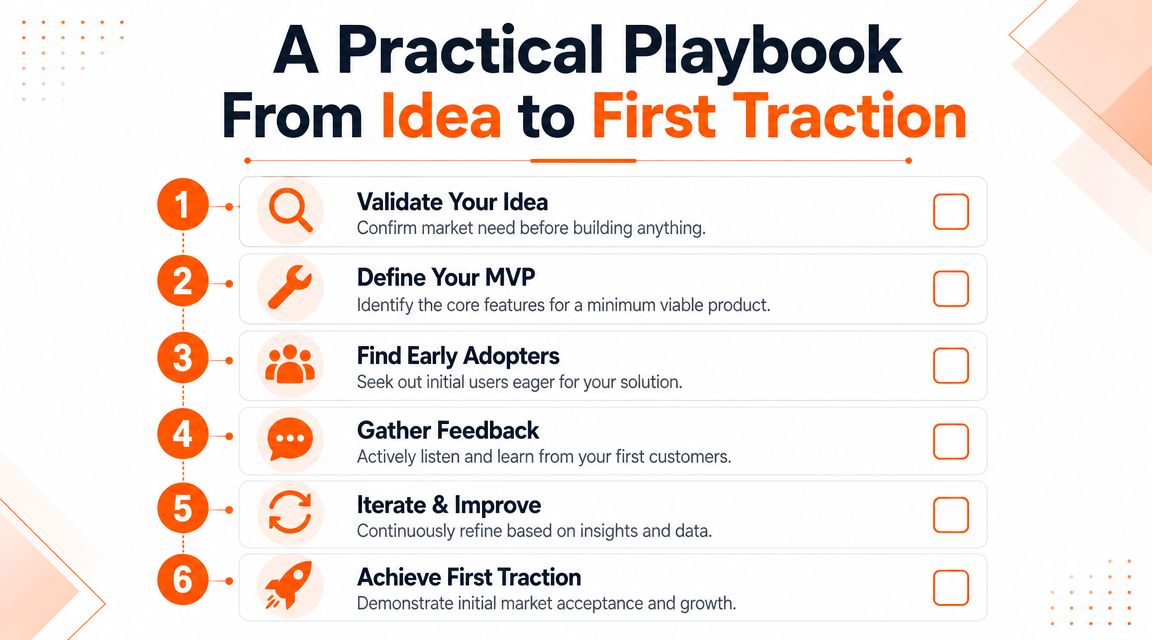
Start with a customer problem you can describe in plain English. If the pain is fuzzy, the business will be fuzzy. Talk to real buyers before you touch features, packaging, or brand polish. Ask what they use now, what annoys them, what they've already tried, and what a fix would be worth.
Then test the offer in its ugliest usable form. For ecommerce, that could be a preorder page, a sample batch, or a scrappy landing page with a clear promise. For product and software founders, it could be a mockup, concierge service, or manual workflow behind the scenes. If you need a simple gut check on scope, this framework to build an MVP helps cut the fluff.
Now go get customers by hand. Send the emails yourself. Ask for intros. Show up in niche communities, local events, trade groups, and buyer conversations already happening. The first sales usually come from work that does not scale, and that's exactly what you should be doing.
Step four through six
Once people start buying or seriously engaging, stop collecting random opinions and start looking for patterns. Ask what almost made them walk away, what confused them, and what result they wanted. Their words should shape your copy, your offer, and your onboarding.
Next, pick a tiny scoreboard and watch behavior. A product founder might track activation and week-two retention. An ecommerce founder might watch conversion, repeat purchase, and email response. Ignore vanity numbers. If people praise the idea but do not buy, return, or refer, you do not have traction yet.
Then build one repeatable loop. Just one. Maybe repeat purchase plus email for an online store. Maybe referrals plus a strong onboarding experience for a service business. Maybe activation plus retention for software. Traction means you can see the same path happen more than once without begging every sale into existence.
Use this checklist:
- Write the problem in one sentence: If it's muddy, your market will feel it.
- Validate before building: Use interviews, mockups, preorders, or a waitlist. This guide on how to validate a business idea is a useful filter.
- Sell manually first: Founder-led sales teaches you what buyers care about, fast.
- Track only a few signals: Focus on actions tied to conversion, retention, or repeat purchase.
- Build a small circle of truth-tellers: Good peers save you from dumb founder fantasies.
That last point matters more than any template. Community is practical infrastructure. It shortens your learning curve, gives you honest feedback before you burn cash, and helps you keep your head straight when the numbers are messy. Chicago Brandstarters is one example. It's a vetted founder community for Chicago and Midwest builders built around small dinners, candid group chat, and operator-level feedback instead of startup theater.
If you're building in Chicago or the Midwest and want a candid room of kind, hard-working founders who'll tell you the truth, take a look at Chicago Brandstarters. It's free to join, built for founders from idea stage through real revenue, and designed for honest conversations instead of transactional networking.
Leave a Reply