Most advice about an in person workshop is wrong.
People tell you to build slides, pick a theme, and stuff the day with content. That's how you get polite nods, fake energy, and a room full of founders who leave with a tote bag and no one they'd trust with the truth.
I run these differently. I treat them like a private operator war room.
If you're hosting founders, your job isn't to impress them. Your job is to create the kind of room where someone says, "My margins are getting squeezed, I'm exhausted, and I don't know what to cut," and nobody turns that into gossip, a sales pitch, or some TED Talk answer. That's the bar.
A good in person workshop doesn't produce applause. It produces honesty, useful pressure, and the start of relationships that hold up when things get messy.
Not a Workshop a War Room
When I hear "workshop," I think of stale pastries, a projector that doesn't work, and somebody reading bullets off a slide. That's not what I'm talking about.
I mean a small, private, confidential room where founders bring live problems and other founders help them solve them. Less classroom. More operating table.
The real return is trust
Many people buy an in person workshop thinking they're paying for knowledge. That's too shallow. The hard part of building a company usually isn't access to generic advice. It's finding a few people who'll tell you the truth, keep your confidence, and stay in your corner after the meeting ends.
That's why I care so much about being in the same room. The strongest return from in-person workshops is relationship-building, trust formation, and tacit knowledge transfer, and those things are hard to copy online, as noted by UNC Charlotte's pre-conference discussion on face-to-face interaction.
You can learn tactics on Zoom. You can even get decent feedback there. But trust grows faster when people eat together, watch each other's reactions, and sit through a hard conversation without tab-switching.
Practical rule: If your workshop could be replaced by a webinar, don't host it in person.
Stop teaching so much
Founders don't need another lecture. They need a room where they can drop the mask.
That means your in person workshop should optimize for three things:
- Candor: People talk about the actual problem, not the polished version.
- Context: The group gets enough backstory to give useful advice, not generic cheerleading.
- Commitment: People leave with a next move and a reason to report back.
I also think most hosts underestimate how much vulnerability changes the room. If you want honest talk, you have to make it normal. I wrote more about that in this piece on vulnerability in leadership, but the short version is simple. If the host performs strength, the room performs strength. If the host tells the truth, other people usually follow.
What this room is for
Call it a workshop if you want. I think "war room" is more accurate.
You're building a place where people can say things like:
I hired too fast.
I don't trust my cofounder anymore.
My product is fine, but my positioning is mush.
I keep pretending this offer works because I don't want to admit I need to rebuild it.
That's useful. That's expensive truth, shared for free, because the room is built right.
If you're doing this well, nobody leaves saying, "That was inspiring." They leave saying, "I know who I'd call if things break."
Define Your Core Who Comes and Why
The guest list is the workshop.
You can recover from mediocre food. You can recover from a cramped room. You can't recover from inviting one person who treats a trust-based session like an audition.
Curate like a bouncer, not a marketer
Most hosts think attendance is the problem. It isn't. Selection is the problem.
High-trust rooms break when you let in people who are there to extract, posture, or sell. I've made that mistake before. One loud self-promoter can turn a candid founder circle into a networking event with better lighting.
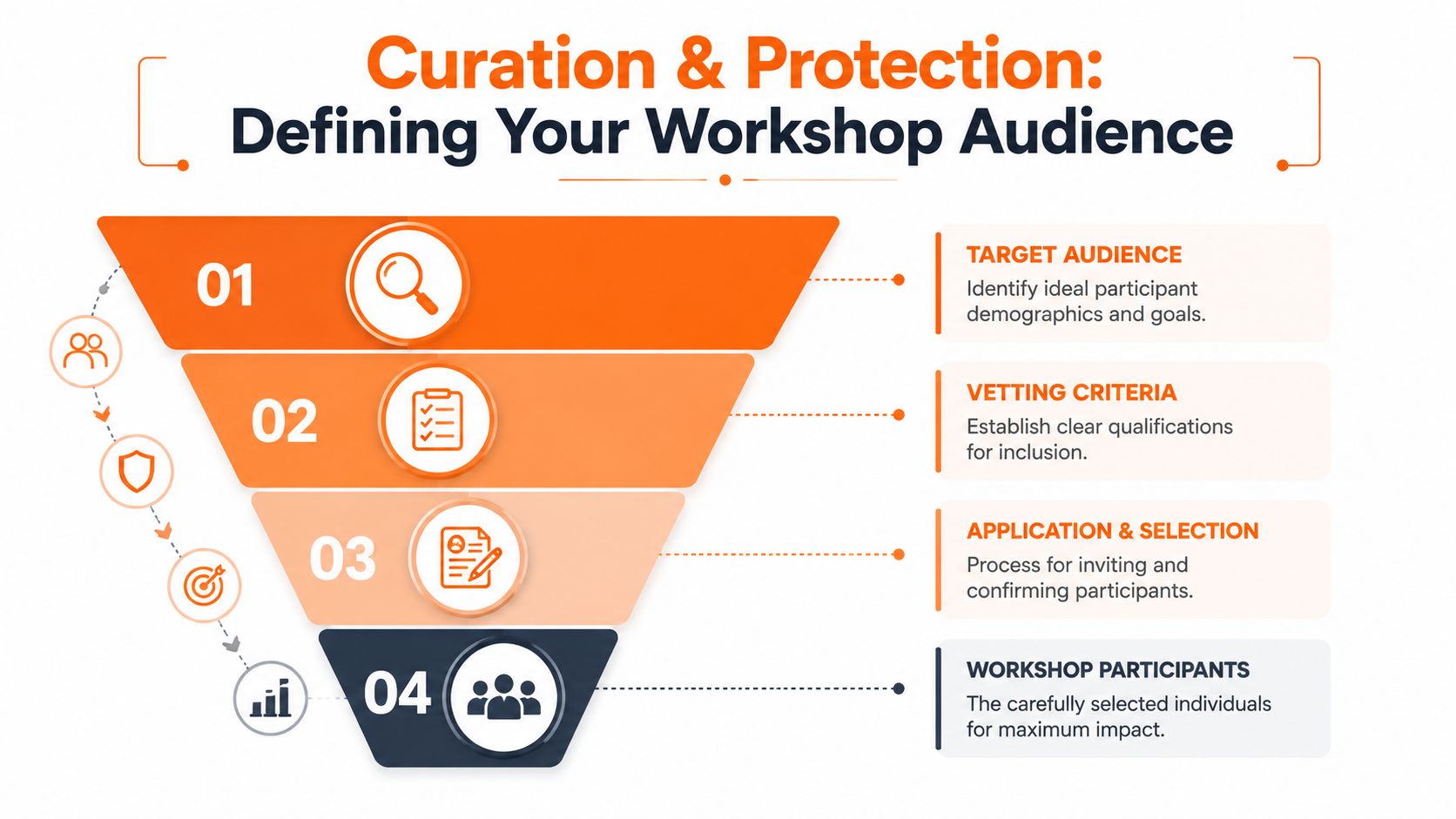
Here's the screen I use before I invite anyone:
- Do they build, or just comment? I want operators. Somebody shipping product, serving customers, or wrestling with real decisions.
- Do they give before they ask? Look at how they show up online and in person. Are they useful, generous, curious?
- Do they sell from the first sentence? If yes, they're out.
- Can they handle honesty? Smart people aren't always good workshop participants. Some get defensive the second they hear hard feedback.
My simple vetting process
I start with LinkedIn. Not because LinkedIn tells the truth. It doesn't. But it does leave fingerprints.
I scan for consistency between what someone claims and what they've done. I look at work history, how they describe themselves, whether every post is chest-thumping, and whether mutual contacts trust them. If someone looks polished but nobody credible seems to know them, I slow down.
Then I do a short call or voice note exchange. I ask what they're building, what they're stuck on, and why they want this kind of room. You learn a lot from how someone answers a simple question. Builders answer directly. Performers answer in slogans.
If you're running check-in tightly at the door, tools that verify seminar attendees with QR codes can keep the room orderly without turning it into airport security. I like anything that reduces awkwardness and keeps the host focused on people, not clipboards.
Confidentiality is not optional
If you want real talk, make the privacy rule explicit before anyone arrives.
Some institutions still keep live workshops protected and unrecorded because the primary learning environment for high-trust exchange is in person, as shown in UMass Boston's workshop page, which references live formats and restricted access norms at places like Stanford. That's the right instinct.
Use plain language. Mine is blunt:
What's shared in the room stays in the room.
You can share your own takeaways. You can't share someone else's story, numbers, or identity without permission.
Say it in the invite. Say it again at the start. Then model it later by never turning private workshop moments into content.
Pick the right reason to gather
A lot of workshop invites are too vague. "For connection and growth" means nothing. Give the room a sharp purpose.
Bad purpose: founders meet and network.
Better purpose: founders bring one live business problem they haven't solved alone.
That single difference changes who says yes and how they show up.
A good invite should answer:
| Question | What to say |
|---|---|
| Who is this for | Early-stage founders, operators, or brand builders with a live problem worth discussing |
| What happens | Small-group discussion, hot seats, direct feedback, and private conversation |
| What is expected | Candor, confidentiality, and useful participation |
| Who should stay home | Anyone looking to pitch, recruit, or collect leads |
If you want one example of a community built around that kind of filtering, Chicago Brandstarters has a simple model: vetted founders, small private gatherings, and a bias toward honesty over performance.
Plan the Experience Not Just the Agenda
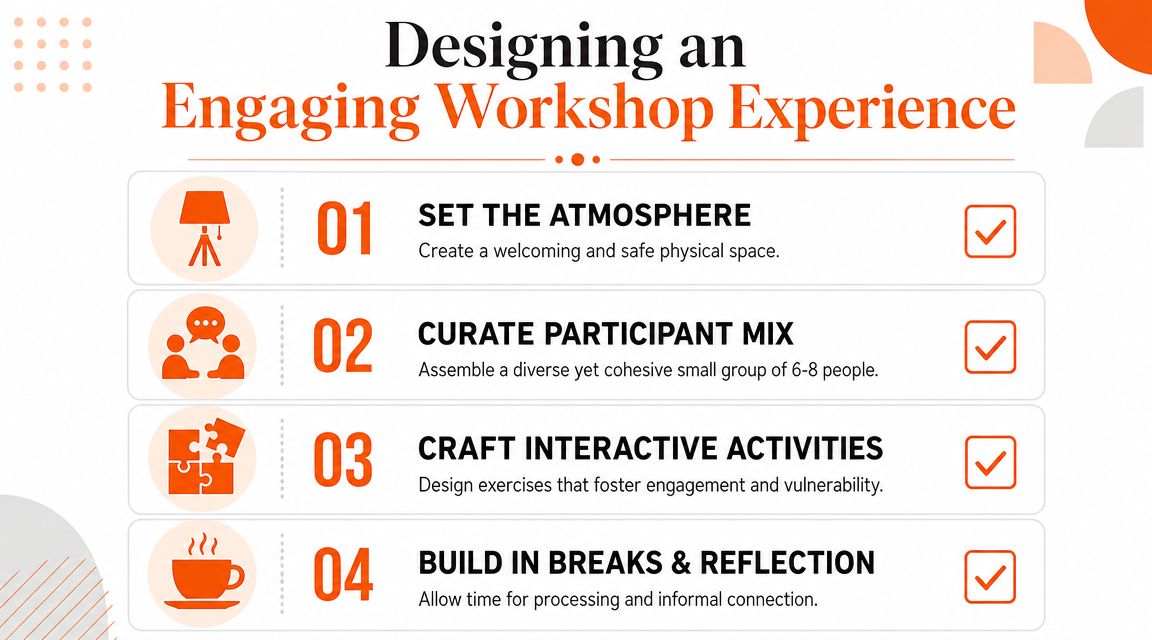
It is common to overbuild the agenda and underbuild the room.
That's backwards. Founders open up because the environment feels safe and human, not because your Google Doc has perfect timestamps.
Keep it small and structured
For an in person workshop, I like a group small enough that everybody can matter and big enough that patterns emerge. A practical benchmark is about 8 to 12 participants, with a workshop built in three phases: introduction, substantive activity, and closure, based on guidance from the Community Tool Box workshop framework.
For founder war rooms, I usually lean even tighter in practice. A smaller group makes it easier to get past surface talk. People can't hide.
Use a three-part flow
I don't want a complicated format. I want a format that keeps people honest and on time.
Opening
Start with names, context, confidentiality, and tone. Then give everyone a fast check-in.
Ask:
- What are you building
- What's one thing that's harder than it looks right now
- What kind of help do you want from this room
This gets people speaking early. Silence at the start makes later honesty harder.
The middle
This is the working block. I like hot seats.
One founder talks through a live issue. The group asks clarifying questions. Then they give direct feedback, options, and pattern recognition. Move to the next person.
A simple flow works well:
- Founder shares the problem
- Group asks questions
- Group gives feedback
- Founder says what they're taking away
Keep the focus on one live issue per person. Don't let people dump their entire company history on the group.
Closing
Most hosts rush this. That's a mistake.
The close is where people turn talk into movement. End with reflection, review, and one commitment per person. If somebody can't say what they'll do next, the session was probably interesting but fuzzy.
The workshop isn't finished when the talking stops. It's finished when each person knows their next move.
The room matters more than you think
Don't use a sterile boardroom if you can avoid it. Founders already spend enough time in rooms that make them sit up straight and say safe things.
Pick a neutral place with decent chairs, natural conversation flow, and food you don't have to apologize for. Shared meals lower the temperature. People talk differently once they've eaten together.
If you're scouting locations, this guide to booking workshop spaces is a useful starting point because it forces you to think about layout and feel, not just square footage.
Here's my quick venue filter:
- Privacy: No loud public traffic ten feet away.
- Comfort: Chairs people can sit in for real conversation.
- Flexibility: Easy to move between circle discussion and paired conversations.
- Food access: Coffee first, meal later, water always.
My favorite mistake to avoid
Don't jam the day with too much content. Leave breathing room.
If your schedule is so tight that nobody can linger after a hard comment, you've built a presentation, not a workshop.
How to Run the Room and Spark Real Talk
Hosting this kind of workshop feels less like presenting and more like conducting a jazz set. You keep the rhythm, create space, and stop one instrument from drowning out the others.
If you do it well, people forget you're facilitating. They just feel safe enough to tell the truth.

Go first or nobody else will
I learned this the hard way. If I open with polished moderator energy, the room gets careful. If I open with an actual founder problem, the room gets real.
So I go first.
I share something unresolved, not a tidy story with a lesson attached. Maybe it's a bad hire, a fuzzy offer, a fear I haven't fixed yet. The point isn't confession for its own sake. The point is giving everyone permission to drop the act.
"Talk about a scar and you'll get polite respect. Talk about a wound and you'll get honesty."
That one move changes the room faster than any icebreaker.
Use structure to make honesty easier
People think candid conversation should feel spontaneous. Sometimes it does. Most of the time, structure helps.
Strong workshops are interaction-led, not slide-led, and one useful technique is 1-2-4-all, where people first reflect alone, then in pairs, then in groups before sharing with everyone, as described in Deelan's workshop guidance).
I use that when the room is thoughtful but hesitant. It works because people get time to think before speaking. Loud voices don't get first claim on the truth.
Try it like this when a founder presents a tough issue:
- One minute alone: Everyone writes what they think the core problem is.
- Two-person exchange: Compare notes.
- Four-person cluster: Pressure-test the best read.
- Full group: Share the strongest patterns, not every thought.
You get better signal. You also avoid the usual problem where the fastest talker defines the whole conversation.
What I say when the room gets weird
Every host needs a few lines ready. You don't want to invent them mid-moment.
When one person dominates
Say:
- "I want to pause you there so we can get more voices in."
- "That's useful. Give me the short version so we can work the room."
Short. Clean. No apology spiral.
When feedback turns fluffy
Say:
- "Can you make that more concrete?"
- "What would you do on Monday?"
Founders don't need motivational wallpaper. They need a move.
When someone gets emotional
Don't panic. Don't become a therapist. Slow the room down.
Say:
- "Take your time."
- "You're safe here. We can sit with this for a minute."
- "Do you want advice right now, or do you want us to just listen first?"
That last question matters. People don't always want a fix in the first minute.
A lot of what makes this work overlaps with good peer feedback habits. I wrote a practical version of that in how to give and receive feedback, and the same rule applies here: be direct, be specific, and don't make it about your ego.
Here's a useful visual if you want a quick facilitation reset before you host:
Leave room for the unscripted moment
My best workshop moments rarely come from the neatest part of the agenda. They come right after someone says the thing they almost didn't say.
That's why I always leave buffer time. Good live discussion runs long. It should. If your workshop has no slack, honesty gets cut off right when it starts getting useful.
Build Momentum After the Workshop Ends
A single in person workshop can create a burst of clarity. Then life rushes back in, inboxes fill up, and the whole thing dies by Thursday.
That's bad hosting.
The compressed workshop model works because it packs content and interaction into an intensive window, but it needs follow-up if you want shared context to become lasting change, as shown by the International Statistical Institute's workshop format.
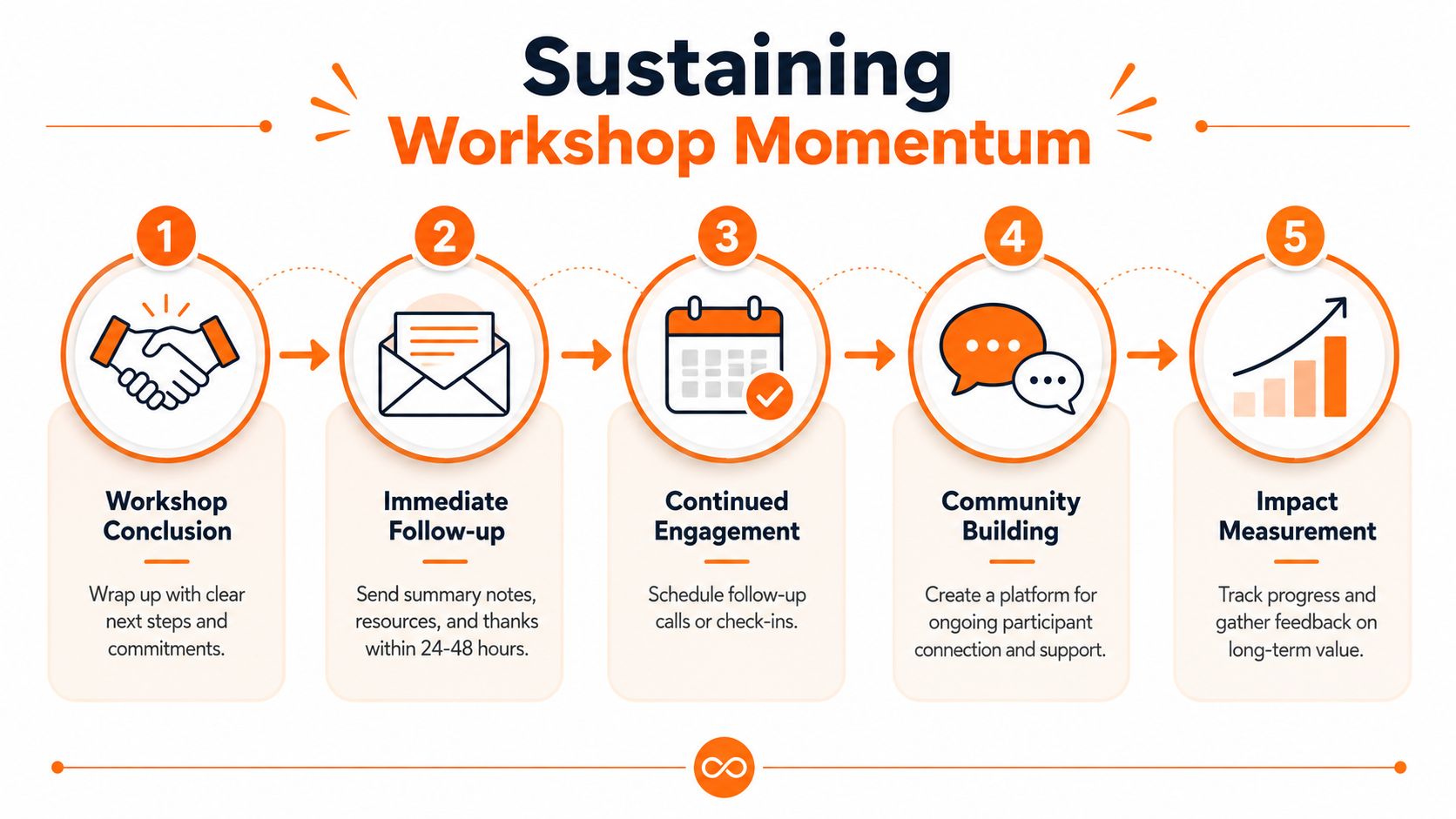
Do the follow-up fast
I send a message soon after the session while the room is still warm.
Nothing fancy. Just:
- A thank you
- A reminder of the confidentiality rule
- A short summary of themes
- A list of each person's stated next step
- A way to keep talking
If you wait too long, everybody slides back into isolation.
Start one simple channel
Don't launch a giant community stack. Start with one private group chat.
Signal, WhatsApp, or a quiet Slack channel is enough. The point isn't software. The point is keeping the social thread alive while people act on what they said they'd do.
I like a simple cadence:
- Right after the workshop: Add everyone and send intros
- A few days later: Ask what action they took
- Later on: Invite one quick win, one stuck point, or one ask
That keeps momentum without turning the group into homework.
Measure action, not satisfaction
Most hosts ask, "Did you enjoy it?"
Who cares.
Ask better questions:
- What's one action you took because of this room
- Who from the group did you follow up with
- What problem feels clearer now
- What do you want help with next time
Operator test: If nobody changes behavior after the workshop, the workshop was social. Maybe pleasant. Probably forgettable.
Turn one meeting into a circle
The long-term win isn't a successful event. It's a durable support loop.
That means you host the next one before energy fades. Keep the same standards. Let a few people return. Add a few new people carefully. Over time, the group becomes less like an event series and more like a trusted bench of operators who can help each other fast.
That's when the workshop starts paying off months later.
Quick-Start Templates You Can Steal
You don't need another theory deck. You need words you can copy, paste, and use.
I've stripped this down to the bare essentials. Edit the tone to sound like you, but don't soften the standards.
Invitation email
Subject: Private founder workshop for honest problem-solving
Hi [Name],
I'm putting together a small in person workshop for founders and operators who want real conversation, direct feedback, and zero performance.
This is a confidential session. People will bring one live business problem, talk it through openly, and help each other find the next move. This is not a networking event. It is not a pitch room.
I think you'd be a strong fit because [specific reason].
What I ask from everyone:
- show up ready to be candid
- respect confidentiality
- help the room, not your personal brand
- skip the sales mode
If that sounds right, reply with:
- what you're building
- the problem you'd bring
- why this format appeals to you
Confidentiality pledge
Use this at the top of the session and in your reminder email:
What's shared here stays here.
You can share your own lessons after the workshop. You can't share another person's story, company details, numbers, or identity without their clear permission.
Hot-seat agenda
Use a simple fill-in-the-blank version:
- Arrival and settle in
- Opening circle and ground rules
- Founder 1 hot seat
- Founder 2 hot seat
- Break and food
- Founder 3 hot seat
- Founder 4 hot seat
- Closing reflections
- Commitments and follow-up channel
If you need a sharper way to help founders explain what they're building before the session, this business model canvas template is a practical pre-work tool.
Workshop Template Toolkit
| Template | Content/Checklist Items |
|---|---|
| Invitation email | Who it's for, what happens, confidentiality, what to reply with |
| Host opening script | Welcome, purpose, privacy rule, tone-setting story, participation norms |
| Logistics checklist | Guest list, confirmations, seating, name tags, food, water, timing sheet, notebook cards, follow-up chat setup |
| Hot-seat prompt sheet | The problem, what's been tried, what's at stake, what help is needed |
| Closing reflection | One insight, one commitment, one person to follow up with |
| Follow-up note | Thanks, summary themes, next steps, private chat link, next gathering date |
Logistics checklist
Don't overcomplicate this. Just don't forget the basics.
- Room setup: chairs in a circle, no classroom rows
- Food: easy to eat, low mess, enough for tired founders
- Name tags: first names only if privacy matters
- Timing sheet: printed for you, not projected for them
- Supplies: pens, index cards, tissues, water
- Entry rule: greet every person yourself if possible
A strong in person workshop feels simple from the outside because the host handled the hard parts in advance.
If you want a vetted circle that already runs on confidentiality, honesty, and small-group founder conversations, take a look at Chicago Brandstarters. It's a free community for kind, hard-working founders and operators in Chicago and the Midwest who want real peer support instead of transactional networking.
Leave a Reply