Brand authenticity is a measurable consumer perception that you keep promises, live your values, signal identity meaningfully, and stay consistent over time. In one 2026 consumer study, authenticity raised trust with β = 0.54 and trust then predicted loyalty with β = 0.47.
You're probably here because you're trying to make your brand feel credible without sounding fake. Maybe you're building a product in Chicago, running an early ecommerce shop from your apartment, or sketching a service business on nights and weekends. You want people to take you seriously, but you don't have years of history, a huge customer base, or a polished origin story.
I know that feeling. Early on, a founder usually faces a weird choice. Sound polished and risk sounding generic, or sound raw and risk looking small. Many bounce between those two and call the whole thing “branding.”
That's where people get stuck.
Brand authenticity isn't about performing honesty. It's about giving buyers enough proof to believe you. If I can help you shift from performance to proof, the work gets simpler. You stop asking, “How do I sound authentic?” and start asking, “What evidence tells a buyer I'm the real deal?”
Introduction Why Authenticity Feels Hard When You Are Just Starting
A first-time founder usually writes their homepage like they're applying for a job they haven't held yet. The copy gets puffed up. The photos get too polished. Every sentence starts sounding like ten competitors mashed together.
I've seen this happen with small consumer brands, local service firms, and software founders. They think the brand has to look bigger than it is. So they borrow the voice of a company with a big team, a PR budget, and years of customer proof. The result is clean, but thin. It reads well and lands flat.
The early founder trap
Here's the tension.
You need trust before you've had time to earn much of it. You need a story before the market has fully answered who you are. You need confidence while you're still figuring things out. That's a hard place to build from, and it confuses a lot of good founders.
You don't need a perfect backstory. You need believable signals.
If you're in the Midwest, this problem can feel even sharper. A lot of founders here are practical. They don't want hype. They want to say what they do, do it well, and let the work speak. That instinct is good. But “let the work speak” only works if buyers can see the work.
Why this feels fuzzy
Most advice on authenticity stays abstract. It tells you to “be real” or “tell your why.” Fine. But what does that mean on your website, your packaging, your Instagram, your reviews, or your search results?
That's the gap.
I think about authenticity like a house inspection. A buyer doesn't trust the house because the seller says, “This home has character.” They trust it because they can inspect the foundation, wiring, roof, and maintenance record. A brand works the same way. People look for proof across many touchpoints.
A simple way to start is this:
- Your words matter. Buyers hear your promise.
- Your actions matter more. Buyers test whether the promise holds up.
- Outside evidence matters most. Buyers look for signs beyond your own claims.
Once you see authenticity that way, the work becomes less mystical. You can build it on purpose.
What Brand Authenticity Really Means Beyond Just Being Real
When people ask, what is brand authenticity, they usually mean, “How do I make my brand feel honest?” That's a fair question, but it's still too fuzzy to use.
A better definition comes from research. One review explains that brand authenticity is a measurable consumer perception with four core dimensions: credibility, integrity, symbolism, and continuity. It also notes that there still isn't one single accepted definition, which is exactly why I prefer to treat authenticity as a system instead of a slogan in this review on brand authenticity dimensions.
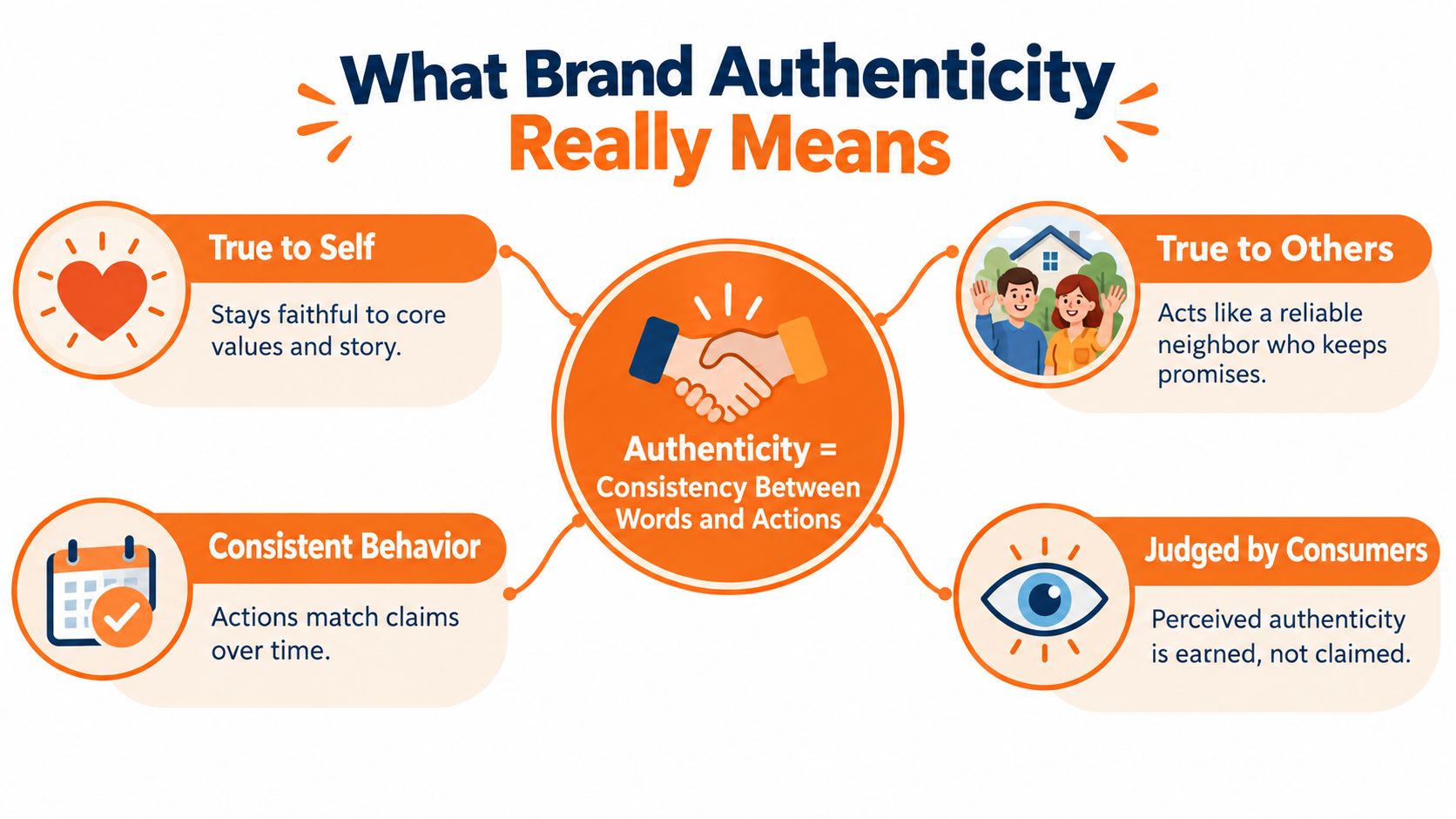
Think of a reliable neighbor
The easiest analogy is a neighbor.
You trust the neighbor who says they'll bring your package inside and does it. They don't change personalities every week. They don't claim to care about the block and then dump trash in the alley. They have a stable character, and over time you believe them.
Brands work the same way.
The four parts in plain English
Here's how I translate those four dimensions into founder language:
- Credibility means people believe your claims. If you say shipping is fast, support is responsive, or ingredients are clean, buyers expect the experience to match.
- Integrity means your actions fit your stated values. If you say you care about craftsmanship, your product, support, and decisions should show it.
- Symbolism means your brand helps people express something about themselves. Think of the coffee shop, skincare line, or apparel brand someone chooses because it fits their identity.
- Continuity means your core stays stable over time. You can evolve. You just shouldn't feel like a different company every month.
Practical rule: If your website says one thing, your product says another, and your customers say a third, your brand doesn't have an authenticity problem. It has a consistency problem.
Why visuals matter too
People often think authenticity only lives in words. It doesn't. Your visual choices shape whether people read you as polished, cold, warm, handmade, local, premium, or generic. That's one reason founders often invest in better founder and team photos. If you're trying to make your online presence feel more human, corporate branding portraits with AiHeadshots can be one way to create more consistent visuals without pretending to be something you're not.
If you need one sentence to share with a teammate, use this: brand authenticity is the buyer's judgment that your brand consistently does what it says, believes what it says, and feels like itself wherever people meet it.
The Five Signals That Make a Brand Feel Authentic
A definition helps. A diagnostic helps more.
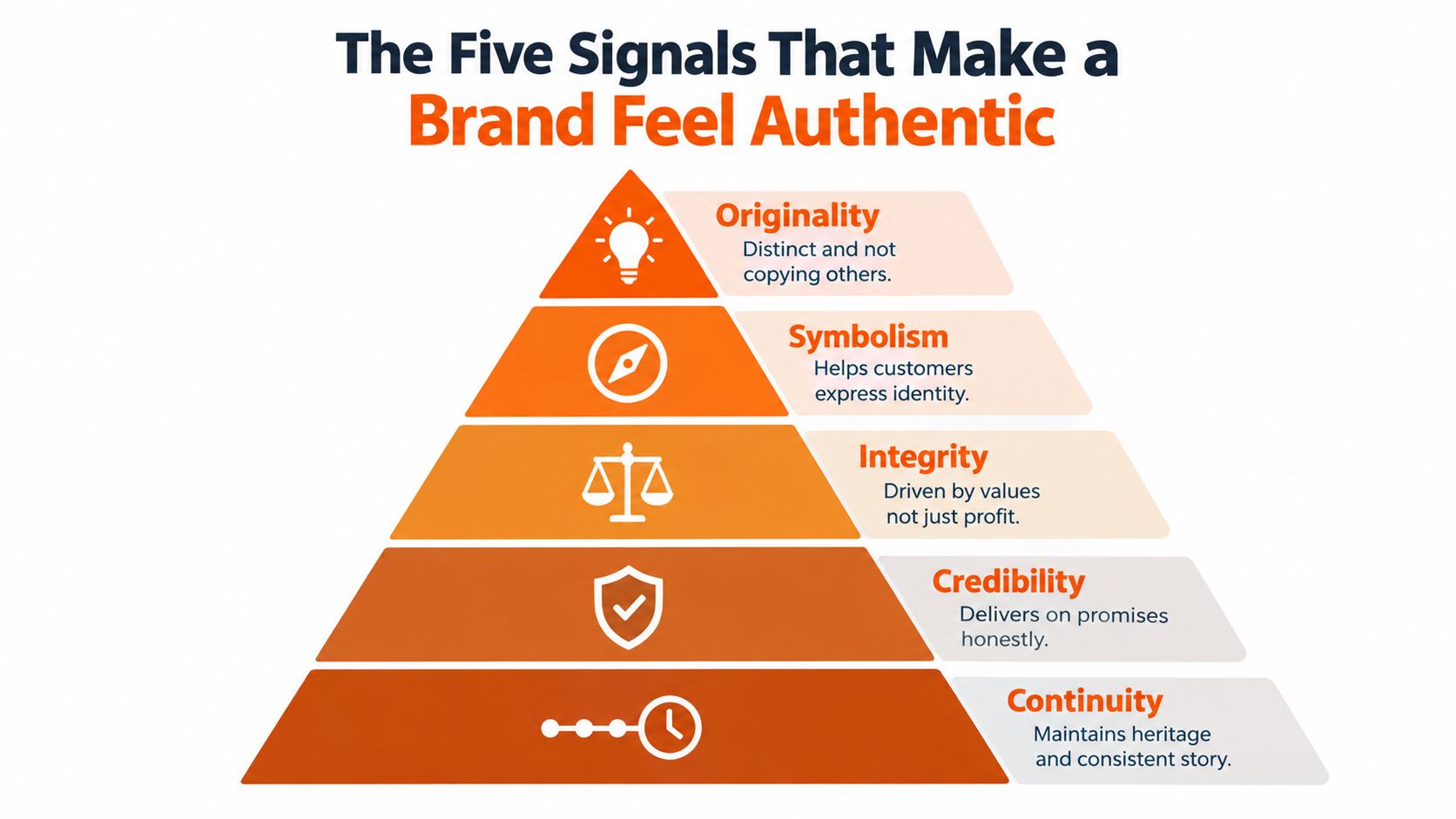
Academic work breaks authenticity into observable pieces like stability and consistency, uniqueness, keeping promises, unaffectedness or naturalness, plus related ideas like accuracy, connection, legitimacy, originality, and proficiency in this academic summary of brand authenticity frameworks. I like to boil that down into five signals you can audit.
A quick visual helps before we unpack each one.
Continuity and credibility
Start with continuity. Does your brand feel like the same company across your homepage, product page, email replies, packaging, and social posts? A small brand can do this well without fancy systems. Use the same core promise, same tone, and same basic visual rules everywhere.
Then check credibility. This is simple. Do you keep the promises you make?
If you say “small-batch,” I should see details that make that claim believable. If you say “fast support,” my email shouldn't disappear into a void. Buyers forgive small scale. They don't forgive a mismatch between claim and experience.
A useful self-test is to compare your headline with your checkout, FAQ, and post-purchase flow. If they sound like three different companies, people will feel that friction.
For a concrete look at how clear positioning sharpens these signals, I'd study these brand positioning examples.
Integrity and symbolism
Integrity shows up when the hard choices match the stated values. Many brands wobble. They say they care about quality, then race to copy a competitor. They say they're community-first, then ignore customer complaints in public comments.
Symbolism is more emotional. It answers, “What does choosing this brand say about me?” A neighborhood bakery, a refillable cleaning brand, or a blunt-spoken B2B founder can all carry symbolism. Buyers aren't only buying function. They're often buying self-expression.
Here's a quick checklist:
- Website copy: Does it sound like a human with a point of view?
- Product decisions: Do they reflect your stated priorities?
- Customer support: Do replies match your tone and values?
- Visual identity: Does it look distinct, or copied from the category leader?
A short explainer can help if you want another lens on this idea:
Originality and naturalness
The last signal is what I'd call originality with naturalness. Academic language sometimes calls this unaffectedness or naturalness. In plain terms, your brand shouldn't look strained.
That doesn't mean sloppy. It means your tone, visuals, and claims should feel proportionate to who you are. A founder with ten customers doesn't need to sound like a public company. A local food brand doesn't need cinematic copy about “redefining culinary narratives.” Just say what you make, why it matters, and who it's for.
If a buyer can swap your logo with a competitor's and the copy still works, you haven't built authenticity yet.
Why Authenticity Directly Drives Trust Loyalty and Pricing Power
A lot of founders treat authenticity like a nice personality trait. I think that's too soft. It affects buying behavior.
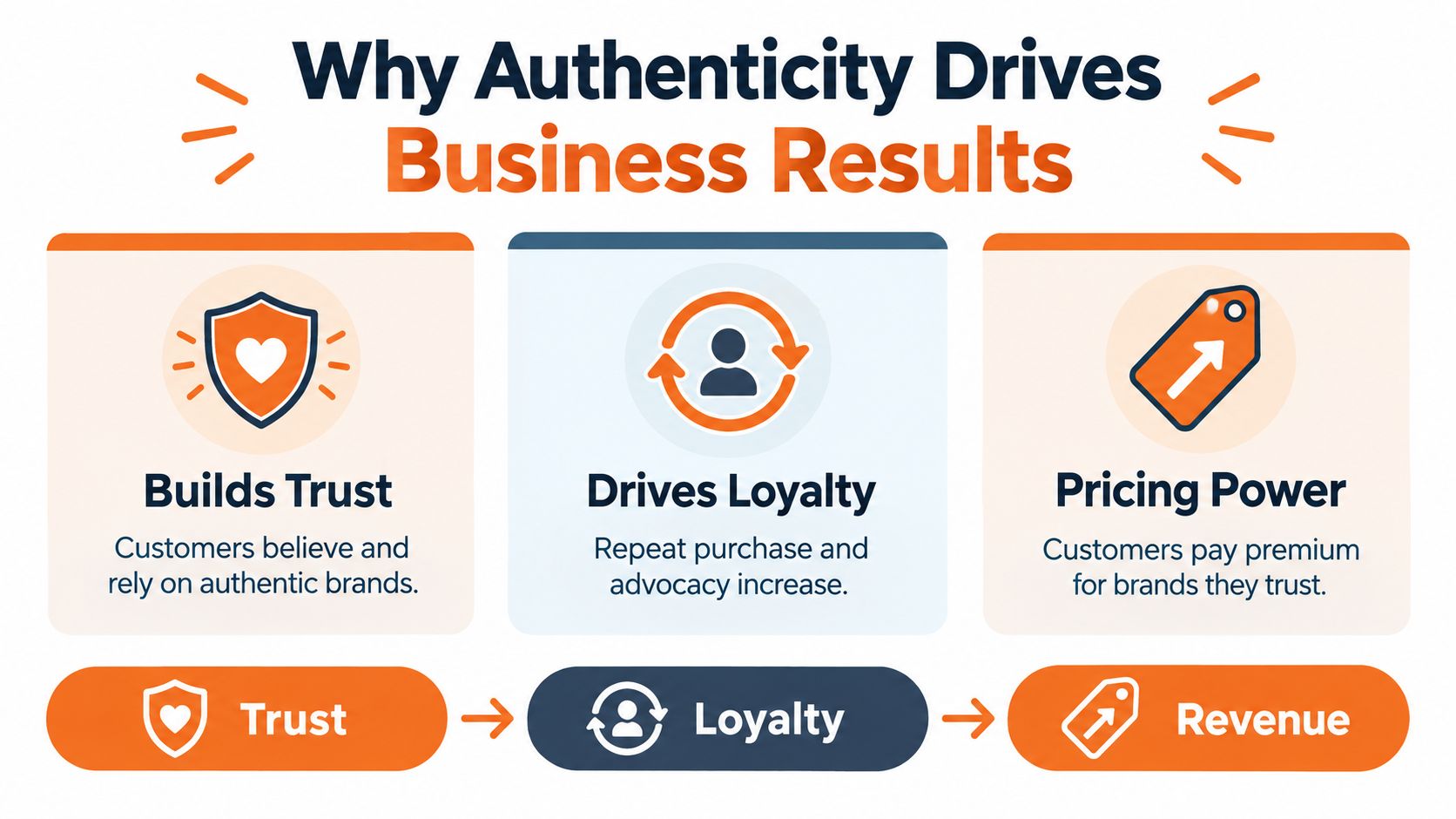
In a 2026 study of nutrition markets, perceived brand authenticity significantly increased consumer trust with β = 0.54, p < 0.001, and trust then strongly predicted loyalty with β = 0.47, p < 0.001 in this consumer study on authenticity, trust, and loyalty. That gives us a clean business chain. Buyers feel uncertainty. Authenticity reduces that uncertainty. Trust rises. Loyalty follows.
Why trust matters more for small brands
If you're unknown, buyers have more questions than answers.
Can this founder deliver?
Will the product match the photos?
If something goes wrong, will anyone help me?
Is this business still going to be here in six months?
Authenticity helps answer those questions before a sales call or first order. It tells people, “What you see is what you'll get.” That lowers the mental cost of buying from you.
I'd pair that idea with practical trust-building work like clear messaging, realistic claims, and social proof. If you want a simple framework for that side of the job, this guide on how to build trust with customers is useful.
Why it affects pricing and retention
There's also a money angle.
A 2026 survey of 1,600 consumers in the U.S. and U.K. found that 93% say authentic engagement builds trust and 85% say they are willing to pay more for brands they perceive as authentic. The same coverage says more than half of consumers would stop buying after an inauthentic experience, and more than one-third would switch to a competing brand in this coverage of the authenticity survey.
That matters because founders often think price resistance is only a product problem. Sometimes it's a belief problem. If buyers don't trust your claims, your price feels risky. If they do trust you, the same price can feel fair.
Why “good enough” isn't enough anymore
Here's the harder truth. Authenticity is becoming expected.
In a 2026 survey, 66% of U.S. and U.K. consumers said search results are a top authenticity signal, 63% said user-generated content is, 79% said they read three or more reviews before buying, and 79% said they prefer authentic brands. The same source says authenticity alone is no longer a competitive advantage. It's an expectation in this survey on digital authenticity and proof signals.
So if you're still treating authenticity like a brand mood, you're behind. Buyers now validate brands through visible proof.
How to Build and Measure Authenticity Without Faking It
If authenticity is proof, then you need a proof system. I'd build it in a simple order. Values first. Promise second. Evidence third. Distribution fourth.
Start with what you can honestly claim
Write down three things:
- What you believe
- What you do well
- What you refuse to fake
That third one matters. If you won't pretend to be luxury, say that. If you won't promise overnight support, don't. Strong brands usually get more trust by narrowing claims, not stretching them.
Then turn that into a plain-English brand promise. One sentence. No fluff. If you need help shaping that narrative, this guide on how to write a brand story is a good starting point.
Build proof before polish
Most founders reverse the order. They polish first and prove later. I'd do the opposite.
Use these proof points early:
| Proof Point | What It Signals | Effort Level |
|---|---|---|
| Reviews | Other people had a real experience with you | Medium |
| Search results | Your brand has a visible footprint beyond your own site | Medium |
| User-generated content | Real customers interact with the brand in the wild | Medium |
| Founder bio and real photos | There's a real person behind the promise | Low |
| Clear policies and FAQs | You've thought through the customer experience | Low |
| Consistent messaging across site and social | You know who you are | Low |
| Public replies to customer questions | Accountability and responsiveness | Medium |
| AI disclosure where relevant | Honesty about how content gets made | Low |
You don't need all of these at once. You need enough of them to reduce doubt.
The fastest way to feel more authentic is to remove claims you can't prove yet.
Measure what buyers can actually see
I'd measure authenticity through observable checks, not abstract vibes.
Try this monthly audit:
- Consistency check: Compare your homepage headline, Instagram bio, and sales deck. Do they make the same promise?
- Promise check: List your top three claims. Gather one piece of evidence for each.
- Proof check: Search your brand name. What appears besides your own content?
- Voice check: Read five customer emails and five social captions side by side. Do they sound like the same company?
- Experience check: Buy from yourself. Go through discovery, purchase, delivery, and support.
If you want peer feedback on that audit, founder groups can help. One option is Chicago Brandstarters, which runs small private dinners and group chat conversations where founders compare positioning, messaging, and customer proof in a direct way.
A simple 30-day build plan
If I had a tiny team and one month, I'd do this:
- Week one: Tighten the brand promise and remove inflated language.
- Week two: Collect customer quotes, reviews, or early feedback and place them where buyers hesitate.
- Week three: Clean up search presence, social bios, founder profile, and product pages so they tell the same story.
- Week four: Document where AI is used in content or support, then decide where disclosure makes sense.
That last point matters more now than many founders realize.
Common Pitfalls That Break Authenticity and How to Avoid Them
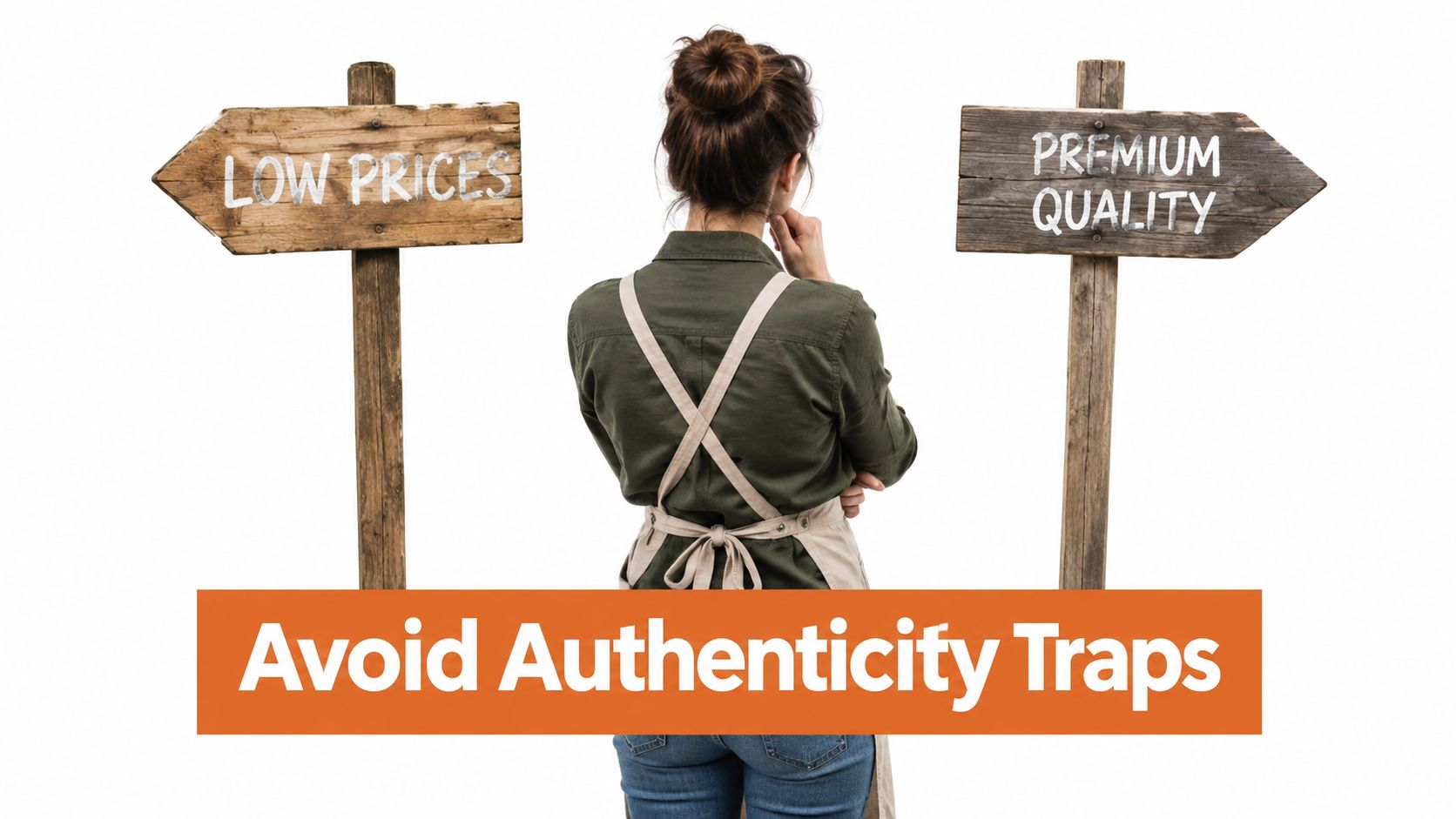
The biggest authenticity mistakes aren't dramatic. They're small leaks. A claim that's too big. A voice that changes by channel. A polished visual style that doesn't match the lived experience.
Four ways founders break trust
Here are the ones I see most often.
- Story drift: You rewrite your “why” every month. Fix it by choosing one stable promise and repeating it across channels.
- Copycat branding: You borrow a competitor's look, tone, or claims. Fix it by naming what only your brand can say from real experience.
- Over-polished AI content: The posts look perfect and empty. Fix it by editing for human texture, specifics, and plain speech.
- Hidden process: Buyers can't tell who you are, how you work, or what happens after purchase. Fix it with clear policies, real team presence, and direct explanations.
The AI problem is real
A 2026 study found that 87% of consumers said the ads, social posts, product images, and other content they see from brands are at least partly AI-generated, and 55% viewed a brand less favorably once they could tell AI created the work. The same study says 93% said authentic engagement builds trust and 85% were willing to pay more for brands they perceive as authentic in this study on AI content and authenticity tension.
That creates a real tension. You can use AI. Many founders do. I do think you need to govern it. If AI drafts your caption, a human should sharpen the point of view. If AI helps with imagery, ask whether the final result still fits your actual business. If AI appears in customer-facing work that could affect trust, think through disclosure.
Buyers usually forgive tools. They don't forgive feeling misled.
Small Brand Examples and Your Next Steps Toward Authentic Growth
Let me make this concrete with two quick snapshots.
The first founder sells a niche household product. Her site makes one clear promise. Her packaging says the same thing. Her reviews use the same language customers heard on the homepage. Her search results show product feedback, founder interviews, and active customer posts. Nothing feels flashy. Everything feels believable.
The second founder chases trends. One month the brand is playful. The next it's premium and minimalist. Product photos look luxurious, but support emails feel rushed and generic. Social captions sound like they came from three different ghostwriters. Buyers may not articulate the problem, but they feel it.
What to do next
If you want your brand to feel more authentic this month, keep it simple:
- Pick one promise: Say one thing clearly before you say ten things vaguely.
- Match every touchpoint: Homepage, bio, packaging, email, and support should sound related.
- Gather outside proof: Reviews, customer posts, and search presence matter more than self-praise.
- Cut inflated claims: If you can't prove it, remove it.
- Review your AI use: Keep a human accountable for the final customer-facing output.
Brand authenticity isn't mystical. It's what buyers conclude after they compare your words, your behavior, and the evidence around you. If those three line up, trust gets easier.
If they don't, no amount of storytelling will save you.
Chicago Brandstarters helps founders pressure-test exactly this kind of work with honest peers, small private dinners, and direct conversations about what buyers trust. If you're building in Chicago or the Midwest and want a place to sharpen your brand without the usual networking theater, visit Chicago Brandstarters.
Leave a Reply