You've posted the same company description on your website, LinkedIn, email footer, and sales deck. Each version sounds reasonable. None sounds like the same company.
That usually happens because founders start with features, services, and origin details before deciding what the brand believes, whom it helps, and what change it wants to create. The result feels polished in isolation but forgettable in the buyer's mind. Brand narrative development gives those pieces one direction, so your website, social posts, customer conversations, and AI-generated summaries point back to the same idea.
A durable narrative doesn't require a dramatic founding story. It requires a clear position, a human point of view, evidence, and rules for adaptation. This guide shows you how to build that system from scratch, test it quickly, and keep it honest when the story meets real customers.
Why Your Brand Narrative Decides What People Pay and Remember
A buyer compares two tools that offer similar features. One company lists speed, simplicity, and price. The other explains why small teams should not need an operations department to produce dependable work. The second message gives those features a position people can remember, repeat, and use to judge later claims.
That is the commercial role of brand narrative development. It turns a product description into a reason to care. Features show what the company has built. A narrative explains the belief behind those choices and the change the customer should expect.
Research connected storytelling with consumer response by the early 2010s. A 2012 Journal of Business Research study found that consumers who encountered a firm-originated story described the brand more positively and showed greater willingness to pay, as documented in the Journal of Business Research source. Your story therefore belongs in the value proposition, not only below the founder's photograph. It can influence brand attitude, perceived value, and pricing power.

Build a narrative spine
Features are the working parts. Channels are the changing presentation. Your narrative spine keeps the company recognizable across a website, social post, email, community discussion, or AI summary.
A durable spine answers four questions:
- Who is struggling: Describe the customer's situation in words they use.
- What do you believe: State the principle that guides your decisions.
- What do you do: Explain the product, service, or mechanism that creates progress.
- What proves it: Provide evidence that makes the promise credible.
The practical test is consistency without repetition. Use the belief as the constant, then adjust the proof and level of detail for each channel. A website can explain the mechanism. Social content can show a customer moment. Email can address a decision point. Community posts can reveal how the team handles disagreement. AI summaries should still recover the same position from those varied signals.
Polish is not always the right choice. Show strong proof when a buyer needs confidence, such as results, demonstrations, or specific customer changes. Show a constraint or unresolved flaw when hiding it would make the promise feel manufactured. A durable story earns trust by making clear what the company does well, what it refuses to do, and where the product still has limits.
To craft compelling brand narratives, study examples that connect origin, belief, customer tension, and evidence without relying on a dramatic founder story.
Without a shared spine, buyers create their own explanation. They may define the company by its cheapest feature, loudest competitor, or latest campaign, leaving the team to correct impressions instead of building preference.
Discovery That Actually Surfaces Your Story
Start with evidence, not a blank page. Founders often write from memory, and memory removes the awkward details that make a story believable. Discovery brings those details back.
Run short conversations rather than long interviews. Give each person a small set of questions, capture exact phrases, and ask for examples whenever someone gives you an abstract answer.
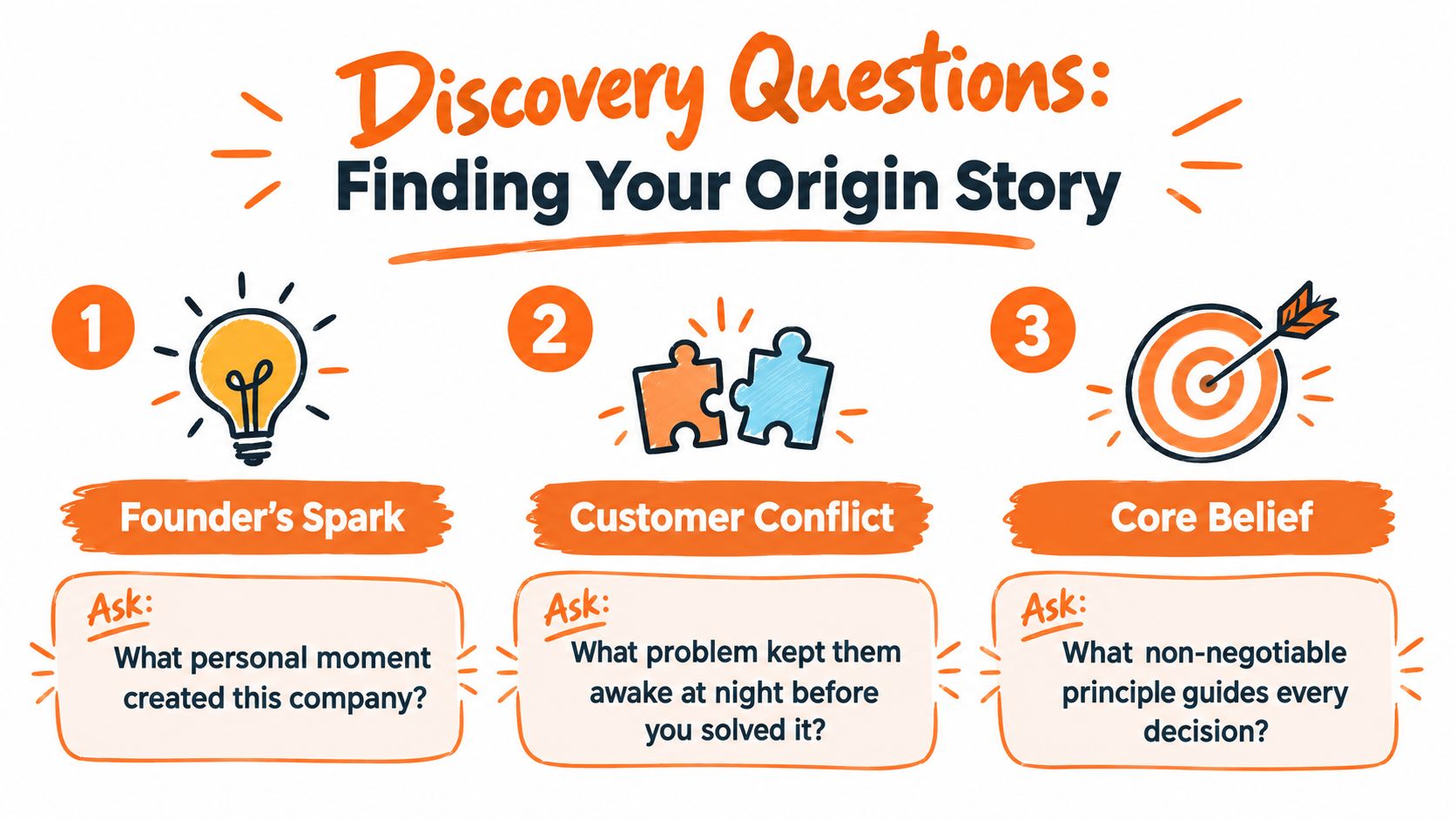
Ask questions that create usable material
Ask founders:
- Founding trigger: What personal moment made you act?
- Previous attempts: What did you try before creating this company?
- Frustration: What felt broken, wasteful, unfair, or absurd?
- Choice: What did you refuse to do, even when it looked easier?
- Belief: What principle guides decisions when the numbers don't give you a clear answer?
Ask customers:
- Before: What happened before you used the product?
- Pressure: What problem kept interrupting your work or life?
- Decision: Why did you choose this option?
- Change: What can you do now that you couldn't do before?
- Proof: What observable detail supports that change?
Ask teammates:
- Pattern: What do customers thank us for repeatedly?
- Contrast: Where do we behave differently from competitors?
- Tension: What tradeoff do we accept to keep our promise?
- Language: Which phrases do customers repeat without prompting?
Sort notes before you interpret them
Put every useful answer into one of five piles:
- Origin: Events that explain why the company exists.
- Conflict: Problems, constraints, and rejected alternatives.
- Belief: Principles that guide action.
- Outcome: Changes customers can see or describe.
- Evidence: Facts, artifacts, demonstrations, testimonials, or records.
Then mark repeated ideas. If several customers mention confusion, speed, or control, don't treat those words as interchangeable. Read the surrounding sentences. “I finally know what happens next” points to control. “I finish before lunch” points to speed. The exact language tells you which idea carries emotional weight.
Practical rule: Keep the customer's wording until you know what it means. Polished language often removes the friction that gives a narrative its shape.
Write a one-page synthesis with three lines: “People struggle with…”, “We believe…”, and “We help them…”. Add a fourth line, “We can prove this through…”. If you can't complete the proof line, don't inflate the story. Record the gap and decide how you'll create evidence.
Positioning and Archetype Choices That Make You Distinct
Positioning defines where you compete. An archetype defines how you behave there. Choose the position first, then select the personality that supports it.
Compare three positioning lanes:
| Positioning lane | Best when | Risk |
|---|---|---|
| Category ownership | Buyers understand the category and need a clear specialist | You may sound interchangeable |
| Distinct value | You solve a familiar problem through a noticeably different method | The method needs clear explanation |
| Specific audience | One group has a sharp need broad providers ignore | Expansion may require a later change |
Write one sentence: “For [audience] who [conflict], [brand] is the [category or alternative] that [distinct change], because [proof or belief].” Remove claims customers cannot recognize or your team cannot support. A durable position should survive a homepage rewrite, a social post, an email, a community answer, and an AI summary without changing its central promise.
Then choose a behavioral archetype. The Hero pushes through difficulty and gives customers courage. The Sage teaches, explains, and reduces confusion. The Rebel challenges accepted practices and invites people to reject the usual path.
Compare the tradeoffs
The Hero creates energy, but constant battle language can exhaust people. The Sage builds authority, but excessive teaching can make the brand feel distant. The Rebel earns attention, but provocation without proof becomes noise.
Match the archetype to how the company operates. A calm financial education company should not use Rebel language because it is fashionable. A product built around radical simplicity should not sound like a Sage explaining every detail.
For a useful reference on how archetypes shape brand perspective, you can schedule Substack notes faster after deciding which behavior fits your company. If you are still testing your category, this guide to brand positioning for startups can help compare audience, category, and promise before you finalize copy.
Name the tension you resolve
A narrative needs friction. “We help people live better” names no opponent, cost, or decision. Use a sharper construction:
- Old belief: Professional help must feel complicated.
- Customer cost: People delay action because they expect confusion.
- Your position: We make the first step clear and manageable.
- Proof standard: Show the process, explain decisions, and publish customer outcomes.
Let the archetype shape how you address that tension. The Hero says, “You can move through this.” The Sage says, “Here's how it works.” The Rebel says, “The old method creates the problem.”
Choose one dominant voice. A brand can borrow behaviors from other archetypes, but equal voices create a personality with no center. Use polish for clarity, then show proof where the promise is tested. Show flaws when hiding them would make the story less credible. That discipline keeps one narrative recognizable across every channel, including summaries written by AI.
Build Your Narrative Architecture and Messaging Toolkit
Once the position is clear, turn it into a working system. The architecture should help a founder write a homepage, help a salesperson explain the company, and help a customer describe the product without memorizing a script. It also gives web, social, email, community, and AI summaries the same underlying story.
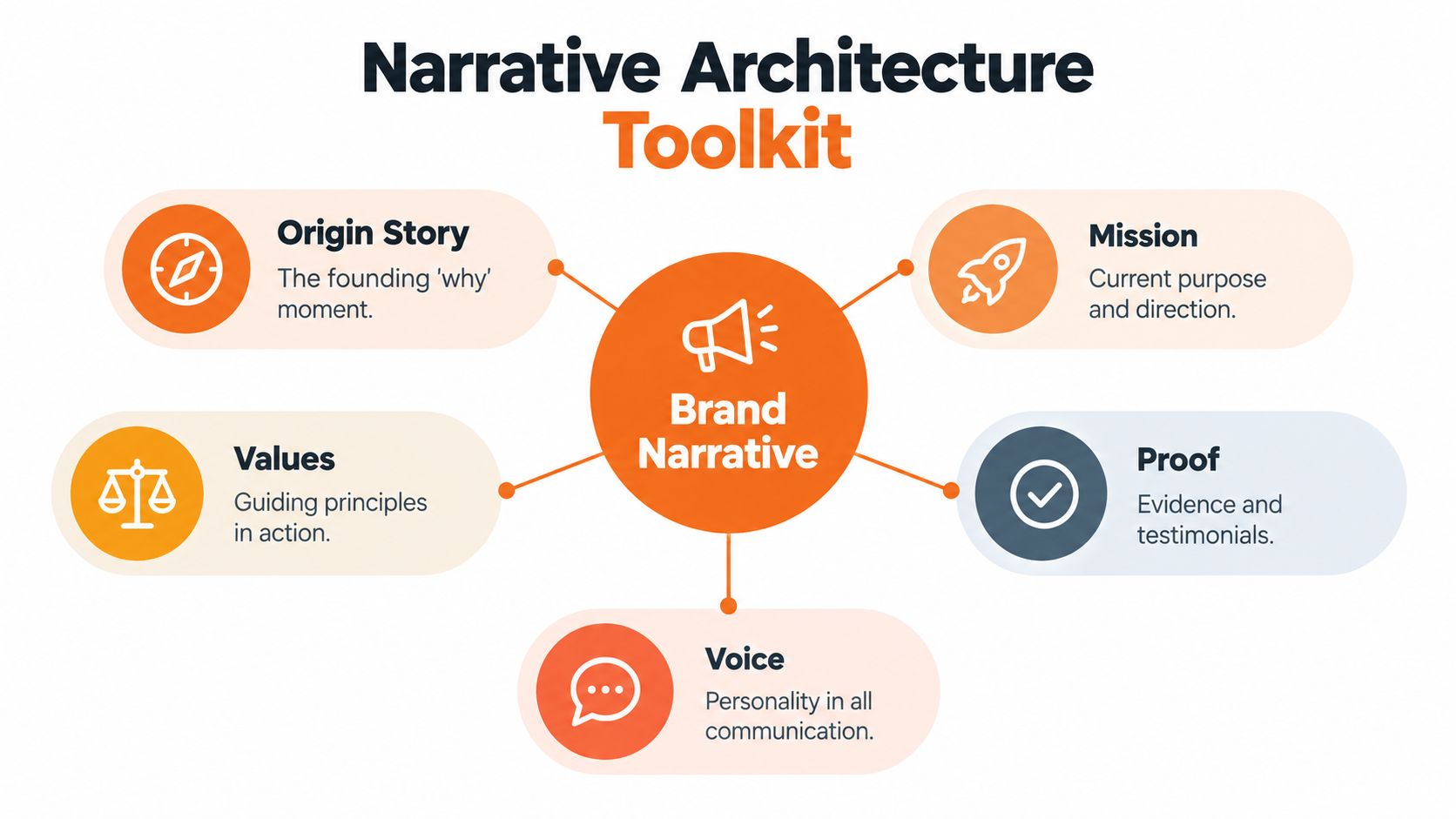
Use five parts:
- Origin story: “I saw [specific problem] when [specific moment], so I built [response].”
- Mission: “We help [audience] achieve [present-tense change] through [method].”
- Values: “We choose [principle] when [real decision or tradeoff appears].”
- Proof: “We claim [promise], and we support it with [evidence].”
- Voice: “We sound [three traits], avoid [three habits], and use [preferred point of view].”
Write like a person who takes responsibility
Active voice keeps the actor visible. “We publish the method” is clearer than “The method is published.” The University of California, Riverside writing guide recommends a direct Subject + Action + Object structure in its active and passive voice guide.
Choose the pronoun based on the relationship you want:
- I: Use it when a founder's judgment or experience creates trust.
- We: Use it when the company speaks for a team or shared community.
- You: Use it when the customer needs clear direction.
- They: Use it sparingly, mainly for describing the customer's situation.
First-person storytelling sounds human when it reflects a real point of view. This brand perspective guide explains the practical distinction between a singular brand voice and “we” as the voice of a larger community.
Create three reusable message blocks:
- Headline: State the customer's desired change.
- One-liner: Name the audience, problem, method, and result.
- Proof block: Pair one claim with one specific piece of evidence.
For customer stories, use Context, Conflict, Resolution, and Impact. A practical framework from Instant Press says a story can include at least three specific numbers and roughly 30% direct quote with 70% narrative framing, as described in its customer storytelling framework. Apply those guidelines only when the evidence exists. Never add numbers to make a weak story look concrete.
Write voice rules as editing decisions. Replace vague praise words with the specific action that proves the claim. Replace abstract smoothness claims with the concrete step you removed. Replace “we care” with behavior customers can observe. Show polish when it improves clarity, then show proof where the promise is tested. Show flaws when hiding them would weaken credibility.
For a fuller writing process, use this guide on how to write a brand story, then test each draft aloud. If you would not say it to a customer, do not make the customer read it.
Make One Story Work Everywhere Without Losing It
Your narrative should travel, but it shouldn't wear the same outfit everywhere. Keep the meaning fixed and change the format, pace, and amount of context.
Lock these elements across channels:
- Customer conflict: Use the same underlying problem.
- Belief: Keep the same principle.
- Promise: Preserve the same customer change.
- Proof standard: Never lower the evidence threshold for a faster channel.
- Voice behavior: Keep the same emotional posture.
Adapt these elements:
| Channel | Adapt | Lock |
|---|---|---|
| Website | Add context, process, and proof | Position and promise |
| Social video | Use one scene, tension, or customer moment | Point of view |
| Build a sequence around one decision | Voice and claim | |
| Community chat | Respond directly and admit uncertainty | Values and boundaries |
| AI summaries | Use plain, explicit language and named evidence | Facts and positioning |
AI-mediated discovery adds a practical requirement. If a summary system must explain your company, vague adjectives give it little to work with. State who you help, what problem you solve, how you solve it, and what supports the claim. “We help independent retailers reduce inventory confusion through shared purchasing data” gives a summary system more usable material than “We're redefining modern commerce.”
Create a channel adaptation sheet
Keep one page with five columns: core idea, channel version, allowed change, prohibited change, reviewer. Give every content producer the sheet before they write. Human review matters because speed can multiply small deviations until the story becomes unrecognizable.
A social post can sound casual. It can't reverse the company's position. An email can focus on one objection. It can't promise an outcome the proof block doesn't support. A community reply can reveal uncertainty. It can't invent certainty to sound confident.
Review this brand storytelling examples guide when you need to see how one idea can take different forms without losing its center.
A durable narrative bends at the channel level and stays firm at the belief level.
Run a simple QA check before publishing: Can a reader identify the audience? Can they name the problem? Can they repeat the promise? Does the proof match the claim? Would the founder recognize the tone? If any answer is unclear, revise the system before you produce more content.
Validate Quickly and Keep Your Narrative Honest
Polish can hide a weak story. Validation exposes it.
Use the journalist filter from a brand storytelling framework: could a skeptical journalist verify the narrative independently and still agree with your framing? The framework organizes a story around tension, point of view, proof, and resolution, then asks you to test whether the story survives scrutiny through this journalist filter.
Run the test with real material:
- Tension: Can a customer describe the problem without borrowing your wording?
- Point of view: Can your team explain what you believe and what you reject?
- Proof: Can you show a record, result, artifact, demonstration, or direct customer account?
- Resolution: Can the customer explain what changed?
Decide when to show flaws
Show a constraint when it affects the buyer's decision. If implementation takes effort, say what the effort involves. If your service fits one customer type better than another, name the boundary. A visible tradeoff often gives the promise more shape.
Defer a flaw when it's temporary, irrelevant, or likely to confuse the decision before you have context. Don't hide an operational weakness that changes the customer's risk. Pair every limitation with the action you're taking, the customer who should wait, or the condition that makes the product work.
Test the draft with a small group and ask:
- What do you think this company believes?
- Who do you think it helps?
- What would make you trust the promise?
- What sounds polished but unsupported?
- What would you repeat to someone else?
Listen for wrong answers. If people remember a side detail instead of the position, your hierarchy needs work. If they like the story but can't explain the product, your resolution lacks a mechanism.
Use this final checklist:
- One sentence: Can you state the narrative without slogans?
- One conflict: Does the customer face a real problem?
- One belief: Does the company make a clear choice?
- One promise: Can the customer describe the desired change?
- One proof block: Does every major claim have evidence?
- One voice: Do all channels sound related?
- One honesty rule: Have you named the tradeoff that affects trust?
For founders who want peer feedback while shaping these decisions, Chicago Brandstarters is a free community built around private dinners and a group chat where members share practical business problems and support. It can give you a setting to hear whether people understand your narrative before you invest in a full content system.
A narrative earns trust when the story and the operation agree. Write the ambitious version, then attach evidence, limits, and next actions. That combination gives people something they can remember without asking them to suspend disbelief.
If you want help turning your origin, customer conflict, proof, and voice into a usable narrative system, visit Chicago Brandstarters and explore the founder community. Bring your rough story, test it with other builders, and leave with clearer language you can use across your website, content, and customer conversations.
Leave a Reply