
Your first order email hits your inbox and you feel great for about ten seconds. Then the actual work starts. Someone has to pack the item, choose a carrier, explain the delivery promise, and make sure the package reaches the customer in one piece.
That's shipping and logistics in plain English. It's the part of your business that takes a product from your hands to your customer's door, and if you mess it up, your brand takes the hit. Logistics is estimated to account for about 12% of global GDP according to this supply-chain statistics source, which tells you this isn't some side task you can ignore. It's the moving parts behind every order, like the roads, traffic lights, and delivery vans your business depends on.

If you're still deciding how to handle fulfillment, start with a simple question, how much control do you want over every box that leaves your brand? That answer drives almost every other choice. If you want a local starting point for vetted help, look at shipping fulfillment companies in Chicago, then compare that against your own time, cash, and patience.
Your First Sale Is In Now What
The first sale feels like proof. It is also a test. Once money changes hands, the product has to move, the tracking has to work, and the customer has to feel like they made the right call.
Treat logistics like your business's circulatory system
I think founders make the same mistake here. They treat shipping like a checkout setting instead of a core operating choice. That's backwards, because the way you move goods affects customer trust, repeat purchases, and how fast your cash gets tied up in inventory.
The cleanest way to think about shipping and logistics is this. You make the product, store it somewhere, pick and pack it, then hand it off to a carrier. Each step can break. If your stock count is wrong, you oversell. If your pack-out is sloppy, you ship damaged goods. If your carrier misses the scan, your inbox fills up with angry “where is it” messages.
A good founder doesn't obsess over jargon. You just need a working mental model. Product in. Order out. Delivery promised. Delivery met.
Practical rule: if you can't explain your fulfillment flow in one minute, you don't understand it well enough yet.
The fastest way to get clarity is to map the physical path of one order from start to finish. Where does it sit? Who touches it? Who prints the label? Who owns the delay if it gets stuck? Those answers matter more than any polished homepage copy.
The Core Parts of Your Logistics Machine
Think of your logistics setup like a restaurant kitchen. If the pantry is disorganized, the cooks waste time. If the prep station is messy, the order goes out wrong. If the runner picks the wrong table, the customer blames the restaurant anyway.
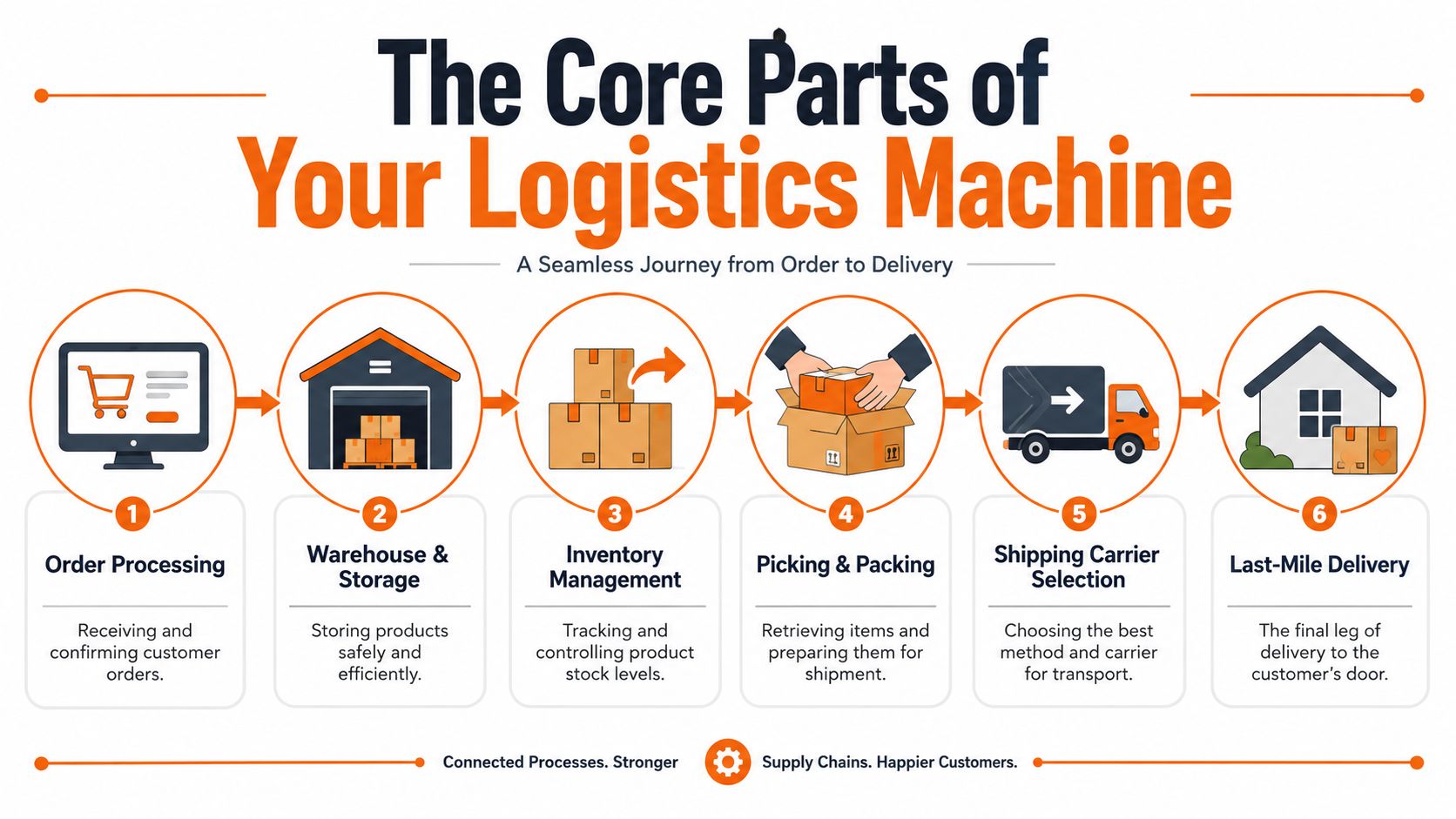
The four parts you actually need to care about
Warehouse and storage is your pantry. You need a place where products sit safely, count correctly, and stay easy to find. If your storage is sloppy, everything downstream gets slower.
Inventory flow is how stock comes in and out. It's similar to ingredient replenishment in a kitchen. If you don't know what's on hand, you'll sell items you can't ship or sit on dead stock that ties up cash.
Fulfillment is the picking, packing, and boxing step. In this step, accuracy matters. A clean fulfillment process lowers mistakes, keeps returns down, and stops your team from wasting time fixing avoidable errors.
Carriers are the people taking the finished package to the customer. They aren't all the same. One might be cheaper. Another might be faster. Another might be better for residential delivery. You need to choose based on the order, not on habit.
A bill of lading helps here because it does three jobs at once, it works as a contract of carriage, a receipt for the goods, and, in some cases, a document of title per this shipping document guide. That matters because one document can shape responsibility, proof, and control of the cargo.
If you sell products that can be bundled or ordered in multiples, a tool like the Multi Product Ordering API can help you think about order flow more cleanly before you drown in manual exceptions. The main lesson is simple. More order complexity means more chances to break the handoff.
Use the restaurant test to find the problem
When something goes wrong, ask where the failure started.
- Late before pickup: your inventory, picking, or packing process probably has the issue.
- Late after pickup: your carrier or service choice is probably the problem.
- Wrong item delivered: your fulfillment process needs tighter checks.
- Tracking silent too long: your carrier handoff or label flow needs attention.
That simple split saves time. Don't blame “shipping” as one blob. Break it into steps and fix the step that failed.
Choosing Your Shipping Model
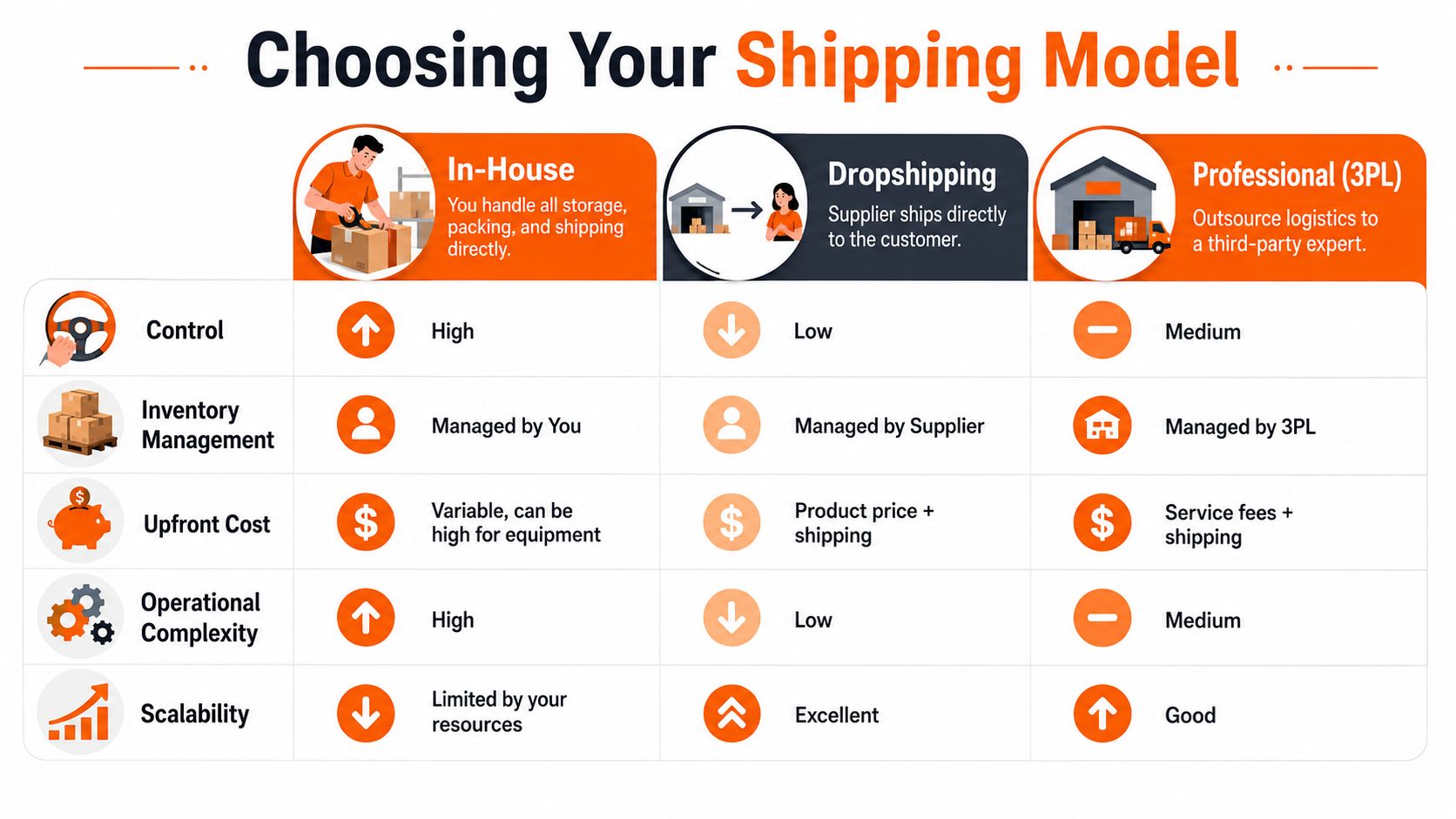
You have three basic ways to run the machine. I'd boil them down to this, do it yourself, let the supplier ship it, or hand the job to a specialist. Each path changes your costs, your control, and your workload.
In-house gives you control, and it also gives you chores
If you ship in-house, you control the shelf, the box, the label, and the customer experience. That feels great early on. It also means you own the clutter, the labor, the packing mistakes, and the late-night label panic when orders pile up.
Use in-house if you want close control and you're still small enough to handle it without losing your mind. It works best when your catalog is tight and your order volume is manageable. Once you start spending more time packing than selling, the model is eating your growth.
Dropshipping keeps startup friction low, and that's the trap
Dropshipping looks easy because you don't hold inventory. You sell, the supplier ships, and you stay light. The catch is simple, you give up control over packaging, speed, and often the customer experience itself.
I don't like dropshipping for brands that care about repeat buyers. You can win on low startup cost, but you often pay for it later in thin margins and weak brand ownership. It can work, but it usually works best as a learning phase, not a forever plan.
A 3PL is the middle ground with fewer headaches
A 3PL, or third-party logistics provider, is a professional partner that stores and ships your goods. You give up some control, but you gain process, tools, and usually better operational consistency than you can build alone early on. That's why many founders move to a 3PL once packing starts stealing their focus.
If you're comparing fulfillment setups against Amazon-style workflows, the internal comparison on Amazon FBA vs FBM is a useful reference point. The bigger question is trust. Are you okay handing your inventory and customer-facing shipping experience to someone else?
For international trade terms, a solid Incoterms guide for Canadian importers is worth reading before you sign anything that crosses borders. You need to know who pays, who clears, and who owns the risk.
Here's my blunt view. If you're pre-scale and order volume is messy, stay simple. If you're growing and packing is becoming a distraction, move to a 3PL. If you care more about speed than brand experience and your margins can take the hit, dropshipping can be a temporary bridge.
The Hard Tradeoffs Between Cost and Speed
Customers want fast shipping. You want profitable shipping. That tension never goes away, so stop pretending it will. You need a policy that matches your product, your margins, and what your customers will tolerate.
Weight, size, and distance drive the bill
Carriers don't price only by weight. They also look at dimensions, which is why a big light box can cost more than a small heavy one. That's why packaging is a money decision, not just a branding decision.
Distance matters too. A package crossing more territory usually costs more and takes longer. So when you choose where to store inventory, you're also choosing how far the average order has to travel.
It's comparable to ride-hailing. A short quiet ride costs less than a long trip across town in traffic. Shipping works the same way, except the traffic is road networks, carrier zones, and service levels.
Pick the service level before you pick the promise
Don't promise overnight delivery if your margin can't absorb it. Don't force free shipping everywhere if your product is small and cheap. Decide what you want to protect, margin, speed, or simplicity, then build the policy around that choice.
You usually have three practical options:
- Free shipping threshold: useful when you want to push larger carts, but it can compress margin if you guess wrong.
- Flat rate shipping: simple for customers, easier to explain, but it can punish you on remote or bulky orders.
- Real-time rates: more accurate, more complex, and often better when your orders vary a lot.
Your shipping policy should feel boring to you and fair to the customer. If it keeps surprising either side, it's wrong.
I'd start with the least complex policy that protects margin. If your products are consistent in size and weight, flat rate can work. If they vary a lot, real-time rates usually make more sense. If you sell higher-ticket items, free shipping can be a strong conversion lever, but only if you've done the math first.
Measuring What Actually Matters to Your Business
You can't fix what you don't watch. Most founders drown in shipping data and still miss the few numbers that tell the truth. Keep the dashboard small, clean, and ugly enough to use every week.
Track the metrics that expose customer pain
A shipping control tower should track on-time delivery rate, first-attempt delivery rate, and WISMO inquiries. One practitioner benchmark says on-time delivery should be above 95% for ground service, first-attempt delivery should be above 92% for residential deliveries, and WISMO inquiries should stay below 3% of total orders per this shipping analytics guide.
Those numbers matter because they tell you whether the carrier is late, the address is hard to serve, or the customer is getting nervous enough to ask where the package is. Don't lump all shipping complaints together. A delay and a wrong parcel are different problems.
Keep your scorecard simple
I'd track four things every week.
- On-time delivery rate: tells you whether your delivery promise matches reality.
- First-attempt delivery rate: tells you whether your packages reach homes without a second try.
- WISMO rate: tells you how often customers need reassurance.
- Order accuracy: tells you whether your packing process is clean.
If you want a deeper lens, freight and parcel teams often organize KPIs around operational, financial, carrier-performance, and customer buckets. That structure works because it keeps you from blaming one problem on another. A late parcel may be a carrier issue. A margin leak may be a packaging or service-level issue. A spike in support tickets may be a communication issue.
If your customer service team keeps answering the same shipping question, your shipping setup is the issue, not the support team.
Going Global and Handling Returns
A cross-border order looks simple on the storefront and messy everywhere else. You are suddenly dealing with duties, taxes, customs forms, delivery timing, and the cost of fixing mistakes after the package leaves your country. Returns make the problem worse in reverse, because every bad return rule eats margin and every confusing rule hurts trust.
Know what happens at the border
Ocean freight still carries a huge share of international trade, so once you sell outside your home market, route choice, port timing, and inventory planning stop being back-office details and start affecting customer experience. The container side of the business is built around scale, which means your product may sit in transit longer than you want while the economics still make sense for larger shipments.
Before you ship abroad, get the duties, taxes, and customs paperwork right. One wrong product classification can stall a shipment or inflate your landed cost in a way that wipes out your margin. Read a practical guide on avoiding customs compliance errors before you send out a single cross-border order, because HS code mistakes are the kind of error that turns a good sale into a bad one.
Build reverse logistics before you need it
Returns are part of the product promise. A clumsy return flow makes buyers hesitate before they click purchase. A clear one lowers friction and makes your brand feel less risky.
Keep the policy plain. Say who pays return shipping, what condition the item needs to be in, how long customers have to request a return, and how refunds or exchanges work. Put that language where customers can find it fast, and make sure your support team can explain it without improvising.
For cross-border sales, do the landed cost computation before you enter a new market. Use it to see the actual total cost of getting a product to the customer, not just the price on the product page. If you skip that step, you end up guessing at margin in a market that already gives you enough variables.
The founders who win here do the boring work early. They set customs rules, return rules, and cost rules before the first problem shows up, because logistics only feels simple until you have to fix it under pressure.
Your Founder's Logistics Action Plan
Start with the basics and move fast.
- Measure your package reality. List your average box size, weight, and product mix. That tells you what carriers will really charge.
- Pick one shipping model. Choose in-house, dropshipping, or a 3PL. Don't mix everything unless you already have the team for it.
- Set one clear shipping promise. Decide what you can reliably ship and when customers should expect it.
- Write your shipping policy in plain English. Include delivery times, return rules, and who pays for what.
- Track a small KPI set. Watch on-time delivery, first-attempt delivery, WISMO, and order accuracy.
- Review partner fit every quarter. Ask carriers and 3PLs how they handle exceptions, damaged goods, and service failures.
If you're talking to 3PLs, ask one blunt question, what breaks first when volume spikes? Their answer tells you more than the sales deck does.
If you want a cleaner shipping setup, fewer fulfillment mistakes, and a logistics plan that fits your brand instead of fighting it, talk to Chicago Brandstarters today and get practical help from people who understand what it's like to build from zero.
Leave a Reply