Most founders get Amazon advertising optimization backwards. They treat it like a bid-tweaking game, then wonder why the account keeps drifting. I don't run accounts that way. I split the work into two jobs, discovery spend and harvesting spend, because they answer different questions and need different rules.
If you use one ACoS target for everything, you'll cut learning too early or waste profit on campaigns that already proved themselves. Amazon's own guidance says optimization starts with goals, structure, keyword work, bidding, budget allocation, testing, and listing improvement, which is already a clue that this is bigger than bids alone, as Amazon lays out in its marketing optimization guide. The cleanest way to manage the account is to ask one question first, is this campaign here to learn, or is it here to print margin?
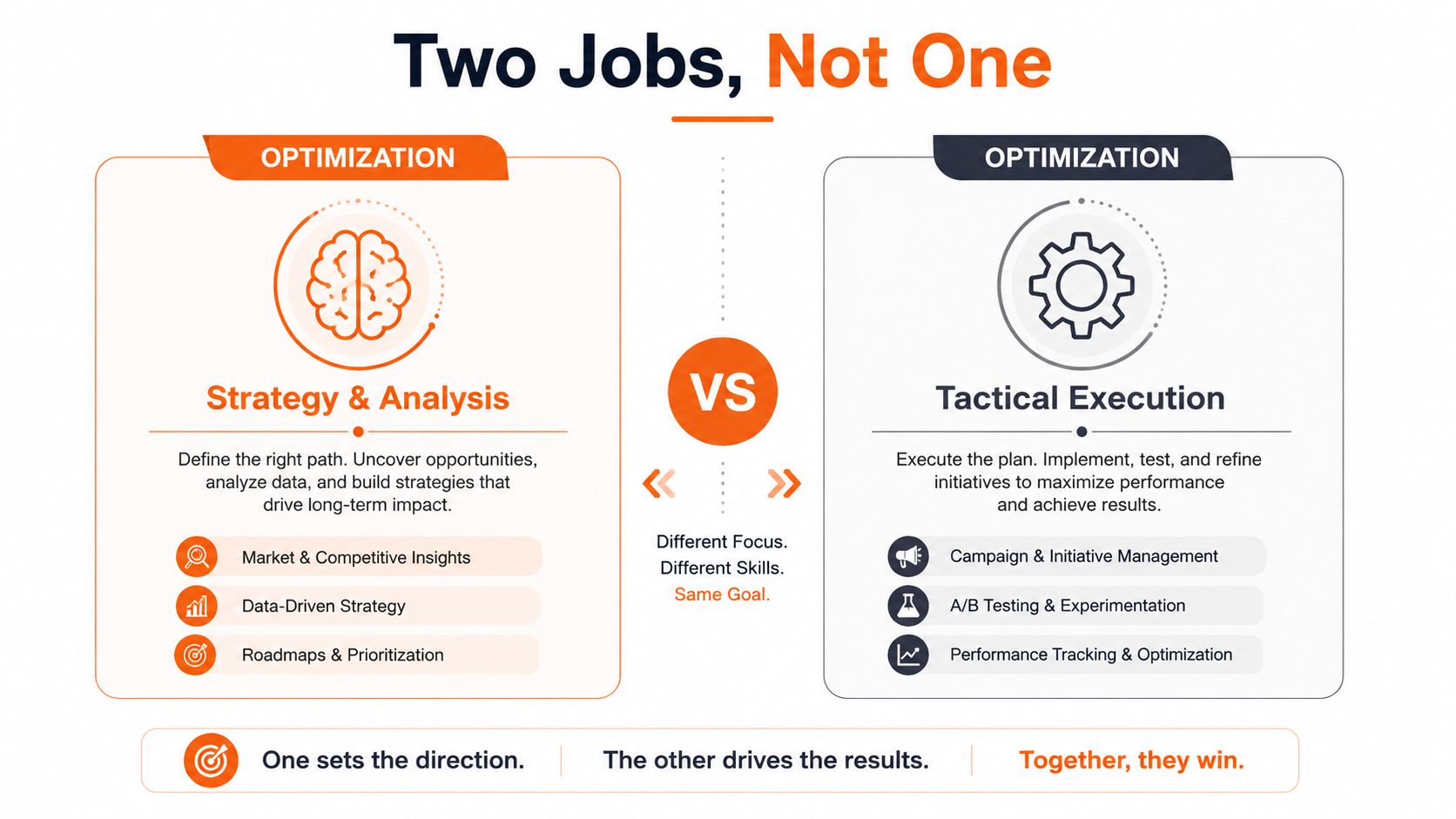
Practical rule: If a campaign is still teaching you what converts, I tolerate messy efficiency. If it already found the winning terms, I expect discipline.
That's the whole game. A new ASIN in discovery mode is not a broken campaign. A mature exact-match campaign with the same slop is a leak. If you want a simple companion piece on how retail pages affect that split, I'd read optimize Amazon listings for AI before you touch another bid.
Why Optimization Is Two Jobs, Not One
The fastest way to waste ad money on Amazon is to run every campaign off the same scorecard. I see founders do it all the time. They treat discovery spend like a profit center and harvesting spend like a science project, then wonder why the account either starves for data or bleeds margin.
Discovery spend learns, harvesting spend extracts
Discovery spend is tuition. You pay it to find which search terms, ASIN targets, and audience pockets move product. Amazon's guidance on campaign improvement points to the same practical moves I use in learning mode, raise bids when impressions are thin but clicks look healthy, tighten the product page when traffic does not convert, and move budget away from weak keywords. That is how I want a new campaign managed. Keep it in motion, let it gather proof, and stop judging it by the same standard you use for a mature exact match campaign.
Harvesting spend has a different job. You already know the term converts, so the work is to buy that traffic cleanly and repeatably. If a mature campaign keeps leaking margin, it is not “still optimizing.” It is failing at the one thing it exists to do.
My rule: Discovery can be inefficient on purpose. Harvesting cannot.
I keep the distinction simple. Discovery is the scout. Harvesting is the truck. Scouts can wander. Trucks need a route.
Decide by lifecycle, not by gut feel
Amazon's help content says to split ASINs by organic performance, and that is the right way to think about it, as described in Amazon's help content. New, low-visibility products deserve more patience because they are still building proof. Mature winners should not get that same slack.
I make the call from lifecycle and evidence, not instinct. If a campaign is still teaching me which search terms matter, I keep funding it. If it already has enough proof and the spend is just cycling through the same weak pockets, I cut it or rebuild it. That sounds blunt because it is. Accounts grow faster when every dollar has a clear job.
If you want a clean way to think about the page side of that equation, optimize Amazon listings for AI before you squeeze another bid.
The other number that matters is your selling cost. If you do not know your break-even point, you are guessing on every campaign decision. Start with landed cost, Amazon fees, and your selling price, then work out how much ad cost the margin can carry. A useful reference for that math is this cost of selling on Amazon breakdown.
The KPIs That Actually Drive Decisions
ACoS gets too much attention because it's easy to stare at. I don't make decisions off it alone. I use ACoS, TACoS, and ROAS together, then I add CTR, conversion rate, and new-to-brand signals so I know what's broken.
Use margin math, not vanity math
ACoS tells me how efficient an ad campaign is. It doesn't tell me whether that efficiency is good for my margin. ROAS flips the same math around and helps me think in revenue terms, but it still needs context. Amazon Advertising's benchmark data for 2026 puts average CTR at 0.58% and average daily seller spend at $331.4 USD per day on Amazon PPC, which is a useful directional baseline. A sub-1% CTR can be normal, so I'm usually looking for better relevance, cleaner targeting, and tighter bids, not magical volume.
TACoS is the honest metric. It ties ad spend to total revenue, including organic sales, which is why it catches business health in a way ACoS can't. If ACoS looks fine but TACoS worsens, I know I'm renting sales instead of growing the business.
Know your break-even before you spend
I like to work backward from margin. If you don't know your break-even ACoS, you're guessing. Use landed cost, Amazon fees, and selling price, then solve for the ad cost you can absorb. If you want a simple selling-cost reference while doing that math, this cost-of-selling guide is a practical place to start.
Break-even ACoS is the line between smart growth and expensive wishful thinking.
A practical benchmark many operators use is that mature products with around 40% gross margins can treat 15% to 22% ACoS as healthy, while launch campaigns in competitive categories can run at 35% to 50% ACoS for the first 90 days when the goal is velocity and ranking rather than immediate profit, as one 2026 guide notes. I use that as a reference, not a religion.
Building an Account Structure You Can Scale
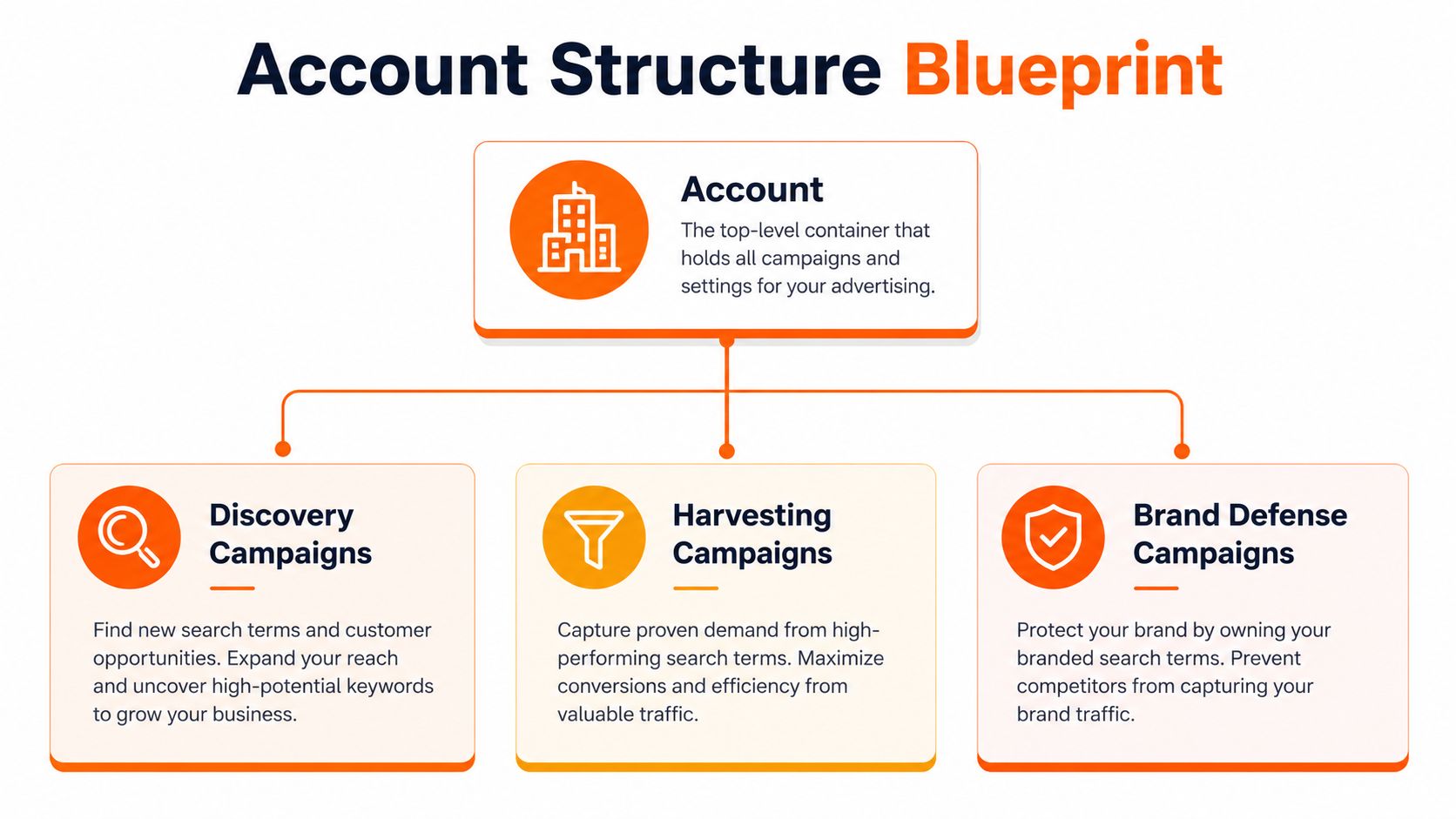
A messy account kills optimization faster than a bad bid. When discovery, harvesting, and brand defense all live in the same bucket, your data gets muddy and your budget decisions get stupid. I've seen good products underperform because the structure made every signal harder to read.
Give every campaign one job
My folders are simple:
- Discovery campaigns for auto and broad harvesting of search terms.
- Harvesting campaigns for exact-match winners that already proved themselves.
- Brand defense campaigns for branded traffic protection.
- Category conquest campaigns for competitor and non-brand terms.
- ASIN retargeting campaigns for product-page targeting.
Each one gets a name that tells me the job fast. I want to know the match type, the ASIN or SKU tier, and the intent bucket at a glance. If I can't tell what a campaign does in five seconds, I rename it.
Separate by product tier and traffic intent
I split campaigns by SKU profitability because one product can carry heavier spend than another. I also keep match types apart because mixed match types blur the signal. The cleanest structure is boring, and that is a compliment.
The practical move is to graduate a term out of auto or broad into its own exact campaign once it shows enough proof. I do not want winning terms buried in discovery forever. They belong in a controlled home where I can bid them with intent.
A neat shortcut, if you are cleaning up the retail side too, is to pair this structure with a listing workflow that keeps images, copy, and SEO tight. You can also compare the ad structure with PPC advertising strategy guidance if you want to sanity-check where each campaign belongs.
Keyword and ASIN Strategies That Compound
Many sellers stop at the search term report. That's where I keep going. The report is useful, but it's only useful if you know when a term is still learning, when it deserves a move, and when it needs to die.
Wait for proof before you swing hard
I don't make major bid decisions until a keyword has at least 30 to 50 clicks, because anything earlier is often noise, which matches a practical Amazon PPC workflow recommendation. Before that, I'm watching direction. After that, I'm making judgment calls.
Here's the decision tree I use:
- Promote it if it converts and the intent is clean.
- Raise the bid if it has the right intent but isn't getting enough reach.
- Negative-match it if it keeps spending without producing the right kind of buyer.
- Leave it alone if the sample is still too small.
The point is to move terms up the maturity ladder. I don't want them stuck in discovery forever.
ASIN targets need the same discipline
Product-page targeting can be a sharp tool or a trash can. If the target ASIN is close to your product in use case and price position, I'll often test it. If it's wildly mismatched, I won't burn budget there for long.
A useful habit is to read the search term report for intent signals, then ask whether the shopper looks like a browser or a buyer. Browser traffic needs more learning. Buyer traffic deserves more direct treatment. If the ASIN target keeps producing clean intent, I'll often pull it into its own campaign and give it tighter control.
The staged Amazon Ads workflow I like is simple: run auto campaigns first, harvest winning terms into manual exact campaigns, add negatives to cut waste, then test Sponsored Brands Video and ASIN targeting later, which mirrors a stepwise system used by experienced operators. I'm not attached to the sequence for religious reasons. I use it because it keeps learning separate from profit extraction.
Bidding Tactics That Earn Their Place
Bids get too much credit because they look like control. They are control, but only if you use them for the job the campaign is supposed to do. I separate bidding into two jobs, discovery spend and harvesting spend, and I treat them differently every time.
Discovery campaigns buy information. Harvesting campaigns buy profit. If you blur those jobs together, you end up paying premium rates for learning, then wondering why the account will not scale cleanly.
Use the right mode for the stage
Dynamic bids, placement modifiers, and rule-based bidding do different work. Dynamic bids help when I want Amazon to respond to conversion signals inside the campaign. Placement modifiers matter when I want stronger top-of-search visibility on terms I already trust. Rule-based bidding fits when I want my break-even math to set the ceiling, not Amazon's default suggestion.
I see founders get one setting wrong again and again. They push aggressive placement on discovery campaigns too early. I don't do that. Discovery needs cheaper sampling, not expensive ego traffic. I reserve premium placement for harvested terms, where the traffic has already proven it can convert.
Let your margin decide the bid ceiling
Every bid needs a ceiling. If the product cannot afford the traffic at your break-even math, the bid is too high. That sounds basic, but a lot of accounts are just running on hope with a number attached.
For a practical bidding reference, the smart bidding tips for Amazon piece is useful if you want to compare rule-based approaches with your current setup. I still start with margin first. The tool comes second.
Top-of-search premiums belong in harvested campaigns. Discovery stays leaner so the account can learn without burning cash on terms that have not earned it yet. If you want a broader reference point for how I think about ad structure and control, this PPC strategy guide matches that way of working.
If a placement multiplier cannot pay for itself in margin, I do not give it a premium.
The Weekly Rhythm That Compounds
I treat optimization like a weekly operating rhythm, not a cleanup project. Small, disciplined checks beat random rebuilds every time. The account gets tighter when I make one pass after another, instead of waiting for a panic session to force changes.
Daily, weekly, monthly
My cadence is simple:
- Daily: check spend pacing and budget caps.
- Weekly: review search terms, move winners, add negatives, and trim waste.
- Monthly: review structure, TACoS direction, and creative performance.
That cadence matches how I run Amazon accounts in practice. I check the money flow every day, make keyword and search term moves every week, and step back each month to see whether the account is getting healthier. If your catalog is still messy upstream, start with prep work for FBA listings so your optimization work has a clean base to build on.
Negative keyword hygiene is not optional
Negatives are maintenance, not a cleanup task I do when I have spare time. If irrelevant queries keep slipping through, the same waste keeps showing up in the same places, and you end up paying for the same mistakes twice.
I also watch for campaigns that have stopped learning. At that point, I usually do not need another bid tweak. I need a creative change, a stronger image, or a different message. I look at impressions, CTR, clicks, orders, and ROAS, then I decide what to scale, pause, or rebuild, which is the right order of operations.
A clean weekly ritual usually beats a heroic monthly overhaul because it keeps the account close to reality. That is where the gains live.
Automation Tools and Growth-Stage Playbooks
I use tools when they save judgment, not when they replace it. Amazon's built-in rules are enough early on. Third-party automation earns its keep when the account gets busy enough that manual controls start lagging behind reality.
Pick tools by stage, not by hype
At launch, I keep it simple. I want clean structure, tight search term review, and enough automation to stop obvious waste. At scale, tools like Helium 10 Adtomic, Perpetua, or SellerApp can help when the catalog gets large and the decisions multiply. I don't buy software to feel advanced. I buy it to reduce drag.
Break-Even ACoS by Gross Margin
| Gross Margin | Break-Even ACoS | Healthy Target | Launch Tolerance |
|---|---|---|---|
| Lower margin products | Lower than the margin ceiling | Tight efficiency target | Limited room for learning spend |
| Mid margin products | Around the middle of the margin range | Balanced profit target | Flexible if the product is still learning |
| Higher margin products | Higher than lower-margin products | Cleaner profit target | More room to fund discovery |
I'm keeping that table qualitative on purpose, because the exact break-even number depends on your landed cost, fees, and price. The point is simple, higher gross margin gives you more room to buy learning, lower gross margin demands tighter control.
Run a stage-based playbook
On launch, I spend to learn and I don't get emotional about temporary drag. On scale, I split discovery from harvesting so I can control the mix. On maturity, every dollar has to justify itself in margin and TACoS terms.
If you want one operational check before you scale inventory and ads together, the FBA prep center guide is a useful companion. Clean fulfillment and clean ads should move together.
My last rule is plain. If a tool helps me see better, I use it. If it only helps me stare harder, I skip it.
If you want help turning your Amazon account into a clean discovery and harvesting system, reach out to Chicago Brandstarters and start the conversation now.
Leave a Reply