
You're three hours into a vendor call when you realize you never wrote down your walk-away number. The vendor has pushed payment terms that strain your cash flow, added an auto-renewal clause, and made you feel that leaving would waste the afternoon. You agree. The next quarter, you keep asking yourself how a deal that felt manageable became a monthly liability.
I've made versions of that mistake with vendors, investors, hires, and partners. Founders lose deals because they negotiate from memory, urgency, and hope. The result shows up as thinner margins, weak equity terms, vendor lock-in, and partnerships that start with quiet resentment. A 2026 Vantage Partners negotiation study reports that 42% of deals were described as adversarial in 2025, compared with 29% in 2018, and says organizations lose 60% of deal value in poorly handled negotiations.
You don't need a procurement department to negotiate well. You need a repeatable ritual, a clear floor, a stronger alternative, useful questions, and language you can say without improvising. This founder playbook focuses on the five outcomes you should leave with: a defined reservation point, a tested BATNA, mapped stakeholders, rehearsed scripts, and a post-deal relationship plan.
Why Founders Lose Deals They Thought They Had
The founder in that vendor call didn't lose because the vendor had superior negotiating talent. The founder lost because the conversation began before the decision had been made internally. Every question felt urgent because no one had written down the priorities, the cash limit, the switching cost, or the terms worth trading.
That pattern creates expensive agreements. You accept a discount that comes with poor payment timing. You give away exclusivity for a promise. You trade equity for speed without checking dilution. You promise a partner access, introductions, or support that your small team can't provide. The signed document captures the other side's priorities because you never defined your own.
The stakes rise when the gap between average and top negotiation performance widens. The same Vantage Partners study says top negotiators secure roughly 60% more value than the bottom quartile and win about three times more value overall. That gap affects revenue, margins, hiring packages, procurement, partnerships, and acquisitions. A founder who improves one negotiation habit can protect value across every seat at the table.
Practical rule: If you can't state your target, your floor, and your alternative from memory, you aren't ready to bargain.
I use five questions before a serious conversation:
- What result do I want most?
- Which terms can I trade?
- What will I do if we walk away?
- Who decides on the other side?
- How will I protect the relationship after signature?
The rest of this guide turns those questions into operating habits. You'll get a one-hour preparation sheet, a stakeholder map, bargaining moves, scripts for uncomfortable moments, and a follow-up system that keeps a signed deal from drifting.
The 60 Minute Pre Negotiation Prep Ritual
I don't start a negotiation by opening the other party's proposal. I start a timer. One hour gives a small team enough structure to separate what it wants from what it can accept.
Minutes 0 to 15 define the outcome
Write the primary objective first. Use a specific term, not a mood. “Keep the contract affordable” gives you nothing to act on. “Keep the annual commitment within our planned cash limit while preserving cancellation rights” gives you a direction.
Then list secondary goals. These might include faster implementation, payment timing, service levels, support access, ownership of work product, or a shorter renewal period. Finally, write your reservation point, the worst deal you'll accept. Harvard's Program on Negotiation explains that you should write down your BATNA, target, and reservation point before the conversation.
Your reservation point is subjective. It depends on your preferences and constraints. It can equal your BATNA, but it doesn't have to, because your BATNA is a real alternative while your reservation point is the floor you choose for this deal. IE University explains the distinction between a BATNA and a reservation point.
Minutes 15 to 30 test the alternative
Write the actual alternative, then price it. Include the time to switch, internal effort, lost momentum, customer risk, and likely response from the other party. A vague backup plan creates false confidence. A tested alternative gives you calm.
The benchmark summary from ZipDo's negotiation data reports that negotiations with a clear BATNA have a 64% higher success rate than those without one. Treat that figure as a reason to do the work, not as permission to exaggerate your options.
Minutes 30 to 45 map trade-offs
List every negotiable variable. Price is only one line. Add payment timing, scope, term length, implementation date, support, exclusivity, renewal, liability, references, and access to decision-makers.
Then label each item as high, medium, or low cost to you. Prepare a give-to-get menu. You might trade a longer term for a lower price, a smaller initial scope for faster delivery, or early payment for a service credit. The same ZipDo summary says deals close 86% of the time when both sides can make multiple concessions. Make each concession conditional.
Minutes 45 to 60 predict pressure
Write three predictions about the other side's pressure points. Add one prediction about where they'll concede first. Then choose your opening question and rehearse your response to an aggressive anchor.
Use this decision tree:
- If interests differ across several terms, propose a trade-off package.
- If both sides care about the same single term, explain your constraint and test alternatives.
- If no overlap exists after you test the interests, use your BATNA instead of arguing.
- If uncertainty drives the dispute, use milestones, review points, or contingent terms.
The filled-in sheet
| Prep Block | Time | Filled-In Example |
|---|---|---|
| Objective and floor | 15 minutes | Reduce SaaS cost while keeping support. Reservation point: no auto-renewal and no annual prepayment. |
| BATNA | 15 minutes | Use the current tool, accept migration work later, and document the switching cost. |
| Trade-off menu | 15 minutes | Trade a longer term for a lower rate, or trade reduced scope for monthly billing. |
| Pressure predictions | 15 minutes | Vendor wants predictable revenue, a reference, and a quick signature. Expect flexibility on onboarding first. |
Mapping the Other Side Before You Open Your Mouth
Price-first openings make you sound interchangeable. Discovery-first openings make the other party explain the problem you may solve.
Before the meeting, identify three things. First, who can approve the deal and who can block it. Second, what they care about beyond price. Third, which constraints shape their choices. An enterprise customer may need procurement language. A senior hire may care about authority and learning. A landlord may care about reliable occupancy more than a small rent increase.
Use customer discovery interviews to sharpen your questions before you turn a sales or partnership conversation into a negotiation. You want evidence about their situation, not assumptions based on their job title.
| Stakeholder Type | Surface Ask | Hidden Interest | Pressure Point to Probe |
|---|---|---|---|
| Investor | Ownership and terms | Confidence, control, portfolio fit | What risk would make the investment difficult to approve? |
| Enterprise customer | Lower price | Implementation certainty and internal approval | Which deadline or stakeholder can stop the purchase? |
| Agency vendor | Scope and fee | Predictable work and a usable portfolio result | Which deliverable creates the most internal effort? |
| Senior hire | Compensation | Authority, growth, and clarity | What would make the role fail after joining? |
| Landlord | Rent and term | Reliable occupancy and low management burden | What vacancy or property concern worries you most? |
Use a three-part opener
Start with an observation about their world. Follow with a question about their goal. Then stop talking.
Try this:
“You're bringing us through procurement while your team is under pressure to launch quickly. What has to be true internally for this agreement to move forward?”
Silence does useful work here. Don't rescue the other person from their answer. Listen for deadlines, approval rules, fear, and personal incentives.
Before every negotiation, answer these five mapping questions:
- Who loses time, money, status, or momentum if no deal happens?
- Who has approval power, and who influences that person?
- What does the other side value that costs me little to provide?
- Which constraint can they not change?
- What is their real internal deadline, and what happens if they miss it?
When you name the other side's problem before stating your terms, you move the conversation away from a single price line. You're designing an agreement around priorities.
Bargaining Tactics That Actually Move the Number
Bargaining works when you trade variables instead of fighting over one figure. If you move on price without receiving something in return, you teach the other side to keep asking.
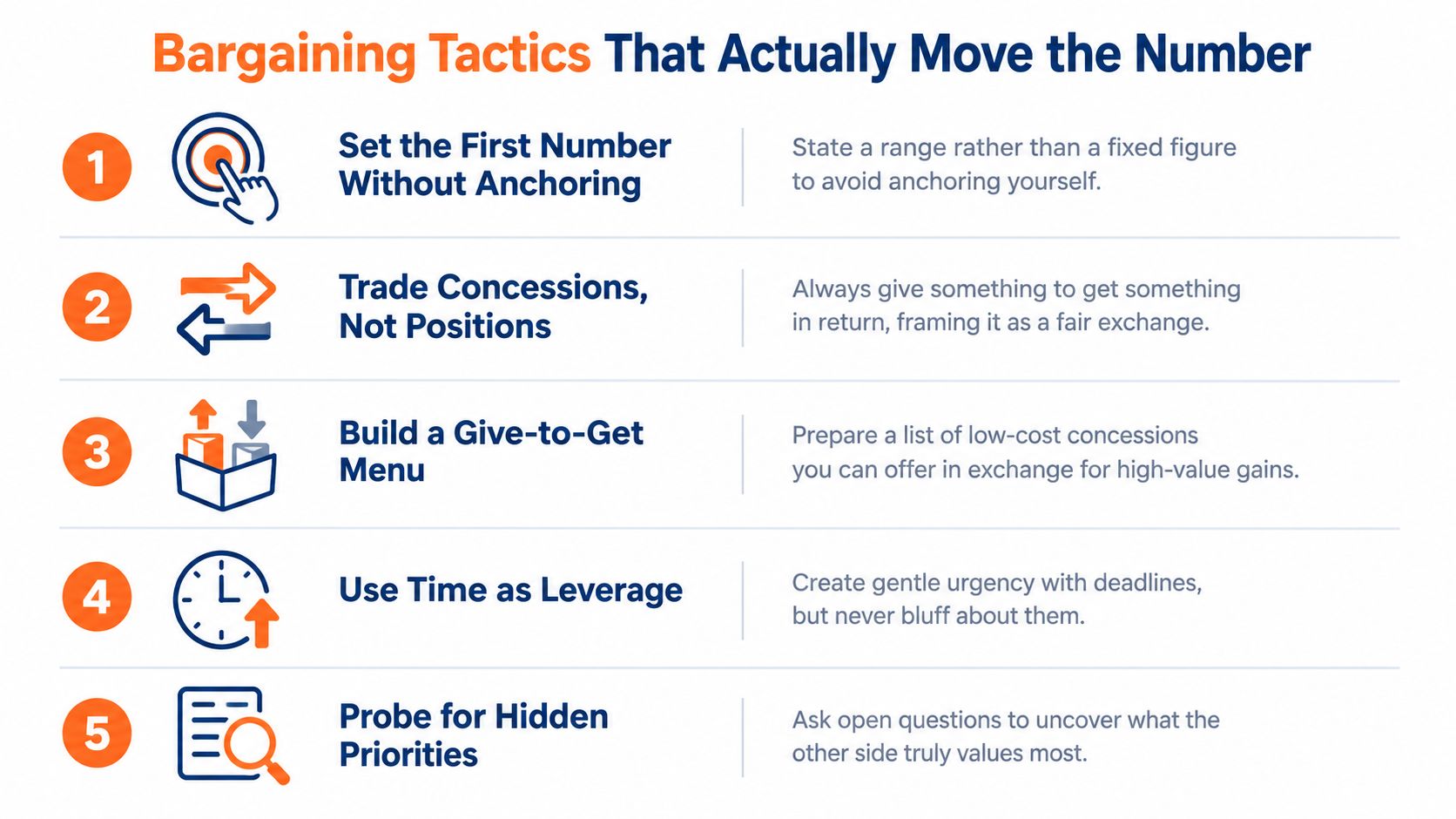
Set an opening without trapping yourself
If you know the economics, state a range tied to terms:
“For this scope, we're looking at a range of X to Y, depending on payment timing, implementation support, and term length.”
A range gives you room to learn. Don't use a range to hide weak preparation. Know which end you want and what would move you there.
When the other side gives the first number, don't react emotionally. Write it down. Ask:
“What does that figure include, and which part has the most flexibility?”
That question turns an anchor into a package you can inspect.
Make every concession conditional
Use plain give-to-get language:
“If you extend the term to 18 months, we can move to X.”
“If you need the lower price, we'll reduce the initial scope and review expansion after delivery.”
Your early flexibility should buy a commitment. Concessions usually get smaller as talks progress, so don't spend your easiest trades before you know what the other side values.
Trade across the package
Build combinations around price, payment terms, scope, exclusivity, timeline, service levels, and renewal. A founder might present:
- Option A: Lower price, longer term, limited customization.
- Option B: Higher price, monthly payment, broader support.
- Option C: Pilot scope, fast launch, expansion review after results.
For more expert negotiation insights, study how experienced dealmakers package terms instead of treating price as the entire conversation. If suppliers are your recurring challenge, this guide to negotiating with suppliers gives you another practical lens.
When someone uses an aggressive anchor, acknowledge it without accepting it:
“I understand that's your standard number. It seems the figure assumes a broader scope than we need. Let's separate the required work from the optional work, then build a package around the outcome.”
Follow with your offer. Don't counter a bad anchor with a pure price fight. Reframe the interests, then make the other side choose among terms.
Scripts for the Hard Moments at the Table
You don't need clever lines. You need short sentences that keep you from reacting too quickly.
When they push back on price
They say:
“Your number is 30% over our budget.”
You say:
“It seems like price is the real obstacle. What would make the rest of this work?”
This line tests whether price is the actual blocker. If it is, ask what they can change in scope, timing, term, payment, or approval. If it isn't, you've exposed the issue they were avoiding.
Then try:
“If we reduce the scope to X, we can move to Y. If you need the full scope, we'll need Z in return.”
You've tied movement to a change instead of apologizing for your price.
When they go silent
Silence makes founders fill the space with discounts. Don't do that.
“How am I supposed to respond to that?”
The calibrated question forces the other side to explain the gap. You can also say:
“What part of the proposal doesn't work for you?”
Then wait. Keep your expression neutral, especially on video. A pause isn't a request for you to negotiate against yourself.
When they ask for one last concession
The final ask often arrives after you've mentally closed the deal. Treat it as a new exchange.
“Before we close, I need one thing in return. If we make that change, can you approve the agreement today?”
If they ask for a lower fee:
“We can make that adjustment if you remove the custom reporting and keep the payment schedule unchanged.”
If they ask for faster delivery:
“We can bring the date forward if you provide final materials by Friday and assign one decision-maker.”
The sentence should contain the concession, the return, and the condition. Don't say “I'll see what I can do” unless you've already decided what you want back.
What Most Negotiation Guides Get Wrong
Many guides present active listening as a guaranteed advantage. Listen carefully, but use listening to collect information, not to perform agreement. A recent academic study of active listening in integrative negotiation, as summarized in improve negotiation skills, found no evidence that active listening improved understanding of the other party or rapport between negotiators. Test your interpretation with a question or proposal before changing a term.
Virtual conversations create different risks. On video, a nod can disappear into lag. In an async thread, silence may signal disagreement, travel, internal review, or distraction. For a high-risk discussion, pause deliberately, request written reactions, and send a recap within 30 minutes.
Cultural intelligence changes the negotiation plan. MarketIntelo's negotiation training market summary reports that 73% of organizations view cultural intelligence and diversity-aware negotiation as critical, while 68% prioritize virtual negotiation effectiveness. The source also values the global negotiation training market at $4.2 billion in 2025.
| Common Advice | Founder Reality |
|---|---|
| Listen and the deal will improve. | Listen, test your reading, and connect information to terms. |
| One tactic works everywhere. | Adjust for culture, channel, authority, and timing. |
| The meeting is the negotiation. | The written recap and implementation plan shape the result. |
| Confidence means speaking first. | Confidence means knowing when to pause and when to walk. |
A high first number does not build credibility in every market. In some settings, it damages trust. In others, direct price talk feels rude, so negotiate through scope, timing, relationship, and delivery.
Treat each negotiation as an information and design problem. Practice with the conditions you face, including video calls, short messages, internal approvals, and decisions made under cash pressure. That preparation helps an operator handle investors, vendors, hires, and partners without relying on a procurement department or a tactic copied from a corporate buyer's playbook.
Closing the Deal and Locking In the Relationship
A handshake doesn't close a deal. Accurate terms do. I use a two-phase close: capture the agreement in the room, then protect the relationship through deliberate follow-up.
Phase one capture the terms
When the other side makes one final ask, don't flinch. Ask what changed, what they'll give back, and whether the request affects any agreed term.
“I can consider that change. What are you prepared to adjust in return, and does everything else stay as agreed?”
Before anyone stands up, summarize the deal out loud. Name the price, payment dates, scope, start date, renewal, ownership, support, approval conditions, and next action. Then ask:
“Have I captured every point we agreed to, and is there anything here you understand differently?”
The goal isn't ceremony. It's error control. People leave meetings with different versions of the same agreement, especially when several terms moved at once.
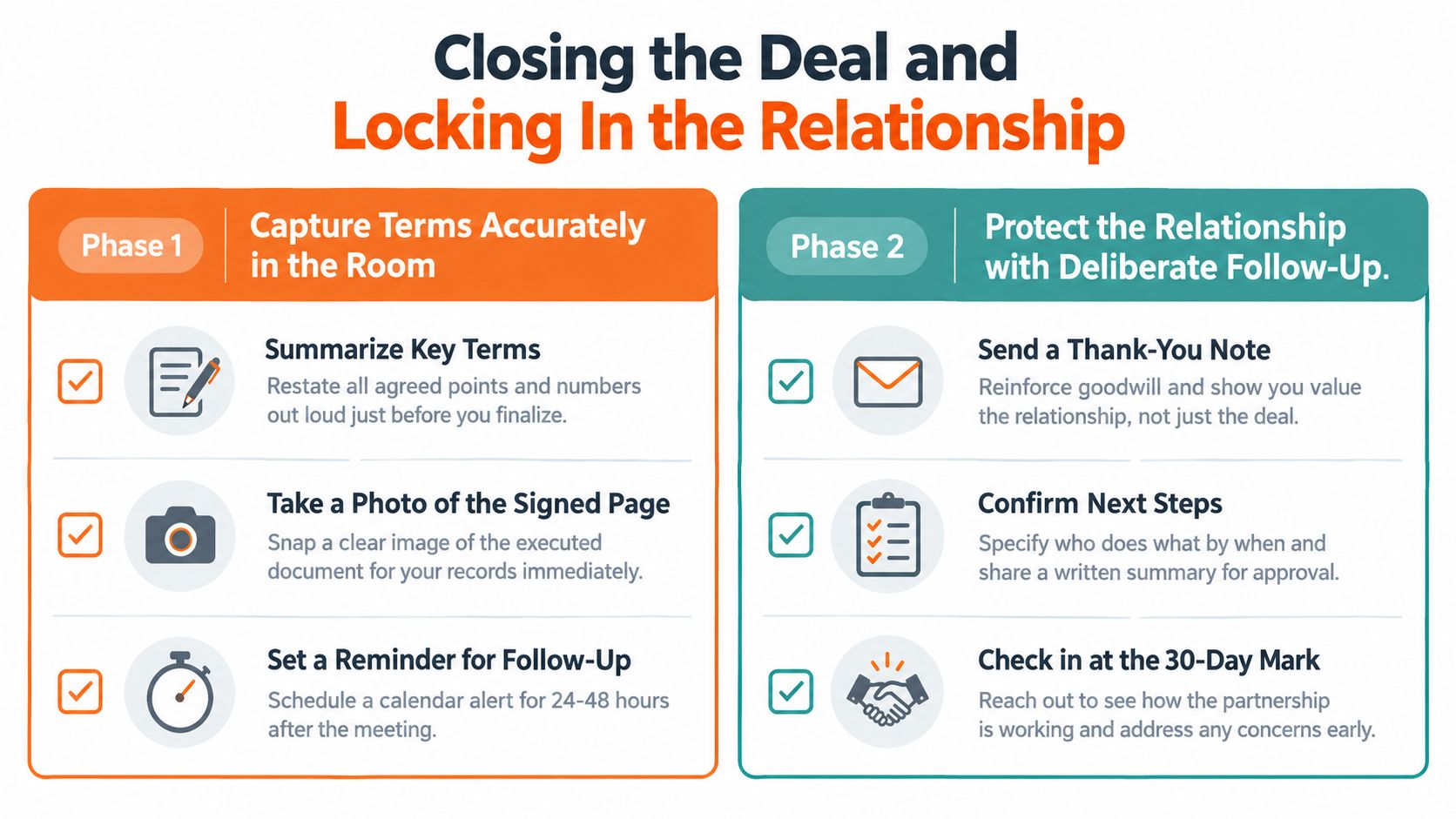
Phase two protect the relationship
Send a written recap within two hours. Keep it direct:
“Thanks for today. We agreed to X, Y, and Z. You'll send A by [date]. I'll send B by [date]. The remaining open point is C. Please reply confirming this matches your understanding.”
Then run the same checklist the same day and at 30, 60, and 90 days:
- Same day: Store the signed document, recap the terms, and assign owners.
- 30 days: Check delivery, friction, and whether the original assumptions still hold.
- 60 days: Review performance, pending changes, and upcoming deadlines.
- 90 days: Decide whether to expand, revise, renew, or end the arrangement.
Use the strategic partnership roadmap when a relationship involves more than one transaction. For sales teams, document the handoff inside your B2B sales process so the promise made during negotiation reaches the person responsible for delivery.
I also keep a 24-hour founder habit. The next morning, I write three notes: what the other side valued, what they resisted, and what I should ask next time. That record turns one vendor, investor, hire, or partner conversation into preparation for the next one.
If you're building a company without a procurement team, Chicago Brandstarters gives you a free, vetted community where founders share practical operating lessons, including supplier and deal preparation. Visit Chicago Brandstarters to meet other kind, hard-working operators and bring your next negotiation plan to people who understand the pressure.
Leave a Reply