A DTC brand sells primarily through its own channels so it can control pricing, customer data, and the buying experience. In the U.S., DTC ecommerce reached an estimated $239.75 billion in 2025, or 19.2% of total retail ecommerce.
You might be sitting with a product idea, a rough supplier quote, and one uncomfortable question: should you build your own store or try to get onto a retailer's shelf? A retailer can bring shoppers, but it controls much of the presentation and customer relationship. Your own site gives you more control, yet you must attract every visitor yourself.
That trade-off explains what people mean when they ask, “What is a DTC brand?” In plain English, it's a brand that sells primarily through channels it owns, usually its ecommerce site, email list, SMS program, and customer service operation, instead of depending mainly on wholesalers or third-party retailers. Industry definitions of direct-to-consumer also treat DTC as a go-to-market model and channel strategy, rather than a special type of product or company.
The word “primarily” matters. You can sell through your own site and still use Amazon, boutiques, pop-ups, or subscriptions. DTC describes how you reach customers and who controls the relationship. It doesn't require permanent loyalty to one channel.
Think of the model as a direct line between you and the buyer. You decide how the product looks, what it costs, how you explain it, and what happens after checkout. You also collect the customer signals that help you improve the next product, email, offer, or delivery experience.
That control comes with work. You need to create demand, pay attention to fulfillment, handle returns, and earn repeat purchases. The rest of this guide breaks down the model, compares it with retail and marketplaces, then gives you a lean way to test your first offer.
Introduction What a DTC Brand Really Means for You
Say you're launching a small skincare line. A boutique offers to stock it, but wants wholesale pricing and decides how much shelf space your bottles get. At the same time, you could launch a simple store where you explain the formula, collect email addresses, answer questions, and see which products customers view before they buy.
The second path is DTC. You sell primarily through your own channel and manage the relationship from product page to post-purchase support. A DTC brand therefore owns more of the pricing, customer data, and end-to-end experience than a brand that relies mainly on wholesale intermediaries. A plain-language DTC definition from CDP.com describes the model as selling through owned channels and collecting first-party data without intermediary margins.
That doesn't mean you manufacture every item yourself. You can work with a contract manufacturer, use a fulfillment partner, or source products from another producer. The direct part describes the selling relationship, not necessarily the factory.
It also doesn't mean “online only.” A brand can begin with its own website, then add retail, Amazon, events, or a subscription. You still have a DTC channel because your owned store remains part of the sales system.
A useful test: Ask who controls the checkout, customer record, pricing decision, and post-purchase conversation. The answer tells you how direct that channel really is.
The U.S. figure gives you a sense of the model's reach. The 2025 DTC ecommerce estimate places the channel at $239.75 billion, equal to 19.2% of total retail ecommerce. That scale doesn't remove the hard parts. It tells you that DTC has moved well beyond a small online experiment.
You should judge the model by fit, not fashion. DTC often fits a product that needs explanation, earns repeat purchases, benefits from customer feedback, or has a clear audience you can reach directly. It can fit a one-time purchase too, but you'll need a stronger plan for referrals, new products, or higher order value.
How DTC Works and Why Brands Choose It
A traditional product journey can pass through several hands before it reaches a shopper. A manufacturer sells to a distributor or wholesaler, the retailer buys inventory, and the shopper finally buys from the store. Each participant adds its own price, process, and customer-facing decisions.
DTC shortens that route. You may still hire other businesses to make, store, or ship the product, but you sell through an owned storefront and communicate with the buyer yourself. Amazon's explanation of the DTC model describes this direct path as a way for brands to control the customer journey from production through delivery.
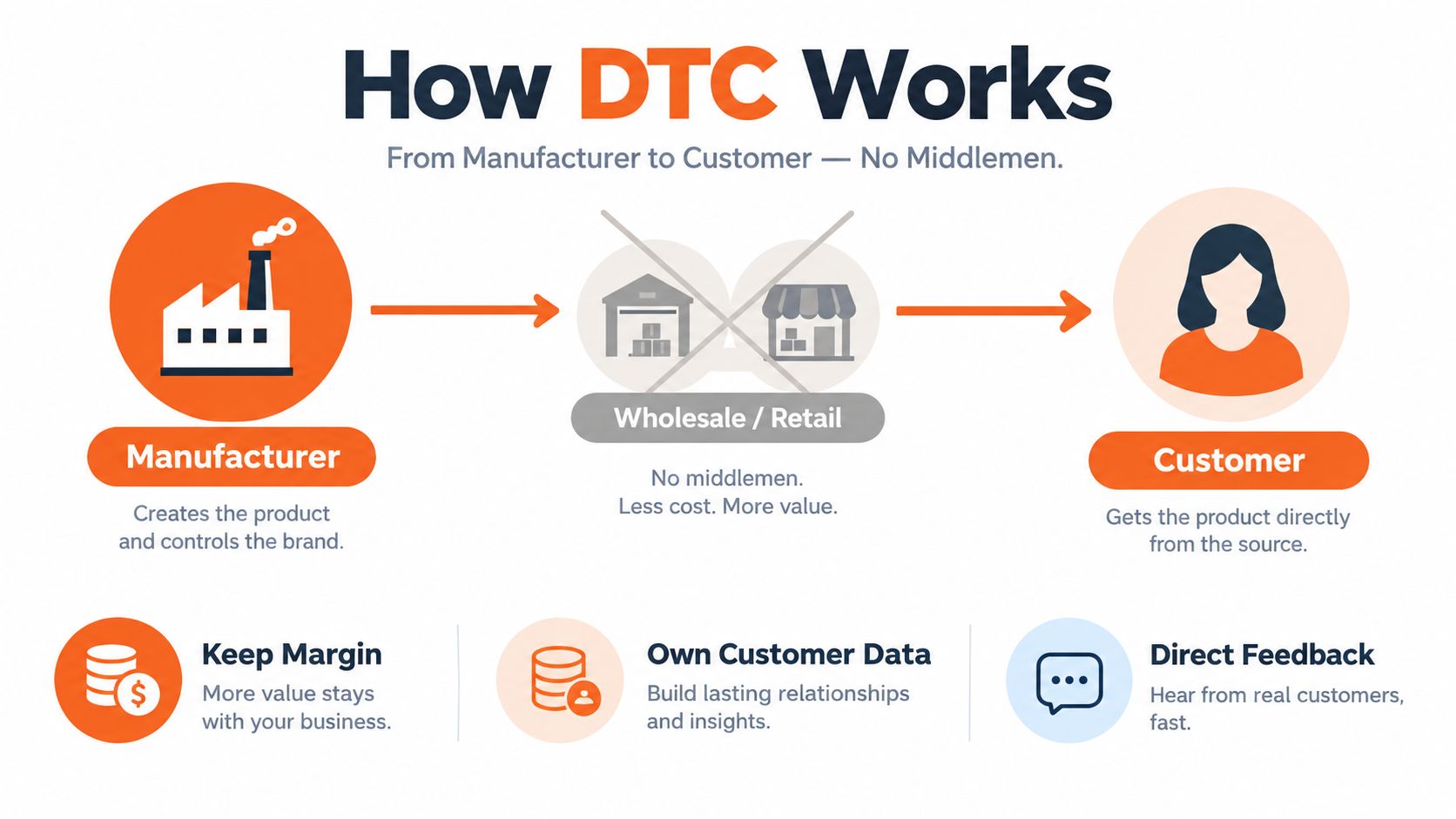
The direct line between brand and buyer
Think about a neighborhood bakery. If you buy flour from a supplier, bake the bread, sell it at your own counter, and learn what customers ask for, you control the customer relationship. If another store buys your bread and sells it under its own rules, you may reach more people, but you lose some control over the interaction.
An owned ecommerce store gives you a similar direct line. You can decide how to present the product, set the price, choose the promotions, and answer support questions. You can also ask for permission to contact customers through email or SMS and use their purchase history to plan useful follow-ups.
That information is first-party data. It can include product views, purchases, returns, preferences, and support conversations. Treat it as a working tool, not a trophy. A founder can use those signals to improve sizing, packaging, bundles, product education, and the next campaign.
Why founders choose the model
DTC gives you three practical forms of control:
- Margin control: You remove wholesale intermediaries from the direct sale, though you still pay for manufacturing, shipping, fulfillment, payment processing, returns, and marketing.
- Experience control: You choose the product story, page layout, checkout flow, packaging, delivery updates, and support tone.
- Learning control: You can connect customer behavior with orders and feedback instead of receiving only a retailer's sales summary.
A DTC brand therefore works as both a business model and a channel strategy. You can build the company around owned ecommerce, or you can add an owned channel to a company that already sells through stores.
The catch is traffic. A retailer supplies foot traffic and a marketplace supplies search demand. Your site needs a discovery plan, such as content, social media, partnerships, referrals, email capture, or paid advertising. You keep more control over the relationship, but you also carry more responsibility for creating the first visit.
DTC vs Retail vs Marketplace Compared Clearly
You're choosing between three different bargains. Your owned site gives you control and customer access. Wholesale retail gives you physical or established distribution. A marketplace, such as Amazon, gives you built-in shopping intent while placing you inside someone else's rules.
The right answer can change by product and stage. A premium product may need a careful explanation that works best on your site. A familiar item may benefit from marketplace search. A product that customers want to touch or try may gain from retail placement.
| Criteria | DTC Owned Site | Wholesale Retail | Marketplace |
|---|---|---|---|
| Pricing control | You set the public price and promotions | Retailer agreements influence pricing and markdowns | Marketplace rules, competition, and fees affect pricing |
| Customer data | You can collect permitted first-party data and manage the relationship | Retailer usually controls the shopper record | Marketplace controls much of the customer relationship |
| Brand experience | You control product pages, checkout, support, and packaging touchpoints | Store layout and staff affect the experience | Marketplace templates and policies limit presentation |
| Discovery | You must create demand through content, referrals, partnerships, or ads | Store traffic can introduce new shoppers | Search and recommendation systems can bring intent |
| Margin structure | You avoid wholesale margins but pay for traffic and operations | You share economics with the retailer and may face wholesale terms | You pay marketplace fees and compete beside similar listings |
| Best use | Learning, positioning, repeat purchase, and relationship building | Reach, physical trial, and geographic access | Convenience, search demand, and product discovery |
Your owned site gives you the cleanest feedback loop. You can see which message brought a visitor in, what they viewed, and whether they bought. That visibility doesn't guarantee profitable traffic, so you still need disciplined testing.
Retail can make sense when customers want physical reassurance or when a store already reaches your audience. It also adds operational demands, including inventory planning, wholesale terms, packaging requirements, and retailer-specific logistics.
Marketplaces can help people find you, but you operate inside a crowded environment. Product titles, reviews, availability, fees, and platform policies all affect the sale. For practical ideas on marketplace advertising and the role paid promotion can play there, read this marketplace advertising guide from Come Together Media LLC.
Before you choose, write down the job each channel must do. A useful distribution channel strategy framework can help you separate discovery, conversion, fulfillment, and retention instead of treating every channel as a simple sales outlet.
The Numbers That Make or Break a DTC Brand
A DTC store can look healthy while losing money on every new customer. You might see a good gross margin on the product page, then discover that shipping, payment fees, returns, and advertising consume the rest.
Start with four measurements: customer acquisition cost, customer lifetime value, repeat purchase rate, and contribution margin. Together, they show whether your sales system can support growth or whether each new order creates more pressure.
Recent DTC economics benchmarks report a blended customer acquisition cost of about $318 and a median return on ad spend of 2.04. The same source advises sustainable operators to target at least a 3:1 LTV:CAC ratio and a 20% to 30% contribution margin after marketing.
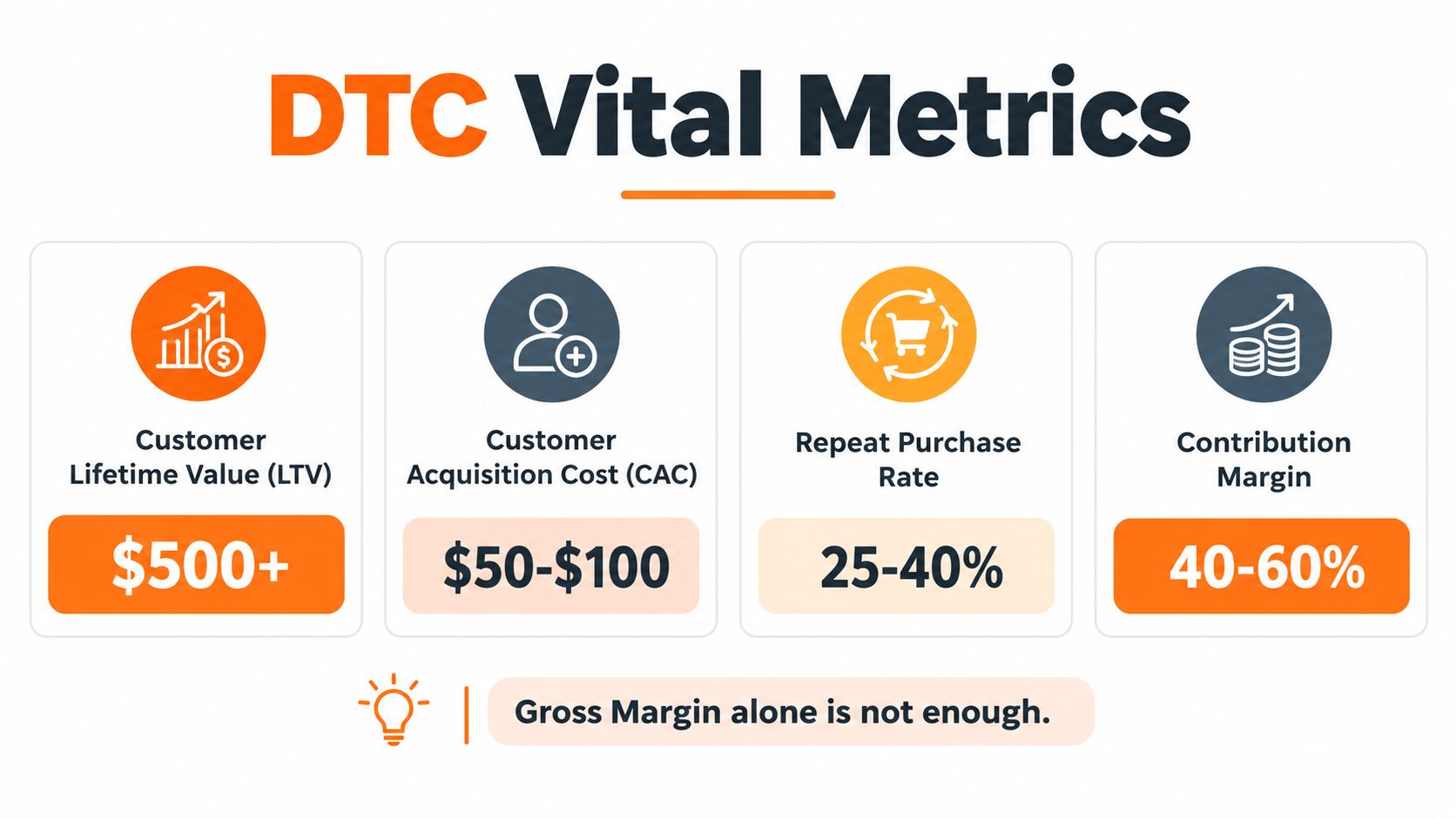
Read the numbers as a system
CAC tells you what you spend to acquire a new customer. Include the marketing cost you use for the calculation, then keep the period consistent.
LTV estimates how much gross profit or contribution value a customer can generate across purchases. A low first order can work when the customer returns, subscribes, buys a bundle, or recommends the product. You need to define LTV clearly because revenue LTV and profit-based LTV answer different questions.
Repeat purchase rate tells you whether the product creates another buying occasion. One 2026 analysis reported that the average DTC brand retained only 28.2% of customers for a second purchase, while customer acquisition costs had risen 222% over the previous eight years. See the underlying DTC statistics analysis. Those figures make retention a financial issue, not merely a customer service goal.
Contribution margin shows what remains after the costs tied to selling and delivering the order. Ecommerce cost benchmarks list shipping at 8% to 12%, payment processing at 2.9%, returns at 6% to 10%, and ad spend at 20% to 30%, with median contribution margin at 15% to 20% after those costs.
Gross margin alone can hide these deductions. Use this gross margin percentage calculation guide as a starting point, then build a contribution view that includes the costs your order creates.
Practical rule: Don't scale an acquisition campaign until you know what remains after product cost, delivery, payment, returns, and marketing.
Subscriptions, bundles, replenishment reminders, and useful post-purchase education can improve the economics when they fit the product. They won't rescue weak demand or poor fulfillment, so measure behavior rather than assuming retention.
Core Channels Every DTC Brand Uses to Grow
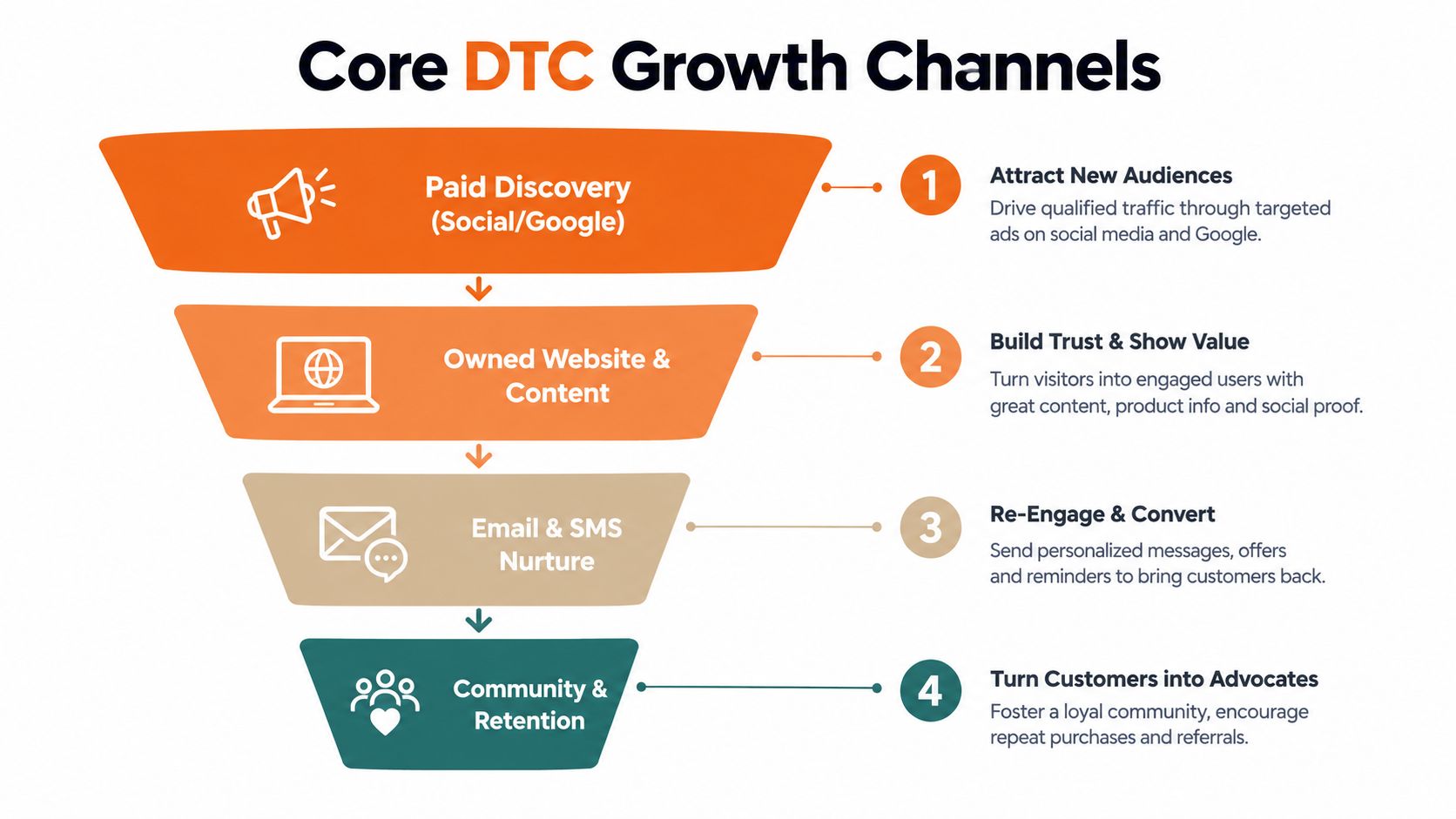
You don't need every channel on day one. You need a connected path that moves someone from discovery to purchase, then gives that customer a reason to return.
Paid social and search can create the first visit. Your website must then explain the product quickly, answer objections, and make checkout easy. Email and SMS can continue the conversation after someone leaves, while content and community can lower your dependence on paid traffic over time.
Give each channel one job
Your website is the store. Make the offer obvious above the fold. Show the product in use, explain who it fits, answer shipping and return questions, and use reviews or demonstrations where available.
Email and SMS are retention tools. Capture consent at a useful moment, such as a guide download, product quiz, waitlist, or checkout. Build a welcome sequence, an abandoned-cart reminder, a delivery message, and a post-purchase sequence before you create a large broadcast calendar.
Content earns attention before the sale. A running brand might publish training advice. A kitchen brand might show recipes and care instructions. Content works best when it helps someone make a decision instead of repeating a slogan.
Paid discovery buys learning. Start with a narrow audience, one clear offer, and several creative angles. Track the quality of customers you acquire, not only clicks or first-order revenue.
Small DTC brands now use AI-generated creative heavily. One 2026 report says AI-generated creative made up more than 50% of ad volume for smaller DTC brands, while blended Meta CAC rose 18% to 22% year over year for brands below $1 million. The same report says 90-day cohort retention fell 5 to 8 percentage points across consumables since 2024. Read the State of DTC 2026 analysis for the full context.
That combination makes creative volume alone a weak plan. You still need a distinct promise, strong product proof, and a follow-up experience that gives customers a reason to stay. If you want to study the production side, this guide to AI ads for online stores from MerchLoom covers one way to approach creative testing.
Use this ecommerce growth strategy resource to connect acquisition, conversion, and retention into one operating plan. Start with the channels you can maintain consistently. A small, reliable system beats five abandoned experiments.
Real DTC Examples and When Pure DTC Stops Fitting
A skincare founder might begin with an education-focused website, email routines to subscribers, and subscriptions for repeat products. A headphone brand might sell through its own store to control the product story, packaging, support, and customer feedback. A specialty food brand might start online, then enter boutiques where shoppers already search for that category.
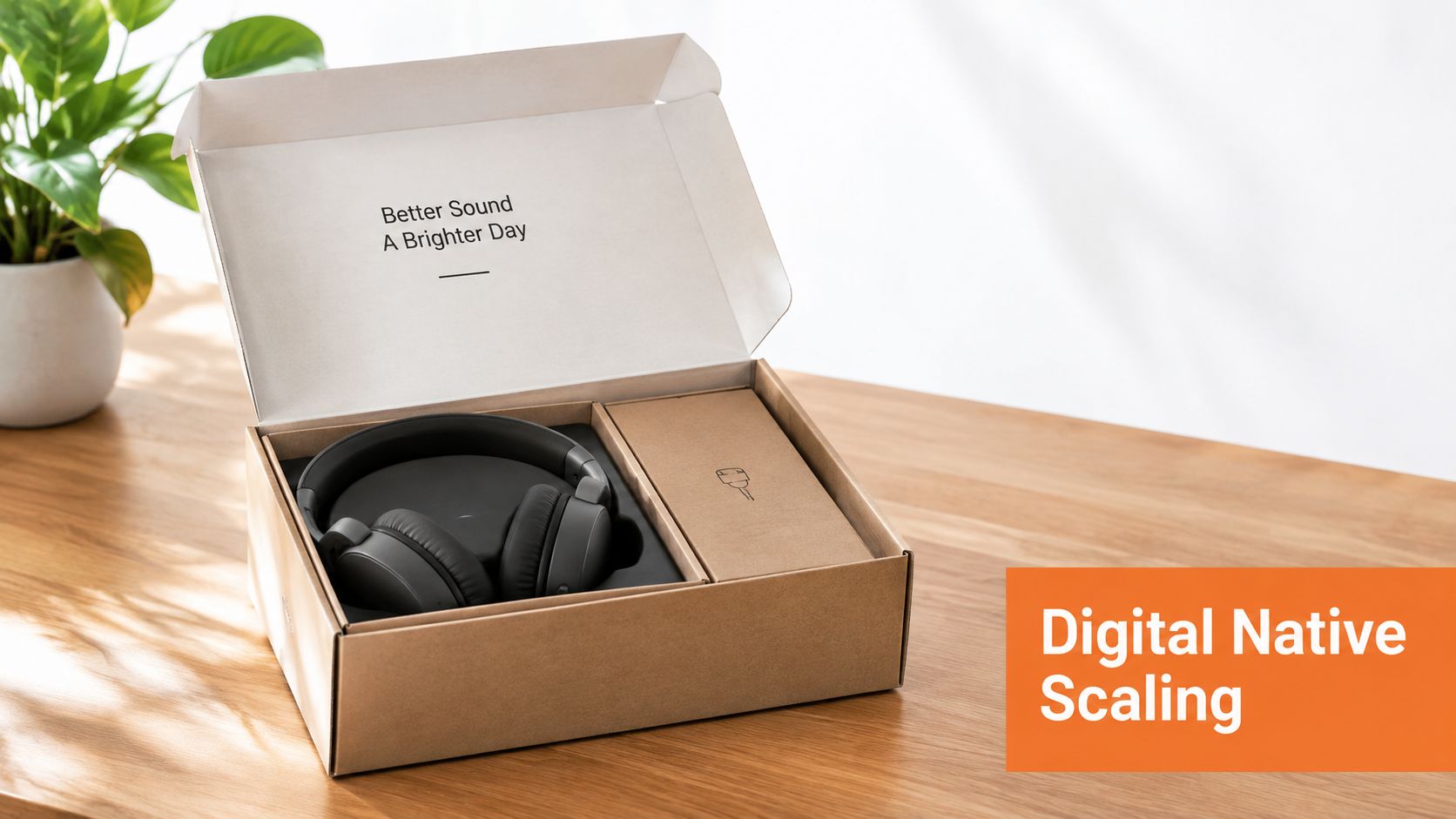
These examples show the main idea: DTC is a go-to-market model, not a permanent company type. Each brand begins with a direct relationship because its owned channel can explain the offer, capture customer feedback, and support future purchases. The brand can then add other routes when buyers want convenience, physical access, or a familiar checkout.
Pure DTC is a starting point, not a rule
A company does not stop using DTC because it sells through Amazon, wholesale, or a physical store. It stops being pure-play online-only when it adds those channels. The broader DTC model still operates when the company maintains an owned channel for direct sales and customer relationships.
That distinction changes how you plan growth. You do not need to protect an online-only identity when another channel improves discovery, retention, or contribution margin. You do need to measure what each route provides, what it costs, and what customer information you lose.
Recent coverage of direct-to-consumer brands describes channel-agnostic and omnichannel brands as the current norm, with companies combining owned channels, retail, and subscriptions. Use that idea as an operating question: where does each customer prefer to discover, evaluate, buy, and reorder?
A marketplace can help someone find a replacement item. Your website can explain the product in more detail and collect consent for future communication. A store can let shoppers touch or try the product. A subscription can make reordering easier.
The right mix depends on your product, audience, and unit economics. Keep the owned channel strong because it gives you direct learning and a place to build retention. Add other routes when they reach customers you cannot acquire efficiently online or create a better buying experience. Channel-agnostic DTC usually wins when each route has a clear job, and the combined economics support repeat purchasing.
This video gives another visual way to think about the direct-to-consumer model:
Starter Steps to Launch Your First DTC Test
Start with one narrow product and one clear customer problem. “Better wellness” is too broad. “A travel-size moisturizer for people with dry skin on long flights” gives you a product angle, a buying context, and a message you can test.
Build the smallest useful storefront
Choose a simple ecommerce platform, publish one strong product page, and make the buying details easy to find. You need a product description, photos or demonstrations, price, shipping terms, return policy, support contact, and a consent-based email capture.
Don't build a large catalog before you learn what people want. A focused offer makes it easier to connect ad cost, customer questions, conversion, and repeat intent.
Check the economics before buying traffic
Write down:
- Selling price: What does the customer pay?
- Product cost: What do you pay to make or source each unit?
- Fulfillment cost: What does picking, packing, and shipping require?
- Payment cost: What does each transaction remove?
- Return exposure: What happens if the customer sends it back?
- Acquisition cost: What can you spend to gain a customer?
- Contribution margin: What remains after the costs tied to the order?
Run a small organic test first. Ask potential buyers to explain the problem in their own words, show them the product page, and record objections. Then test a limited paid campaign with a few messages, not a large budget spread across every platform.
Track whether people join your list, add to cart, buy, ask about reordering, or refer someone. Those signals tell you more than compliments from friends.
If you want lightweight support while you shape the idea, you can explore the Starter App as one option for organizing early work. You can also find peer feedback through Chicago Brandstarters, a free community built around small private founder dinners and an active group chat.
Your first goal isn't scale. It's evidence that a specific customer understands the offer, pays for it, receives it smoothly, and wants a reason to come back.
Give yourself a short launch cycle. Improve the page, offer, fulfillment, and follow-up based on real customer behavior. When the numbers make sense without optimistic assumptions, add another channel or product.
Chicago Brandstarters helps idea-stage and early ecommerce founders think through positioning, distribution, unit economics, and launch decisions with practical peer support. Visit Chicago Brandstarters to connect with kind, hard-working builders who share real operating lessons and help each other move from first test toward sustainable growth.
Leave a Reply