You're staring at a churn dashboard, acquisition costs keep climbing, and your marketing lead wants a points program because a competitor has one. The pressure feels familiar. You need more repeat orders, your team wants a visible retention project, and a loyalty widget looks easier to ship than a better product experience.
Slow down. Loyalty program design starts with unit economics, not points, colors, or a catchy name. Harvard Business School cited research is widely summarized as showing that a 5% increase in customer retention can raise profits by 25% to 95%, while acquiring a new customer can cost 5 to 25 times more than keeping an existing one (SellersCommerce summarizes the research). Those figures make retention worth examining, but they don't make every loyalty program profitable.
The Moment You Decide a Loyalty Program Is Worth Building
A competitor launches a points program, your repeat orders look weak, and the team starts debating reward names. Stop there. The first decision is not the points structure. It is which customer behavior deserves a subsidy.
Approve the project only after checking three signals:
- Repeat purchase rate under 30%: Your second-order problem may be more urgent than a loyalty program. According to SellersCommerce, the probability of a second purchase sits close to 30% and rises above 50% after a third purchase. Focus first on bringing more first-time buyers back quickly.
- Average order frequency above 3: Customers already return often enough for rewards to influence timing, basket size, or product selection.
- A product line that supports cross-sell nudges: A skincare brand can move a cleanser buyer toward moisturizer. A coffee brand can move a pod buyer toward accessories or a subscription.
Each signal points to a different job. The first calls for a second-order intervention. The second gives rewards enough purchase occasions to matter. The third creates a target beyond “buy again.”
Your competitor's program says little about your economics. Their free product may cost less than your discount. Their customers may buy more often, and their margins may support perks yours cannot. Copying a reward table without modeling your own contribution margin is how retention spend becomes hidden leakage. Before launch, calculate the reward cost, expected redemption, and margin left after fulfillment. That breakage math belongs in the decision, not in a later cleanup.
A useful explanation of brand loyalty helps your team separate genuine preference from promotional behavior. I also browse how brands that buy from small CPG brands near you communicate product value without relying on discounts. That exercise can sharpen the offer before software enters the picture.
According to SellersCommerce, loyal customers can be worth up to 10 times their first purchase. Treat that as a reason to test the economics, not permission to spend freely. Start with a narrow launch, measure whether the rewarded behavior changes, and expand only when the margin case survives real orders.
Founder rule: Before writing one earning rule, answer this question: What behavior are you trying to change, and what is that behavior worth to you?
Set Goals, Metrics, and a Budget That Won't Wreck Margins
A loyalty program can improve retention and still lose money. Set one primary objective before choosing rewards, then build the measurement and budget around that objective. Trying to improve retention, purchase frequency, average order value, referrals, reviews, and social engagement in one launch creates expensive confusion.
Choose one:
- Retention lift: Bring more first-time buyers back.
- Repeat purchase frequency: Shorten the gap between orders.
- Average order value growth: Give customers a reason to add another item.
The goal determines the reward. To drive a second order, make the first post-purchase reward easy to understand and quick to reach. To grow basket size, set a threshold that still leaves margin after fulfillment and redemption. Do not copy a competitor's reward table before modeling your own contribution margin.
Track four numbers:
- Repeat purchase rate: Compare enrolled customers with a suitable non-member group.
- Redemption rate: A low rate can signal poor explanation or an unreachable first reward. An industry summary recommends targeting a rate above 50% (Rivo).
- Incremental margin per member: Count the margin from behavior the program caused, then subtract reward and platform costs.
- Program cost as a percentage of revenue: Include discounts, free products, points redeemed, referral credits, software, and support time.
Set a liability ceiling before launch. My planning heuristic for an early-stage brand is 4% to 7% of revenue as total exposure, not an automatic spending target. If gross margin is thin, start below that range. Your marketing budget allocation framework should show which acquisition or retention work loyalty spend will displace.
A simple budget example
Suppose a brand generates $1.2 million in annual revenue and has a 22% gross margin. That produces $264,000 in gross profit before loyalty costs. A 4% to 7% revenue ceiling allows $48,000 to $84,000 in total program liability.
Do not treat that ceiling as a reward budget. It covers software, issued value, redeemed value, referrals, fraud, and customer service. At a 22% gross margin, a careless discount can consume a large share of the contribution from the order it was meant to create.
| Gross Margin Tier | Program Cost Cap (% of Revenue) | Per-Member Annual Ceiling | Breakeven Repeat Lift |
|---|---|---|---|
| Thin margin | 4% | Set from contribution margin and CLV | Lift must cover reward and platform cost |
| Moderate margin | 5% | Tie to member-level incremental margin | Lift must create positive incremental contribution |
| Higher margin | 7% | Tie to CLV, not enrollment count | Lift must exceed total program liability |
Use the table as a control system, not a performance promise. Before launch, document the response if redemptions spike:
- Pause expensive earning actions without disabling existing balances.
- Cap promotional issuance by customer and campaign.
- Review member versus non-member margin before increasing reward value.
- Reserve cash for redeemed rewards, not only points issued.
- Check fraud and duplicate accounts every reporting cycle.
A narrow first version protects the margin while you learn which behavior changes. Expand the reward only after real orders prove that incremental contribution exceeds total program cost.
Map Your Segments and Pick Reward Mechanics That Fit
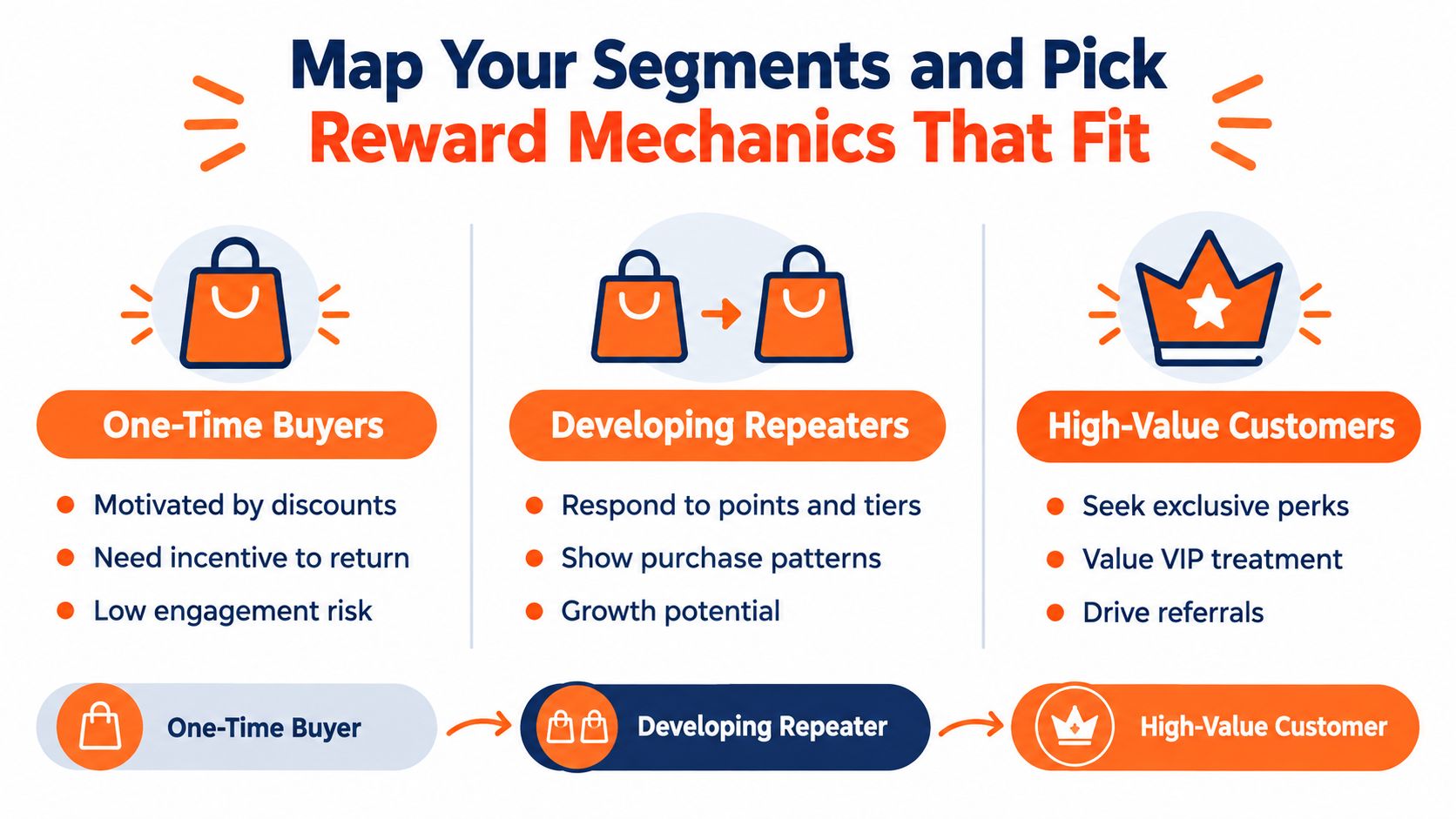
A single reward rarely fits every customer. Start with three cohorts and track the moment each cohort decides whether to return.
One-time buyers need a reason to place another order. Their decision often happens after delivery, during the first replenishment window, or when they receive a useful product reminder. A modest points balance, a welcome reward, or a small referral credit can give them a reason to reopen the relationship.
Developing repeaters have already shown a purchase pattern. They may respond to points, a progress bar, or a simple status threshold. Your job is to make the next purchase feel like progress rather than another isolated transaction.
High-value loyalists already give you repeated business. They often care less about another generic discount and more about early access, product availability, priority support, or recognition. They can also become strong referral sources when the referral experience feels easy.
The segmentation logic resembles a proven segmentation strategy for SaaS: define groups by behavior, then attach an action to each group. Don't segment because your platform has dropdown fields. Segment because the customer needs a different prompt.
Match the mechanic to the job
- Percentage back in points: Use this for low-average-order-value products where a small future credit feels more useful than free shipping. It can work well for consumables with regular replenishment.
- Tiered status: Use this when customers have enough purchase occasions to notice progress. A tier should change what customers receive, not only change the label beside their name.
- Referral credits: Use this for subscription brands or products customers naturally discuss with friends. A referral can create a new customer while giving the existing member a reason to stay active.
- Surprise free gifts: Use this when samples, accessories, or low-cost add-ons carry strong perceived value. Keep the gift predictable enough for operations to fulfill.
- Exclusive access: Use this for launches, limited inventory, or products where early access feels meaningful. It often protects margin better than a broad discount.
The right mechanic depends on the behavior and the cost. Free shipping may look attractive, but it can hurt a low-AOV order more than a small points credit. Referral credits may beat discounts when a subscription brand can turn one customer's advocacy into another paid account.
For version one, choose no more than two mechanics. I'd usually pair points with referrals, or tiers with exclusive access. Every extra mechanic creates another rule to explain, another integration to test, and another cost line to monitor. Your first release should produce a clean signal.
How to create a referral program can help your team think through the referral path before you add it to the loyalty interface.
Design Tiers, Points, and Breakage With Real Numbers
Tiers create aspiration, but they also create rules, status calculations, customer service questions, and liability. Pick the smallest structure that can change behavior.
| Tier Model | Estimated Cost as % of Sales | Breakage Assumption | Best For |
|---|---|---|---|
| Flat points | Budget-defined | Model unredeemed points at 15% to 25% | Simple catalogs and low operational capacity |
| Two-tier VIP | Budget-defined | Model unredeemed points at 15% to 25% | Brands with a clear repeat customer group |
| Three-tier ladder | Budget-defined | Model unredeemed points at 15% to 25% | Frequent purchasing and meaningful status differences |
The breakage range above is a modeling assumption for planning, not a guaranteed outcome. A redemption cost of $0.01 per point, paired with a 15% to 25% breakage assumption, gives you a starting model. You still need to replace the assumption with observed behavior after launch.
Build the points economy first
Start with the amount you can spend. Divide your loyalty budget by expected eligible spend. That gives you the total reward value your program can support across qualifying orders. Then convert that value into points and test the result against gross margin, shipping, refunds, and likely redemption behavior.
Take a skincare brand with a $40 average order value, 35% gross margin, and a 2% revenue loyalty budget. Each order produces $14 in gross profit before loyalty cost. The annual loyalty allocation equals 2% of eligible revenue, so the reward model must stay inside that boundary after accounting for points, platform fees, gifts, referrals, and support.
A flat model might give every member the same earning rate. A two-tier model could reserve better earning or early access for customers who cross a defined annual spend threshold. A three-tier ladder adds another threshold, but it also creates another status edge case. If the brand's customers buy only occasionally, the ladder becomes decoration because most customers won't have enough purchase occasions to feel progress.
Tiered programs normally use a clear entry threshold based on annual spend or accumulated points, then attach a defined reward set to each level. Customers keep benefits while they maintain status (99minds explains tiered program structure). Use that structure only when customers can realistically reach and retain a tier.
Practical rule: If a customer can't understand how to reach the next tier in one sentence, the tier probably doesn't belong in version one.
Model cost per active member, not enrolled member. An enrolled customer who never earns or redeems points creates little behavioral value, while an active member can consume rewards quickly. If repeat frequency stays too low for status to matter, skip tiers and use one clear post-purchase reward.
Choose Tech and Integrations Without Overbuilding
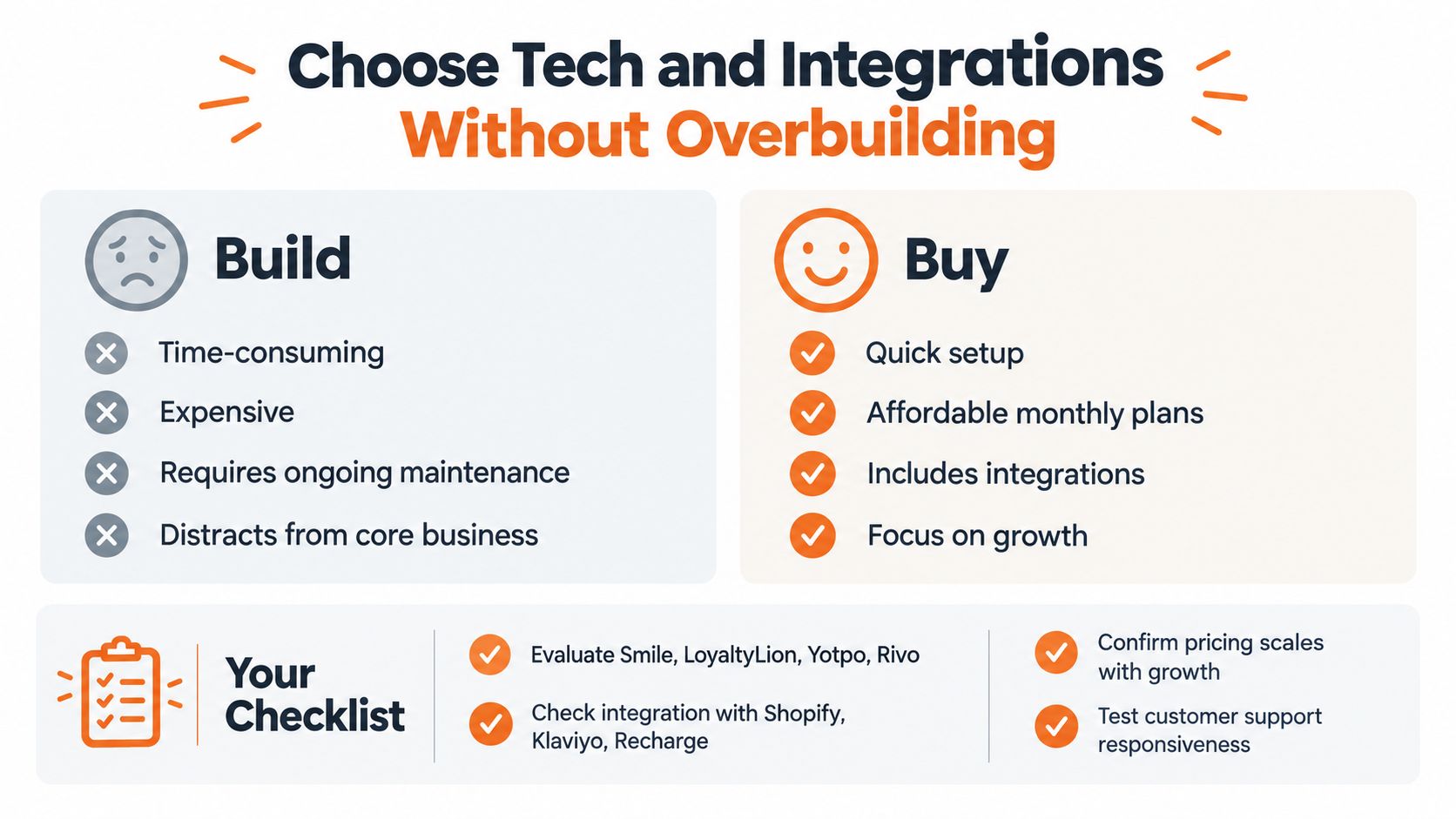
I've sat through enough software demos to know how this goes. A vendor shows you a sprawling retention suite, your team gets excited about capabilities you won't use, and six months later you're paying for complexity while customers still can't see their point balance clearly.
For most early-stage brands, buy a SaaS loyalty platform before building custom software. Compare Smile, LoyaltyLion, Yotpo, and Rivo against your actual requirements. A platform gives you configured earning rules, redemption logic, customer accounts, and integrations without asking your team to maintain every edge case.
Use a strict integration checklist
Your storefront can be Shopify or headless. Either way, the loyalty system needs reliable event flow.
- Storefront connection: Confirm that account creation, checkout, refunds, cancellations, and order status reach the loyalty platform.
- ESP sync: Send tier and activity data into your email service provider so members receive relevant messages.
- CDP event streaming: Pass customer and transaction events into your customer data platform when your reporting model requires it.
- Minimum data fields: Move the order ID, member ID, point events, reward redemptions, refunds, and reversals in both directions.
- Reporting access: Export enough data to compare members with non-members and calculate incremental margin.
The Berkeley framework for loyalty planning puts objectives, budget, eligibility, rewards, partnerships, organization, database capacity, evaluation, and corrective action into a ten-step sequence. It also connects program performance to data warehouse and data-mining capability, especially for categories with frequent purchases, multiple provider choices, and meaningful switching opportunities (Berkeley California Management Review framework).
Skip custom development until your rules require it. A custom build can make sense when loyalty is your product, your customer data model is unusual, or your business needs a workflow no platform can support. It rarely makes sense because your team wants a more branded points widget.
Watch two overspend traps. First, don't buy a broad retention suite when you only need points and referrals. Second, don't sign an enterprise contract for features your team won't touch in year one. Chicago Brandstarters is another founder community option for operators who want to discuss practical brand decisions with peers, but it isn't a loyalty platform.
Launch Experiments and Iterate From Real Behavior
An apparel founder I worked with wanted one answer: would 2x points on the second purchase move new buyers into a second order within 45 days?
We wrote the hypothesis before touching the creative. The team planned a soft launch to the top 10% of the email list, then tracked redemption rate, incremental average order value, and cost per acquired repeat buyer. The point was to learn whether the reward changed behavior, not to celebrate enrollment.
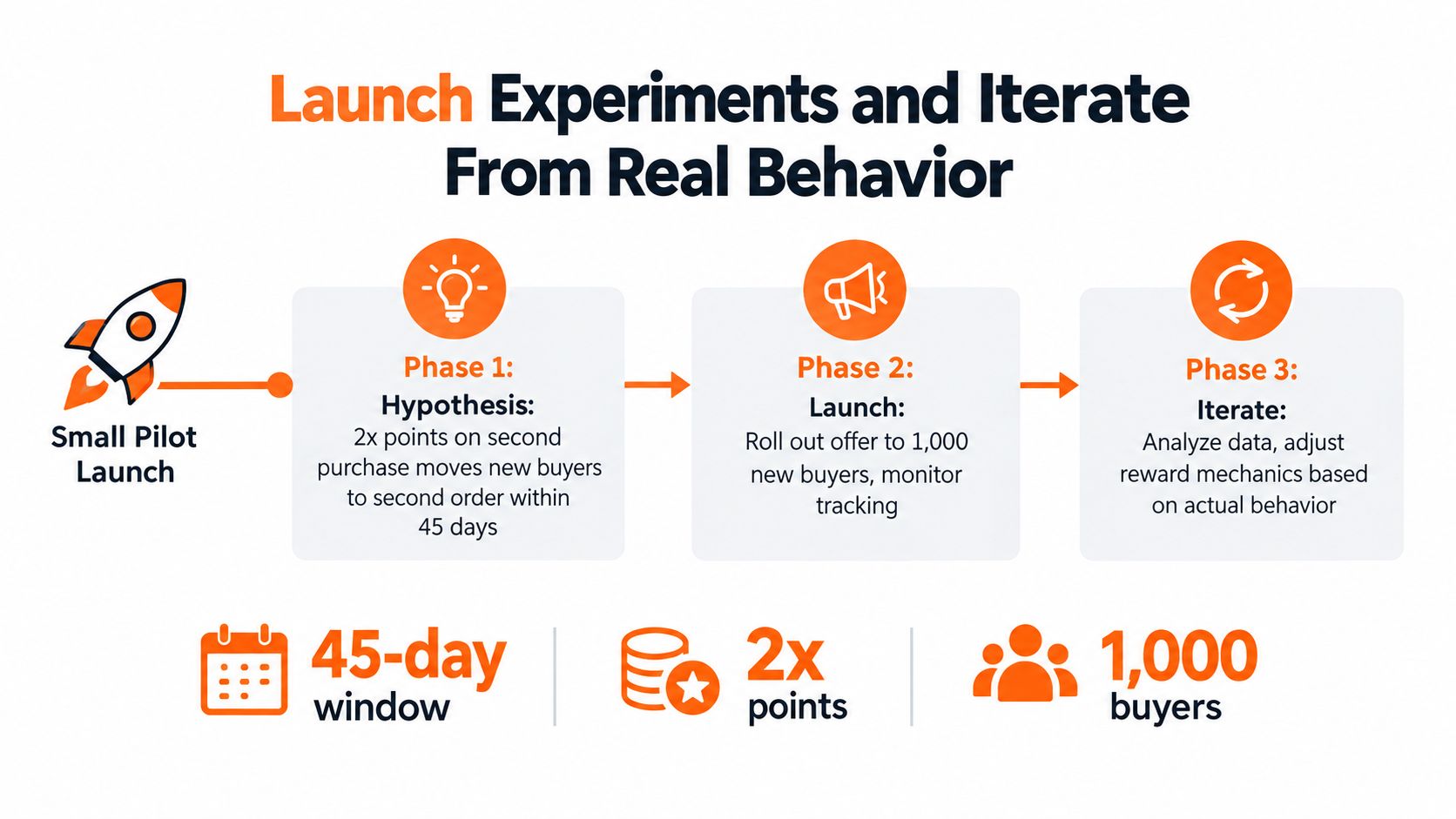
The result surprised the team. The referral hook outperformed the points mechanic on a cost-per-repeat basis. Customers responded more efficiently when they could invite someone else and receive a benefit than when the brand accelerated their own points balance.
That finding didn't prove referrals always win. It showed why you test behavior instead of importing assumptions from another brand. The team could now ask a better question: which referral message and reward produce repeat behavior without pushing acquisition cost above contribution margin?
Keep the testing loop small
Run one mechanic change at a time. If you change the points rate, landing page, email subject line, and reward at once, you won't know what caused the result.
Use a monthly operating rhythm:
- Review the dashboard: Check repeat purchase rate, redemption rate, incremental AOV, member margin, and cost per acquired repeat buyer.
- Retire ignored rewards: If customers don't redeem a reward after clear exposure and adequate opportunity, remove it or change the presentation.
- Inspect customer questions: Support tickets often reveal rules customers can't understand.
- Test one change: Adjust one earning action, reward threshold, or message.
- Record the decision: Write down what changed, why you changed it, and what result would justify keeping it.
Marigold's implementation guide separates expiration into schemes based on last activity, every activity, program date, and program date with a delayed cycle. It also requires selecting the scheme in an admin console and running an automatic expiration job on a schedule (Marigold point expiration guide). That kind of operational detail belongs in your test plan, especially when customers earn, spend, or lose points across several systems.
Here's a short visual walkthrough of the experiment mindset:
A loyalty program is a learning tool. Treat every reward as a hypothesis with a cost.
Templates, Checklists, and Your First 60 Days
A loyalty program can fail before launch if the team cannot explain its economics in one Monday planning meeting. Keep the operating document short, practical, and tied to decisions. Your worksheets should expose reward cost, breakage assumptions, margin limits, and the experiments that will decide whether version one deserves more investment.
Start with a tier-structure worksheet. Give each tier a row for its entry threshold, desired member behavior, reward cost, operational requirement, customer message, and exit condition. Delete any row that changes nothing for customers or protects no margin.
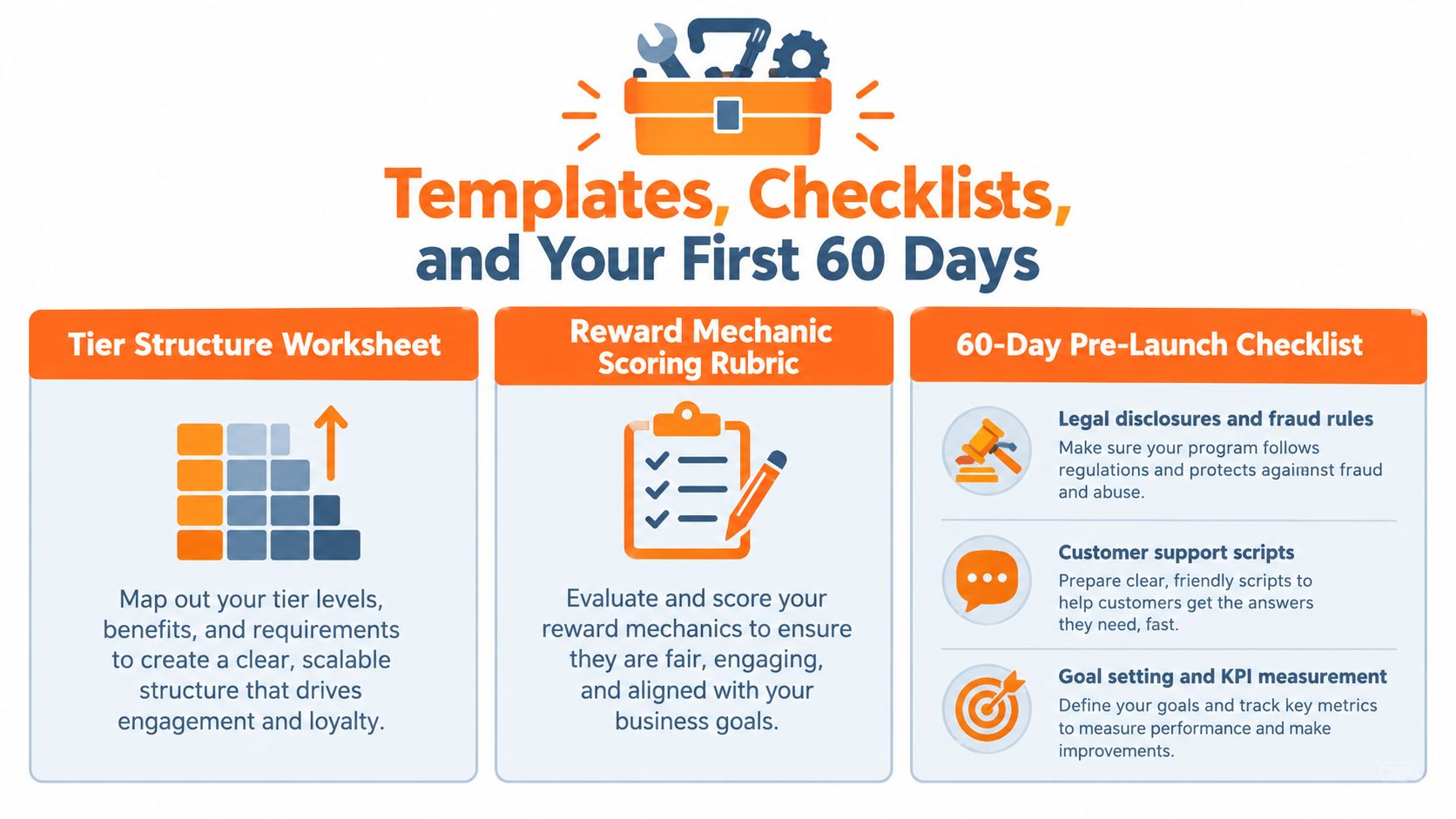
Paste these templates into your operating document
Goals and KPIs one-pager
- Primary goal: Retention, repeat purchase frequency, or average order value.
- Target behavior: The exact customer action you want to change.
- Primary KPI: The measure that decides whether the program works.
- Guardrail KPIs: Redemption rate, incremental margin per member, and program cost as a percentage of revenue.
- Decision owner: The person who can pause, revise, or expand the program.
Points economy model
- Eligible spend: Which orders and products earn points?
- Point value: What does one point cost when redeemed?
- Redemption ceiling: What total liability can the brand carry?
- Breakage assumption: What share of issued value may remain unused?
- Exceptions: Refunds, cancellations, returns, fraud, and expired balances.
- Review date: When the team replaces assumptions with observed behavior.
Launch experiment brief
- Hypothesis: State the behavior change in one sentence.
- Audience: Define the customer group receiving the test.
- Minimum sample size: Set the smallest group that can support a decision before launch.
- Metrics: Track repeat purchase rate, redemption, incremental AOV, and cost per acquired repeat buyer.
- Decision criteria: Write the result that means keep, change, or stop.
- Test window: Give the behavior enough time to occur, then close the experiment.
Use a 30-60-90 operating plan
Days 1 to 30: Finalize the goal, segments, margin ceiling, earning rules, reward costs, expiration policy, fraud rules, legal disclosures, and customer support scripts. Test the complete journey, including earning, redemption, refund reversal, account recovery, and expiration notices.
Days 31 to 60: Launch to a controlled audience. Watch active participation, redemption cost, repeat purchase rate, and member margin. Keep the first reward reachable. As noted earlier, a strong redemption rate matters because unused rewards can hide weak engagement and distort your breakage assumptions.
Days 61 to 90: Remove weak mechanics, revise confusing messages, compare members with non-members, and decide whether the program deserves broader exposure. Continue quarterly iteration based on observed behavior, not competitor envy.
Points expiration can use a rolling inactivity window or a fixed deadline from the earn date. Under the rolling approach, points expire after a defined period without earning, spending, or manual adjustment, and the platform can send advance notice. Fixed deadlines apply the rule to each earning event. Common windows include 12, 18, or 24 months, as explained by LoyaltyLion explains rolling inactivity expiration and The Points Guy explains expiration approaches. Pick one rule, state it plainly, and warn customers before they lose value.
Your first program should stay small enough to change. Build only the system needed to measure incrementality, then revise it quarterly. Software, support time, and customer attention all carry a cost, even when redemption stays low. A program that shows which customers return, why they return, and which reward earns that return can justify its place in the stack.
Chicago Brandstarters gives early-stage founders a place to work through brand, retention, and customer-growth decisions with other operators, including the economics behind a first loyalty program. Visit Chicago Brandstarters to find a practical founder community and bring your Monday-morning loyalty worksheet to the next conversation.
Leave a Reply